Wombwell Rainbow Interviews: William Oxley

Wombwell Rainbow Interviews

I am honoured and privileged that the following writers local, national and international have agreed to be interviewed by me. I gave the writers two options: an emailed list of questions or a more fluid interview via messenger.

The usual ground is covered about motivation, daily routines and work ethic, but some surprises too. Some of these poets you may know, others may be new to you. I hope you enjoy the experience as much as I do.
oxley

William Oxley

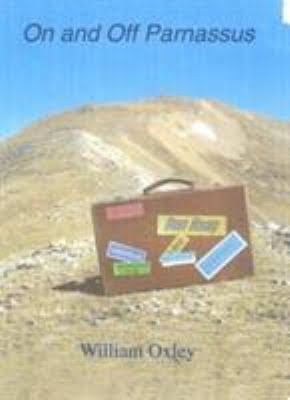
was born in Manchester. A poet and philosopher, he has also worked as accountant. part-time gardener, and actor. At present he divides his time between London and South Devon. His poems have been widely published throughout the world, in magazines and journals as diverse as The New York Times and The Formalist (USA), The Scotsman, New Statesman, The London Magazine, Stand, The Independent, The Spectator and The Observer. Following the publication of a number of his works on the Continent in the ’eighties and ’nineties, he was dubbed ‘Britain’s first Europoet’ He has read his work on UK and European radio and is the only British poet to have read in Shangri-la, (Nepal). Among his books of poetry have been Collected Longer Poems (Salzburg University Press, 1994), and Reclaiming the Lyre: New and Selected Poems (Rockingham Press, 2001). A former member of the General Council of the Poetry Society, he is consultant editor of Acumen magazine and co-founder of the Torbay Poetry Festival. In 1995 he edited the anthology Completing The Picture for Stride. The founder of the Long Poem Group, he co-edited its newsletter for several years; and in 1999 his autobiography No Accounting for Paradise came from Rockingham Press. He was Millennium Year poet-in-residence for Torbay in Devon. A limited edition print employing lines from his epic, A Map of Time, was chosen by the Dept. of Cartography, University of Wisconsin to use, with appropriate illustration, in their Annual Broadsheet for 2002. Another of his long poems, Over the Hills of Hampstead, was awarded first prize by the on-line long poem magazine, Echoes of Gilgamesh. He has co-edited the anthology Modern Poets of Europe (Spiny Babbler, Nepal 2004). In 2004, Hearing Eye published Namaste his Nepal poems, and Bluechrome published his London Visions in Spring 2005. A study of his poetry, The Romantic Imagination, came out in 2005 from Poetry Salzburg. A fine, limited edition of his Poems Antibes, illustrated by Frances Wilson, was launched in Antibes, Côte d’Azur in December 2006. In 2008 he received the Torbay ArtsBase Award for Literature. His latest collections are: Sunlight in a Champagne Glass and Collected & New Poems (Rockingham Press 2009 & 2014); Walking Sequence & Other Poems (Indigo Dreams Publishing 2015). In 2018 Rockingham Press published his prose anecdotes On and Off Parnassus. His work is featured on various websites, including, from its beginning, Anne Stewart’s prestigious www.poetrypf.co.uk and www.creativetorbay.com.

The Interview

Paul Brookes: What inspired you to write poetry?

William Oxley: Falling in love when I was seventeen years old. Then joining a Shakespearean drama company in Manchester and being transported imaginatively by the poetry in Shakespeare’s plays. I never had really major parts but because I was mostly ‘in the wings’, so to speak, I had hours and hours of rehearsals to enjoy the words of the Bard: mostly uttered by my fellow actors. I think a third factor was that my father was fond of the work of many poets, and he communicated the love of them to me.

PB: Who introduced you to poetry?

WO: Shortly after first going to school around age five, I became seriously ill with rheumatic fever. I spent many months in a children’s ward in hospital. The fever eventually receded and I left hospital. But it suddenly came back and I found myself incarcerated in hospital again. Fortunately for me, penicillin had just been released to the NHS after the end of the Second World War, and I was permanently cured. However, the illness had left me with a damaged heart valve, and I was strictly forbidden all excitement or violent exertion. But I still had to be educated and I had a retired headmistress as a tutor. Her name was Miss Cawthorne, and she it was who first introduced me to poetry. This she did rather cunningly. As I had been forbidden any sporting activity, it was inevitable that all I ever wished to talk about was cricket and football, especially the former. So, cleverly, she had me read poems aloud that were about sport. The one that I best recall was about cricket and was called ‘King Willow’. It began something like this:

‘King Willow, King Willow thy guard hold tight!

Trouble is coming before the night:

Hopping, galloping short and strong,

Comes the Leathery Duke along…’

Not only did such poems as this inspire me to love poetry, but in my late teens and twenties – when I was no longer under medical supervision – I became a fast bowler in cricket.

PB: How aware were you of the dominating presence of older poets?

WO: After I moved to London with my wife, I read more and more poetry. Poets of the past like Milton, Tennyson, Chaucer, and the main Romantics – Wordsworth, Coleridge, Keats et al – became dominating presences in my life. My father had a great fondness for the South African poet Roy Campbell, and he passed this enthusiasm on to me. I repaid the compliment with Ezra Pound and T.S. Eliot, the great Modernists, and they loomed over me for several years. I also took on board the Irish poet W.B. Yeats and the Welsh poet Dylan Thomas. Among the younger poets, then active and publishing new work, I was drawn to Hughes and Plath, Thom Gunn and Philip Larkin; and Robert Graves was still alive into the 1980’s, and I was very keen on his poetry and life story. There were others, too, who could be said to be dominating presences like W.H. Auden and the Scots’ poet Hugh MacDiarmid. Then, too, in the 1970’s I encountered the work of Rilke, especially his great ‘Duino Elegies’, and was in the vernacular ‘blown away’ by the Leishman translations of Rilke.

PB: What is your daily writing routine?

WO: I don’t have one. I’ve never had one. At most I’ve just been at the mercy of what is called ‘Inspiration’ – and that can strike at any time, any place. I even wrote a poem once that I called ‘Waiting for Inspiration’!

PB: What motivates you to write?

WO: I’d like to give the novelist’s reply: money. But there is no money in poetry. I would hazard a guess that there are two motives for writing poetry – and indeed for all art – personal suffering, pain; or praise of life. My long childhood illness put me off suffering and its frequent concomitant of self-pity. So, mostly, I praise being alive in this, often beautiful world. My poetry shows my obsessions with love and truth.

PB: What is your work ethic?

WO: Love and truth, as I have said. Successful poetry is the art of utmost honesty. This also embraces technically and ethically the wish to write poetry that is as accurate as possible and as cliché-free as possible; and which has some musical-rhythmic-metrical form about it.

PB: How do the writers you read when you were young influence you today?

WO: I think I’ve explained the role Shakespeare has played in my life. Other writers and playwrights like Christopher Marlowe, Ben Jonson and the likes of John Milton, Rupert Brooke, Dylan Thomas, Robert Graves (and other First World War poets), Dante shaped my instinctive style. Eliot more than Pound – among the less traditional, more innovative poets – helped me to explore and write about the impact of urban, city experience in a world dominated by technology. My first long poem ‘The Dark Structures’ was my ‘Waste Land’, and all the many long poems I subsequently wrote can be said to have sprung from that first Eliotesque effort. But the more traditional poets whom I loved kept my shorter poems within the earlier lyric mode. I remember giving a reading in my early poetic years to a Sixties’ audience at a pub in Covent Garden and, afterwards, a poet came up to me and said ‘Your poems are too lyrical – there’s no audience for that sort of writing these days. Poetry today has to be more experimental.’ The poet in question wrote supposedly innovative, experimental poetry. He also founded an avant-garde poetry publisher which lasted for many years after the 1960’s. I have never forgotten what he said after that reading.

PB: Who of today’s writers do you admire the most and why?

WO: I still read voraciously the various poetry magazines that come my way as a result of being a consulting editor and interviews’ editor of Acumen Literary Journal : to give the full title of my wife’s magazine, now 34 years old. I have also done a great deal of book reviewing at the behest of her book reviews’ editor, a retired academic from Swansea University. In the Nineties I co-founded The Long Poem Group and its newsletter with the late Sebastian Barker. He and I had a common interest in the long poem: I having published my longest poem A Map of Time and he subsequently The Dream of Intelligence: on which latter poem he consulted me at the manuscript stage. I certainly admired his work in the field of the long poem. Then I got to know the Welsh poet Dannie Abse, and for thirty-odd years until his death we regularly discussed each other’s poems in draft. I particularly admired Dannie’s grasp of what I would term ‘verbal texture’. Like Robert Graves, Dannie was a great reviser of his poems – even after they had appeared in published form in many cases. Then I seem to have kind of grown up with the poems of Danielle Hope, since I first encountered her when she was a student in Nottingham editing a small magazine called Zenos. We have helped each other for many years editing collections of our work published by the Rockingham Press. Another poet whom I was especially drawn to was Ken Smith, the first poet ever to be published by Bloodaxe Books. Ken Smith, a northerner, was regarded as the doyen of the so-called New Generation of poets of the Nineties, a kind of father figure who wrote what was termed a ‘gritty’ sort of verse. I liked his work and enjoyed his company. I suppose I ‘admire’ the poets I admire because they offer me different work from my own: taking me along different, unfamiliar routes than those I am used to. Part of poetry’s attraction is it is a learning process. A road to greater enlightenment.

PB: Why do you write, as opposed to doing anything else?

WO: If you were to consult my autobiography No Accounting for Paradise (Rockingham Press, 1999), you would have your answer. I have done various jobs in my life, from Office Boy to Chartered Accountant. I gave up my fulltime profession in the City of London because I preferred using words to figures. I wasn’t bad at figures but the use of words excited me more. I have always been more of a contemplative than of a practical disposition, and that led me to a fascination with thought and word, viz, poetry.

PB: What would you say to someone who asked you “How do you become a writer?”

WO: Read writings of the past and present in prose and poetry. And read as widely as possible: from Homer to Dante to Milton to Wordsworth, et al. Read the great epics of the West like The Iliad and The Odyssey; and those of India like The Mahabarata and The Ramyana. Read the great novels of Hugo, Dostoyevsky, Flaubert and others. It all helps with the process of maturing your talent. And if you feel it will help, try a creative writing workshop or two, but don’t get bogged down by too much of the communal teaching that imbues workshops and creative writing courses.

PB: Tell me about the writing projects you have on at the moment.

WO: This interview.


The Shahanshahnameh, an epic poetry collection by Ahmad Tabrizi

Intriguing

Soodabeh's avatarPoemedicine

mahshid

Recently, the Ahmad Tabrizi’s Shahanshahnameh has been edited for the first time by the editors, Mahshid Gohari kakhki and Javad Rashki, and published in December 2018 in Iran by Mahmoud Afshar Foundation & Sokhan publication.

In the Mongolian and Timurid era, writing the historical books flourished in Iran, and a large number of historical poems were composed in this period of time. The “Shahanshahnameh”, an epic-historical poetry, composed by Ahmad Tabrizi, is one of the collections written in the Sultan Abu Said’s court (8th century A.H.). In this poetry book, the stories of Genghis Khan, his ancestors and his successors have been narrated. The Shahanshahnameh, which was written in the style of Ferdowsi’s Shahnameh, consists of 16,419 verses. This book has edited for the first time and published in december 2018 in Iran.

The only available copy of the Shahanshahnameh is kept in a single collection along with three other…

View original post 948 more words

Wombwell Rainbow Interviews: Guy Farmer

Wombwell Rainbow Interviews

I am honoured and privileged that the following writers local, national and international have agreed to be interviewed by me. I gave the writers two options: an emailed list of questions or a more fluid interview via messenger.

The usual ground is covered about motivation, daily routines and work ethic, but some surprises too. Some of these poets you may know, others may be new to you. I hope you enjoy the experience as much as I do.

guy farmer

Guy Farmer

writes evocative, minimalist, modern poetry about the human condition. Visit him online at Unconventional Being, https://www.unconventionalbeing.com/.

Unconventional Being: Poems by Guy Farmer

Available on Amazon at https://www.amazon.com/Unconventional-Being-Poems-Guy-Farmer/dp/1722369477.

The Interview

  1. When and why did you begin to write poetry?

I studied poetry in college, but it was over ten years later when my mother was terminally ill that I started writing poetry seriously. I wrote some poems for her, expressing how I felt, and it planted the seed that led to immersing myself in writing.

  1. Who introduced you to poetry?

A good friend of my family who was an English teacher would recite poems and it always stirred something inside me. I also had professors in college who kindled my interest.

  1. How aware were and are you of the dominating presence of older poets?

I think poets from different periods and styles influence my writing. I use their legacy to inform my writing rather than dictate it.

  1. What is your daily writing routine?

I take the time to acknowledge and connect with whatever is swirling inside me and write about that.

  1. What motivates you to write?

I love sharing who I am with the universe.

  1. What is your work ethic?

I write daily and fill my day with poetry-related tasks that help me get the word out about my writing.

  1. How do the writers you read when you were young influence you today?

I’ve been particularly influenced by Robert Frost, Emily Dickinson, E.E. Cummings, Langford Hughes, Walt Whitman, and many others. I take bits of each of their styles and amalgamate them into mine.

  1. Who of today’s writers do you admire the most and why?

I admire many. I just finished reading We Need New Names by NoViolet Bulawayo. I appreciate her ability to deal with even the most difficult topics with clarity, honesty, grace, and wisdom. I love work that is deeply introspective and also grapples with the human condition at many levels.

  1. Why do you write?

I write poetry because it’s who I am and what I do.

  1. What would you say to someone who asked you “How do you become a writer?”

Sit down and write about what you love and let people know you do it.

  1. Tell me about the writing projects you have on at the moment.

I’m working on a book of social justice poems and I also share my work on my website, Unconventional Being, www.unconventionalbeing.com.


Wombwell Rainbow Interviews: Steven J. Fowler

Wombwell Rainbow Interviews

I am honoured and privileged that the following writers local, national and international have agreed to be interviewed by me. I gave the writers two options: an emailed list of questions or a more fluid interview via messenger.

The usual ground is covered about motivation, daily routines and work ethic, but some surprises too. Some of these poets you may know, others may be new to you. I hope you enjoy the experience as much as I do.

calligramms

SJ Fowler

is a writer and artist who works in poetry, fiction, theatre, film, photography, visual art, sound art and performance. He has published seven collections of poetry, three of artworks, four of collaborative poetry plus volumes of selected essays and selected collaborations. He has been commissioned by Tate Modern, BBC Radio 3, Whitechapel Gallery, Tate Britain, the London Sinfonietta, Wellcome Collection and Liverpool Biennial. He has been sent to Peru, Bangladesh, Iraq, Argentina, Georgia and other destinations by The British Council and has performed at festivals including Hay on Wye, Cervantino in Mexico, Berlin Literature Festival and Hay Xalapa. He was nominated for the White Review prize for Fiction in 2014 and has won awards from Arts Council England, Jerwood Charitable Foundation, Creative Scotland, Arts Council Ireland and multiple other funding bodies. His plays have been produced at Rich Mix, where he is associate artist, and his visual art has been exhibited at the V&A, Hardy Tree Gallery and Mile End Art Pavilion. He’s been translated into 27 languages and produced collaborations with over 90 artists. He is the founder and curator of The Enemies Project and Poem Brut as well as editor at 3am magazine and executive editor at The European Review of Poetry, Books and Culture (Versopolis). He is lecturer in creative writing and english literature at Kingston University, teaches at Tate Modern, Poetry School and Photographer’s Gallery. He is the director of Writers’ Centre Kingston and European Poetry Festival. http://www.stevenjfowler.com

The Interview

  1. When and why did you begin to write poetry?

In 2010. I began because I embraced the chance entry of poetry into my life and needed its incursion. I was just old enough to recognise that I needed something entirely intellectual that wasn’t theoretical but immersive. Something I took to be best when obscure, hidden, ludic and requiring a grand active application of the individual. And I realised, being hyper verbal, poetry, which was given to me, might be that thing.

  1. Who introduced you to poetry?

I bought some poetry books in a charity shop. In Paddington, London. So the charity shop system of England introduced me.

  1. How aware were and are you of the dominating presence of older poets?

I actually have never felt dominated by older poets. Maybe because, also by accident, I found myself, early on, in a very specific tradition in the UK, what we might see as the British Poetry Revival and the older poets were really supportive and generous. More than poets my own age, but they were pretty grand on the whole too. But poets like Tom Raworth, Maggie O’Sullivan, Robert Sheppard, Iain Sinclair, Allen Fisher, Tony Lopez, Anselm Hollo and Tomaz Salamun, I can point to distinct moments with each of them when I had barely written / done anything and they took the time to encourage me. And poets a generation younger too, a generation on from me – Carol Watts, Jeff Hilson, Tim Atkins, Philip Terry, Peter Jaeger, they were also very very supportive. In fact I would say now this is something I take to be a responsibility. To teach the works of these older poets, to share them outside of the UK and to connect my students, those a generation younger than me, to the poets who have lived the life they might follow.

  1. What is your daily writing routine?

Completely changeable, I have no routine. Often I write while travelling, in London or beyond. Often while reading something. I like it this way. I take it to be a symbol of the freedom of time I have worked for. Years ago, when I worked jobs with very rigid shift patterns I promised myself I would earn the right to set my own schedule and routine and would do something different everyday.

  1. What motivates you to write?

I often ask myself. I don’t feel easy with the notion of catharsis, I think this is mostly a false and self-serving approximation by poets. I know it’s not for repute or money (well not entirely anyway, as much as one can control these instincts), or I would’ve chosen a different field. I think now, probably out of familiarity and desire to learn, to use poetry as a vehicle for increasingly the possibility of contentment, for meeting other human beings, for creating abstract and mysterious connections between my confusions and still being alive.

  1. What is your work ethic?

I enjoy working as I work now. I have spent years trying to fashion a work environment where I like what I do, working hard to get that, and now I have it, so I work harder, as it doesn’t feel like work. Both my parents were working class, they grew up in Liverpool during WWII. They grew up without education in bombed out buildings. They worked incredibly hard and taught me their ethic.

  1. How do the writers you read when you were young influence you today?

I didn’t read when I was young. But when I discovered poetry, I was about 24, there were poets then who startled me, shocked me into a renewed awareness of reading, and writing, and seeing, and I’ve revisited some of them recently, after nearly a decade, poets like Mayakovsky, Herbert, Salamun, Pizarnik. They retain their power over me.

  1. Who of today’s writers do you admire the most and why?

I read backwards. I try to read around 100 books a year, more, I have a system even, and I’m still in the past, trying to catch up. So those I read from now are those I work with, collaborate with and whose poetry ends up in front of me through the computer or with a book generously put in my hand. I can say poets like Harry Man, Maja Jantar, Ailbhe Darcy, Prudence Chamberlain, Ross Sutherland, Christodoulos Makris, Hannah Silva, have my admiration because they are genuinely remarkable, original, leave me wanting to copy them and all share the distinction of being warm and generous human beings while investing so much into their work.

  1. Why do you write?

I’ve started now. And if I can expand on what I said in the ‘motivates’ question, I don’t know really. Every week I think why do I do this? It’s useless and stupid and no one likes my work and I don’t even like it and there’s something wrong with me. This performance reveals how I feel.

But I also remember a John Steinbeck quote – “A writer must believe that what he is doing is the most important thing in the world. And he must hold to his illusion even if he knows it is not true.” Yeah well, easier said than done. My stuff isn’t that important at all.

  1. What would you say to someone who asked you “How do you become a writer?”

I would say it depends on them, who they are, where they are from, what kind of writing, to what end… There is no one answer, and if I’m honest if someone asks me that, without context, I’d ask them why are you asking me?

  1. Tell me about the writing projects you have on at the moment.

I’ve a few. Well, to keep it succinct, I have a series of new publications arriving in 2019. Many not quite ready for public declaration yet but I’m happy to have a collection with Dostoyevsky Wannabe coming later in the year, it’s a book about neuroscience and poetry, all poems though. And I’ve a new art poetry book coming with Hesterglock Press called Memoirs of a Hypocrite. And a pamphlet with If a leaf falls press as well, called Reading List Massage. I’m a lucky bastard to be able to keep up this rhythm of publications which suits me so well, my own speed of writing, or mulching, churning, moving language, which I spent years resisting, feeling embarrassed about, feeling I released too much, until recently when I accepted it was a genuine expression of my internal mechanism for poetry. Like Schopenhauer said, we can chose what we will but we cannot will what we will.


Wombwell Rainbow Interviews: Ben Ray

Wombwell Rainbow Interviews

I am honoured and privileged that the following writers local, national and international have agreed to be interviewed by me. I gave the writers two options: an emailed list of questions or a more fluid interview via messenger.

The usual ground is covered about motivation, daily routines and work ethic, but some surprises too. Some of these poets you may know, others may be new to you. I hope you enjoy the experience as much as I do.

ben ray

Ben Ray

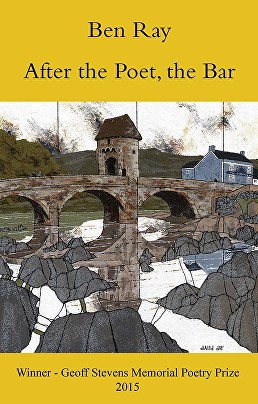
is an accomplished young poet from the Welsh borders whose work is story-telling, risk-taking and exact in all the right ways’ (Fiona Sampson). His second collection ‘What I heard on the Last Cassette Player in the World’ is scheduled for release with Indigo Dreams Publishing in 2019, and he will be performing at the Edinburgh Festival Fringe this August. Since his first publication, ‘After the poet, the bar’, Ben’s work has appeared in a wide array of journals and websites and he has gone on to explore a wide range of poetic disciplines, from mentoring to running workshops in schools and charities. For more information go to: www.benray.co.uk or use the Twitter handle: @BenRayThePoet .

The Interview

  1. What were the circumstances under which you began to write poetry? 

I’ve been writing ever since I can remember, really. I was lucky in that I grew up in a house surrounded by books (I was bribed to learn swimming with the promise of a trip to Waterstones afterwards!) and was encouraged to keen scribbling stories and poems on scrap paper all the way through my childhood. I’ve always loved telling stories, exploring language and, I have to admit, performing in front of people. I find you can’t write without reading, they’re two sides of the same coin –throughout my life I’ve tried to read as much as possible. When I was 14 I was encouraged to enter a competition to become a local poet laureate, which kept me writing at a time I might have given it up. Miraculously, this position demanded poetry from me throughout the year, and I feel really cemented my beginnings as a poet – I began to take poetry more seriously, and since then never looked back.

  1. Who introduced you to poetry?

I honestly can’t remember. I think my first encounter was through cassette tapes of Edward Lear and books of children’s poetry as a young child, which I loved. I’ve always wanted to share poetry with others, I think that’s one of its main joys – my family have always had to put up with me reading at them. I was read poetry as a child and had books of children’s poetry around the house – it was hard to avoid the stuff!

  1. How aware were you of the dominating presence of older poets?

Wouldn’t call the presence of older poets ‘dominating’ – whilst of course the ‘classic’ poets like Eliot or Byron can be unapproachable when young, I feel that they will be discovered at the right age. Also, I feel contemporary poets are very present in society, and are becoming ever more present whilst not smothering young poets – on the contrary, they’re giving young poets the vital space and impetus to grow. Like light, poetry doesn’t exist in a vacuum! Once I scratched the surface of my local Waterstones or even logged onto YouTube I found older poets I could relate to and work from to build on and influence my own work.

  1. What is your daily writing routine?

Oh, I wish I had one! My routine is sporadic, though I try to write a little every day. I find that once I start writing and enter a poetic frame of mind, poetry starts appearing everywhere. I carry a notebook with me where I try to note down any phrases, words, scenarios or ideas I find even remotely interesting – for me it these often take a few weeks or even months to come to the boil and find the right moment. I had a post-it note on my wall for three months where I’d scribbled a line a friend used over the phone. Last week, after visiting a museum and after being inspired by an exhibit, I found the perfect place for them – in the mouth of a 15th century sailor drowning in Gdansk harbour.

  1. What motivates you to write?

Like most poets, almost anything! I used to study history and thus would write a lot of what I called ‘historical place poetry’ – snapshots or explorations of a certain moment in time. Recently I’ve been enjoying giving my work a more surreal, abstract twist. I’ve loved watching my work develop, and want to see it continuing to grow.

  1. What is your work ethic?

I think the frank answer to this is that I try to write as much as possible because it’s one of the things I most enjoy. I love exploring and expressing the world in such a personal and intimate way, and I find myself more and more interpreting how I see my life and future within a poetic form. Thus I feel my ethic is quite strict, though this is more due to pleasure than anything else! I also feel that if I come back to poetry after a long absence, it can be hard to find inspiration. I hate this sensation (it feels I have lost a part of my voice), and thus try to keep one foot in the world of poetry constantly.

  1. How do the writers you read when you were young influence you today?

The poets I admired when younger still shape me as a writer today through their influence on my poetic style – I feel very much moulded by the work I explored when younger. Many poets who influenced me as a child I later return to with a new understanding of the depth of their work. When young I could feel there was something significant and profound in their writing, as well as admiring their writing as much for their wordplay and use of the poetic form than anything else (Owen Sheers, for instance, or Alice Oswald’s fantastic poem ‘Dart’). Now, on returning to these poets, I find myself able to relate to and emulate in turn that significance and deeper layer of meaning I previously could only sense from afar. I think that rereading poets thus reveals not only different layers within their poetry, but reflects on your personal growth as a reader, an interpreter of poetry and a poet.

  1. Who of today’s writers do you admire the most and why?

This answer changes daily for me – I try to read as much as I can, and love discovering new and unexpected poets. I feel having ‘favourite’ poets and styles can limit your scope of reading, so I try to avoid this. I’m currently really loving Jonathan Edward’s beautifully crafted second collection Gem, and am also enjoying Robert Minhinnick’s book Diary of the Last Man. Go out and read them! I do try to read the shortlist for the Costa poetry Prize every year – it’s a great way of discovering poets I might have otherwise not ventured out to read.

  1. Why do you write?

I’m tempted to leave a terribly soundbite-style, meaningful line like: “because there’s no way I cannot write.” But in truth, I write because I’ve never loved any other activity more, or found anything nearly as rewarding, fruitful and meaningful. It’s let me grow and develop as a person, opened doors to a world of literature and prisms through which to look at life, and lets me travel, meet and make friends as I perform across the UK. For me, writing is intimately tied up with performing – I am, at heart, a bit of an attention seeker and a performer, and love the ability to hold and impress a crowd. I’ve found a medium of expression that I love, am moderately good at and which lets me perform in front of people in fantastic ways, with limitless forms of expression and experimentation – what could possibly be better than that?!

  1. What would you say to someone who asked you “How do you become a writer?”

Read, write, read, write. Try to find work you love and let it influence you. Don’t worry about developing a style – that will come naturally, probably not for a good few years (I’m not sure I’d say I have a certain style yet, to be honest. I love experimentation and pushing my boundaries as much as possible in this sense). Get in contact with and talk to as many poets as possible – be proactive! Enter competitions and magazines, try to get published as much as possible and to perform as much as possible. The more you ‘become’ a writer, the more you will know whether you truly love it and want this as a path in life. The poetry community exists both off and on the page, and is friendly and welcoming – build up a repertoire and get out there performing and meeting people!

  1. Tell me about the writing projects you have on at the moment.

I’m in the process of publishing my second collection, ‘What I heard on the Last Cassette Player in the World’ with Indigo Dreams Publishing, which will be out this summer. I am also taking a solo poetry show to the August 2019 Edinburgh Festival Fringe and will be touring the show around the UK in July beforehand. I am currently trying to write a series of longer poems reflecting my time studying in Warsaw and am trying to collate another manuscript for my third publication. Keep an eye on my website for details of my work and upcoming projects – I’d love to share my poetic adventures with you!

Wombwell Rainbow Interviews: Fay Musselwhite

Wombwell Rainbow Interviews

I am honoured and privileged that the following writers local, national and international have agreed to be interviewed by me. I gave the writers two options: an emailed list of questions or a more fluid interview via messenger.
The usual ground is covered about motivation, daily routines and work ethic, but some surprises too. Some of these poets you may know, others may be new to you. I hope you enjoy the experience as much as I do.

contraflow image cropt

Fay Musselwhite

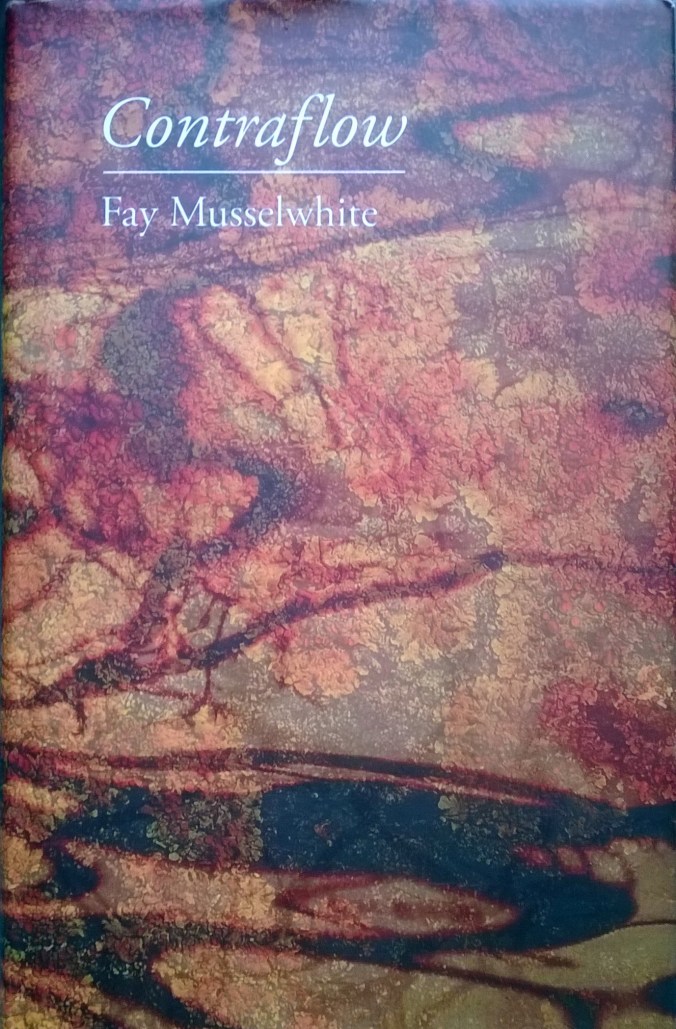
lives and writes in Sheffield, where she leads workshops and walks, and collaborates with artists in film, sound and other media.  Her poems have appeared in a range of publications, including The Footing (Longbarrow Press 2013).  Her first poetry collection Contraflow was published by Longbarrow Press in 2016.

https://faymusselwhitecontraflow.wordpress.com/

The Interview

1. What led you to start writing poetry?

Words have always fascinated me. Even before I could read, I tried to guess at their derivations and connections. Growing up in a politically active household gave me a keen interest in politics, history, and how the world fits together. However, knowing no-one who wrote, I became used to getting my creative sustenance from textile media.

From my teens onwards, I’d jot down bits of memoir and treatise, attempting to get things straight in my mind, and soon began to discover the joy of sentences, their structure reminding me of the physical dynamics inherent to sewing and knitting. During my Film and Literature degree course I took modules in writing fictional narrative, but still couldn’t quite hit my stride.

Then, when I needed to get something said to someone who was dying, I remembered seeing Tony Harrison on television talking about the mechanics of the sonnet, and thus poetry came to my aid. It wasn’t a sonnet I wrote but a ballad, in which I found I could say so much more than with the declarations I’d been trying before.

It seems that the intensity of forcing sound and meaning up against each other, in the way poetry does, makes it almost impossible to tell anything but the truth. As if the concentrated energy required, once mustered can only be used for that purpose.

1.2 Strict form moulding high emotional intensity?

Emotional intensity always spurs the poetry, and strictness of form moulds – harnesses? stabilises? – that emotional intensity. In the poetry I’m aiming for truth
and precision, so the poem is precisely true to itself.

I tend not to write in reusable form, though. My adherence to rhythm and rhyme – the poem’s sound – feels quite strict (to me), but seems to happen at a subconscious level. It’s as though something in me can almost hear what the poem will sound like, and my mind tries to find the words that make that sound, and carry meanings that say what the poem seems to want said.

2. How aware were you of the dominating presence of older poets?

Dominating what?

2.1. I guess what I’m asking is whether when writing poetry you feel the weight of tradition, the established Canon, the All White Men Establishment of poetry putting you under scrutiny.

No, I really don’t.

3. What is your daily writing routine?

I always read and write something first thing, with my second coffee, between getting dressed and leaving my bedroom. Other than that, there’s nothing you’d call a routine. If I’m engaged in a textile project, I might not write anything else all day, but usually there’s another chunk of writing before day’s end. And for much of the time in between, there are lines I’m trying to write or resolve running through my mind.

4. What motivates you to write?

Capturing something of the world as art / craft has been satisfying to me for as long as I can remember. Through childhood I enjoyed drawing, painting and textile crafts, for the feeling of being absorbed, connected to materials, of operating in the physical world, expressing it, and, somehow, my place in it. These days I enjoy the feeling of making, capturing, learning and progressing in the same way I always have.

To make a piece of art that combines the shape and atmosphere of something with the energy of how it hits me is a thrilling thing to find I can sometimes do. Seeking that is motivating.

Sometimes I write to find out what I really mean, what I really think, or to try and find out what others might really think and mean. Sometimes to explore a connection or parallel, how far it goes, what else the material holds.

When I’ve got going on a piece of work, when it’s piling up and has started to stay in place on the page – when I feel I’m onto something – then those lines and phrases, and that feeling, are a strong motivation to continue digging to find the rest of it. From that point on, I do it for the sake of what’s already there, to give the work the best chance to be itself.

5. What is your work ethic?

That’s quite a question. Not sure what it means, but I’ll have a go.

Like nature, art is surely an ethics free zone, in the sense that it deals with what actually is rather than how we consciously decide to negotiate the world and each other. That said, art will certainly explore the ethics of those decisions, and I hope readers can see my fascination with those ethics, and the dilemmas they present.

I’ve never, so far, had to ask myself whether it’s ethical to put something into a poem. Neither (as far as I remember) have I been challenged on ethical grounds regarding anything that has gone into a piece of work or workshop draft. Nor can I imagine either situation.

As for the time I spend writing poetry rather than doing something ‘more useful’, well I do sometimes wonder. So I try to make the poetry worthwhile, worth having spent the time on, and hopefully useful to someone.

In collaborations I let my genuine engagement in other people’s work guide my contributions. In teaching and leading workshops it seems important to divide time and attention equally between participants. And in performance of my own work or anyone else’s I want to give the poetry the best chance of reaching its audience, and vice versa.

Then there’s the money side of it: needy and bossy, can’t let any of us be. Its divisive insistence on competition seems antithetical to creative spirit. It feels like an occupation by a foreign force which we all live under, and must perform its rituals regardless of whether we believe in its values. So, we all do what we do to get by.

That said, the difference between art and advertising seems clear enough: if you begin a piece of work without heed to where it’ll end, and follow it until it seems able to stand on its own, then that’s art; if you commit from the start to some kind of end product, for instance a shape, sound or message, then that’s akin to advertising.

These are all points which I’m happy to discuss and, if necessary, change my mind over…

6. How do the writers you read when you were young influence you today?

The first writer I was excited by was Dr Seuss. A lifetime later, many of his lines and images, for instance his Herk-Heimer Falls –‘where the great river rushes / And crashes down crags in great gargling gushes’ – still keep me company.

As a growing child, I soon enjoyed the same belligerence and joy of language in Tom Lehrer, a favourite of my parents, then later in Frank Zappa. These three confirmed that social commentary needn’t be earnest, nor protest hectoring. Joni Mitchell was another early discovery who showed me subtler ways to express bitter wisdom.

The energy Ted Hughes achieves with stacked consonants, and his other methods of rallying sound, have always thrilled me, though for a long while I thought it all too far beyond me to be worth attempting.

John Clare’s passion for nature and against its enclosure, still fresh centuries later, is and was always encouraging. And like Clare, the war poets I read at school – Owen and Sassoon were prominent – have a way of focussing on detail to illuminate the broader story, and of making public concerns personal.

All these along with encountering Tony Harrison several decades ago, and a growing awareness of Coleridge’s and Wordsworth’s poetry, have helped me realise that a desire to relate narrative didn’t mean I had to struggle on with prose fiction when it wasn’t satisfying my creative itch.

7. Of today’s writers, whose work do you admire the most and why?

A few months ago I read Roar! by Martin Hayes and was blown away. The belligerence he gets onto the page is the full-on tone of adrenaline that still kicks around even when despair has fully arrived.  I’ve seen / felt it on dance-floors before, when all you can do is revel in the pure sharing of it – there is no solution, there is no brighter side.  This is the poetry of that experience.

There’s something of the same in Cazique, the title sequence of Matthew Clegg’s latest collection.  I really appreciate how he represents the weapons-grade capitalism that we’re currently culturally subjected to by a grubby little con-man, as much a victim of his own hype as those he cons. The humanity of being invited, by means of compelling poetry, to sympathise with the victimhood of the central character, as well as everyone else’s, strikes a massive chord with me too – we are all complicit in this, none of our hands are clean.

Clegg’s tanka sequence “Edgelands” (published in his West North East collection) has long been a particular favourite of mine.  A series of understated and achingly tender images depict the protagonist’s spell of sharp loneliness after a break-up.

But there are now dead poets who feel contemporary to me, so I must at least mention Ken Smith and Peter Reading, both of whom died in the last fifteen years.  Reading’s Perduta Gente feels so relevant to our times, and the protagonist in Smith’s Fox Running is surely still glimpsed by Hayes’s drivers and riders.

Perhaps because I have a son and no daughters, or perhaps because I’m female, I’ve a strong interest in war poetry, with its insight into that otherness of being male.  Christopher Logue’s War Music is a favourite of mine for the immediacy of its style.  And Rob Hindle’s recent book The Grail Road is a fascinating and atmospheric melding of people and scenes from World War 1 with those from the King Arthur story.  He knows this isn’t a new idea, but his take on these blokes served up to fulfil the power fantasies of those who survive them is well drawn and worthwhile.

8. Why do you write, as opposed to doing anything else?

This is a question I ask myself – indeed recently wrote a poem about – especially as my work often features elements of sound and vision.  Part of the answer must be to do with not needing any particular tools or materials: you can write a poem in your head, scratch it in mud or sand with a stick.  But even if paint and canvas, decent cameras, knitting yarn in any shade, and / or a host of musical instruments were readily available, I’d still favour the craft of corralling words on the page, resolving the snags that arise between sound and meaning.

Because the best language for poetry is the stuff that’s in common use, using it for poetry always feels like a marvellous feat of recycling: like reshaping and realigning a substance that the world has already worked on, and has thus gained in potency.  Yes, words get tired, but turn them over to find them enriched by the history, context and broader references they’ve gathered.  All humans are accustomed to metaphor, perhaps to a surprising degree.  Any word or phrase carries with it – blatantly or surreptitiously – what it’s previously said, bringing depth, texture, tone, colour, action and music to the thing you build.

Alice Oswald said she became frustrated, when working as a gardener, that she couldn’t quite get to the growing tip of what she was dealing with.  Much as I enjoy crafting things in a physical realm, there are always things you can’t reach, and it can feel more like representation than actually collaborating with an audience / readership to create something real and visceral in the world.  This extends to the way sentences behave, which is also endlessly fascinating: changing a sentence’s structure to alter what it can hold and carry can feel like proper engineering.  Language, for me, is a very satisfying material to work with.

9. What would you say to someone who asked you “How do you become a writer?”

I suppose I’d ask them what they think a writer is…

10. Tell me about the writing projects you have on at the moment.

Right now I’m writing a piece for a geographer’s PhD project, in which Fens dwellers, who don’t think of themselves as writers, are paired in correspondence with writers who live elsewhere.  It’s an open ended project, and it will be interesting to see how it progresses, where it goes.

Other than that, I’m working on my own pieces, which are yet to coalesce into anything that can be described as one thing, though connections are emerging as I go on.  It all feels quite wait-and-see, and I’m enjoying a time largely free from deadlines.

Thanks ever so much for your interest in my work and practise.
On Fiction Wombwell Rainbow Interviews: Liz Wride

On Fiction Wombwell Rainbow Interviews

I am honoured and privileged that the following writers local, national and international have agreed to be interviewed by me. I gave the writers two options: an emailed list of questions or a more fluid interview via messenger.

The usual ground is covered about motivation, daily routines and work ethic, but some surprises too. Some of these poets you may know, others may be new to you. I hope you enjoy the experience as much as I do.

liz wride

The front cover of Issue 3 of @PopToMag (Pop To…Magazine). Her piece: ‘Questions on a Pub Quiz’ is featured inside.

Liz Wride

writes plays and short fiction. Her 2014 Dylan Thomas centenary play toured Wales and was performed at the Lost Theatre’s ‘One Act Festival’. Her short fiction (‘Potato’) has been shortlisted for the 2015 ELLE UK Talent Awards and (‘Fillet’) appeared in The Mantle Arts anthology ‘Beneath the Waves’. Her most recent pieces can be found in @turnpikezine, @poptomag, and @okaydonkeymag. Her work will soon appear in @milkcandyreview.

I’ve included a photo of the front cover of Issue 3 of @PopToMag (Pop To…Magazine). My piece: ‘Questions on a Pub Quiz’ has appeared in Issue 3.

The Interview

  1. What inspired you to write fiction?

I just really remember always wanted to write. As a child, I remember writing so much, I got a callus on my finger (it’s still there!) In terms of actual books that inspired me – I’d have to say fairytales. The stories I wrote as a child were full or magic and anthropomorphic animals – so the work of Enid Blyton (I still have the ‘Squirrel Nutkin’ book) and Lewis Carroll (I still have the copy of Alice in Wonderland) were definitely important to me.

  1. Who introduced you to fiction?

My parents. They always made up bedtime stories and bought me books. My mother introduced me to a lot of the books she loved as a child (such as ‘Little Women’) my Dad introduced me to ‘The Wind in the Willows’.) I remember vividly ‘The Chronicles of Narnia’ being read to us at school – and there was something unmatched about the excitement of the Scholastic Book Fair.

  1. How aware were you of the dominating presence of older writers?

As a child? Not really. Looking back, I feel like there wasn’t the avenues (pre-internet) for children to get into creative writing, in the way there is now (or, maybe I was just unaware of them!) I was always impressed by the writers I read at that age, though – I read the blurbs about them, in the back of their books. One author, (who wrote horror) claimed to have a haunted writing desk – I thought that was the greatest thing ever.

  1. What is your daily writing routine?

I tend to write when, and where I can. I normally write after work, and on weekends. I’ve written on my phone in the Doctor’s Reception; jotted ideas down when I’m doing my shopping. I’ve found that coffee helps enormously when writing, so before writing – there is coffee!

  1. What motivates you to write?

I don’t want to look back, and think I didn’t try hard enough. I don’t want to look back and think: “Oh, I could have been a writer if I’d just done X, Y or Z.” Certain stories are written because I have something specific to say (these are often the hardest to compose); others are written because I get a very strong sense of character or character voice. Seeing the successes of other writers is also hugely motivational.

  1. What is your work ethic?

I like to think I have a pretty strong work ethic. I think the most important thing is to think of any work you produce as a learning curve. You can always be a better writer. It’s important to know what nothing you write is ever wasted – there are no writing failures, in a sense – you can just use what you’ve written for another story, or another medium.

  1. How do the writers you read when you were young influence you today?

I don’t think I’ve quite managed to let them go. One particular writer, Sylvia Waugh, produced a series of children’s books centred around life-sized cloth dolls (The Mennyms series), which I still think are fantastic. As a kid, it was this great, fun story. When I re-read it as an adult, it was clear that there were themes of loss and family, faith and love, that went over my head as a child. It reminds me to keep my intended audience in mind – but also to give my reader credit; to not over-write. Readers are clever – regardless of age – they’ll get it.

  1. Who of today’s writers do you admire the most and why?

Zach Doss. I discovered who he was, too late. After his passing, I read the pieces he had linked on his website. I was blown away by the humanity of his prose (‘The Bloodmouth’ in Passages North, is my favourite). There was something so universal about his writing – it really struck an experiential chord – but at the same time, his style and tone were so unique. Kathy Fish’s ‘Collective Nouns for Humans in the Wild’ is a masterclass in the specific power of the poetic art form to speak with devastating clarity about social issues.

  1. Why do you write?

I have no idea why I have a general desire to write – I have no idea what fuels that – a tiny little bibliophile inside my brain, maybe? (I am joking!) Day to day, I write because there is a topic I care deeply about; or as a way to work through a difficult time; or a way to document a joyful time, in a creative way; because I’ve been inspired by the work of someone else…the list goes on. It’s fun to challenge yourself in your writing – to see how you can push your creativity.

  1. What would you say to someone who asked you “How do you become a writer?”

Read. Write. Find a community. For me, that #writingcommunity is Twitter. There are a staggering array of magazines and journals on there – all are a great way to find new reading material; new voices; new ways of seeing things. The best thing about all the journals, editors and other writers, is the support they give. Rejections never feel like something finite; just encouragement to refine pieces and hone the writing craft. It’s a fantastic, creative, collaborative space.

  1. Tell me about the writing projects you have on at the moment.

I’m putting together a collection of short fiction; and I’m trying to figure out which stories will best go together. There’s a sort of ethereal novella (that involves quite a few science fiction elements) which exists in draft form and staccato sentences, at the moment. I’m constantly looking at online literary journals – I have this dream list of journals – that someday I hope to get published in. I’m slowly creating stories to submit to them.


Wombwell Rainbow Interviews: Christopher Bernard

Wombwell Rainbow Interviews

I am honoured and privileged that the following writers local, national and international have agreed to be interviewed by me. I gave the writers two options: an emailed list of questions or a more fluid interview via messenger.

The usual ground is covered about motivation, daily routines and work ethic, but some surprises too. Some of these poets you may know, others may be new to you. I hope you enjoy the experience as much as I do.

chien lunatique

Christopher Bernard:

is a writer and editor living in San Francisco. He is founder and co-editor of the literary and arts webzine Caveat Lector (www.caveat-lector.org) and contributes regularly to the monthly online magazine Synchronized Chaos Magazine (www.synchchaos.com).

His books include the novels A Spy in the Ruins and Voyage to a Phantom City; two books of stories, In the American Night and Dangerous Stories for BoysThe Rose Shipwreck: Poems and Photographs; Chien Lunatique (poems); and the play The Beast and Mr. James. His new novel for adults, Meditations on Love and Catastrophe at The Liars’ Cafe, will be published this year. His work has appeared in several anthologies and many periodicals, including cultural and arts journalism in the New York Times, San Francisco Chronicle, Chicago Tribune, San Francisco Bay Guardian, Philadelphia Inquirer and elsewhere, and poetry and fiction in literary reviews in the U.S. and U.K. He has also written plays that have been produced and radio broadcast, in part or complete, in the San Francisco Bay Area. His poetry films have been screened in San Francisco and his poetry and fiction have been nominated for the Pushcart Prize and Best of the Web. He is currently working on a series of children’s books, called Otherwise.

The Interview

  1. What inspired you to write poetry?

When I was very young, I had little or no interest in verse; it struck me as an awkward and contrived way of saying what could be said more effectively and directly in prose. I wrote a few poems, for the experience of the thing, when I was nine, and first began writing “seriously”—“with deliberate intent” (a writer is like an imaginary criminal plotting an imaginary crime): my first stories, plays, fragmentary novels, essays, etc. The tenth year of each decade often jolts me into more feverish activity than usual, as though I feel time breathing down my neck more keenly just before the next zero descends on my personal history. The year I turned nine was in fact my own annus mirabilis, when I first discovered the life of the mind would be an immense journey, rich with discovery, invention, adventure, sometimes frightening, sometimes despairing, but never less than interesting, and of which writing would be a central part. My first poem, called “Old Hundred,” was about an imaginary blind, ageing, loyal and loving dog.

But I didn’t really see the point of poetry until sometime later, during my 12th summer: I picked up, at a seaside soda fountain and notions store called Jump’s, a little book of poems with a dazzlingly white cover, yellow edges, and a wonderfully wicked title: “The Flowers of Evil,” by one Charles Baudelaire, translated by Edna St. Vincent Millay. The combination of lyricism and sensualism, moralism and cynicism (or realism, if one prefers) that I found between its covers entirely fascinated me. I had already discovered the Russian novelists and poets, and the modern-day existentialists, and was already drawn to staring into the abyss down the long well of white pages and black type with the rapt eyes of a bookworm tween. I was even writing a novel in this vein, never finished, called “The Atheist.” (I had already written an adventure novel, about an eighteenth-century pirate with the not terribly original name of Captain Skull, in lieu of my social studies homework for an entire year; my teacher, unsympathetic to the honor of literature, flunked me. The handwritten manuscript was stolen from me by an older, somewhat suspicious friend in Mexico, where we were living at the time.) After wading into Baudelaire’s provocative verses (I hadn’t known poetry was allowed to be confrontational, sardonic, intellectual, even shocking), I began turning my hand at bleak sonnets and sensually rhyming ecstasies between chapters plumbing my strictly literary notions about the tragicomic human condition.

But what finally captured me in thrall to the muses happened a few years later, when I discovered the oceanic lyricism of the English Romantics: Wordsworth, Coleridge, Byron—but above all Shelley and Keats. I will never forget standing inside a silent, shadowy, dusty, cramped, almost empty used bookstore in Philadelphia one Saturday afternoon when I was 18, and opening a green volume of Keats’s poems, the book turning to a poem I had never heard of, called “Hyperion”:

“Deep in the shady sadness of a vale

Far sunken from the healthy breath of morn,

Far from the fiery noon, and eve’s one star,

Sat gray-hair’d Saturn, quiet as a stone,

Still as the silence round about his lair; …”

The lines hit me with the shock of recognition, though a recognition of what was as mysterious then as it is to me today.

I felt at once, with a sharp sweet pain, that I wanted to be able to do something—to be something—like this, just like this—of this dignity and gracefulness and truthfulness and power—in my life ahead. I still confused the poetry with the poet, as I suppose many do. I didn’t want to be a “poet” so much as be a poem—even though I realized I would probably have to be satisfied with being a mere flesh-and-blood scribbler.

Not long afterwards, I came across the recent paperback edition of Aileen Ward’s (for myself, perfectly timed) biography, John Keats: The Making of a Poet; after reading which (“inhaling” it, as the phrase does, between endless underlinings), it was all over for me. I despaired of achieving Keats’s eloquence: that Keats himself never quite realized the heights he had attained makes his story all the more painful. (And yet it remains true that, however great a poet is, he (or she) cannot, if he is honest with himself, be certain, ever, of his “genius”: it could all be mere daydreams and will-o’-wisps. And, in the end, it doesn’t depend solely on himself anyway: a “great poet” is half-created by the poet’s society and the accidents of history.)

But I decided to try; I would rather fail in the attempt than succeed at just about anything else. And I still do, actually, unreconstructed romantic and irrational fantasist as in many ways I remain to this day. Was it a good decision? Perhaps not. And yet . . .

  1. Who introduced you to poetry?

Books introduced me to poetry. In fact, no one I knew had any serious interest in poetry. My teachers’ interest seemed to be at best dutiful. I was alone, not that this bothered me terribly, as it has been a condition I have submitted to for a great deal of my intellectual and cultural life.

  1. How aware were you of the dominating presence of older poets?

Much: I still prefer them, as a rule, to my contemporaries, who are still proving themselves. One of the things that deeply impressed me when I was very young—and still does—is that cultural, artistic, and literary immortality (in the sense of longevity long after one’s body is dead) is the one overcoming of death that is available to us: as long as we are reading Emily Dickinson, she still, in a significant sense, exists.

I have also been impressed by the fact that kings and emperors, pirates and capitalists, empires and armies and kingdoms and cities vanish as if they had never been, but a poem can outlive a monarchy—a line of verse from Sappho has triumphed over all the invasions of Alexander—and can do so even if it is forgotten for millennia. “Oxymandias” and Gilgamesh are the proofs of my, of our, joy.

  1. What is your daily writing routine?

I try to write on first waking up, for an hour or longer if possible. If I have no particular project, I write in my journal (a serpentine monster that has grown to over a hundred volumes since I was eleven; I have even given my pet python a name).

  1. What motivates you to write?

An idea comes to me, seemingly out of nowhere. usually when I am very relaxed and a bit daydreamy: this can be while in bed in the early morning, while riding a bus, sitting in a café, etc., and that I see I might be able to do something with: some scrap of words, a title, a phrase, numinous and ramifying, specifically and narrowly for a poem, more vaguely, and widely, for a novel.

The literary habit was already well established in our household when I was a child: my father wrote (and directed) for the new medium (at the time) of television, and had ambitions to write “fiction,” his own father had had literary ambitions, having spent time in Paris in the ’twenties, and my grandmother on the same side had been a talented poet.

I never thought much about this until I started getting vocabulary exercises in English class in fourth and fifth grades: a list of new words for each of which we needed to compose a sentence. And we had ample license over what to write. Not much in school up to that time engaged my interest. Education was at best tedious stuff; at worst it was as much fun as wrestling a water moccasin: if you lost, you were killed with an “F”; if you won, you were rewarded with a sense of Absolute Pointlessness, symbolized by an “A.”

But this was fun: I was being rewarded to make things up (when I did this at home, it was called “lying” and brought down on my head the severest punishments). I was always pressing my “vocabulary” luck; to this day I’m amused by what I got away with (nothing terribly indecent: my tendencies lay more toward the fantastic and melodramatic).

Then, around that time, I discovered “horror stories” and the high-style bloody-mindedness of Edgar Allan Poe. And one day after school, having finished one of my vocabulary assignments, and feeling on a literary roll, I decided to try my hand at one and dashed off a quick mystery cum horror tale before dinner, at which I announced it to the family and my great aunt, who was visiting for the weekend. I was invited to read it aloud after dinner, and it proved a hit.

The combination of pleasure in writing and this early taste of “success,” coupled with the active encouragement by my parents (“For a writer everything is grist for the mill,” as my mother memorably told me—some of the best advice I ever received), sealed my fate.

  1. What is your work ethic?

I believe you owe it to yourself, and to everyone else, to do the best you can. Sloppy work has three strikes against it: it is lazy, it is disrespectful, and it makes you lose the self-respect I believe everyone needs in this life.

My cultural and literary attitudes (unapologetically straight, white, dinosaurian Eurocentric male, with a few dozen Facebook friends and little interest in conquering the cyberverse) are far from fashionable, and so the prospect of my making a marketable career out of my words is unlikely. Thus I have to do something other than “writing” to pay my bills (I am currently a freelance technical editor, with some technical writing).

I have strong perfectionist tendencies, and so rewrite constantly. For me, 80 percent of writing is rewriting; to reread my own work is to rewrite it. This can be perilous: in my own case, it has sometimes had the bad effect of draining the work until it becomes perfectly bloodless. It took me some time to work out the right balance: to polish a piece only so far without murdering the original inspiration that gave it life. Sometimes this requires it to keep some of its “imperfections”: better imperfect while still keeping it breathing than a smooth smile in a polished coffin.

  1. How do the writers you read when you were young influence you today?

Those writers include Baudelaire, Shelley, and Keats, as I mentioned before, Shakespeare (in his tragedies), and, above all, Dostoyevsky, whose “Notes from Underground,” The House of the Dead, Crime and Punishment, The Double, The Possessed, and The Brothers Karamazov had an enormous impact on me when I read them in my later childhood to mid-teens. To these I would add more modern writers, such as James Joyce and Malcolm Lowry.

In my puberty and teens, I was also strongly affected by philosophical writing: Plato (the gadfly Socrates may have had more influence on me than is strictly healthy), Aristotle, and the Stoic Epictetus among the ancients; and Kierkegaard and Nietzsche (ditto, re influence), Miguel de Unamuno, Jose Ortega y Gasset, and Jean-Paul Sartre among the “moderns.” All of these writers are deeply interested in the vagaries of the human condition, the meaning (or, more appropriately, the many possible meanings) of human existence, the peculiar combination of strength and weakness, power and impotence, the endlessly bizarre combination of cleverness, wisdom, heroism, lunacy, cowardice, arrogance, humility, and brazen stupidity of human existence.

All of these authors continue to influence me as I age and see just how profound their insights were, and are, and how deeply brilliant their writing.

  1. Who of today’s writers do you admire the most and why?

Most of the modern writers I admire are now dead: most of them belonged to the second wave of European modernism after the second world war, in particular the “new novelists” based in France, and those influenced by them: Alain Robbe-Grillet, Nathalie Sarraute, Samuel Beckett, Claude Simon, Robert Pinget, and the late Juan Goytisolo. Also Thomas Bernhard, the Austrian novelist and playwright, who is a kind of updated Dostoyevskian “underground man” whose “notes” turned into an entire literary career. What I admire in these writers is their insistence on approaching the writing of fiction as an art form, and how they make a virtue of pursuing innovations of form, explorations I have also tried to pursue in my novels. These innovations of form allow one to explore aspects of the human condition unavailable to earlier writers: the result is not just innovations in form (intriguing and often exciting in themselves) but discoveries of what I believe may be important truths, or, if not that, fruitful errors. (Sometimes there is nothing more exciting than finding out just how wrong one has always been.)

I sometimes have a hard time with American writers, as I don’t always find the American literary tradition completely sympathetic (I find, to be candid, just a little too much of the “barbaric yawp” in it, and a kind of compulsive, unconvincing optimism and what I call “the great American delusion” (“exceptionalism,” they call it) that, well as it may often be for society, makes for a literature that can run from the self-important to the hysterical to a kind of manic wishful thinking).

I have a soft spot for Henry David Thoreau (that great nay-sayer to some of our national self-conceptions), and another for the other great “nay-sayer,” Emily Dickinson, and I am a fan of Henry James, hardly a typical “American” writer. I also like Ambrose Bierce and keep his Devil’s Dictionary in my satchel for salutary communion with a saner compatriot on train journeys.

  1. Why do you write, as opposed to doing anything else?

Partly to express, partly to invent, partly to organize my thoughts, partly to explore my feelings, partly to celebrate life and its oddities, partly to take revenge against it, partly to rejoice in language, partly to rail against it through the very eloquence it makes, amazingly, when not alarmingly, possible.

  1. What would you say to someone who asked you “How do you become a writer?”

You sit down (or take some other posture you can sustain for a few hours at a time without distraction) and you write.

If you don’t enjoy doing that, then you are not a writer, because that is all a writer is: someone who enjoys the act of writing for its own sake. If money and celebrity and status come, all the better. If obloquy, notoriety, ostracism, and contempt, so much the worse. If being ignored, so much to be expected. But write one will.

  1. Tell me about the writing.

Writing is a bit like dreaming while awake. I have a certain amount of conscious control of the dream, but not so much my brain can’t surprise me. It’s also like a drug, or like alcohol: it lowers the defenses and lets feelings and thoughts sneak through that might be suppressed or ignored if I were fully awake.

It is like walking on a high wire: keeping my balance while ever moving forward is my uppermost thought. It is thinking in slow motion. It is a game of charades. It is a theater where I am author, actors, director, stage hands, audience, and critic, all in one. It is one of the few escapes, however temporary, from the prison of existence. It is a form of mysticism. It is a form of magic. It is a kind of witchcraft. It is a kind of lunacy, harmless except to the practitioner and a few foolish folk who have fallen into his hands at an impressionable age.

It is one of the keys to the door of possibility that opens just enough to give a peek at a horizon above which lie infinitely changing clouds. It is a displacement of aggression. It is a substitution for reality. It is a cry of despair. It is a form of hope.

Wombwell Rainbow Interviews: Charles G Lauder Jr

Wombwell Rainbow Interviews

I am honoured and privileged that the following writers local, national and international have agreed to be interviewed by me. I gave the writers two options: an emailed list of questions or a more fluid interview via messenger.

The usual ground is covered about motivation, daily routines and work ethic, but some surprises too. Some of these poets you may know, others may be new to you. I hope you enjoy the experience as much as I do.

bleeds

Charles G Lauder Jr

was born and raised in San Antonio, Texas, lived for a few years each on both the East and West Coasts of America, and moved to south Leicestershire, UK, in 2000. His poems have been published widely in print and online, and in his two pamphlets Bleeds (Crystal Clear Creators, 2012) and Camouflaged Beasts (BLER, 2017). From 2014 to 2018, he was the Assistant Editor for The Interpreter’s House, and for over twenty years he has copy-edited academic books on literature, history, medicine, and science. The Aesthetics of Breath, his debut poetry collection, will be published by V. Pres in late 2019.

Twitter: @cglauder

He doesn’t have a website, but is on Twitter and Facebook. No cover has been produced yet for his upcoming collection, but will probably be available by next summer.

The Interview

1) When and why did you start writing poetry?

I don’t remember when I started writing poetry. I know I wrote my first story when I was seven, which my teacher shared with the rest of the class. When I was eight, I had a story included in a Readers’ Digest children’s anthology, and so the writing bug bit. I’ve wanted to be a writer every since, but I always envisioned myself a novelist. I wrote poems as a teenager, and while I don’t remember which was the first, I do remember one in particular that appeared in my high school literary magazine. It was the first one I had published–that’s probably why it stands out–and was called ‘The Wind Blows through the Barren Trees’. It was about a priest rambling about an empty church, partly inspired by the Beatles’ ‘Eleanor Rigby’, I’m sure. It was a poem of quatrains with a lot of repeated lines, and the magazine editor very succinctly cut the repeats and turned it into a poem of couplets. It was a much better poem after that.

Like I said, I wanted to be a novelist but kept finding myself returning to write poetry. I studied literature at university and took creative writing courses in both fiction and poetry. The poems were coming as emotional outbursts. I remember writing poems in my journal at night to try and make sense of the day and what I was feeling. Sometimes I would make a real concerted effort to turn some of that doggerel into a poem. So if fiction writing was large slabs of concrete, poetry was what I poured into the cracks between the slabs. Then for 5 years I focused solely on writing a novel and didn’t write a single poem. At the end of that time, my daughter was born, and when she was less than 4 months old, she had a serious accident. She was fine in the end, but those few hours of rushing to the hospital in an ambulance, watching the paramedics give her oxygen to revive her, the tests, and waiting around to hear if she was going to be OK were hell for my wife and I. A week later I had to stop in the middle of working and write it all down. It came out as a poem, and I realized how much I had missed writing poetry and how essential it was for me. And I haven’t stopped since.

2. How aware are and were you of the dominating presence of older poets traditional and contemporary?

Growing up, my education in literature was on British poetry up until about the Victorian era, then it swapped over to American literature through modern and contemporary times. My only exposure to a contemporary British poem while in high school (that I can recall) was Ted Hughes’ ‘Esther’s Tomcat’. While studying literature at university, I spent a year focused on the Romantics, especially Blake and Keats. I love the way Blake used his poetry, art and original mythology to portray such iconoclastic philosophy and ideas. In short, he’s a rule-breaker: he was true to himself and his visions.

For American literary history, contemporary poetry begins with Emily Dickinson and Walt Whitman, two more rule-breakers, Whitman being a bigger influence on me when I was younger. Other major American influences on me while at university (or immediately thereafter) included Robert Lowell, Sylvia Plath, Wallace Stevens, Audre Lorde, and John Ashbery. Eliot’s work, especially ‘Love Song of J. Alfred Prufrock’, would not make an impact until much later.

I didn’t start to read contemporary British and Irish poetry until my last year of university. I was working part-time in the English Department when I accompanied one of the secretaries to a reading by a visiting Irish poet named Seamus Heaney. And I was hooked. Years later, Heaney’s poetry would be one of the things my wife and I bond over when we first start dating. A couple years after graduating I moved to the UK and eventually got a job in Collet’s bookstore on Charing Cross Road in London, overseeing the poetry and literary criticism sections, exposing me to a lot of contemporary poets in the process.

I’ve lived in the UK for many years now, reading as much British and Irish poetry as possible; however, as before, it’s difficult to keep current with another nation’s poetry if you’re not living there. Thankfully the Poetry Foundation, under former US Poet Laureate Donald Hall, created the Essential American Poets podcast, which provides a great selection of 20th and 21st century poets to choose from. I like to listen to them while walking the dog.

3. What is your daily writing routine?

My daily writing routine is currently on hiatus–it’s slipped because my discipline has slipped in recent weeks. But it’s on my resolutions to get it up and running again in January. When it is going well, I write for an hour most mornings, mainly Monday to Friday. When my children were younger, I would get up before everyone else and write for an hour or so, then get everyone else up for school, make lunches, etc. Now that my children are off at uni or doing exams, they make their own lunches, and I get up after they’ve headed out. Sometimes when the writing’s going very well, and I’m not getting distracted, I will write for longer than an hour. Then I go walk the dog, where sometimes I will continue to mull over what I’ve written, and then when I get back, I will adjust the poem. On rare occasions when I have an idea or impulse that won’t leave me along, I will jot down stuff when I go to bed and just before I turn out the light. Otherwise, I don’t like to write at night. Also I only work on one poem at a time over several days, until I feel it’s at a good point to be shared with my writing group or emailed to a poet friend for her comments, or ready to be sent out. My ultimate critic is my wife, who while claiming not to be completely astute in poetry is a very sound judge of when a poem works and when it doesn’t. Occasionally if I’m really struggling with a poem, I will abandon it and come back to it weeks or months later. In this way, some of my poems take months or years to write, evolving over many drafts.

4. What motivates you to write?

That’s a good question. I’ve always thought of it as a compulsion. When I was writing mainly fiction, it was a desire to be a storyteller. But in the years since my sole focus has been poetry, I realize writing is a conduit to how I explain myself to the world and how the world explains itself to me. A little over 15 years ago, I had just finished a novel and hadn’t written poetry for 5 years when my infant daughter had a serious accident. In the 20 minutes that it took the ambulance to arrive, my wife and I were in a frantic state. Thankfully the paramedics revived our daughter and life returned to normal. But for several days afterward, the whole incident, how close we came to losing our baby girl stayed with me, and suddenly I had to stop in the middle of work and write it all down. And it opened the floodgates, and it kept them open.

As I mentioned earlier, I can be very undisciplined when it comes to writing. In other words, I’m lazy. And in order to stop this, I’ve made myself get up early to write, to keep myself focused. Otherwise I’ll read other people’s work and end up feeling frustrated with myself for not getting my act together. In the end it just kindles much more strongly that compulsion within to write and create.

In many ways I feel I have no choice. I see the Universe has a great river that we all draw from when we create, and when we create we are choosing to be a conduit for those waters. It moves through us with such force that if we don’t create, if we don’t allow it to move through us, to express itself through us, we end up destroying ourselves.

5. What’s your work ethic?

I need to feel invested in what I’m creating. Also the work needs to be honest. While I take inspiration from fellow poets, I don’t like the golden shovel writing method nor starting a poem with lines(s) from a published work–that way leads to the Dark Side. So I need to believe in what I’m creating: I don’t want to send out or share work that I’m not completely satisfied with. Often that means going down roads I’ve not been down before with my poetry, to take a chance and trust when the direction, often new, feels right. That entails removing ego from the process, which is a very difficult thing–to just be focused on what I’m creating and not to be caught up in self-doubt or envisioning how the work will be received. Removing ego means getting out from underneath those plaguing thought, to not pay attention to those demons and just focus on the work at hand. Lastly is discipline, which I’ve mentioned already: building and maintaining the discipline to work each day, dedicating the time to achieve what I want to achieve: to create poetry I believe in.

6. How do the writers you read when you were young influence you today?

William Faulkner wrote in long sentences that wandered and meandered, and his narratives are just as complex and convoluted, often of multiple voices. I like that complexity, to the point where I have to be careful not to overload a poem with too much imagery or metaphor. Likewise, I have been intrigued by Eliot’s use of cultural and historical references throughout The Waste Land; some of my poems have focused on historic figures or events, but much more distilled than the richness of Eliot. The emotional power of Sylvia Plath’s work, in contrast to the cerebral power of Eliot’s, shows how words can carry emotional impact, especially the darker side of the heart, how the personal can be the universal. The evolution of Robert Lowell’s poetry, how he continually challenged himself, reinvented his style with each new book, has reminded me not to settle for the tried and tested, but to push and try new ways of structuring a poem, lest I be seen as a one-trick pony. Blake, even more than Lowell, continues to remind me that one should be true to one’s vision. Keats had his high ideas, especially those about love, which compels me to weave mine into my own lines without hitting the reader over the head with them. And Seamus Heaney to write the effortless, seamless poem, lines full of music—to use the sound of the line to hook and enthral the reader.

7. Who of today’s writers do you admire the most and why?

The contemporary poet I admire the most is Seamus Heaney–he has such a music to his poetry that I love listening to and reading again and again. He makes it seem so effortless and simple, when actually it’s not. His poetry is also deceptive in that there’s more depth to the lines and to what he’s writing about than what you might imagine at first. I’m always learning from his work.

After him, Sinead Morrissey runs a close second–her imagery is so rich and you get the impression that all her words, flowing so easily as they seemingly do, are painstakingly planned out. I feel at ease when I read her work, but also deeply invested. Among American poets, I love the complex imagery and deeply feeling poetry of Yusef Komunyakaa, as well as the frank intimacy of Sharon Olds’ work.

Among British poets, I love the beautiful music and imagery of the poems of Alice Oswald and Nichola Deane. The way Mark Goodwin splits his words and sounds, gappy poetry as he calls it, is quite experimental, ground-breaking, and inspiring–he’s also pushing himself into new areas. Martin Malone’s poetry has a great mix of history and contemporary life, deeply felt, and very intellectual at times.

The poetry of Buddhist priest Dh Maitreyabandu is quiet and subtle, unexpectant. Finally, Lavinia Greenlaw, Jane Draycott, Selima Hill, and Julia Copus are four poets whom I don’t read enough of–again the emotion and the imagery and the music of the lines speak to me, stop me in my tracks, make me want to have the same effect in my own poems. When I read all of these poets’ works, I am deeply inspired and amazed at what poetry can doIf I wasn’t writing, I’d probably be a mathematician or a computer programmer. I’ve always been very good with numbers, and love mental calculations and math games/puzzles. I was studying English at university and my family were strongly encouraging me to study math instead, and for a while I did switch my major to mathematics. But one day I remember sitting in my differential equations class and thinking how bored I was. ‘x’ will always equal ‘x’ … whereas with writing there was so much more possibility. I’m sure mathematicians would argue that x could equally be of any value you wanted. But it wasn’t the same–it was a Blake vs Newton moment. So I switch back to English and haven’t regretted … except that perhaps with math I would have earned more money.

8) Why write, as opposed to doing anything  else?

Writing opens up the world for me, releases the imagination with such elation. It is hard work at times, but it is such a joy to discover what can be written about next, or when I feel I’ve managed to capture what I was trying to say or that a poem has evolved in a direct I wasn’t expecting at all. I love drawing and I love photography, too. For a while, I fancied creating comics, but my drawing skills just aren’t good enough and I’m much more critical of them than of my writing ability. If I’m drawing and drawing and it just continues to look like shit, I give up, whereas if my writing is failing and crashing, I try to learn why and make it better. No matter how hard my writing/poems has fallen on its face, I’m willing to get up, brush myself off, and try again. I don’t know of anything else in my life, with the exception of my relationships with my family, am I willing to do that with.

9. What would you say to who asked you “How do you become a writer?”

I’m sure others have answered this before, but the simple answer is ‘Write, write, write!’ It definitely takes a discipline, in particular to write everyday, but that is the essential step.

What makes the difference is what you do with the writing. If it’s purely for your enjoyment, that’s fine. However, if you intend to share it and perhaps publish it, then being a writer also entails ‘Rewriting, rewriting, rewriting!’ You have to not only be able to create, but as Allen Ginsberg said, to ‘kill your darlings’ as well. To realize you’ve not gone far enough or deep enough. To be willing to learn. Basically, you’ve got to be willing to put the time in. And that takes passion, and from that passion springs a commitment, a commitment that if you were tasked to describe yourself, being a writer would be first and foremost.

Being a writer is not a completely joyful task—it is very stressful, full of hard work, but it calls to you. It’s an innate calling that you have to come terms with, make peace with. So in that regard, “How do you become a writer?” also means recognizing that passion, that calling within yourself and acting on it.

10. Tell me about a writing project you’re involved with at the moment.

I’m currently putting together my debut poetry collection, “The Aesthetics of Breath“, which will be published by V.Press in November 2019. The publisher, Sarah Leavesley, is a very thorough, committed editor, and I’m enjoying working with her. She’s very hands on and it’s good to get her opinion on my work. The other half of the project is putting together a strategic plan on how to promote it, which I’m currently doing with Nichola Deane, whose collection “Cuckoo” is also being published by V.Press at the same time.

Wombwell Rainbow Interviews: Paul Sutton

Wombwell Rainbow Interviews

I am honoured and privileged that the following writers local, national and international have agreed to be interviewed by me. I gave the writers two options: an emailed list of questions or a more fluid interview via messenger.

The usual ground is covered about motivation, daily routines and work ethic, but some surprises too. Some of these poets you may know, others may be new to you. I hope you enjoy the experience as much as I do.

parables

Parables for the Pouring Rain, (BlazeVOX, December 2018)

Paul Sutton

was born in London, 1964, but brought up in Hertfordshire and Wiltshire. He graduated from Jesus College, Oxford, worked in industry until 2004, then left to travel, and now teaches English at a secondary school. He finds this environment stimulating – the joys, rages and stresses are exactly the spurs needed for writing. And the insight gained is revealing; of how dull and pointless most ‘mainstream’ poetry seems, to those who don’t have to feign interest.
A related inspiration is the liberal intelligentsia’s stranglehold on poetry – the absurd perfection and self-appointed moral guardianship, of language and much else, that they seek. Poetically, this is manifested in the domination (particularly in Britain) of the low-voltage faux-modest lyrical anecdote.
He has published six poetry collections –Falling Off (The Knives, Forks and Spoons Press, January 2015) was Poetry Book Society Recommended Autumn Reading, in 2015.

His most recent are The Diversification of Dave Turnip (The Knives, Forks and Spoons, March 2017) and Parables for the Pouring Rain (from US avant-publisher BlazeVox, December 2018):

https://www.knivesforksandspoonspress.co.uk/product-page/falling-off-by-paul-sutton-55-pages

https://www.knivesforksandspoonspress.co.uk/product-page/diversification-of-dave-turnip-by-paul-sutton

http://www.blazevox.org/index.php/Shop/new-releases/parables-for-the-pouring-rain-by-paul-sutton-519/

The Interview

1. When and why did you start writing poetry?

My father was an Eliot fanatic, and I was immediately hooked. As a teenager, I tried to write some Eliot-like pastiches. He also bought me this corny anthology “Other Men’s Flowers”, which I devoured.

I did sciences at A-level – hated dropping English – and also at university. But I wrote for myself, for years – mostly lyrics, for imaginary bands.

I had no idea how to get anything published – though, tragically, used to send stuff to competitions! Crazy. Eventually I joined a poetry writing class – and the discipline of that gave me the focus (and the anger) to be much more serious.

1.1 What was it about Eliot that hooked you?

The sleazy, urban settings, mixed with mythology. Dad played recordings – and I couldn’t believe the dryness and precision of the voice. I’d heard Dylan Thomas – who I now revere – but I was repulsed by the gaminess of it! And Eliot has phrases which, once heard, you can never forget. At the time, I’d never read any urban poetry.

At school, we’d have done Hughes – but all that animal stuff bored me to death. The first modern English poet I liked was Roy Fisher – in fact, I wrote him a fan letter, in 1997, and corresponded on and off with him – organised an Oxford reading, in 1999.

1.2 What attracted you to the sleazy, urban settings, mixed with mythology?

I’ve very powerful memories of late 60s/early 70s London – especially around Kings Cross, to which my parents commuted (both doctors, they worked at University College Hospital). It’s a very Eliot landscape – with Bloomsbury next door (Russell Square in particular). Utterly changed now – but the mythology is both universal but touching – and funny:

While I was fishing in the dull canal
On a winter evening round behind the gashouse.
Musing upon the king my brother’s wreck
And on the king my father’s death before him.

2. How aware are and were you of the dominating presence of older poets traditional and contemporary?

When I write, I’m totally unaware of them, at a conscious level. But unconsciously, I guess everything one has read is somehow accessed – when it’s going well.

I don’t think any contemporary British poets are “dominating” – perhaps the last who were would be Larkin or Auden.

The “elder statesmen” poets we’ve had recently, at least here, are too dull for that. Heaney is a frightful bore. Geoffrey Hill is more interesting, but lacks any of Eliot’s magic. Hughes leaves me cold.

The recent ones I most admire – Roy Fisher, Ken Smith, Peter Reading – aren’t dominating, they’re wonderfully underrated. The big names – Don Paterson, Armitage and Duffy say – just aren’t good enough. No wonder they’re so unknown internationally.

But wonderful American poets – say Ashbery – well, that’s different. But he’s inimitable.

3. What is your daily writing routine?

I don’t have one. I wait until I feel pressured, almost obsessed – and then do it, wherever. I’ve often written at work. But then I’ll edit – mostly for the dynamics. I tend to write sequences, so usually have one “on the go”.

This may be misleading – since the ideas are always churning around. Then a phrase comes. For example, I wanted to write something on pure joy, but had a terrible awareness and inhibition, of how awful that could be.

I was in my local, and a song I realised I loved “Heaven must be missing an angel” came on – and that gave me it:

http://stridemagazine.blogspot.com/2018/12/some-1970s-scene.html?view=classic

4. Is this need to write about a particular thing what motivates you to write?

Yes, though there’s more than one! But I’ve certain obsessive ideas and interests – decay, violence, crime, gentrification, authenticity, serial killers, humiliation – and many more. I especially like mixing the absurd and hyper-reality (as opposed to surrealism, which I dislike). The great French writer Celine (can’t do the accent on the e) is the model for that. I think this captures our reality our frenzied state far better than surrealism, which is often very dull.

4.1. How would you describe hyper-reality?

“Hyper-reality” is a frenzied state, but using concrete objects and ideas from the base situation. It merges internal and external consciousness, without any distinction.

In fiction, Dostoevsky’s most psychological prose would be a perfect example.

4.2. No distinction between fantasy and reality?

Well, more like an elision. But the important thing is a heightened energy – almost a delirium. The point then is to make it readable.

Another favourite (prose) writer of mine – the crime/psychological novelist Patricia Highsmith – is brilliant at it.

4.2. How do you make it more readable?

That’s the question!

I think far too many people – I’ve certainly been guilty – forget this. Poetry is a very highly differentiated type of writing, simply from its name – with all the connotations.

Personally, I just read it cold, and see if I find it interesting.

I ignore all the stuff about form/craft – NOT that this is unimportant. But it can totally obscure the basic act of reading.

As for what makes things readable, I’m convinced it’s pacing and energy – how this is structured. I’m unconvinced “poetic craft” is that relevant – though it is vital, for the poet.

5. How do the writers you read when you were young influence you today?

I’m so glad you focus on “writers”, not just poets. By “young” I guess you mean early teens on?

Hugely! I’m addicted to all the Sherlock Holmes stories – which I reread constantly. And Orwell was my first great love, at school. And Alan Sillitoe. Then I discovered Greene and Waugh. I remember reading “Decline and Fall” literally in the middle of A-level exams. But then reading say Kafka or Doesteovsky – well, it’s like an explosion.

I think the influence is in subject matter; both the mainstream and the dull “experimental” people, with their obsessions over form, seem very limited. Put very crudely, poetry is so marginal an activity that this is pointless.

Subject matter is so much more interesting to experiment in. And virtually all poets seem too sane and measured – poetry can inherently create this “superior seer” mode, which increasingly seems ridiculous.

Again, very crudely, so much mainstream work seems “nice” and preachy – almost like Soviet era propaganda, but for a patronising left-liberal mindset. The group-think aspects are horrific.

6. Whom of today’s writers do you admire the most and why?

I won’t (much) distinguish between living and dead!

I think Coetzee is by far the greatest living prose writer, in English. “Disgrace” is his masterpiece. I can’t think of a better modern political novel, which uses the human condition and exposes the ruthless authoritarianism of modern “liberals”.

I’d say the same of Philip Roth. “American Pastoral” is comparable to “Devils”. Again, he is driven and almost deranged, but incredibly tight and, when that novel ends, one is speechless.

I also think David Mamet is a genius. Better than most poets, in energy, rhythm and imagery. He captures so much that “on message” writers can’t.

Poets I especially admire are: Ken Smith, Roy Fisher, Peter Reading, John Ashbery (all dead, but near contemporary).

I’d not want to say much about truly contemporary ones – but Martin Stannard is one of the finest British poets. I also admire David Harsent, though he is too much “in the scene”.

I think Tom Raworth is outstanding – above all, for the speed and the energy.

7. Why do you write, as opposed to doing anything else?

I write because I love doing it; it’s the only way I can use how I feel and think.

I’m a state secondary school English teacher – working part time; I don’t think a poet can write “full time” – you need another string.

I worked in contract negotiation, purchasing offshore gas fields, for years – a highly technical and very aggressive environment. I hated the corporate environment, but it was very inspiring – I used to write (and photocopy!) extensively at work.

8. What would you say to someone who asked you “How do you become a writer?”

I don’t want to sound trite – but you write and, above all, find out if you can stomach your own stuff. Read it sideways, drunk – whatever. Reread it constantly – and, any slight dislikes you have, act on.

What you don’t do is listen to self-appointed gatekeepers, droning on about whatever.

You find what you enjoy writing, and focus on that,

The “poetry world” is now – like so much of life – managerial and group-thinking, with ludicrous prizes and meaningless “leading figures”.

I’m sure I’m not alone in having picked up their latest hyped figure/collection and thought (as a reader):

“Christ, this is shit.”

Not always, of course. But it’s best to not try and fit into that structure.

9. Tell me about the writing projects you have on at the moment.

I’ve this alter-ego (Dave Turnip), who I thought was finished with me – but I don’t think is.

My last Knives Forks and Spoons’ collection (“The Diversification of Dave Turnip“) collected up all the work – and was illustrated, by an amazing comic artist:

https://www.knivesforksandspoonspress.co.uk/product-page/diversification-of-dave-turnip-by-paul-sutton

The madman has now started stalking me, and I’m going to do another one, as a graphic novel.

He moves between service stations, waits for those perfect dawns found only on slip-roads.

Then foot down – and he’s in the rear-view mirror.