Wombwell Rainbow Interviews: Grumpy Gorman

Wombwell Rainbow Interviews

I am honoured and privileged that the following writers local, national and international have agreed to be interviewed by me. I gave the writers two options: an emailed list of questions or a more fluid interview via messenger.

The usual ground is covered about motivation, daily routines and work ethic, but some surprises too. Some of these poets you may know, others may be new to you. I hope you enjoy the experience as much as I do.
2019-02-01 (1)

Grumpy Gorman

On his website Grumpy describes himself

I am a Social Worker by day and an artist/writer by night. I use the written word in an attempt to make sense of the secret worlds and dysfunctional dynamics that lurk beneath the facades of our daily interactions. I am not sure how my writing styles are characterized, nor am I overly concerned about it. I am immensely enthusiastic about music and often connect better with songs than I do people. I also have an intense appreciation for quality wines and whiskies, frequently consuming them in excess. I like things that smell good and struggle to manage the symptoms of a life-long relationship with depression. So, why “grumpygorman”? Spend some time here and find out…

https://handsinthegarden.wordpress.com/

The Interview

  1. When and why did you begin to write poetry?

I began to write poetry when I was a child as an escape from the real world. It’s not much different than the fantasy play with toys. If I was engaged with something creative, things didn’t feel as bad. I would try my signature, and then put words together and it just kind of went on from there..

  1. Who introduced you to poetry?

For me, poetry came in the form of song lyrics. I am very musically inclined though i have not had a lot of opportunity to create music. It was following lyrics along with songs that really got me into expressing myself through words. Many musician poets have influenced me, then later on I discovered online poets that resonated with me, and then I actually started exploring poetry from classic poets,  so it was kind of a backwards process.

  1. How aware were and are you of the dominating presence of older poets?

I dropped out of high school and grew up in a fairly blue collar family. I was not exposed to a lot of literature until I went back to school as a mature student to get my Bachelor of Social Work. My favourite class in university was about children’s novels.  The professor’s name was Lovejoy, which added to the fun. I loved the classic children’s novels, the innocence, the wide-eyed’ness. I didn’t have much exposure to older poets, i must confess until much later.. i was not very aware of older poets…

  1. What is your daily writing routine?

My daily writing routine trains me. I don’t train it. I get up, live, eat, do what I need to do and then  at about 2:00pm I light scented candles, dim the lighting, choose my writing music and then melt into my chair for a good portion of the evening lost in my mind, trying to cross wires, make sense of stars, pull strings, etc.

  1. What motivates you to write?

emotion, humour, colours, sounds, smells, absurdities, unfairness… ego, my children, hopes     that my children will see how much their dad felt and cared about the world around him. They mean the world to me.. I don’t get to see them very much, so I write out my thoughts.. so that maybe someday they can sit down and read me. 🙂

  1. What is your work ethic?

When I am passionate about something, I become immersed. I could paint or write for seven hours straight if I needed to. Things like eating, and peeing become annoying burdens.. when you spend so much time out there…it can be hard to pull yourself back back in. I enjoy the pursuit of knowledge, thoughts

How do the writers you read when you were young influence you today?

When I was young, I read a lot of Roald Dahl, Shel Silverstein, nursery rhymes, Judy Blume, Lynn Johnstone. I think they helped shape how I viewed family, and relationships. I think a lot of the playfulness of my childhood influences appear in my poetry. It was a messy time, but a time ripe with so much feeling. I think reading the Herman and Far Side books, helped shape my strange sense of humour. I think that much of my writing today, is composed through the lens of 1990’s grunge rat. That’s pretty much what I am, just a bit wiser, more particular and slower thinking and moving

  1. Who of today’s writers do you admire the most and why?

The writers I admire, are not likely to be the writers who will have their work in book shops, , not to say that mainstream poetry doesn’t have value, because it does, but most of the writers I like are relatively unknown (which is a shame) online poets. I really appreciate the work of Robert Okaji, Rory Matter, David Redpath, Jeanne Elizabeth, My Valiant Soul, Lou Rasmus and Braeden Michaels. I am sure that I am forgetting many.  One commonality between these writers is that they tell you about what’s going on in their minds by writing about the things outside of it. They are also authentic about their warts and write for writing’s sake. Some lyric writers that I enjoy are Matt Berninger of the National, Hayden Thorpe and Tom Armstrong of Wild Beasts, James Graham of Twilight Sad, Scott Hutchinson of Frightened Rabbit and John Talbot of Idles. I also admire many writers for the TV show, Shameless.  It’s brilliant humour and dialogue.

  1. Why do you write?

Why don’t more people write?  I write because if I don’t i start to decay.  I become bitter, ugly and very unhappy. It’s how I manage to keep myself on the right tracks and my head in the right place.

  1. What would you say to someone who asked you “How do you become a writer?”

You listen to your heart. You try to block out comparisons, expectations and outcomes and you just practice.  The beauty of writing is in the process, not the product. Don’t be afraid to take risks but more than anything, be authentic. The second you try to write someone else’s poem is the second you’ve ceased in your relevancy.

  1. Tell me about the writing projects you have on at the moment.

I am currently working on a project where I am writing poems to my paintings as an objective observer.  When I painted them I was in a certain headspace. I am curious to see what I have to say about them outside of their creation.  I know it’s very self-involved, but I think it will be worthwhile. I will continue to post poetry on my site and hopefully champion some less known online writers.  Sharing the writing of others is amazing.


Wombwell Rainbow Interviews: Oz Hardwick

Wombwell Rainbow Interviews

I am honoured and privileged that the following writers local, national and international have agreed to be interviewed by me. I gave the writers two options: an emailed list of questions or a more fluid interview via messenger.

The usual ground is covered about motivation, daily routines and work ethic, but some surprises too. Some of these poets you may know, others may be new to you. I hope you enjoy the experience as much as I do.

lthl

Oz Hardwick

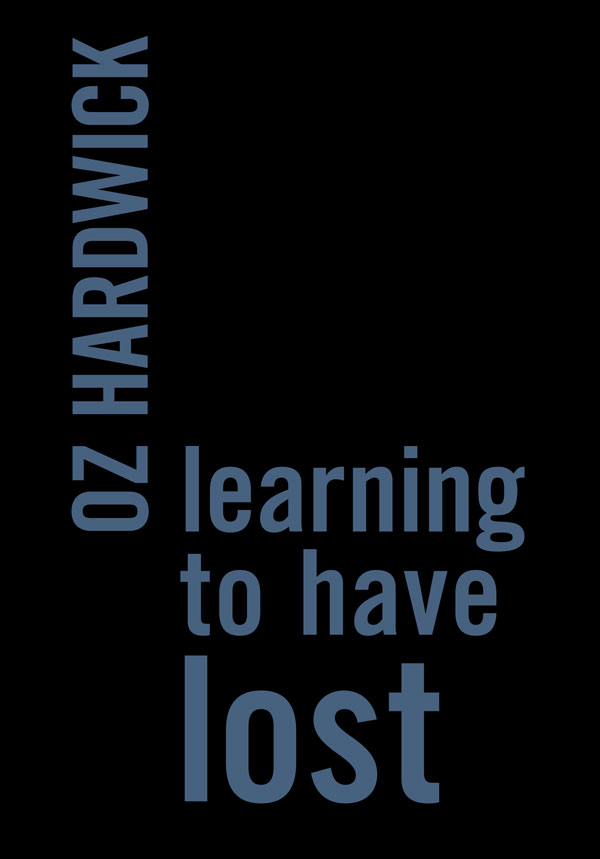
 is a York-based writer, photographer and musician, who has been published extensively worldwide, and has read everywhere from Glastonbury Festival to New York, via countless back rooms of pubs. His most recent poetry collection is Learning to have Lost(IPSI, 2018). A keen collaborator with other artists, Oz has had work performed by classical musicians in UK concert halls, by flamenco musicians in Italian villas, and with experimental sound and film artists in an Australian cinema. By day he is Professor of English and Programme Leader for Creative Writing at Leeds Trinity University. In his spare time, Oz is a respected music journalist. ‘The poetry is as good as it gets’ – HQ

https://ozhardwick.co.uk/

https://recentworkpress.com/product/learning-to-have-lost/

The Interview

  1. When and why did you start writing poetry?

I really don’t know. I always liked rhymes and playing about with words, but I don’t know when I started writing them down. Also, I was fortunate in that my maternal grandparents lived with us, and my granddad was passionate about Robert Burns and the Lake poets, and could recite vast swathes of their work. He’d left school early and gone into agricultural work, so was a bit of an autodidact: loved poetry and wrote poetry (very much in the Romantic mode), as well as drawing and playing folk tunes – again self-taught – on the melodeon. And he was a huge influence on me, so I just grew up with the idea that poetry was a normal thing that happens in a working-class household.

The first poetry I remember responding to personally, though, was Brian Patten when I was maybe 11 or 12. I came across ‘A Small Dragon,’ ‘The Projectionist’s Nightmare,’ and so on, and it was in language I understood, and spoke of the world I recognised, both in the everyday and in that magical aura which shimmers just beneath the surface of that world. I still love his work, and he led me to Roger McGough, Pete Brown, Adrian Henri and so on. If I hadn’t been writing things down before, I most definitely did then. The final piece in the early picture was Robert Calvert, who was doing really interesting spoken science fiction poetry with Hawkwind, who I also discovered when I was 12, and have been a fan ever since – 45 years or so later, there are things about his approach that, though you may not see any similarity in my writing, I still see in my approach to certain projects.

A long answer, which just takes me up to starting writing poetry, but these were the things that set the wheels turning – part grandfather born in the last years of the 19th century, part future-focused space rock.

2. How aware are and were you of the dominating presence of older poets traditional and contemporary?

I had the usual 60s/70s school introductions to ‘The Greats’ from Chaucer to the First Wold War poets, but it was the ones I encountered more serendipitously that had a more profound effect. I remember a few of us bunking off games in the library, and a teacher finding us and deciding to tell us about the poetry he loved. It started with Coleridge, and then went on to the Metaphysicals, and it had such an impact because it wasn’t someone going through the motions but, rather (like my granddad), getting carried away with a passion. The other epiphany was Hopkins, to whom we were introduced by a teacher who couldn’t hide his distaste, which sort of contaminated my reading, but I remember taking out this book in one of my favourite places, leaning against a tree, overlooking the sea on a summer afternoon, and for some reason reading it aloud. Wham!

In my 30s, I went to York University as a mature student (English and Art History), by which time I had a real enthusiasm for early 20th-century poetry – imagism and surrealism in particular – and, much to my own surprise, became passionate about medieval literature. Three degrees later, the pattern and texture of medieval poetry is pretty much a constant thread through my own writing, whether I’m thinking about it or not – it’s just in the air I breathe, even though most of what I read is contemporary.

2.1.Why did you become passionate about medieval literature?

I think it was initially the music of the language. I’d had a very unrewarding run-in with Chaucer at school, where it was taught as line-by-line translation, and that had put me off completely. However, I went to see a performance of a couple of the York Mystery Plays in the original language, in a medieval church, and it sounded magnificent! That primed me for the compulsory medieval literature module, which up to then I’d been kind of dreading. I still think Sir Gawain and the Green Knight is one of the most wonderful things I’ve ever read – and, incidentally, that Simon Armitage’s version is the only modernisation that does it justice. That, along with the sheer stylistic diversity of Chaucer, the overwhelming complexity of Langland, the York Master’s robust dialogue, and on, and on … My interest in contemporary writing remains undiminished but, at the same time, immersing myself in medieval literature – and art (I live in York, so it’s everywhere) – has been incredibly enriching.

3. What is your daily writing routine?

I write every morning, pretty much first thing – generally while I’m having a coffee. I belong to an online group which grew out of a prose poetry project at the University of Canberra. It put writers in the form in touch with each other in a creative dialogue. I was involved for about the last 18 months of its official life, but after the project finished it seemed too good to let go, so a  number of us stayed in touch, swapping poems and responding to each other’s work. With most of the other writers being in different time zones, I generally wake up to something interesting in my inbox, which mixes with whatever’s on the radio, whatever’s still buzzing about from dreams, and so on, and I just write from these diverse, sometimes clashing, sources. My critical faculties come into play later, whenever I find the time, but I have this half hour or so each day during which I will write. And – with due apologies if this sounds arrogant – I have a pretty good hit rate on raw material that will develop into something worthwhile. This most definitely isn’t because I have a unique and wonderful talent, or that I’m ‘inspired’ (I’ve never knowingly been inspired in my life) but, rather, it’s because I have worked on writing and thought carefully about it on a daily basis for many years. I think I often give the impression of being a bit scatty, a little bit flippant even, perhaps, but beneath the slightly shambolic exterior, I’m actually very focused, very disciplined and quite possibly unhealthily driven.

4. Clashing sources motivates you to write?

Very much so. Often writers will talk about the blank page and how they respond to its challenge, but for me it’s much more akin to Michelangelo’s description of sculpting an angel, by seeing the angel inside the marble and carving everything extraneous away until the angel is set free. I don’t necessarily know what is inside the chaos of stimulation, but I have become quite adept at cutting everything away to get at what it actually is that I feel needs to be set free. So, for me, there’s never a blank page, just a huge – almost overwhelming – mass of stuff waiting for me to find the shape of my thoughts within it. Sometimes it takes the delicate application of the finest chisel, and sometimes it takes a pneumatic drill. Or maybe explosives. I think that’s possibly a metaphor that’s gone about as far as it can!

5. How do the writers you read when you were young influence you today?

The very general answer is that they gave me the passion for what I do now. I’ll set my own parameters for ‘young,’ and go back to my mid teens for the most profoundly influential, and that was Richard Brautigan. I discovered him by chance in the library – an experience that the internet will never replace – when I came across ‘The Cleveland Wrecking Yard’ in an anthology. I was absolutely hooked, and picked up everything available – and, indeed, waited eagerly for his further books. Apart from the understated surrealism of the story, the language and structure of the paragraphs was closer to poetry than to prose. I wouldn’t hear the term ‘prose poetry’ until a lot later (well, not consciously, as Brian Patten has a self-professed prose poem in The Mersey Sound, but somehow that had sailed past me), but I recognised Brautigan’s work in these terms straight away. He wrote both poetry and prose, but I’m of the not uncommon opinion that his novels are way better poetry than his actual poems. I am a very different writer, but I think my prose poems share a similar aesthetic – and that’s an aesthetic that in my case was partly shaped by my love of his work. His In Watermelon Sugar is as good as it gets, as far as I’m concerned.

5.1. Why is the language and structure of Brautigan’s work closer to poetry?

Brautigan’s is a prose that foregrounds language over narrative development, and often uses simile and metaphor in ways that are intensely suggestive, yet do not fully cohere into a fixed image. To take a very simple – and quite typical – example: when native Americans ‘report like autumn’ to the army, for instance, it doesn’t service the narrative, and I can’t quite pin down how they are reporting, but I find it deeply satisfying at the level of language. Although distinctly different in all manner of respects, there’s a similarity here to, say, the discontinuous juxtapositions in Lyn Hejinian’s work. This quality is something that was even commented upon by his contemporaries: I don’t recall the exact words, but Michael McClure said something about Trout Fishing in America being a great poem. Of course, on a pure gut reaction level, the brevity of Brautigan’s chapters or short stories makes them look like poems: there’s a lot of white space around the ink which – and it’s something that Glyn Maxwell talks about in On Poetry – is a part of the reader’s encounter with text that we shouldn’t underestimate.

5.2 How do the medieval works influence your writing?

That, I think, is much more complex and subtle. A clear example would be my An Eschatological Bestiary (Dog Horn, 2013), which took the medieval bestiary form and, instead of combining biblical and doctrinal material, natural history, folklore and so on in order to attribute allegorical meaning to animals (I’m grossly oversimplifying here), I combined newspaper reports, overheard conversations, a lot of my own academic writing on medieval animal iconography, and other found sources, and employed a few chance procedures in order to engage very obliquely – there’s nothing didactic about it – with topics that concern me, such as dissociation from the natural world, miscommunication, and personal dissociation through mental illness. That makes it sound very dark indeed, but actually it’s a very playful work, which owes as much to Tristan Tzara and Max Ernst as it does to the great medieval Anonymous. At the other end of the scale, the poems in my collection The Ringmaster’s Apprentice (Valley Press, 2014) are sequenced in a way that owes a lot to Sir Gawain and the Green Knight, though you wouldn’t know if I didn’t tell you, and probably still wouldn’t be any the wiser now that I have. It’s as much a pattern of thought as it is an ‘influence,’ I think.

6. Whom of today’s writers do you admire the most and why?

That is very hard to say, as there are so many writers whose work I admire, and for different reasons. I find Claudia Rankine’s challenge to form, in concert with her work’s challenge to learned cultural perception, really exciting, particularly in view of the way it incorporates visual material in a dynamic dialogue. A profoundly different writer, who also incorporates visual material is Bella Li, who I only discovered a few months ago. She has an unashamed debt to the surrealists, but there is a pared-back, meditative quality to her writing that is like imagining Solaris as a haiku sequence – or something like that, anyway. Her books are wonderful. A complete contrast, but Simon Armitage is a poet who seems to be everywhere these days, and quite rightly so. As a prose poetry enthusiast, Seeing Stars is a particular favourite – subtly disruptive – and, as I said earlier, he’s the only person to have done a worthwhile job of making Sir Gawain and the Green Knight accessible to the modern reader while as much as possible retaining the texture of the original. And I don’t think many come close to Alice Oswald and Katrina Porteous when it comes to separating and articulating the archaeological layers of place. I could – and frequently do – go on, but I will just namecheck Agnes Lehoczky and Bob Beagrie, whose work constantly astounds me in its linguistic intensity. There are more …

7. Why do you write, as opposed to doing anything else?

Ah – I don’t! Way, way back when I left school, I went to Art College, where I studied photography, and I have kept up a keen interest and taken the pictures for the covers of most of my books, as well as a number of others (and a few albums, too). Each of the poems in my Eschatological Bestiary is accompanied by a collage, too – I’m really interested in the interaction between word and image. I also play a bit of music – at a rather basic level of competence – and whenever I can I put that into the mix. The current project is The Forgotten Works (the name’s a Brautigan reference), in which I read and play treated electric guitar and kaossilator, along with Amina Alyal – a poet with whom I collaborate on projects as often as possible – and a very versatile guitarist/keyboardist called Karl Baxter, who also does clever electronic stuff. We will at some point record an album, but the immediate plan is to work some lighting effects into performances, too. In my head, the effect we’re going for is a sort of Bells of Atlantis meets Bob Calvert and Gilli Smyth, but there’s more than enough creative waywardness amongst us for it to sound nothing like that. To get back to the question: I write because it’s what I do, and it bothers me if for some reason I can’t for a day or so, but as soon as I’m given the chance, I’ll be chucking it in the mixer with other artforms, often with other people.

8. What would you say to someone who asked you “How do you become a writer?”

I can only think of a very cliched response, though it has become a cliché by virtue of being true: read voraciously and write because you love it.

9. Tell me about the writing projects you have on at the moment.

There are two big projects at present. First, with Anne Caldwell, I’m co-editing an anthology of contemporary prose poetry, which will be coming out with Valle Press in the summer. We’ve been working on it for some time, and are just finalising the manuscript. There will be a symposium to coincide with publication at Leeds Trinity University on 13th July, and all manner of excitements. To find out all about it, it’s best to just go to the website at https://prose-poetry.uk/events

As for myself, my chapbook of – who’d have thought it? – prose poems, The Lithium Codex has just won the Hedgehog Press Full Fat Collection competition, and Hedgehog will be publishing that in July, too.

While this is going on, I’m working on a new full collection, which should be out in the first half of 2020.

So, with all this, and a couple of editing projects, along with a couple of new writers I’m helping out, things are pretty busy. Oh, yes – and then there’s the day job …
Wombwell Rainbow Interviews: Cherry Potts

Wombwell Rainbow Interviews

I am honoured and privileged that the following writers local, national and international have agreed to be interviewed by me. I gave the writers two options: an emailed list of questions or a more fluid interview via messenger.

The usual ground is covered about motivation, daily routines and work ethic, but some surprises too. Some of these poets you may know, others may be new to you. I hope you enjoy the experience as much as I do.

Arachne

Cherry Potts

is author of The Dowry Blade, a lesbian epic fantasy, and 2 collections of short stories, Mosaic of Air and Tales Told Before Cockcrow. She has had many stories (and one poem!) published in anthologies, magazines and on line, and her work has been performed (sometimes by actors) in London, Leeds, Leicester, Oxford, Cumbria, Bath and Hong Kong.

Cherry edits short story/poetry anthologies including Award Winning Weird Lies for Arachne Press, which she owns. She runs the literature & music festival Solstice Shorts and is visiting lecturer in Creative Writing at City, University of London.

The Interview

  1. What inspired you to write poetry/flash fiction?

I was a horribly precocious child, telling stories before I could write, then ‘writing’ them in pictograms on the giant blackboard that took up a wall in our house. Not having a written language was hugely frustrating and I took to reading like a drink in a desert. I wrote my first novel at 12, and churned out poetry that was perfectly correct in its meter and rhyming structures but about absolutely nothing. It kept me amused when I ran out of library books to read. I write almost no poetry now, and have only ever had one poem published, but I know the real thing when I see it, and I publish lots of poets. Flash fiction wise, notwithstanding a mammoth epic fantasy novel, my first love is short form fiction

  1. Who introduced you to poetry/ flash fiction?

My parents. My mum is a writer, so it was almost expected that I read, and write something. My dad introduced me to folk music and blues which taught me a huge amount about both the patterns you can make (with or without music) and the tiny amount of words needed to tell a story powerfully. I didn’t know it was flash at the time of course. I think I realised that some of what I was writing had a name when I came across it on twitter.

  1. How aware were you of the dominating presence of older poets?

Hardly at all. Maybe because I’m opinionated? Maybe because it wasn’t how I was taught? Maybe because I don’t know them? I’ve found things I like but never feel dominated by them, just delighted that I enjoyed it. I’m a bit of a sucker for metaphysics. I love John Donne and Shakespeare and I enjoy William Blake in small doses. I think it’s contrarianism in poetry that gets me interested, and it was reading Sylvia Plath as a teenager that woke me up to what could really happen in poetry – I started reading women almost exclusively, so my canon is very female! I don’t have much time for 19th Century poets apart from Emily Dickinson (or music either actually), it’s all either really old or fairly modern. For example I have discovered the Trobiaritz poets (another music link) of 12th-13th Century Languedoc on one hand, and I am publishing poets writing right now.

  1. What is your daily writing routine?

I wish I had one. I have just embarked on a fortnightly routine. A friend and I get together on Wednesday mornings and write really hard – sometimes in silence, sometimes trying things out on each other. And we both go to the same monthly writers group which is mostly talk and feedback. If I manage anything else in between it’s a proper cause for celebration. I like to write in bed – the desk is for admin. Although if an idea has got its teeth in me I’ll write anywhere anytime – I once wrote almost nonstop for 24 hours – on the train, in a work meeting, park bench… Editing other people is very good for me – I think so much more before I commit to a sentence or a line.

  1. What motivates you to write?

Ideas. An idea will slap me on the forehead and keep shouting at me till I get it on paper/screen, and then the real pleasure is in deciding how to shape it.

  1. What is your work ethic?

I am constitutionally unsuited to work, so it’s lucky I don’t think of writing as work. It’s a total pleasure.

  1. How do the writers you read when you were young influence you today?

I am wary of influence. Occasionally I discover I’ve been too influenced, I’m a bit of a style sponge. What did I take most from what I read? The joy of words. The power of structure. The urge to always tell a story no matter how obliquely. The right to be angry and say so.

  1. Who of today’s writers do you admire the most and why?

Temptation to just list some of the writers I publish- (Jennifer A McGowan, Sarah James, Elinor Brooks, Jeremy Dixon, Cathy Bryant, Math Jones, Ness Owen, Jane Aldous, Emma Lee, Lisa Kelly, Michelle Penn, Laila Sumpton…) All mainly for wit, compassion and panache, but there are others!

Kate Foley: she has such a wicked wit, and can turn from laugh to anger to sorrow on a comma. (I set up Arachne in the hope I could convince her to let me publish some work. Yes! I did! Yes, I have: The Don’t Touch Garden and A Gift of Rivers)

Jay Bernard: spectacularly vivid poetry, and brilliant live too, had me on the edge of my seat at the Keats festival once. Jay, if you read this, I still want to publish you!

I loved Julia Bird’s Now You Can Look. It’s a mistress-piece of storytelling and style.

  1. Why do you write, as opposed to doing anything else?

I do lots of somethings else, but all connected to writing, (publishing, editing, typesetting, teaching, singing…) which keeps my brain alert for material and honed for the job at hand. After I was made redundant for the second time in 5 years I thought ‘come on Cherry, what do you really want to do, because this isn’t working’. So I set up Arachne Press, which rather eats my time, but I enjoy it!

  1. What would you say to someone who asked you “How do you become a writer?”

Read everything you can get your hands on in order to learn what captivates you and how to achieve it. Keep your ears and eyes open and engage with the world so that you find something you want to write about. Words are lovely in their own right, but they are there for a reason, to communicate. As soon as something excites you enough that you find it hard to think about anything else, start. Try. Try harder. Scream in frustration and throw things away. Start again. Share. Start again. Share. Start again. Continue.

  1. Tell me about the writing projects you have on at the moment.

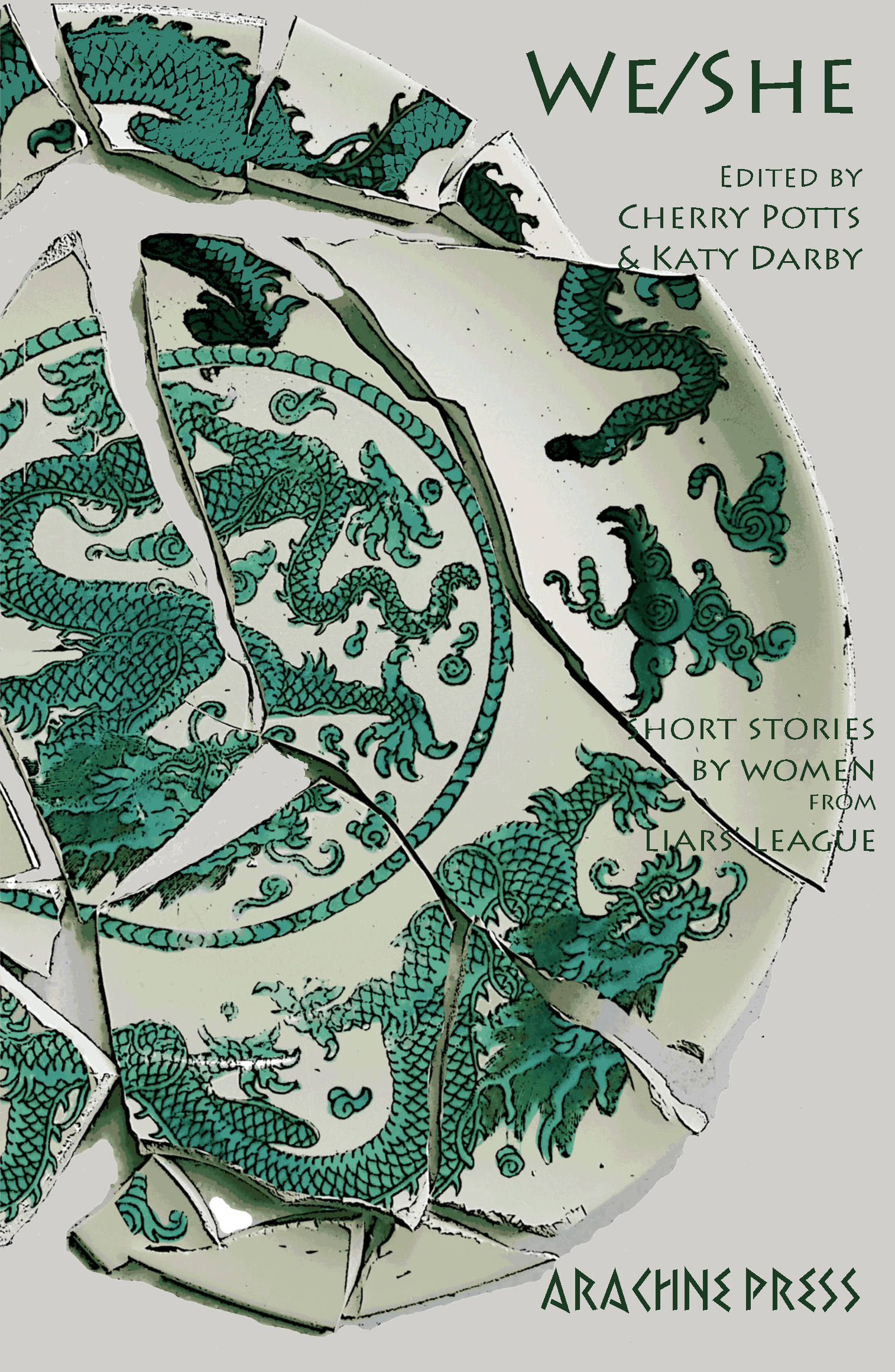
My most recent publication was The Real McCoy in We/She Arachne’s Liars’ League women’s anthology last August. It’s about a real mermaid in a fairground side show. There’s a bit of a theme going there at the moment as I’m writing a novel(la) called The Bog Mermaid. The indecisive brackets are because it is very short, and might work shorter still. The first draft is almost finished. It might even be a novel(la) in flash – each section is well under 2000 words, and many are much shorter, and it’s deliberately quite disjointed, but makes up a whole story (two actually) by the time it’s threaded together. It’s about two families living in the same house fifty years apart 1926/76 and how the lives and decisions of the first family keep touching the later one.

And I’ve just had a Selkie themed story, Fish-fish, chosen to be read at Liars’ League London on February 12th. I may stop writing about sea creatures and using them as metaphors sometime.


Wombwell Rainbow Interviews: Dave Pitt

Wombwell Rainbow Interviews

I am honoured and privileged that the following writers local, national and international have agreed to be interviewed by me. I gave the writers two options: an emailed list of questions or a more fluid interview via messenger.

The usual ground is covered about motivation, daily routines and work ethic, but some surprises too. Some of these poets you may know, others may be new to you. I hope you enjoy the experience as much as I do.

dave pitt

Dave Pitt

is a Writer and Performance Poet.
Theatre and Performance

  • Co-writer / co-director and co-performer of “Poets, Prattlers and Pandemonialists” – Shows in around the UK including a run at The Edinburgh Fringe in August 2017.
  • Co-MC of Poetry Slams in Wolverhampton, Shrewsbury and Audlem.
  • Co-MC of Yes we Cant poetry night in Walsall.
  • There is None Who Does Good (Writer) – Production by Arena Theatre (December 2017)
  • Bert (Writer) – Productions by Arena Theatre (February 2016) and Holly Bush Arts Group (August 2016 & March 2017)
  • Self Contained Rhythmic Narratives (Writer and Performer) – Produced by Arena Theatre.
  • Smoking Cessation Project (Writer) – An Invisible Theatre piece written and devised in conjunction with Gazebo Theatre. September / October 2015 & September / October 2016
  • Curator and MC of Eclectic Poetry Pagoda – June 2017.
  • Winner of Wolverhampton Story Slam – Oct 2016
  • Winner of Wolf Pack award for 14/48 Wolverhampton. June 2015
  • Umpumi – Shortlisted for funding award. 2010.
  • Adaptation of The Illustrated Man by Ray Bradbury – Co-Director / Adaptation. 2005.
  • Hundreds of gigs across the country.
  • Co-Founder of the successful Anarchy Comedy Club which ran in Willenhall between 2012 and 2015.

Publications

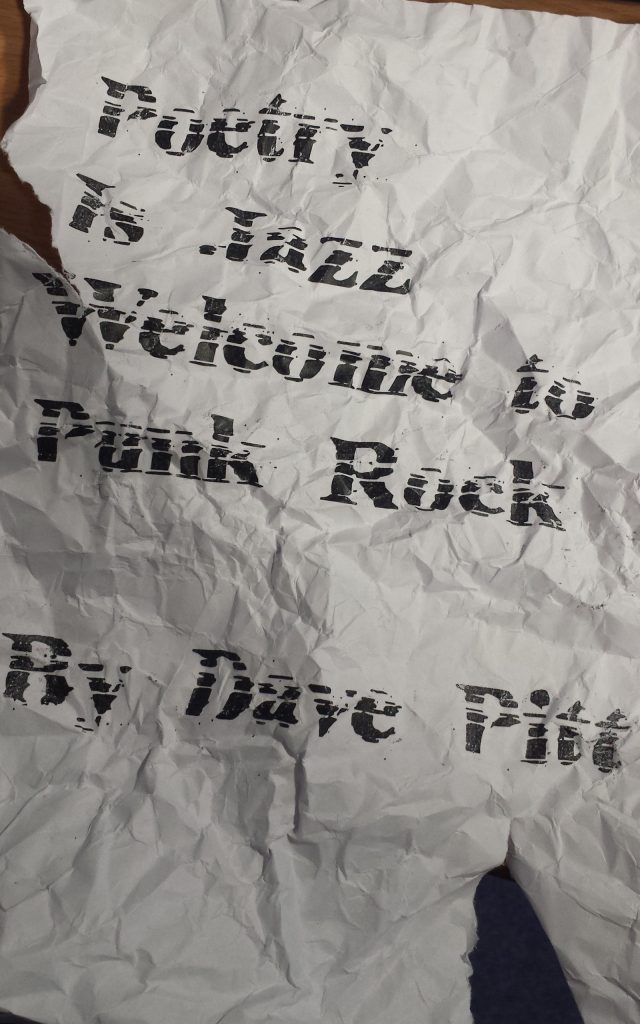
  • Poetry is Jazz. This is Punk Rock. Poetry Collection.
  • Starting Out in Stand-Up or Why Stand-Up Comedy Saved my Life and Why it Could Save Yours published in 2013. Peaked at No. 3 in the Amazon charts. and is currently rated 4.6 / 5.0.
  • Short Stories published in a variety of publications and websites.
  • Articles published on platforms such as Giggle Beats, WV11.co.uk, Worcestershire Film Festival and by GMB Trade Union.

Mentoring and Workshops

    • Workshops on the performance aspect of performance poetry.
    • Improving the writing and communication skills of young people via Talent Match. A voluntary engagement programme which acts as a platform to increase optimism, motivation and confidence.

Film

  • Writer of “You Must Go On”. Neverwhere Media Productions.
  • Writer / Director of “Visitor” shown at festivals across the country. Sound as a Pound Films.
  • Writer / Director of drama pieces in “Battered Britain” a documentary shown on Channel 4. Evans Woolfe Productions.

The Interview

1.       When and why did you start writing poetry?

I’ve always written because it’s always felt like a form of expression I can do and enjoy. I dabbled for years. And it was literally dabbling. I mainly wrote screenplays and short films but also acted, directed and generally got involved in creative things.

My school was terrible and seemed to suck creativity out of us. I think part of the reason I continued being creative was it felt like being creative was rebelling against my school. However, I hated poetry because I was just exposed to dead white guys who I couldn’t relate to. The closest I got to poetry was song lyrics and hip hop. And I remember fastidiously pouring over song lyrics, pulling out hidden meanings. And back in the day I remember seeing people like Craig Charles or John Cooper Clarke occasionally appear on TV and thinking, “That’s cool.” But in those pre-Internet days it just seemed other worldly.

On a creative level, deep down, I wanted to do stand up comedy but I didn’t have the nerve. I became disillusioned with film making because I was spending so much energy just trying to get people into a room to make a film that by the time I managed it I was knackered.

So I started out by doing storytelling because it just needed me and it was just a way to try to build up the nerve to do stand up. Eventually, in 2010, I did stand up. I tottered along for a while but it dawned on me that stand-up had run it’s course when I had a good gig and walked off stage thinking, “Meh”. The audience laughed in all the right spots, I’d got praise for the set but I had walked off stage thinking, “Meh.”

I had also explored my mental health in stand up and was trying to write new material. The trouble was I felt I was always chasing the joke. And I didn’t want to. All this combined made me quit stand up. I just wasn’t getting anything out of it anymore. The piece I was working on became a play, “Bert” and I started doing story telling again.

At these gigs I’d see some poets perform. I remember seeing Emma Purshouse years before when I was doing storytelling and just thinking, “Wow. She’s good.” But it was so good it felt like it was a million miles away from where I could ever be.

Then, one night, in a fit of anger at some perceived injustice on my drive to Birmingham, I wrote a poem right before I went on stage to do some storytelling. I have no idea why. I delivered it and it went well.

Within 6 months I was doing 10 minute poetry sets. Then it all kind of exploded.

Poetry felt like it brought everything together. I could tell stories, I could perform, I could make people laugh but I could also make them think.

Strewth I wrote a bit there, didn’t I? Does this count towards my daily word count?

2. When you fully entered the poetry scene how aware are and were you of the dominating presence of older poets traditional and contemporary?

I wasn’t. This must sound awful to someone who has spent their lives reading, writing and performing poetry but it’s true. I wasn’t completely ignorant. I could tell you about Owen, Poe, Shakespeare and more modern poets like John Cooper Clarke, Scroobius Pip and Ian McMillan but I was by no means an expert in any of them and I’m still not.

I started a uni course and we had a poetry module there but it was all old dead Greek guys. I enjoyed it a lot but the language was so removed from what I was writing that I didn’t give it a second thought. In fact, I think I drew more theatrically from it than poetically.

One of the great things about being in Poets, Prattlers and Pandemonialists with Emma Purshouse and Steve Pottinger is it helps me fill these gaps. Emma in particular has an almost encyclopedic knowledge of poetry. She will very often recommend poets and collections for me to try and she’s never wrong.

But in a way I think the ignorance helped me in those early few months of writing and performing poetry. As I said I have mental health problems. I’m also working class and suffer from imposter syndrome and a lack of self esteem. These are horrid thing to combine with an innate knowledge of a subject. You have a lack of belief in your own voice so try to copy others. If I’d come into poetry knowing a load about poets I’d have tried to be them. The ignorance meant I had to be myself.

What then happened as I got more knowledge (and I’m still very much a beginner in poets and poetic forms) I tried to imitate others. Again, having Emma and Steve around helped so much because they’re smart enough to knock that stuff out of me without belittling me. I remember a stand up comedian once saying to me, “When there is a brilliant stand up comedian it ruins the circuit for the next 15 years because everyone tries to be that comic.” And he was right. I remember so many comedians (myself included) trying to be Stewart Lee.

The best advice I can give anyone is don’t try to be someone else. They’re better at it than you are. But you are the best you this planet has.

I wish someone had said that to me 30 years ago and I scream it into the face of any new creative I meet. BE YOU!!!!

3. What is your daily writing routine?

I have a full time job which I have to do to pay the bills. As a consequence that takes my focus. This can sometimes mean I work and then when I get home I’m too tired to write. That’s frustrating but I have to accept it.

If I have energy I will do “something” each day. What that is depends what’s going on. I have a strong work ethic but I’m aware I can burn myself out. I need to schedule breathing room and a bit of me time. A lesson I’m only really starting to learn now.

Even tight deadlines can benefit from a bit of breathing room. It’s important to me that I’m not just day job, writing, day job, writing.

I have a little box room at home and my wife is also a creative (painting, drawing, sculpture). This means we’re not in competition with each other but both understand the hoovering hasn’t got to be done EVERY day. We give each other space to be creative.

So most nights I will disappear for some time into my little den and something creative happens in there. It might just be a few notes and a few laps on Gran Turismo on the PS4. Or it could be a few thousand words. It’s very much a “vibe” thing. I will write poetry, plays or fiction. Depending what idea is floating around, or what I’ve been put on a deadline to do, depends on the focus. Sometimes projects will be started and left for months others will pour out almost fully formed.

But I also think part of the writing process is reading and observing. I always make sure I read something every day. Even if it’s a page of a novel in bed and a news article or three. And I’ve always got my eyes open for something. And it always tends to be the little details you spot which you can use more than the big stuff.

4. What motivates you to write?
When I have the energy you mean? I have to do it. Some writers say writing is like giving birth. I don’t think that at all. I feel most of my writing is about discovering a Bot Fly Lava under your skin. You’re too scared to do anything about it for a while but then you can hear the maggots crawling around and eating you from the inside out so you have to get a knife and stab your own neck and rip the grubs out.
It’s cheesy to say it’s cathartic but it is. Of course you’ll feel better when you’ve got rid of a parasite. When I have a week like just where I’ve had to work so hard at work that I’ve been too tired to write I get tetchy and down.
I use my writing to explore ideas. I have lots of conversations written which is basically the two viewpoints in my head arguing the toss.
But sometimes I’m forced to write. Doing 52 last year forced a poem a week out of me. But even then, I dug deep and ripped maggots from under my skin.
I suppose you could say, “I hate written. I adore having written.”

5. How do the writers you read when you were young influence you today?

Like a lot of kids who read back then there was a lot of horror. Stephen King, Shaun Hutson, James Herbert that sort of thing. It seemed a bit risky and adult. Ironically I’ve never really written a horror and when I have touched on the genre it’s been more influenced by movies than books.

I also remember reading “The Lion, The Witch and The Wardrobe” about a million times. This gave me a sense of wonder and magic. A feel for world’s other than this one. That still influences me now.

Weirdly I think a big influence was a book called Empty World by John Christopher. I’ve no doubt if I were to read it now I’d hate it but back then, as a kid, it really appealed. It was about a kid who survives a plague which wipes out most of humanity. He meets the odd survivor along the way but the thing I remember most is the ending. The character has a big fight with someone else and he has a chance to walk away but he brings the person back into his life. It was a weird ending which to this day I never understood but it kept me thinking. I still write endings now which leave things in the air. Sometimes the questions are more important than the answers. Empty World taught me that.

6. Whom of today’s writers do you admire the most and why?

Cormac McCarthy just blows me away. I maintain he’s the greatest living writer. Yes it’s dark but the language is beautiful. The problem is it’s so good I tend to spend a hour or two thinking, “I just can’t write. I’m useless.”

I also love Alan Moore. I got into comics quite late and Moore was my way in. His writing is superb and full of subtext but I’m also new to the medium so I find I’m learning something new about writing and comics everytime I read a book of his.

But it’s not just literature. I adore Josie Long’s work both as a comedian and screen writer. Her work is full of empathy and helps remind you there is good in everyone but it never feels twee. People think writing comedy is a throw away exercise but if you think that, try it. It’s one of the hardest things to do and doing it as a woman is even harder. The industry is so set up against anyone not white and male it’s unbelievable. Long’s work shatters the glass ceiling and makes me laugh like a drain.

And you know what… she’s going to kill me if she reads this but Emma Purshouse. I’ve held her on a pedestal for years and now I’m working alongside her. I still have to pinch myself. Her writing is unbelievably good and a completely unique voice. I can feel her dragging me along and I’m a better writer, poet and performer because I’m swimming in her wake.

7. What would you say to someone who asked you “How do you become a writer?”

If you want to make a living out of try to ensure one of your parents is a writer.

It’s cynical but we’re not living in a meritocracy. We live in a world powered by nepotism. When millions of people want to be writers, when agents and publishers are getting thousands of manuscripts and when you can stumble into any coffee shop and find the nearest Apple Mac and find a novel in the works then how do you lift yourself above the noise? People who know others in the industry will always get to the front of the queue.

It’s not impossible but it’s a lot more difficult if you don’t have someone who can give you the nudge in the right direction.

But it’s not just about making a living out of it. If you want to write then… write. If you want to perform… perform. There is enough opportunities for people to do that but making money is a lot tougher.

To give yourself the best chance you have to write and read a lot. And find people you can share work with. It makes you a better writer to produce a lot and get good constructive feedback.

8. Tell me about the writing projects your involved in at the moment.

I wrote a one man show last year and I’m performing it for the first time in April. The thing is the script was always a placeholder. It’s about the power of stories and therefore filled with stories. They now have to jump off the page and out my mouth. And while this sounds weird, this jump from page to performance is a rewrite. That is taking up a lot of time.

Last year me, Emma and Steve did 52 which involved us writing a poem a week all year. We did it and enjoyed it so this year we’re doing it again. But this time, we’re writing our own prompts as well.

The three of us are about to go on our yearly writing retreat. It’s definitely not a holiday and pure coincidence it happens at the same time as the Six Nations and the Wolves Newcastle game. We’re more than likely going to write a new show there. But I’m also scrabbling though notebooks finding old ideas which I’ve forgotten about. I know something will come out while I’m there.

“Global Harming” . . . and other responses to the last Wednesday Writing Prompt

Stoked to have three poems featured in The Poet By Day in great company. Thankyou Jamie.

Jamie Dedes's avatarJamie Dedes' THE POET BY DAY Webzine

“This sweet virginal primitive land will metaphorically breathe a sigh of relief — like a whisper of wind–when we are all and finally gone and the place and its creations can return to their ancient procedures unobserved and undisturbed by the busy, anxious, brooding consciousness of man.”
Desert Solitaire, Edward Abby


BEFORE THE ENVIRONMENTAL POEMS, A THANK YOU

Thanks for waiting patiently and courteously for this post to go up. I have returned to the world of the living after health complications and another protracted stay at Stanford Hospital (also know in my family as The Stanford B & B).  I am grateful for your understanding and for the concern, intelligence, and perseverance of my cadre of doctors and other professionals at Stanford. Though there has been a precipitous decline in my lung function and I am completely homebound now, there is some potential for improvement and certainly my…

View original post 2,741 more words

Wombwell Rainbow Interviews: Wansoo Kim

Wombwell Rainbow Interviews

I am honoured and privileged that the following writers local, national and international have agreed to be interviewed by me. I gave the writers two options: an emailed list of questions or a more fluid interview via messenger.

The usual ground is covered about motivation, daily routines and work ethic, but some surprises too. Some of these poets you may know, others may be new to you. I hope you enjoy the experience as much as I do.

prescription

Wansoo Kim

achieved Ph. D. in English Literature from the graduate school of Hanguk University of Foreign Studies. He was a lecturer at Hanguk University of Foreign Studies and an adjunct professor at Incheon Junior College for about 20 years. He has published 5 poetry books, one novel, and one book of essays. One poetry book, “Duel among a middle-aged fox, a wild dog and a deer” was a bestseller in 2012, one page from the book of Letters for Teenagers was put in textbooks of middle school (2011) and high school (2014) in South Korea, and four books (Easy-to-read English Bible stories, Old Testament(2017), New Testament(2018) and Teenagers, I Support your Dream”) were bestsellers. Kim was granted a Rookie award for poetry at the magazine of Monthly Literature Space in South Korea, and in 2004, the World Peace Literature Prize for Poetry Research and Recitation, presented in New York City at the 5th World Congress of Poets.

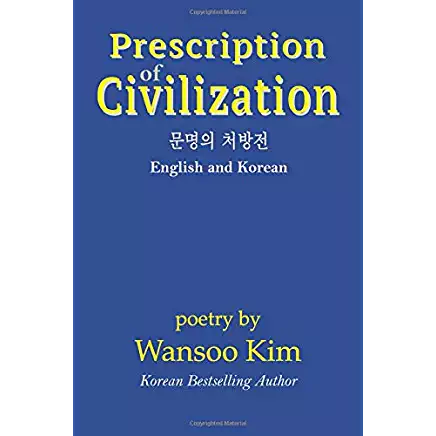
* Wansoo published a poetry book titled Prescription of Civilization in America.(2019)

tinyurl.com/y856tb24

The Interview

  1. What inspired you to write poetry?

Preparing for the national exam for a diplomat while in university, I was extremely frustrated by the diagnosis that even modern medicine had no cure for my disease from the doctor at the best hospital in South Korea.

Finally I took a year off from university, went to my country home and struggled against disease being seriously tormented by the problems such as ‘why on earth does such fatal disease come to me?, what will happen to me after death? etc.’

Attempting suicide a few times due to the unbearable pain, I had the opportunity to meet God at the revival service of a neighboring church. Beginning a life of faith, I’ve got a challenging hope of life with the miraculous healing of my disease. Besides, forming the sense of value totally different from that before the incurable disease, I have opened the eye of a new vision on everything of life.

Entering a graduate school and majoring in English and American poetry after graduating from university thanks to the recovery of health, I began to write poems, fired with the strong desire to express my literary and philosophical insight formed by the wide knowledge of English and American literature and the Christian faith.

These days, I get inspiration about writing when I study the Bible or listen to the sermons.

  1. How aware were you of the dominating presence of older poets?

I majored in English and American literature at graduate school. So I studied most of the important poets in the history of English and American literature.

3.What is your daily writing routine?

As soon as I get up at dawn, I usually write. And in the morning or in the afternoon when I have free time. I don’t write at night, because I can’t sleep well after writing.

4.What motivates you to write?

Many years ago, social injustice made me write. But recently prayers, listening to sermons and reading Christian books make me write, because I mainly write Christian poems and essays.

  1. What is your work ethic?

Essentially to me, it is based on common sense, conscience and God’s love. I don’t like wicked or obscene writings.

6. How do the writers you read when you were young influence you today?

When I was at graduate school, I studied Shakespeare’s sonnets. I liked them very much. I learned the image development from him. I learned conceit and wit from John Donne. I learned harmony of opposites from his concept of imagination. I learned imagism from Ezra Pound. I learned fusion of thought and feeling, objective corelative from T.S. Eliot. The techniques of all these poets are very helpful to write poems.

7. Who of today’s writers do you admire the most and why?

I have been reading the poems of so many writers on the poetry sites recently. I don’t have the writers to admire in foreign countries, but I admire a few Korean poets and novelists, because their works are wonderful enough to get a prize of authority in a foreign country.

8. Why do you write, as opposed to doing anything else?

I don’t write with a simple reason or as a hobby. I write with a mission to write. As a Christian writer, I write to express God’s love and plan for His people as well as my gratitude to Him. So writing has priority over everything to me. But writing is not a obligatory or hard burden. I am willing to write with the help of the Holy Spirit because I experience His presence, help, or guidance every day.

9. What would you say to someone who asked you “How do you become a writer?”

Continue to read the works of the genre you are interested in. Take a writing lecture. Join a writing circle. Have a great vision of being a writer. Write every week even though you are not good at writing.

10.Tell me about the writing projects you have on at the moment.

I am going to publish a poetry book titled “Flowers of thankfulness” this year in America. And I am planning to publish an essay book titled “Heart of God” in Korea and in America next year.


Wombwell Rainbow Interviews: Danielle Holian

Wombwell Rainbow Interviews

I am honoured and privileged that the following writers local, national and international have agreed to be interviewed by me. I gave the writers two options: an emailed list of questions or a more fluid interview via messenger.

The usual ground is covered about motivation, daily routines and work ethic, but some surprises too. Some of these poets you may know, others may be new to you. I hope you enjoy the experience as much as I do.

beautifully chaotic

Danielle Holian

is a poet, journalist, and photographer, born in the West of Ireland. She studied digital media of journalism and marketing in college and has since gained substantial experience in the media field branching off into poetry and photography. She flourishes her creative love through words and art. She continues her passion for words through her media work as a music critic of reviews and interviews. She documents her interests, sparks, and amusements as she captures moments she relives through her art.

On the release of her debut book, Danielle says, “Writing this collection was a journey I knew I needed to adventure on. From being in a dark place to find the light again. I discuss some heavy topics that are close to my heart that I hope to open conversations for the ones that were once me.”


 The Interview 

  1. When and why did you begin to write poetry?

I have been writing for as long as I can remember, but I began writing poetry in my teens. I used it as a way to express myself going through things where I found I couldn’t voice myself thoughts, feelings and emotions out loud. It was theraphetic and lead me to find my inner voice that I hope can inspire others. And writing has always been there for me through the good and bad times of my life.

2. Who introduced you to poetry?

I sort of just stumbled upon poetry one day and as they say the rest is history. There’s been many influences in my life both personally and writers I’ve come across through my time. I’m a creative individual with a constant urge to keep learning, evolving, and growing.

3. How aware were and are you of the dominating presence of older poets?

With the likes of Sylvia Plath, William Shakespeare, and Oscar Wilde, I know they have an influence in today’s writing many years later. They made their mark and continuously inspire writer’s like me. I grew up loving writing in school, so certain classes I studied involved older poets which evolved my love for writing. The art of creating a story to share intrigues me. They showed me that it is possible once you believe.

4. What is your daily writing routine?

As well as being a poet, I am a music critic and songwriter. So, my daily writing routine differs each day. It keeps the spark and interest alive as something always catches me off guard and develops into something unexpected. But, I generally try to journal something daily whether it becomes something or not in time.

5. What motivates you to write?

Life. People. My everyday experiences. I cannot live through this life of mine without documenting, journaling, and finding new ways to express myself through writing. It gives me a purpose.

6. What is your work ethic?

I think I have a strong work ethic, with strong perfectionist tendencies. I am constantly testing myself to do better. I know nothing I do wastes my time, rather prepares me for something greater. Everything I do is a learning experience with some curves that do try to keep me off target, but it’s the motivation and love for art is what keeps me going. It has taken me a long time to find a perfect balance with my work, life and everything in between.

7. How do the writers you read when you were young influence you today?

They gave me courage to pursue my love for the art of writing. I have found the strength to discuss heavier topics in my writing and without the writers before me I doubt I would have considered writing as an outlet.

8. Who of today’s writers do you admire the most and why?

At the moment, I would say the likes of Nikita Gill, Olivia Gatwood, Rupi Kaur, Lauren Eden, Taylor Swift, and Demi Lovato are my biggest influences. I prefer to connect with a creative and the stories they tell. So, these women inspire me to be my best self in a world so cruel yet full of love. Their unapologetic vibe and strength to share their stories makes me feel invincible. Without these people it would have taken much longer to find the inner strength to carry on through.

9. Why do you write?

I write for the child inside me that didn’t have a voice growing up. I discuss heavy topics in my writing that I know will help someone. Give someone a voice. So, that alone is enough for me to know what I do is worthwhile. It’s a way for me to express things I either bottle up inside or cannot voice immediately. Writing is my escape from life and a way for me to ground myself.

10. What would you say to someone who asked you “How do you become a writer?”

There’s no set rules. For me, it was as simple as picking up a pen and paper and writing whatever inspires me in that moment. I then began sharing my work with friends. . .which lead me to begin sharing my work online. It’s important to build up contacts when wanting to pursue life as a writer. And never give up on your dreams.

11. Tell me about the writing projects you have on at the moment.

I have just published my debut poetry book, Beautifully Chaotic. It’s available through Amazon. Other than that, I am still reviewing music, songwriting, and writing to my heart’s content.

Wombwell Rainbow Interviews: Bruce Alford

Wombwell Rainbow Interviews

I am honoured and privileged that the following writers local, national and international have agreed to be interviewed by me. I gave the writers two options: an emailed list of questions or a more fluid interview via messenger.

The usual ground is covered about motivation, daily routines and work ethic, but some surprises too. Some of these poets you may know, others may be new to you. I hope you enjoy the experience as much as I do.

bruce alford

Bruce Alford

According to Mud Season Review 

“is a columnist, reviewer and creative writer. He has published fiction, creative nonfiction and poetry in journals such as the African American Review, Comstock Review, Imagination & Place Press. His first collection, About the Manuscript Alford’s Devotional and Guide to Poetry combines writing instruction, autobiography, devotional, and philosophy (based on the writings of Nietzsche and specifically on his philosophy of anti-pity). This book was his way of working through his mother’s death from cancer and his father’s death from West Nile virus two years earlier.”

https://bruce-alford.com/

The Interview

  1. When and why did you begin to write poetry?

I wrote my first poem when I was about eleven years old, but I didn’t know that it was poetry. I was simply playing with words. I’ve always been attracted to language and sound. I didn’t purposely pursue writing poetry until graduate school, and even then, I seemed to have fallen into it. I was awarded a fiction fellowship to the University of Alabama. My thesis was, in fact, a novel. After taking Introduction to Poetry (We called it baby poetry.), I continued to write verse and to attend poetry readings where I would listen to others and where I read my own poetry. I specifically am attracted to the genre because of my nature. I am detail oriented. In a way, poetry is similar to physics. You have to really think about the particles of language – little things such as periods, a syllable, a sound; you attend to and break language into fundamental parts. That appeals to me.

  1. Who introduced you to poetry?

That’s a tricky question. It’s taking me a while to think about it, but you know, my introduction to poetry came about without my realizing that I was reading and hearing it. Macedonia Missionary Baptist Church was the focal point of my early life. We read a lot of the Bible. About 75% of the Bible is poetry. The Psalms and Proverbs or primarily poetry. There’s the Song of Solomon or the Song of Songs and of course, the long poem, Job. I was also influenced by a series of Baptist preachers who were skilled at using language. Those sermons were indeed poetic.

Reading the Bible, memorizing it’s language and hearing it chanted and sung – all of that combined to create my love for poetry.

  1. How aware were and are you of the dominating presence of older poets?

I learned to have a conversation with previous generations through my training in graduate school and through teaching others. Education introduced me to various schools of poetry and to poetic theory. That gave me a way to recognize progression and to place certain aspects of poetry in certain periods. Speaking of “dominating presence”: will symbolism and surrealism ever go away? The primary characteristics of these poetries: juxtaposition, disruption of narrative and vagueness, seem to be the definition of contemporary poetry.

  1. What is your daily writing routine?

Honestly, I don’t presently have a daily routine. I am not working in academia now; although, I am looking for another university position. My current job doesn’t allow much time, and right now, I’m trying to negotiate my way through each day. I’m not doing any long forms. Before bedtime, or sometimes during the day, I will juxtapose words or practice meter. That’s all I have time for.

  1. What motivates you to write?

I want to speak to others. But if you submit works for publication then you know that, more often than not, what you write often isn’t heard or seen by others. So the motivation to write is deeply held.

Writing puts one into the present while ironically, simultaneously, removing one from that present. As when praying, you spend time with yourself. Writing allows me to discover what’s happening in myself. Also, there’s something about the simple pleasure of sound. (I am attracted to lyric.)

  1. What is your work ethic?

My work ethic comes out of my Protestant upbringing. Also, I may be hardwired to feel that work is important, that is, that work is virtuous and that it builds character. This is a difficult question for me. Is it wise to link self-worth to work? What is work, what is art work? Sometimes, we interchange work and play.

  1. How do the writers you read when you were young influence you today?

When I was seeking representation for my novel, A Toy in Blood, some literary agents asked this question in one way or another. It made me take a step back and consider why I had written the story I had and why my poetry often assumes a particular tone and often a certain form. My poetic influences include Shakespeare and the Bible. Pop culture influences include Edgar Rice Burroughs’ Tarzan, Thor and Pippi Longstocking.

  1. Who of today’s writers do you admire the most and why?

The only contemporary writer that I consistently read is the novelist Anne Tyler. Her characters are authentic. I also suspect that she is not making them up. She seems to be writing about her own family. Different characters in different books suspiciously talk, act, and look alike. (Tyler may be both lazy and brilliant.)

  1. Why do you write?

I write because I like play. In addition, writing is a way to self-discovery, a way of making friends with yourself; a way to stop yourself from hiding or covering wounds; it’s a way of moving forward.

  1. What would you say to someone who asked you “How do you become a writer?”

Well. I went to graduate school, but that’s not necessary. You can learn by taking classes or you can read books on writing or subscribe to trade magazines such as Poets & Writers or Writer’s Digest. Writer’s conferences are great places for getting inspired and for learning. A writer can also learn by submitting to journals: when a rejection comes back, I tend to see that piece in an entirely different light. I’ve also belonged to some excellent writing groups in which I received helpful feedback. In short, a writer does writerly things.

  1. Tell me about the writing projects you have on at the moment.

I have completed two new poem cycles: Both draw on biblical literature and language. Alford’s Devotional combines autobiography, devotional, and philosophy (based on the writings of Nietzsche and specifically on his philosophy of anti-pity).

Alford’s Guide to Poetry was my way of working through my mother’s death from cancer and my father’s death from West Nile virus two years earlier. I countered sentimentalism by creating a handbook based on my area of expertise as a creative-writing instructor.

Fiction (Currently seeking an agent or publisher)

Chosen by Heidi W. Durrow, author of The Girl Who Fell From the Sky as winner of the Rings True Contest, my novel, A Toy in Blood, is a revisioning of Shakespeare’s Hamlet. This novel was also a finalist in the 2018 William Faulkner Contest sponsored by The Pirate’s Alley Faulkner Society.

Wombwell Rainbow Interviews: Hiram Larew

Wombwell Rainbow Interviews

I am honoured and privileged that the following writers local, national and international have agreed to be interviewed by me. I gave the writers two options: an emailed list of questions or a more fluid interview via messenger.

The usual ground is covered about motivation, daily routines and work ethic, but some surprises too. Some of these poets you may know, others may be new to you. I hope you enjoy the experience as much as I do.

undone

Hiram Larew

According to Oregon State University

“Distinguished” agricultural scientist, Dr. Larew is an accomplished and decorated poet.

From a recent interview with Grace Cavalieri,host of “The Poet and the Poem from the Library of Congress”, she provides a synopsis of his work as follows: “Hiram Larew’s poetry has appeared in more than 100 journals and books such as Rhino, Ars Poetica, Poet’s Corner, and Innisfree. His poems have received numerous awards, including three Pushcart nominations and first prizes from Louisiana Literature, the Washington Review, and Baltimore’s ArtScape festival.””

Link to Podcast “The Poet and the Poem” from the Library of Congress hosted by Grace Cavalieri:

His fourth collection, a chapbook titled Undone, was published in 2018 by FootHills Publishing. He has written and revised poetry while at the Weymouth Center in North Carolina, Bread Loaf Writers Conference, Rope Walk, the Catskills Poetry Conference, and the Virginia Center for the Creative Arts, and he has organized a number of poetry events that feature the diversity of voices in the greater D.C. area.  He is a member of the Folger Shakespeare Library’s Poetry Board, and his poetry papers are held in the Washington Writers’ Archive at George Washington University’s Gelman Library.”

He is on Facebook at Hiram Larew, Poet and Poetry X Hunger

The Interview

  1. When and why did you start writing poetry?

In so many ways, I started writing poetry tomorrow. What I mean by that is that each time I begin to write a poem, the terrain ahead feels wholly new, untamed, a wilderness. Surely, I use tools that I’ve used over the years.   And, the internal motivation is a constant – to discover.

But, in so many respects, I’m a poetry first-grader. Tomorrow’s poem will re-teach me to write.

Rarely is the outcome or ending of a piece known at its outset or middle. I may begin with a phrase, a blink or a twist. But soon enough, the path becomes paths or meandering streams. All too quickly, I’m not so much in control as I am a hostage to the piece’s will. Pacing, tone, rhymes – even the structure – are all unknown, often daunting, at a poem’s start.

So, truly, with each piece, I’m a beginner.

Time being the wonderful critic that it is, I set pieces aside for a while to make sure that my initial compositional burst of warm enthusiasm seems worthwhile in later’s calm, cooler mode.

As mentioned, over the years, I’m in love with poetry for discovery.   If, as a result of encountering a poem – someone else’s or mine – I’m changed even a smidgen, then yes, my partnership with poetry becomes that much more fulfilling.

2. Who introduced you to poetry?

My paternal grandmother wrote poetry and shared her work with me when I was a kid.

3. How aware were and are you of the dominating presence of older poets? Many of the poets who came before are ever-present in my work. For example, I’ve said that if I could just be one of Emily’s dashes, I’d be happy. I tend to especially enjoy those poets who wrote poems that nearly sing with sound, and those who, by their work, showed me what is possible in poetry with unexpected loops, leaps and twists.

4. What is your daily writing routine?

I tend to write before heading to bed. Or when I’m on a subway (I live in Maryland, outside of Washington, DC.) Or, when (if I’m so lucky) I’m in Ireland!

5. What motivates you to write? Coffee. Surprises. Walking at night. Hearing a wonderful speech or sermon. And, broad vista landscapes.

6. What is your work ethic? Now that I’m retired, I work on those things that make me grin. These include not only writing poetry, but reading it, sharing it, commenting on it, and organizing activities around it. Of late, I’ve launched Poetry X Hunger (on Facebook) to advocate for poetry that responds to the scourge of hunger in the U.S. and around the world.   And, to increase the visibility of poetry, I developed the Poetry Poster Project that displays poetry by a diversity of wonderful nearby poets as framed artwork.

7. How do the writers you read when you were young influence you today? Poets who blazed trails by leaping from a stanza here to a stanza way over there showed me early on how poetry can, in fact, connect disparates, and as a result, surprise with amazingly powerful insights. Poets who suggest of imply, rather than lead or declare have also left their mark on me.

8. Who of today’s writers do you admire the most?

As an active listener, I thoroughly enjoy hearing poets read their work – online or in person. And so, some of those who I admire most are those who contribute to community-based readings or showcases.  Rick Lupert comes to mind. I also admire news accounts, thoughtful radio programs such as On Being, and compelling histories and biographies as they all provide important prompts.

9. Why do you write?

I write to ask questions. Not so much to answer them, but to ask them.

10. What would you say to someone who asked you “How do you become a writer?”

The fundamental question is Why should I become a writer? If the answer compels you with insistence, then the How do I become a writer? will pretty much follow.   And, by watching, listening to and learning from other writers, most aspiring writers will find their own path.

11. Tell me about the writing projects you have on at the moment.

In recent months, I’ve been teased by a strong sense of gratitude. And so, while not deliberately working on pieces themed to gratefulness, I’m freely allowing expressions of gratitude to pop up in my work with the notion that a collection of such grins might one day result.

Wombwell Rainbow Interviews: K Weber

Wombwell Rainbow Interviews

I am honoured and privileged that the following writers local, national and international have agreed to be interviewed by me. I gave the writers two options: an emailed list of questions or a more fluid interview via messenger.

The usual ground is covered about motivation, daily routines and work ethic, but some surprises too. Some of these poets you may know, others may be new to you. I hope you enjoy the experience as much as I do.

ab70de26-9e75-4b49-8dc7-7925bad230a2

K Weber

makes poems happen from her perch in the midwestern United States. She has self-published 4 books of poetry in PDF and audiobook formats since 2003. Her poetry has most recently been featured in Writer’s Digest and Memoir Mixtapes, with more forthcoming in 2019. Her photographs have been included in 2 issues of Barren Magazine. K is a contributing writer for the Memoir Mixtapes song recommendations blog as well. More writing credits and projects can be found on her website!

Website: http://kweberandherwords.wordpress.com

Twitter: http://twitter.com/midwesternskirt

HER ONLINE POETRY BOOKS (PDF AND AUDIO)

cling as ink (2018): https://kweberandherwords.wordpress.com/2018/08/22/cling-as-ink-2018/

i should have changed that stupid lock (2014): https://kweberandherwords.wordpress.com/2018/08/22/i-should-have-changed-that-stupid-lock-2014/

bluest grey (2012): https://kweberandherwords.wordpress.com/2018/08/22/bluest-grey-2012/

midwestern skirt (2003): https://kweberandherwords.wordpress.com/2018/08/22/midwestern-skirt-2003/

A FEW PUBLISHED POEMS

(full publishing credits available at https://kweberandherwords.wordpress.com/about-k-weber/)

– “…and I guess I just don’t know” https://mockturtlezine.com/past-issues/issue-16-fall-2017/#jp-carousel-2511Mock Turtle Zine, Issue 16/Fall 2017

– “When this world is trying its hardest” https://memoirmixtapes.com/wp-content/uploads/2018/11/18.-K-Weber.pdfMemoir Mixtapes, Vol. 7/2018

– “postural pastoral” https://hornypoetryreview.com/2019/01/03/postural-pastoral/horny poetry review, January 3, 2019

– “Unevensong” http://wordsdance.com/2016/06/unevensong-by-k-weber/Words Dance, 2016 (includes audio)

K performs her poetry at iambapoet.com

https://www.iambapoet.com/k-weber

The Interview

1. When and why did you begin to write poetry?

I had interest in writing poetry somewhere around age 8. In general, words interested me and I liked the idea of playing with rhyme. I liked to browse the dictionary and I enjoyed spending rainy days at my grandparents with paper and pencils and singsong ideas. I didn’t always keep poetry in the foreground but would really start finding my niche in high school during those few, short months of my first love. I also enjoyed being a part of literary magazine staff and submitting my work. In college I took advantage of most any creative writing opportunity possible, edited, developed more of my written voice and pushed myself in new directions form-wise and theme-wise. Once I was in the workforce, writing poetry was something I could lean on outside the usual routine and remind myself of myself.

2. Who introduced you to poetry?

I have been introduced and re-introduced to poetry many times throughout the years. Originally, family, grade school teachers and librarians exposed me to a variety of children’s poetry. In junior high there were more opportunities to write poems for homework and do special projects and book reports involving the research of poets. High school definitely gave me a glimpse into the classic, mainstream poets. At the college level I learned more about contemporary, modern, and experimental poetry and French poetry. Since graduating college I have been reading more independent and small press poets.
3. How aware were and are you of the dominating presence of older poets?

My awareness of poets before my time from John Milton to Elizabeth Barrett Browning to Paul Laurence Dunbar to Dickinson to Gertrude Stein to Keats to Sylvia Plath to Shakespeare to e e cummings to Langston Hughes to Homer and all points in between and all over that map were really all I knew in my earliest education in poetry. When I sang in the chorus from grades 6 through 11, it was not uncommon to perform a choral version of poems by Poe (“Annabelle Lee”) or Frost (“Stopping By Woods…”). Those classics will always remain in my memory. But I treasure that I had the chance to be taught by poets at Miami University (Annie Finch and David Schloss influenced me greatly) and go to readings by contemporary authors (Alice Walker being a highlight) in the craft. Through workshops, online communities, open mic opportunities and more recently, social media, I have become a fan of many who are writing and publishing at a similar level as I am. Our goals and themes may differ but it is incredibly rewarding to have such an eclectic poetry community thriving. I can’t even name one modern poet who I was aware of circa junior high 🙂

4. What is your daily writing routine?

In all honesty, I deal with anxiety and not very well. I have tried numerous ways of setting up a writing schedule but it never seems to click. I utilise prompts when I am not feeling immediate inspiration but want to get ideas down. Otherwise, I try to make lists of ideas that come my way and use those as starting points for new material. It is also so important to sit down with poems that need revision and work on the best and most comfortable ways to approach revising. I like knowing that when I make time to write, I have different aspects I can focus on from brand new poem development to heavy editing and revising or researching and preparing for submitting.
5. What motivates you to write?

I get inspired by other writers – especially my peers who write. Having hobbies beyond writing also motivates me and influences the subjects I incorporate. I enjoy so many subjects, have worked and volunteered in a variety of areas, and relationships and strangers inspire me. I don’t always have an end game with a poem or collection. I like to occasionally submit but I am not prolific there. Sometimes writing is simply free therapy for me or a compilation of works that I may or may not figure out their fate until later. I do like creating audiobooks and recording my poems. I have an upcoming piece that features my voice and sounds I have layered. I get motivated by trying poetry from new vantage points. My recent book, cling as ink, is a collection of poems sharing the titles of work featured in Inklings, a magazine I edited 20 years prior in college. Having a unique project in mind helped me produce not only a new book of my work, but enabled me to reach out to my college professors and the writers, artists and staff involved in the original magazine’s creation. I never regret seeing my unusual or seemingly lofty ideas through when it comes to poetry.

6. What is your work ethic?

I consider any writing I do to be good practice. If I dislike something I wrote I try to keep it and focus on some descriptions or lines that might be salvageable later and used in a new poem or revision. I try not to have assumptions or put restrictions on my writing except that my rough drafts should never be final drafts. Also I try not to compare my writing schedule or awards (or lack of) or number of poems or especially my work ethic to others. Everyone’s ability is so unique but having many or few writing credits should not be a measurement of poetic prowess or a deterrent from taking your writing as far as you’d like it to go.

7. How do the writers you read when you were young influence you today?

Such a fantastic question! As a child, I read a lot of Beverly Cleary books. I also was endlessly fascinated with a set of science encyclopaedias I had. Shel Silverstein’s poems felt so brilliant and unusual. I guess if you add these together it sort of represents my underlying aesthetic which seems to involve accessing the variety of ideas and experiences I have lived and let them engage inside my poetry. I still have the mischievous Ramona Quimby peeking over my shoulder as I write. Silverstein’s absurd-yet-profound poems still inspire me to stretch through my go-to images and themes and explore wildly. Those science encyclopaedias took my mind to so many places I still haven’t and may never see in this lifetime. I often struggle with unknowns in my writing but rather than give up I treat those uncovered territories as an important mission. I feel very fortunate to have remained curious and a quiet observer all these years!

8. Who of today’s writers do you admire the most and why?

Jenny Lawson’s nonfiction writing resonates deeply on both personal and comedic levels. While not a poetry writer, her personal writing on mental illness is tinged with sadness but mostly the fight to persevere by laughing through the reality of life’s battles. “Furiously Happy” is such a stand-out book about holding the very best parts of yourself together when it feels impossible. I also really admire Pema Chodron for her ability to write on such difficult topics so beautifully and easily for everyday understanding. The mindfulness components and applications can be life-changing. I realise I haven’t mentioned poets here and honestly I am not extremely versed in the more well-known modern-day poets and the ones I am thinking of do not resonate as much with me. A major exception here is a fairly recent book of prose poetry I have read more than once. “Brown Girl Dreaming” by Jacqueline Woodson is such a masterful, often emotionally overwhelming book. It is a YA book filled with reality. No sugar-coating. Life in this story is presented in its joys and tragedy; carefully but also as close to real life as we can touch. All the glimmers of good feel exceptional. Some of the more indie poets I enjoy reading and watching their writing grow are many but include Kristin Garth, Barton Smock, Robert Lee Brewer, Tzynya L. Pinchback, Noah Falck, Darren C. Demaree, and Allie Marini. So many more…

9. Why do you write?

While I don’t feel the urge to write every day or even every week, poetry does not judge my timeline. I write because it feels just right to get the words down when they come to me or more often, as I fit them together from thin air into the start of something. I love the feeling of a good line or line break… it feels like a new invention. I enjoy the challenge of constructing poems that really fit my voice and the subjects and imagery I want to portray. I enjoy wordplay (the first time I discovered Heather McHugh, Bernadette Mayer and Jean Cocteau set this appreciation in immediate motion!) and working with prompts to keep my writing fresh and examining new territory. Writing poetry has lead to writing my books, editing projects, being published, has forged many friendships and romances… and good or bad I can still write about these things 🙂

10. What would you say to someone who asked you “How do you become a writer?”

Although I started writing fairly young with poetry and writing and have a degree in creative writing, I have found that the best advice came much later. “Write what you know” transcends genre or education in the craft. It doesn’t mean to forget what you’ve been taught or deny your assumptions about writing. It also doesn’t mean you must bare your soul on the page. The idea is for a writer to avoid grasping at overused ideas and dig deeper to begin recognising the practice, style, and time commitment that works best for them. I like to share this advice as much as possible because new writers sometimes think they need to write in the style of well-known poets or they have to write in a particular form or that writing has a formula or rules in general. Write what you know and the logistics and structure will fall into place in time.

11. Tell me about the writing projects you have on at the moment.

For the first and probably the last time, I wrote over 300 poems in 2018. I am selecting some of the pieces I like most and revising them. Hoping to submit to a few more journals this year. I continue to contribute song recommendations to Memoir Mixtapes. I have a poem, an audio poem/sound collage, and some other writing coming soon in a few online literary magazines. I am mostly just very happy to be here and writing, submitting, revising, and enjoying these opportunities as someone who once thought I would not enjoy writing after a few years of not writing much!