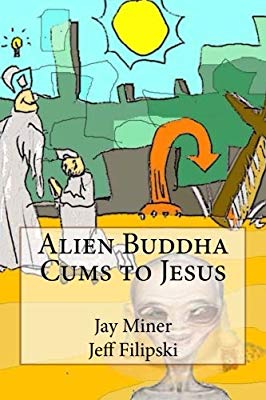
Wombwell Rainbow Interviews: Jay Miner

F WORD WARNING

Wombwell Rainbow Interviews
I am honoured and privileged that the following poets, local, national and international have agreed to be interviewed by me. I gave the writers two options: an emailed list of questions or a more fluid interview via messenger.
The usual ground is covered about motivation, daily routines and work ethic, but some surprises too. Some of these poets you may know, others may be new to you. I hope you enjoy the experience as much as I do.
51S5HbhiMBL._AC_SY400_

Jay Miner

The Interview

1. What were the circumstances under which you began to write poetry?

When I started writing I started by writing fiction. This was right after I graduated high school and started college. At some point in college I took one creative writing class which was largely a waste of time. However, I met a few kindred spirits in that class that decided to start a print lit ‘zine with me and through that process and around that time I started delving into poetry. I think some of the more underground poets that I was exposed to around that time as well as Bukowski and the beats showed me that poetry didn’t have to be what most people think it is – rhyming and all flowery and nice. I began to appreciate the fact that I found this outlet for quick bursts of energy, intensity, anger, sarcasm, etc., etc.

2. Who introduced you to poetry?

As I addressed in the first question, I was always aware of poetry, but there was a time when I had the wrong idea about it. It wasn’t until I met some underground poets and was exposed to a lot of the writers of the beat generation that I came to understand poetry as I understand it now.

3. How aware were you of the dominating presence of older poets?

Very aware. I was a big fan of the beat poets and other poets of that generation. Even though he wrote mostly prose, William S. Burroughs had a large influence on me, maybe more than anyone else. Just the way he bent language and tossed it around like a fucking rag doll. He didn’t give a fuck about the rules. He was very risqué with his subject material and the way he presented it and I really dug that about him. It really opened my mind a lot and changed the way I see writing as well as the world around me. I think some writers can clean the lens of your third eye just as well if not better than a handful of magic mushrooms.

4. What is your daily writing routine?

It varies and depends on the circumstances. Right now I am working on a Novella. Most of it is already written by hand. When I was writing it by hand I had just one rule: write at least a page a day. I usually did much more than that though. Now that I am typing it and editing as I go I try to do it in instalments throughout the day. I find that if it gets too tedious that I can lose some enthusiasm and energy and that will have a negative effect on the writing. So, I am trying to hit it hard and in short bursts: once early in the morning, once toward the end of the day and as many short sessions throughout the day as I can. Once I start losing steam or focus I like to let it lay and simmer for awhile and then come back to it fresh.

5. What motivates you to write?

I enjoy the entire process. You’re creating something from scratch for yourself and others to hopefully enjoy. It’s not unlike a mad scientist in his lab or a chef in the kitchen. But I don’t write flowery horseshit to appease the masses of Pollyanna. I like trying to get under peoples’ skin so when I do get a reaction positive or negative that’s a bonus. I don’t mind pissing people off in fact I rather enjoy it, but when I can find kindred spirits who are into my stuff I enjoy that as well. Mostly I do it for myself. It’s a great outlet.

6. What is your work ethic?

I’m a pretty driven person so my work ethic in general is strong and my approach to writing is no different. However, I would also say that sometimes no matter how bad you want to write sometimes you have to know when to step away and regroup. If nothing is coming or I feel like I’m writing a bunch of garbage I’d rather not write at all than try to force it.

7. How do the writers you read when you were young influence you today?

Burroughs and others from his generation showed me how to let loose and not worry too much about rules or structure and to be open to some pretty bizarre ideas and imagery. A lot of those folks also influenced me to this day with regards to the sound of language in my head. Something may not necessarily make a lot of sense but when I read it back to myself it might have a good ring to it, almost like song lyrics. If that’s the case I’ll often go with it. Just ranting and raving. Diarrhoea of the mouth. It’s how I came up with the term “Alien Buddha.” I had no clue what it meant I just know it sounded cool as fuck to me.

8. Who of today’s writers do you admire the most and why?

There are too many to mention by name, but one thing I can tell you is that most of them are not very well known unfortunately, hopefully at some point that will change for some of them. Certainly there are some good writers with big balls that break through from time to time but I feel like most of the ones that are out there making a big name for themselves are pandering to the average middle to upper class suburbanite slob at airport bookstores and most of what they are pumping out is slop that I wouldn’t line my birdcage with if I had one. One of the benefits of doing Alien Buddha Press and our Facebook group is it’s exposed me to a lot of talented people whose work I admire very much. A lot of good writers and they are writing from the heart. These people are making little to no money and they’re still doing it and will continue to do so because they feel compelled to do so and are passionate about it and I really respect and admire that a lot. Most of the lightweights that I addressed in the beginning of this paragraph would tuck their tails and run away crying if they weren’t famous or well paid anymore. Fuck them. God bless the goddamn underground.

9. Why do you write?

I enjoy it, it can be very cathartic. I enjoy building something of my own from scratch and then showing it to others and seeing their reaction.

10. What would you say to someone who asked you “How do you become a writer?”

I would tell them to go write something down on a piece of paper and to stop asking me stupid questions.

11. Tell me about the writing projects you have on at the moment.

Right now my main focus is finishing this novella that I am currently working on. It’s a pretty twisted tale of a bunch of drug addled cannibal freaks who find themselves among some of the last beings on the planet after an apocalyptic event and their struggle for survival. I already have two more ideas for after that that I haven’t begun working on yet, but I may soon if I need a break at times from the tedium of working on my main current project. One is a third person fiction piece about an amish guy who incurs brain damage and ends up in a psych ward after being hit by lightning and starts to travel the country hacking people up with a machete. Very romantic. The other is an idea I have for a semi-autobiographical story although I may tell it in the third person. Basically, it would detail a lot of the seedier and more painful details of my past especially with regards to struggling with a chemical dependency and some of the crazier shit I got into in Las Vegas as a result of that. Lastly, I am strongly considering putting out a compilation of sorts in the very near future. It would include a re-release of my novelette Bulls in a China Shop along with some old previously unreleased short stories and poems as well as some new stuff. Also, since I like to mess around a lot with photography that would give me the chance to throw some of my photographic work in there too.

Wombwell Rainbow Interviews: Rob Cullen

Wombwell Rainbow Interviews

I am honoured and privileged that the following poets, local, national and international have agreed to be interviewed by me. I gave the writers two options: an emailed list of questions or a more fluid interview via messenger.
The usual ground is covered about motivation, daily routines and work ethic, but some surprises too. Some of these poets you may know, others may be new to you. I hope you enjoy the experience as much as I do.

uncertain times wrap[97044]

Rob Cullen

Rob Cullen studied at Bristol and Cardiff art colleges (1969 to 1973 respectively), lived in New York and Brighton returning to South Wales in 1982. For 37 years he worked with severely damaged and damaging individuals. For the latter 9 years of his career he was an Expert to the Family & Criminal Courts and Higher Courts. He retired in 2012 after suffering severe depression and PTSD.
In 2013 Rob returned to his arts background focussing on writing and photography.
• His short story The Choice was published in the anthology A Fall into Grace. This project involved a day of storytelling in the town of Aberdare in which each writer performed the story at different venues around the town. The anthology was published on 16th December 2015 with a launch at the National Folk Museum of Wales in St Fagans.
• Rob’s first poetry collection “Uncertain Times” was published by Octavo (Accent) in 2016.
• Rob had four short stories published in Ystrad Stories another community project related to the artist Ernie Zobole.
• Rob has completed a psychological novel awaiting publication “Under the Stone Eyes of Mary”.
• Rob is working on a second novel “Imaginary Beaches”.
• Rob’s poetry has been published in the online magazines I am not a silent poet, The Learned Pig, TheBezine, and 2017 & 2018 editions of Red Poets magazine.
• In 2017 Rob collaborated with the artist Jon Pountney on a short film “Beachcombing” exploring the foreshore of Cardiff Bay. Rob’s provided poetry and the voice over for the film which was shown in an exhibition at Oriel Conwy August 2017.
• Rob is looking to publish a second poetry collection “Notes from a small garden”.
Rob has organised “Voices on The Bridge” spoken word and music events in Pontypridd Museum since 2016. He read at Walls: Muriau Welsh Mental Health Arts Festival at the Millennia Centre Cardiff 2016. He read with the Red Poets in the Indyfest, Womanby Street, Cardiff 2017 & Merthyr Rising 2018. He also regularly reads in open mics The Imp, Merthyr Tydfil & The Capel, Bargoed.
http://www.robcullenauthor@wordpress.com
robcullen@celfypridd.co.uk
voicesonthebridge@wordpress.com

The Interview

1. What inspired you  to write poetry?

Song writing and understanding the connectedness between song and poetry.

2. Who introduced you to poetry?

Initially Grammar School.

Reading Yeats aged 12 in school. Growing up in Wales I was aware of Dylan Thomas (winning competition for the cover of a programme for a production of Under Milk Wood). Didn’t like his poetry much. Art College and art history 1969 led to Surrealism and introduction to French Poetry Rimbaud, Paul Valery poetry of Russsia – Pasternak, Block and Achmaktova etc and then Garcia Lorca and thence to  Zen Japan and Haiku. And back again to Heaney.

3. How aware were you of the dominating presence of older poets?

Dylan Thomas, and Louis McNeice/Auden and the War Poets. I was averse to them Ted Hughes above all.
More positively  Imagists and Ezra Pound (Gaudier Breska)  came later. Heaney and early Irish writers, Gary Snyder. Octavio Paz. Federico Garcia Lorca profound interest. R S Thomas. Apollinaire, Neruda and Cernuda.

4. What is your daily writing routine?

Prose writing two hours or two thousand words between 9 and 12.
7 mile walk with notebook and pencil. Return to house and in the evening write.

5. What motivates you to write?

I’ve been artistic since I was very young – visual art which migrated into writing short stories.
My observations through a day over a week. Natural world/an acre garden – social wrongs. Overheard conversations. The influence of a visual art training is never far away – so describing a vista.

6. What is your work ethic?

Its just there. Something I do and can’t imagine anything else.

7. How do the writers you read when you were young influence you today?

I reread them frequently – return to the familiarity of their voices.

8. Who of today’s writers do you admire the most and why?

Gillian Clarke. Christina Thatcher.

9. Why do you write?

It’s part of me of  my creative being. Somethings have to be said and read aloud.

10. What would you say to someone who asked you “How do you become a writer?”

Write at any opportunity wherever you are with a pencil and a hard back good  sized notebook. A4. Just write and read aloud.

11. Tell me about the writing projects you have on at the moment.

Getting a second collection of poetry published – lots of rejection but heartened by a request for a copy to be placed with the Federico Garcia Lorca Foundation Library after they read my tribute poem to Lorca.

Getting a Psychological novel published.
Completing a second novel. (almost cooked).
Compiling a book of short stories.
Compiling a third collection of poetry.

Wombwell Rainbow Interviews: Becky Cherriman

Wombwell Rainbow Interviews

I am honoured and privileged that the following writers local, national and international have agreed to be interviewed by me. I gave the writers two options: an emailed list of questions or a more fluid interview via messenger.

The usual ground is covered about motivation, daily routines and work ethic, but some surprises too. Some of these poets you may know, others may be new to you. I hope you enjoy the experience as much as I do.

Becky Cherriman

Becky Cherriman is a writer, performer and workshop leader based in Yorkshire.

Becky’s first poetry collection “Empires of Clay” was published in November 2016 by Cinnamon Press. Her poetry pamphlet “Echolocation” published by Mother’s Milk in February 2016 was longlisted in the Saboteur Awards 2016.

Becky has written short stories and poetry for commission, performance and publication and was shortlisted in the 2009/10 Fish Short Story Prize. Successes include second prize in the Ilkley Literature Festival Open Mic for Paisley Quilt and first prize in the Speakeasy Open for her poem Namesake. Her poetry has been published by Mslexia, New Walk, Envoi, Mother’s Milk, Bloodaxe, Well Versed, Seren and in “Poets For Corbyn” and “Yorkshire Poetry Anthology”. It has manifested on umbrellas, on the walls of a recording studio, in libretto form and in Italian translation.

Becky was resident poet for Morley Literature Festival in 2013 and lead artist for Altofts Festival In A Day 2016. She is co-writer and performer of Haunt, a site-specific theatre commission for Imove, a project about homelessness that featured material from her, as yet, unpublished first novel.

Much of her time is dedicated to other people’s writing, running creative writing and combined arts workshops with different groups across Yorkshire – a job she adores. http://www.beckycherriman.com/

The Interview

1. What were the circumstances under which you began to write poetry?

As a teenager I had a tough time and began writing poetry as a way of dealing with what was happening to me and to articulate my understanding of the world. Looking back on those early notebooks and the rawness of the poetry on the pages makes me cringe. Still, at least my handwriting was neat! The more crafted my work becomes, the more untidy the writing of early drafts becomes. I wonder if this says anything about creativity more generally or whether it’s just me.

2. Who introduced you to poetry?

Like most people I was introduced to poetry at school. I was lucky in that I had teachers who were passionate about creative writing and encouraged me. My mum went to uni as a mature student and when I was 18 she met her long-term partner who is a big lover of literature. At every spare moment I delved into all the anthologies and collections they had lying around the house and lost myself in them.

3. How aware were you of the dominating presence of older poets?

As an early teen not much! My upper school English teacher didn’t exactly manage to infuse a love of poetry into me or my classmates but in my late teens I started reading more independently. I moved town and, with my new school, I attended an Arvon Foundation Course with Carol Ann Duffy and Liz Lochhead. At the time I was reading philosophy and experimenting with writing surrealistic poetry, which probably didn’t make much sense! Duffy hated it and pretty much told me so in my one-to-one. She said that every line and word of a poem should make immediate sense to the reader. I still don’t agree with her on this – sometimes the best poems are those you need to puzzle over and I’m a big fan of deliberate, considered ambiguity. But it did make me consider the issue of accessibility in my work, a question that is still not satisfactorily resolved for me.

Through English A level (in which I only attained a D due to illness), I discovered Renaissance poetry like Shakespeare’s sonnets, John Donne and Andrew Marvell – I loved their wit and enjoyed T.S. Eliot but it was Dylan Thomas who I fell in love with. It was the lyrical way he used language, his imagery and those big themes of death and growing up and religion. My teacher introduced me to the term pantheism and there was a huge aha moment when I realised she’d named my understanding of ‘god’ although I’d be more likely to use panpsychism or panexperientialism now. I suppose I found my spirituality through poetry and the two have remained inextricably linked. So yes, I was aware of older poets but I found them stimulating and inspiring rather than oppressive.

4. What is your daily writing routine?

I’m always bleating on to workshop participants about how important a writing routine is but I haven’t always been good at keeping to one myself. Most of my living is made from running workshops either as a self-employed writer or in my small role at the University of Leeds as Creative Writing Community Development Officer. There is a lot of planning and reflection involved in this work and an increasing amount of admin and I also have chronic illnesses and some caring responsibilities so I don’t always have the time or the creative energy to write daily. Having said that, last year I set myself the target of writing for an hour daily first thing in the morning and trying to set half days aside for writing when I can. I’ve slipped a little the last couple of weeks but, despite being as busy as ever, I’ve had a very productive year with my writing and I put this down to the regularity.

5. What motivates you to write?

Injustice. Nature. How people relate to one another. Humanism. An inner compulsion. Frustration.

Sadness. Anger. Wonder. Passion. Ideas. Things I don’t yet understand.

6. What is your work ethic?

Throw yourself into everything you do and always go the extra mile for those you work with if you can. Be diligent in everything. Like water you flow into every available channel but sometimes this results in you drying up. You know you should rest more but find that hard when there is so much incredible and exciting work to be involved with.

7. How do the writers you read when you were young influence you today?

When I was 13 I read Oliver Sacks, The Man who Mistook his Wife for a Hat, Eric Berne’s Games People Play and The White Hotel by D.M. Thomas. As well as the poets mentioned above, I also read the Brontes and Plath and all the science fiction and horror stories in Eccleshill Library.

I could talk about how I think they or the books I read in my English degree might have influenced me. But instead I’m going to answer you with a quote from Walt Whitman’s Leaves of Grass. ‘No longer take things at second or third hand nor look through the eyes of the dead nor feed on the spectres in books. You shall not look through my eyes either nor take things from me, you shall listen to all sides and filter them from yourself.’

I’m loathe to identify the precise points of influence because I think that would be disingenuous to my usual process, which is more akin to what Whitman suggests, a kind of creative homeopathy which is free, at least measurably, of the original substance and yet infused by it. Necessarily so perhaps because my memory doesn’t keep hold of precise wordings effectively. I realise that referencing the suspect science of homeopathy is risky but that doesn’t make it less true.

8. Who of today’s writers do you admire the most and why?

This is always my least favourite question in interviews. There are so many. Where do I start? My answer is dependent on what I’ve been reading. Lately it has mainly been novels.

Margaret Atwood – for her incisive commentary on society and damned good storytelling

Arundhati Roy for the same reason

Zadie Smith for her characters

Miranda July for using what could be personality flaws to create a compelling persona that is exactly the right vehicle to deliver her stories, whatever form they take

Eimear McBride for her brilliant energy of form

Phoebe Wallace Bridges for her discomfiting challenging of stereotypes and for creating scenes which are poignant and hilarious at the same time

All the novelists I’ve reviewed on my blog.

When it comes to poets, I’d like to mention those I’m working with at the moment – Sai Murray, Michelle Scally Clarke, Cherie Taylor Battiste and Julie Easley for their bravery in tackling the difficult subject of race from unexpected angles whilst making it entertaining – no easy task. And my critique partner Matthew Hedley Stoppard for his touches of shamanism, acute cultural references and unashamed celebration of the shabbier sides of life.

9. Why do you write?

For the same reasons I did when I was a teenager. Because I have ideas for poems and stories and plays and wouldn’t know what else to do with them. Because there are tales that need telling and new ways of telling them. Because there are so many ways to experiment with language. Because if I go too long without writing I start to get restless and grumpy. Because I have to.

10. What would you say to someone who asked you “How do you become a writer?”

Move to London. A less facetious answer would be: write and read as much as you can. Be open to learning your craft in all manner of ways, including non-traditional ones. Think critically but kindly about your own work. Also, grow used to rejection – you’ll get a lot of it, especially if you don’t live in London.

11. Tell me about the writing projects you have on at the moment.

Together with Michelle Scally Clarke, Sai Murray, Cherie Taylor Batiste, Ricky Venel Stone, Richard Bostock and Julie Easley, I’m working on an exciting literature, spoken word and music show which explores experiences of living with particular skin colours. You can see Words on Skin at the Ilkley Literature Festival on Friday 12th October or Musicport on Saturday 20th October.

I’m also part of a roundtable discussion with Amina Alyal and Lucy Arnold at Ilkley Literature Festival on 14th October to launch the Women Write Now issue of Moving Worlds journal. We’ll read our poems – mine are based on the volunteering I did with refugees in Calais – and discuss the intersections of writing, womanhood and the contemporary moment.

I’m also dabbling in short stories, slowly working towards a collection of poetry and looking for an agent and or publisher for my speculative fiction novel. You can see the problem I have with finding time to rest!

You can see more about my work here: http://www.beckycherriman.com

Wombwell Rainbow Interviews: Lailah Saafir

Wombwell Rainbow Interviews

I am honoured and privileged that the following writers local, national and international have agreed to be interviewed by me. I gave the writers two options: an emailed list of questions or a more fluid interview via messenger.
The usual ground is covered about motivation, daily routines and work ethic, but some surprises too. Some of these poets you may know, others may be new to you. I hope you enjoy the experience as much as I do.
FullMoodCov3

Lailah Saafir

Lailah Saafir was born in Jackson, Mississippi on September 20th. She was raised as a Muslim until the age of 14, then was raised as a Christian. At that time, she began writing poetry. She spent most of her younger years acting in plays and short films. Lailah also did public speaking about AIDS awareness. In her 30s is when she really began writing again. She was inspired by her daughter to write more about her experiences. Lailah currently lives in Arlington, Texas. Her first ebook was published in March 2018, entitled Full Mood.

The Interview

What inspired you to write poetry?

When I was 14 years old, I tried to commit suicide. I didn’t feel like I could really talk about my feelings so writing allowed me to express myself.
Who introduced you to poetry?

My drama teacher introduced me to poetry, allowing me to read Shakespeare, Longfellow and Wordsworth. I was immediately drawn to everything that I was reading. I really just wanted to express myself the way these people were expressing themselves.

How aware were you of the dominating presence of older poets?

I wasn’t very aware of the dominating presence of older poets. It wasn’t until I was in my twenties that I became aware of the presence of older poets.

What is your daily writing routine?

I try to write for at least 2 hours a day. I begin reading, followed by brainstorming, then writing.

What motivates you to write?

Many emotions motivate me to write, including pain, suffering, happiness, and interactions with and observations of other people.

What is your work ethic?

My work ethic includes studying God, nature, and other people. Out of that, I write down what my experiences are and then I try to refine them so that others can relate. Sometimes I have to go over these experiences twenty something times until I find the essence of what I want to share.

How do the writers you read when you were young influence you today?

Maya Angelou influenced me to share the deepest feelings that I have. Other poets who also influenced me, caused me to examine behavior on a deeper level, trying to get to the source of humanity.

Who of today’s writers do you admire the most and why?

I admire Natasha Trethewey because of her vision and her experience with the sides of two races. My daughter is also biracial so this gives me a better understanding of her. Mark Antony Rossi is another writer I admire because he speaks straight from the heart and is very relatable. Scott Thomas Outlar is also a writer I admire, for the fire in his belly.

Why do you write?

I write to keep my sanity. I also write so that I can express myself without being judged face to face. In addition, I write so that I can look back at things and see how far I have come. Lastly, I write to relate to others.

What would you say to someone who asked you “How do you become a writer?”

I don’t believe that you “become” a writer, you either are or you aren’t. That’s not to say that we can’t improve on our writing, but I don’t think it is something you are only taught.

Tell me about the writing projects you have on at the moment.

I am working on another book of poetry and a volume of short stories.


Wombwell Rainbow Interviews: Ralph Dartford

Wombwell Rainbow Interviews

I am honoured and privileged that the following writers local, national and international have agreed to be interviewed by me. I gave the writers two options: an emailed list of questions or a more fluid interview via messenger.
The usual ground is covered about motivation, daily routines and work ethic, but some surprises too. Some of these poets you may know, others may be new to you. I hope you enjoy the experience as much as I do.
IMG_1216

Ralph Dartford

Ralph was founder of spoken word upstarts,  ‘A Firm of Poets ‘ and has been published in the Guardian, Stirring Magazine and WordLife amongst many other publications. His first collection, ‘Cigarettes, Beer and Love’ received wide acclaim and his current touring theatre show, ‘Recovery Songs’ is in high demand.

Ralph is about to start an MA in Creative Writing at Sheffield Hallam.

The Interview

What were the circumstances under which you began to write poetry?

I suffered terribly from dyslexia as a child (I still do, but it’s manageable) and guess I looked at words in a compromised way. I was forever looking at what words sounded like backwards, with a letter replaced by another etc. It was an obsessive pursuit. I also became fascinated by songs and would forever make them up on my own, singing them to myself walking to and back from school, to my baby sister in her pram. My Dad brought me a record player and a copy of ‘Sgt. Peppers Lonely Hearts Club Band’ by the Beatles. I played and played it to death. I was especially struck by the sadness of the song, ‘She’s Leaving Home’, the drama of the narrative. The line from the song, ‘Meeting a man from the motor trade’ always broke my heart (still does). The unknowable knowledge of what is not going to happen to the girl in the song fascinated me. Through this song I became obsessed with stories and began writing them as poems. This hasn’t changed at all over the years.

Who introduced you to poetry?

My English teacher, Mr Samson. He introduced me to literature generally. Especially John Steinbeck, Ted Hughes, George Orwell and Spike Milligan. He was quite a subversive man, a proper old socialist. He was the first person to note my dyslexia and really took his time with me. I am indebted to him and my schoolboy poem, ‘Samson’ is a homage to his enduring influence.

How aware were you of the dominating presence of older poets?

When I went on to study Poetry at Birkbeck College where the great and sadly missed, Micheal Donaghy was my tutor, I became acutely aware of a world beyond my narrow knowledge of Bob Dylan, Wilfred Owen and Charles Bukowski. Micheal had a bewildering brain of poetic history that had me running for cover. I always remember at our first lesson he produced a recording of Alfred Lord Tennyson reciting one of his own poems. I started to become aware that there was more to writing poetry, that reading was of greater importance.

What is your daily writing routine?

I try and write everyday. It could be in a notepad, my phone or computer. I think about writing constantly, looking at ideas, people, situations. I don’t have set times to write, but my head is always doing it. I think that is quite common.

What motivates you to write?

I am compelled to. It’s the only time I am truly contented and connected to myself. That may appear terribly sad, but to me it is a truth. I suffer from anxiety and depression and to write gets me away from that.

What is your work ethic?

To write and read as much as I can. Life gets in the way. Relationships have to be sustained, bills have to be paid and wellbeing has to be looked after. I’m just about to start an MA in creative writing at Sheffield. This will change my work ethic and will be welcome. I think all writers need a certain structure to work in and that increases the chances of becoming a success as a better writer.

How do the writers you read when you were young influence you today?

Politically, I am still influenced by George Orwell, John Steinbeck, Colin MacInnes and the free spirited Beat Generation. These writers left an indelible mark on me.  You may laugh, but before that there was Enid Blyton.  She knew how to construct a story. That is important to me, construction and craft.

Who of today’s writers do you admire the most and why?

I love storytellers, both in fiction and poetry. Kate Atkinson is a wonderful novelist as is Donna Tartt. Both have the ability to craft characters and plots that get inside the story, to make the reader feel. Ian McEwan also has the deftest of touch, the confidence to take the reader on a long ride. I think ‘Atonement’ is a masterpiece. Poets. Simon Armitage is a clever writer. Deeply northern with the ability to be cruel and kind. Imtiaz Dharker is a beautiful narrative poet who gets under my skin. Her collection, ‘Over the Moon’ with its heartbreak, wit and storytelling is a modern classic in my opinion.

Why do you write?

It’s the only thing I can do well. It consumes me on good days. Leaves me in despair on bad.

What would you say to someone who asked you “How do you become a writer?”

I would say that you have to read. You cannot do it without knowledge or technique. You would not drive a car without knowing how it works. The same applies to writing.

Tell me about the writing projects you have on at the moment.

I have a theatre show on tour at the moment called, ‘Recovery Songs’. It’s autobiographical and deals with addiction and mental illness. It’s a mix of spoken word poetry and no nonsense storytelling.

I have recently completed a collection of poetry called ‘Dirty Needle Rain’ and hopefully that will see the light in the next year or so. I’m at the mercy of publishers though. Early signs are encouraging.

I’m also teaching Poetry for the NHS in Leicester and at a rehab unit in Middlesbrough.

But most importantly, I’m studying for a Creative Writing MA in Sheffield. To be around other writers, learning, reading and writing more is probably the most exciting project of them all.

Wombwell Rainbow Interviews: Andrew McMillan

Wombwell Rainbow Interviews

I am honoured and privileged that the following poets, local, national and international have agreed to be interviewed by me. I gave the writers two options: an emailed list of questions or a more fluid interview via messenger.
The usual ground is covered about motivation, daily routines and work ethic, but some surprises too. Some of these poets you may know, others may be new to you. I hope you enjoy the experience as much as I do.
9781911214373 copy 3[98828]

Andrew McMillan

Andrew McMillan was born in 1988.  He is senior lecturer at the Manchester Writing School, MMU. He studied English Literature w/ Creative Writing at Lancaster University, and then an MA in modernism from University College London. As well as poetry, he has written journalism for The Guardian and The Independent and appeared on BBC Radio 3 and 4 (Free Thinking, The Echo Chamber, Front Row, Something Understood)

His first full-length collection, physical, was published by Jonathan Cape in July 2015 and is the first ever poetry collection to win The Guardian First Book Award. The collection also won the Fenton Aldeburgh First Collection Prize and was shortlisted for the Dylan Thomas Prize, the Costa Poetry Award, the Forward Prize for Best First Collection and the Roehampton Poetry Prize.  This follows three highly successful pamphlets, the first of which, every salt advance, was published in 2009 by Red Squirrel Press. A second pamphlet, the moon is a supporting player, was published by Red Squirrel Press in October 2011 and a third, protest of the physical, a single long poem, was published by Red Squirrel Press in October 2013. A selection of his poetry can be found in anthologies such as  The Salt Book of Younger Poets, Best British Poetry 2013 and Best British Poetry 2015. Recent single poems can be found in the Poetry, The Poetry Review and Poetry London.

The Interview

1. What inspired you  to write poetry?

I think, like all writers, it was that I loved reading it. I loved reading it, and wanted to sit inside the poems that I loved as much as possible and wanted to find out how they were having the effect that they were on me. And so I started to imitate and to write and then to keep trying to get better.

2. Who introduced you to poetry?

I was lucky enough because of who my dad is to grow up in a house that was full of contemporary poetry books, so it’s an odd thing in that it was never something I had to be introduced to, as it were, it was just always there.

3. How aware were you of the dominating presence of older poets?

I’ve been really lucky to be part of what feels like a really special generation of young poets who have all come up and started publishing together, which has been really lovely. But I always read and respected the older generations too; I took my cues and my inspirations from the mid-20th century poetry, rather than any of my contemporaries.

4. What is your daily writing routine?

I wish I had one.  I get up at five for the dog, feed her, let her out and then she tends to go back to sleep and I can have a couple of hours of solid un-interrupted time. I don’t write poetry every day, I don’t see how one could, but I try to do something connected to it each day. Editing, emailing, mainly reading other people’s stuff as well.

5. What motivates you to write?

To try and get closer to the thing that it is impossible to articulate in language

6. What is your work ethic?

I work very hard at this, all aspects of it, seven days a week. But I’m lucky that I have my health, a job that provides me enough money to be comfortable, no dependents (apart from the dog); I have a lot of space to indulge my work ethic

7. How do the writers you read when you were young influence you today?

Thom Gunn showed me a queer life could be worth writing about, Selima Hill taught me to have fun, Mark Doty showed me how to find the sublime in the mundane and Philip Larkin taught me not to be afraid of Poetic endings

8. Who of today’s writers do you admire the most and why?

I literally can’t list them all, and I think with questions like this people just end up listing their friends, which seems counterproductive. I will say that Layli Long Soldier’s collection, Whereas, is something quite remarkable.

9. Why do you write?

To make sense of the world

10. What would you say to someone who asked you “How do you become a writer?”

It’s not something you become so much as something which just gradually comes upon you through a love of reading and a love of language

11. Tell me about the writing projects you have on at the moment.

I’m working on a version of Dorian Grey for Proper Job Theatre, and trying my hand at a couple of as-yet-untitled projects.

Wombwell Rainbow Interviews: Deborah Alma

Wombwell Rainbow Interviews

I am honoured and privileged that the following writers local, national and international have agreed to be interviewed by me. I gave the writers two options: an emailed list of questions or a more fluid interview via messenger.
The usual ground is covered about motivation, daily routines and work ethic, but some surprises too. Some of these poets you may know, others may be new to you. I hope you enjoy the experience as much as I do.


Deborah Alma

According to Amazon “Deborah Alma was born in North London, has lived on the Welsh/ Shropshire borders for the last 25 years where she brought up her 2 sons and she lives with the poet James Sheard. She teaches creative writing, works with people with dementia and at the end of their lives and is the Emergency Poet in her 1970 s ambulance. She edited The Emergency Poet-an anti-stress poetry anthology and The Everyday Poet-Poems to Live By (Michael O Mara Books) and was the editor of the landmark #MeToo poetry anthology, published by Fair Acre Press. Her first poetry pamphlet True Tales of the Countryside was published by The Emma Press. She is currently Honorary Research Fellow at Keele University.”

The Interview

1. What were the circumstances under which you began to write poetry?

Oh dear! I think I started to write poetry out of a classic and embarrassing teenage existential angst. I have read poetry all my life, but didn’t really start writing it and being careful with line breaks and what it looked line on the page, or with an imagined reader in mind, until my 40’s when I did a Creative Writing BA at Birmingham University. Before then it was either a feeling of playfulness or necessary in a cathartic sort of way.

2. Who introduced you to poetry?

My much-loved Grandmother, loved to bounce me on her knee to strange nursery rhymes and I loved reading her Arthur Mee’s 10 volume Children’s Encyclopaedia published in the 1950’s which was full of the classics, La Belle Dame sans Merci and Sea Fever and Edward Lear. When I was a young woman, as a bookseller and then working for a publisher we would share poetry books that I brought for her; we loved Dylan Thomas and RS Thomas in particular. My Dad and my Uncles all wrote poetry too, and I think we all got it from her.

3. How aware were you of the dominating presence of older poets?

I was very aware of them; felt often that I was presumptuous to even call myself a poet. I wrote a lot of scraps in notebooks and never typed them up. As a young woman working for Jonathan Cape I almost read too much so that even now I struggle not to be overwhelmed by them. I love the absorbed music in my head though and know that reading is the best route to writing well. Why oh why aren’t I better?

4. What is your daily writing routine?

Can I use one of those rolling around on the floor laughing emoticons?
I am not great with routines. I started writing on Sunday mornings when my children started to lie in as they moved into their teenage years. It was literally the only space I had as a single working parent. Oddly, now that I have more time to write I find that it comes less urgently or easily. That’s a bugger!

5. What motivates you to write?

I tend to write from a sense of something hanging around unexpressed or poorly understood in my own psyche; a strange habit of making connections between apparently unrelated things. The way pain from one thing connects to another older hurt for example. I remember bursting into tears over the death of a much-loved hen and realising I was crying about the Brexit vote and the poem written at that time connects those things.
I really do love the feel of a good black-inked pen in my hand, a new notebook and the almost dream-like state of creating something new. It’s like flight or something a bit wild and uncensored. And there’s pleasure too in the crafting afterwards and seeing if there’s any sense or value in the outpouring

6. What is your work ethic?

For writing? None at all. I could do with one. Where can I get one?
Outside of that, in my employed work, which now luckily enough is in the world of writing; in teaching and editing and ‘poetry on prescription’ it’s a deep-rooted working class get on with it and work hard.

7. Who of today’s writers do you admire the most and why?

Admire is a tricky word . And this question is too enormous !
I admire a lot of the writing of women in particular, those who have written out of the domestic, or the apparently small stuff of the everyday and seen it as beautiful or fascinating. I would name Jane Burn, Wendy Pratt, Angela Readman, Liz Berry, Helen Ivory, Kim Moore, Jacqueline Saphra, Nicky Arscott amongst those. They all have a sense of the surreal which I’m particularly drawn to as well.
I also really admire poets who are open and receptive to learn and develop; I’ve loved watching my friend Pat Edwards do this over the last few years- and I admire my friend Meg Cox for her out of this world simple-seeming poetry and perfect delivery when she’s performing her work. I admire the work of Brett Evans and the carefully managed thin-line between ugly and beautiful and the art of self-deprecation.
I started to type more and realised that the list would go on and on, so I’ll stop there…

9. What would you say to someone who asked you “How do you become a writer?”

I say to them, go on then and have some fun with it. Get some peer review set up, through a course or a writer’s group. Read, read and then read. And then write. And keep reading. Nothing gets on my nerves more than people who say they are writers and don’t take the time to read the work of others. Not just for the short-sighted lack of educating yourself, but also for the lack of generosity to those in the community of writers.

10. Tell me about the writing projects you have on at the moment.

I have returned from 3 weeks in the north of Norway, ostensibly to read and write and maybe think about actually working on a second collection, but I was very disappointed in myself and have terrible self-doubt all over again.
My creative energy is all going into the possible development of a writing retreat/poetry centre in my home town of Bishop’s Castle in Shropshire which will develop my Emergency Poet ‘poetry on prescription’ project much further.

Thank you so much for being interested and for the opportunity to answer your questions!

Wombwell Rainbow Interviews: Ruth Aylett

Wombwell Rainbow Interviews

I am honoured and privileged that the following writers local, national and international have agreed to be interviewed by me. I gave the writers two options: an emailed list of questions or a more fluid interview via messenger.
The usual ground is covered about motivation, daily routines and work ethic, but some surprises too. Some of these poets you may know, others may be new to you. I hope you enjoy the experience as much as I do.
51DljOan1pL._AC_US500_QL65_

Ruth Aylett

Ruth Aylett lives in Edinburgh where she teaches and researches university-level computing. She was joint author of the pamphlet Handfast, published in 2016 (Mothers Milk). One of four authors of the online epic Granite University, she performed with Sarah the Poetic Robot at the 2012 Edinburgh Free Fringe. She has been published by The North, Prole, Antiphon, The Lake, New Writing Scotland, South Bank Poetry, Envoi, Bloodaxe Books, Red Squirrel Press, Doire Press and others.

The Interview

1. What inspired you to write poetry?

I don’t really know. Maybe nursery rhymes. I wrote poems when I was a child. I remember writing a piece when I was about 9 in which I had a squirrel leap into his leafy realm – and was very put out when my parents explained it was not pronounced re-leam. I’d wanted it to rhyme. Still, that was my intro to half-rhyme.

2. Who introduced you to poetry?

I’m guessing it was my parents, most likely my father. He would recite poems. I particularly remember Blake’s Tyger, which really entered my imagination. ‘Burning bright/ in the forests of the night’ – how gripping is that! When I was 13 I bought myself a collected poems of Yeats with a school prize, and read it obsessively. I decided I liked Yeats and did not like Keats, Shelley, Tennyson, Wordsworth and all that Victorian stuff. Somewhere around then, my class had to take its turn  doing a poem in School Assembly, and our English teacher suggested we do Rupert Brooks. I was so disgusted by his view of WW1 that I ferreted out a Wilfred Owen and got my classmates  to agree we’d  do that instead. And of course that meant I had to do the reading.

Then I got the Faber Book of Modern Verse. I remember bending my younger brother’s ear when I was 16 or 17, insisting he listen to me read The Wasteland out loud in the kitchen (for some reason this didn’t turn him on to poetry). I got Louis MacNeice’s Collected Poems and typed out the whole of Autumn Journal for myself.

3. How aware were you of the dominating presence of older poets?

I never saw it like that. When I found stuff by existing poets I liked, I was delighted. And then there was a lot of stuff by famous poets I didn’t like at all. I was about 17 when the Liverpool Poets burst into life and for a while poetry readings became as popular as pop music. I got myself the Penguin Mersey Poets book and was knocked out by Brian Patten’s ‘I’m dreaming of a white Smethwick’, about a racist bye-election campaign there, with its ‘allwhite allright children and the white and white minstrel show’. This wasn’t domination, it was inspiration.

4. What is your daily writing routine?

I am not a full-time writer. I actually work as an academic in Computer Science, which has its own fascinations.  So I write around various other commitments. We had four kids as well, with the two youngest twins, so there was a period of more than twenty years when I wrote very little.

5. What motivates you to write?

The need to communicate something, to capture an idea, a feeling, something I’ve seen or heard. Or a phrase comes into my mind and I want to add things to it. And it’s a way of making sense of the world, of grabbing a piece of it and making it mine.

6. What is your work ethic?

I was in Jo Bell’s 52 project on Facebook in 2014 and that improved my work ethic no end. I got used to writing much more quickly, and even now I try to produce a poem a week, with reasonable success. I have also written short stories and I am on the last stretch of my second novel (‘Angels of Alba’), so I move from one thing to another. The novel is currently grabbing my attention a lot as I am on the last lap and it’s calling out to be finished.

7. How do the writers you read when you were young influence you today?

I sometimes hear them in my head when I am writing. This isn’t necessarily a good thing, since I don’t want to write just like them. But when I wanted to write a piece about robot drones, Yeats’ ‘An Irish Airman Foretells his Death’ leapt into my mind and I just couldn’t avoid making my piece a parody (‘A robot drone foretells your death’ – Yeats would not have been amused) . MacNeice throws phrases into my pieces all the time, but I often try to take them out again.

8. Who of today’s writers do you admire the most and why?

I like Don Paterson because I have a continuing sympathy for form, for metre and – unfashionably – for rhyme or at least for half-rhyme. I like John Glenday’s compression and elegance. My ideal of poetry is something that is muscular and more than purely descriptive. I like Adrienne Rich (she was a today’s writer until six years ago, how time flies)  for marrying poetry and feminism, and Tony Harrison for taking poetry into the wide world and engaging with what is happening out there. I like Jo Shapcott because she writes about unusual topics, and especially science, since I write about that too. I like Helen Mort, partly because she sometimes writes about Sheffield, a place I once lived in and for which I retain a lot of affection.

9. Why do you write?

Well, see what I said about motivation. I write because the voice in my head says I must.

10. What would you say to someone who asked you “How do you become a writer?”

First, just write lots! You have to do it to get better. If you write, you are a writer. If you write poems, you are a poet. But also, read lots. You need to know what people have tried, what you think works and what doesn’t, what is going on out there. You can always tell when you read stuff by people who haven’t read anything.

Sometimes when people ask that question, what they really mean is ‘how do you become a professional writer?’ I am not one, so they might want to ask someone that is. I observe though that very few writers make a living out of it, and certainly not poets. They are all doing other stuff  to put bread on the table– running workshops, teaching, being academics, acting as reviewers, performing.

11. Tell me about the writing projects you have on at the moment.

Well, there is the almost finished novel, Angels of Alba, which you might say is the Iraq war in an alternative Edinburgh with extreme Presbyterians as the religious element. I am on chapter 28 of what should pan out at 32. Then I revise the first draft and try to get someone interested in publishing it. This is my second novel in fact: the first one Collateral Damage, was about a murder and political intrigue in a local authority not a million miles from South Yorkshire. I was pleased with it in the end but my father’s critical comment stuck: ‘Very good, well-written. But who wants to read about that?’

Then I am writing an homage to MacNeice’s Autumn Journal called Autumn Blogging, which I am hoping will eventually get to pamphlet length. I am seven pieces in with this and my plan suggests twelve, so more than halfway through.  Other than that, I have been assembling various single-author pamphlets without as yet getting a taker, though I have been highly commended and shortlisted in various competitions. I also have an idea for a sequence called The Singularity about artificial intelligence and robots (I research these fields in my academic life).  But that’s on the back burner right now.

Thankyou to Visual Verse for publishing my ekphrastic poem “Jo Needs”

Thankyou to Visual Verse for publishing my ekphrastic poem “Jo Needs”

https://visualverse.org/submissions/jo-needs/

Wombwell Rainbow Interviews: Ryan Quinn Flanagan

Wombwell Rainbow Interviews

I am honoured and privileged that the following writers local, national and international have agreed to be interviewed by me. I gave the writers two options: an emailed list of questions or a more fluid interview via messenger.
The usual ground is covered about motivation, daily routines and work ethic, but some surprises too. Some of these poets you may know, others may be new to you. I hope you enjoy the experience as much as I do.

512pZr9SOeL._AC_SY400_


Ryan Quinn Flanagan

Ryan Quinn Flanagan is a Canadian-born writer presently residing in Elliot Lake, Ontario, Canada with his wife and many bears that rifle through his garbage.  His work can be found both in print and online at many cool joints such as: Ariel Chart, The Rye Whiskey Review, Under The Bleachers, Outlaw Poetry Network, Evergreen Review, Cajun Mutt Press, and The Dope Fiend Daily.  His personal website is: http://ryanquinnflanagan.yolasite.com/

Personal website: http://ryanquinnflanagan.yolasite.com/

Links: Poem to Knock the Sun Out of the Sky: https://www.amazon.com/Poems-Knock-Sun-Out-Sky/dp/1948920069/ref=sr_1_5?s=books&ie=UTF8&qid=1537646963&sr=1-5&keywords=ryan+quinn+flanagan
Copious Amounts of Nothing: https://www.amazon.com/Copious-Amounts-Nothing-Quinn-Flanagan/dp/1724874284/ref=sr_1_7?s=books&ie=UTF8&qid=1537647188&sr=1-7&keywords=ryan+quinn+flanagan

The Interview

1. What inspired you to write poetry?

For me there was no single inspiration.  It is much more of a compulsion.  I’ve just kind of always done it since about the age of ten onward.  No specific reason or subject matter, I just kept doing it and haven’t stopped.  I feel much more comfortable expressing myself through writing than I do in day-to-day conversation or other social interactions.  I’m quite the shut-in and introvert in many ways so writing offers a way to express myself that is fairly anti-social.

2. Who introduced you to poetry?

I guess that would be the public school system.  Within months of switching schools, my new school made you do two types of public speaking as a way of promoting socialization and communication skills.  The first was speeches which you had to do in the first half of the school year and the second was poetry.  Each student had to stand up in front of the class and recite a poem that had to be longer than 2 minutes in duration.  Your classmates marked you on such things as: verbalisation, eye contact, clarity etc. and the teacher also marked.  It was truly terrifying!  Most students went to the library and found a poem to memorize and recite.  I was the only student who wrote my own.  It never occurred to me to just go find one.  I am slow to everything.  They made us do this each school year.  I just kept writing new ones each year and even when the school didn’t ask me to do it anymore.

3. How aware were you of the dominating presence of older poets?

Not that much until I went to university.  Before that, I had read some Leonard Cohen and other things such as Siegfried Sassoon’s first world war trench poetry and some Auden, Roald Dahl, Dr. Seuss and Shel Silverstein.  But I really was a true novice in such things and almost completely unaware of what was really out there.  I just stumbled along with my own thing and worked back breaking jobs.  At university, I spent my nights in the library there and read everything I could get my hands on.  Not just the poems themselves but on the lives of the poets and various philosophies and artistic movements behind them.  Each offering seemed to open so many new doors.  I did that for four years, making friends with the security guard at the library because I pretty much lived there during that time.  It was amazing to see all the things I really had no idea about.  My education really had nothing to do with the classroom.

4. What is your daily writing routine?

When I have an entire day to write, I don’t shower.  I want the dirt of living on me and I want to feel it.  I make some oatmeal and listen to music before heading upstairs pouring some wine or beer and putting on some classical music and writing for about six or seven hours.  I often have no notes or idea of what I will write about.  I just zone out and clack away.  I am usually pretty sauced by the time I am finished but the poems are there.  Usually 20-25 on a good day.  Then I make a late dinner and watch some television before going to bed.  I repeat the process as many times as I can throughout the year, almost always eating the same thing and going through the same process.  The rest of the time, life invades and very little writing gets done.  I have always written in spurts when I can find the time.  I used to write late at night, but now it’s more in the afternoon and early evening.

5. What motivates you to write?

As aforementioned, it really is much more of a compulsion for me.  So nothing really motivates me to write.  I do enjoy seeing what my friends and other writers are doing though.  I always find that interesting and inspiring.

6. What is your work ethic?

I try to make as many days as I can clear for writing.  Then I drink and write.  When I feel I have enough poems to construct a book, I print them out and see what I have.  Then I build the book as if I were constructing a concept album.  Music has always been such a big influence for me.  I loved all those great album covers growing up and listening to the music and reading the liner notes.  I treat books the same way as I do albums.  I try to create something that pops like all those great albums from my childhood used to do.

7. How do the writers you read when you were young influence you today?

Early on it was a lot of Dr. Seuss and Shel Silverstein and Roald Dahl.  Both Huxley and Orwell were a huge influence on me in my teens.  I read them as warnings about both technology and human nature.  Along with William Golding and Salinger as well.  Then I found the Romantics and the Beats and enjoyed their musicality of language and image.  Then the more realist writers such as Bukowski and Fante provided a much more assessable and relatable form of writing.  I’ve always been heavily influence by strange writers or stories though.  Jules Verne and Isaac Asimov were huge, along with Kafka and Edgar Allan Poe’s strange stories and Richard Brautigan’s humour along with bp nichol and e.e. cummings experiments with form.  And William Blake’s art and Emily Dickinson and so many others!  All these things have created a hodgepodge that has influenced me greatly.

8. Who of today’s writers do you admire the most and why?

Oh, there are just too many cool writers out there at the moment to name here.  We’d be here all day.  My boys at the Frat are doing amazing things, but yeah, there are so many people out there right now that the future looks bright.  And not just for writers, there are so many fantastic fine artists and publishers out there really pushing things along.  Even a few columnists doing great things.  The wealth of stuff out there at the moment is great to see!  So many people out there creating is an amazing thing to me.  I try to support them in any way I can and I know many others who do as well.

9. Why do you write?

Just a compulsion for me.  Even when I am not writing poems, I am always scribbling on oatmeal packets and spiral notebooks and making lists and observations and such.  I just scribble over everything, always have.

10. What would you say to someone who asked you “How do you become a writer?”

Just be yourself and try to find your own voice and way.  When you start out there will be some mimicry, but as you go along more of yourself should reveal itself over time.  Trust your instincts and don’t let others tell you how to write or what is acceptable to write about.  Go for broke and do not be afraid to experiment, try to surprise yourself.  If you can still do that, than you’re doing alright.  Besides that, just sit down and write.  That is the only way it will happen.  All the rest of it is secondary to sitting down to the actual act.  Bang those keys as much as you can and just let it come.

11. Tell me about the writing projects you have on at the moment.
Many writing projects on the go at the moment, I am always working on something.  I find it is good for me to stay busy.  Currently, I just released a new book with Pski’s Porch titled: Poems to Knock the Sun Out of the Sky.  New collections while Weasel Press and Marathon Books should be out in the coming weeks titled: In Winter’s Dreams We Wake, and Once Around the Maypole, Twice Around the Sun respectively.  I am also working on a new collection of short stories with super talented artist Marcel Herms for Alien Buddha Press.  We are just creating and putting it together now.  Marcel and I are also working on broadsides with John Robinson and a split chapbook early in the new year.  Probably about nine or ten other projects on the go as well with various fine artists and publishers.  I like to stay busy.

Thanks so much Paul!