Wombwell Rainbow Interviews: Ernest O. Ògúnyemí

Wombwell Rainbow Interviews

I am honoured and privileged that the following writers local, national and international have agreed to be interviewed by me. I gave the writers two options: an emailed list of questions or a more fluid interview via messenger.
The usual ground is covered about motivation, daily routines and work ethic, but some surprises too. Some of these poets you may know, others may be new to you. I hope you enjoy the experience as much as I do.
Ernest


Ernest O. Ògúnyemí

is an eighteen-year old writer and spoken word artist from Nigeria. His works have appeared/ forthcoming in: Kalahari Review, Litro ‘Comedy’ Issue, Lucent Dreaming, Low Light Magazine, Canvas Lit Journal, Agbowó ‘Limits’ Issue, Erotic Africa: The Sex Anthology, and elsewhere. He is a 2019 Adroit Summer Mentee, and a 2019 COUNTERCLOCK Arts Collective Fellow. In 2018, he won the Association of Nigerian Authors NECO/ Teen Prize for his manuscript of short stories, “Tomorrow Brings Beautiful Things: STORIES“. He is currently working on his first novel.

The Interview

  1. When and why did I start writing poetry?

I started writing poetry when I moved from Lagos – that mother with too many children, that one city that is packed with all kinds of people and things, that is loud in all forms: speakers blaring ” shepeteri” (street) songs, pastors filling mics with tongues that feel as ragged and unrefined as the many screams of cars and “danfos” and “okadas”, the smooth voices of muezzins calling Muslim brothers and sisters to salatt, matched with the voices of a new crop of evangelists who do the work of God with megaphones – to Abéòkuta. Abéòkuta is the very opposite of Lagos. In Abéòkuta, I met calm – the calm of a river untouched by the wind in fact.

This change of place brought me to solitude, and it was my aloneness that brought me to the page. I came to the page to express all that I was feeling, that I had no one to talk to about. And, at the time, I had some real questions about God and Fate and Destiny and Culture, so I asked those questions on the page.

I was sixteen or so.

2. Who introduced you to poetry?

Somehow, a teacher.

When I was in Lagos, there was this festival that gave space to students to present dramas, songs, and dramatic poems (presentation of a poem accompanied by drama). It was also a competition. Our school was invited, so a teacher, one of my English teachers then, (I don’t remember her name right now) – she asked me to write a poem. I didn’t. She wrote the poem and gave it to me to present.

I recited the poem at the audition, with the cast dramatising. Though we didn’t get to perform at the finale, we were awarded the fourth position at the finale.

When I moved to Abéòkuta and there was a competition for dramatic poems, I presented the poem with a cast made up of students from my new school (I directed the drama). Funny, but we won the competition with that poem.

After sometime, I started writing poems, too. I stuck them to the small notice-board where nobody read them – nobody but me.

Soon teachers started noticing what I was doing, and, while they didn’t introduce me to poetry or groom me, they made me love what I was doing.

After sometime, I met someone who first taught me certain basic things about poetry. His name is Ayoola Goodness, author of “Meditations” (one of the very first collections I read that influenced me at the very early start of my poetry-journey).

3. How aware are, and were, you of the dominating presence of older poets, traditional and contemporary?

I would say, at the start of things, when I first began writing poetry, I was more conscious of older poets—the traditional ones. This was because the poets we read in Literature Class, the poems on the syllabus, were poems by old traditional writers—George Herbert’s “The Pulley”; Lord Alfred Tennyson’s “Crossing the Bar”; William Blake’s “Schoolboy”; Robert Frost’s “Birches”; and, of course, Shakespeare’s “Shall I Compare Thee to a Summer’s Day.” We never read any contemporary poet. Even the African poems we read were by old poets, the custodians; the likes of Christopher Okigbo and Lenrie Peters.

The other reason I was more aware of older, traditional poets was that the books I had access to were the old books, the ones by older, traditional poets. There was nowhere I knew where I could buy the new books—where I stay presently, there’s no bookshop selling new books (there is more than enough in Lagos though, an hour’s ride from her); there are only two or three men who sell old, still covered, sometimes tattered, books by the roadside. It was from those men that I bought the books that introduced me to poetry, the traditional poetry by Emily Dickinson and Matthew Arnold and other traditional poets. It was also from one of them that I bought The Complete Works of Shakespeare, a big book containing all of Shakespeare’s works with green hardcovers with the titled engraved in golden letters on the front cover. The African poets I met, too, in anthologies weren’t contemporary, and, yes, they weren’t traditional poets either; they were just old poets.

I didn’t know any contemporary poet until I met works by new Nigerian writers, who, though writing in this time, would still fall under the category of old poets. There was no innovation to their poetry, but for the works of a few of them. One of the few was Ayoola Goodness’ Meditations, a poetry collection that shifted my eyes away from the traditional poetic form to something somewhat new.

However, it was until I, by chance or fate, picked up a Pushcart Anthology at one of the bookstalls by the roadside that I began to see what poetry could be—fluid, like water. But then, the Pushcart Anthology was published in 1993 or so, so it was still the old kind of poetry in a way. I remember writing a poem after one of the poems in the anthology, which was titled ‘Green’ and was written by an eighteen-year old Canadian writer. When I submitted what I’d written, inspired by ‘Green’, I got a rejection where the editor mentioned that the form was old.

When I began playing around with my dad’s phone, in late 2017 and early 2018, I began to witness wonder, in poetry. I read every poem I could find online, and I really fell in love with Danez Smith, and, very recently, Tianna Clark and Ocean Vuong. I also remember buying a copy of both the translation and original of Neruda’s The Captain’s Verses; it changed my life. A Feast of Return by Odia Ofeimun did a lot for me, too.

Today, I’ll say I’m fascinated by both poets. Though I read more contemporary poets, I do read older, traditional poets, too, because I need them both as ancestors on this path, as guiding lights on this journey.

3.1 How did “Neruda’s The Captain’s Verses and Feast of Return by Odia Ofeimun” change your life?

Before reading those two collections, I had read no poetry collection at all; but I had read a few poetry anthologies. One of the anthologies I read was “An Anthology of African Poems” whose editors I can’t recall now. The anthology included poems from the oral Yoruba poetry to Taban Lo Liyong and Niyi Osundare and Fusho Ayejina. And those poems were helpful.

However, it wasn’t until I read Odia Ofeimun’s “A Feast of Return” that I really felt a strong connection to poetry. There were times I sat outside and read the collection out loud, imitating the voices of all the characters in the poetry book. Whenever I finished reading, it felt as if somebody had immersed me in water and brought me out refreshed. I just felt light. The effect it had on me is quite similar to the effect weed has on people.

“A Feast of Return” had a freshness of imageries and an Africanization of poetics that made it beautiful and accessible. Also, because it was a communal kind of poetry collection (a dance drama in poetry), I felt as if I was a part of community, a part of the South Africans who were fighting apartheid. I don’t know, it just spoke to me. It still does.

On the other hand, Neruda’s “The Captain’s Verses” was a revelation. Reading that collection made me understand that poetry doesn’t have to be complex to be poetry; it could be simple and yet powerful.

Though the poems were love poems, I still connected to them. And the recurrence of certain imageries – earth, flowers, rivers – in the collection was something that stuck with me.

The collection also helped me understand that poetry is a thing of the heart first; the heart is the important thing. That a poet can write about the most mundane things in this world, the things that go unnoticed by the human eyes, and those things would be beautiful and become things we find very hard to forget – the only thing is, whatever you’re writing as a poet, let it matter.

3.2. What do you mean by “Africanization of poetics”?

What that – *the Africanization of poetics” – means is, “A Feast of Return”, for me, is poetry that is African in every way I know: the language, the voice(s), the characters, the imageries. It felt as if the collection was written in a particular African language first, and was later translated into English. But that’s not really true. Odia Ofeimun wrote it in English, but because the story the book tells is first an African story – a story about the struggle against apartheid in South Africa and about Africa – there is a way he Africanized his poetry. For example, the poetry is really oral poetry and is meant to be performed, though it is written. In fact, Odia Ofeimun makes notes on how it should be performed at the end of the book. So, maybe it is “the Africanization of poetry”, instead of “the Africanization of poetics”.

Note that before “A Feast of Return”, I had encountered other poems that were written in English but were African (Woke Soyinka’s “Abiku”, most of the poems written by Kofi Awoonor, the poems of Niyi Osundare, among others) – but in “A Feast of Return”, it was extended.

4. What is your daily writing routine?

Do I have a writing routine? I don’t think I do. I just know I write, and I do that every day. No day goes by that I don’t write something, even if it’s trash.

I write mostly at night, especially when the day is very tight for me. Or some times, very early in the morning.

Still, I won’t say I have a writing routine. I just write. However, that I don’t have a writing routine does not mean I write whenever I feel like, I write even when I don’t feel like.

5. What motivates your writing?

My motivation varies. Sometimes it’s the want to record a moment; at other times, it’s a story asking me to write it. But then, there is the joy that I feel when somebody reads my work and connects with it, when my name is there on the cover of a literary magazine. So, yes, those are motivating.

However, my greatest motivation is survival. I write to survive. If I get not to write again, I will most likely die. So, when I think of survival, I think of my writing. It’s all I have.

6. How do the writers you read when you were young influence you today?

I’m still very young, so I’m still reading and I’m still influenced by what I read. However, the works I read before I even thought of wanting to write anything – books by Frank Peretti, Ted Deker, C.S. Lewis, Charles Dickens, and a lot of children or YA books written by Nigerians and Ghanaians – made me believe in a different world from this; they helped my imagination. I don’t think there’s more that I learned from those books asides that, and that, the broadening of my imagination, is one of the reasons why I am a writer today.

6.1. What “children or YA books written by Nigerians and Ghanaians” broadened your imagination?

I can’t remember any specifically. Those books were tiny story books that were self-published by the writers. They weren’t even so well-written, but they were interesting. I don’t remember any now.

7. Who of today’s writers do you most admire, and why?

I don’t think there’s a specific writer writing today that I admire the most, but there are a whole lot that I really admire – and for different reasons.

I admire Ocean Vuong for his poetry. There’s a way his poems reach out to me, even though some of the themes explored on his works are not directly themes I can relate to. (I’ve been reading his poem “Someday I’ll Love Ocean Vuong” every day for the past few days.) More than that, I admire him for who he is. I don’t know what it is specifically about him that I find interesting – I mean, he is Vietnamese-American, I am Nigerian; he is gay, I am not. But there’s something to him, a kind of simplicity to his personality that I find interesting. And, maybe because my mother was also illiterate and could speak no English, and because of the kind of feeling I got from knowing there was a time he had no place to stay and was sleeping in Penn stations.

8. What would you say to someone who asked you “How do you become a writer?”

Lol. I’ll probably suggest reading “How to Become a Writer” by Lorrie Moore, but don’t mind me, I won’t. I think I don’t know how people become writers, but I guess it all starts with reading. If you read so many stories, you get to some point where the stories you read either bore you or appear to not be what you really want to read. Because you are not getting what you really want from the stories you read, like Achebe once said, you write your own.

9. Tell me about writing projects you are involved in at the moment.

A few. I’m curating an anthology of poems by young African poets between the ages of 15 and 19. I just won a small grant to start the first literary magazine for young African writers and artists. I should be writing my novel but I’m too lazy I guess. I’m also looking at writing a chapbook. And, as always, I’m making art and sending work out.


Wombwell Rainbow Interviews: Jane Sharp

Wombwell Rainbow Interviews

I am honoured and privileged that the following writers local, national and international have agreed to be interviewed by me. I gave the writers two options: an emailed list of questions or a more fluid interview via messenger.

The usual ground is covered about motivation, daily routines and work ethic, but some surprises too. Some of these poets you may know, others may be new to you. I hope you enjoy the experience as much as I do.

Jane Sharp

Jane Sharp has been called a surreal writer. She freely admits to inhabiting other worlds from time to time. When she is not writing she enjoys playing the piano and the cello. Her home is in Yorkshire where her roots run deep. She also has a passion for dark chocolate.

Jane’s Blog: https://www.janesharp.org

Higgs Bottom: https://www.amazon.co.uk/dp/B07WLVTQP6

The Interview

  1. What inspired you to write poetry?

I began wanting to write verse as a young child, by entering competitions in the comic I took every week. I never won anything, but I was inspired by the fact that somebody did. Add imagination and a competitive spirit, plus a great deal of parental praise, and like a rosebud my passion for poetry began to blossom.

  1. Who introduced you to poetry?

Moving past the nursery rhymes of my childhood, I was first introduced to verse by the elders of the Methodist Chapel in Long Preston. As a part of the annual anniversary service I had to learn a few lines to recite along with other children of the Sunday school. At junior school I moved through the nonsense poetry of Edward Lear, The Owl and The Pussycat, A. A. Milne ‘Where the Wind Comes From… ‘ etc into the realms of Walter de la Mare, and I found myself in the throws of GCSE exams, being taught by a young, just out of college teacher, Mr Jackson, who, in his first teaching position, turned up at school with a Beatle haircut and a snazzy jacket. I thought he was the ‘bees knees,’ and consequently went all out to impress him. He encouraged me to let my imagination go wild, and seemed to appreciate my efforts at story telling and writing poetry. I even wrote a play, ‘Oedipus,’ which I have kept to this day. I would say, he was the one person who cultivated the opening rosebud with his enthusiasm for literature, and his praise of my immature efforts.

  1. How aware were you of the dominating presence of older poets?

By older poets, I take you to mean poets of past times, such as Wordsworth, Keats, Byron, etc. Having a general education, I was introduced to these poets at an early age. I still have my copy of The Golden Treasury, from my school days. As far as being aware of their dominance, I did not think of them in that way. I did not have a choice in the matter and was simply fed whatever the curriculum deemed appropriate. Fast forward to the present day, and I am happy to have been introduced to those heavyweights, just as I am happy to have been able to study the works of the war poets, and in more recent times, Ted Hughes, Sylvia Plath, Matthew Sweeney, Yevgeny Yevtushenko, and so many more excellent poets.

  1. What is your daily writing routine?

The words, ‘daily routine,’ imply that I do something at the same time every day. For me, writing poetry is not like that. I sometimes wake up with a poem in my head, or at least a couple of lines, in which case I jot it down straight away. I always have a pen and notebook on my bedside table. I have been known to catch a line or two whilst swinging the vacuum around, or pegging the washing on the line, or even whilst waiting for a bus, but there is no daily routine. I do, however, make sure that I read at least one poem every day, and this can be first thing in the morning, or last thing at night. Of course the novel writing is more like a nine to five job when it is in full swing.

When I am in writing mode I can sit and work on a poem for days until it is finished, and even then come back to it a week later and make revisions, and that might not be the end of it. Unless I have a deadline there can be constant additions or subtractions before I am satisfied with the result. But generally I will have a sound outline in one or two days.

  1. What motivates you to write?

Motivation: that great, unseen push. Well, it isn’t money, that’s for sure. I write because I want to write, because I have all these words spilling out of my head that are just looking for a home. They want to manifest, they need a physical form; they are ideas, which need to be spoken out loud, stories that don’t want to sit in the void, and characters that are banging on my skull to let them out.

Of course, deadlines for magazines, spoken word events, poetry society meetings, are all great motivators, and they bring focus and an intellectual approach to my writing. Being given a subject to write about is never as easy as going with the flow, but it is possible to stoke up passion for the unlikeliest of themes, such as ‘warts’ for instance, the subject of one of my poems.

  1. What is your work ethic?

‘Just do it!’ I can be as lazy as the next person, but I know that if I don’t get off my backside and do something, it doesn’t get done. There is a time for work, and a time for play, but there is no ‘set’ time for either.

  1. How do the writers you read when you were young influence you today?

A perfect example of this is when I began to write my latest novel, Higgs Bottom. The main character is a 13-year-old schoolboy. I had in mind Jim Hawkins from Treasure Island, and I did my best to channel him. It didn’t work. The way a schoolboy of today speaks is far removed from the way a young cabin boy would have spoken in 1756. Yet the idea of a first person narration did come from my childhood memories of Treasure Island. My reading of Alice in Wonderland has influenced my writing greatly; I take the philosophical ideas, and the bizarre imagery from such books.

  1. Who of today’s writers do you admire the most, and why?

I have long admired the accessibility of poems written by Simon Armitage. His use of form is a joy, and his vocabulary hits the spot. He can be humorous whilst at the same time very serious. And, of course, he is from Yorkshire, and like all good Yorkshire people I support members of the clan, so to speak.

I also like the poetry of Isabel Bermudez, who I think is a rising star. I find her poems to be soothing, and thought provoking, and full of imagery.

  1. Why do you write as opposed to doing something else?

Well, I do have many other things to do, such as practicing my cello, or the piano, or even reading, in fact I would say that reading is just as important to me as writing. And I have to make time to do all of these things. But I’m not the sporty type, I can’t sew, I avoid baking because that would mean I would have to eat too many cakes and biscuits, my grandchildren are grown up, therefore there is no babysitting, and I am retired from work, and, and this is a big and, I enjoy writing. I enjoy creating a poem, or a story, and what’s more I enjoy performing and making people feel emotion, whether it be laughter or tears.

  1. What would you say to someone who asked you “how do you become a writer?”

This is an easy one. How do you become a writer? You write: you write every day. You write down what you hear people say, you write down what you see, you write down what you smell, and you write down what you feel. And then you write down what you think.

  1. Tell me about the writing projects you have on at the moment.

I have just wrapped up my second novel, Higgs Bottom. It is now available on Amazon as a Kindle download, or as a paperback book. It has taken me several years to complete, and I am very proud of the finished work. Higgs Bottom is my second novel, the first being Tears from the Sun – A Cretan Journey. So, now I have to announce to the world that their copy is just sitting there waiting for them to snap up. It is a book for all ages, and here is a spoiler – Higgs Bottom is a place, not a bottom. I hope to write a follow up to Higgs Bottom, but I have a work in progress, which may take precedence.

I have also been working very diligently on a poetry collection, which is now complete and should be published before October is out. I have called it Scary Woman – A poet in Barnsley, and it is an eclectic mix of personal, serious, erotic and humorous poetry. I have to add that my husband, David, is such a great help in all my endeavours.

Wombwell Rainbow Interviews: Kerry Darbishire

Wombwell Rainbow Interviews

I am honoured and privileged that the following writers local, national and international have agreed to be interviewed by me. I gave the writers two options: an emailed list of questions or a more fluid interview via messenger.

The usual ground is covered about motivation, daily routines and work ethic, but some surprises too. Some of these poets you may know, others may be new to you. I hope you enjoy the experience as much as I do.

Kerry Darbishire

songwriter and poet grew up in the Lake District where she continues to live and write in a remote area of Cumbria. Her poems have appeared in many anthologies and magazines and have won competition prizes including shortlist Bridport 2017. Her first full poetry collection, A Lift of Wings 2014. Her second collection, Distance Sweet on my Tongue 2018, both with Indigo Dreams Publishing. A biography, Kay’s Ark published 2016 by Handstand Press. Kerry is a co-editor of the new Cumbrian poetry anthology, This Place I know 2019 – Handstand Press. She is a member of The Brewery Poets, Write on the Farm and Dove Cottage Poets.

Follow her on Twitter: @kerrydarbishire

Find her two poetry collections: A Lift of Wings and Distance Sweet on my Tongue

http://www.indigodreams.co.uk/kerry-darbishire-distance/4594375662

Find her biography: Kay’s Ark

http/www.handstandpress.net/product/kays-ark/
www.poetrypf.co.uk/kerrydarbishire.shtml

Future talks/readings up to date:

Manchester Central Library – Vaster than Empires, Grey Hen Press – October 26th

Kendal Mountain Festival: Further Than it Looks, Grey Hen Press November 16th

Both 2019

www.greyhenpress.com

Settle Sessions – November 15th 2019

www.settlesessionspoetry.co.uk

Dentdale WI – biography/memoir, Kay’s Ark – April 20th 2020

Garsdale Retreat – October 7th 2020

www.thegarsdaleretreat.co.uk

The Interview

When and why did you start writing poetry?

I’ve always written songs or poetry, but only began writing poetry seriously through the grief of my mother’s death in 2005. I attended a local workshop which eventually lead to my first collection, A Lift of Wings (Indigo Dreams Publishing) in 2014, a biography, the story of my mother’s life, Kay’s Ark in 2016 (Handstand Press) then a second poetry collection: Distance Sweet on my Tongue (IDP) in 2018. I’ve always found inspiration in people and landscape present and past.

Who introduced you to poetry?

I don’t have a definite introducer of poetry, I wasn’t very attentive at school and learned more at home amongst books, art, verse and music – they were my childhood companions, our house was always full of musicians, artists and writers so I guess my home environment introduced me to poetry. The real turning point was when I was mentored by the poet in residence Judy Brown at the Wordsworth Trust in 2013. It was like being given the right fuel for this journey

How aware are and were you of the dominating presence of older poets traditional and contemporary?

I became aware of the Lakeland poets – Wordsworth, Coleridge, and others: Yeats, Frost, Thomas Hardy etc. briefly at school and writers like the vagabond Jim Phelan who often stayed in our house, but at the time I never thought I was absorbing or being influenced by them.

What is your daily writing routine?

I like to write in the mornings after I’ve walked my dogs, but I can spend a whole day working on poems, to the extent I forget the time. Then again, if I get an urgent idea in the evening, I’ll go back into my room until I’ve made some sense of it

What motivates you to write?

If I’m suddenly grabbed by something I’ve heard or seen about people’s lives. I love responding to art works. Music can often also trigger a memory, a time or a place. Reading beautiful writing also inspires me.

What is your work ethic?

I don’t write about politics, religion or conflict of any kind as I find this too upsetting. I’m very involved with my wild surroundings, this ever-changing beautiful landscape and the River Brathay I grew up alongside and mostly up to my neck every day finding fossils and fish. If readers of my work find my poetry uplifting, then I’ve done something good

How do the writers you read when you were young influence you today?

It’s hard to know how much sunk in and remained from reading as a child. I loved simple books such as Lassie, Heidi, Black Beauty and nursery rhymes. I was very in love with Coleridge’s The Rime of the Ancient Mariner. I married young and spent many years with little time to read but I guess everything I have ever read has affected my writing in some way.

Whom of today’s writers do you admire the most and why?

There are so many brilliant writers today, my bookshelf overflows with broad styles of poetry and it’s very difficult to choose a few, but ones that spring out particularly for their accessibility: Seamus Heaney, Dylan Thomas, Ted Hughes, and Sylvia Plath, for their rich conjuring of nature and transportation to other eras; Billy Collins, for his flowing voice, detail and humour; Jack Gilbert, Norman Nicholson and James Sheard for their memories and evocation of precious times. And even more modern poets: Helen Mort, Kim Moore, Judy Brown, Esther Morgan, Carola Luther, Ocean Vuong, and many more for their brave strong evocative voices.

Why do you write, as opposed to doing anything else?

Because I love it, because I have to – writing is my addiction, if I didn’t write I’d be lost and miserable.

What would you say to someone who asked you “How do you become a writer?”

I would say sit down and start writing, allow yourself time and let your pen flow freely. Surprising things can happen on the page, go wherever it takes you, let your imagination take flight, don’t worry about the initial quality, that comes later. Join writing workshops with accomplished tutors, either face to face or online, there are wonderful courses to be had on the Poetry School and other websites. And read, read, read, novels, poetry, ‘how to write’ books, listen to interviews with writers, there is always something more to learn. I never thought I would eventually be doing this, so, always carry a notebook, be brave and do it!

Tell me about the writing projects you have on at the moment.

I’m building up another possible full poetry collection, I’ve got two pamphlets I’m considering sending out. I like the challenge of submitting to anthologies and poetry competitions. I’m loving this ‘new’ life, this supportive world of poets, reading at events, and enjoying writing as though I’m running out of time


Wombwell Rainbow Interviews: Greg Freeman

Wombwell Rainbow Interviews

I am honoured and privileged that the following writers local, national and international have agreed to be interviewed by me. I gave the writers two options: an emailed list of questions or a more fluid interview via messenger.

The usual ground is covered about motivation, daily routines and work ethic, but some surprises too. Some of these poets you may know, others may be new to you. I hope you enjoy the experience as much as I do.

Greg Freeman

Greg Freeman

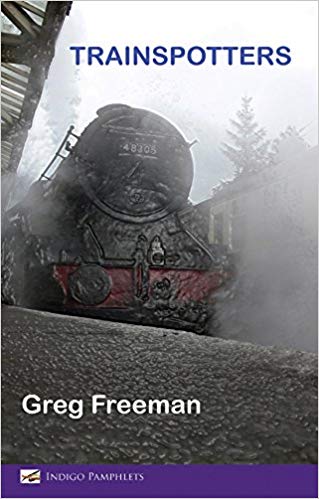
was born in 1952 in Wimbledon, and lives in Surrey. He is a former newspaper sub-editor, and now news and reviews editor for the poetry website Write Out Loud. He co-comperes a monthly poetry open-mic night in Woking with Rodney Wood, and his debut poetry pamphlet Trainspotters was published by Indigo Dreams in 2015. His poems have appeared in South, South Bank Poetry, The Interpreters House, the Morning Star, the High Window, and are plastered all over England and even offshore on the Places of Poetry map.

https://www.indigodreams.co.uk/greg-freeman/4587958507
https://www.writeoutloud.net/profiles/gregfreeman

The Interview

1.  What inspired you to write poetry?

I was meant to be revising for my O-levels. I would have been 16, the year was 1969. Blimey, that’s exactly 50 years ago!  I was staring out of the window. It was a distraction technique. And I did write a poem about the moon landing.

2.  Who introduced you to poetry?

An English teacher notorious for getting benignly intoxicated in a nearby pub at lunchtime introduced us to the Penguin Book of Contemporary Verse. And I thought I’d have a go myself. (Much later, I wrote a poem about him, as the only schoolmaster that had motivated me at my dusty old grammar school). Then there was The Mersey Sound, that inspirational anthology of Adrian Henri, Roger McGough, and Brian Patten that opened up poetry to so many young people. No reflection on those three, but I wrote fairly awful adolescent poetry for two years, attended one poetry reading, by Brian Patten, and gave it up when I went to university in 1971. I didn’t take poetry up again until I attended a creative writing group in 2004. In the intervening time I had put together three or four novels and a few short stories without any success and very little encouragement. In 2008 I had a poem published in South magazine. It was quite something to see my name in print at last, after all those years. I concentrated entirely on poetry after that.

3. What is your daily writing routine?

I am afraid that that old distraction technique I referred to earlier now works against any chance of me writing poetry on a daily basis. Before retiring as a newspaper production journalist, I had been volunteered to become the news and reviews editor for the poetry website Write Out Loud, which now occupies me almost daily, writing news stories about poetry, and book reviews as often as I can. It’s great to be still working as a journalist, even if unpaid, and to be writing about poetry – so much so that it often doesn’t feel like work. But maybe it also prevents me from producing more poems than I actually do. Then there’s monthly co-compering of the Write Out Loud Woking poetry night, of course. Excuses, excuses.

4. What motivates you to write?

A lot of my earlier poems were about looking back at moments in my life. I suppose that seam is never exhausted, but these days I often need to be away from home for an idea to come – and sometimes on long-journey trains. Since the wonderful Places of Poetry project was introduced, to which I have contributed enthusiastically, I have realised that I am very much a poet of place. And I still can’t help writing poems about railways, from time to time.

5. How do the writers you read when you were young influence you today?

As I said, Brian Patten was the first and only poet I heard when I was much younger. In 2014 I reviewed for Write Out Loud a reading he gave in Teddington. Someone sent it to him, he emailed his thanks, and I seized the opportunity to do an email interview  –  a bit like this one, I suppose. Soon afterwards I met Brian at the Aldeburgh poetry festival, and he introduced me to another of my poetry heroes, Tom Pickard, and even gave me a name check when being interviewed at the festival the following evening. Lovely man. Not only that. The following year my poetry pamphlet Trainspotters was published and I sent him a copy. He liked it, immediately sent me some unsolicited comments, and my publisher Ronnie Goodyer at Indigo Dreams quickly reprinted to give them pride of place on the back cover. I also found myself at the same table as Roger McGough at a poetry event earlier this year, at which my wife seized the opportunity to apologise to him publicly for plagiarising one of his poems in her school magazine at the age of 17. He was very good about it. I should also mention Philip Larkin, probably the poet I admire the most. ‘The Whitsun Weddings’ is the most wonderful poem about a train journey I know. I enjoyed it when I was 16, and I love it now.

8. Who of today’s writers do you admire the most and why?

I was a great fan of Paul Farley, although he seems to have slipped off my radar a bit recently. The performance poet Luke Wright often succeeds in placing his finger on the nation’s pulse. He wrote a prescient, epic poem called ‘Essex Lion’ a few years before the referendum; it empathised with people that want to believe in something, whoever outlandish, and cling on to it doggedly, especially when Guardian readers tell them that it can’t be true. A so far overlooked poet that I really rate for his warmth and humour, as well as his craft, is Matthew Paul, who has published just one collection so far called The Evening’s Entertainment. His time must come. There are other poets who come to the Write Out Loud Woking nights – some of them published, some not – Kitty Coles, Karen Izod and Ray Pool I would mention. Another fine local poet, Eddie Chauncy, resolutely refuses to submit any of his work for publication. If he did, I believe he would be a popular success; you would find his books in Waterstones.

9. Why do you write, as opposed to doing anything else?

I have no physical skills, like bricklaying, or indeed, no talent for any form of DIY. I wish I did. After dropping out of university after just one year, I didn’t really know what to do with my life, but started trying to write a novel, feeling that I might be better at being an observer rather than a participant, somehow. Within a few months I was incredibly lucky enough to land a job as a junior reporter on my local paper. I knew almost at once that this was where I wanted to be. Within a few years I chose to switch from being a reporter to working as a desk-bound sub-editor, a production journalist, as I believed that would help my novel writing. It did, and it didn’t, you might say. Probably a mistake, in retrospect. But no regrets. Not now. Sub-editing should involve condensing words to their essence, getting rid of anything that is unnecessary. Very much like poetry.

10. What would you say to someone who asked you “How do you become a writer?”

Read voraciously. As soon as you think you can or want to do better, make a start. In the case of poetry, go to readings, listen to poets. And buy their books! They’re usually quite cheap.

11. Tell me about the writing projects you have on at the moment.

I was lucky enough to have a pamphlet accepted by the good folk at Indigo Dreams on the theme of trains, which was published four years ago. I remain very proud of it. But my ambition is to get a full collection out there before too long. I think I may have enough poems of sufficient quality, but whether they are exactly the right poems, whether they fit together, is another matter. Still more work to be done, I think.

12. What is so fascinating to you about steam trains?

I love to see and hear and smell steam trains – as do so many others who work on and visit heritage railways. But really it’s not so much the locomotives – as beautiful and alive as they are – as what they represent to me. Their disappearance from the national rail network, which had to happen, coincided with Beeching’s butchery of the branch lines. I’ve always linked the axeing of all those little branch lines with the end of Britain’s empire, which is not be mourned, of course. And in my own case, there was one particular branch line. During my childhood in the early 60s we stayed in a camping coach on a line in east Devon that ran alongside the valley of the river Otter, and a tank engine with two coaches – sounds familiar?! – would pass us regularly while we were looking out of the window, and the driver and fireman would wave to us. If there were any passengers they would wave, too. The names of the stations on that line read like a Betjeman poem – Tipton St Johns, Newton Poppleford, Ottery St Mary, East Budleigh, for Otterton and Ladram Bay. I see it in my mind’s eye as a paradise lost. There’s a poem about it in my Trainspottters collection – and I’ve posted that same poem on the Places of Poetry map, of course!

13. Ah, yes. “The Old Branch Line”. That list of station names. You use lists in your collection to show the passage of time, or convey a place.

The list of retail outlets in ‘Betjeman at St Pancras’ is intended to sound like station stops. In ‘A Job on the Railways’ they are just the stations where my father worked before the war came. Three favourite railway poems listed in ‘The Rother Valley Railway’. A number of locations in ‘The Butterflies of Yorkshire’. You’re right, there are a few lists!  I think they serve different purposes in each poem.

14. I agree. They complement your almost notetaking style.

Dead-end canal delivers its waters

To the Wey and Thames,

and always thirsts for more.

(The Basingstoke)

Your eschewing of the word “The” at the start of this sentence, and the circularity of meaning “waters” and “thirsts”. Converting conversational cliché into fresh perspective metaphors.

Ah, you’ve spotted another poem that contains lists! As for “almost notetaking” style, maybe that’s a result of my background in journalism. I think that’s why I find clarity in my poetry unavoidable, because of an instinct to communicate, to get my meaning across simply. I couldn’t do obscure if I tried. There’s nothing wrong with poetry that is conversational. Cliché is another matter, of course.

15. How important is popular culture in your poetry?

In ‘Dance On’,  the opening poem of Trainspottters, (Aha, another list, of Shadows hits!) the all-conquering Beatles leave a Shads fan floundering. ‘A Job on the Railways’ mentions my father’s love of Thirties crooner Al Bowlly, listening to him on the radio just before the outbreak of war, oblivious to the sound of “breaking glass” elsewhere. ‘Train to the Kwai Bridge’ refers to the Hollywood film starring Alec Guinness. The TV programmes Dad’s Army and 60s pop show Ready, Steady, Go! crop up in different poems. Peter Green of Fleetwood Mac and the group’s no 1 hit Albatross get an honourable mention in ‘Climbing the Malverns’. I would say those references help to ground the poems, establish a landscape or backdrop. I’ve written a poem about being in the crowd on the night of the live recording of Chuck Berry’s My Ding a Ling. I’m not sure how significant a cultural moment that was, but it meant a lot to me at the time, and still does. It was published in a fairly obscure music magazine shortly after he died. Checking over my oeuvre, as it were, I find I’ve written poems about Andy Williams, Julie Christie, Bud Flanagan, stars that made films at Shepperton studios, Ealing comedies in the context of Brexit, football, including a poem comparing Alf Ramsey and Alf Garnett, and one about characters from the Beano and Dandy. Does that answer your question?! No poems about the opera, I’m afraid.

16. I love the way you hint at a modern update of “Brief Encounter” in “The 21:53”.

Well, Brief Encounter is one of my favourite films, of course. I still need to make a pilgrimage to Carnforth one day. ‘The 21.53’ was one of the first poems I wrote after my newspaper shifts changed, and I was able to take the train in to work for the first time. This was in 2005. I felt a sense of liberation, and from then on began to think of myself as a poet.

Wombwell Rainbow Interviews: Adrian Ernesto Cepeda

Wombwell Rainbow Interviews

I am honoured and privileged that the following writers local, national and international have agreed to be interviewed by me. I gave the writers two options: an emailed list of questions or a more fluid interview via messenger.

The usual ground is covered about motivation, daily routines and work ethic, but some surprises too. Some of these poets you may know, others may be new to you. I hope you enjoy the experience as much as I do.

Adrian Ernesto Cepeda

is the author of the full-length poetry collection Flashes & VersesBecoming Attractions from Unsolicited Press, the poetry chapbook So Many Flowers, So Little Time from Red Mare Press. Between the Spine is a collection of erotic love poems published with Picture Show Press and La Belle Ajar, a collection of cento poems inspired by Sylvia Plath’s 1963 novel, to be published in 2020 by CLASH Books.

His poetry has been featured in Glass Poetry: Poets: Resist, Cultural Weekly, Frontier Poetry, Yes, Poetry, 24Hr Neon Magazine, Red Wolf Editions, poeticdiversity, The Wild Word, The Fem, Pussy Magic Press, Tiferet Journal, Rigorous, Palette Poetry, Rogue Agent Journal, Tin Lunchbox Review, Rhythm & Bones Lit, Anti-Heroin Chic, Neon Mariposa Magazine, The Yellow Chair Review and Lunch Ticket’s Special Issue: Celebrating 20 Years of Antioch University Los Angeles MFA in Creative Writing.

Adrian is an LA Poet who has a BA from the University of Texas at San Antonio and he is also a graduate of the MFA program at Antioch University in Los Angeles where he lives with his wife and their cat Woody Gold. You can connect with Adrian on his website: http://www.adrianernestocepeda.com/

His links:

http://www.AdrianErnestoCepeda.com
twitter,

instagram

facebook


The Interview

1. What inspired you to write poetry?

It was listening to Jim Morrison and The Doors. When I was younger in my mind Jim’s songs were the essence of poetry. He was my gateway drug to the verse. I was lucky to have visited his grave at Père Lachaise cemetery in Paris. I actually left Jim a poem and a rose to say thank you. He spoke to me, I felt his voice at his grave. urging me to return to America and follow my destiny to become a poet. True story, it was a life changing moment that day at the cemetery it snowed as I walked out of Père Lachaise. I owe my career to Jim Morrison.

2. Who introduced you to poetry?

Good question, when I was in elementary school I had a teacher Mr. Babcock who would have us memorize poems. We would then have to recite them in front of the class. This is I was first introduced to poetry and the first poet I loved was Robert Frost.

3. How aware were you of the dominating presence of older poets?

Frost was the first poet I learned about in elementary school. Later it was the Beat poets, Kerouac and Ginsburg that channelled the spark that Morrison and Frost had first glowed inside me. It wasn’t till I discovered Pablo Neruda and Sandra Cisneros that I found my true voice as a romantic love poet.

4. What is your daily writing routine?

Since I work as a Writing Specialist/Tutor at my MFA alma mater Antioch University Los Angeles, I set my alarm clock and wake up extra early to write. I always start my day with writing poetry. Something I learned from the late great Leonard Cohen. When he was at the monastery in the hills of Los Angeles, Cohen would wake up and write in the early morning in the dark. It’s the perfect time to write, so thanks to Leonard Cohen, I discovered my daily writing routine. I also have notepads around our apartment and in my car. So, if a line comes to me, I always write it down. I always say, if inspiration calls, you always have to accept the charges.

5. What motivates you to write?

It’s my calling. What I was born here to do: write poetry and inspire others to write, create and share their verses with the world. Mostly, I write now to transcribe memories that come to me from my past. Passions and fantasies that arrive from my carnal subconscious, like “Symbiosis” and “Mon Amor” that were published by Anti-Heroin Chic in 2018 and are both feature in Between the Spine: my erotic love poetry collection published by Picture Show Press ( ‘Symbosis” and “Mon Amor” that were published by Anti-Heroin Chic ) (Between the Spine: my erotic love poetry collection published by Picture Show Press.)

Sometimes I write a poem as an ode to writer, artist or someone who inspires me. Lately, current events and the travesty that this administration has brought to our beloved country inspired some poems. At Antioch Los Angeles, for my MFA, one of the tenants of this program and the main reason I attended AULA was their focus on social justice. Some of my best poems have this theme. One of my poems “Invisible Tan” published in 2018 by Rogue Agent Journal was inspired by Alejandra Sanchez’s MFA student presentation Words dipped in Honey in 2014 at Antioch LA and Gloria E. Anzaldúa’s Borderlands. Alejandra’s presentation was so inspiring that I remember writing down the first lines as she spoke. Still it took over four years and so many revisions and best of all, Rogue Agent Journal has nominated “Invisible Tan” for Best of the Net 2019 (http://www.rogueagentjournal.com/acepeda)

6. What is your work ethic?

For me it’s all about the poem. When an idea strikes me, I stop what I am doing and write it down. Eddie Vedder said it best: “I just try to always remember where that initial spark came from, and it’s like a pilot light, and I try to make sure that thing doesn’t go out.” Like I said before, I always have notepad’s around me around the house and even by my bed. Some nights the best lines and poems come to me before I fall asleep. Anytime is the right time for a poem. One time in 2011, I was camping with my wife and her family and I had this idea for a poem while we were at Point Mugu in Malibu. I remember being on the beach and seeing the lines in my head. I instantly ran back to our campsite. I recall while I was running, I began editing the lines in my head. When I made it back to the campfire I wrote down those lines.Cell phone dying near Point Mugu” was included in my first poetry collection  Flashes & Verses… Becoming Attractions.

7. How do the writers you read when you were young influence you today?

I see the writers who I read when I was young as trailblazers who lead me on the path to other writers who have influenced me along the way. Frost led to Dickinson, which leads to Woolf. Jim Morrison lead to Baudelaire and the Beats. What I realized during my MFA program at Antioch Los Angeles the more I read, the better I wrote. Reading makes the poet. It opens doors to syntax, vocabulary and imagery. And the best writers inspire me to want to write my own poems.

8. Who of today’s writers do you admire the most and why?

Latinx poet’s like Anna Suarez’s erotic and empowering collection Papi Doesn’t Love Me No More published by CLASH Books, (Papi Doesn’t Love Me No More published by CLASH Books. )

Ariel Francisco who specializes in literary translation has a new poetry collection A Sinking Ship is Still a Ship from Burrow Press coming in 2020 (Ariel Francisco A Sinking Ship is Still a Ship from Burrow Press) and his poems are truly inspirational, Leza Cantoral is one of the founders of CLASH Books and I connect with her emo/pop culture inspired her poetry collection Trash Panda (https://www.clashbooks.com/new-products-2/leza-cantoral-trash-panda) and Chris Campanioni who is hybrid writer, who has a very motivating TedTalk “Living in Between.” Campanioni writes essays, poetry and fiction, who’s latest book is Drift (https://www.kingshotpress.com/shop/drift-by-chris-campanioni) published by King Shot Press, this multi-layered writer is fearless on and off the page. I connect with writers like these who are courageously rousing that their mastery of the language and la lengua make you want to immediately write your own poems after reading their masterful work. Coincidentally, Anna, Ariel, Leza, Chris and I will be on a panel at AWP 2020 in San Antonio. Our panel Latinx Poets: Speaking from El Corazon are looking forward are looking forward to sharing our experiences on how being a modern Latinx poet in today’s poetry community.

9. Why do you write, as opposed to doing anything else?

Any other career path I have attempted I’ve hit walls. Poetry is the one vocation that not only empowers me and gives me strength, writing poems inspires me to speak out and want to read my poems to students, other would be poets and those who have an affinity for the craft. Poetry is necessity as an art form that we need today now more than ever. Nothing feels better than crafting a resistance piece and having resonate with an audience who feels the creative fury I am challenging on the page. This is why I write to reflect, connect and inspire others with my gift of writing poetry.

10. What would you say to someone who asked you “How do you become a writer?”

Although I love it, being a writer is not as glorious as it sounds. To be successfully published and have a career as a writer you need to be 1000% devoted to your craft. Writing must always come first. You also need to surround yourself with likeminded creatives/artists/writers along with friends/loved ones who support you on your quest to become a writer. For me being a writer, no matter how many books or poems I have published is never ending, I am rarely satisfied with what I write. I know and I want to write better and challenge myself every day on and off the page. Being a successful writer is that, always not settling and challenging oneself on a daily basis. Making time for writing, reading, researching along with having time for your personal/family life. It’s a balance. I know so many writers that have children and I am amazed and have respect for them, because I don’t know how they do it. I have so much respect for those with large families as I know how hard enough it is for me and I am lucky to have a home with my cat and my wife. That’s the key, my wife supports and believe in me. You need to have that support system that believes in you when you have those down days. Most importantly is keeping an even mindset, Benecio Del Toro said it best, “Turn down the volume of your Expectations, and Turn up the volume of your Perseverance,” not to get too low with rejections or too elated with publications. I love being a writer. It’s the hardest and most fulfilling job I’ve had in my life. And every day I wake up, I am excited about what I am going to write today.

11. Tell me about the writing projects you have on at the moment.

I have my third book La Belle Ajar, a collection of cento poems inspired by Sylvia Plath’s 1963 novel to be published summer 2020 by CLASH Books. I am working on a collection of poems inspired by mi Mami who passed away two years ago. I also have a chapbook of political poems that I would love to publish to inspire students and other young voters to cast their ballots before the election in 2020. Like I mentioned before, I am moderating a panel with Anna Suarez, Ariel Francisco, Leza Cantoral and Chris Campanioni for AWP 2020 in San Antonio. Our panel Latinx Poets: Speaking from El Corazon is one that I have dreaming of moderating for years. I was one of the lucky ones to have their panels chosen by the Association of Writers & Writing Programs. It’s a full circle moment for me. I earned my Bachelor’s degree in English at the University of Texas at San Antonio so presenting at AWP in the city where I first started my career as a writer is emotionally significant for me. I am looking forward to 2020 and beyond to see where my poetry takes me.

Wombwell Rainbow Interviews: Clare Pollard

Wombwell Rainbow Interviews

I am honoured and privileged that the following writers local, national and international have agreed to be interviewed by me. I gave the writers two options: an emailed list of questions or a more fluid interview via messenger.

The usual ground is covered about motivation, daily routines and work ethic, but some surprises too. Some of these poets you may know, others may be new to you. I hope you enjoy the experience as much as I do.

Clare Pollard

has published five collections of poetry with Bloodaxe, most recently Incarnation. Her play, The Weather (Faber) premiered at the Royal Court Theatre. Her translations include Ovid’s Heroines, which she toured as a one-woman show, and a co-translation of Asha Lul Mohamud Yusuf’s The Sea-Migrations with Mohamed Xasan ‘Alto’ & Said Jama Hussein, which was The Sunday Times Poetry Book of the Year in 2017. She edits Modern Poetry in Translation. Her latest books are a non-fiction title, Fierce Bad Rabbits: The Tales Behind Children’s Picture Books (Fig Tree) and a pamphlet with Bad Betty Press, The Lives of the Female Poets. www.clarepollard.com

The Interview

1. What inspired you to write poetry?

I’ve always written, but it would have probably been novels without Sylvia Plath’s Ariel, and the lyrics of Tori Amos and PJ Harvey.

2. Who introduced you to poetry?

I did Plath at A-Level, at the same time I was very into indie music and trying to write my own song lyrics, and the lyrics started turning into poems. Plath just exploded my mind really. My first book, The Heavy-Petting Zoo, is basically a reimagining of Sylvia Plath as a 17-year old in Bolton.

3. How aware were you of the dominating presence of older poets?

Oh, not really at all. I didn’t know anything. I subscribed to Poetry Review once I got interested, and that was about it. Poetry Review published me early on, but I had no idea how lucky that was. And then Neil Astley from Bloodaxe just wrote to me asking if I had a manuscript. I mean, that almost never happens, but I didn’t know my luck. I knew about Carol Ann Duffy and Simon Armitage because we went on a school trip to see them, and I came across some Selima Hill and liked her, but I was blithely unaware of older poets really.

4. What is your daily writing routine?

I don’t have a routine. I write in fierce bursts. Collections often come over an intense six months; I did first drafts of my play The Weather and my translation Ovid’s Heroines in about a month each. I’ve been busy the last couple of years as an RLF fellow and editor of Modern Poetry in Translation, along with having two small children, and then I was distracted by my non-fiction book Fierce Bad Rabbits: The Tales Behind Children’s Picture Books, which required a lot of research. I didn’t write any poems at all for two years. But a couple of months ago a long poem just appeared entire over about two days, The Lives of the Female Poets, which is coming out with Bad Betty Press this month.

Too be honest, the last thing people need is me having a daily routine, I’m over-productive enough anyway! There are already an awful lot of Clare Pollard books out there. When I do write though, it’s usually at my kitchen table with a laptop and a large pot of coffee and I like a couple of clear hours to get in the zone.

5. What motivates you to write?

I can’t help myself. It’s how I process the world. When my dad died, I found myself composing a poem in my head on the drive home, just hours later. ‘Cordelia at the Service Stop’. It almost sounds cold but it’s how I cope – it’s the only way I know how to get some kind of control over bad things. To make something beautiful out of something ugly and difficult.

I’m political too, and I know I have a platform, so I feel a sort of responsibility to use it. To articulate things that matter.

6. What is your work ethic?

I work very, very hard at literature. But it’s not all my own. I might be reading or translating or judging or editing or blurbing or reviewing or chairing a panel or teaching or mentoring or tweeting, but most hours of my life I’m thinking very hard about books and poems, and hopefully giving a platform to good writers and helping get more poems to more people. It’s hard to make a living when all your payments are piecemeal, a hundred pounds here, two hundred there, so I’ve never been very good at saying no. I work ridiculously hard for MPT, just the admin side is insanely demanding, but I’m at least quite efficient. I have epic to-do lists. Juggling literature and motherhood means I spend a lot of time furiously emailing on playpark benches, and can knock up 500 words in a naptime.

Housework, on the other hand, I do the absolute minimum.

7. How do the writers you read when you were young influence you today?

My book Fierce Bad Rabbits is actually about how picture books influenced the course of my life! I think the earliest stories you read shape your character in profound ways.

But in poetry terms, though I still love my teen idols – Sexton, Plath, Donne, Angelou – it’s new books that influence me most. I love reading something thrilling by a peer. It brings out my competitive spirit. I’ve always been interested in the zeitgeist, when I read a book that catches the moment we’re in I start trying to work out how I can do it myself. This year: Jay Bernard’s Surge; Ilya Kaminsky’s Deaf Republic.

8. Who of today’s writers do you admire the most and why?

Anne Carson’s cool isn’t she? I’d like to be Anne Carson when I grow up.

9. Why do you write, as opposed to doing anything else?

It’s my superpower.

10. What would you say to someone who asked you “How do you become a writer?”

Well, aside from the obvious answers of reading and writing, you’ve just got to put yourself out there. You have to attend readings, buy books, submit, go to open mics, ask magazines if they need reviewers, set up your own webzines or presses or evenings, enter competitions, workshop your peers, get involved. It’s a DIY scene and there’s barely any money involved, everyone does it for love.  You can’t expect people to want to read your poems if you don’t read theirs. If you throw yourself into it and are generous, poetry will pay you back.

11. Tell me about the writing projects you have on at the moment.

Well Fierce Bad Rabbits has only just come out, and I have a pamphlet with Bad Betty Press out this month called The Lives of the Female Poets, so I’m not in a hurry to write anything else for a while, but I am working on a translation of my Hungarian friend Anna Szabo’s Selected Poems, for Arc in 2020.

Stoked to bring you a video of my Sunday poetry performance at Jackanory. Thankyou Adrian for the video and Halima Mayat for the opportunity. Here’s “Bibliomancy”

Paul Brookes © Paul Brookes 2019 https://youtu.be/mbDZGbx9R0M via @YouTube

Wombwell Rainbow Interviews: Richard Waring

Wombwell Rainbow Interviews

I am honoured and privileged that the following writers local, national and international have agreed to be interviewed by me. I gave the writers two options: an emailed list of questions or a more fluid interview via messenger.
The usual ground is covered about motivation, daily routines and work ethic, but some surprises too. Some of these poets you may know, others may be new to you. I hope you enjoy the experience as much as I do.

Annotation 2019-10-07 092133

Richard Waring

has lived in Belfast all his life. He loves his city and like many who live there shows that love by constantly complaining about it. His first poem ‘To Lie On White On Green’ is
published in the 2019 CAP anthology Find.

The Interview

1. When and why did you start writing poetry?

Apart from the occasional poem for my wife until the summer of last year I hadn’t written any poetry since leaving school. I had been trying to write a short story about a piece of work a teacher had rejected and it didn’t work, a mess of words on a piece of paper. when I stopped trying to force the story something happened and I wrote The Monkey pt2 which has since been published in PoetryNIs

2. Who introduced you to poetry?

It definitely wasn’t in school. School was the place where any love I might have had for poetry died or at least took a fatal blow. Presented in a “this is something we have to do so let’s get it over and done with” manner and made all too clear that it wasn’t something that I would be able to understand let alone create.

I was a big Metal Head in my teenage years , still am although a bald head and creaking joints makes my headbanging a little less impressive. Iron Maidens song Rime of the Ancient Mariner preformed some much needed life support on the joy of poetry. It didn’t spark a newfound love or start a lifelong journey searching out great poetry old and new but listening to that song and reading the poem that it’s based on had, over the years, kept a little spark of hope burning inside. I just didn’t know it.

Last year I joined the Belfast Writers Group in an attempt to get over my social anxiety and to finish work on the novel I had always told myself, and anyone who would listen long enough, I would write. When I brought along some of the poems I had begun working on and shared them with the group they encouraged me to continue.
I have found social media to be a great place for poetry. I discovered the writers group on Facebook and over on Twitter after responding to a submission call for a new online journal I discovered my poetic home. I am so glad I found the great people of the Black Bough Poetry community, interacting with so many fantastic poets from around the world all with their own style, voice and love has helped that little spark, that Iron Maiden kept glowing, burst into flames.

2.1. How would you describe the “flames”?

The “flames” have shone a light on a whole new world of creativity and entertainment for me. It’s been like rediscovering music, all these great artists, new and old, and I get to read them all for the first time. it’s a little overwhelming at times but it feels good to be lost sometimes.

Creativity wise it’s given me a second life. I have always loved writing but sometimes days, weeks, months and if I’m honest even years could pass before I would write a single word, now rarely a day passes when I don’t scribble down a little word doddle at the very least.

3. What is your daily writing routine?

I don’t have a proper routine I just try to make sure that as soon as something strikes me I jot it down as quickly as possible. a few lines even a couple of words can feel so right in the moment but if I forget to capture them they’ll be gone forever.
I don’t currently have a laptop and I’ve a nasty habit of losing notebooks so all my writing is done on my phone at the moment which is very handy when random ideas strike.

My phone is always with me, I’m always playing games, reading books, watching Netflix and scrolling through social media. so it’s become a habit to occasionally look over my poetry files during the day, stretching them, editing them, polishing them and ending up with dozens of folders full of bits of poetry all called “New Folder”.

4. What motivates your writing?

The first poem I can remember writing was about the death of my younger brother Kenneth when I was nine years old. he had only just turned six and although he left his mark in the lives of his family he died too young to make much of a mark in the world. I wanted to write something that would honour his memory, make a mark for him and let the world know that this beautiful soul existed.
It’s been more than thirty years since he died, the poetry I have written in the past year has helped me come to terms with his loss more than I ever thought possible.

4.1. How does writing poetry help you cope with grief?

It allows you to face it honestly without filters. Because if you want to try to craft a few words of beauty you need to look at the whole truth not just the darkness of loss but the reason the loss was hard all the good things that are now gone can be remembered and bring joy. I can now take pleasure in the memories of before.

5. How does your early experiences of reading and writing poetry influence the writing you do now?

During my GSCEs my English teacher refused to accept a piece of work(The Monkey). I was told that it couldn’t have been my work, that I must have copied it from somewhere because someone like me couldn’t write something like that. it broke my heart and I turned my back on poetry. Didn’t read it, didn’t write it, didn’t think about it.
Now when I write I sometimes get the feeling that this is something I shouldn’t be doing, that I don’t deserve it, that I’m not allowed. Part of that is guilt on my part for cutting something so beautiful out of my life for so long but part of it is that first rejection. That feeling isn’t quite as strong as when I first started/restarted writing poetry and I think part of that is that if even one person enjoys something I’ve written, if my words reach them in some way it feels like a big “Fuck You” to those early experiences.

6. Who of today’s writers do you admire, and why?

There are quite a few poets I follow on Twitter who I really look forward to showing up on my feed. Ankh Spice work is always so uplifting and shows a real love and care for the world we live in. When Upfromsumdirt shows up I can’t wait to read what he’s written humorous, thoughtful, passionate his poetry and non-poetic posts are always a highlight of my day. Kyla Houbolt is another writer I’m so glad I followed and I’m always scanning my feed for some new piece of work. I could list dozens of names, I just love to see the work of people who write with passion and the internet is a great place to find them.

7. What would you say to someone who asked you “How do you become a writer?”

Don’t worry about spelling, don’t worry about grammar or punctuation, don’t worry about style or form. All that comes later. If there are words within you, a story to tell a thought to share, put them down in honesty.
once they are written down that’s when you use the tools you have, or are still developing, to shape and polish it. the most important thing is capturing the thought no matter how raw and unformed it is when it first appears.
And never allow yourself to feel guilty for not reading enough. Read as much as you want but don’t allow it to become a chore or obligation. those words were written for you to find and enjoy and want to read not have to read.

8. Tell me about writing projects you’re involved in at the moment.

At the moment I’m trying to edit a collection of my poetry down into a manageable chapbook. I kept adding more and more to it and it’s grown into a bit of a monster so I’m going to need to give it a serious pruning.
I’ll also be working on the finishing touches of a poem telling the story of Cúchulainn which I started about seven months ago. I haven’t looked at in for a few months so hopefully I’ll be able to work on it with fresh eyes, sometimes in the rush of new writing you blind yourself to the flaws you are making.
Finally I’m also working on a second novel. I know what I’d like to happen in it and can’t wait to see if it works out the way I’ve planned, when I start writing the characters take control of their own lives.

Wombwell Rainbow Interviews: Kim Fahner

Wombwell Rainbow Interviews

I am honoured and privileged that the following writers local, national and international have agreed to be interviewed by me. I gave the writers two options: an emailed list of questions or a more fluid interview via messenger.
The usual ground is covered about motivation, daily routines and work ethic, but some surprises too. Some of these poets you may know, others may be new to you. I hope you enjoy the experience as much as I do.

coverthesewings[48298]-PageResBackup-1-1

Kim Fahner

lives and writes in Sudbury, Ontario, Canada. She has published five books of poetry, You Must Imagine The Cold Here (1997), braille on water (2001), The Narcoleptic Madonna (2012), Some Other Sky (2017), & These Wings (2019) .  A member of the Writers’ Union of Canada, the League of Canadian Poets, and a supporting member of the Playwrights Guild of Canada, Kim was Poet Laureate for the City of Greater Sudbury from 2016-18.

She loves trees, backyard swings, Irish music, yoga, lake swimming, ceili dances, walking by water, witty conversation, hiking, canoeing, and silent spaces out in the Northern woods.

In March 2019, Kim’s poem, “They Shall Have Homes, 1928,” was awarded an Honourable Mention in the League of Canadian Poets’ National Broadsheet Competition.

Her blog, which she calls The Republic of Poetry, www.kimfahner.wordpress.com

Her author site is found at www.kimfahner.com

The Interview

1. When and why did you start writing poetry?

I started writing poetry when I was a teenager. It was mostly bad poetry at that point, largely because I hadn’t read enough poetry to know what decent poetry was all about. I began to write poems more seriously when I took an undergraduate degree in English at Laurentian University in Sudbury, Ontario, Canada. I took a third year Modern Poetry course and the professor was Laurence Steven. He talked about the importance of being a ‘traveller’ and an ‘explorer’ rather than a ‘tourist’ when it came to journeying into the realm of poetry. In that class, I fell in love with the work of W.B. Yeats and Seamus Heaney, and they’re two of my most constant companions and influences. Soon enough, I was writing my own poems and being asked to read at university open mic nights. That was in the early 1990s.

As to why I write poetry, it has always been the way in which I see the world. Images and lines come into my head and then I need to write them down. I am constantly aware of the sensory (and sensual) details of what I experience, and I’ve been combining my poems with photographs I’ve been taking in the last few years, so this just further cements my view that having poetic tendencies is about being mindful and aware of your surroundings, emotions, and experiences. In the last few years, I can see a photo and that can quickly serve as a place to begin writing a poem, so ekphrastic poetry is one of my favourite areas to delve into creatively. All of life is fodder for some kind of poem, at some point in time.

2. Who introduced you to poetry?

My dad worked in mining when I was very young, but had a deep love of Shakespeare. Some of my earliest memories are of him reciting pieces of dialogue from Macbeth. He loved to recite all of the witches’ voices and act them out for us when my sister and I were younger. The poem he most loved, though, is a Canadian classic that was written by a poet named Robert Service. Even in the weeks leading up to his death, my dad would recite parts of “The Cremation of Sam McGee” with perfect recollection. It’s a very long poem, and it’s known by most Canadians. Service was born in England, but traveled in the Yukon and other parts of northern Canada.

The other two people who really influenced my love of W.B. Yeats’s poetry were my great-aunts, Norah and Maureen Kelly. I still remember Norah reading me “The Lake Isle of Innisfree” when I was young, and telling me stories of Ireland and family history. That led to me doing an undergraduate thesis on Yeats’s work, and a graduate thesis on Seamus Heaney’s bog poems.

My grandmother, Alice Ennis, was the person who first gave me a lined journal to write in when I was just a teenager. She knew, before I even did it seemed, that I was a writer at heart and needed a place to write poems down.

2.1 What is it about Yeats and Heaney that you enjoy and why?

I love Yeats because of how he wove old stories and legends into his work. Some of my favourite pieces are the ones of the faeries. When I did my thesis in my final undergraduate year at Laurentian University in Sudbury, I wrote about Yeats and his various motifs and patterns. His work was so complex and fascinating to me, and it always will be.

The following year, I completed my Master’s degree in English Literature at Carleton University in Ottawa. My graduate thesis work focused on Seamus Heaney’s bog poems, particularly in terms of how they reflected the political tensions that existed between the Republic of Ireland and Northern Ireland. I considered them in reference to Ben Shahn’s The Shape of Content, in terms of how artist and poet are so closely woven. This would, before I even knew it, set up my love of ekphrastic poetry years before I even began to write it myself.

Yeats was the gateway to other Irish poets like Patrick Kavanagh, Paul Muldoon, John O’Donohue, Eavan Boland, Eilean Ni Chuilleanain, and Seamus Heaney. What I love about Heaney’s work is the way he uses language so precisely. When you read his work out loud, it sings. I also love how he weaves landscape so vividly into his work, so that it comes alive in my mind’s eye.

I met him in a pub in Sligo back in the summer of 2012 while I was there writing, and I was so shocked that I came face-to-face with him that I was gobsmacked. I said hello, and he smiled and said hello back, but I felt my knees wobble and couldn’t really speak when I really ought to have told him how much his work meant to me.  He was, for me, a sort of poetic father. When he died a year later, my heart broke. His work, for me, is a poetic touchstone. I read his poems regularly and always learn how to be a better poet.

3. What is your daily writing routine?

I don’t sleep well, so after a night of sporadic fits and spurts of some kind of sleep, I get up fairly early–around 5 and sometimes earlier. I tend to go walking every morning as I live a block or two away from Ramsey Lake, which is the lake that’s in the centre of Sudbury. I spend up to about forty-five minutes walking there with my dog, and then I sit for a while and look at the lake.

I’m drawn to water, and to sky, and to birds and trees, so this is the best way for me to start my day. It washes clean the slate for me, mentally and physically. Then, I come home and begin whatever project I’m working on. Often, I’ll try to read quietly for about an hour in the morning. If I’m working on a play, I tend to just read plays so that I can get a hold of the language, structure, and cadence of how a play moves on stage. I read poetry every day, mostly because it’s how I think about, and see, the world around me.

If I’m working on an editing project for another author, I’ll set aside a morning or afternoon for that. I only work on projects like that for a couple of hours at a time, mostly because I am fastidious in editing people’s writing and want to keep my mind (and eyes!) sharp.

In terms of how my day is structured, I tend to follow my intuition. One day, I may work on poetry book reviews for a couple of literary journals here in Canada. Another day, I may spend three hours on my new novel, creating new scenes, as well as spending some time incorporating research. On other days, I’m working on structuring my next manuscript of poetry, shuffling poems into new sequences and orders, as well as writing new ones.

If I get a bit ‘stuck’ on one writing project, I shift to another. This just allows me to cleanse my writing palate a bit and take a break from being frustrated with working through something in my head. I tend to get ideas for collaborative projects when I’m out walking. I also get ideas when I’m dancing. I dance a lot throughout the year. My favourite thing to do, though, is swim in local lakes during summer. I always feel as if I’m swimming into a painting and the natural landscape plays a key role in my work as a writer. For the most part, though, being out in nature, hiking or walking through the Northern Ontario bush, is usually what gets my mind moving in terms of new writing ideas and projects.

4. What motivates you to write?

I write ekphrastic poetry, so I will often visit art galleries for inspiration. This week, I went to see a Maud Lewis exhibit at the McMichael Gallery in Kleinburg, Ontario. She was a folk artist from Nova Scotia who died the year I was born. I’ve loved her work for years. After seeing the exhibit, I wrote a blog reflection, but I know that I now need to write a poetic sequence about her work. I’ve been inspired by the work of artists like Georgia O’Keefe, Frida Kahlo, Mary Pratt, and Alex Colville. I’m curious, in particular, about how women work as visual artists, and also how they managed their lives and relationships, in terms of balancing love with creativity.

I like the word ‘inspire’ more than ‘motivate,’ to be honest. I don’t sit around waiting for an elusive muse to hover down to earth, but I do get a lot of ideas from listening to other people’s stories about their lives. Often, I’ll ‘borrow’ lines from friends. I’m often inspired by photos that friends take, and I’ve found (in the last few years) that images inspire me to write poems. I can’t just write a poem about anything off the cuff. I’ll see something, or a phrase or line will pop into my head, and I’ll sit down to write a poem. People live poetically, but I find they aren’t even really aware of it, so it’s sort of magic when I can see the poem inside a photo they’ve taken.

I don’t do it often, but I’ll sometimes gift my closest friends with poems…and that, to me, is a gift of the purest sort of energy. It can’t be contrived or forecasted. It’s magic. I hope they feel the same way when I give them the gift of a poem, but I never really know…and probably don’t need to know…if the intention behind the creation is clear and pure…and it always is.

In terms of writing blogs, I’m motivated to speak when I feel something is unjust. Something gets inside me, a sort of sparkly energy of an idea that needs to be expressed, and then I write an entry. The same sort of energy happens inside my body when I write plays. For me, plays are constantly dynamic and alive. I love the collaborative aspect of writing a play. You have a dramaturge who makes you think twice about why you are writing what you are writing, and asks you to consider how characters will behave on stage. I’ve learned a great deal about plot and dialogue from having written two plays in the last couple of years. I’m still a novice, but I love that I feel like an explorer in my own head and heart. Then, when actors read the words dramatically for a staged reading or workshop, I often find myself sitting very still and losing track of my hands in my lap because I’m in a bit of shock. To hear your written words come to life, as actors give them a real physicality, is one of the most magical things I’ve ever experienced as a writer. I’m hooked on writing plays now, even though I know I have a lot to learn in writing for this genre.

With writing novels and short stories, I’m motivated by ideas that seem to arrive in strange ways. Right now, I’m working on a novel about the Morrigan legend in Ireland. I have always been drawn to corvids (crows, ravens, and magpies in particular), but to add in the supernatural aspect of the Morrigan story makes me want to write a novel about how a woman evolves in her 40s, which is where I’m at now in my life. I don’t ever doubt my creative impulses, but I’m cautious in my day-to-day life. I’m quite private and shy with people I’m not close to, and I’m guarded, I think, but in my creative work, some wilder part of myself is given permission to emerge, whether in a phrase or line of poetry, or in the guise of a character

5. How do the writers you read when you were young influence you today?

I don’t know that they do, specifically. My parents were readers, so I always remember them reading at night. They modelled good reading for me, and when I started writing, they were puzzled, but supportive. They were working middle-class people, so my being a poet was a steep learning curve for them. Never mind trying to raise a child, but try raising an artistic and introverted child.

I read more fiction before I began to read and write poems seriously in my late teens and twenties. My first loves, in terms of fiction, were Jane Eyre by Charlotte Bronte, Great Expectations by Charles Dickens, and I read whatever was the school-assigned book list every year with a fierce passion. For a time, in my early teens, I fell in love with dragons and read through all of Anne McCaffrey’s Dragonriders of Pern series. I also loved Tolkien’s The Hobbit, and The Lord of the Rings. Along the same lines, I fell into the C.S. Lewis Narnia books. I read about faeries and Irish legends as I grew up, curious about my family history on my mum’s side. My great-aunts fuelled that interest, and they had a number of great books in their front room bookcase.

I feel that I’ve always read widely, across genres. All of that somehow mixes together to influence my style of writing, which varies according to genre. Funnily enough, though, my plays are full of poetic imagery and motifs, so poetry is always the bedrock upon which I build my stories, regardless of whether they come in stanzas, or scenes, or chapters.

 6. Who of today’s writers do you admire the most and why?

Right now, I’m reading David Chariandy’s novel, Brother, and I love how beautifully written it is, and how it’s so evocative of a particular time and place. He writes of how gun violence can change lives and families in an instant. It shatters you when you read it, and it’s an important and powerful read.

I also recently read Newfoundland based writer Joan Clark’s An Audience of Chairs back in June, a novel that is set in Cape Breton, Nova Scotia. It struck me because I had an episode of major depressive disorder about a decade ago, and I was impressed that Clark deals so realistically and compassionately with a protagonist who struggles with mental health issues.

Beyond that, I read a lot of Indigenous literature, so I love work by First Nations prose writers and poets like Richard Van Camp, Richard Wagamese, Greg Scofield, Liz Howard, Cherie Dimaline, and Robin Wall Kimmerer. Wagamese’s book, Embers: One Ojibway’s Meditations is a book I return to every week. It gives me guidance as a writer and person.

When I’m writing plays, I read a lot of plays at the same time, to keep my mind within that particular genre as I write.  My favourite Canadian playwrights are Hannah Moscovitch, Kate Hennig, Hiro Kanagawa and Jordan Tannahill. I’ve learned how to write better dialogue (in stories, novels, and plays) because I read and study their work. I’m still a fledgling playwright, but two of my plays, Sparrows Over Slag and Letters to the Man in the Moon, have had staged readings in a local theatre festival called PlaySmelter over the last two years. I’d like to see one, or both, produced for the stage, but I know that will take time and I’m uncertain of how to move forward in this particular genre.

I read widely, and I like following up on friends’ suggestions of books I might like to read. Recently, I’ve come to Robin Wall Kimmerer, Graham Greene, Joan Didion, and Kathy Page because of people recommending certain books, and I’m grateful for that expansion of my reading life.

Two writers who have been very important mentors to me are Timothy Findley and Lawrence Hill. I love their novels, and that’s why I applied to different literary retreats to work with them as writing mentors. Their books tell vivid and interesting stories, and their characters always feel so real, so human to me. I admire the way neither of them never really seemed to get caught up in the ego game of Canadian Literature. They both have created work that is beautifully crafted, and then let it speak for itself. Both were important teachers for me and helped me to improve as a writer.

In terms of current poets whose work I admire, I had the real pleasure of working with John Glenday and Jen Hadfield as mentors at Moniack Mhor, Scotland’s Creative Writing Centre, in the summer of 2016. I admire their poems a great deal, and I learned a lot from them in terms of how to make my own poetry much stronger. I also learned a great deal from Seattle-based poet, Susan Rich, at an ekphrastic poetry writing retreat at Anam Cara Writers’ and Artists’ Retreat on the Beara Peninsula, County Cork, Ireland. I also love the work of Edmonton-based poet, Alice Major. She was a great supporter of me when I became Poet Laureate of Greater Sudbury in 2016, encouraging me as someone who had been a laureate in her own city. She offered me sensible advice that helped me make it through my term as laureate relatively unscathed.

7. What would you say to someone who asked you “How do you become a writer?”

I think that, to be a “good writer,” you need to read quite a lot of books. You need to immerse yourself in books you like, as well as ones you might not like, or ones you might not know about. I often have friends (writers and non-writers) suggesting books that I should read, and I’ve come to new authors that way.

I also think that writers need to observe things carefully. Back in my late twenties, I worked with Timothy Findley through the Humber School for Writers on a collection of short stories that I was writing at the time. The best piece of advice that he gave me was that I should be out in public places and that I should take the time to listen carefully. This is, in effect, all about taking the time to eavesdrop. His suggestion was meant to help me improve my dialogue, and it did help. Now, as I write plays, I am listening never  more closely to how people speak to one another, and to the subtext that is heavily hinted at in written communication, or in body language, or even in conversation. The places where the silences live tend to be ripe, full of things to write about.

What I learned from Larry Hill, when I worked with him at the Banff Centre for Arts and Creativity in April 2016, was that I should not be afraid to mine the stories of my own life. I had been worried about that, mostly as my first novel is based on a rumoured family story that stretches back a couple of generations. I took his advice and wrote the novel. I think it’s a good story, but I know I’m biased.  I’ve been blessed to have very good mentors over my time as an emerging and established writer. I love to learn how to be a better writer, in whatever genre I’m working.

The other thing I would say is that you need to develop a writing practice. As you brush and floss each day, I think writers who feel compelled to write know that they must fashion a space within which to write. This doesn’t mean a physical space, per se, as I’ve learned this last year. Instead, it means setting your mind and intention to a task and making progress each day. I don’t believe in “writer’s block.” I believe in a daily practice, like yoga or meditation, for example.

I studied literature at university, attaining an undergraduate and a graduate degree in English literature. This allowed me to place myself within a history of writing and reading. That academic training rooted me in how to recognize the various “parts” of a writing practice. I still read as critically now, learning from the authors whose work I read.

I think, too, it helps if you’re an empath. You can imagine how people feel. You can feel how people feel. All of this helps you to write characters who are true to life and believable.

8. Tell me what inspired “These Wings”?

Most of These Wings was written in a tiny town in Southwestern Ontario called Kingsville, which sits in Essex County just outside of Windsor. I fell in love with the landscape—with Lake Erie, the hiking trails and conservation areas, Point Pelee National Park, the gorgeous Carolinian trees, and the birds (especially the barn swallows and red-winged blackbirds)—when I first went to a writing retreat on Pelee Island that featured a workshop with Margaret Atwood back in May 2016. I went back to work on my novel at the Woodbridge Farm in Kingsville in August 2016, and then rented a cottage called the Bird House Cottage on Pelee Island in August 2017. The funds from the rental of that cottage helps to support the work of the Pelee Island Bird Observatory, an organization I love.

I’ve been on leave from teaching high school English, writing my new novel, a play, and more poems. Part of my second novel is set in the Kingsville area, as well as in Creighton Mine, a mining town that once stood outside my hometown of Sudbury. I lived in Kingsville from March until December of 2018, working on my writing.

These Wings speaks to the tangible pull that I feel between two very distinct landscapes—from the raw and rugged beauty of Northeastern Ontario’s pines, lakes, and rocks, to the fertile pastoral farmland of Essex County, with its wide open skies and murmurations of birds. That sense of a sort of elastic tension between two places underpins much of These Wings. I felt, when I was writing those poems, so torn between two places. I was in love with both places at the time.

It’s also a book about what I call “surfaces and underneaths,” a book that reflects the place where I was born. Sudbury, and my family’s history, is all about mining. Its economy has diversified over the years—with an excellent university and two fine colleges, as well as a beautiful art gallery, professional theatre centre, and symphony orchestra—but underneath it all is a labyrinth of mines. Sudbury wouldn’t exist if it weren’t for the nickel and copper mines.

As a writer, I am intrigued by what we can see, and even more fascinated by what we cannot see. Sometimes you can sense things without seeing them. In my town, there are “surfaces,” and there are “underneaths,” but what holds it all together for me is the beauty of the lakes and trails. I can swim in lakes every morning in the summer months, and I can be physically active outside throughout the year.

For me, after time spent away writing in a different part of the province, eight hours to the south, These Wings is a book about exploring and journeying, both into landscapes and into self. It’s also very much about being grateful for the beauty of our wild spaces here in Canada. I’m a proponent of conservation of the environment, and I believe that is fairly obvious in the poems I write. We are here on the planet for a very short time. We need to be mindful of how we walk on the earth, and how we need to be guardians of it.

The title, These Wings, is really about how you can feel free to explore, just as a bird flies in the sky above. Metaphorically, it’s about flight and freedom, and also a great deal about the power of hope and love. We live in dark times, and I believe art (visual, literary, theatrical, musical) is what can help us to bring light to the world. Artists do this because we see things in different ways, and because we are mindful of the world around us. This is why I think it’s important to support the arts, and to value the crucial work that all artists do. We are the ripples in the pond…

8.1. The moon is a recurring image in these poems.

I am fascinated by the phases of the moon. Since I was a little girl, I have always been drawn to the sky, in the day and in the night. Still, I have always loved the night sky because of the moon and the stars. I loved astronomy, and still do, even though I never did do very well academically in science classes at high school.

I remember reading about how women used to “call down the moon,” and found that a fascinating image. When I was little, I used to stand on the dock of my family’s camp

on the edge of Lake Nipissing and throw my arms wide open to the moon and the stars, wishing that they would just settle inside my chest and heart. I felt that I could almost harness the moon’s power and beauty, to make myself feel stronger on days when I felt weak, worried, or even just “outside of everything else.”

I am drawn to the moon’s beauty. Its power intrigues me a great deal. It controls the tides; nothing seems as amazing and magical as that one fact. There is an ebb and flow in the ocean that I do so love. You can stand there, on the edge of the Atlantic, and feel the water pushing you back towards land in one moment, and then feel it pulling at your feet as the waves go back to the sea. I love that sense of being drawn in so completely and passionately, as if I am entering into the landscape in a sensual way.

This summer, my dream was to swim under a bright moon late at night in a local lake, and I did. It felt like I gathered the moon into my body and heart as I swam through the water. The moon makes me feel strong and elemental, and it makes me so grateful to be mindful enough to have it play such a role in my creative process and in my writing.

My latest play is called “Letters to the Man in the Moon,” and it’s about a young girl—Lucy—whose father dies in a mining accident. She tries to work through her grief by sending him letters. She thinks that he is perhaps somewhere above her, so she writes letters to him, and then burns them in a backyard fire pit, hoping that the ashes of the words in the letters will rise up so that he will read them. In between each scene in the play, I’ve written in little snippets of moon knowledge.

For me, the moon is a gateway to other places, including sleep and dreaming, when I’m lucky enough to be able to sleep. That the moon changes, has different phases and “faces” throughout a month, is beautiful. We, as humans, are not unlike the moon in the way that we shift and change. We have seasons, too, just as the moon has its phases.

8.2. Noticing another recurring image of “breath”, I wonder how important line endings and the phrasing of sentences are  to your work.

Yes. Breath is everything. I practice yoga regularly, so I’m mindful of how I breathe every day. When I get anxious, I come back to the rhythm of my breath and imagine it as an ocean, with waves coming in and going out. I think, too, of how spaces work within poems. Punctuation is so important. Stanzaic structure is crucial to how a poem works. I often take most of my time, when writing and revising poems, adjusting and readjusting line breaks. I’m much more aware of the meticulous and thoughtful task of crafting a poem now that I’m in my late 40s, after decades of practice. I naively thought I knew a lot about how poetry worked when I was a new, young poet back in the 1990s. Now I know I knew very little. Another twenty years of reading and thinking has helped me to evolve, and I hope strengthen, as a poet.

8.3. In writing plays a writer assumes a character who is unlike themselves, how does this manifest in your poetry?

In writing prose, and in writing dialogue for plays, I’m very much aware of how my sentences work. I read everything out loud after I write it. (My dog thinks I’m a bit off, but he’s used to it now.) I need to hear the rhythm, cadence, and music of my work to be sure it has weight. I want it to have both substance, ballast, and grace, but I also want people who may not normally read poetry to be able to understand it. I want it to move people’s hearts and minds, to show them that there are other ways of living in, and interpreting, the world. I want my words, my work, to convey what I see, think, and feel as clearly and evocatively as possible. I never know if they do, but I hope so…

I can’t stand going to poetry readings where everyone listens and nods as if they understand, when they actually might not. It seems a bit like the story of the Emperor’s New Clothes. Some types of poetry exclude people who aren’t in academic circles, or who don’t have connections to literary criticism. For me, and this has been true since I began to read and write poetry as a young girl, I believe that poems should invite people in for a cup of tea and a chat. In the Irish tradition, which I inherited from my mother’s side of the family, I grew up with a love of storytelling, and of learning to listen to people’s stories. Poorly told stories never really impressed me. A good storyteller makes you feel adept and certain in your own mind, so that means they won’t try to make you feel daft just to prove that they’re clever.

I often sing at my poetry readings, usually old Irish songs. I love them because they are narrative and poetic, and because they tell stories. So, I suppose, now that I think about your question…my poetry is likely the most auto-biographical in essence of all of my genres of writing. In other genres, like my novels and plays and short stories, I create distinct characters. There is some creation of characters in These Wings, in the sequences like the Frida poems, the WAR Flowers poems, and the Forty-Part Motet poems, because if you take the poems together, as they should be read as parts within a whole, then there is a narrative thread that carries through those suites. There are ‘personas’ in those poems, in many of the poems, I guess, and maybe having a persona allows me to give it some space to just be a poem on its own two feet.

8.4. Interesting that you speak of singing Irish songs in your performances because I notice distinct references to choral music throughout the poetry.

I have always loved to sing, and have sung solo and also in choirs. I sing every day, whether in my car or my house. I love the traditional Irish songs, the ones that tell stories. Some of the ones I most love to sing are “Red is the Rose,” “She Moved Through the Fair,” “The Fields of Athenry,” and “The Parting Glass.”

For me, poetry is music. I am not a fan of rhyming poems, but I love the subtle music of internal rhyme and echoes of phrases or images that just sort of come up over you as if they are waves. Poetry is meant to be read out loud, so how things sound in a poem is important to me. That’s why word choice, punctuation, and line breaks are key.

The Forty-Part Motet poems are based on Janet Cardiff’s sound exhibition at the National Gallery of Canada in Ottawa. It’s one of my favourite places in the entire world, and the Rideau Chapel is the most beautiful space in which to hear it. Thomas Tallis’s Spem in Alium is one of my favourite pieces of music, and I often play it when I’m writing. The layering of voices is too gorgeous for words, but still, I somehow managed to try and convey the intense experience of listening to Tallis in that space, and watching people’s reactions to how the music swirls up around you and crashes in a climax. Every time I’ve sat in that chapel space, I’ve sat for long periods of time, and each time I start to weep. It’s that powerful for me. Music—like poetry, or lake swimming, or doing yoga, or even like hiking in the bush—is one of my sacred things. It lets me be rooted in the physical, but it also lifts me up out of my body into more numinous spaces.

Stoked to receive another five star review on Kobo for my latest ebook “As Folk Over Yonder”. Thankyou Sheila Jacob.

Here is the text of the review with a link;

Memory Keys

Paul has dedicated this e-book to his “good neighbours” and neighbourliness is the “garden twine” (from The Yarn) that ties these poems together. He takes “memory keys from the behind the cellar door” (from Unhooks) and shows us a world where working folk live side by side. The reader is invited to urban South Yorkshire and a community that’s rich with a sense of belonging, both to one other and to their historical roots. In the wonderful Knackered Up we meet an elderly man “Outside bog still hung with bog roll newspaper/ he cuts up himself” “Flatcapped/in shirtsleeves he saws wood/folk leave in the entry to feed his grate” Paul vividly evokes a place and people where the past echoes around every corner. “See him dig over his borders with fork, /and see years ago through red eyes/a sharp school uniform in black.” (From Spiked, I) In I Fry Me Chips the narrator cooks his chips “in proper fresh Beef fat for better flavour, in a proper chip pan.” and attempts to come to terms with the ways of his neighbours “Yon young un” and “him next door” who “bags in grey bin, pussy cardboard boxes in blue.” “Tha allus sees summat proper fresh art thee windows.” Paul’s use of dialect is unforced and adds a special dimension to his poems. Sometimes there’s an awkward neighbourhood intimacy as in Hear Her and Bob, The Gardening Crack. “All neighbours saw/was Bob’s trousers/rapidly descending/as he bent to weed” If garden twine is the unifier of this collection, compassion, insight and generosity of spirit are the knots that hold the twine. I was particularly moved by Blanket, Mum Is A Child, Why Move, This Stolen Garden, Every Key She, and Grandad. Don’t just take my word for it; read and delight in As-Folks-Over-Yonder “where neighbours hear through walls/or in entryway/our oven fan/flaps through boisterous/kids play football/humped backed lovers at night/a gunning motorbike” (from The Spring Town Bounds)

Show less