Gathering Grounds 2011-2019 by Harriet Tarlo images by Judith Tucker (Shearsman Books)

tearsinthefence's avatarTears in the Fence

In her introduction to The Ground Aslant, An Anthology of Radical Landscape Poetry (Shearsman Books, 2011), Harriet Tarlo had suggested that the word “landscape” was itself a compound of both the land and its scape, its shaping. The importance of this note was in its acknowledgement of the interventionist human engagement with land. The title of her new collection of poems, accompanied by the powerful evocations of place contained within the drawings of Judith Tucker, contains a similar acknowledgement. “Grounds” are themselves the foundations upon which something is built up, suggesting an underlying principle of growth, and it is entirely appropriate that the opening section of some fifty pages (poems written between 2011 and 2014) should be titled ‘Tributaries’, those streams of water which lead into larger rivers. In his copy of A.N. Whitehead’s Process and Reality Charles Olson made a note alongside the philosopher’s statement that “the term many

View original post 565 more words

..day 17..

Sonja Benskin Mesher's avatarsonja benskin mesher

..isolation diary..

..day 17..

bright clear cold today
early before folks wake i
light the incinerator

to burn the leaves
garden debris

the wild cat watches
each time i clear a patch
he finds another heap
to nestle in

so i wonder whether to leave
a place for him, the darling

for that is his given name

on my walk i noted the numbers
one hundred up the hill to pentre

ten at the gate

the sheep was 28 with two
lambs marked the same
there is multiplication
for you

i stopped to watch as the vehicle came
a tractor

i have been walking the centre of the track
no vehicles a fortnight all on lockdown

the farmer fetching bales and nodding
as he passed

i nodded back

noted the blossom
noted the crystal stones

walked home

it is suggested that we are out walking for one
hour

i should…

View original post 20 more words

oxford, ohio and Nice Rejection Letter – Two Works by Ava Hofmann

robertfredekenter's avatarIceFloe Press

oxford, ohio


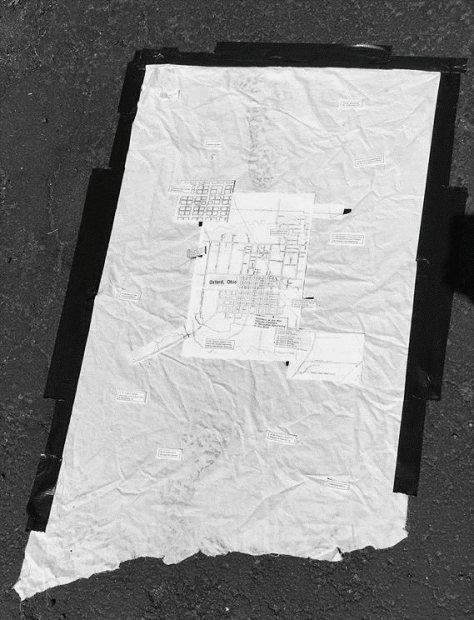
oxford, ohio was an installation poem i set up in the summer of 2019 in boulder,
Colorado (1). the project consisted of paper sheets glued onto a cloth canvas which was then taped onto a parking spot on an asphalt lot. during the 3 or 4 days in which it stood, oxford, ohio was driven upon, parked upon, and was generally overlooked or ignored; it also experienced some short periods of being experienced as an artwork.


this was, of course, the intent: i wanted to create a work which was intervening in public space but which was also being destroyed by that public environment in ways which were reflective of modern and historical systems of destruction: capitalist land property “development”, the prioritizing of public spaces around the community- and environment-destroying private cult of the automobile over the more equitable creation of bus and rail services, and, first and…

View original post 721 more words

..day 16..

Sonja Benskin Mesher's avatarsonja benskin mesher

..day 16..

yesterday came challenging
perhaps i have tired myself

taken in the news
the numbers

we are promised a letter from
the minister who is sick with it

mild he says
and will battle on

as are some of the other
of the cabinet

a letter that may take my walks away
i fear
so am glad of my garden

it is a country place with planned
wildness
neat is never the word
if i am grounded
so to speak will micro
manage
get to know all the little places

spaces

things broke yesterday, got lost
so i have a list for lookings, mendings
spaced
out

in my diary

police are stopping folk
keeping the isolation
as best they can

i saw he had gone to bed early, was real surprised
looked at the time and i went to bed too.

clocks changed today.

28413_443158311176_675531176_5656840_5857100_s

View original post

Wombwell Rainbow Interviews: Mat Riches

Wombwell Rainbow Interviews

I am honoured and privileged that the following writers local, national and international have agreed to be interviewed by me. I gave the writers two options: an emailed list of questions or a more fluid interview via messenger.
The usual ground is covered about motivation, daily routines and work ethic, but some surprises too. Some of these poets you may know, others may be new to you. I hope you enjoy the experience as much as I do.

Mat Riches

Mat Riches

is ITV’s poet-in-residence (They don’t know this). His work’s been in Dream Catcher, Firth, London Grip, Poetry Salzburg, Under The Radar, South, Orbis, Finished Creatures, Dreich, Fenland Poetry Journal, Atrium, And Other Poems and Obsessed With Pipework.

He co-runs the Rogue Strands poetry evenings and has a pamphlet due out from Red Squirrel Press in 2023.

He’s on Twitter as @matriches and blogs at Wear The Fox Hat. Both places are filled with bad puns and occasionally something useful will occur to him that will be posted

One of these facts is not true.

The Interview

Wombwell Rainbow Interviews

1. What inspired you to write poetry?

I’d love to be able to say that it was as a result of some great flash of light, or that some lightbulb moment occurred above my cot when I was a child and that the ghosts of Byron, Milton, etc fell out of some cosmic phonebooth in a Bill and Ted-type moment to inspire me to become the world’s greatest poet.

My earliest ‘poetry’ memory would probably be writing song lyrics on the brushed tile floor of my gran’s outhouse…I can remember using pink ink (an early sign of a diseased mind) and an old Silverline notebook. I was writing lyrics about someone called ‘Bobby Bingo’. I think it may have been a song I’d heard somewhere, and I wrote more verses using rhymes like jingo, Ringo and Dingo (clever, no?)

I wish I’d held on to that book for my archives.

If I’m scraping the outside of the barrel for memories, there was also the ‘Come and Praise’ song book, especially ‘Autumn Days’ with its line about the silk inside a chestnut shell.

Come And Praise

It was very much this edition. My friend Simon castigates me for having almost no memories of events when we were at school, but this cover triggers off images of the school hall, classrooms, assemblies and carol concerts. It’s a heady set of memories.

2. Who introduced you to poetry?

I’m sure I would have read some at Worstead Primary School, but it’s only getting to secondary school that I remember seeing any. I think it would have been Tim Phillips, my English teacher at North Walsham High School that first introduced me to the stuff. It was a copy of the Mersey Sound as well as the stuff we studied in English Lit lessons. I don’t really remember it, but I know The Mersey Sound stayed with me. Quite literally, as I nicked the copy from Tim’s classroom. Sorry, Tim.

I have to say thank you to my English teachers later in secondary school and at Sixth Form…Bamber de Tessier Prevost and Rob John. Bamber taught me at both levels and was just enormously encouraging. When I was doing my A Levels she agreed to read a few poems I’d bound together with a view to them becoming my first book – I’m fucking glad they didn’t…I’d typed them up on the college word processor – this was before laptops had been invented (NB may not be historically true, but they certainly weren’t common place in the home then). She handed the pages back to me and had said nice things—she was too kind. She mentioned she didn’t get the first poem as it was more abstract then any of the others. Reader, it was the contents page…

There are many others I’d like to thank, but I’m saving that for the first six pages of a collection.

3. How aware were you of the dominating presence of older poets?

I think the answer to this depends on when you’re talking about. At a general level I’m aware of it all the time.

However, I think I’m more aware of my ignorance of older poets rather than a dominating presence. I know there are many, many poets from the past that I’ve not read or not read closely enough. I did hear someone say once that they are there in latter day work of newer poets – the influences of these poets’ filters through, but in many cases, I’ve not gone back to the source – yet.

It can be like trying to get into Bob Dylan or Joni Mitchell, etc. The catalogue is so vast, where do you start? I think the answer is to dive in and swim about – you won’t go everywhere, but you’ll see some new sights or make sense of places you’ve been before.

4. What is your daily writing routine?

I don’t have one. I have spent the last ten years or more setting my alarm for 6am to get up and write. It has happened about twice in that time. One day I’ll learn.

I want to be one of those poets that can go for a walk or a run and come back with an idea, or someone that channels ideas into notebooks on the go/chisels work out of freewriting and I just don’t think I am.

Perhaps, one day, when I retire to the country it will change, and I know many people have a routine that works, but I think I mainly just have to grab the time when I can. I try to make use of the spaces in between things in the day to write. I’ve tried using my daily commute, but I’ve never felt comfortable writing on trains without a table. I guess it’s possible, but I don’t enjoy it. I do try and make myself use my lunch break at work (when I get a chance to take one), but by the time I’ve eaten my lunch, etc I end up with about 30 minutes. It’s usually enough time to edit a line or a stanza. It’s never the right time to start a poem.

In practical terms, I try to work on one poem at a time until it’s finished. It goes back and forth between me and another poet. He’s very kind, in the sense that he looks at my work and feedbacks his thoughts. He can be brutal with things, especially in the early stages, but I like that. I want that and like that he doesn’t say change it to this but points out where stuff is flat or just plain shite.

Last year I set myself the task of writing a post every week, and so far, I’ve stuck to it (pretty much). I like the task of finding something to write about. I try and keep it poetry related. I also include, for free, a title giveaway. Any ideas I have during the week where something sounds like a good title for a poem, I note down and give them away on my blog. So far there are 243 titles there – take your pick, do what you want with them. I may use some myself but, given the glacial pace I move at, it will likely be a while.

5. What motivates you to write?

What doesn’t? What motivates me to actually write it down is a different thing, and I don’t know the answer to that. I don’t think I want to know.

6. What is your work ethic?

Pretty awful, really. I know it’s important to show up and I do when I can, but I’m not going to beat myself up about it when I don’t. It’s only poetry. However, I think that when you do show up you should make the most of the time you have. I get easily distracted…

7. How do the writers you read when you were young influence you today?

I’m still young, cheeky sod. My manager at work (same age as me, also called Mat, also has a beard – although it’s not white like mine) never gets tired of telling the story of when we were travelling on the Central Line together, probably to a meeting of some description. We’d just alighted at the start of the journey and a young man offered me a seat. Mat just about stopped laughing in time to attend the meeting several stops and a short walk later.

Anyhoo, I digress. The writers I read when I was a younger man were The Liverpool Poets. I spent a long time trying to get away from writing McGough like things, running words together, etc…Or trying not to be Brian Patten and writing intense things about nature and doomed love affairs, etc, or like Adrian Henri with artists creating giant canvases of the UK, etc. Obviously, there is more to all three and I still love them, but I still have to look back sometimes and stop myself from mimicking them.

I think as I got older and read a little more widely, getting into magazines and the like I think the influences got wider – just in the sense of generating a hunger to read more…Poetry Review introduced me to the New Gen Poets of Duffy, Armitage, Paterson, Greenlaw and Donaghy and the like. They then introduced me to the idea (if not actually followed up on until later) the likes of Elizabeth Bishop, Hughes, Akhamatova, etc. In short, to keep reading, to keep learning.

8. Who of today’s writers do you admire the most and why?

There are too many to mention and it would be unfair not to mention those I will inevitably forget. I will say, however, that anyone that is writing and finding a way to carve out time and a space for themselves is to be admired. Not always listened to, but certainly admired,

9. Why do you write, as opposed to doing anything else?

It’s something I enjoy, it’s something I think I’m starting to get close to be ok at. I can’t paint, I can’t sing or play more than 4 chords on a guitar. My DIY skills are appalling (although I like to try), I am inept at all forms of sport* (again, I have tried) and I love writing, A good novel, a poem or non-fiction can change your breathing pattern, pause your heart or put steam in your strides. If I can get within a light year of achieving that then I’m going to keep trying.

* One day I’ll tell you the story about being a goalkeeper with one foot in plaster.

10. What would you say to someone who asked you “How do you become a writer?”
Fancy a pint? And then to pick up a pen and a piece of paper, a voice recorder, a twig on a beach, a blanket and send smoke signals, a sparkler and write your name for a few seconds…anything will do. You’re there. You’ve started. The rest comes later.

After that, it’s the obvious stuff like “Fancy another?” aka read, read, read, buy as much as you can by other writers, read it, learn from it. Go to readings to watch and to join in if you can. If you go to an open mic and the rules say 3 minutes, stick to three fucking minutes. No, you don’t have time for one more.

Submit to mags (Read them first – do you like the poems in there? Do you think yours will fit? NB: This second bit takes a while to remove your ego from the decision making)

Keep records of where you’ve submitted.

Do you want to go to another pub?

Find someone that might have been doing it for a smidge longer than you, listen to them. Really listen and don’t think you know it all. Send stuff out. Get knock backs, learn from them. Put stuff in a drawer for a while and then come back to it. Don’t stop.

Remember it’s ok to not be writing. If it’s not coming out don’t worry. It will – it may take ten years, or 1 day, but it will come.

Margaret Atwood said “There’s a lot of burnt toast in the lives of poets” – it’s ok to be staring out of the window for a month, literally or metaphorically.

Make sure you learn some craft – you can’t learn when to ignore it or break the rules if you’ve not paid them the courtesy of learning the exist. You can’t say you don’t like a food until you’ve tried it; the craft and the building blocks are the same thing. I wish I’d got to grips with them sooner. There is so much out there to learn from don’t feel overwhelmed by it.

Spend more time with people that aren’t writers.

11. Tell me about the writing projects you have on at the moment.

I don’t think I really have projects. Although, I guess, each poem is a project in itself. I am a project as well – I want to improve and keep growing as a writer. I want to get better as a reader of my work in public. I’d like to keep getting better as a reader of poems, a close reader. The reviewing helps with that, so I’ll keep doing that.

Given what’s happening in the world now, who knows if it will happen at all, but I have a pamphlet coming out with Red Squirrel Press in 2023. I don’t know what will be in it yet. I don’t think I need to yet either. I have an idea what poems I’d put in now if I were being published this year, but who knows what will be in the “finished” pile in a couple of years.

I’m not going to worry about it for a while, but I think about it every day.

..day 15..

Sonja Benskin Mesher's avatarsonja benskin mesher

starts the day much like any other
spring time, unless you hear the news

now rationed to once or twice a day
with tea or knitting

just now am up to light the garden
fire before the neighbours rise as

we don’t wish to annoy no one with
leafy smoke

have thoughts of fumigation down there
still in my pyjamas for i don’t see the point
of wearing something clean for such a smelly

job

two geese fly over
slight formation

wood pecker in our lane
rattling if that is the word

the air is cold clean before the smoke
hits then quickly dispersed gefore the waking

i imagine one day will stay in bed late
with nothing to worry yet i have had that

once

or even several times

now enjoy the early days the changes
and hope for the best

folks are kind
those i hardly now
with…

View original post 21 more words

Wombwell Rainbow Interviews: Briony Collins

Wombwell Rainbow Interviews

I am honoured and privileged that the following writers local, national and international have agreed to be interviewed by me. I gave the writers two options: an emailed list of questions or a more fluid interview via messenger.

The usual ground is covered about motivation, daily routines and work ethic, but some surprises too. Some of these poets you may know, others may be new to you. I hope you enjoy the experience as much as I do.

Briony Collins

Briony Collins
is a writer, artist, and actor based in North Wales, represented by DHH Literary Agency. Her career began when she won the 2016 Exeter Novel Prize. Since then she has gone on to publish poems with Agenda Magazine, Black Bough Poetry, Vociferous Press, and Creative Bangor. Last year, her short story ‘Citroen Sid’ was published by Retreat West to raise money for Indigo Volunteers, and her first play, For the Sake of the Jury was performed to packed audiences at the Victorian Christmas Festival in Beaumaris. She is currently the co-editor of Cape Magazine and co-host of the Altered Egos podcast. In addition to her writing, Briony enjoys directing and performing in plays. Most recently, she starred in Birdsong as Lieutenant Stephen Wraysford in a production for Bangor.
Links:
Twitter: @ri_collins
Instagram: @ri_collins96
Personal Website: https://brionycollins.co.uk/
Cape Magazine Website: https://capemagazineteam.wixsite.com/mysite

The Interview

1. What inspired you to write poetry?

Music has always played a huge part in my life. I grew up on just about anything I could get my hands on. When I was ten years old, I heard Queen for the first time and fell in love. I had feelings and reactions to their songs that I couldn’t explain or understand. How could words and melodies bring forth such potent and undeniable emotions in me? Why did the sound of another person’s sorrow make me cry? This was the first time I became aware of empathy and what it meant. From then on, I was fascinated with the idea. I had to know how it was done, how the power of words could be harnessed.

I wrote in school, but didn’t take it upon myself to write independently until I was about fourteen. Those initial, angst-ridden, pain-drenched scratchings in my journal were abysmal. I hope they never see the light of day! I began to hear something as I wrote though, which wouldn’t let me give up. I found that, when I write, I don’t hear words in my head; I hear music. It’s difficult to explain. I don’t experience this when writing prose or scripts. Something about the craft of poetry feels more like composing a melody to me, and this has only gets stronger with practise.

2. Who introduced you to poetry?

I don’t know if I was ever “introduced” to poetry. It’s always been there. My father was a poet and had a piece he’d written framed on our living room wall. He was always working on projects. It has been a part of my life since the day I was born. However, I was certainly introduced to the notion that I could write it too. That happened in school. I took a lot of pride in my schoolwork even at a young age. I’ve always enjoyed learning. I wrote my first short story when I was eight, but it wasn’t until I was nine that I really began to try writing. That was a big year for me. My teachers would let me and my best friend, Nimah, leave classes to work on a project in the library. We were compiling a non-fiction book on sharks. My cousin was one-year-old then, and I used to write him his own comic book series – The Adventures of Disco Pig. I think I made the protagonist a pig because I couldn’t draw human faces very well at the time. I wrote a newspaper article with another friend, Oscar, about a ghost that was meant to be haunting the school bell-tower. Best of all, Oscar and I, along with a couple of other students, would write our own skit-shows and perform them to younger students. Everything that year just clicked for me. All I needed was for my teachers to tell me I could write my own things. As soon as I was told that, I never stopped.

3. How aware were you of the dominating presence of older poets?

Being a “young poet” is something older writers often refer to me as, but I don’t see it that way. I’m just a poet. The first time I experienced this was when I won the 2016 Exeter Novel Prize. I showed up with my grandparents and a few people actually thought my grandma was me because of how much younger I was than everyone else! I started writing that novel when I was nineteen and was twenty at the awards ceremony. I think being recognised for my age made the situation even more intimidating. I was so hyper-aware of how out of place I was that I felt extraordinarily awkward. Everyone there was lovely. I still deal with similar feelings at events, but I’m starting to be recognised as just another writer now, which is wonderful.

There have been a couple of instances where I’ve felt patronised or taken less seriously for being younger. It used to bother me, but I’m not upset about it anymore. I’ve got more grit because of it and that’s vital for any artist.

4. What is your daily writing routine?

I get asked this all the time and I’m afraid my answer is a disappointing one! I don’t have a daily writing routine. I can go months without writing a single word and then hit about 20,000 over a single weekend. It doesn’t take me very long to physically write a poem either – perhaps half an hour for a solid draft – but it takes me quite a while to get in the right headspace for it. I know the general advice is to never wait for inspiration and to just get on with it, but I find that hard sometimes. I attribute that to being a full-time student. I spend so much time writing and reading for classes that a lot of my creativity gets sapped out of me.

5. What motivates you to write?

I had a tumultuous upbringing that really affected my work and the motivations behind it. My mother passed away, my father disowned me, and I live apart from my brothers, who are in the United States. I went to high school out there too, but moved back to the UK on my own when I turned 18. I had a single bag of clothes to my name, zero qualifications, and had to live with my grandparents for a few years. Seeing your entire life fit into one bag is an odd sensation. You feel really small, like you haven’t done anything with your life at all. I didn’t want to feel like that ever again. I use that as motivation to write and keep pushing myself.  I also want to make my brothers proud and let them know that moving away really was the best decision. I left behind my mom too (not my birth mother, but a parent in every way). I want her to feel like I’m doing something special. I don’t know if those are good motivations, but that’s an honest answer.

6. What is your work ethic?

Ultimately, what I value above all else in writing is honesty. I try to captivate this in my work, but particularly my poems. I want everything in my poetry to have a point. Each word, each piece of punctuation, must have a purpose. If there is ever a part of a poem that isn’t adding to it in some way, the poem isn’t finished. That’s why a lot of my poems are short. There’s a lot of cutting back. In fact, one of my first published pieces was only two lines.
I start with an idea or a feeling and I just free-write in my journal about it for a couple of pages, normally in prose. Then I go through with a pen and circle all the bits I like, and rewrite those parts down separately. I start playing with the language, seeing if any of those words prompt new ones. Normally this is when I also being to move the words around the page, seeing how they can physically fit together too. I like to have a fairly consistent structure throughout my poems. I rewrite it again and go through crossing out every word I don’t need. I examine the verbs and see if I can switch them to anything more powerful. I’ll toy with synonyms to see if I can develop any internal rhymes. I never worry about rhythm or metre – that happens naturally. When I have a piece that I think is about done, I make sure the punctuation is the way it needs to be. The last thing I do is give it a title. Only when all this is done do I type it up onto my computer. If it looks good on the screen too, it’s finished.

7. How do the writers you read when you were young influence you today?

I would say that every writer I’ve ever read has influenced me in one way or another.  I learned to write by reading frequently and broadly.  As a child, my favourite authors were Jacqueline Wilson and Roald Dahl. I don’t think there was a single book by either of them at that time that I hadn’t read. In particular, I adored Dahl’s Danny the Champion of the World. It’s a magnificent book about a father who teaches his son how to poach pheasants. It brought to light many subjects I was familiar with as a child, such as working class issues, the loss of a parent, and the importance of friendship. There are many times now when I am writing on these subjects and my mind drifts back to Danny in his little Gypsy caravan.

The only other author I read when I was younger that comes to mind now is Terry Pratchett. His book Nation remains one of my favourite novels to date. I can say with absolute certainty that many of my works would not exist if it weren’t for the phenomenal tale of Mau, a young boy suddenly thrust into the position of chieftain after a tsunami wipes out the rest of his tribe. His iconic phrase, ‘DOES NOT HAPPEN,’ which he screams in the face of adversity, is one that I cannot forget. If I find myself struggling with a poem or a story, I feel the spirit of Mau raging through me. I have a blue hermit crab tattooed on my arm now too, just as he did.

I don’t really write children’s fiction, but Dahl and Pratchett’s work certainly influenced me as a person, and changed my attitude towards writing.

8. Who of today’s writers do you admire the most and why?

Most of the writers I am currently influenced by are no longer alive, the most important to me being Kurt Vonnegut and Jim Morrison. However, of today’s writers I would be remiss if I didn’t name Forrest Gander or Carol Ann Duffy. I’ve had the very great pleasure of meeting them both and found that they are not only excellent poets, but examples of how poetry lives inside us.

I became acquainted with Gander’s work in a class on contemporary writing in my second year at Bangor University. His collection Be With was an attempt to articulate many of the emotions and experiences he went through after the loss of his wife. It was my first experience reading something that really represented my continuing grief at the passing of my mother. Gander does a lot of work with translations and it brought to my attention the way that the act of poetry is a type of translation; we are taking our most powerful emotions which should transcend language and finding a way to put them to paper. Be With is translation at its finest.

I was fortunate to be accepted onto the 2017 Spring Poetry Masterclass at Ty Newydd Creative Writing Centre, tutored by Carol Ann Duffy and Gillian Clarke. This was my first exposure to Duffy’s work and it left a permanent mark on me. Like Be With, I found her collection The Bees to express thoughts and feelings I had but could not yet put into words. The Bees explores the loss of Duffy’s mother, but there is so much tenderness and beauty between the lines of her pain that it changed me irrevocably as a writer and as a person. After reading it, I gave myself license to start writing about my own mother for the first time. It wouldn’t be hyperbolic to say that changed my life. The relief and power that comes from an epiphany like that is unmatched.

9. Why do you write, as opposed to doing anything else?

I came to writing somewhat accidentally. It’s something I’ve always done – even as a toddler I’d try to tell my family stories in incoherent baby babble – so it never seemed special to me. I don’t even think I realised I was actually good at it until I was twenty. It was just second nature to me; it was just something I did from a young age, so I never paid any mind to it.

When I moved back to the UK from the US at age eighteen, I had to live in the country again for three year before I obtained any student finance. Without qualifications too, I knew I had to use this time to go to college so that I could get into university one day. I started my A-Levels at Rhyl Sixth later that year. When I finished two years later, I was accepted into Bangor University, but I had to defer my place another year because I still wasn’t eligible for financial help. I took some GCSEs to kill time, but also took both years of A-Level Creative Writing simultaneously. My teacher, Samantha Egelstaff-Thomas, had taught me for all three years and I think she saw something in me that I didn’t know was there.

One of my assignments for Creative Writing was to write the opening of a novel. It was supposed to be 4,000 words, but I couldn’t stop myself. I soon had 10,000. Sam urged me to enter the Exeter Novel Prize, which she’d heard about in Mslexia – a magazine for female writers. I was hesitant. The entry fee was more than I could really afford and I thought my work was abysmally average. I almost missed the deadline because I couldn’t decide what to do. Sam told me that if I didn’t invest in myself, nobody else would. That was the best advice I ever received. I was longlisted and then shortlisted, and was invited to the awards ceremony.

As I stood there I felt stupid and awkward. I was so young and had no idea what I was doing. I knew nothing about writing competitions, submissions, publishing… I didn’t even know what an agent was really. When they announced me as the winner, the first words out of my mouth were, ‘Are you sure?’ They laughed and nodded. That was the moment it clicked for me. I couldn’t understand how so many people could see something in me that I didn’t pay any attention to. I haven’t been able to stop writing since that moment. It wasn’t a conscious choice to write as opposed to anything else initially, but now it’s all I want to do.

10. What would you say to someone who asked you “How do you become a writer?”

I would tell them to write. Next question!

In all seriousness, you start simply by starting. Read as much as you can. Consume art like it’s the air you breathe. Gravitate towards work that makes you feel something and then try to dissect why you feel that way. Writing isn’t something you can learn just by theory; it’s a practical skill.  Open yourself up to new experiences and opportunities even if they aren’t directly related to writing. Live a full and varied life. That’s how you find things to write about. Once you have that sussed out, just do it.

11. Tell me about the writing projects you have on at the moment.

I have a few projects on the go right now. I’m in my last year of university at the moment, so I have my dissertation. It’s a self-illustrated memoir-in-verse called Blame It On Me, and will feature poetry that articulates my ongoing journey through the grief of my mother’s passing. I’m currently developing my third novel, Simulacrum, which is a quirky and amusing sci-fi that explores the reliability of memories. It’s also quite metafictional. Think Vonnegut’s Breakfast of Champions for a comparison. My second novel, Ambergris, is currently with my agent.

I recently launched Cape Magazine with my dear friend and fellow writer Aaron Farrell. We’re a digital publication seeking poetry, prose, and visual art, especially if they’re experimental! We’re hoping to launch our podcast, Altered Egos, in tandem with Cape.

Thankyou to Renee of Literati Magazine for featuring my “Three Poems In These Viral Times” in the company of so many amazing writers

https://literati-magazine.com/three-poems-in-these-viral-times/

lm

Social Distancing, Phoenix-style

Peter Kruschwitz's avatarThe Petrified Muse

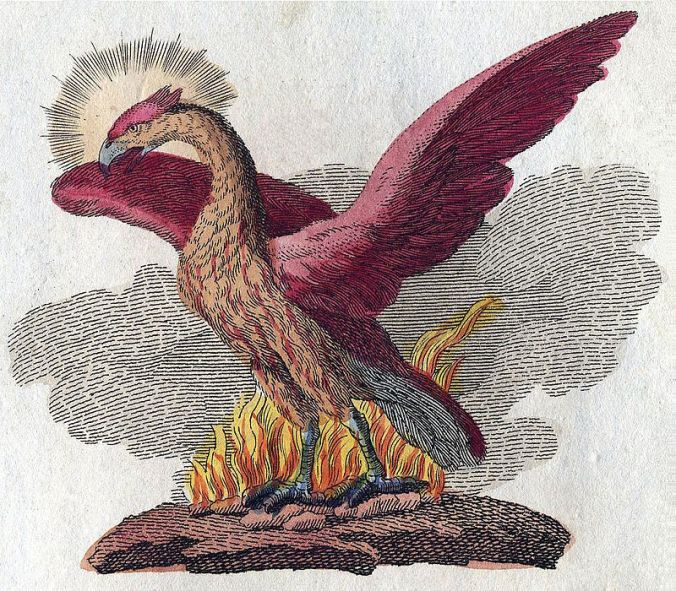
Of all bizarre creatures in that imaginary space that is Greco-Roman myth, Phoenix, the fabled, long-lived, cyclically re-born bird who knows how to go out (and come back in) with a bang, has to be one of the most remarkable and mysterious ones.

F. J. Bertuch: Phoenix

The late antique poet Claudian gives a delightful version of the myth in one of his shorter poems (see here for the Latin text and an English translation).

Turns out, the majestic creature was a bit of a recluse, who practised social distancing long before it was cool, and thus managed to avoid the threats of contagious diseases (Claudian. carm. min. 27, transl. M. Platnauer):

haec fortunatus nimium Titanius ales
regna colit solusque plaga defensus iniqua
possidet intactas aegris animalibus oras
saeva nec humani patitur contagia mundi.

This is the kingdom of the blessèd bird of the sun where it dwells…

View original post 66 more words