National Insect Week Poetry Challenge: Take part with Colin Dardis, Laura McKee, Kate Mattacks@mypaperskin, Cheryl Moskovitz, Phil Sheppard, Andres Rojas, sonja benskin mesher, Ankh Spice, Ian Seed, Amy Evans Bauer, Yvonne Marjot, Ama Bolton, Debbie Strange, Rachel Deering, Ama Bolton, John McManus, Claudia Serea, Linda Imbler, Anjum Wasir Dar, Judi Sutherland, Dai Fry and myself. Monday: Dragonflies, Tuesday: Wasps And Bees, Wednesday: Ants, Thursday: Beetles, Friday: Butterflies, Saturday: Moths, Sunday: Flies and sundry insects. Email me and I will add yours to my daily WordPress posts, also posted to Twitter and Facebook. This is the final day , but you can still add to all the posts already published. Here are today’s: Flies and other sundry insects

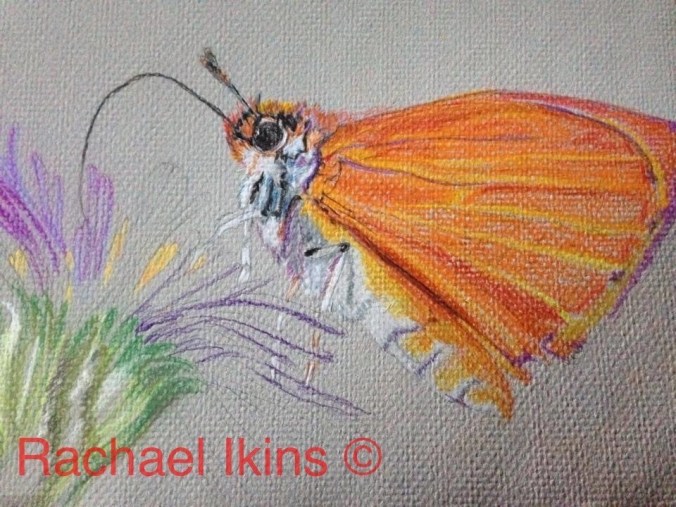
Rachael Ikins skipper on Aster

“Skipper on Aster” by Rachael Ikins
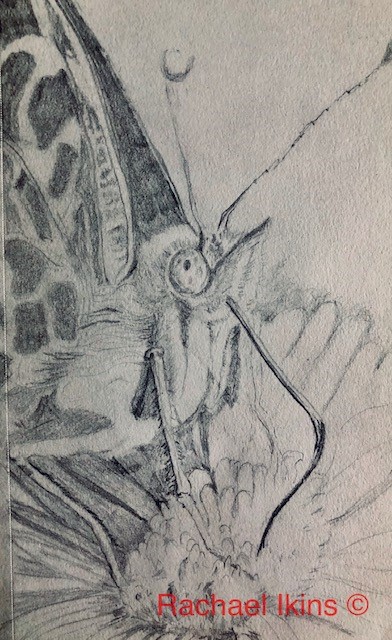
Rachael Ikins sipping nectar

“Sipping Nectar” by Rachael Ikins

image4

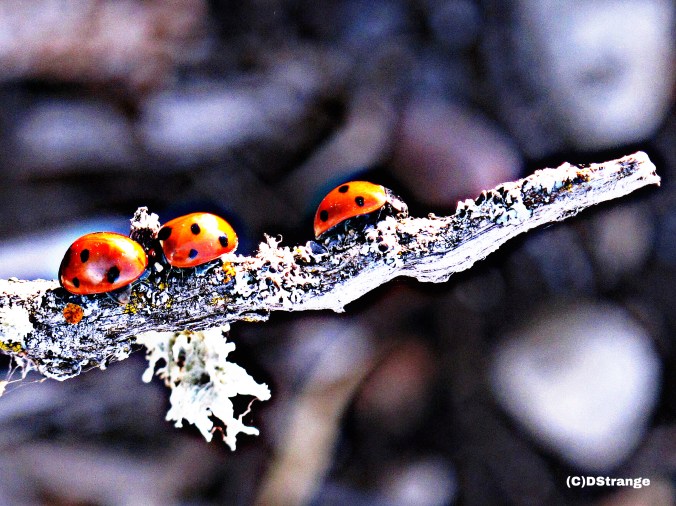
Lady Birds by Debbie Strange

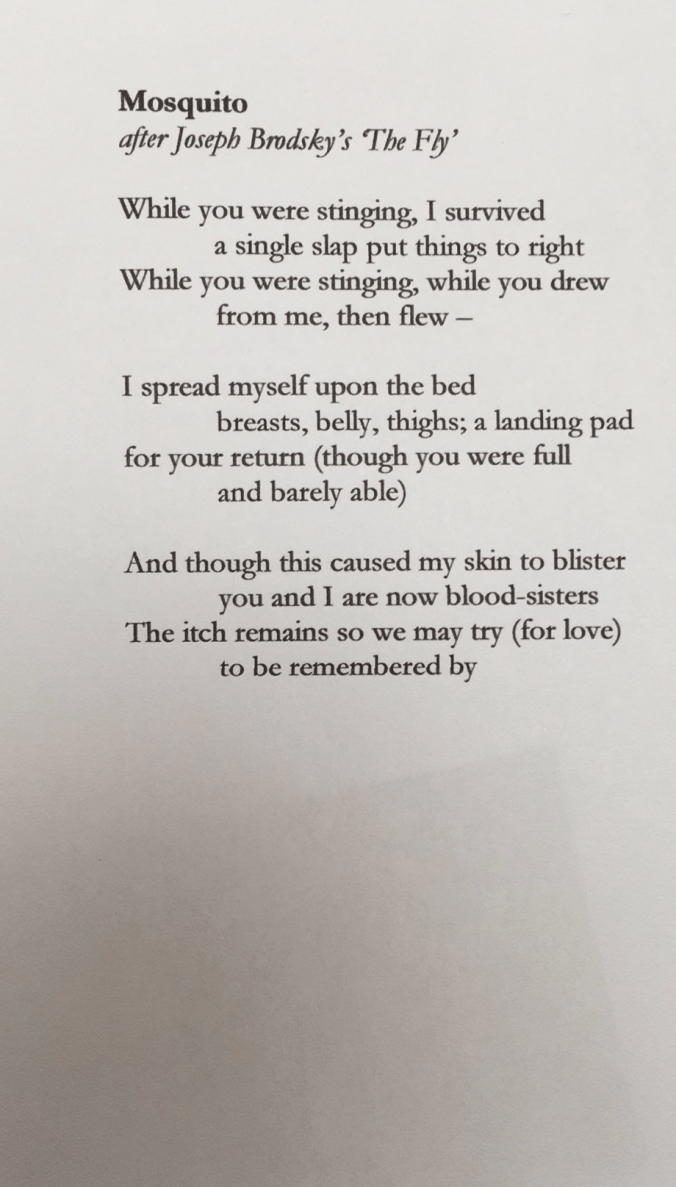
Cheryl Moskowitz Mosquito

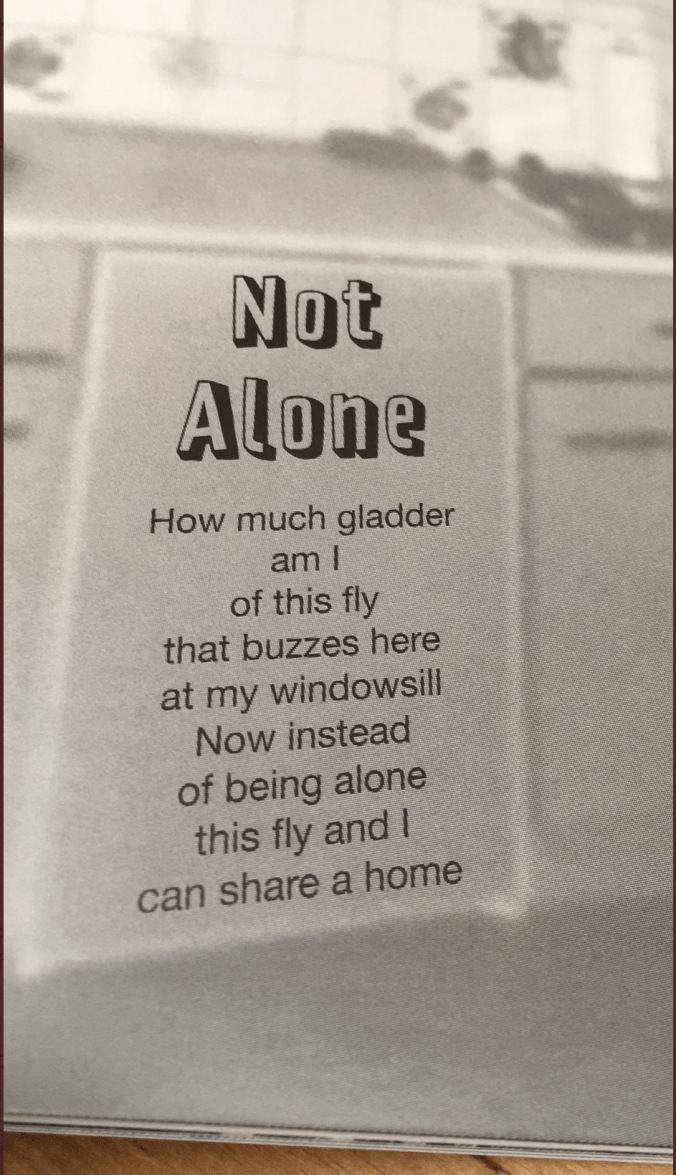
Cheryl Moskowitz Not Alone

-Cheryl Moskowitz

Intruder

No time for the unbelievable;
eyes follow in alarm,
around and conclude out;
a sound more often than a sight.

Think how human mechanics might
enable size for that same sound,
interlude for sleep, for dreams,
for needed solitude.

=Colin Dardis

Jo Weston “The Fawn And The Flea”. Please scroll down to the bottom of the link to see her video:

https://joweston1.wixsite.com/joweston/poetry-videos

beer can graveyard
the house fly
does another lap

surprise party
gnats congregate around
the toilet light

afternoon heat
a couple of flies rest
on the guard dog’s nose

a fly floats
around my pint glass —
lock in

-Johnny Haiku McManus
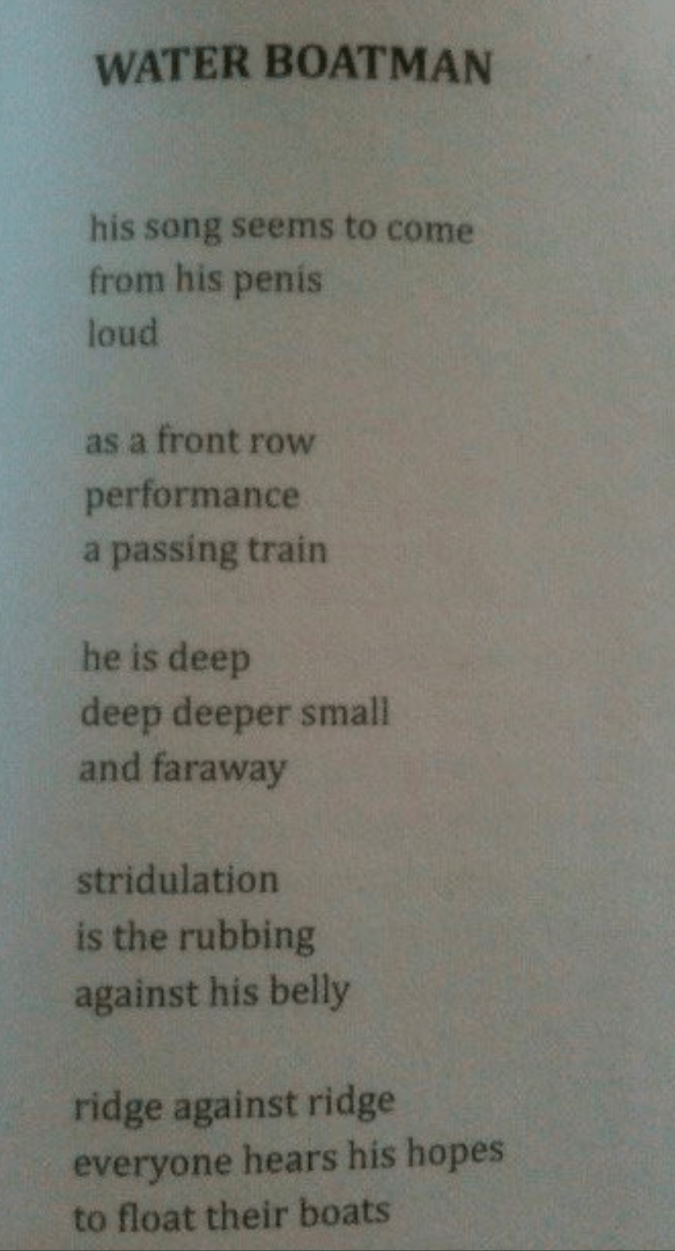
Laura McKee Water Boatman

As it appears in Ink, Sweat And Tears

-Laura McKee

Winged Arrivals

Suddenly jewelled green is bitter.
Under the hottest sun this year
thin legs land on skinned brown.

I watch wondering.

How can that beautiful peacocked metallic hue
associate with this dull stench?

Hand gloved in plastic bag
I encompass the gathering point,
remove the flies feast.

I long to reclaim that brightest of greens
take it back for Barcelona days,
but the tainting odour lingers.

-Sue Finch

Cockroaches

The Stalls crowd eating salmon at the bar
suspected nothing of the teeming mass,
a cast of thousands underneath the fridge
that held their ices for the interval,
their chocolate, strawberry and vanilla tubs.
One night, some careless usher dropped his change;
we had to move the thing to get it up.
Out came the cockroaches, big, little, large,
by ones and twos at first, dazed by the lights,
they straggled on. Then came a seething crowd,
returning veterans from Waterloo.
We left the room, lacking the killer drive.
The crackling-creaking-rustling quickly stopped.
They’d all returned to their ancestral home.

In time, some trendy so-and-so decreed
(ignoring the past visits of the Thames),
the basement decor needed livening up.
He had it done in smart brown hessian
to show off theatre prints, costume designs
from plays, grey aluminium-framed, for sale.
The Thirties’ paintwork was all covered up,
and things got warmer. He’d not bargained for
the insects having his same sense of taste,
brown sacking, just what any roach would love.
They did too. What a Spring they had, up, down
and round about. They even did things by
the cloakroom hatch, rode on velvet jackets,
drowned in gin.

-FIona Pitt-Kethley

Insect

Walking by the council houses in the falling snow, I thought I saw someone waving to me from a downstairs window. Yet when I got close enough to press my face against the frosty glass, I realised I had been mistaken; there was only a family watching television. Looking more closely still however, I saw myself walking on the screen. The youngest daughter was crying because the way I dragged my crushed leg behind me reminded her of an insect.

(From Shifting Registers, Shearsman, 2011)

Flies

in their armies
crawl across the stinging desert,
eyes begging the horizon to
meet them.

The sun is a metal mirror
reflecting, shooting the sting into
black backs till they
wilt yellow;
die;

crumble into,
become a part of, that
sand they once crept on –
the white dust
of their ancestors.
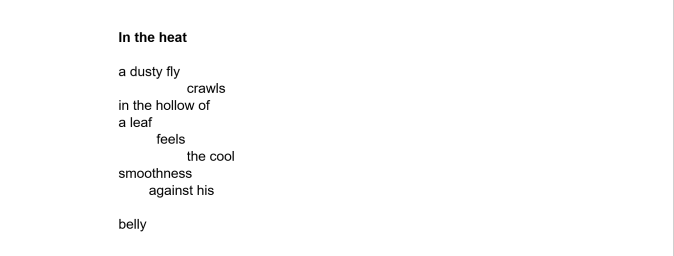
Ian Seed In The Heat fly poem

-Ian Seed

Cicada nymphs spend years deep underground
then (should) emerge in the cool night to shed their skins.

That summer afternoon
you became a mother
for three days, and a tree
for three minutes. She’d emerged too early,
the small brown spaceship of her body
launched to the surface
by the tumult of a fallen oak. The sound
a woman looses when her bare leg
is persistently climbed by tiny hooked crampons
is shrill and bounces the eardrums. Cicada
choirs echo the same – perhaps
that’s how you bonded so deeply
with an insect. So tender
as she slowed, her skin hardening
in the sun, so carefully her stiff feet
pinned into cradle-cracks of branch. Once in a lifetime
or never, may all of us witness something born
again. And this creature, transparent as a body
of water, fighting from a split rock. Becoming deep
impossible with setting vein, aurora blood-
inked by sky and leaf and petal. Her wings twisted
awry too fast, betrayed by time
of day. The female of this species
stays silent. She watched us
quietly, complaining never
of our strange delight
our stranger grief
until she left this brief, hard light.

-Ankh Spice
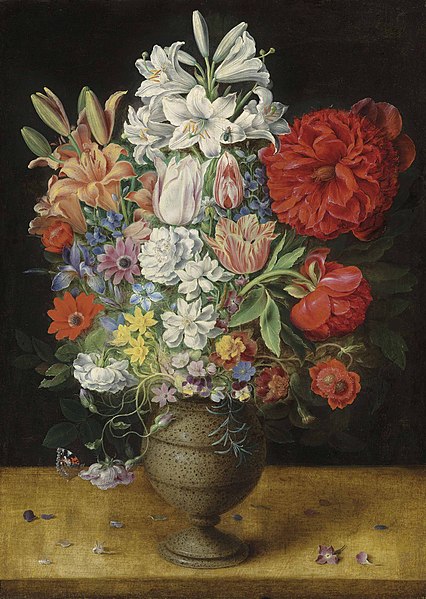
Rachel Deering Blue bottle 426px-Osias_Beert_-_Flowers_in_a_German_tigerware_vase,_with_a_bluebottle_fly_and_a_Red_Admiral_butterfly,_on_a_ledge

File:Osias Beert – Flowers in a German tigerware vase, with a bluebottle fly and a Red Admiral butterfly, on a ledge.jpeg
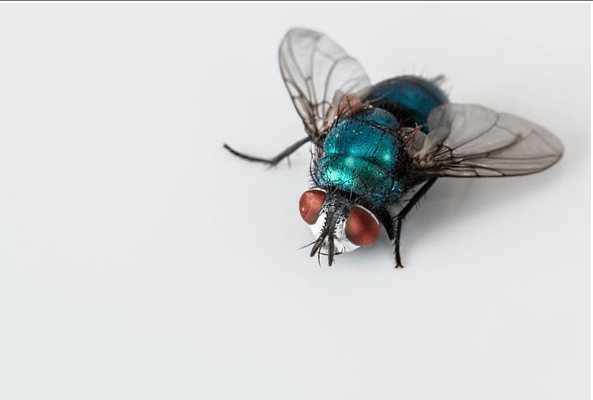
Rachel Deering Bluebottle

Bluebottle by Rachel Deering

Bluebottle

Funeral directors of blow flies arrive,
always punctual to manage the dead,
compound eyes range a corpse
with an efficient fervour,
appropriate the decay required
to feed and lay their gentles,
and despite their necessity,
their indisputable place
in the order of things –
we are disgusted –
death is not a nursery for the young.
Unashamedly, they wear their colours
with pride, electric blue and green,
polished to a mirrored sheen,
bristled, claw-toed, filigree-winged:
beautiful, in fact, and yet,
the buzz – the noise of corruption,
the bold pronouncement of the presence
of the proximity of death;
mortality hovers, frightens,
darts to take flight from my swat.

Rachel Deering.

The Lonely Fly

Looking for love?????
Must like fresh vomit,
taste with your feet.
Enjoy walking upside down
and be fond of defecting
whenever you land.

In it for the buzz.
Young and single male fly
with a zany sense of humour
and a love of travel.
Life’s short, so live a little.
No spiders need apply

PS Must lay your own eggs.

-Dai Fry

Upside Down with a Hundred Eyes

Grapes are sour in Antarctica
But we have abundant decaying
matter, all over the world a scatter
to lay our fine family eggs,

From the Order of Diptera, almost
all terrestrial habitats are ours, a
hundred eyes to see, nothing is hid
from land or sea,

The only weapon we dread is the ‘swat’
ever present by the dining table spread.
We live on a liquid diet, Ah God did not
bless us with teeth, but designed us to

Taste food with our legs and feet,we can
walk up side down, anywhere green or
brown, fear us-
Fear Us more, than Covid-19, the
dangerous part lies with the eyes in between.

We can survive all pesticides insecticides,
be a nuisance with our buzzing noises
carry diseases all around in the air, on ground
cover the fruit or food, we will find the way around.
We the flies are magnificent in minuteness.

-anjum wasim dar
Copyright CER 2020

Musca domestica

I drive you mad
I’m the least of things
cruising just out of reach
on cellophane wings

in through the keyhole
looking for meat
I walk on the ceiling
on six sticky feet

I spit on your food
I sample your beer
I shit on your lampshade
I buzz in your ear

I sit on your breakfast
and wash my face
I land on your neck
and leave a kiss

I land in your hair
you shake me out
I land on your cheek
bloody cheek you shout

I land on the baby
I land on the cot
I take off backwards
to evade the swat

I see in slow-motion
I see in the dark
I sleep on the pelmet
I’m up with the lark

I breed at great speed
to replace the dead
I’m the least of things
and I drive you mad

-Ama Bolton
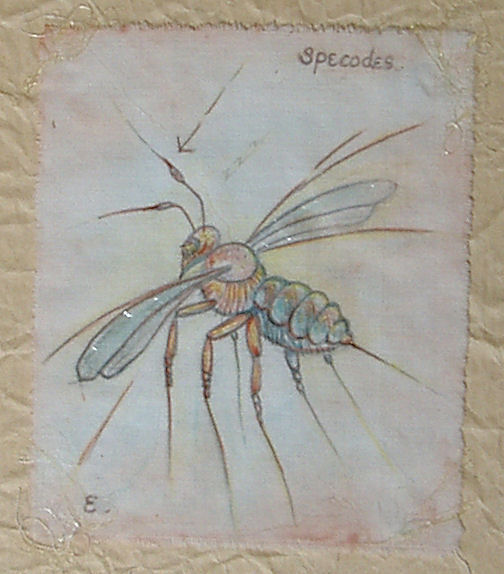
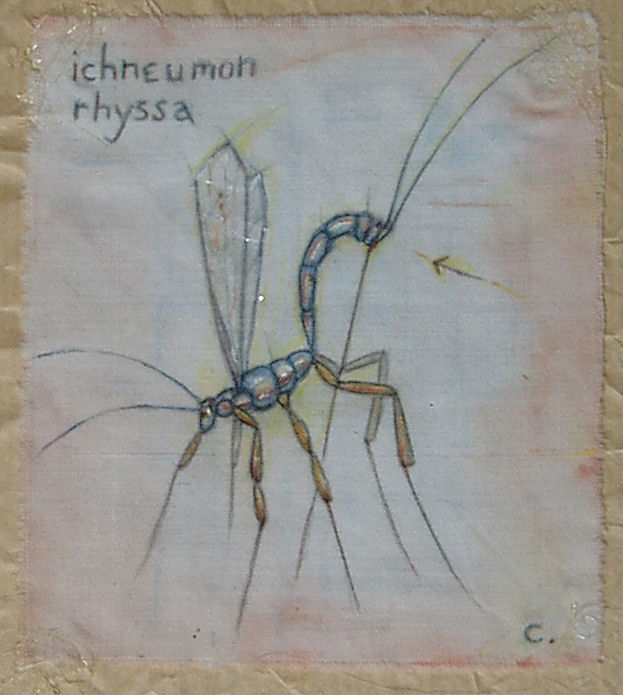
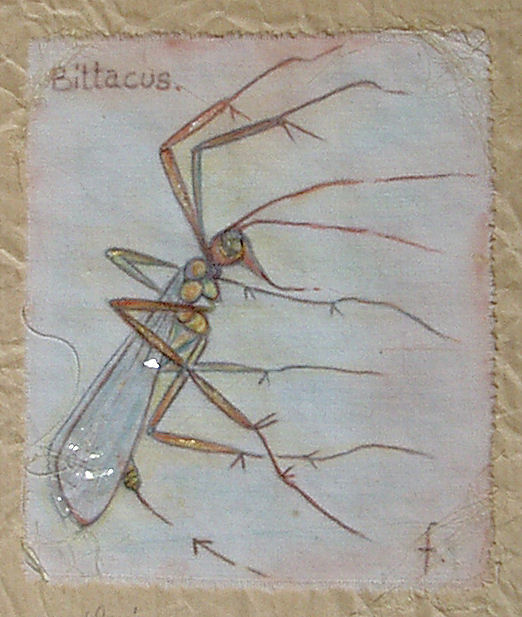
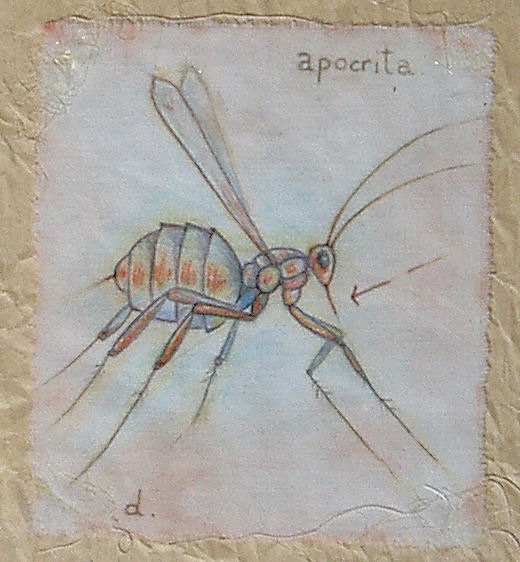
specodesichneumon rhyssabittacusaprocita

.flies.

day of flies, warm weather.
say what you will.it is
not
my fault .
the day begins.

sbm.

. flying things.

surround this area,
live inside. loving
lamps ,damp october air.
shadow, films
with out words, stuttering.
moths, yes i usually write
of moths, now long legs
come into play. outside
planes fly over, estuary
birds call. autumn.

sbm.

My Millipede

I’ve never met the millipede
That lives within these walls.
From baby-steps pattering ear-filled
To stomping wheelie bin thunder above
But I’ve seen the forlorn piles of shoes
Clogging up the hall
Holding the imprint of his resolve
Believing he is owed all the odd socks
Liberated laundry rebel
When he leaves
I shall miss the perennial warm-toed thief
We’ll shake many hands
A long farewell of regal waving
Scurrying to standstill
Steve.

-Kate Mattacks@mypaperskin

Incubation

So this is what I’ve arrived at—this mouthful existence,
this pale-green that even breath might break. There is no sky.

Only the flatness of blood and feelers. Taut for release
is the world, a flood that will engulf even the sky.

Frog, snake and hawk—all sound the same under water. I float
a bird in the lagoon as if it were the sky.

Soon, the hungers will take me in their arms and pollen
will light everything in yellow drifts. Soon, nothing but sky.

And yet there’s nothing colder than the rooms of waiting,
told nothing, knowing nothing. It’s easier to forsake sky,

to accept this incarceration as permanent,
a cell no key may breach. I grow still as the sky.

Hour by hour even the slightest breeze can kill. Stealth
lodges in my veins, a song. There is a lowering of sky.

Time slides like sheets of rain. Inside me, something opens,
anemone of many petals. It must be the sky.

-Anindita Sengupta
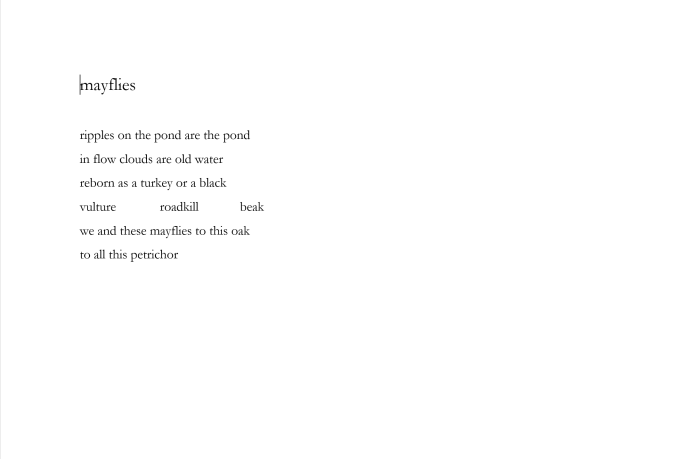
Mayflies by Andres Rojas

-Andres Rojas

The centipede that liked to read

The centipede
Loved to read
From her head to her very last toe
There’s mystery afoot
One in each book
And fifty books on the go

The ladybirds
Like the words
The leeches like the pictures
The caterpillars
Like creepy thrillers
The spiders ones with witches

When the sun gets low
The glow worms glow
To light up every last word
Then she marks all the pages
(that takes her ages)
And they dream of the stories they’ve heard

-Phil Sheppard

Fly

I would melt a frozen orchid
in my mouth until it blossoms,
cradle the mosaic of a shattered
snail in my hands, fuse it whole,
breathe orbs of sunlight through
the ether to the chrysalis
of your body, turn your sickness
into strength.

But instead,
this summer afternoon, I scoop
a meniscus-flattened fly
from the bathtub, dab
the pool of wetness from around
its waterlogged remains,
blow like a miniature zephyr
until I sense
an almost imperceptible stirring,
gentle twitch of consciousness.

A single glistening
thread unpeels from human skin.
Six black legs spring
against hot pink finger,
separation of bodies,
shake of slick wings,
a moment of orientation,
suddenly flight.

This I can do
again and again,
give someone else
another chance at life.

(Anti-Heroin Chic, December 2019, Peace – Kindness – Sensitivity issue, Ed. James Diaz)

-Lucy Whitehead

Humming Tree

This Olearia:
every floret holds a hum.
Hoverfly heaven.

Midge

A midge is a fly
with a look in its eye:
here’s my itchy surprise.

-Yvonne Marjot
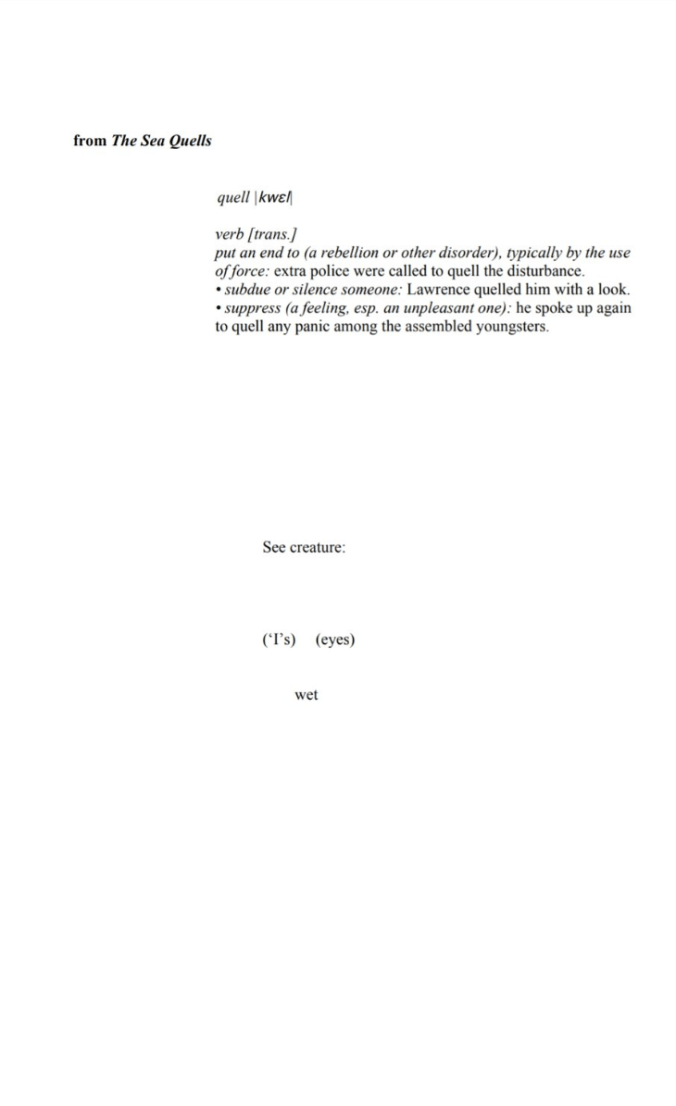
Amy Evans Quell

-Amy Evans Bauer

Fly Me To The Moon
(One Day in the Life of a Fly)

Born at dawn in this nightclub lounge,
I’ve got a talent that may astound.
I might be only a bug without a stinger,
But, no razzing, I’m quite a singer.
Give me Blues or Dixieland,
A little swing, I’ll swing it, Man!

And as for requests, this one’s the bomb,
Old Bart wrote well when he wrote this song.
A snappy tune worthy of sharin’
Sung also by Frankie and Bobby Darin.

(It was the first song played on the moon
by Buzz Aldrin. Hey—Buzz! Dig it, Pally!!)

So, you’ve got me, the zippy crooner
Belting out a tune that once went lunar,
Bringing out the smooch in honeymooners,
Making me feel like a floating ballooner.

So, I ain’t a poet,
Don’t I know it!

La-la-la-it’s cold up here in the air.

Wait!! Is that a lounge lizard
that just sat down in front
and is sticking out his ton..?!!!!!!

-Linda Imbler
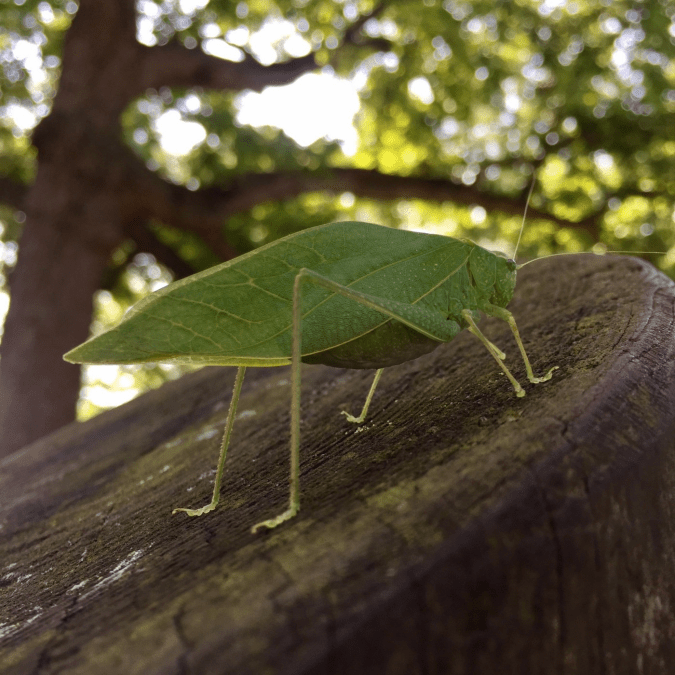
Ode To A Katyadid

Ode To A Katydid

Katydid, your appearance beguiles —
Resembling that which does not dwell
Among the creeping.

Silent and separate from the choir,
You slowly slink beneath the sunlight as a specter,
So rare to behold.

Exquisite beauty so easily overshadowed
By the bittersweet song of your ensemble,
And so elusive to the human eye!

Katydid, bask in Summer’s glow while the sun still allows,
And when the day is done, sing your measures of
The season’s sorrowful song.

Your symphony awaits and
Your audience knows that your notes
Will yield to snowflakes and shivers before too long.

-Rachel B. Baxter (previously published in Medium)

dead houseflies
litter my windowsill
blindsided
not even compound eyes
see the way out of here

Undertow Tanka Review 7, Sept/15

-Debbie Strange

wild carrots in the meadows
a horsefly settles on Queen Anne’s lace

The Asahi Shimbun

away from the crowd
estuary fireflies
and I

Creatrix 45 Haiku June 2019 Issue.

isolation
on a sultry night
mosquitos

Pangolin Review, Covid-19 May 2020

orphan
a fly shares
her begging-bowl

FemkuMag 2, July 2018 and
Wind Flowers – the Red Moon Anthology 2019 and
https://www.redmoonpress.com/catalog/product_info.php?cPath=32&products_id=324

long month
the cicada’s cry
yet to arrive

Re-side Issue 3, Winter 2019

very s l o w l y
a sudden swat
misses the fly

Shot Glass Journal Issue #31 May 2020

Christina_minerbee_bleachedbutterfly[84027]

a yellow jacket miner emerges
the secrets

A haiga in the inaugural issue of Bleached Butterfly Magazine

-Christina Chin

Bios and Links</strong

-Christina Chin

is from Kuching, Sarawak, Malaysia. Recently she won two of City Soka Saitama’s 2020 prizes. She is the 1st place winner of the 34th Annual Cherry Blossom Sakura
Festival 2020 Haiku Contest hosted by University of Alabama’s
Capstone International Center. Her photo-haiku won a Grand Prix Award in the 8th Setouchi Matsuyama International Contest in 2019. She is published in the multilingual Haiku Anthology (Volumes 3-5) and the International Spring Saijiki. Christina is published in Haikukai (俳句界) one of Japan’s biggest monthly haiku magazines. Her poems appear in many journals including AHS Frogpond Journal, the Red Moon Anthology, Akitsu Quarterly Journal, The Asahi Shimbun, ESUJ-Haiku, Presence, Chrysanthemum, The Cicada’s Cry, The Zen Space, Wales Haiku Journal, Prune Juice, Failed Haiku and Cattails (UHTS).
You can find Christina Chin online at WordPress: https://christinachin99blog.wordpress.com/. She also maintains an ongoing scheduled blog of featured and published haiku: https://haikuzyg.blogspot.com/.
Twitter:
https://twitter.com/Christina_haiku?s=09
Instagram:
https://instagram.com/zygby22

-Anindita Sengupta

is the author of City of Water (2010) and Walk Like Monsters (2016). Her work is in several anthologies and in Plume, Asian Cha, One, Bombay Literary Journal, High Desert Journal and others. She has been a Charles Wallace Fellow, and has received awards from TFA India and Muse India. She is from Mumbai and currently lives in Los Angeles. www.aninditasengupta.com

-John McManus

is an award winning Haiku poet from Carlisle, Cumbria, England. He’s the author of Inside His Time Machine (Iron Press, 2016) and After The Rain (Bones, 2019)

-Rachel Deering

is a teacher who lives in Bath with a cat. She loves history, folklore, nature, science, art and literature. She has been published in a few journals and anthologies here and there. In January, 2020 Cerasus Poetry published her debut collection, ‘Crown of Eggshell’. Rachel contributes regularly to ABCTales writing under the name of onemorething.

-Rachael Ikins

Associate Editor Clare Songbirds Publishing House, Auburn NY

https://www.claresongbirdspub.com/shop/featured-authors/rachael-ikins/

2020 NLAPW Biennial Letters Competition 3rd prize Childrens category

2019 Faulkner Finalist, 2019-20 Vinnie Ream semi-finalist, 2018 Independent Book Award winner (poetry), 2013, 2018 CNY Book Award nominee, 2016, 2018 Pushcart nominee

Www.writerraebeth.wordpress.com

https://m.facebook.com/RachaelIkinsPoetryandBooks/

@poetreeinmoshun on Instagram

@writerraebeth on Tumblr

@nestl493 on Twitter

-Ama Bolton

is a writer, editor and book-artist and convenes a Stanza group in Somerset.

-Kate Mattacks@mypaperskin–

I’m a researcher at the University of Reading with the Stories of Ageing Project. I support therapeutic writing workshops in hospitals and prisons. Trying to write more poetry, feed 3 dogs and be more human…

-CHERYL MOSKOWITZ

writes poetry for adults and children. Her most recent publication is THE CORONA COLLECTION – A CONVERSATION. http://www.coronacollectionpoetry.com Cheryl’s website is http://www.cherylmoskowitz.com

=Andres Rojas

is the author of the chapbook Looking for What Isn’t There (Paper Nautilus Press Debut Series Winner, 2019) and the audio-only chapbook The Season of the Dead (EAT Poems, 2016). His poetry has been featured in the Best New Poets series and has appeared in, among others, AGNI, Barrow Street, Colorado Review, Massachusetts Review, New England Review, and Poetry Northwest.

-Yvonne Marjot

-FIona Pitt-Kethley

is the author of more than 20 books published by Chatto, Abacus, Salt, Peter Owen and others. SHe lives in Spain.

is a lost kiwi, now living on a Scottish island. She has been making up stories and poems for as long as she can remember. Her first volume of poetry, The Knitted Curiosity Cabinet, won the Brit Writers Award for poetry in 2012. She loves her job, running a small public library, and has published four novels and a book of short stories. Twitter handle: @alayanabeth

-sonja benskin mesher

born , Bournemouth.

now

lives and works in North Wales
as an independent artist

‘i am a multidisciplinary artist, crafting paint, charcoal, words and whatever comes to hand, to explain ideas and issues

words have not come easily. I draw on experience, remember and write. speak of a small life’.

Elected as a member of the Royal Cambrian Academy and the United Artists Society
The work has been in solo exhibitions through Wales and England, and in selected and solo worldwide.
Much of the work is now in both private, and public collections, and has been featured in several television documentaries, radio
programmes and magazines.

Here is my interview of sonja benskin mesher:

https://thewombwellrainbow.com/2018/10/16/wombwell-rainbow-interviews-sonja-benskin-mesher/

-Ian Seed’s

latest collection of poetry is Operations of Water (Knives, Forks and Spoons Press, 2020). His collection of prose poems, The Underground Cabaret, will be published by Shearsman in autumn 2020.

-Phil Sheppard

is a writer and illustrator from Doncaster. A former primary school teacher, he is currently working as Doncaster’s Senior Project Officer for the National Literacy Trust. His website is http://www.philshepp.com
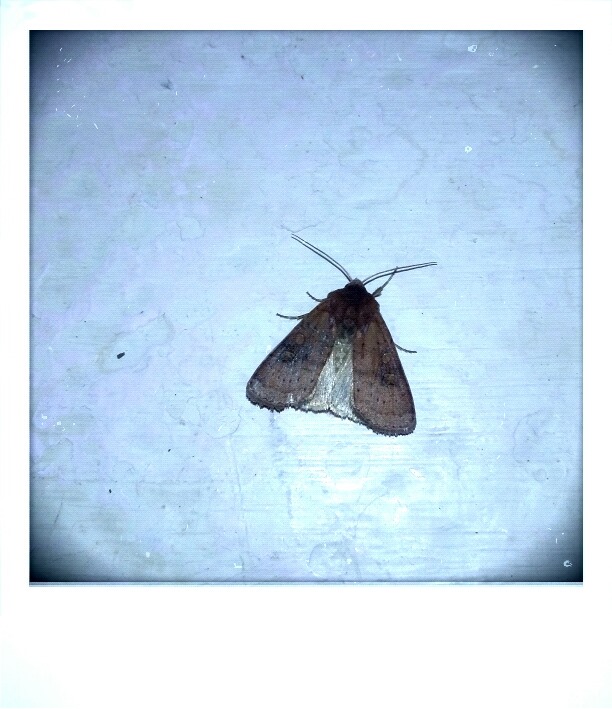
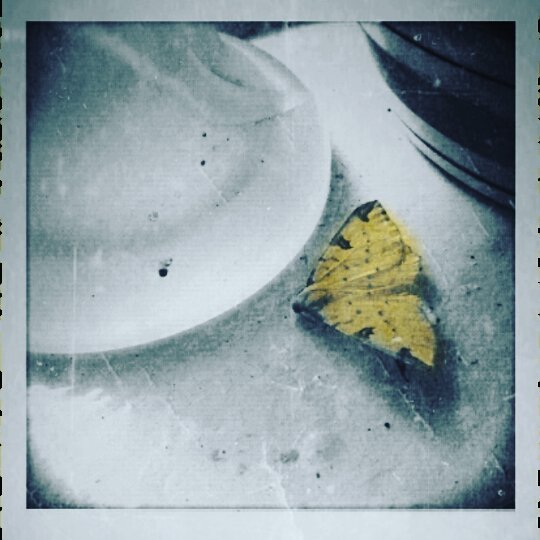
National Insect Week Poetry Challenge: Take part with Fi, Anna Kisby, Lucy Whitehead, Geraldine Clarkson, Colin Bancroft, Elizabeth Moura, Debbie Strange, Karlo Sevilla, Dr. M. W. Bewick, Samantha Merz, sonja benskin mesher, Chris Jones, Jay Caldwell, David Rudd-Mitchell, Yvonne Marjot, Susanna Lee, David Pollard, Mark Grainger, Samantha Merz, Bethany Mitchell, Charlie Ulyatt, Claudia Serea, Michelle Stevens, M. T. Simon, Anjum Wasir Dar, Jim (the Poet) Young, Devon Marsh, Graham Bibby, Briony Collins, Dai Fry and myself. Monday: Dragonflies, Tuesday: Wasps And Bees, Wednesday: Ants, Thursday: Beetles, Friday: Butterflies, Saturday: Moths, Sunday: Flies. Email me and I will add yours to my daily WordPress posts, also posted to Twitter and Facebook. You can still add to all the posts already published. Here are today’s: Moths

Night after night, the tiniest moths snip
Bits off stars, causing them to fall.
You may have seen these moths, and ignored them.
They are very plain, and very small.
Yet the giant lunas of dreams and nightmares
Are not able to reach those stars.
-Elizabeth Moura

14463277_10154638723256177_7804934958290103387_n26157751_899422956889654_1732781852374073344_n64913344_2258318620954480_2057297422207418368_nIMAG4574sonja benskin mesher. threeteeth

-sbm

#vss365 #BardBits #WrittenRiver 1613 #DimpleVerse #FeelLines #acrostic

“SLOW”
Shadowy
Lepidoptera
Opens
Wings

”Hedonist of souls and seasons”
-Fi

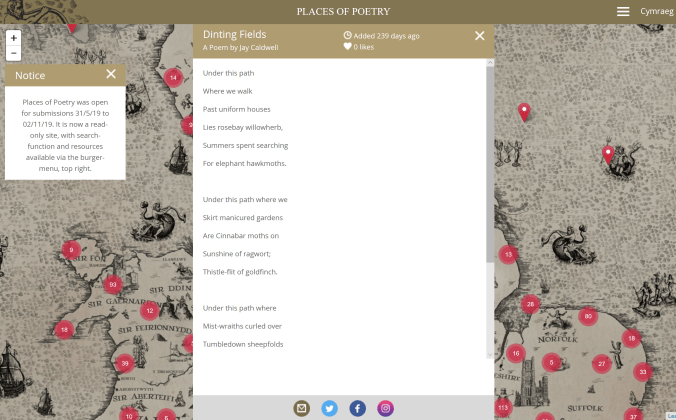
Dinting Fields by Jay Cladwell in Places Of Poetry

-Dinting Fields by Jay Caldwell, originally published in Places Of Poetry. Published by kind permission

Nuns Galore

I remember a time when the desert wasn’t metaphor,
when I was inserted there, for dry-throated reasons,
for years. A tree outside my cell leaved itself after rain
with lime parakeets and open-handed moths cloaking
the trunk with heavy wings of serge.
A decent desert, worth its salt. A sister-lined system.
The desert isn’t the desert unless it is too big for you.
This spiritual wilding lacks waymarkers and bounds.
And we were desert mothers and accomplices,
engendering puddle-babies and preening date palms;
aspersing them with quarter-buckets of day-old
well water, when it could be spared:
until they poked out flaring devils’ tongues—
which seemed to give a focus.

Days Round like the Moon

Mapped to the urban (but the soul can live on a little green,
can thrive on a tree; witness Coleridge’s patch of sky),
they nonetheless call themselves women of the blue flowers,
who flow back to the source, small and pink-breasted, multifoliate,
stamens alight. They will never be obsolete, women of the blue faces,
women of the blue fleeces, their tongues plumped up, giving rue,
dealing it like it was a winning hand at rummy, a many-wristed mother
wiping little mouths with a muslin napkin, while slow white moths
gather at the door. During Compline on the radio, a husband makes a pass
at the agency cook, who takes it all in her athletic stride. At day’s end,
the rhythm of the hours pauses on its cusp and the women reclothe
themselves in midnight blue, clutching the stars, women of the blue faeces,
dusting the moon and sinking down naked to dawn and Lauds.

-Geraldine Clarkson

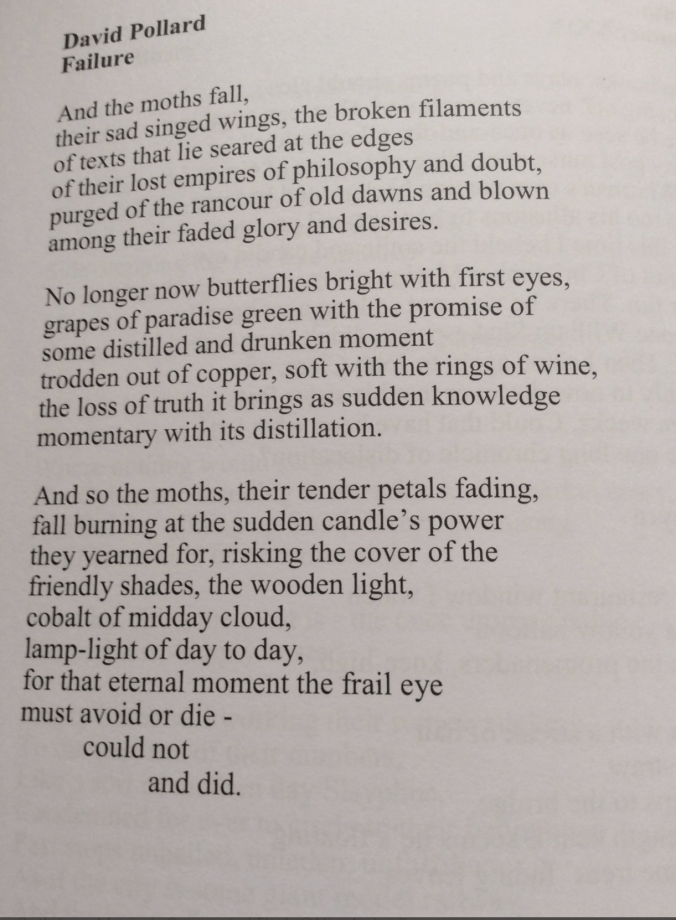
David Pollard Moths

-David Pollard

moths on the screen door
light is a wicked thing
blinding the hopeful
drawing in fragile creatures
looking for something real

-Elizabeth Moura

a hammock
of tent caterpillars
sags with dew . . .
our differing opinions
on the nature of beauty

tanka published in Atlas Poetica Special Feature, January 2018

bind my body
with spanworm silk
lay me down
in a shaded garden
until I turn to earth

tanka published in Atlas Poetica Special Feature, August 2019

-Debbie Strange

cicada
lichen

lizard
moth

-Charley Ulyatt (Published in Hummingbird)

MOTH-KU

lamp lamp lamp lamp lamp
lamp lamp lamp lamp lamp lamp lamp
lamp lamp lamp lamp lamp

=Susanna Lee

Faceless extinctions

A moth arrives like a small hand passing over my face
and when I open my eyes a heartbeat thuds against my
bedside shade. Leave your window ajar and your lamp lit –
why, that’s an invitation, says he. White ermine, little prince.

It was all my fault. No sooner had he nested than I requested
him gone. My insides spun him a silk cocoon, simple to sweep.
He had no face. A moth is a butterfly as a weed is a flower
alighting in the wrong place. Garden tiger, he grew.

A moth arrives like tinnitus, but listen and he stills his wings.
He only begins again on his own terms. Tell me my name?
he asks and won’t stop, like I am a light-trap and he is stunning
himself. Blood-vein, a lost boy looking for his shadow.

It was a hospital bed in strip-light. How uselessly we witness
the faceless. Our windscreens are clean of winged-reminders
of what is lost. In each of my hands, a small hand of the living.
Notice these night-thoughts and let them go. V-moths, thinning.

-Anna Kisby (originally published in Ink, Sweat and Tears)

The Butterfly will be admired,
While moths are often less desired.

-David Rudd-Mitchell

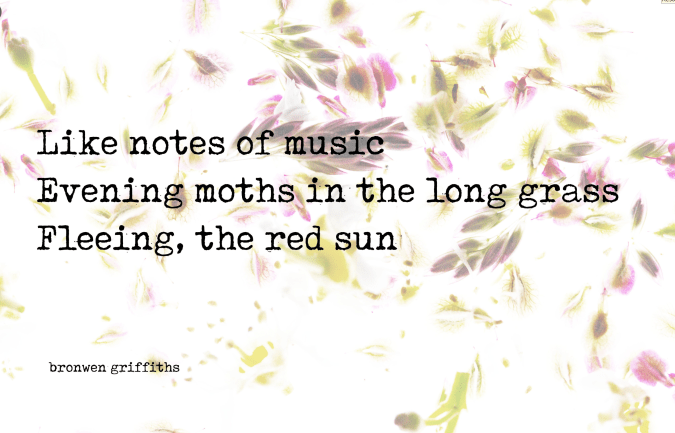
bronwen griffiths moth hailku

-bronwen griffiths

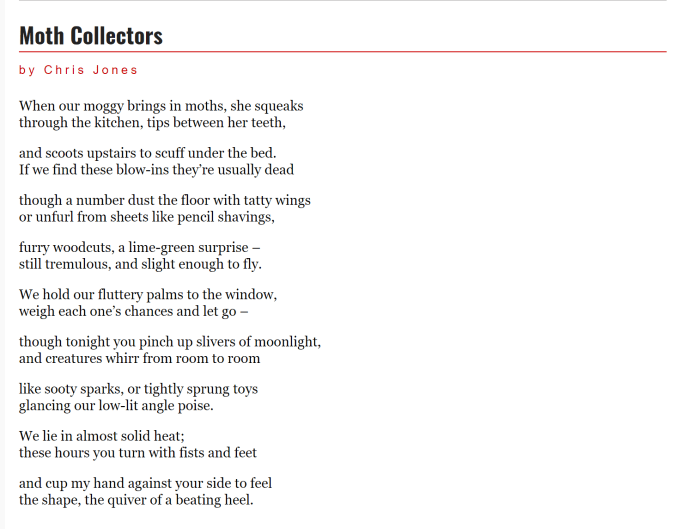
Chris Jones Moth Collectors

-Chris Jones

Colin Bancroft Moth poem

-Colin Bancroft

The large moth that flew in

It poked me in the cheek, trying to fly into my mouth, seeking refuge as if it were a word I uttered long time ago and now awakened from the dead.

Moth, from Old English moththe, Middle Dutch motte, Old Norse motti—were you a sound from sleep, a muffled cry? Were you spoken in error in the wrong ear, unintelligible, soft? Were you lost, looking for meaning down my throat?

Were you the comet moth, the black witch, the luna or the Gypsy, the emperor’s gum, good god, the dark dagger, dusky brocade, the death’s hand, the flame, the ghost, the shark, the snout, or the true lover’s knot? Were you November, or winter?

I’ll never know. I picked you up and threw you out into the night.

-Claudia Serea

Moth

This crypt still place
of twisted sheets,
a midnight room
black wings in flight.

I wake and struggle
to free my tangle
understand where
and how I lie.

The room lightens
monochromatic,
a landscape of shape
and shadow.

A large patterned
moth a terror to me.

A single flame,
a wooden box.
At last I sleep.

In this morning light
I opened the box,
it was empty.

-© Dai Fry 26th June 2020

A Lime Hawk Moth M W

-Dr. M.W. Bewick

The moth and the moon

The moth in my hand stopped
chained by the dust on my fingers.
Its fluttering receding with the moon
that it will never chase again.
The dust is mine
but the prized moth
that I thought was within my grasp
is now the moth and moon of a tragedy.
Forgive me.

-Jim (the poet) Young

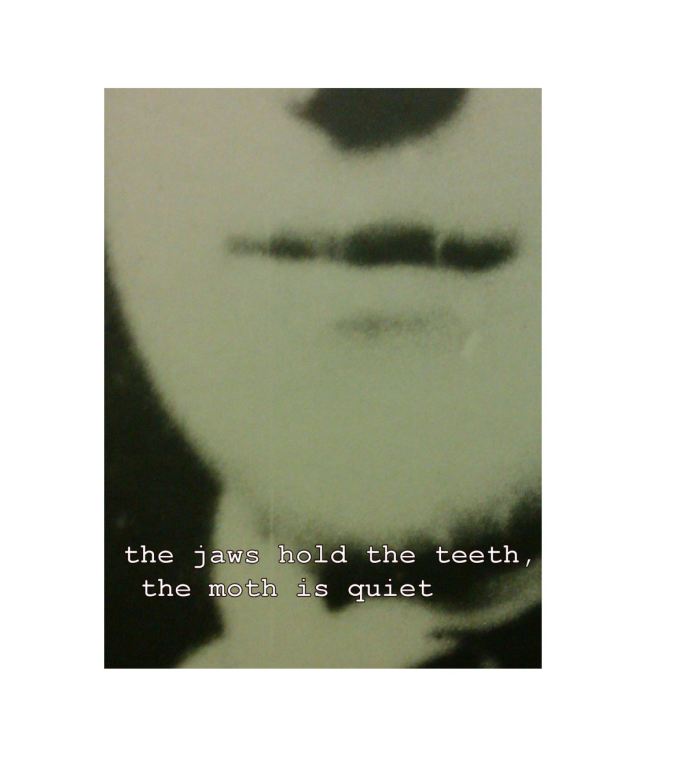
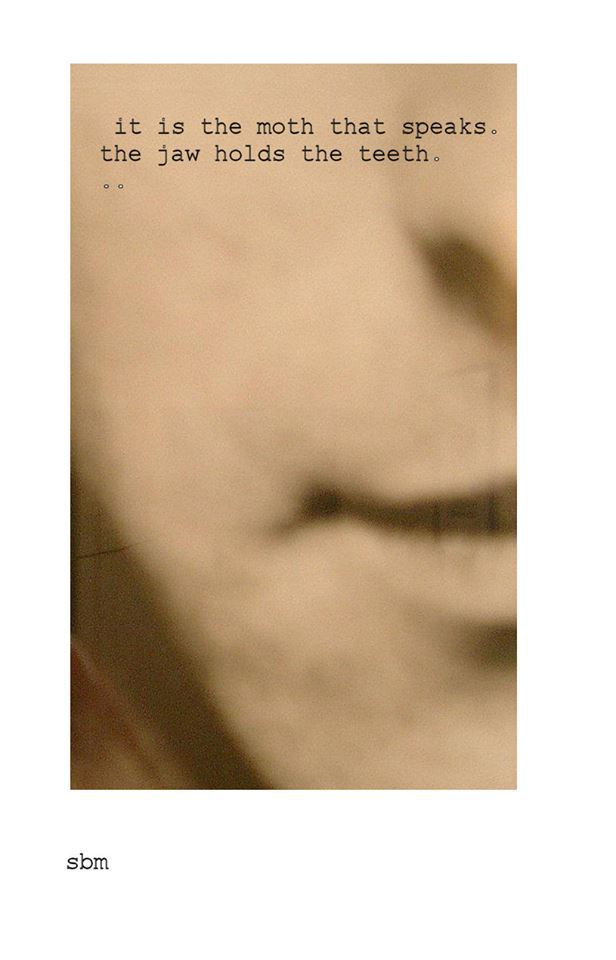
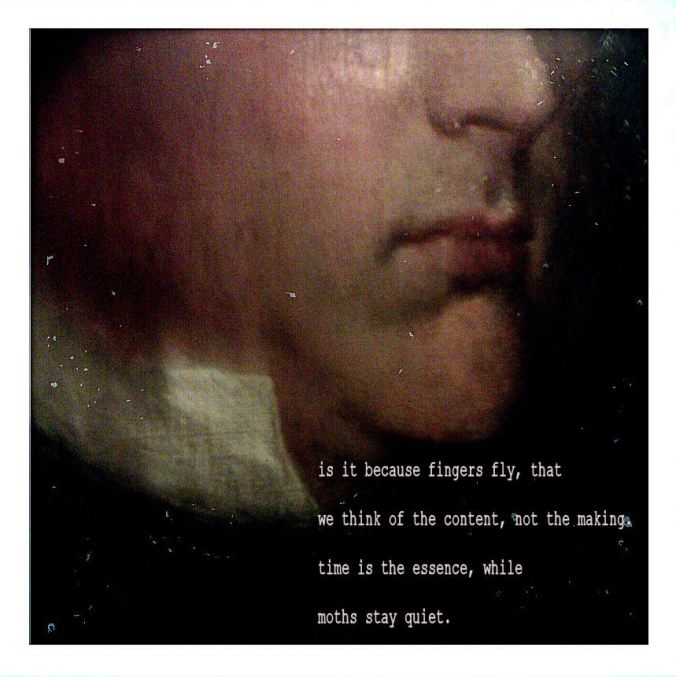
.. mothth..

the mothth as collage.
a quiet ththing.

#jaw

(photo challenge)

mothth 1mothth 2mothth 3mothth 4mothth 5

-sbm

fire fetish

she reaches
for the flame,
and her fingertips
burst into moths…

=Karlo Sevilla

This piece was previously published here in Quatrain.fish: https://quatrain.fish/post/148500316772/karlo-sevilla on August 9, 2016.

 Queen Carola’s Parotia on the Pergola

There was a gypsy moth massacre
Searching under decaying wood to get to the heart of contentment
Queen Carola’s Parotia on the Pergola
Reminiscent of a young European Paola
I heard news reports that it would be too windy for the vessels to dock
Ignoring the coarse-haired drummer
Into the virtual portal, longing to feel the sun again
Getting carried by Sunday schemes in your Chevrolet Blue Blazer
In the middle of doubting myself before speaking out
Overjoyed when I saw you outside the drugstore
I’m glad you’re grounded because I don’t want you to leave
Just know I’m wide for you

-Samantha Merz
Vancouver, British Columbia

Queen Carola’s Parotia on the Pergola poem published online at Grey Thoughts on May 25, 2019.

Autograph

You watch inky glass warp
+ shimmer — speckled
with dust. A noctuid
on the windowpane. Silver
y quivering between lilac
stars, agitated as water.
One of you enshrouds
the night.

-Bethany Mitchell

There once was a tailor of cloth
Who fought with a wily old moth
He gave it his all
And it bounced off a wall
And landed fair square in his broth

-Graham Bibby

Poetry on Phentermine
Spring, 2017

Often, I truly believe I am not asking
too much because the words weigh
less than all the buds on my tongue
but I later find out they
Weigh more than all the stars
in the sky to the one I
am asking whomever that
may be…

Right now. I feel very afraid.
Of what I do not know.

the other night I saw a moth
that, as it turns out, wasn’t
there.
It fluttered, beating
against the wall opposite of
my bed then disappeared, taking
its shadow with it…
Maybe it was just that—a shadow
of a memory of a moth.

My brain is palpitating. And so too
the day.

Marie died and “took” Cindy with her.
Deborah died. Connie is
Slipping away. I don’t much
like that other lady.

When you feel too alive does
That make you a running, screaming, breathing
fire?

And when in fires form you become
The first alien moth on Earth
Drawing companions of a feather
To you to beat a horde of tiny wings
Against a wall. Leaving smoky
Impressions behind that say

“We were here.”

-M T Simon

Island Sonnets 1

Rarities

The Slender Scotch Burnet Moth clings on
To this yellow bloom, this basalt cliff:
The fragile edge of a fragmentary life
Confined to islands. Under the melting sun
Summer’s haze shimmers over the sea.
There’s a threat of cloud in the west. The wind spills
A scent of gorse flowers over the folded hills.
This warm day’s a welcome rarity.

There’s so much peace in my heart it’s almost pain.
I’m bracing myself to withstand the next surprise,
Which isn’t coming. Ever. Only summer lies
In the days ahead. I’m facing the curious, strange,
Singular thought that it may all be over and done.
I cling to that fragile edge and bask in the sun.

-Yvonne Marjot

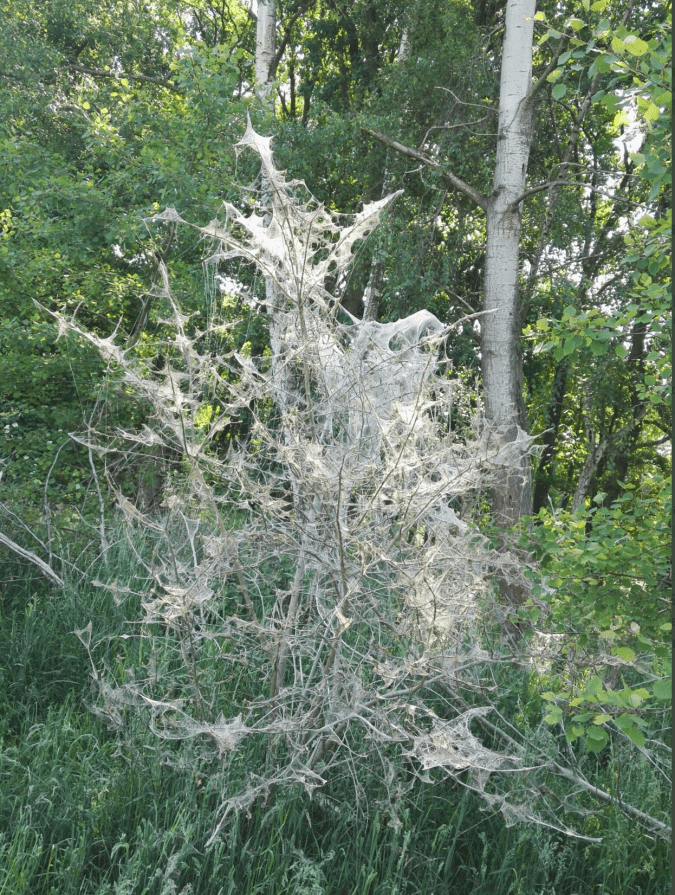
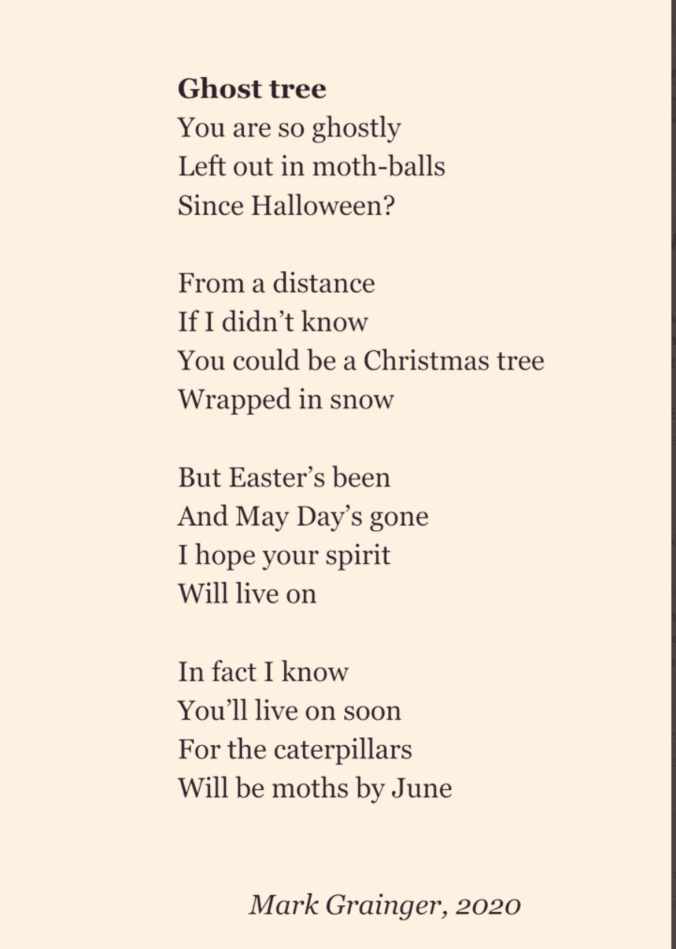
Ghost Tree by Mark Grainger 2Ghost Tree by Mark Grainger

Debbie Strange Dying Moth

-Debbie Strange

dying moth” – haiga, Failed Haiku Journal of Senryu Vol.3, Issue 33, Sept/19

moth dust
my muse speaks
of distant stars

Stardust Haiku, issue 35, November 2019

exotic moth display
a dream fragment
surfaces

Acorn #44, spring 2020

a silver moth
among the strawberry roots
autumn chill

Otata 47, November 2019

a white moth
lingers at the window
new moon

Asahi Haikuist Network, 29 June 2018

new moon
silently a chrysalis
splits open

Asahi Haikuist Network, 29 June 2018

Suicidal Moths

Ignorant moths dancing around the flames,
Unaware they’re participating in suicidal games.
Blissful in their quest, heading for the light,
Oblivious of the consequence of their self-destructive plight.
Expecting their fluttering to result in a gain,
Not the inevitable feel of life consuming pain.
Unknowing that their bodies are set to bubble and froth,
They joyously dance around the light,
each in turn becoming . . .
another suicidal moth.

Michelle Stevens

The moth child

All night
nestled in
her shell of light
she sings
of her sadness.
Fluttering wings
surround her,
flashing silver
in the moonlight.
And when she is
afraid,
her body
dissolves
into a thousand
white moths
which disappear
into darkness.

pale autumn moon
who is knocking
at your door?

-Whitehead L, 2018, “The moth child’, in Scryptic: Magazine of Alternative Art and Literature 2.4, Eds S C Gagnon, L A Minor, p70

Missing the Transformation

Moth, we owe you
Our deepest apology.

Not for letting little hands
Capture you in caterpillar
Youth, tiny feet tickling
Wrists and forearm skin;

Not for placing you
In a plastic box,
Snapping shut the lid,
Watching you build a rough cocoon;

Nor for placing you atop
A catch-all table in the kitchen
To which we gravitated,
Observing you at perigee.

Instead, we apologize for
Forgetting you at Christmas.
You emerged and spread wings
In a vacant world,

Devoid of blooms, without a mate.
You are significant for the miracle
We failed to see. Rest now in our garden,
Transform once more for our benefit.

Forgive us for ignoring
Your advent in our home.

-Devon Marsh

she is suspended
between here and gone
a cobweb
catching the light
of this moth-winged life

A Hundred Gourds 4.1, Dec/14

-Debbie Strange

Power of The Moth

Yet un described
member of the Order of Lepidoptera
of the Paraphyletic group, one
of the 160,000 alive on this planet.
Think not of me as a butterfly
though I am a painted lady, breeding
in Royal State, beware I am deadly
my habitat disturbed, not comforting,

I hide and rest by day, not for fear of the
butterfly, I believe in peaceful coexistence,
having long witches’ nose, but not casting spells,
keratin I love, in silk cashmere wool angora fur,

Yes I often hit the wall, I am confused by light
but when I fly by it, I frighten the flame, I love
to play the game, I bite , chew from side to side
hiding in basements cool fabric folds , inside.

Nature created me to warn mankind of the
temporal world, whatever lies unused, I eat
and destroy, so world ends and I too die
or else so delicate , how long can I fly?

“Lay not up for yourselves treasures upon earth”,
where moth and rust doth corrupt, and where thieves
break through and steal, but lay up for yourselves
treasures in heaven , away from moths and all decay.

-anjum wasim dar
Copyright CER 2020

Moth

She stares into the droplet of water
and pretends to be a bear.

Her body is covered in brown fur
and she has a bump, right where

her shoulders should be, like a
great grizzly that wanders through

forests of geysers at Yellowstone
or the snowfalls of Canada.

She’ll be dead before she sees the
world beyond the garden of

42 Arnold Avenue, where she was
born two months ago underneath

the lilac tree and filled her belly
on honeysuckle syrup. She sizes

herself up in the droplet – one of
the many mirrors of the rain.

When winter comes, she’ll dry up
with the leaves, never having

pawed her way through Alaska
and without feeling the warmth

of a cub’s scruff against her lips.
She drinks the droplet, watching

her reflection vanish for the sake
of a thirst still unsatisfied.

-Briony Collins

Bios and links

-Fiona H

lives in Ireland and is rather shy so would prefer to let the writing do the talking. She is a former Humanities student, now she studies humanity through creative writing.

-Anna Kisby

is a Devon-based poet, archivist and author of the pamphlet All the Naked Daughters (Against the Grain Press, 2017). She won the Binsted Arts prize 2019, BBC Proms Poetry competition 2016, and was commended in Faber’s New Poets Scheme. In 2019 she collaborated on the project Creative Histories of Witchcraft and is subsequently working on a collection exploring historical magical practitioners.
Note: White ermines, Garden tigers, Blood-veins and V-moths are British moths on the verge of extinction.

Karlo Sevilla,

from Quezon City, Philippines, is the author of the full-length poetry collection, “Metro Manila Mammal” (Some Publishing, 2018), and the chapbook, “You” (Origami Poems Project, 2017). Recognized among The Best of Kitaab 2018 and twice nominated for the Best of the Net Anthology, his poems appear in the journals Philippines Graphic, Small Orange, Black Bough Poetry, Shot Glass Journal, detritus, Radius, Matter, The Daily Drunk, the anthology, “NOSTALGIYA, Antolohiya Ng Mga Tula” of Samahang Lazaro Francisco, and others.    

-Jim Young

– a poet from the Mumbles – who does most of his writing in his beach hut at Rotherslade Bay baitthelines.blogspot.com haikueye.blogspot.com

-Samantha Merz

Samantha’s Pinwheels poem was published in Reality Break Press’ Volume I Poetry Issue. Other poems by Samantha have been published by Polar Expressions Publishing, Grey Thoughts, Fevers of the Mind Poetry Digest, Nymphs, Malarkey Books and Poetry Festival. In 2019, Samantha self-published a collection of poetry called Kazoo.

-Bethany Mitchell

has an interest in poetry which can be read ecologically. She often researches place and landscape through site-specific writing. She recently reviewed Maria Sledmere’s nature sounds without nature sounds for amberflora, co-edited the zine VOICES in association with Nottingham Poetry Exchange, and her poems have been published or are forthcoming in Crêpe & Penn, Kissing Dynamite, lower ground 18 and (w)hole. She tweets @bethjmitch

-Yvonne Marjot
is a lost kiwi, now living on a Scottish island. She has been making up stories and poems for as long as she can remember. Her first volume of poetry, The Knitted Curiosity Cabinet, won the Brit Writers Award for poetry in 2012. She loves her job, running a small public library, and has published four novels and a book of short stories. Twitter handle: @alayanabeth

-Lucy Whitehead

writes haiku and poetry. Her haiku have been published widely in international journals and anthologies such as Acorn, Autumn Moon Haiku, bones, Frogpond, hedgerow, Modern Haiku, Otata, Presence, Prune Juice, The Heron’s Nest, and The Red Moon Anthology of English-Language Haiku 2018 and 2019. Her longer poetry has been published this year or is forthcoming in Broken Spine Artist Collective, Burning House Press, Clover and White, Kissing Dynamite Poetry, Parenthesis Journal, Pink Plastic House, Pussy Magic, 3 Moon Magazine, Re-side, and Twist in Time Magazine. You can find her on Twitter @blueirispoetry.

-M T Simon

reads and writes poetry of all forms but is especially fond of haiku/senryu, tanka and haibun. Her poetry has been published in several magazines both online and in hard copy. Most notably, she won first prize in the Dreamers Creative Writing Haiku Contest and was published in the Jul-Oct 2019 issue if that magazine. She is also an essay finalist and enjoys writing flash fiction, short stories and novels. Her first novel, Heart of Malice, came out in 2015 and another, Six Strings is soon to be released both are under the pen name: C Billie Brunson.

-Devon Marsh

served as a Navy pilot before a career in banking. His poems and essays have appeared or are forthcoming in The Lake, Poydras Review, The Timberline Review, Remembered Arts Journal, Black Bough Poetry, and periodicities: a journal of poetry and poetics. Devon lives in the North Carolina piedmont.

-Debbie Strange

is an internationally published short-form poet, haiga artist, and photographer whose creative passions connect her more closely to the world and to herself. She enjoys exploring the wilds with her husband in their lime green 1978 VW campervan. Debbie maintains a publications and awards archive at debbiemstrange.blogspot.com.

-Briony Collins

is a writer, artist, and actor based in North Wales, represented by DHH Literary Agency. Her career began when she won the 2016 Exeter Novel Prize. Since then she has gone on to publish poems with Agenda Magazine, Black Bough Poetry, Vociferous Press, and Creative Bangor. Last year, her short story ‘Citroen Sid’ was published by Retreat West to raise money for Indigo Volunteers, and her first play, For the Sake of the Jury was performed to packed audiences at the Victorian Christmas Festival in Beaumaris. She is currently the co-editor of Cape Magazine and co-host of the Altered Egos podcast. In addition to her writing, Briony enjoys directing and performing in plays. Most recently, she starred in Birdsong as Lieutenant Stephen Wraysford in a production for Bangor.

-Mark Grainger

was born in Sussex, but now translates financial reports for a living in Frankfurt, Germany, where he lives with his fiancée and their dog. Inspired by his grandfather, also a poet, he began writing poems to share with his family in 2018. When his output ballooned under the coronavirus lockdown, he began sharing ‘lockdown poetry’ on Twitter (@marktgrainger).

-‘Bronwen Griffiths

is the author of published two novels and two collections of flash fiction. She also writes poetry and attends the Rye Harbour poetry workshop (or used to before Covid). She lives on the East Sussex/Kent border.

-Chris Jones

lives in Sheffield and teaches at Hallam University. His last published poetry collection was Skin (Longbarrow Press, 2015).

=Geraldine Clarkson

lives in the UK Midlands and her first full poetry collection from which these two poems are taken is called Monica’s Overcoat of Flesh and is published by @NineArchesPress

-Charlie Ulyatt

A poet of two halves – Charlie Ulyatt started writing poetry in his early twenties with earlier short poems printed in publications including Haiku Quarterly, Purple Patch, Peace and Freedom, Iota and Sepia amongst others. He also self published a small booklet of predominantly small vignettes called ‘Scorched Wings’, before ‘semi retiring’ from poetry for a while to focus on improvised music.

The second half ‘kicked off’ a little over a year ago with a more minimalistic approach to poetry, allowing space for imagination and reflection. He has recently self published a small pamphlet entitled ‘Absent Stirring’ and a small 8 poem ‘beak book’, ‘Slow Day Ahead’ and has also had poems published in HQ Poetry Magazine and Hummingbird (US) along with poems included in a garden poetry project.

-David Pollard

has been furniture salesman, accountant, TEFL teacher and university lecturer. He got his three degrees from the University of Sussex and has since taught at the universities of Sussex, Essex and the Hebrew University of Jerusalem where he was a Lady Davis Scholar. His doctoral thesis was published as: The Poetry of Keats: Language and Experience (Harvester and Barnes & Noble). He has also published A KWIC Concordance to the Harvard Edition of Keats’ Letters, a novel, Nietzsche’s Footfalls (Self-published) and five volumes of poetry, patricides, Risk of Skin and Self-Portraits and Broken Voices (all from Waterloo Press), bedbound (from Perdika Press), Finis-terre (from Agenda) and Three Artists (from Lapwing Publications). He has translated from Gallego, French and German. He has also been published in other volumes and in learned journals and many reputable poetry magazines. He divides his time between Brighton on the South coast of England and a village on the Rias of Galicia.

There is a substantial article on his work which appeared in Research in Phenomenology and which can be read at:
http://www.davidpollard.net/david-pollard-and-philosoHi Paul,

phy-by-jason-m-wirth/

Further information can be found at
davidpollard.net
http://en.wikipedia.org/wiki/David_Pollard_(author)

..day 106..

Sonja Benskin Mesher's avatarsonja benskin mesher

..day 106..

sometimes i have to check my numbers
sometimes they run out of corn all together
and offer me peas

not the same james
a different colour
i like yellow

i place the bone
where the mouse once was

the other bodies are boxed now

murky this morning and possibly cool
outside
with promise of a social occasion possible

unless there are more gigantic congregations
with no worth other than to scatter their litter

they will come with fire here on the bridge
where he spent the day scraping tenfold
maybe gave up

i have not heard him since
told me he had obsessions
i tend to agree

excitement here over the boxes
due here soon, parcel force

do you remember my love

this is a new project

anyway

that is the way i get stuff now
no travelling
no stores

no hassle
only the joy of expectation james

View original post 46 more words

Where The Fog Has No Name – Poems and Images by Eliot North

robertfredekenter's avatarIceFloe Press

Where the Fog has No Name

Conceived in a sea fret, whilst resident artist for ‘Djerassi: Scientific Delirium Madness’, 2018

Elements of Paint


Barbara H. Berrie, grew into her name;
a scrap of a girl, all angles. She felt at odds

with the round sound on her tongue,
her name passed down through generations.

We walk and talk, about many things:
including where the sea ends and sky begins.

The chemist in her is so precise, she thinks carefully before
she opens the lid on the depth and breadth of her knowledge,

the elements of paint in sky:

Azurite,
Ultramarine,
Prussian Blue,
Cerulean,
Smalt.

The landscape speaks.

When asked to name the colour of sun
her answer is considered. By sun, you mean fire,
a sunset spectrum. Well now let me see.

You’ll need red oxide, deep orange, canary yellow
then something paler, diffuse sunlight:

Minium,
Gamboge,
Aureolin,
Litharge.

View original post 902 more words

National Insect Week Poetry Challenge: Take part with Yvonne Marjot, Anjum Wasir Dar, Alan Toltzis, Debbie Strange, Maryann Corbett, Stuart Buck, Dai Fry and myself. Monday: Dragonflies. Tuesday: Wasps And Bees, Wednesday: Ants, Thursday: Beetles, Friday: Butterflies, Saturday: Moths, Sunday: Flies. Email me and I will add yours to my daily WordPress posts, also posted to Twitter and Facebook. You can still add to all the posts already published. Here are today’s: Butterflies

Friday: Butterflies

Butterflies’ Finding Joy in Fluttering’

Delicate majestic royal
tiny fluttering  fragile flyers,
the fine beauty of  gardens
the butterflies-

multicolored, patterned winged
true and rare like Riodinae
the smallest Lycaenides, the
common family of Blues
little whites flying close to the
ground are ‘Psyche’-
And Great Mormon with
velvety wings found in forests thick.
Butterflies by day delight the eye
moths by night, with hairy antennae
tell the watchful, flight by dye-
Skippers Coppers even Tigers are
in, the metamorphosis of life-

what a fine lesson of adaptation
in times of pandemic change in nations
Man will always find nature glowing
showing courage, praying bowing.
Who best to be the change, without a
cry but the tender carefree tiny butterfly.

-anjum wasim dar
Copyright  CER  2020


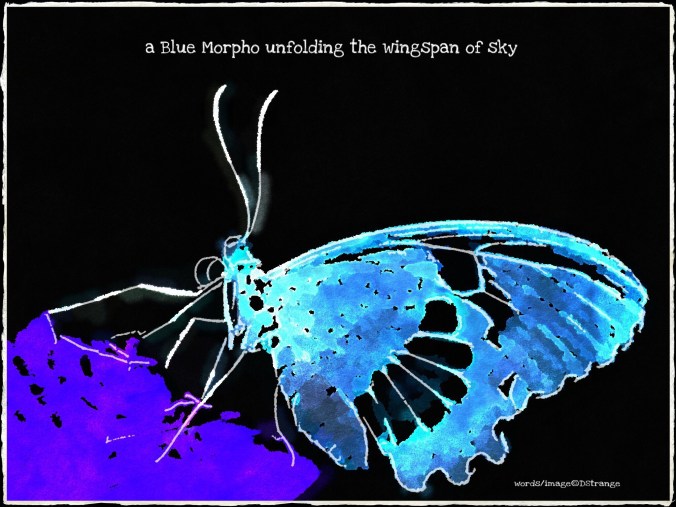
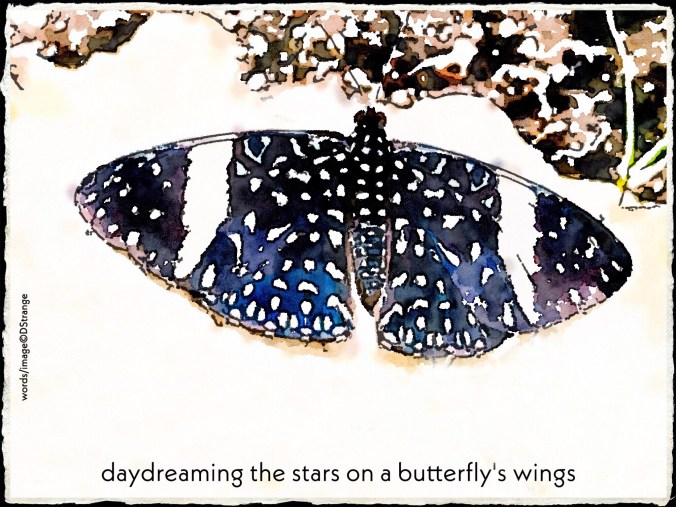
Debbie Strange Blue Morpho unfolding Butterflies

) “a Blue Morpho” – monoku, Otata 36, December 2018

Debbie Strange a blue morpho butterflies

“daydreaming” – monoku haiga, Incense Dreams 3.1, October 2019

in my garden
a gatekeeper butterfly
basks in the sun
I cover my pale body
only coming out at night

Tanka published in Cattails, September 2016

it was
as if she were
a butterfly
the way words flew
from her open hands

tanka published in Cattails, April 2018

we once played
in this tangled garden,
enchanted
by the quiet fireworks
of bergamot and butterflies

tanka published in Atlas Poetica 36, February 2019

=Debbie Strange

Alan Toltzis Butterflies 1

Alan Toltzis Butterflies 2

-Alan Toltzis

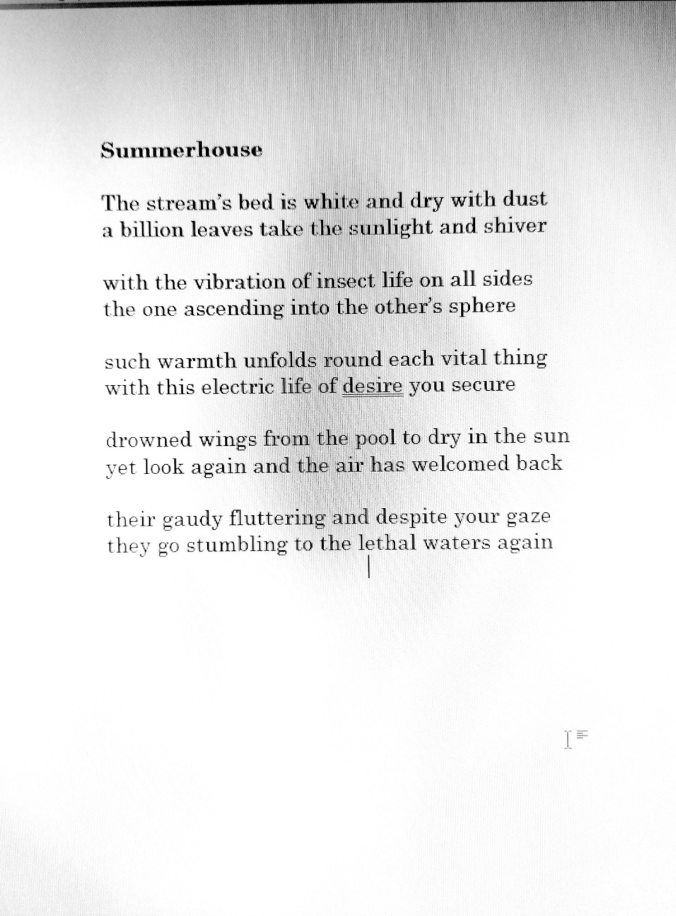
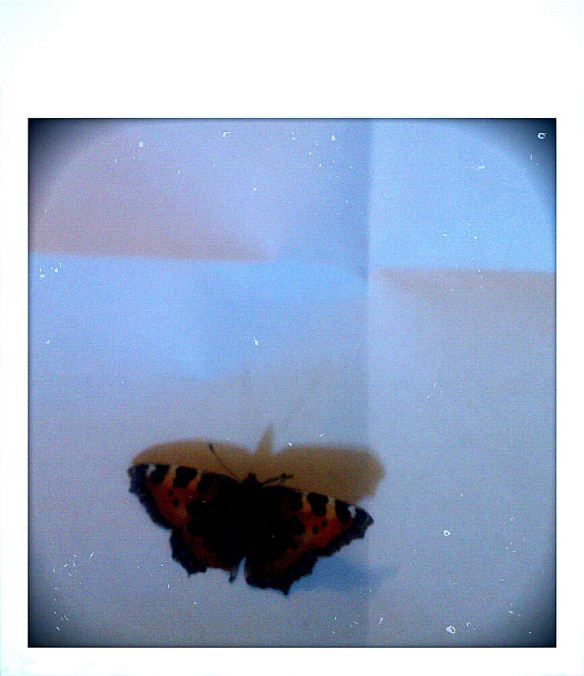
Summerhouse Tristan Moss

=Tristan Moss

Fritillary

Scrap of Turkish
carpet, October leaf;

airborne
dancer riding fragrant
currents

with skip and dart;
pearled slurper

of nectaries
of ragged-robin,
bugle, self-heal.
buttercup.

Not so bad then
an inchworm life

of toil and spin
heave and crawl,

if our reward
were this.

(The poem has been previously published in In The Cinema
( Playdead Press 2014 ) and is to appear in the forthcoming Emma Press,
Anthology of insects.)

-Stephen Bone

sonja butterfly

. black hearts .

black topics.
cause and effects,
the butterfly’s wing.
so here on the night watch,
all is quiet , no birds sing.
touched by the small thing,
softly, we drew together,
with words, and gestures
in air, in mind.
touched by the old things
i draw and weave
the ways of night.
upload the black heart,
later.
i write, edit, delete.
words here,
you cannot see,
do they leave a trace,
tell me.
do you sense their meaning?
and the rhyme,
are there codes
between the lines.
is there something
in words not said,
or is it here,
as clear,
as day.
when it comes..

sbm.

Butterfly Unit

Old equivalents:
insect metamorphosis
and the grade-school class

blundering with me
through a weed-choked patch along
railroad rights-of-way,

plucking milkweed plants.
On fat leaves, Danainae
bug-adolescents

hunch, gorging, brainless
motor-mouths on sixteen legs,
to be seized and press-

ganged to middle-schools.
Clown-clad and ridiculous,
writhing their own rules,

in the end they close
off all contact, lacquered to
one long, studied pose –

held, the way one holds
breath, waiting to see what form
so much thought unfolds.

Later, on school lawns,
whoops of pleasure will set free
gold-and-sable gowns.

Old, the lesson here.
Teachers stand and clap as lives
lurch, lift, disappear.

-Maryann Corbett (previously published in The Harlequin)

Clouds

There is a country path
bound by a country hedge
and a field of barley.
Blood splatter of poppies,
heads of hot crimson shame.

And early summer bakes
the fields and hills.
And you walk slow
and dusty.

And all the way
down the slope
to the wooden fingerpost.
Clouds of butterflies
erupt from the hedge
woven of bladder campion,
hazel, old mans beard,
scarlet pimpernel and
hogweed… a pretence
of cow parsley.

© Dai Fry 25th June 2020.

As The Butterfly Flies

A splash of colour,
hurricanes flutter.
Wind it its wings,
my heart sings.

A merry sight,
a silent flight.
A tedious existence,
duplication resistance.

My gut, my heart, my eyes, my art.
Cause and effect miles apart.
Over the flower and under the leaf,
serendipity to my sister’s grief.

This memory, a moment you and I share;
as the butterfly flies unaware.

-Ria Gupta

Christina_butterfly_bleachedbutterfly[84026]

butterfly
clings to a bluebell
broken wing

A haiga in the inaugural issue of Bleached Butterfly Magazine

deeper–
in the orchid
a butterfly

The Zen Space Spring 2020 Showcase

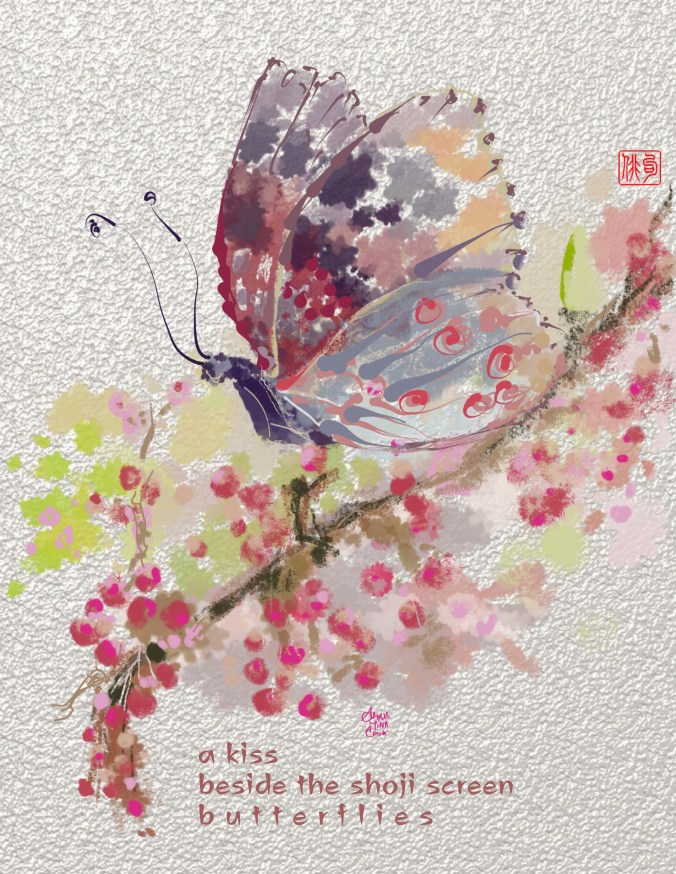
ChristinaChin_a kiss beside the shoji screen butterflies

a kiss
beside the shoji screen
b u t t e r f l i e s

Haiga published in Akitsu Spring issue March 2020.

stay home order
butterflies swarm
my fruit feeder

Pangolin Review, Covid-19 May 2020

-Christina Chin

Butterflies Are Flames

Flicker, white, red, blue,
Every butterfly takes away your loss
on fragile wings autumnal leaves
in flight.

Don’t say you wish to be a caterpillar
again. Do not say you want to lose
your wings, fold them into your body
hang by a string a chrysalis,
turn into an eating machine again.

Every butterfly takes the last flame
of your breath and carries it from your coldness,
carries your fire, brightens the day.

-Paul Brookes

Bios And Links

-Ria Gupta, a resident of New Delhi, India. Pursuing a Bachelor’s in English Honours, an aspiring writer and an artist by passion. She is currently exploring various avenues of content writing along with managing her personal blog https://candourandflavour.wordpress.com/ . At 21, she has polished her skills through experience in varied fields like teaching, writing, performing arts, and social media management. She is now working towards assimilating and sharing it all with the world in a creative way.

Instagram : @ria_gupta
Blog : https://candourandflavour.wordpress.com/

-Stephen Bone

Stephen Bone’s latest pamphlet Plainsong ( Indigo Dreams )
appeared in 2018. A Hedgehog Press Stickleback pamphlet
due in 2020.

-Dai Fry

is an old new poet. He worked in social care but now has no day job. A keen photographer and eater of literature and lurid covers. Fascinated by nature, physics, pagans, sea and storm. His poetry seeks to capture image and tell philosophical tales. Published in Black Bough Poetry, Re-Side, The Hellebore Press and the Pangolin Review. He can be seen reading on #InternationalPoetryCircle and regularly appears on #TopTweetTuesday.
Twitter. @thnargg
Web seekingthedarklight.co.uk

Audio/Visual. @IntPoetryCircle #InternationalPoetryCircle Twitter
#TopTweetTuesday

-Christina Chin

is from Kuching, Sarawak, Malaysia. Recently she won two of City Soka Saitama’s 2020 prizes. She is the 1st place winner of the 34th Annual Cherry Blossom Sakura
Festival 2020 Haiku Contest hosted by University of Alabama’s
Capstone International Center. Her photo-haiku won a Grand Prix Award in the 8th Setouchi Matsuyama International Contest in 2019. She is published in the multilingual Haiku Anthology (Volumes 3-5) and the International Spring Saijiki. Christina is published in Haikukai (俳句界) one of Japan’s biggest monthly haiku magazines. Her poems appear in many journals including AHS Frogpond Journal, the Red Moon Anthology, Akitsu Quarterly Journal, The Asahi Shimbun, ESUJ-Haiku, Presence, Chrysanthemum, The Cicada’s Cry, The Zen Space, Wales Haiku Journal, Prune Juice, Failed Haiku and Cattails (UHTS).
You can find Christina Chin online at WordPress: https://christinachin99blog.wordpress.com/. She also maintains an ongoing scheduled blog of featured and published haiku: https://haikuzyg.blogspot.com/.
Twitter:
https://twitter.com/Christina_haiku?s=09
Instagram:
https://instagram.com/zygby22

Paul Brookes

is a shop asst. Lives in a cat house full of teddy bears. His chapbooks include The Fabulous Invention Of Barnsley, (Dearne Community Arts, 1993). The Headpoke and Firewedding (Alien Buddha Press, 2017), A World Where and She Needs That Edge (Nixes Mate Press, 2017, 2018) The Spermbot Blues (OpPRESS, 2017), Port Of Souls (Alien Buddha Press, 2018), Please Take Change (Cyberwit.net, 2018), Stubborn Sod, with Marcel Herms (artist) (Alien Buddha Press, 2019), As Folk Over Yonder ( Afterworld Books, 2019). Forthcoming Khoshhali with Hiva Moazed (artist), Our Ghost’s Holiday (Final book of threesome “A Pagan’s Year”) . He is a contributing writer of Literati Magazine and Editor of Wombwell Rainbow Interviews.

..day 105..

Sonja Benskin Mesher's avatarsonja benskin mesher

..day 105..

the storm came last evening
well, late afternoon really. we

were talking as i watched the
water fall down the window

there was none the other end
though breezy with the doors

open

the studio was an oven of
oppression
skin pricked
while

i drew the tiny coat faintly
and left to sit outside to
think

to

then carry compost round
the back

filthy then i bathed, put on
cotton pyjamas
heard the heaviness of water
drops

we have cat slide windows
here

james

water runs down
water runs everywhere

that was last evening and it all steamed later

it is morning
the mist hangs
in the place i walk
each day

that place i lived was on the news
&
for that one day i am glad i moved
away

all the other days too
i have been here a while
now

softly

2

View original post

..day 104..

Sonja Benskin Mesher's avatarsonja benskin mesher

..day 104..

the wild thing entered the studio again
whilst
i was not looking

the dead things are missing
presumed eaten

years old
dried must
have tasted bitter

feathers left outside
in scatters

i had taken photos

the rat remains under glass

even at home small dramas occur

they had the drain issue
while i experienced non delivery
though they said they had
delivered

so today we talk of cows
now up behind the yard
where i can see them all

together

so pretty with differing patterns
james
with a chevrolet bull he said
he possibly will have spelled
it different

i don’t know

i see a lot while walking yet
still envy those that pass by
bike

i still pick up things that they
may not see going by so quick

like he did not see the objects
the idle artefacts in passing
so busy thinking of his own…

View original post 21 more words

National Insect Week Poetry Challenge: Join Yvonne Marjot, Anjum Wasir Dar, Dai Fry, Imogen Forster, Susie Wilson and myself. Monday: Dragonflies, Tuesday: Wasps And Bees,Wednesday: Ants, Thursday: Beetles, Friday: Butterflies, Saturday: Moths, Sunday: Flies and sundry insects. Email me and I will add yours to my daily wordpress posts, also posted to Twitter and Facebook. You can still add to all posts. Here are today’s: Beetles

Thursday’s post: Beetle

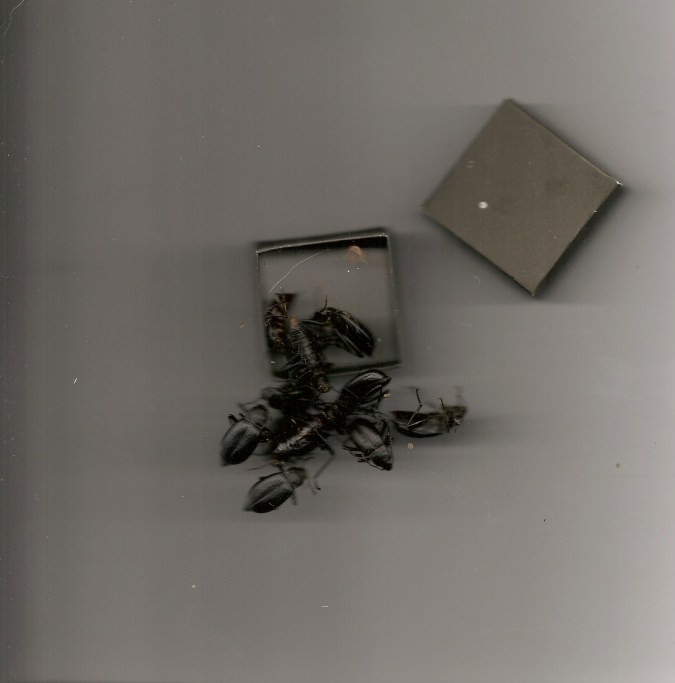
LOVE SONG OF A GROUND BEETLE TO NEPTUNE

Some beetles have fantastic colours which persist even across thousands of years as a fossil, retaining their iridescence, which they have even though they are nocturnal and which is counted, scientifically, as an enigma.

Beyond the sea of Madagascar,
our floating island prison,
he is more blue and far more lovely every night.

Beyond the dark blue evening
and the dusk men think we come to life in,
he hangs pulsating in the sky: cyan, cerulean.

His hardened wings he has made for himself:
ammonia, hydrogen, iced methane capes,
still iridescing in thousand-mile winds.

Each night we arrange our ridged back plates,
our blue and half blue horns and antennae
ready to send back a signal to you.

I will swim over the hills of the stars.
I will leave behind my desert isle ship.
No more will we wait here waving, waving

our arc’d antennae every endless dark evening.
Hydrogen, await me! Ammonia, embrace me!
Wild rocking of poles in each rotation until we meet.

Oh, Neptune! Beautiful bluest of blue,
Whose light we creep out to reflect each night,
Tell us the time to fly up to you!

-Susie Wilson

sonja Beetles


. water men and beetles .

there are a few, those who should tidy,
those who pump and clear, those who
investigate.
water beetles float their legs, paddle
the river, dimpling surface. hang on
the bridge , warming back and watch.

water men wear high visibility, while
the beetle shines black.

lately we have cut the paths
and planted bluebells.
sbm.

the graffiti
of firefly stars at dusk
we follow
until our eyes adjust
to the narrative of night

tanka published in Earth: Our Common Ground, April 2017

-Debbie Strange

611. black beetle

have you read of them before?
the beetles here turn over,
legs waving, we turn them back,
then,
it is all repeated.
empathy kicks in
for all small folk
who suffer, who cry
in dark corners.
we know he will die,
yet cannot save him.
all is in disorder.

sbm.
.

.288 beetle.
it was my beetle, dead, not buried.
i keep them, yet it fell
to the floor,
mysteriously lost.
we try to turn disasters round,
here, knowing it will be found,
some time.
my dear sweet sexton, the burying kind.
aptly the grave digger, it seems
you can buy dead insects on line.
sbm.

..harry lime..

i am a detective a bit
like
harry lime
looking for a beetle
blackened ; crusty with a smart serge suit from
foster brothers

went missing a week or so ago
the full moon following

reported by a family in the
cellar concerned

by its legs waving wildly ; sock dangling
backed on flagged floor

missing person

crisp printed poster
denoting

sbm.

Scurrying

There’s a lot
of to and fro
on the flat patio stones.

I lack their language
size and drive.
So consequently,
a world of mystery
exists under my feet.

The economy
lockdown and the NHS
are as strange to these
beetles as a distant
neutron star.

“Where’s my dung ball
I’m sure I left it over there”

© Dai Fry 24th June 2020.

Chrysolina Americana: Rosemary Beetle

Opportunists, night-arrivants
on some aromatic spoor,
in their bronze clusters
they chew the tough leaves
with relentless mouthparts,
leaving a dry grey ruin.

Under the microscope
they are beautiful: striped,
red and green, iridescent.

Crushed in my fingers
they have the dark
rosemary smell of sticky
pine resin, varnished pews
and the creosote dust
of old garden sheds.

I kill them, but I am
glad they come.
I should dislike them
much more than I do.

-Imogen Forster
Dung Beetles

Our lass and I often roll
away your dung ball together,
dig a nice hole for it,
drop it in, and cover it.

Below ground, our lass reworks
your dung into the shape of a pear,
leaves the top hollow,
where she inserts her eggs.

When the larvae hatch,
they have more than enough to eat,
eventually pupating
before emerging into the light.

-Paul Brookes

On Beetles ~ The Blister Beetle of Europe

I, the Blister Beetle of Europe am feeling so
proud to be named as “The Insect of the Year”,

Let the Ancient Greeks know that  I am  the
“endangered species”, and  I am still the best,


My healing properties are vital, deadly toxic
secretions Cantharidin  a healing salve , an

Aphrosidiac, the best of forty types of oil
beetles, my poison helps to kill enemies,

The Greeks know it, if I am threatened I
secrete more drops, my home is in sandy

Open spaces dry meadows and orchards
part of human culture for more than 4000

Years, watch out, my odorless  droplets
cause blisters,I use it to protect larvae

Though I am hardly 10 to 35 millimeters in
size,valued  high I am Crowned “Insect 2020”

My Cantharidin is enough to kill one adult
one blister beetle for one human, plenty.
 

-Anjum Wasim Dar
Copyright CER 2020

Bios And Links

-Imogen Forster

lives and works in Edinburgh. In more normal times she’s active in a number of reading and writing groups in the city. She has an MA in Writing Poetry from Newcastle University, and has published poems in various online and print magazines. She expects to have a pamphlet next year, and tweets as @ForsterImogen.

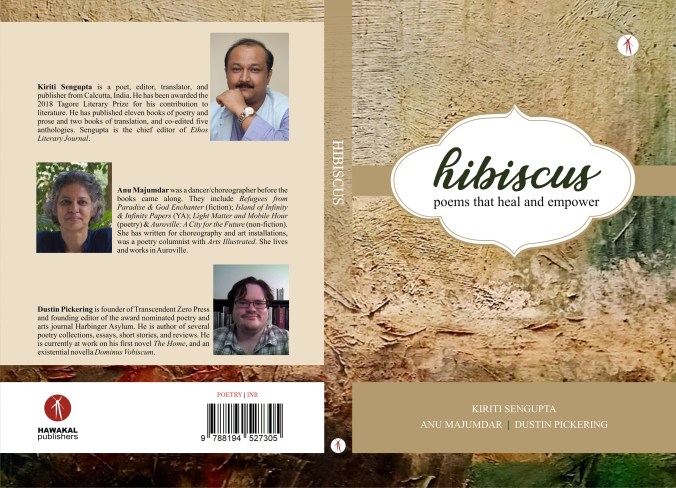
Wombwell Rainbow Book Interviews: “Hibiscus: poems that heal and empower”, edited by Kiriti Sengupta, Anu Majumdar and Dustin Pickering

Hibiscus Cover

1. How does poetry heal?

In the introduction to Hibiscus, I wrote: “Can poetry heal us? Of course, it does. The importance of healing and the power of the spirit can never be hyped or ignored, for it is as integral to our living as breathing.” So, I understand where the question comes from. Art heals in more than one way. It can disturb us, and thus, prepares us to address the concerns on our own. And at times, art makes us feel good.

Nevertheless, poetry, like other expressions of art and culture, stimulates our nerves, or the brain, to be precise. There is no point in explaining how the brain receives and processes the impulses. I’ll quote George Harrison: “It’s all in the mind!” Rhythm, not necessarily rhyming, and the contents of poetry help convey the stimulus to the brain. Let me cite an example: the Vedic verses (the shlokas) are chanted even now to boost mental and physical wellbeing.

Kiriti Sengupta

Poetry is capable of cauterizing wounds where the language is most pertinent. Language is the human capacity to challenge and evade reality on grounds of its unreality. It can create worlds where reality meets our expectations or where we are met with ourselves in such a light that we recognize Caliban’s face in the mirror of literature, Our hideousness is before us, as in Plath’s “Tale of a Tub” where “the stranger in the lavatory mirror” both encapsulates humanity in truth and also beautifies the ugly through sublimating its presence in life. Poetry is the sublime capacities of language, emboldened by fears and hopes held in human hearts, which serve as a kind of escapism but also as revelation. Poetry reminds us in so many ways that God is present within or that the divine spark within us can speak. Poetry confounds boundaries of the recognizable and intuitive reality shaped by forces beyond our control. It exists on the liminal dreamscape of communication and human yearning.

The feeling compelled in poetry speaks volumes more than much of what is written in prose. Because it can transcend storylines, plot barriers, restricted flow of thought, or the everyday process of life it has the ability to flood into the mind with subtle healing. The art of crafting poetry offers surprises and helps victims contextualize the things hurting them. People see things differently when they write about them. Writing helps trauma victims safely face their private tragedies, and as a form of self-communication poeticizing unveils histories and allows us to see things much differently than we had before. It also opens us up to discussing things we are afraid to discuss openly because it creates a distance between us and the subject at hand.

Even though the world holds the suffering of the greatest poets in front of us, might we consider that poetry became their armor rather than caused their turmoil? Plath, again, wrote from her domestication troubles and mythologized from histories and folklore to show us how deeply personal the human experience is. The most minute details of life can be memorialized in poetry, thus poetry acts as memory as well.

Dustin Pickering

2. How does poetry empower?

Empowerment precedes healing. Honestly, when I conceived Hibiscus, I was particularly keen on curating poems that addressed healing. Anu Majumdar, one of the associate editors, proposed “empowerment.” It was an eye-opening moment. Where does healing lead to? As a clinician, I can tell you, healing is not all about back to normalcy, or in other words, restoration of the state of being. Healing imparts strength. It renders authority. Post-extraction, the edentulous gum gradually turns hard to aid in chewing, and at times, it rejects prosthesis. Empowerment is a spontaneous phenomenon. It exposes us to more injuries—a lot more scratches. You know, wounds are impressive: they bleed, itch, ache, and enlighten. What about the laceration of the soul? It is invisible but never ceases to make its presence felt at every crucial juncture. The resultant scar is the real master who teaches us the essence of healing and, thus, empowerment.

Poetry empowers us the same way as it heals. One must remember, healing is an essential prerequisite to real empowerment.

Kiriti Sengupta

In lieu of my previous remarks regarding healing, poetry presents us with the specter of death, the prospect of Becoming, and reminds us of imminent loss. By wrestling with mortality, poetry restores the human mind to hope and dream while embracing the possibility of change. Heidegger, though a designated fascist, once remarked that the poet ushers in a new state of being.

On a personal level, poetry can empower the same way it heals. When a person reads poetry, they engage in a body of thought and learn to see the world anew. This is the very meaning of death– letting go, opening to the New.

Dustin Pickering

Anu answers both questions:

How does poetry heal?

Both questions move between the inner and outer territories, between darkness and light, In the case of healing, poems negotiate grey zones of illness, death, fear or anger and often pole vault through spirit space like this haiku by Issa: In this world / we walk the roof of Hell / gazing at flowers. Beauty discovered or recovered is often the source of that healing, through a deeper wellspring of the soul or of nature as with the Romantics once. Hibiscus missed a contribution from Arundhathi Subramaniam by two weeks unfortunately. Here is a touch from her collection, “When God is a Traveller” – Not scripture, no, / but grant me the gasp / of bridged synapse…/ that allows words / to spring / from the cusp of breathsong, / from a place radiant / with birdflight and rivergreen. The Hibiscus anthology abounds in such flashes of tat radiant space and a will to break out into a healing breath at a time besieged and suffocated by the Covid-19. In The Virus, April 2020, Steve Denehan writes: this universe is empty of stars / is walls and ceilings / that we push outward / upward / inward. Or, it is an acknowledgement of another power that propels healing through an inner assertion, as in Claudine Nash’s poem: someone holds our uncertainty / at a distance which allows the masses to lift the waves and search the sand for hope. This is echoed differently in Sanjeev Sethi’s Inducement: His omnipresence/ erases the offensive. For Raja Chakraborty, healing is freedom regained through a dive inwards: The earth is breathing / Can you hear her… / Go inside…/ And when this night ends / Count the fallen stars / It took you so many light-years / To understand freedom. A freedom that not just heals but empowers. empowers.

How does poetry empower?

The empowering word looks at the sun, holds the light, it is almost an act of will, an act of greater breath, one could say, like Dylan Thomas’ : Do not go gentle into the good night / Rage, rage, rage, against the dying of the light. It can summarize the work of poets throughout time. That’s “All it Takes” as in John Grey’s poem: Sure, the night rolls round again. / But not for us. / We’ve been there./ We won’t let go the light. For Usha Akella, empowerment comes from being a witness, an active will, uttered from a distance: Unbridge the latitudes that arise from hate…/ We are here, we do not come to stay…/ Let our steps be the flight of doves, and let our roads be incense. And finally, Michael R Burch’s “Peace Prayer” – Be one with the buffalo…/ Lift your face to the dawning light, feel how it warms / And be calm/ Be still/ Be silent, content. The buffalo is an invocation of spirit power, in a world clearly in need of peace, though not stated here. The poem stands in the full glory of light, Lift your face to the dawning light. And there it finds its seated poise and empowerment.

3. Why do you think there are more descriptions of the natural world, plants, trees, gardens in the poems than the interior experience of home, hearth and kitchen?

I believe Covid-19 and the ongoing climate crisis are interwoven. The lockdown globally seems to have more effect on the natural environment than on us individually at home. While we grow restless in our homes, economic activity harming the environment is relaxed. Major offenders are transportation and waste.

The anthology is a response to coronavirus generally, and the healing of Nature from our negligence is a primary observation in the course of events.

Dustin Pickering

Nature holds the keys to all disorders. In an extreme crisis, people tend to adopt a holistic approach to life. The COVID-19 has not only impaired the world economy and mobility as well as the positioning of people, but it has also cautioned us to become sensible and diligent.

In a recent review of Hibiscus, Prof. Mosarrap H. Khan writes: “A young, audacious Pushkin found in the plague a way to defy death, a way to steal life faced with an unprecedented crisis. [Hibiscus] is no less audacious in its claim that poetry has a role to play in moments of collective crisis, a pandemic. Poetry ought to not only heal but empower us in uncertain times, enable an inward journey of self-consciousness, and make us rethink our way of life. As Sengupta writes: “Our Hibiscus will bloom amid corona infestation, self-isolation, unemployment, famine, and suffering. This anthology will comfort and rejuvenate the readers to step into a world that might not allow reckless lifestyles we were used to. Self-restraint comes with a price.””

“You see, what we claim to be a “new normal” isn’t really the “latest.” In ancient times we maintained close contact with Nature: with the progress of civilization, we severed the connection. We forgot our camaraderie. The pandemic allowed us to revisit the togetherness. Thus, the inevitable descriptions of the natural world in the poems.

Kiriti Sengupta

4. Often in this collection the poets speak of the divine, and prayers and praise and lifting up. Why do you think poet;s turn to religion at times like these?

I’m not sure it is only poets who turn to religion during these times, and I don’t think it is only during these times that we seek divinity. People of various faiths believe God is the supreme good, a being with omniscient qualities who has a plan for humanity. Poets are great revelators as I previously mentioned. I think part of healing and empowerment is recognizing that something eternal is on our side in spite of obstacles and wrongdoing. It keeps us strong and healthy. Such things aren’t only a matter of religion, but of a positive outlook. Learning to appreciate and share gratitude for what one lives and understands of life.

Dustin Pickering

Now, there is the catch: why poets turn to religion at these times can only be answered by them. I can’t speak for others. Poets are human beings in the first place, and this is a general tendency to involve the gods when one is in danger. My poem, “Gateway to God,” will address your query, hopefully. Note, the poem first appeared in The Earthen Flute (Hawakal Publishers, Feb 2016):

Prayers carry lives within.
They are expressions
our desires take refuge in.

For all worldly pleasures and fulfillment
we remain scared, perhaps.

Wishes are chanted with closed eyes
and we continue to live being frightened.

Like an inevitable death
an enormous God steps in.

In “Inducement” (Hibiscus, p 142), Sanjeev Sethi writes, “… What’s my catalyst / to keep on truckin’? / His omnipresence. / He erases the offensive.” You know, faith blooms in quietude—in isolation. The pandemic gives us another chance to seek divine intervention.

Kiriti Sengupta

5. Despite the alphabetical structure there is the surprise of an underlying shape to the content: An introduction to the pandemic, the experience of the pandemic, then the vision of a time after the pandemic, a hope for change and renewal. How correct is this as a reading?

That’s an interesting question. Perhaps a divine hand took part there. I don’t think it was intentional.

Dustin Pickering

We, the editors, have jointly penned the introduction, named “The Silver Lining.” It has a well-planned layout, and we were sure of what we would write for the piece. We thought Hibiscus wouldn’t be just the poems we’d curate. It should provide future readers about the perspective of this collection. We would eventually forget the pandemic, these difficult times, the crisis, and the COVID-19 would find a tiny place in world history. As editors, we accepted our accountability to record the vantagepoints. So, even after a few decades, when someone would read Hibiscus, s/he would understand what made these 104 poets write on “healing and empowerment.”

I hope you are aware that I conceived the anthology. I found it apt to write a post for my blog, The Straight Bat, which will inform readers, critics, and media about my motives. I named it, “Hibiscus—a palliative measure.” I had no intention of including it in the collection. However, the publisher’s (Bitan Chakraborty) insistence changed my mind, and after a few minor edits, the post turned into a preamble.

-Kiriti Sengupta

6. How did you choose what poems to include and what to exclude?

That would be a question for Anu and Kiriti who did the bulk of selecting. I promoted and invited poets I felt were of the calibre needed for this important book in crisis literature. My role has been one of promoter and adviser. I did not have much of a role in final selection.

Dustin Pickering

We had a set of guidelines we shared with the calls for submission. We sought shorter poems: the length shouldn’t exceed 14 lines. Although we made a few exceptions, we politely declined all submissions that weren’t related to the theme of the anthology. One hundred and fifty-six poets from across the world submitted to Hibiscus. We selected 104 of them.

-Kiriti Sengupta

7. What do hope the reader will leave with after reading “Hibiscus“?

I expect them to leave the book with a sense of hope. I also anticipate that the reader will be challenged to see healing and empowerment differently than sentimental tales convey. Healing is an arduous task, one fit for a warrior, and it applies to our world, our friendships, our families, our societies, and our art. The anthology sought to encompass a wide array of aesthetics from all over the globe. I hope the reader will find commonality in their own life with the overall feeling of what is expressed across these aesthetics.

=Dustin Pickering

Paul, we did our bit and sincerely. Now, I’ll love to listen to the readers instead.

Kiriti Sengupta

*******

Copies of  “Hibiscus” may be bought here: Hibiscus: poems that heal and empower

National Insect Week Poetry Challenge: Take part with Hugh Dunkerley, Tom Harding, Debbie Strange, Stuart Buck, Zachary Payne, Tania Hershman, Peter Hughes, Dai Fry and myself. Monday: Dragonflies, Tuesday: Wasps And Bees,Wednesday: Ants, Thursday: Beetles, Friday: Butterflies, Saturday: Moths, Sunday: Flies. Email me and I will add yours to my daily wordpress posts, also posted to Twitter and Facebook. You can still add to all the posts already published. Here are today’s: Ants

Monday’s post: Ants

Ant

to the ants

i am sorry that i used to collect you in matchboxes
in my pocket, far away from the rest of your family

i was young and had yet to discover how cold life can be
without the soft crawling of other bodies

-Stu Buck

-Dr. Tania Hershman


METAMORPHOSES

Ants in their city of sisters
sing molecule lullabies

*

my animal heart
my nettle nerves

*

five years underground, four weeks on the wing
stag beetle, sing!

*

blind architects, boys and girls in desert towers
termites eat the world, peaceful little ones

*

does the butterfly remember
what the caterpillar knows?

-Anja Konig

The Ants

Perceive the ants
Toiling hard
Constantly collecting countless
Grains inside the Earth
Crawling in line,
Oblivious of time
Fearless of being crushed
Treading unawares,
Little creatures greatly great.
Presenting a lesson
Of unity and discipline.
Engrossed in their work,
duty they do not shirk.
If so little an insect
Can be so perfect,
I regret so say, that man
Has still a lot to learn
To earn, to live, to give and grant
To work and work like…
The little Great Ants.

-Anjum Wasim Dar
Copyright ©2020 Anjum Wasim Dar

Zachary conversation among pesticides

=Zachary Payne

an ant
pushing the universe
up this hill
in a water droplet
i find my inner strength

tanka published in Atlas Poetica 25, July 2016

a black river
of ants surges across
the pavement
they know their destination
long before I know mine

Honourable Mention, 2019 British Haiku Society Tanka Awards

-Debbie Strange

Ant 1 Hugh DunkerleyAnt 2 Hugh Dunkerley

-Hugh Dunkerley

Ant Peter Hughes

-Peter Hughes

Warrior Poet

My tribe the Dorylini,
we were there when
the continents broke.
I am an army ant.

My mandibles are strong
as is my armour
and if you believe
then I have wings.

Spiders and scorpions
sometimes my friends
other times prey.
Marching, hunting, resting.

We are nomads
destroyers…
Eating anything
that gets in our way.

I have loved queens
and fought armies.
When my legion rests,
I compose laments
of love and death
and the futility of marching.

My poems are formed
from chemicals
and pheromones.

Don’t loiter in my path,
listen for I am close.
My antennae will
know you and I will
take your life.

-© Dai Fry 23rd June 2020.

Must Rid

these mites and flies, unneeded
thoughts, prick painful memories,
as they sip my Corvid blood,
shit and sick beneath my wings.

Must sit in a nest of wood
abided ants, who alarmed
swarm all over me, and burn
off waste with formic acid.

Envy pheasants as dust in hot
ash from bonfires, and more so
the Jay as steals a lit fag
to fry their unwanted pests.

Ant Poem 1

Ant Poem

Here’s someone
broken free of wherever
they’re supposed to be,
venturing along your arm
as easy as a person
going out to buy the morning paper.
Pausing, perhaps to listen
to the wind in the poplar trees
shivering above you both;
his future, momentarily,
in the palm of your hand.

Ant Poem 2

Summer Wind

I wouldn’t be surprised
if a few of these ants
have begun to lose faith
what with the summer wind gusting
so wildly about them,
the tall grass sounding like a sea
preparing to part itself.
What’s to stop one or two
falling behind?
Forsaking what may come
for the pleasures
of this earthly afternoon,
sheltering in the shade
of a dandelion or curling
beneath the marble temple
of your naked arm.

-Tom Harding

Its Path

An ant wends
between my boots

Your trail unplanned, unkempt
unruly this way and that,

yet, looked back on
your path dignified,
august.You define

it by use. A search
for provisions others
may follow. An invisible
map to some.

Paul Brookes

Bios And Links

-Zachary Payne

is poet and translator who works as a Spanish Professor on the island of Oahu. Poetically he has published poetry chapbooks in Spanish in Peru and Spain and has published two full collections of poems in Spanish, the most recent being Robos, Setas & Sombras(Huerga y Fierro, 2014) and was included in the anthology: Disidentes: antología de poetas críticos españoles 1990-2014. (La oveja roja, 2015).
Zach continues to write in Spanish but on occasions will write in English. Termites: the illegal occupation of paradise is his first poetry collection written entirely in English. In late July 2020 his second English collection Beyond Heroin will drop with Hesterglock Press.

Twitter: @arteenlazanja

-Tom Harding

is a poet and illustrator based in Northampton, UK. His second collection of poetry and drawings, Afternoon Music, is available now from Palewell Press.

He is also the editor of the Northampton, UK poetry magazine Northampton Poetry Review

-Anja Konig’s

first collection “Animal Experiments” was published by Bad Betty Press in June 2020. Her first pamphlet “Advice for an Only Child” from Flipped Eye was shortlisted for the 2015 Michael Marks prize. She is obsessed with ants and always carries a magnifying glass.

-Hugh Dunkerley

has published two full collections, Hare and Kin, both with Cinnamon Press. He lives in Brighton and teaches at The University of Chichester.

Peter Hughes

is based in north Wales. He is a poet and the founding editor of Oystercatcher Press. He has produced innovative versions of several classic Italian texts. His most recent book is ‘A Berlin Entrainment’, from Shearsman.

-Tania Hershman’s

poetry pamphlet, How High Did She Fly, was joint winner of Live Canon’s 2019 Poetry Pamphlet Competition and was published in Nov 2019, and her hybrid particle-physics-inspired book ‘and what if we were all allowed to disappear’ was published by Guillemot Press in March 2020. Tania is also the author of a poetry collection, a poetry chapbook and three short story collections, and co-author of WritingShort Stories: A Writers’ & Artists’ Companion (Bloomsbury, 2014). She is co-creator of
@OnThisDayShe
, curator of short story hub ShortStops (http://shortstops.info) and has a PhD in creative writing inspired by particle physics. http://taniahershman.com