Review: Paul Brookes, These Random Acts of Wildness and Othernesses

merrildsmith's avatarYesterday and today: Merril's historical musings

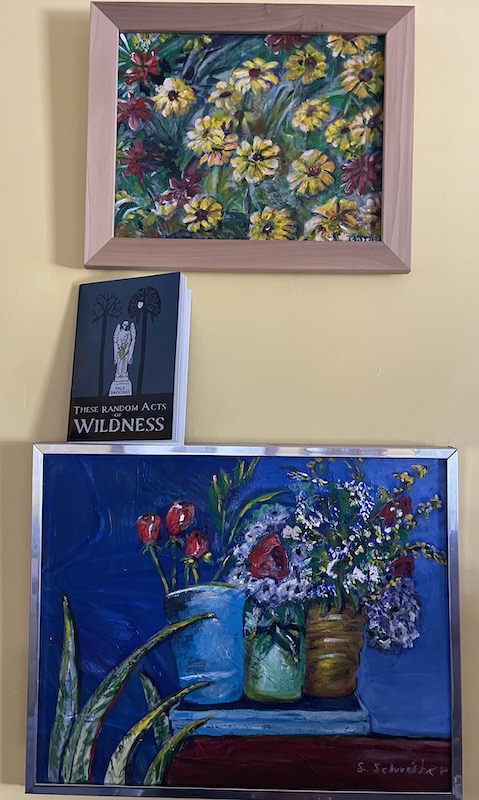
These Random Acts of Wildness with my Mom’s Paintings

Paul Brookes, Otherness (Jane’s Studio Press 2023) and These Random Acts of Wildness (Glasshouse Press, 2022)

Paul Brookes’ These Random Acts of Wildness is an amazing tour de force. In this collection, Brookes manages to explore nature in all its wild glory and the human compulsion to tame it within the confines of the sonnet form. Along the way, he explores family life, grief, love, loneliness, death, and memories.

In “Wildlife Map,” Brookes’ wit shines through:

In “I Make A Cuppa,” Brookes reveals truths in his poignant poem–
we drink tea at the cost of workers who harvest it, and at the risk of remembering—

This collection bravely reveals childhood and adult loneliness and being bullied, but it is “My Bella” that affected me the most. Anyone who has had a beloved animal companion will understand.

In Othernesses, Brookes once again…

View original post 142 more words

Karen Pierce Gonzalez – Guest Feature

K

Patricia M Osborne's avatarPatricia M Osborne

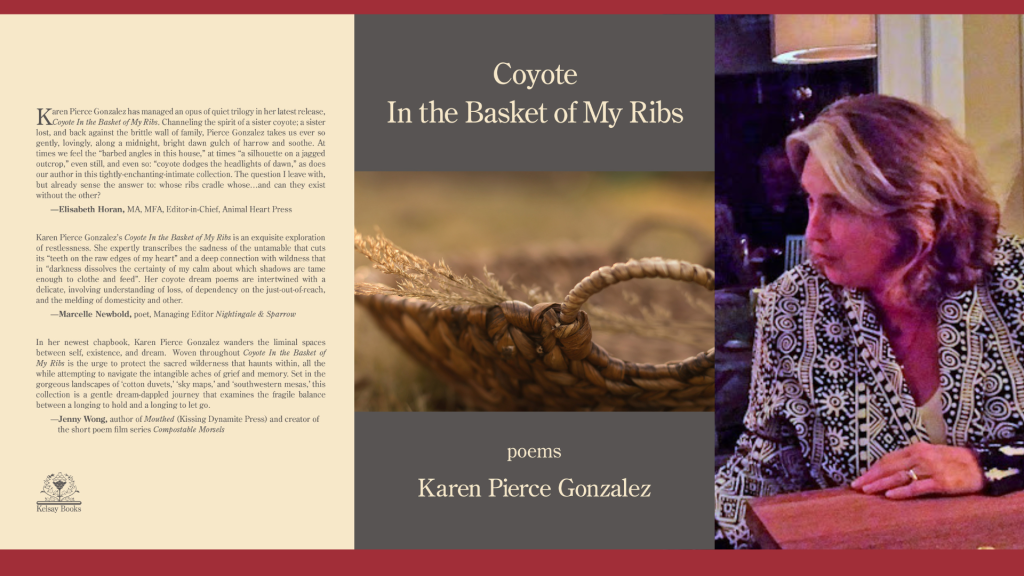
Patricia’s Pen is delighted to welcome poet, Karen Pierce Gonzalez as she celebrates the launch of her poetry pamphlet Coyote in the Basket of My Ribs published by Kelsay Books.

Coyote In the Basket of My Ribs

Karen Pierce Gonzalez

Coyote in the Basket of My Ribs was inspired by a long-held kinship I have with Coyote. Not the trickster most people think of, but the mythic messenger who travels between life and death with seamless ease. Little did I know that, as the collection came together, she would guide by example as I unearthed again regions of my own very difficult life/death terrain.

The loss of my sister Fortunee when we were children was one of those canyons. Her death, unfortunately, occurred in a car accident as she and my mother were driving to the store to get something for me. The many facets of this loss have…

View original post 224 more words

Review: Sarah Connor, The Crow Gods

merrildsmith's avatarYesterday and today: Merril's historical musings

The Crow Gods by Sarah Connor (Sidhe Press 2023)

Sarah Connor’s long-anticipated chapbook (long-anticipated by many, including me), The Crow Gods is everything I hoped for–and more. It is carefully crafted and self-assured, the work of a poet who knows what she wants to say. Connor’s work is sensory, both melodious and stark—a balancing act on a tightrope crossing joyful meadows to stormy seas and back.

The title poem, “The Crow Gods,” hits like a crow flying right into your gut. It is a recitation that is all the more powerful for its calm recitation.

But there are poems of children, love, and love of place.

There are ghosts and spring sunlight that

Throughout, there are rooks, hares, goldfinches, and the sea. There is wisdom in this book. There is courage. There is love—so much love. The poems here fly, swim, gallop, and drive through the English countryside, traveling through…

View original post 102 more words

Poetry inspired by Plath & Sexton by Sarah Wallis

davidlonan1's avatarFevers of the Mind

Bio: Sarah Wallis lives by the sea on the East Coast of Scotland, since moving from Yorkshire x4 years ago. She publishes cross genre, highlights are poetry in The Yorkshire Poetry Anthology, Abridged The Violet Hour, flash fiction at Ellipsis, a winning story at The Welkin and art in Feral. Recent work includes hybrid poem art at Osmosis, in print journals Gutter, Fragmented Voices, Eat the Storms –print and podcast. Chapbooks include Medusa Retold, Precious Mettle and How to Love the Hat Thrower.

Old Eign Hill

after Anne Sexton’s 45 Mercy Street

In my dream I’m walking up and down the Hafod Road and searching for a sign to - Old Eign Hill – but no, I’m on the wrong hill, and every time. I know the number, the varnished door, the clean, clear glass to see visitors through, and just in case, the Brasso’d doorknock, the shining bell. The…

View original post 308 more words

One Last Song by DK Snyder (inspired by Townes Van Zandt)

davidlonan1's avatarFevers of the Mind

Bio: DK Snyder's work appears in Cease Cows Magazine, Unbroken Journal, Shotgun Honey, and elsewhere. She lives in Virginia. Find her on Twitter @millioncandles. 

ONE LAST SONG

By DK Snyder

By 2:30 in the morning I’d eased the last stragglers out onto the sidewalk, where they lingered in the pool of light spilling from the front window and the neon sign. I locked the door to the club. Through the smudged windowpane, I watched until two aging regulars, Bobby and Pete, made it safely across the street and out of sight. The empty club was quiet. I wiped the wobbly, mismatched tables, my knuckles stiff with the dull ache of 35 years working here. I stepped behind the long wooden bar top to gather the dirty glasses, and froze: a tall, angular man was slouched on the last stool. My jaw dropped. A glass slipped from my hand and…

View original post 709 more words

Fevers of the Mind Poetry & Art Issue 6: The Empath Dies in The End Coming Soon!

davidlonan1's avatarFevers of the Mind

(c)HilLesha O’Nan

Coming very soon Issue 6 of the Fevers of the Mind Poetry & Art Print Anthology will be available for purchase on Amazon. I’m still putting together the submissions to doc format. This will feature the collaborations that i’ve (David L O’Nan) have done with several other great writers on “The Empath Dies in the End” series of poems last Fall (the remainder will be placed in future anthologies including The Whiskey Mule Diner for the Elliott Smith inspired pieces) this issue will also include features from poet/writers Christian Garduno, Pasithea Chan, Kushal Poddar, Michael Igoe, also included is our photo prompt challenge poems to a photo supplied by writer Kevin DeLaney. Also included so far but definitely not limited to are poems/prose by Ceinwen E Cariad Haydon, HilLesha O’Nan, Ethan O’Nan, Victoria Leigh Bennett, Peter Magliocco, Donna Dallas, Joan Hawkins, Lorna Wood, Matthew Freeman, Lesley Curwen, Tova…

View original post 239 more words

Poetry Showcase: Jennifer Patino (May 2023)

davidlonan1's avatarFevers of the Mind

Bio: Jennifer Patino is a poet who lives for books and film. She has had work featured in Door is A Jar, Punk Noir Magazine, A Cornered Gurl, The Chamber Magazine, Fevers of the Mind, Free Verse Revolution Lit, Windy Knoll Zine, and elsewhere. She lives in Traverse City, Michigan with her husband. Visit her blog at www.thistlethoughts.com.

Heather Donahue in Voice-Over Sharpening nails for the final girl battle, scream queens give stank eye. Pick apart Heather’s flannel and question her sexuality. They want to borrow her lip shade because it’s autumnal. Want to know what happened when the cameras were off. Want to know if they can mimic her screams. No one offers Heather a tissue or a bloody shoulder. No one checks her for ticks. They just want the boys’ juicy secrets. Cool girl Heather. A woodland princess. Scotch mouthwash and a last phone call home. Curious…

View original post 1,005 more words

This Day 611. If you have a creative response to it. Email it to me and I will feature it in my new challenge “Created Responses To This Day”

photo by Paul Brookes

Enduring a Morning

During a morning
of impossible climbs
out from the valley of sleep,

I saw a cliff face
woven into a flower,
the crags and moss

of unconquered peaks,
moors of rugged flora
all sewn onto one stem.

If nature can be
a mirror unto itself,
then I can be

the water, the waker,
the dawn chorus, an embrace
of Spring-fuelled air.

Colin Dardis

Bio and Links

Colin Dardis


Poetry inspired by Picasso from Jackie Chou “The Path”

davidlonan1's avatarFevers of the Mind

inspired by Pablo Picasso's poem "A Lonely Road is That I Walked"The Path

I walk a lonely road,
because I know no other way.

I have broken the bridge,
which stretches across the lake 
to the laughing crowd.

I walk a lonely road,
because my lover
has let go of my hand,
and taken a detour 
to follow the trail of glass.

And I know of no street,
that glistens in the sunlight,
only this black asphalt path,
on which my shadow grows.

Bio: Jackie Chou is a poet whose work is inspired by her inner world and the urban landscape where she grew up.  Her work has appeared in Alien Buddha Zine, Cajun Mutt Press, Spillwords, Highland Park Poetry, and Fevers of the Mind Poetry Digest.  Besides writing, she loves to watch Jeopardy and thriller movies.

View original post

Wombwell Rainbow Book Interviews: “The Second of August” By Peter Donnelly

Peter J Donnelly lives in York where he works as a hospital secretary. He has a MA in Creative Writing and a degree in English Literature from the University of Wales Lampeter. Thanks are due to the Dreich magazine, Writer’s Egg, Southlight and South Bank, where some of these poems have previously appeared. His poetry has also been published in other magazines and anthologies including One Hand Clapping, Black Nore Review, Ink, Sweat and Tears, Obsessed with Pipework, High Window and The Beach Hut. The 22 won second prize in the Ripon Poetry Festival competition in 2021 and The Second of August was a joint runner up in the Buzzwords open poetry competition in 2020.

The Interview

Q: 1. How did you decide on the order of the poems in the book?

I felt that the poem that gives the collection its title should be near the beginning but not the first poem in the book. I’ve got to be honest and say that it and the one that is the first were both successful in competitions,  one winning second prize and the other a joint runner up.  I tried to make them flow, keeping something of a trail between the subjects of the poems,  though some have nothing to do with the one that came before. There  is a small group of poems about the Bronte sisters and their characters quite close together, and couplets of poems about butterflies, moths and birds.  I tried to even them out as well,  rather than for example have all the ones about butterflies together.

Q;2. How important is a sense of place in your poetry?

Very important.  I have been greatly influenced by my native North Yorkshire which is a very scenic area, as well as other parts of Great Britain that I have visited, most notably Wales and the South West of England.  My home city of York gets a mention in a few of the poems and is the subject of one of them. Place is also an important factor in the poems I write about people,  animals, literature and music amongst other things.

Q:3: How important is form in your poetry?

Not greatly important,  though there has to be something that makes a poem more than just chopped up prose. Some of the poems in the chapbook are rhymed, which is not a form I use very often now.  I experimented with it quite a bit when I got back into writing a few years ago after quite a long period of not writing,  but I have moved away from it. Where I do use rhyme I usually don’t use iambic pentameter,  so the rhyming may not be immediately obvious.  I maintain that verse is not necessarily poetry.   Most of my first drafts are not split into verses. Once I think I have a complete poem I experiment with splitting it up. Sometimes I end up with couplets, sometimes three line verses, sometimes four or more, and often it remains free verse. Very occasionally I have verses of unequal length but not very often.  I usually begin a verse with the beginning of a sentence,  but not always.

Q;4. What role does music play in your poetry?

It has influenced many of my poems, not least the one that gives this collection its name. Though I tried to learn instruments as a child I can no longer read music nor do I know a lot about it,  many of its technical terms mean nothing to me.  I very rarely have it playing in the background whilst I am writing poetry,  though I do regularly have Radio 3 playing whilst I am doing other things.  It is a station I would struggle to live without,  and gets a few mentions,  directly and indirectly,  in my writing.  I certainly have an appreciation of many forms of music, and concerts in cathedrals and churches, as well as opera, ballet and performances of symphonies I have attended been the influence behind quite a lot of my poetry.  It is often the place where I heard the music performed, or the people I attended with, that have made the piece significant to me and inspired me to write a poem about it.

Q;5. Nature seems important in your poetry, thinking especially of Peppered Moth and Painted Lady?

It is. Butterflies and moths in particular are of great interest to me, as are plants, especially orchids.  I have largely been influenced in this by my late great aunt who was also very fond of these things. She too has influenced much of my writing.  I have also written poems about birds and other aspects of nature. I love walking in the countryside and visiting gardens. Other poets have of course written about these things, and have inspired me. The Welsh poet Gillian Clarke,  whom I met at university played a great part in my development as a poet, as did my former teacher,  the poet Carole Bromley.

Q:5.2. What is it about butterflies, months and orchids that fascinates you?

Their physical beauty, the colours and shapes of their wings and petals. I like dull coloured moths just as much as multicoloured butterflies.  I am intrigued by the ability of something so small and delicate to disguise itself in order to survive, the theme of ‘Peppered Moth’. With orchids I am intrigued by their ability to surprise, often flowering more than I imagine they will, developing stems off stems and occasionally baby orchids as well.

Q;5.3. Moving on to the other influences. How did Gillian Clarke and Carole Bromley influence your work?

Carole Bromley taught me English at secondary school and again at A level. I knew I wanted to write but I thought I wanted to write stories.  She encouraged my love of reading.  By the time she taught me in the sixth form she was beginning to write poetry herself,  and getting us to write it too. I  was reluctant as I didn’t think I could do it, and she told me I needed to read more of it. She was right of course.  I met Gillian Clarke at university,  she didn’t teach me but ran a workshop in the evenings.  I was quite glad when she announced to the group that she was a poet. What I was writing at the time,  certainly in terms of attempts at poems, I think now was rather rubbish,  but by the end of my first year at university we workshopped one of my pieces and she told the group that ‘Peter has really come to poetry school’ meaning as a compliment that my writing had improved.  I met other established and developing poets there, including Stevie Krayer,  Kathy Miles and Anne Grimes. I am always reading a poetry book as well as a novel,  and these five poets I re-read once a year. I have had to be careful that my own work doesn’t too closely resemble theirs,  but I think I can confidently now say that I have developed my own style,  and found my own voice.

Q;6. How important is narrative, telling a story in your poetry?

I would say most of my poems do tell a story,  usually a true one. Those written from the point of view of a plant or animal perhaps less so. Most of my poetry is not fictional but occasionally I will assume the voice of a character in a novel I have read, often a minor character,  giving their point of view,  often not heard in the novel.  This is the case with ‘Mrs Fairfax’, written in the voice of a character in ‘Jane Eyre’. Many of my poems take the form of letters,  often to people who are no longer with us, and they do contain narrative.

Q:8. Why does the month of f August figure so prominently in the poems?

I hadn’t realised how many times it was mentioned, except in the title piece,  and then only in the title itself of that poem. It is one of my favourite times of year, often associated with holidays and hot weather,  which is perhaps why it is mentioned in so many of my poems.

Q:9. It is very rare to find a poem in this collection that doesn’t have numbers in it? Is this deliberate?

This was not deliberate. I am not numerate at all. I have attempted a GCSE maths exam three times and each time failed, never managing to get a higher grade than a D. But I suppose maths is a bit like music,  I can’t do it but I have an appreciation of it, and understand its importance. More unconsciously than music,  it creeps its way into my writing.

Q:10.  Your final poem Wensleydale Faith imagines a creator. How important is faith in your writing?

I once had a very strong faith,  now I am not so sure, but I cannot completely abandon what I once believed. Maybe it will come back to me one day. It is quite rare for me to mention it in my writing,  at least nowadays.

Q:11. Once they have read “Second of August, what do you hope the reader will leave with?

Without wanting to sound too self-praising,  I hope they will be left looking forward to reading my next collection,  of which I can promise there will be one, and hopefully many more after that. Not everyone who reads it will feel that way of course, but I hope that even those who didn’t think my debut chapbook was that good will be interested to read more of my work, before deciding they don’t like my poems at all.

Peter’s book can be purchased here:

https://www.amazon.com/dp/B0BV4JF13Y

and here is a video of him reading from it:

https://m.youtube.com/watch?v=hG9AfPWWCVc&feature=share