Wombwell Rainbow Interviews: Moinak Dutta

Wombwell Rainbow Interviews

I am honoured and privileged that the following writers local, national and international have agreed to be interviewed by me. I gave the writers two options: an emailed list of questions or a more fluid interview via messenger.
The usual ground is covered about motivation, daily routines and work ethic, but some surprises too. Some of these poets you may know, others may be new to you. I hope you enjoy the experience as much as I do.

44444449_1093740104136879_8395803281401577472_n

Moinak Dutta

Published fiction writer, poet, teacher,
Born on 5th September, 1977, he has been writing poems and stories from school days. Presently engaged as a teacher of English. Many of his poems and stories are published in national and international anthologies and magazines and also dailies including ‘The Statesman’ ( kolkata edition), ‘ World Peace Poetry  anthology ‘ ( United Nations),  ‘Setu’ (published from Pittsburgh, USA,)Riding and Writing ( as a featured poet twice, published from Ohio, USA), ‘ The Indian Periodical’ ‘ Pangolin Review’, ‘ Tuck Magazine’ ‘ Duane’s Poetree’, ‘ Tell me your story’ ( literary and travel magazine), ‘ Nature Writing ‘ magazine ( U.K.), ‘ Oddball magazine’ ‘Soft Cartel’ magazine, ‘ Diff Truths’ magazine,   ‘ The Literary Fairy Tales’ ‘ Defiant Dreams’ ( a collection of stories on women empowerment published by Readomania, New Delhi ), ‘Dynami Zois’ ( a selection of short stories comprised of works of authors from India and abroad), etc;
Written reviews of books and fictions, among which notable ones are : on  ‘ The   Upanisads ‘ ( translated by Valerie J. Roebuck) which can be found at http://www.blogapenguinindiaclassic.blogspot.com and the review of ‘ The Ballad of Bapu’ ( written by Santosh Bakaya). Written some essays and articles on education and literature and other topics which had been published in both e- books/e – journals ( like Cafe Dissensus)  and as  printed books/ papers ( like one on ‘ Amalgamation of social media and literature: pros and cons, published by Viswa Bharati Research Centre and Sahitya Anand), ‘ Erothanatos’ ( academic and literary journal), etc;
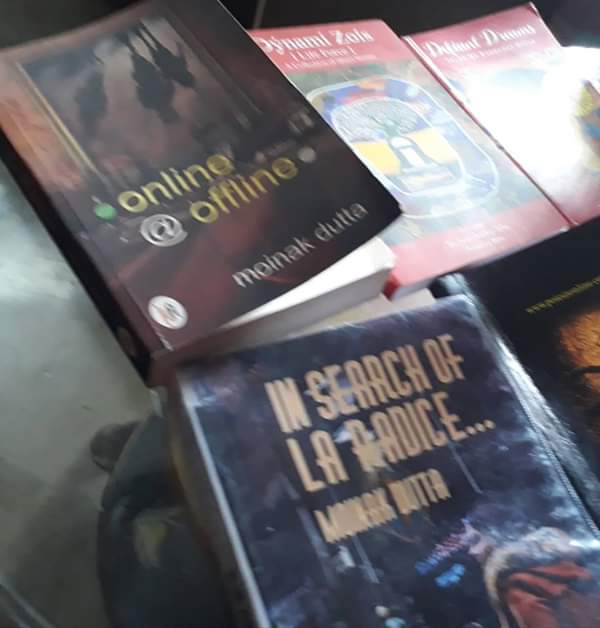
His first full length english( genre: literary/romance  ) fiction ‘Online@Offline’’  had been published in 2014,  by Lifi Publications.His second fiction(genre:  literary/quest) titled ‘ In search of la radice’ was published in 2017 by Xpress Publications. Also worked as an editor of a poetry collection titled ‘ Whispering Poeisis’ , which had over one hundred poems from sixty poets from different parts of India and abroad, published in 2018 by Poeisis. Loves to do photography apart from listening to music and watching films and traveling.

email :moinakdutta@yahoo.co.in
http://www.moinakdutta.wordspress.com


The Interview

  1. When and why did you start writing poetry?

I have grown up in a literary and cultural world so to say. My dad had been a gifted poet and artist. He had been one of the founder editors of a bengali magazine ‘ Krishanu’. He and his friends often would gather at our house and have long sessions of literary ‘ adda’  as it is called in our bengali  common parlance which means informal discussions and debates and interactions ranging from poetry to essays and fictions. One person in particular Dr. Dinesh Chandra Singha, a writer by himself and a researcher on bengali folk culture and folk songs would oft come to our house and he, apart from being a great litterateur had an amysing sense of wit which kept me glued to that ‘ adda’  session though at that tender age I had little idea of what they discussed for their discussions had been eclectic. Later on reading books of poetry , of Tagore ( most of his songs and poems from Kheya , Sonar Tori, Balaka and that highly experimental yet simple poetic prose ‘Shesher Kobita’  , Wordsworth ( his Tintern Abbey, Prelude and Lucy poems being my all time favourite apart from his long essay ‘ Preface to the Lyrical Ballads’ ) , Robert Browning ( his dramatic monologues), Purnendu Patri ( his book of poetry with his own illustrations), William Blake ( Songs of Innocence and Experience) , W.B. Yeats ( most of his poems, those magical ones and his wonderous preface to Tagore’s ‘ Song Offerings’ ) , T. S. Eliot ( Mariner, Wasteland, Love Song of J. Alfred Prufrock ), Jibanananda Das ( most of his poems) , Joy Goswami ( ‘ Pagli tomar songey ‘  etc;) , Arun Mitra, Lawrence Ferlinghetti, Alen Ginsberg, Sunil Ganguly, Maya Angelou, Bishnu De and works of many other poets shaped my views and visions with regard to poetry.
However, if am I to choose the most favourite of all poets I have read I would name Tagore and Wordsworth.
2.  Who introduced you to poetry?

My dad late Malin B. Dutta and some of my teachers.
3.  How aware are you of the dominating presence of older poets traditional and contemporary?

I am very much influenced by Tagore and Wordsworth and I do not know whether they could be called ‘ older poets’ for their works appear to me universal and eternal, having lyrical cadence and conspicuous love of nature. Tagore had been very modern I think for his songs touch all facets of human emotions, not only nature and romantic school of poetry. His treatment might be rhythmic but his poetry deals with subtleties of human existence, its agonies and ecstasies, its spiritual positionings, its religiosity and also its irrreligious presence. Moreover, he had, inspite of being a man, had brought out the minds of women which , appears to me the most fascinating part of his writings. Perhaps he had been the most gifted poet of all times.

4. What is your daily writing routine?

I follow no strict routine. However early morning is my preferred time of writing for it is the most blessed and fresh hours of the day.
If any thing stirs my mind, I do take up pen and paper and write down the thought or idea which I later on explore.
5. What motivates you to write?

Anything that touches me. It could be nature, paintings,  ( I love paintings and drawings and wrote a fiction titled ‘ In search of La Radice…’ published in 2017 which had a female protagonist who had been a painter. ) any event that has occured, a particular poem or some of its lines, even a song or a portion of a movie which enthralled me, a photograph.
I believe in esemplasticism. My poems are eclectic too.
6. What is your work ethic?

I try to find out some hours out of my daily life completely devoted to writing be it prose or poetry. As I write stories and fictions too, which usually take more time than writing poetry, I try to write poetry only when I am not occupied with prose works.
Having said that, I should also say that there are occasions when poetry comes in the middle of writing stories. Then I put my mind into poetry completely.
7.  How do the writers you read when you were young influence you today?

I still read stories of Ruskin Bond and poems of Sukumar Roy who influenced me very much in my childhood.  I should not say that I follow their writings but they keep me grounded to simplicities of life.
8.  Who of today’s writers do you admire the most and why?

Of today’s poets I have a strong reverence towards some bengali poets like Sankha Ghosh, Joy Goswami etc. As I am connected with some english poetry magazines, I am lucky to have some friends who are awesome poets. Their works I read and mine they.
9. Why do you write?

I write because I love writing and I believe writing is a beautiful vocation.
10.  What would you say to someone who asked you “How do you become a writer?”

I became a writer for I love writing and by writing I can easily entertain myself and also the world around me.
11. Tell me about any writing projects you are involved in at the moment.

Presently I am working on a fiction , genre : literary – romance which is my favourite.
It has a perspective which is very much Tagorean and yet it is modernistic for it has characters set in this century, this age. Apart from that I am also working on a book of poetry.


Wombwell Rainbow Interviews: Sam Smith

Wombwell Rainbow Interviews

I am honoured and privileged that the following writers local, national and international have agreed to be interviewed by me. I gave the writers two options: an emailed list of questions or a more fluid interview via messenger.
The usual ground is covered about motivation, daily routines and work ethic, but some surprises too. Some of these poets you may know, others may be new to you. I hope you enjoy the experience as much as I do.

Sam Smith

Editor of The Journal (once ‘of Contemporary Anglo-Scandinavian Poetry’), publisher of Original Plus books, I was born Blackpool 1946 and am now living in Blaengarw, South Wales. While I am still a freelance writer my last day job was as an amusement arcade cashier. But I have also been a psychiatric nurse, residential social worker, milkman, plumber, laboratory analyst, groundsman, sailor, computer operator, scaffolder, gardener, painter & decorator…….. working at anything, in fact, which paid the rent, enabled me to raise my three daughters and which didn’t got too much in the way of my writing. I now have several poetry collections (the latest being Speculations & Changes: KFS) and novels to my name (the 2 latest novels being Marraton: IDP and The Friendship of Dagda & Tinker Howth: united p.c. (see website http://thesamsmith.webs.com/

and for The Journal http://sites.google.com/site/samsmiththejournal/ )

The Interview
1. What inspired you  to write poetry?

It was so long ago, and it all seemed to happen at once. A girlfriend gave me Henry Miller’s Smile at the Foot of a Ladder, and it decided me to become a writer, to try to produce, in my then worthless life ,something as worthwhile as that novel. But when I imagined myself as writer it was as a novelist, not a poet. Albeit that my very first attempt as a ‘writer’ was a poem, about an abortion. I was 22. And over the following 23 years of trying to get my novels published in moments of crisis I often sought to express side issues in poems. But not poems that I ever tried to get published.

2. Who introduced you to poetry?

Libraries, I think. But I was a voracious reader from an early age, absorbed a lot through cultural osmosis. A post-WW2 baby there was so much change happening about me as I grew, Blighty-type doggerel and tin pan alley pop music was slipping rapidly into the past. Simon and Garfunkel, Bob Dylan, Leonard Cohen, Ginsberg’s Howl, were all showing me how different just song lyrics could be; and I was knocked sideways by the poetry of Thom Gunn. That spoke to me.
But as I say I was concentrating on writing novels and trying to get them published. I was given enough encouragement by leaping various publishers’ hurdles, and by agents briefly taking me on, to keep on writing and trying. Even though my biggest fault so far as publishers were concerned was that they didn’t think my novels ‘commercial.’ Until, after the latest disappointment, when all had seemed so promising, I decided I had to have something of mine in print and poems seemed the easier option. So I dashed off a 5 page poem featuring my work then as a psychiatric nursing assistant.
My friend and neighbour at that time was the painter Derek Southall. I gave him a copy of the poem. He was old friends with the poet and translator Michael Hamburger, and Derek sent him a copy of the poem. Michael commended the poem but said that it contained at least 10 shorter poems. I broke the 5 page poem into shorter poems, submitted batches to various magazines and was soon getting an acceptance a month. I wrote more poems. Within a couple of years I had my first collection. That sold well, and then the novels started getting into print. And I haven’t stopped since.
A side effect of having so much to do with publishers, and curious about how it was done, led me – under the guidance of the late Derrick Woolf of Odyssey Press – to also starting my own magazine and small press. Principally to help others into print, and to put forward my own taste in poetry and to put back some of what the small press had given me, principally confidence.

3. How aware were you of the dominating presence of older poets?

They belonged back in school. Except for Thomas Hardy, he was still, and still is, relevant. But beyond school there was Rimbaud, Auden, Eliot waiting and to have me wondering what next? And then of course there was Ezra Pound. But it was all kinds of writing that I was, and still am, interested in, novel ways of looking at any subject by any author in any genre. Just take Stephen Dobyns, thriller writer and poet, or Martin Stannard, critic and poet, Sylvia Plath, playwright and poet.

4. What is your daily writing routine?

Up at 6:30, desk at 7:00. Answer emails, fill orders for The Journal and Original Plus; then see where I am in my writing schedule. Which can be my blog – http://www.thesamsmith.simplesite.com   – or my latest novel, or ideas for a poem, or to catch up on Submissions to The Journal or edits for a new Original Plus chapbook. The schedule can of course go out the window if there’s something outstanding or urgently required.
That will take me up to midday when I pause for lunch. If the weather is fine and dry I might go for a walk, do some gardening; or more likely get stuck into household chores, family obligations. If it’s raining, and there’s no chores, family things to do, I’ll probably return to my desk, or take up a book, newspaper. Evening’s usually telly: at my age I’m too knackered for ought else.

5. What motivates you to write?

In the beginning it was to explain myself, to tell of the world that I knew, in my way. The way other people used words didn’t match what I was experiencing. And I’m still struggling to find that metier.
Now though writing has become my character. It’s who I am, what I do

6. What is your work ethic?

I’m task-oriented. The work needs to be done, I do it. So I set myself tasks, see them through to completion. Fortunately I’ve never been driven by the desire for either fame or fortune. Fame could have sold more books, and fortune would have been helpful, but really satisfaction lies mostly in getting the job done.

7. How do the writers you read when you were young influence you today?

We had very few ‘good’ books at home. ‘Coral Island’ by Ballantyne I must have read about a dozen times. It was when I was at sea I read most – Hemingway and Steinbeck in the ship’s library among the storytellers. What drew me to them was their willingness to try new ways of telling a story. Then when I left and lived in Chelsea, books that were pressed on me came from many directions. Eliot and Auden I suppose continue to influence, along with William Carlos Williams, and through those three to Japanese poetry. Which among other translated poetry has been a greater influence on my own writing than any in English. Something about the different rhythms, a certain clarity…

8. Who of today’s writers do you admire the most and why?

Over the last few years I’ve been amassing the works of Haruki Murakami, fascinated by his storytelling abilities, different again. Of poets another who, like Murakami, can seamlessly introduce the fantastic into the ordinary and make it make sense, is K V Skene. Both are beyond magic realism, make the ordinary extraordinary. But really there are just so many good writers about at the moment and it’s been my privilege to work , as editor and/or publisher, with many of them.

9. Why do you write?

Not to get rich. One of the hardest things to accept in my first few years of being a writer, of trying to find time to write, was having to have a day job. Now, with it being nigh on impossible to make a living out of writing, I see it as part of any writer’s/artist’s calling – the day job.
As I said before I write to try and get across my version of the world, which is still at odds with the mainstream version. I’m still trying to create the perfect work of art. I’ll know it when I see it. But I know now my limitations. I am no showman, am rubbish at publicity and performing. The private bit of writing is what I relish.

10. What would you say to someone who asked you “How do you become a writer?”

Get pen, paper, keyboard; and write. And when you’re pleased with what you have written, submit it to an appropriate publisher; and accept the likely rejection. Look again at the work, identify failings, and try again. And take care over which day job, or way of making a living, you go for: it will inevitably inform your writing.

11.Tell me about the writing projects you have on at the moment.

I’ve got several poetry projects. One long term one is occasionally adding poems to a collection, Scenes from a Country Life, which has poems covering all the country places I have lived for any length of time. Another looks to be building up to a chapbook length collection of Mock Sonnets. Another in the making is one provisionally titled Futureless.
The novel I’m working on has the working title http://www.spousecheck.com. I’m still uncertain what that’s about.
I started a year of blogging called Beginnings and I’ve yet to bring that to a close. At least let myself off the hook of regular postings.
And then of course there’s the next issue of The Journal to put together. Reviews to do for that; and the latest Original Plus production.
I also have 2 novels, Trees: the Tree Prospectus and Once Were Windows Once Were Doors, sitting in publisher’s slush piles. Should either get accepted then I’ll be immersed in the edit of that. I love working with a good editor. Best learning curve I know

Beginnings. http://www.thesamsmith.simplesite.com

My front page – thesamsmith.simplesite.com
http://www.thesamsmith.simplesite.com
As a writer it is so easy to be seduced into the use, the re-use, the misuse of myth. It is such a convenient shorthand, be it of the savagery of Vikings or, here in the UK, the hardiness of Ooop-North menfolk.


in t’ George by Geoff Hattersley — Proletarian Poetry

The pub I spent much of my twenties in during the 1980s, is no longer. Turned into an Indian bar and restaurant. I’m not too down about it. After all that’s where people tend to end up after the pub anyway, so why not make it the pub. Better than some overpriced hipster bar where […]

via in t’ George by Geoff Hattersley — Proletarian Poetry

Wombwell Rainbow Interviews: M. J. Oliver

Wombwell Rainbow Interviews

I am honoured and privileged that the following writers local, national and international have agreed to be interviewed by me. I gave the writers two options: an emailed list of questions or a more fluid interview via messenger.
The usual ground is covered about motivation, daily routines and work ethic, but some surprises too. Some of these poets you may know, others may be new to you. I hope you enjoy the experience as much as I do.

Images from Mary’s forthcoming debut to be published by Seren next year called

JIM NEAT, THE CASE OF A YOUNG MAN DOWN ON HIS LUCK.

M. J. Oliver

was awarded 2nd prize by New Welsh Writing in 2017. Her poems have appeared in periodicals and anthologies in UK and US. Prizes won include those judged by Paul Muldoon and Ruth Padel. She edits a Poetry Newsletter promoting live poetry events in Cornwall, UK, and is chair of The Poetry Society’s Penzance Stanza Group. In January 2018 she was awarded a place on a year-long Mentoring Scheme run by the Cinnamon Press. Her debut book is to be published by Seren in September 2019.

table3 (2)

The Interview

1. What inspired you to write poetry?

A dark family event occurred that triggered a desire to find out who my Dad really was. He’d been dead for 25 years, but he’d always been a mystery to me. So I started to research his early life. Discovering that he’d been a Hobo in Canada during the 1930s, I took a trip across the country in his footsteps. Twelve years later, a long narrative poem emerged from my copious notes, which, rather astonishingly, Seren is going to publish, as a memoir, in September 2019. That’s how it all started.

2. How aware were you of the dominating presence of older poets?

I was aware of the giants, but they didn’t influence me; I did what I was told at school but it didn’t penetrate – Paradise Lost at 13? I preferred taking my dog for a walk.

3. What is your daily writing routine?

While I was writing my book I worked almost all day every day. As a result, I’m told my bum muscles atrophied rather. So I’ve changed my routine now; I work all morning and in the afternoon I go for a boxing workout or swim in the sea. Luckily I live 3 minutes from the sea and 4 minutes from a friendly gym. I usually work in the evenings again. But Friday nights are sacrosanct.

4. What motivates you to write?

It was an existential force that took over my life! I was driven to tell this amazing story. I couldn’t not. And in the process, I became doubly driven; not just to tell the story, but to tell it well. That meant learning the craft to the absolute best of my ability; and reading as I’ve never read before – not just literature, but books about literature as well. Obsessed I was.

5. How do the writers you read when you were young influence you today?

I was always most interested in stories that dealt with conflict and loss. How people survived. And maybe thrived. It’s still those issues that fascinate me most.

6. Who of today’s writers do you admire the most and why?

Contemporary women poets do it for me. Plath and Akhmatova of course (they’re still alive for me). Penelope Shuttle. Katrina Naomi. Pascale Petit. Pam Zinnemann-Hope.  Nancy Mattson. Sharon Olds, Jenny Lewis. Eliza Kentbridge.  I’ve learned from them how to write fiercely about being alive. Twentieth century prose writers influence me too: where to start? Margaret Attwood, Sinclair Ross, Lydia Davies, David Stouck, John Steinbeck, John Williams, Richard Ford, William Maxwell, Nabokov , Steinbeck, Alice Munroe.  Where to stop?

9. Why do you write?

I find it thrilling, and essential for my sanity actually, to make something creative out of my experiences; to give carefully constructed form to some of the trickier aspects of life. My training was in the visual arts. I found it stimulating teaching Fine Art at degree level, but what I loved most was going into prisons; we’d start by scribbling to music, with charcoal onto large sheets of paper; then we’d look at the scribbles, turn them round and round and slowly develop them, using a rubber and more charcoal, into something amazing – always amazing.  See these examples, by people with no art training: they’d never drawn before.

Wow. When I retired from art teaching I switched to writing, and discovered how similar the two processes are. Fundamentally, you have to make the thing work. And that struggle, I really enjoy, I love getting my teeth into it.

10. What would you say to someone who asked you “How do you become a writer?”

I believe everyone’s life experience is interesting, but not everyone has the time or opportunity to reflect on it. First you have to feel driven, then you study the craft. You need to be prepared to spend a lot of time alone. You have learn to self-edit, ruthlessly. You need to listen to feedback. Groups like Penzance Stanza have been valuable sources of feedback for me. And I’d say, ‘look at all the fabulous examples there are; they’re even free from libraries’.

11. Tell me about the writing projects you have on at the moment.

For fresh ideas and new work, I attend as many workshops and poetry festivals as I can. Cornwall is alive with them – and I promote them via an online newsletter of Poetry Events in Cornwall. As a visual artist, I did a lot of collaborative work. This example was made by my mother, my daughters and myself, a light box combining text and image. It’s called Consequences. Soon I’m hoping to start a collaborative writing project.

lightbox

Meanwhile, I run a small reading group for people keen to get to grips with the likes of Anne Carson’s Float. And, on the advice of my editor, I’ve signed up to Twitter. I find it frustratingly difficult to comprehend, but in my darkest moments I tell myself, if Trump can do it, surely I can.

https://instantloveland.com/wp/pinboard/patrick-heron-at-tate-st-ives/

Wombwell Rainbow Interviews: Peter J. King

Wombwell Rainbow Interviews

I am honoured and privileged that the following writers local, national and international have agreed to be interviewed by me. I gave the writers two options: an emailed list of questions or a more fluid interview via messenger.
The usual ground is covered about motivation, daily routines and work ethic, but some surprises too. Some of these poets you may know, others may be new to you. I hope you enjoy the experience as much as I do.

Peter J. King

was active on the London poetry scene in the 1970s, running Tapocketa Press and co-editing words worth magazine with Alaric Sumner. Aside from a brief return to writing and publishing in the 1980s, and translating from modern Greek poetry with Andrea Christofidou, he abandoned poetry for philosophy until 2013, since when he has been writing, performing, and publishing frenetically.
His poetry, including translations from German and modern Greek, has been published in journals such as Acumen, Bare Fiction, The Curlew, Dream Catcher, Eye to the Telescope, The Interpreter’s House Lighthouse, New Walk, Osiris, Raum, Oxford Magazine, the Quarterly Literary Review of Singapore,
A Restricted View from Under the Hedge, Shoreline of Infinity, Tears in the Fence, and The Writers’ Café. His latest collections are Adding Colours to the Chameleon (2016, Wisdom’s Bottom Press) and All What Larkin (2017, Albion Beatnik Press). A second, expanded edition of the latter is scheduled to come out some time in 2019.

https://­wisdomsbottompress.wo­rdpress.com/

Peter J. King
wisdomsbottompress.wordpress.com

The Interview

When and why did you start writing poetry?

It was at school — probably when I was about sixteen or so. I can’t say why (it’s a fairly common thing to do at that age, or was then; perhaps less common to think in terms of people reading it, and to continue writing).

2. Who introduced you to poetry?

It’s hard to say; I have two sets of memories, but they’re not chronologically orderable. One is of my father’s books, and his encouraging me to read (not that I needed much encouragement!); the other is of what I encountered at school, both primary and (more significantly, I think) secondary.

3. How aware are you of the dominating presence of older poets, traditional and contemporary?

The question assumes that there’s a dominating presence of which to be aware… I don’t feel dominated by other poets; I either enjoy what they write or I don’t. When I do (perhaps especially when I don’t), it might give me ideas for my own writing, or it might have no effect on me.

4. What is your daily writing routine?

I’m not a creature of routine, except when it’s imposed upon me. In the dim, dead past (especially in the 1970s), I used to write a lot at night, often all through the night. That’s no longer possible, but I might write (or paint, or both) at any time that I feel like it. I do tend to like writing in public places such as cafés, restaurants, and trains — but that’s also irregular.

5. What motivates you to write?

I ought to be able to answer that, as my career (?) as a poet has a very useful shape: I was very active on the London poetry scene in the 1970s, centred on the Poetry Society and the Troubadour; I had what might be termed an emotional breakdown which stopped me writing for a few years, but I returned briefly in the early 1980s; academic work then took over, and I didn’t write again until 2013, since when I’ve been extremely active. So, given all that, shouldn’t I be able to say why I did or didn’t write during those different periods? Yet I can’t. I write because I enjoy it, both the process and the product. I’d write even if no-one but me was going to read it, but having other people read and hear my poetry is also a pleasure.

6. What is your work ethic?

I’m never wholly sure what that means. There’s the chilling notion of a Protestant Work Ethic, but having been brought up a Catholic (long lapsed) I’ve never suffered from that. Leaving aside an odd usage that uses “ethic” to gesture at a kind of self-absorbed concern with oneself, but taking it to mean some sort of set of moral principles, then I think that most work is demeaning and soul destroying, forced upon people as a necessary part of the capitalist system in which we’re imprisoned. That our current government thinks that it has a duty to force people into this demeaning activity (relabelled “dignity-providing”)­ by treating them badly until they give in, is appalling. On the other hand, as Flanders and Swan so elegantly put it:

Heat is work and work’s a curse
And all the heat in the universe
Is gonna cool down as it can’t increase
Then there’ll be no more work
And there’ll be perfect peace
(Really?)
Yeah, that’s entropy, man!

7. How do the writers you read when you were young influence you today?

Another one that’s hard to answer. Leila Berg’s “Little Pete” stories have never left me, and my lifelong love of science fiction has had a big (and is currently having a huge) effect on my writing. Of all the poets whose work I read before the age of, say, nineteen (before I discovered “experimental” poetry, and came under the influence of Bob Cobbing, et al.), the ones that made the biggest impression were probably Rupert Brooke, Gerard Manley Hopkins, Paul Verlaine, T.S. Eliot, Ezra Pound, E.E. Cummings, and Kenneth Patchen. They’ve probably all affected me in one way or another.

8. Who of today’s writers do you admire the most and why?

I love Sophie Herxheimer’s poetry — both on the page and in performance. Camilla Nelson and Amy McCauley have both produced poetry and performance that have really grabbed and excited me. Adnan al Sayegh, Ruba Abughaida, Wole Soyinka, Jenny Lewis, Jee Leong Koh… I’ll end up just listing all the poets whose poetryI’ve enjoyed. For the most part, I’m very reluctant to rank them in any way.

9. Why do you write?

I can’t really disentangle that from Q. 5 (“What motivates you to write?”).

10. What would you say to someone who asked you “How do you become a writer?”

You write. There’s nothing more. To be a good writer, you read (not just the same things over and over, but new things), enjoy what you read, and write a lot.

11. Tell me about the writing projects you have on at the moment.

I don’t generally have projects, as such (I find the idea of “writing my next book” rather perplexing and alien to my understanding of poetry — more like what an academic writer does, or a novelist). I’m currently putting together a collection of poems that I’ve written over the decades inspired by and on themes of science fiction, fantasy, horror, and myth, and writing some new poems for that. I’m creating some new cut-up poems for the second, expanded edition of my “All What Larkin”, coming out next year from Albion Beatnik Press. I’m writing lots of other poems as they come to me, in all sorts of styles and on all sorts of themes. I’m filling in gaps in a sequence of seven-line poems on “Great Britain by Registration Numbers”, which I’ve been writing on and off for a couple of years. I’m also working intermittently on translations of the Greek poets Kavafis, Karyotakis, and Doros Loizou ( in collaboration with Andrea Christofidou) and the German poet Gustav Sack, and on reversionings of Rabindranath Tagore’s poems.

Wombwell Rainbow Interviews: John Greening

Wombwell Rainbow Interviews

I am honoured and privileged that the following writers local, national and international have agreed to be interviewed by me. I gave the writers two options: an emailed list of questions or a more fluid interview via messenger.
The usual ground is covered about motivation, daily routines and work ethic, but some surprises too. Some of these poets you may know, others may be new to you. I hope you enjoy the experience as much as I do.

the_silence

John Greening

was born in London, studied at Swansea, Mannheim and Exeter, and after working for Hans Keller at BBC Radio 3, became a teacher, living in Egypt, Scotland, New Jersey and Cambridgeshire. Since Westerners (1982) there have been well over a dozen collections, notably To the War Poets (Carcanet, 2013), and several studies of poetry and poets. His Oxford edition of Edmund Blunden’s Undertones of War appeared in 2015, as did his music anthology, Accompanied Voices: Poets on Composers. Subsequent publications include a major collaboration with Penelope Shuttle, Heath, a memoir of two years in Upper Egypt, Threading a Dream, a new edition of Geoffrey Grigson’s poetry, and the gift anthology Ten Poems about Sheds. The Silence appears from Carcanet in June 2019. He is a regular TLS reviewer and a judge of the Eric Gregory Awards. He has won the Bridport Prize, the TLS Centenary Prize and in 2008 received a Cholmondeley Award. He was until recently RLF Writing Fellow at Newnham College. He is married with two daughters.

Website: http://www.johngreening.co.uk
Facebook: https://www.facebook.com/john.greening.10
Twitter: https://twitter.com/GreeningPoet

The Interview

1. What inspired you to write poetry?

I suspect that the instinct to write poetry is in all of us at some level; but not everyone becomes as obsessed with it as poets do. The simple answer to what inspired me would be ‘reading other poets’, and that will have meant very early jingles like ‘What a clamour, what a fuss/Getting on and off the bus’ and some often surreal nursery rhymes (‘If all the world were paper…’), then ear-candy such as ‘The Jumblies’, and basically anything that entertained. I can remember now being given Hilaire Belloc’s Cautionary Tales by an aunt; it was a lovely pale, squarish hardback, with those slightly unnerving original line drawings. There must have been hymns that appealed too – the puzzle of ‘There is a green hill far away/Without a city wall’ (why would it have a wall anyway?) and ‘From Greenland’s Icy mountains’ (my sister and I liked to play at ‘Going to Greenland’).  But as to what stirred me to write…? Those Jumblies were surely behind a rollicking ballad I produced about ‘Jehoshaphat Jim and Jehoshaphat Joe’ when I was at primary school. I had my first ever good review when the headmistress invited me into her study to congratulate me.  Goodness knows where I found the word Jehoshaphat, but I clearly liked the noise it made, which is where poetry begins. But the first proper poem I wrote was actually about the Pyramids – long before I had any inkling that I would live two years in Upper Egypt, that my first collection would be entirely Egyptian in theme, that I would still be writing about it half a century later, culminating in my 2017 memoir, Threading a Dream: a Poet on the Nile*.  I felt early on that poetry was something I could do, that it was the closest I could come to composing music. I would very much like to have been granted that gift, music is so important to me.

2. Who introduced you to poetry?

Perhaps it was my mother. She certainly helped me choose a poem when I had to learn one for a school competition:  ‘Ozymandias’  – yes, Egypt again. I can still recite it by heart. But my father was very fond of certain poets and poems. He adored Betjeman (being a 9-5 Ruislip Gardens man himself) and was never happier than with an anthology, Palgrave or Wavell usually. He would quote Leigh Hunt. But teachers played their part. One English teacher was fond of Louis MacNeice, and he’s a poet I still return to. It’s probably at school I came to know the First World War Poets. But we looked at some surprisingly contemporary work too. One of the first poems that really affected me was by the American, Howard Nemerov, his ‘Brainstorm’, which I found and copied out when I was perhaps fourteen. When in 1990 I attended the Geraldine Dodge Poetry Festival in Waterloo, USA , I actually heard and met Nemerov and was able to tell him this. He thought it rather a grim poem to have made such an impression on a boy. Meeting Jane, my future wife, when I was at university in Swansea, threw me headlong into Eliot, whose work I had somehow avoided. I learnt ‘The Waste Land’ off by heart in order to impress her.

3. How aware were you of the dominating presence of older poets?

I’m not sure that young readers even think of poets as alive, let alone dominatingly old. I naturally turned to the big names (male chiefly, I’m ashamed to admit), such as W.B.Yeats and Wallace Stevens. My first encounter with a Living Poet was when John Montague came and read at Swansea in 1974 . I had the sad task of writing Montague’s obituary for the Guardian in 2016. A bit later it was Ted Hughes I was most aware of: I even sent him some of my early poems and verse plays and he wrote back saying that he thought they were ‘the real thing’(one of his letters is in the Christopher Reid selection). He was always very encouraging, and whatever Hughes’s failings as a human being, one cannot lightly dismiss the kindness he showed to young writers. I’ve never felt hobbled by my elders. I’m of that generation that tends to look up to them and assume they have things to teach us. Perhaps that’s why I’ve spent so much time writing about and editing other poets. Some of those poets have themselves restored reputations. Edmund Blunden (whose Undertones of War I edited*) was responsible for the first selections of Wilfred Owen, Ivor Gurney, not to mention John Clare, whose manuscripts he found in a cupboard in Peterborough. I’ve just brought out an edition of verse by Geoffrey Grigson*, a man whose thumbs up or thumbs down could make or break a career. More often than not it was a thumbs down. Nevertheless, Grigson was an interesting poet and doesn’t deserve to be forgotten just because he was mean to those who didn’t impress him. Personally, I feel it’s important to encourage young poets, which is why I’ve been one of the Eric Gregory Award judges for the past ten years.

4. What is your daily writing routine?

I tend to have spells of intense work, in which case I can find myself getting up ridiculously early or versifying late into the night, oblivious to the world around me. This happened with my recent ‘Huntingdonshire Codices’ (a group appeared in the last Poetry Review) which I began on Boxing Day 2017 and was still writing by 20th March, which was my 64th birthday. So I resolved to stop that day at 64 poems, knowing that I might find it difficult to start afresh. I do like a project – my chapbook, Knot (Worple 2013) was a planned operation produced at Hawthornden –  but that doesn’t always bring out the best work. The ideal thing is when a poem or even a book just drops into your head. When Penelope Shuttle and I were talking after I’d read at Falmouth, we found ourselves reminiscing about our childhoods around Heathrow, and the legends of that area. I laughingly said that we should collaborate on something… So a day or two after I went home to Cambridgeshire, I sent Penny three new poems. She replied with some of her own. After six months of  obsessive writing (and many emails) we had a 200-page book, Heath, which Nine Arches brought out in 2016.* It was the first time I had collaborated like that, and I think we both had fun. But it was entirely unexpected and all the better for it. So, routine? There is something of that. I was a teacher for many years, so it was a case of doing what I could when I could, but I try and write something every day. I do a lot of reviewing, chiefly for the TLS. Like Eliot, I believe that writing prose should go hand in hand with writing poetry.

5. What motivates you to write?

Do you remember that poem of Richard Wilbur’s, ‘To the Etruscan Poets’? It’s only six lines, but it’s enough to make anyone give up. The Etruscan language is long extinct, so the point is that its poetry cannot be read. It’s a state of affairs that will come to all cultures in the end. There are considerable advantages to writing in such an enduring and internationally known language as English, but perhaps not so many in actually being an English Poet. Just as Seferis and Ritsos and Elytis always felt the ancient Greek poets at their back, so we can’t escape our own poetic heritage. We were born into an archive, and it’s guarded by… well, talk about dominating presences! I don’t think any poet considers posterity when writing, though it’s occasionally worth asking yourself how much what you write is going to date. Grigson complained about Robert Lowell’s work that it was full of terminology that would soon be incomprehensible. It’s rather like when you watch a film and the kind of computer or phone instantly gives the period away. What’s the poetic equivalent of the telephone in a film?  Edmund Blunden maybe had the right idea when he decided to write in much the same way as a poet would have done in the eighteenth century. The equivalent of a film where there are no telephones.  Read MacNeice and you’re back with the antique Bakelite in the hall.  I suspect that a good few of  us today (not only the young) will quickly find themselves sounding quaint for all the allusions to smartphones and apps.

6. What is your work ethic?

Once I get going I stick at it. But for most of the time I’m like the Scholar Gypsy, waiting for ‘the spark from heaven’.

7. How do the writers you read when you were young influence you today?

Yes, it’s interesting how tastes change. I seem to remember W.H.Auden saying something like ‘I can no longer read Rilke’, and there are poets who don’t cast the same magic now. In some cases we’re back with the question of ‘best before’ dates. I wonder whether Ted Hughes will end up becoming a marginal figure like … I don’t know, Thomas Beddoes, perhaps, or George Darley.  I think Philip Larkin, many of whose poems are in my head, will survive the decades, and there will always be certain techniques and tonal slants that I can attribute to him in my own work. I got to know High Windows entirely from his recording of the poems which I had with me when I was studying in Germany. When I eventually saw them on the page I was amazed at the formal ingenuity, the subtle rhyme-schemes. There are poets who speak for their age, whose nuances have lost their impact. But it only needs one poem to end up in the anthologies. I don’t think I’ve written an ‘Innisfree’ or an ‘Adlestrop’ yet. Edward Thomas is still one of my favourite poets, perhaps the most widely influential of all the War Poets, stylistically at least. I still return to T.S.Eliot, especially Four Quartets, which has long been a touchstone, and Louis MacNeice, who holds up well, despite the ‘thirties trappings. Wordsworth is lodged deep inside me and is unlikely to go away, and the same is true of  Marvell, and the much neglected William Cowper. Yeats was important to me in my late teens, and I recently read right through a new edition of his Collected (I was on a retreat on Achill Island, so it seemed appropriate). Since he always adopted a lofty tone (‘the rag-and-bone shop’ claim is a diversion) he has weathered better than many of his more colloquial contemporaries. Heaney I could not do without, although it’s a while since I read him in bulk (one of the most memorable days of my life was meeting the great man at Little Gidding). Being something of a pastoral writer myself, I have to make sure I don’t become too Heaneyesque. There are days when only Derek Walcott will do. Among foreign poets, I return regularly to George Seferis, admiring the way he can draw mythology into his personal preoccupations, and certain Germans such as Peter Huchel. Tomas Tranströmer too, though I came to know him later. Being of a certain age, there are women poets whose work simply didn’t come my way, although I was always drawn to Marianne Moore – perhaps less so to Bishop, much as I admire her. But Penelope Shuttle’s work I got to know early on (which is why it was such a thrill to collaborate with her) and Kathleen Raine has long been important to me. Nowadays there may well be more women poets than men that I read. I couldn’t do without Denise Levertov, Eavan Boland, Louise Glück…

8. Who of today’s writers do you admire the most and why?

Where to start? With those women mentioned above – they are fixed points.  I admire those who have stuck at it, too, whether I like their work or not, and especially if they have produced a lot. There’s something about a mighty Collected that inspires confidence (see Glück, Levertov and Boland).  The very prolific Charles Tomlinson was a considerable influence in the 80s and 90s, perhaps less so now, as was Iain Crichton Smith. I went through a potent Lowell phase, a C.H.Sisson phase. Living in America drew me to A.R.Ammons and James Merrill. But these poets are all dead now so don’t count as ‘today’s’. Of course, I’m always delighted to read the latest from the poets I know personally such as Penny Shuttle or (the one I see most often) Stuart Henson. Stuart and I regularly show each other new work, and we hope to publish a selection of our occasional ‘postcard’ sonnets in 2020.  The real test, I suppose, is whether you feel you need to buy a copy of a living poet’s latest book – be it by Fleur Adcock, Gillian Allnutt, Alison Brackenbury, John Clegg, John F.Deane, Elaine Feinstein, Mimi Khalvati, John Matthias, Esther Morgan, David Morley, Andrew Motion, Les Murray, Anne Stevenson, Rebecca Watts or several dozen others. I wish I could buy another by my dear late friend Dennis O’Driscoll. Anthony Thwaite was right when he wrote that ‘we are too many’, but there’s something to be said for an embarrassment of riches.

9. Why do you write?

Alexander Pope asked himself the same question, and came up with one of his best poems (‘Epistle to Dr Arbuthnot’). I suppose if I could stop, I would. Nemerov used to answer that question by saying it was to ‘get something right in the language’, which I like.

10. What would you say to someone who asked you “How do you become a writer?”

I would say: don’t worry about becoming a writer. Just learn to write. And how you do that is by reading as much as you can. Then when you do write, make sure you cut out all that you dare. As Brahms said, it’s the notes that fall under the table that make the symphony. You probably have to write for Malcolm Gladwell’s 10,000 hours before something really decent begins to emerge. I’m not sure I’ve quite got there yet.

11. Tell me about the writing projects you have on at the moment.

I’m always afraid of that question because it makes me feel as if I should be working on something, rather than just waiting. I do believe that producing poetry is largely a question of making yourself ready to ‘receive’, remaining alert, tuning in: if you find the right wavelength, things will happen, image will connect with image.  There may even be something in common with prayer. I’m very interested in spirituality and have more time than most people for the ‘silly’ side of Yeats (my wife belongs to the Society for Psychical Research, and I’ve attended the odd event). I wrote a piece on Poetry and Coincidence recently for the RLF where I talk fairly lightheartedly about the mysterious connections that poetry makes*. I have just finished a long poem about the British Empire, which was one of those that took me unawares, but I’m currently in thrall to no special theme. At Hawthornden last year I became very preoccupied with trees and Nicholas Ferrar, eventually writing a long poem, ‘The Giddings’, which combined the two. Then came the ‘Codices’, which were the fourth in a series of  long-lined ‘local’ poems which I began in the 1980s. One day I hope to bring out the entire ‘Huntingdonshire Quartet’. Anyhow, I shall be leaving Hunts and going to the USA next month to do some readings and to talk about Edmund Blunden, so maybe some poems will come out of that. Travelling is quite good for prompting poems. I have a few possible publishing projects in the offing. I’m also about to begin the editing of my 2019 Carcanet collection, The Silence which features (along with much more, including a few of those ‘psychic’ pieces) a long poem about the composer Jean Sibelius. It’s essentially a study of the tensions within any creative process, and how the artist handles them. I keep coming back to musical themes, and I may write a prose book on the relationship between poetry and music.

*Books and articles mentioned above:
Threading a Dream:  http://www.gatehousepress.com/shop/collections/threading-a-dream/ )
Blunden’s Undertones of War:  https://global.oup.com/academic/product/undertones-of-war-9780198716617?cc=gb&lang=en& ]
Geoffrey Grigson, Selected Poems: http://www.greenex.co.uk/ge_record_detail.asp?ID=177
Heath (with Penelope Shuttle) http://ninearchespress.com/shop.html#!/~/search/keyword=Heath&offset=0&sort=relevance
‘Only Connect’ – RLF essay: https://www.rlf.org.uk/showcase/only-connect/

The Silence (June 2019): https://www.carcanet.co.uk/cgi-bin/indexer?product=9781784107475 ]

Wombwell Rainbow Interviews: Jenn Zed

Wombwell Rainbow Interviews

I am honoured and privileged that the following writers local, national and international have agreed to be interviewed by me. I gave the writers two options: an emailed list of questions or a more fluid interview via messenger.
The usual ground is covered about motivation, daily routines and work ethic, but some surprises too. Some of these poets you may know, others may be new to you. I hope you enjoy the experience as much as I do.


Image collaboration with Jordan Trethewey Ars Technica…second one called the Witch of Lower Cornwall .. 

Jenn Zed

My name is Jenn and I make stuff.

hehe

The Interview

  1. When and why did you start to write poetry?

Pretty late, I guess .. in my early 20’s .. I always admire writers and writing but never felt I had much talent for it

I started writing more as an exercise in trying to organise and define my own ideas that came out of reading other people .. philosophers, idealists, and so on .. but also as a daily exercise in trying to hone some attempt at writing poetry.

2. Who introduced you to poetry?

My ex .. Hannah .. she introduced me to a lot of literature I may not have otherwise sought out. I tend to let things come to me rather than go looking for them .. I have enough of my own ideas to be going on with .. but, when a writer or artist comes to my attention I usually absorb as much of them as I can if I find them interesting.
3. How aware are you of the dominating presence of older poets traditional and contemporary?

Well, quite aware, but mostly through other writers, their inspirations and stylistic muses .. for myself, I have my own influences though I have spent quite a few years removing myself from any influence through literature in order to try to find my own voice, in my writing .. like stopping reading any publication by any major or minor name in the genre for over 15 years .. I’m not sure I consider myself a writer or poet, so I can take a step outside of any ‘presence’ dominating or otherwise.

For example .. the most influential poet who helped me shape and find my poetic voice is an unknown poet by the name of 9. But, the English Poet Billy Childish would be the other main and published, overall influence to style and poetic voice.

4. What is your daily writing routine?

I have none .. no routine for writing, not any more .. I have a pen or pencil and notebook always at hand and scribble down ideas as and when they come to me.

5. What motivates you to write?

I need to create.

6. What’s your work ethic?

For my personal art and writing, I am chaotic .. I make for the creative need to create .. I have no real vision beyond that .. I need to create, it is the only true meaning I can make any sense of.

7.  How do the writers you read when you were young influence you today?

Barely. I feel so far removed from any writer I read when I was young .. though, they remain important to me.

7.1 Important. In what way?

Well, for example .. Mary Shelley shaped the idea that women are able to write about complex scientific ideas within a philosophical narrative that explores the human condition, who we are, how our decisions define us. Angela Carter extended this into a feminist structure that broke conventions of what was considered ‘normal’ .. and then William S. Burroughs showed me that the traditional novel / writing can be deconstructed into any new form you wanted it to become .. these were seminal moments in my personal education on ‘what is art’ when considering literature.

8. Who of today’s writers do you admire the most and why?

To be honest, I couldn’t name a single contemporary writer. My self-imposed exile from the world of literature continues .. with one exception .. Stieg Larsson, he of ‘The Girl’ series .. and I admire him as a man who not only explored the inherent violence towards women in ‘the patriarchy’ but also managed to write such a complex and complete female character that does not easily fit into a generalised and easy to define type.

There are a lot of writers who I met through the two websites ‘Poetry Circle’ and ‘Open Arts Forum’ who I admire greatly .. to many to list, really .. but, people like Lavonne Westbrooks, Jordan Trethewey, Dan Flore III, Roger Fenton, Maggie Flanagan-Wilkie, Paul Brookes, Wren Tuatha, Trish Saunders, Maria Mazzenga, Starr Sarabia, Tom Riordan, Ton Romus, Ron Androla, Marc Woodward, Jay Gandhi, Mary McCarthy, Michael Ashley .. and many, many other writers showed me a very vibrant community of creative and thoughtful people which I felt very privileged to be part of.

9. Why do you write?

For the same reason as I make any art .. because I must .. it’s a steam valve. Without it, I may not have been able to explore ideas to the degree I have.

10. What would you say to someone who asked you “How do you become a writer?”

Heh .. the great question. How isn’t as important as the why, in my opinion .. but, how is only done by the doing. To learn one must do, the act itself becomes the idea, from there things like style and technique are learned as one evolves in the art.

11. And finally, Jenn, tell me about the writing projects you have on at the moment.

None at all! I have about 5 notebooks worth of scribbles that I may try to shape into some short form poems that I will turn into ‘visual poems’ .. other than that, I continue to collaborate with Jordan Tretheway on our SyncWorld series .. but, I also have upcoming visual art collaborations with people such as Ian Badcoe (Bodkin) and Wren Tuatha .. my personal philosophy toward my own art is ‘Artist without Vision, and even less Ambition’ .. so, I tend not to think very far beyond the next few pieces I have on the go right now .. and then I move on from those, onto the next thing, and so on .. always moving forward.

Image collaboration with Jordan Trethewey called the Witch of Lower Cornwall ..second one .. called Ars Technica


Wombwell Rainbow Interviews: Anthony Etherin

Wombwell Rainbow Interviews

I am honoured and privileged that the following writers local, national and international have agreed to be interviewed by me. I gave the writers two options: an emailed list of questions or a more fluid interview via messenger.
The usual ground is covered about motivation, daily routines and work ethic, but some surprises too. Some of these poets you may know, others may be new to you. I hope you enjoy the experience as much as I do.

9781999870201

Anthony Etherin

is an experimental formalist poet. He founded Penteract Press and he invented the aelindrome. Find him on Twitter, @Anthony_Etherin, and via his website: anthonyetherin.wordpress.com.

The Interview

1. What inspired you to write poetry?

I started with music. Throughout my teens and early twenties, I played in a number of bands—bass guitar, lead guitar, and some reluctant singing. I was always writing songs. Academically, however, I was more focussed on the sciences. I studied Physics at university, leaning heavily towards the mathematical side of things.

It was only after graduating, and when the bands I played in fell apart (for various artistic and geographical reasons), that I started to write poetry. It immediately appealed to both the musician and the scientist in me. It felt, to some extent, the perfect meeting point of these two mindsets: a place where melody meets reason. Since then, I’ve tried to write with this complementarity in mind, applying various rules and procedures to words, but always with an ear on rhythm and euphony.

2. Who introduced you to poetry?

My parents were both teachers—my father Chemistry, my mother English/primary. Both read widely. The house was full of books, which gave me plenty of opportunity to discover poetry for myself. Also, I listened to a lot of music, growing up, and there was a natural progression from reading song lyric to reaching for poetry books.

3. How aware were you of the dominating presence of older poets?

I never saw it as a drawback. I’m not one to think that new ideas, styles and paradigms require the destruction of older ones. The more poetry (old or new), the better.

4. What is your daily writing routine?

I don’t have a fixed routine, but I make sure to write something every day.

5. What motivates you to write?

Simply: I enjoy it. I enjoy the challenge, and I enjoy the thrill of making things.

6. What is your work ethic?

I sit down to write, and I don’t get up until there’s a complete poem there—even if the poem’s going to need extensive editing, later. I have an ability to concentrate for long periods, and I hate leaving drafts incomplete. So, I’ll work intently, for long, unbroken stretches—sometimes up to eight hours, without taking a break…. (Of course, when it’s time to stop, relax and unwind, I like to do that properly too.)

7. How do the writers you read when you were young influence you today?

The first poets I took a strong interest in were the romantics (British and beyond—I read a lot of Poe), and I can still detect their influence in a lot of my poems, particularly in my more pastoral or gothic pieces. Their mark is there rhythmically, too.

Also, the influence of the music I listened to as a teenager remains: I was into the punk scene, and I still have a strong DIY ethic, particularly with my small press, Penteract Press. (Plug: PenteractPress.com).

8. Who of today’s writers do you admire the most and why?

I admire anyone willing to dedicate time to writing and promoting poetry. It requires resilience! I’ve enjoyed the company of nearly all the poets I’ve met. A poet is a mad thing to be, and we are all united by this odd feeling that what we’re doing is entirely pointless, and yet somehow the most important thing in the world. I’ve made a lot of friends, and I’ve had the opportunity to work with some wonderful people, as both poet and publisher.

9. What would you say to someone who asked you “How do you become a writer?”

I’d tell them to write what they want to write, and not what they feel will earn them praise; but I’d also warn them that “writing from the heart”, as advice, only goes so far. Every style of writing has an associated set of techniques and tricks, and these will need learning. So, be suspicious of anyone who tells you to write poetry with complete freedom, and be prepared to work very hard….

10. Tell me about the writing projects you have on at the moment.

I am currently compiling a small chapbook of short poems, which I have been asked to put together by a small press. I’m also still promoting my recent collection of short anagrammatic and palindromic poems, “Cellar” (https://penteractpress.com/store/cellar-anthony-etherin).

Other than that, I continue to publish leaflets and books, via Penteract Press, and to explore short-form constrained poetry via my Twitter feed and Patreon account (both …/Anthony_Etherin).

Wombwell Rainbow Interviews: Jake St. John

Wombwell Rainbow Interviews

I am honoured and privileged that the following writers local, national and international have agreed to be interviewed by me. I gave the writers two options: an emailed list of questions or a more fluid interview via messenger.
The usual ground is covered about motivation, daily routines and work ethic, but some surprises too. Some of these poets you may know, others may be new to you. I hope you enjoy the experience as much as I do.

JSJ Book[119348]

Jake St. John

writes out of New London, CT and is the author of several collections of poetry including Workingman’s Odyssey (Analog Submission Press, 2018), In All The Cities The Same Faces (CWP Collective, 2017) and Rotations (Night Ballet Press 2015). His poems have appeared in print and online journals around the world. He can be found wandering the streets of Coyote Territory in SoHo, New London.

Book Links:

In All the Cities the Same Faces
https://www.cwpcollectivepress.com/bookstore-1/in-all-the-cities-the-same-faces-by-jake-st-john

Rotations

http://nightballetpress.blogspot.com/2015/01/our-world-is-spinning-with-rotations-by.html

20150120_165958
Our World Is Spinning with ROTATIONS by Jake St. John!
nightballetpress.blogspot.com
NightBallet Press is an independent small press, interested in the musicality of language and the originality of expression in poetry, with a commitment to excellence.

The Interview

Wombwell Rainbow Interviews

1. What inspired you to write poetry?

I was writing song lyrics all the way back in high school.  There was a group of us that would write down lyrics together.  As I got older, Jim Morrison’s lyrics and poetry really grabbed me.  Bob Dylan too.  It all kind of started in college when I spent the day out in the woods reading a Morrison biography.  There were references to On The Road and so I went down to the used bookstore and grabbed a copy.  That’s how I found Kerouac, through Jim Morrison. From there it was all the Beats.  Kerouac, Snyder, Baraka.  I was reading everything I could get my hands on.  I loved the way Kerouac wrote.  I’d never seen anything like it.  All these poets and writers opened my eyes wide.  I started to really see the world.

2. Who introduced you to poetry?

I kind of found it on my own.  I got turned on to The Doors when I was pretty young.  Watching the Lost Boys movie, which featured a Doors cover of Riders On The Storm.  That pushed me toward The Doors and I discovered Jim Morrison.  Morrison’s words and poetry was something I was drawn to.  It was different, he was different.  Like I said, Jim’s words introduced me to Jack’s words which brought me down the highway.

3. How aware were you of the dominating presence of older poets?

I wasn’t really aware of the poetry world until I met Tom Weigel in New London back in 2004.  We met at a Sunday afternoon reading in the winter.  Tom became my mentor and my friend.  He put books of poetry in my hands at the right time.  He turned me on to Ted Berrigan, Pete Spence, Tom Clark, Bob Kaufman.  Tom introduced to me to Joel Daily in New Orleans and Dick Martin in Boston, Through Tom, I met John Landry, who has stayed a friend and mentor still.  Once I met Tom I was introduced to this world of poetry and poets that just keeps growing.  When it comes to older poets, Tom was the single greatest presence in relation to my poetry.  He pointed me in the right directions.

4. What is your daily writing routine?

I try to write a few lines every day.  It’s tough some days to get real work completed. I have two kids, a family.  I might get 3 lines down one night and the next I might get 3 poems finished.  I try to use the time I have appropriately and make the most of it when I get it.  If I’m unable to write, then I read.

5. What motivates you to write?

My motivation is getting the voices that are reciting poetry in my head to stop.  There’s a poetry reading that happens at any time.  Out of the blue.  Driving down the highway, mowing the lawn, taking a walk.  They just start.  They’re recited over and over in my head until I can get them on paper.  I write them as I hear them then I go to work editing and revising until the image is what I hear in my head.  With each poem I feel like I’ve learned something, discovered something new, connected in some way.

6. What is your work ethic?

I try to do something poetry related every day, even if that means reading a book.  When I get stuck and I’m not hearing the words, I’ll grab a book of poems and start reading and soon that poetry reading in my head starts and the words are bouncing around.  Tom Weigel always told me, “If you want to WRITE good poetry you need to READ good poetry.”  That’s the best advice that I’ve ever received when it comes to poetry. I just finished reading John D. Robinson’s new book Echoes Of Diablo (Concrete Meant Press, 2018).  That’s a book everyone should read.  It just tore me up.  Every poem, perfect.  Really moved me.

7. How do the writers you read when you were young influence you today?

I still go back to all the writers of my youth.  I’m always grabbing a Kerouac book or Gary Snyder.  Kerouac’s Dharma Bums puts me in a different world. Makes me want to get back into the woods.  Snyder’s RipRap & the Cold Mountain Poems makes me want to get back into the mountains. I never go anywhere without a book by AD Winans.  I got a copy of his North Beach Poems Revisited years back and it just changed the way I saw poetry.  Winans wrote the kind of poetry I had been looking for.  From Winans I found out about Jack Micheline. I reread Great Gatsby often.  I was in my thirties when I really discovered Bukowski.  I stayed away for years (Tom’s advice) until I was pulled in and just fell in love with his novels.  I feel like you need to reread your influences every few years and see how they speak to you.  Sometimes it’s the same message and sometimes you discover something new even though you’ve read it multiple times.

8. Who of today’s writers do you admire the most and why?

There are so many great writers out there.  Right now I have Adrian Manning, John Greiner, Victor Clevenger, John Dorsey, Todd Cirillo and Ryan Flanagan books in my heavy rotation.  Flanagan is just prolific, it’s tough to keep up with him, he’s always got something new out.  It’s great to see.  Makes me want to write more and more to keep up.  I just really dig how those guys play with language.  There is a familiarity in their works that pull you in and make you feel part of the poem.

9. Why do you write?

I write because I have to.  Like I said before I have to write to get the words out of my head.  They will stay there reciting over and over until I get them on the page.  And when the voices come they come with a whole set.  I end up with 3 or 4 poems at a time when I’m really listening.

10. What would you say to someone who asked you “How do you become a writer?”

I don’t know.  I guess to me, you either are a writer or you’re not.  It’s an innate thing.

11. Tell me about the writing projects you have on at the moment.

I haven’t made any official announcement yet but I have my first full-length poetry collection, Lost City Highway, with the editor now.  I’m real stoked for this book.  It’s about 10-15 years of poetry in one collection. Jon Dambacher for A Jabber Publication is putting it out.  Really captures my time living in New London and travelling America on the back roads.  I’ll be making an official announcement soon.  I’m really looking forward to getting this book out.  Another book I am real proud of is In All The Cities The Same Faces.  CWP Press put that out last year and it’s still available from the publisher.

Wombwell Rainbow Interviews: Alan Catlin

Wombwell Rainbow Interviews

I am honoured and privileged that the following writers local, national and international have agreed to be interviewed by me. I gave the writers two options: an emailed list of questions or a more fluid interview via messenger.
The usual ground is covered about motivation, daily routines and work ethic, but some surprises too. Some of these poets you may know, others may be new to you. I hope you enjoy the experience as much as I do.

51CPOcMZ3FL._AC_US500_QL65_

Alan Catlin

has been writing and publishing for the better part of five decades and hopes to survive long enough to make it six decades.  He has published dozens of books and chapbooks on a wide variety of topics including books such as “The Schenectady Chainsaw massacre”, “Alien Nation” and “Last Man Standing” based on his work as a barman.  His ekphrastic based arty books include ”The Effects of Sunlight on Fog”, “Our Lady of the Shipwrecks”, “Stop Making Sense”, “Self-Portrait of the Artist Afraid of His Self-Portrait” and “Three Farmers on the Way to a Dance”.  He has won a number of contests  such as the 2017 Slipstream Chapbooks Award for “Blue Velvet” and evil twin of “Hollyweird” He is finishing the eighth book in the series of movie poems now.  His quasi ekphrastic books include “American Odyssey” and “Wild beauty” He is working on a final draft of the concluding volume to be titles “Asylum Garden” He has written a memoir “Books of the Dead “ and novella “From the Waters of Oblivion.

He is the poetry editor of misfitmagazine.net

The Interview

  1. When and why did you start writing poetry?

There is so much to say and no other way to say it.

2.  Who introduced you to poetry?

I cannot remember a time without poetry so we were never properly introduced, we just always knew each other . I was an early reader. I read everything. I still do. Poetry is what moves me most.

3.  How aware are you of the dominating presence of older poets traditional and contemporary?

Extremely aware. That is what course work in poetry is all about.  Reading your predecessors, older then newer one. Then your contemporaries.

4. What is your writing routine?

I don’t have one. I used to write a poem a day which I did for three and half years and then my father died. It was impossible to do for some time after that (in 2004). Never resumed the practice. Now I write as projects evolve, stimulus inspires.  The world turns.

5.  What motivates you to write?

Without writing there is nothing.  It is what being is all about. The soul of matter. I can’t imagine not writing.  You don’t give up writing, writing gives you up. Or you die.

6. What is your work ethic?

I am generally considered prolific.  Whereas I do not write everyday now, once I am  involved in a project I can write dozens of poems at a sitting.  Have done, not so much anymore, as I don’t have the mental energy I once had.  I would say obsessive might cover my work ethic, though driven works also. I can’t stop, and won’t do so until the project feels finished. it’s why I don’t write novels.

7.  How do the writers you read when you were young influence you today?

Intimately. I can look back at poems from years ago and I can recall exactly what I reading then, as something from the reading has crept into the work,  subconsciously, or more overtly, as a quote or reference.

8.  Who of today’s writers do you admire the most and why?

I admire writers who are intellectually honest, are willing to take risks, transcend borders and eschew bullshit. They know who they are.

9. Why do you write?

It is in the blood.

10.  What would you say to someone who asked you “How do you become a writer?”
You have to work at it. Learn from your mistakes, read , read, read and read some more. What have other people been doing, what do they avoid, how can I learn to make the kind of positive decisions they do. Revise.  Rewrite.  And work harder.  Ask questions. Never give up.

  1. 11.  Tell me about the writing projects you have on at the moment.

I generally have several ongoing projects. The longest one right now is a series of dark noir poems based on movies that has a working title of Hollyweird. They are social commentary disguised as pictures on a moving screen. I guess you can consider that a natural extension of another project called Alien Nation which were political and social commentary disguised as bar poems.  Yes, there are aliens among us, Trump proved it and continues to prove it daily. We must not let them take over our culture. It’s like the movie “The Mysterians” when the general said we can’t give them an inch and they will take a mile.  Boy, was he ever right.  In the end the good guys prevail as they generally do in all those low budget sci fi movies form 50’s and early 60’s but that does not mean solutions always happen for the best . I’m also at work on a quasi-ekphrastic series of poems based on artworks of both high and low culture concentrating on photography.