I often enjoy listening to stand up comedy on TV, video or live. I admire the skill of weaving the stories so one joke pops up later in a different story unexpectedly. Or the twists and turns from one sentence to another.
Another great skill is its delivery to a waiting audience. One or two of the following interviews will be with comedians.
I am honoured and privileged that the following writers local, national and international have agreed to be interviewed by me. I gave the writers two options: an emailed list of questions or a more fluid interview via messenger.
The usual ground is covered about motivation, daily routines and work ethic, but some surprises too. Some of these fiction writers you may know, others may be new to you. I hope you enjoy the experience as much as I do.
Rachel Burns
was born in Newcastle Upon Tyne and lives in County Durham. She was selected for a screenwriting talent scheme with Northern Film and Media in 2012 and produced a sample script for ITV Vera. She was shortlisted for the Gillian Hush Award and received a place on an Arvon writing for radio with Anjum Malik and Peter Wild. She has been longlisted in several playwriting competitions, including High Tide, Verity Bargate and Papatango. Her scripts were longlisted in recent BBC Script Rooms 11 and 12 and received feedback and she was invited to a special event at BBC Writersroom. She was longlisted again in Script Room Drama 2018.
She has completed a one year’s mentoring scheme 2017/2018 with Arvon and The Jerwood Foundation mentored by the playwright Tim Crouch. An extract from her play The Graffiti Bunkers was performed at The Free Word Centre in June 2018.
Rachel Burns writes prose and her short story was published in Mslexia and Here Comes Everyone. Her flash fiction was published in Flash Fiction Magazine. She has completed a YA novel and took part in the Northern Writer’s Awards, Summer Talent Salon 2017. Her YA novel was selected for TLC Free Reads.
Her poetry has appeared in various magazines including The Fenland Reed, Head Stuff, Ink, Sweat & Tears, South Bank Poetry, SOUTHLIGHT, The Herald Newspaper, Marble Poetry, Arfur, Crannog and is forthcoming in the Poetry Salzburg Review, SurVision, Eyeflash and The Rat’s Ass Review. Poetry has been anthologised in #MeToo; Poems for Grenfell Tower; Please Hear What I’m Not Saying; Our Beating Heart: NHS hits 70; and Poems for the NHS. She has been shortlisted in Mslexia Poetry Competition, The Keats- Shelley Poetry Prize 2017, HeadStuff 2018 and Poetry School Primers 2018.
I was a late starter only signing up for a WEA creative writing course in my thirties. We were given homework assignments each week and I’d write a poem. Jackie Litherland partner was the poet Barry McSweeney. He died of alcoholism. I read his poetry collection ‘Horses in Boiling Blood’ which is his translation of Apollinaire. The title poem is called ‘Horses in Boiling Blood or The Fenwick’s Third Floor Hair -do.’ I love the inventiveness of his language, he writes half-Apollinaire, half-Geordie poet about love and the horrors of war but also at the same time about the horrors of addiction. It completely changed the way I thought about poetry. Colpitts Poetry was still going strong, organised by the poet Michael Standen, editor of Other Poetry. I saw some incredibly talented poets read, too many to name but included Matthew Sweeney, George Szirtes, Vicky Feaver, and Anne Stevenson. I signed up for another evening class at my local college in creative writing and was tutored by Gillian Allnutt which was around the time she won the Northern Rock Award. We wrote in the session sometimes to music or with a line of poetry as a prompt. I remember her talking about her own work, saying her poetry had become more condensed over the years. Kevin Cadwallender took over the post from Gillian and he was another source of inspiration. I loved his Baz poems and the fact that he came from a northern seaside town. He talked about growing up in Blackhall Rocks and his journey to becoming a poet.
2. Who introduced you to poetry?
My Dad introduced me to poetry. I should say ‘brainwashed’. He played Richard Burton reading Under Milk Wood at bombastic volume throughout the house, and another tape of Burton reading Hardy, Coleridge and Donne. As a child I read children’s poetry, my Dad’s cousin was a travelling book salesman and visited regularly so I had my pick of books.
3. How aware were you of the dominating presence of older poets?
I’m more aware of the dominating middle-classes in the world of poetry than a dominating presence of older poets. Poetry costs money, attending poetry events and festivals, paying for poetry course fees, studying poetry at a higher level, entering competitions, and subscribing to magazines. These are barriers to low income writers and off putting to anyone thinking about embarking on a poetry career. The people who dominate the poetry world in general are middle-class academics. There is a huge north-south divide. I don’t think we see enough diversity in poetry not by a long chalk. Barry MacSweeney again, ‘We want new sounds not neat Faber and Faber/ we want new sounds no Simon Armitage/with hands in the pockets of his suit in Paris/ half a pound of badly-fried chips on each shoulder.’ (From Victory Over Darkness & The Sunne.)
4. What is your daily writing routine?
My writing routine varies. I write plays as well as poetry and I am currently working on a YA novel. I have an arthritic condition of the spine which means I can’t sit for long periods, so I tend to write in bursts, an hour at a time. Some days I’ll take the dog and walk through the woods and down to the river with a notebook. I juggle writing with supporting my three kids who all have dyslexia, so although my youngest is nine, she still can’t read. My time is spent attending meetings, making sure support plans and provision is in place and arranging extra-curriculum support. I’m also active in a voluntary capacity. I’m a partner patient insight partner with Arthritis Research UK reading grant proposals. I volunteer with a prisoner’s charity at two Crown Courts, supporting defendants facing a custodial prison sentence and providing information and advice to their family members. I’m a writing mentor with Live Tales, Live Theatre working with primary school children encouraging them to think imaginatively and creatively.
5. What motivates you to write?
I can’t imagine not writing. I was always and still am a voracious reader, so writing is an extension of that. I do have periods of despair and think why on earth am I doing this? What is it all for? The poem by Anne Stevenson, ‘Making Poetry’, sums up how I feel about writing poetry in a far better way than I can articulate.
6. What is your work ethic?
My work ethic is pathetic. I am the world’s greatest procrastinator. I’m terrible for wasting time on social media!
7. How do the writers you read when you were young influence you today?
I didn’t read much poetry from about age ten as it wasn’t considered cool! Instead, I read and memorised song lyrics. Artists such as David Bowie, Patti Smith, X-Ray Specs, Leonard Cohen, James Taylor, Bob Dylan, Paul Weller, and The Sex Pistols. I can recite the lyrics (as can all ten-year-olds from that era) to The Sex Pistols, Bodies off by heart.
She was a girl from Birmingham
She just had an abortion
She was a case of insanity
Her name was Pauline she lived in a tree
8. Who of today’s writers do you admire the most and why?
Patti Smith is the greatest living female poet. I have listened to her Horses album 1975 many, many times. The lyrics on that album are belter. Horses lyrics start with ‘The boy was in the hallway drinking a glass of tea.’ and builds into, ‘he saw horses, horses, horses, horses…’ and then turns again ‘life is filled with holes, Johnny’s laying there, his sperm coffin…’ It is genius! I saw her perform the entire album live at Newcastle, then again at Manchester during Horses Tour 2015.
9. Why do you write?
Writing has become an addiction. I don’t do anything by half. I throw myself in at the deep end. If you drown, you drown, to hell with it!
10. What would you say to someone who asked you “How do you become a writer?”
When I first took up the pen, I read a pile of ‘how to’ books in the hope that the answer to the Holy Grail ‘becoming a writer’ might be in the pages somewhere.
It wasn’t sadly. My advice for anyone starting out would be sign up for a creative writing class either online or in the community. It doesn’t have to be expensive.
I am honoured and privileged that the following writers local, national and international have agreed to be interviewed by me. I gave the writers two options: an emailed list of questions or a more fluid interview via messenger. The usual ground is covered about motivation, daily routines and work ethic, but some surprises too. Some of these poets you may know, others may be new to you. I hope you enjoy the experience as much as I do.
Aoife Lyall
is an Irish poet living and working in the Scottish Highlands. Longlisted for the inaugural Rebecca Swift Women Poets’ Prize 2018 and shortlisted for the Hennessy New Writing Awards 2018 and 2016, her writing has appeared in The Irish Times, The Stinging Fly, Magma, Banshee Lit, among others. She has just completed her first collection, which explores pregnancy and early motherhood.
As a student, it was my teachers. As a teacher, it was my students. As children, we are exposed to poetry every day through lullabies, nursery rhymes, and rhyming stories. Yet, as we get older, poetry can become a childish pursuit, then an adult and inscrutable one, determined to catch you out and show you up, something you could ‘get wrong’. I knew I would have to impress my students with the cleverness of the poems we were studying, so I studied them in great depth and developed my own appreciation for the craft at the same time.
2. How aware were you of the dominating presence of older poets?
In university I was drawn to studying poems and poets; from Beowulf, the Gawain-poet, and Chaucer, right up to Seamus Heaney, Michael Longley and Patrick Kavannagh. While I didn’t feel dominated by older poets in the sense of being intimidated by the quality of their work, I was keenly aware of the hierarchy of subject matter. Having read very few poems about pregnancy, motherhood, and family, I felt these topics were unimportant, off-limits, and self-indulgent and, for a long time, felt any reading should be prefaced with a self-deprecating acknowledgement that, however well-written, they were ultimately ‘domestic’ poems. My earlier poems, which I never put forward for publication, focused on illness and death and grief and these felt more palatable, more acceptable topics in the context of these older poets. It has taken years to shake that feeling of being lesser. 4. What is your daily writing routine? To read and write every day. Before I was a parent, I could be very rigorous and systematic: up at 6am, write until 8am, go for a walk, edit in the evening. These days it is a case of writing and editing when I can. My daughter is almost 3 now, and most mornings or afternoons we sit at the kitchen table in companionable silence as I write in my black notebook and she draws in hers. Editing I do when she is asleep. The lack of time removes the opportunity for procrastination and doubt: first drafts are written freely, and editing is ruthless.
3. What motivates you to write?
The awareness that while everything can change in a hearbeat, change is more often a gradual transformation and something that is easy to miss. My poems bring me back into my intimate emotional memories in a way few photos can. 6. What is your work ethic? Be prepared to succeed, be willing to fail. In the beginning every acceptance was euphoric, a validation, while every rejection was a devastation. Now I am pleased with good news and more, if not totally, accepting of bad news. I have learned that opinions don’t change the quality of the work, and it is up to me to judge whether I am happy with it or not.
4. How do the writers you read when you were young influence you today?
I mostly read novels when I was young- The Secret Garden, A Little Princess, Anne of Green Gables, Little Women. In these books I found characters I could identify with; sour girls, oppressed girls, wildly talkative girls, story-writing girls. But nothing beyond that. Nothing about navigating womanhood and motherhood. That is a narrative I want to share.
5. Who of today’s writers do you admire the most and why?
Jacqueline Saphra, Sara Baume, Anna Burns, Sally Rooney, and Imitiaz Dharker to name but a few. All women exploring a narrative that has been historically downplayed, silenced, or simply ignored. This narrative is fascinating to me. 2018 was a year I dedicated to reading more women writers; 2019 I will be focusing on writers in translation.
6. What would you say to someone who asked you “How do you become a writer?”
Pay attention. Write things down. Give yourself permission to take it seriously. Don’t tell anyone you’re doing it- to begin with. Too much scrutiny, even from well-intentioned eyes, can be overwhelming. Be prepared to change your thinking, your interests, your style, your attitudes. Start developing opinions. Go online and ask for help. Read: I am currently writing a creative non-fiction piece inspired by a novel I read recently. It was a revelation, understanding that I could write in my own voice, and I have written over 200 pages so far.
7. Tell me about the writing projects you have on at the moment.
I am currently submitting my first poetry manuscript to publishers. I am also working on my first piece of extended creative non-fiction. I have used 2018 to write reviews of poetry collections and pamphlets, and will decide how to record my exploration of writers in translation in 2019.
I am honoured and privileged that the following writers local, national and international have agreed to be interviewed by me. I gave the writers two options: an emailed list of questions or a more fluid interview via messenger. The usual ground is covered about motivation, daily routines and work ethic, but some surprises too. Some of these poets you may know, others may be new to you. I hope you enjoy the experience as much as I do.
Jeremy Dixon
lives outside Cardiff making Artist’s Books that combine poetry, photography, queerness, individuality, compassion and humour. His poems have appeared in Found Poetry Review, HIV Here & Now, Liberty Tales, Lighthouse Journal, Really System, Roundyhouse and other magazines both online and in print. He was commended in the Cafe Writers Competition 2016. For more information visit; http://www.hazardpress.co.uk, or follow him on Twitter; @HazardPressUK
The Interview
1. What inspired you to write poetry?
I am incredibly grateful to two people who both inspired me in different ways and without them in my life I doubt that I would be writing as I am now. The first was my English teacher at Radyr Comprehensive School, Mr ‘Gus’ Williams who would have all the class recite Chaucer and Shakespeare and Dylan Thomas and then ask us what these combinations of words actually made us feel. He also took us to an open air performance of the Mabinogion in the grounds of Cardiff Castle where there were real horses, jousting, a medieval fair, and even a representation of gay sex, all of which I remember vividly! Secondly, there is the wonderful Sarah Williams, who back in the 1990s after many months of having to listen to me moan that I wished I could write poetry, that I’m sure I could write poetry, that I should be writing poetry, entered my name (without telling me) for a ¬Bristol Poetry Slam competition, which gave me just over a week to compose and perform my first ever complete poem (and I made it through to the second round).
2. How aware were you of the dominating presence of older poets?
I’m slanting this question to acknowledge those poets of the past who have influenced both my life and my writing just by them being part of the world, they are my creative possibilities of how you live and write in societies that are constantly threatening and manipulating the ‘other’ to conform or to face erasure. There is an alternate queer history of modern poetry and writing that is never quite acknowledged, one that begins with Emily Dickinson and Walt Whitman and runs through many, many lives including: Oscar Wilde, Hart Crane, Countee Cullen, H.D., Federico Garcia Lorca, Gertrude Stein, Allen Ginsberg, Joe Orton, Audre Lorde, Frank O’Hara, Elizabeth Bishop, Thom Gunn and John Ashbery. These are just some my dominating presences and I can only hope to try and live up their varied examples.
3. What is your daily writing routine?
4. What is your work ethic?
I have gradually shaped for myself a portfolio career where I undertake a collage of different jobs such as shop work, Yoga teaching, dog walking and freelance design in order to carve out enough time to create. This means that every day is split differently and so my creative routine will vary. As well as writing poetry I make artist’s books, which I describe as ‘poetic queer artist’s books’, and as such both writing and making are pretty much of equal importance to me. I only have so much creative energy, so one day I may draft poems, the next I might photocopy and stitch pamphlets, I see it as all part of a whole. All I ask myself of a day is that I spend at least some part of it on a creative project.
5. Why do you write?
6. What motivates you to write?
Time is what motivates me! How much longer can I afford to create, how much time do I have left on the planet, how much longer will the earth exist, am I using my time to my full creative potential, am I writing and making poetry and books that need to exist, can I lead through example, can I inspire others to be creative, and by unlocking the collective’s creativity can the world be saved?
7. Who of today’s writers do you admire the most and why?
Listing and mosting feels rather too excluding and subjective for me, any list of names would change and grow from day to day, moment by moment, but here they would be frozen on the page and I would soon regret who wasn’t there. However I must say that I find this fantastic new generation of queer poets worldwide incredibly inspiring to me. As I mentioned earlier, the history and example of any kind of queer poetry was deliberately hidden from me as I grew up, and now that no longer has to be the case. These new poets are enabling and showing us different ways of how poetry can be done, of how we can live our lives now. There is hope for change and for the future because they are creating in this world.
8. What would you say to someone who asked you “How do you become a writer?”
Here’s a secret that I wish I had known earlier, that you don’t really ‘become’ a poet or writer, if you write then you are already a poet and a writer and you don’t have to hang around waiting for someone to bestow a title upon you, you should just get on with the job of creating. You must be a writer to yourself, you must write, and redraft, and edit and write more. You should read and read and read and actively support the work of other poets and writers and presses. Join Twitter, follow everyone. Join a writing group. Join a tribe. Join as many libraries as you can. Enter competitions, pamphlet call outs, submit to magazines, submit to publishers, go to book fairs. Or then again, don’t do any of this if you don’t want to. Don’t denigrate, judge or bitch about the work of others. Don’t compare yourself to others, let them be them, let you be you. Do the WORK. Own your WORK. Be prepared for it all to take time. Remember that only you have the power to be the means of your own ‘becoming’.
9. Tell me about the writing projects you have on at the moment. .
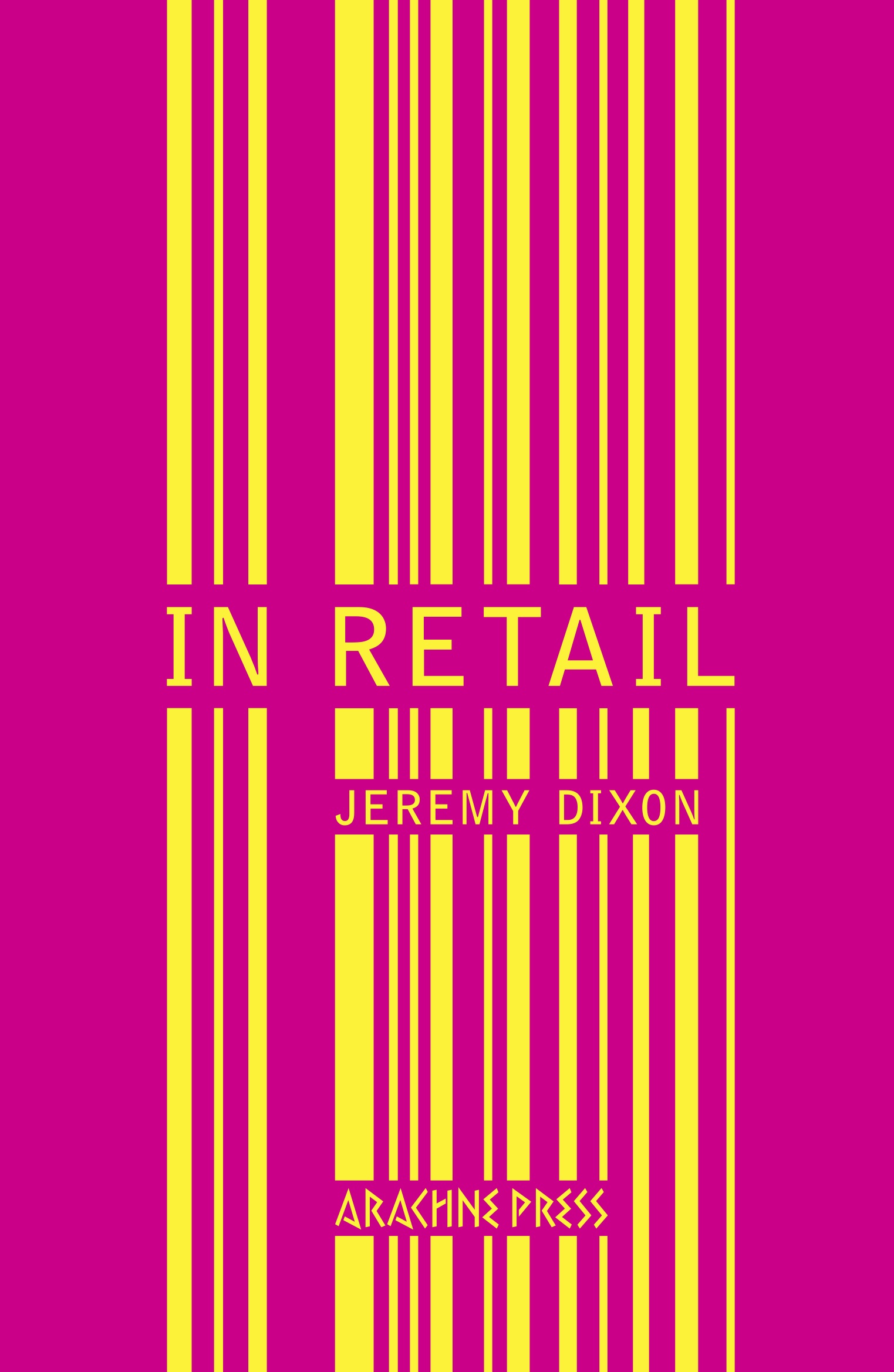
I am very excited that in February 2019 my first poetry collection will appear in the world, just one month ahead of my 55th birthday (please seeyuupûyoo second from last line in the question above). The book is called IN RETAIL and is being published by the wonderful Arachne Press. I am very lucky that my editor, Cherry Potts, has been incredibly supportive in terms of pushing the envelope of how poetry can be presented in book form and the collection incorporates influences from my parallel world of artists’ book. The poems contained within IN RETAIL are the result of my part-time job in a well-known high street chain of chemists, which rather unexpectedly turned out to be a great source of inspiration. Most of the poems began life as hurried lines scribbled on the back of a length of till roll in the lull between sales. I’m in the process of working out how to perform these poems and also arranging a reading tour (which is all completely new to me, so if any of your readers have any ideas or suggestions that would be fantastic!). IN RETAIL is available for pre-order now from Arachne Press (with free UK p&p and a free limited-edition IN RETAIL badge). Order link:
I am honoured and privileged that the following writers local, national and international haveagreed to be interviewed by me. I gave the writers two options: an emailed list of questions or a more fluid interview via messenger.
The usual ground is covered about motivation, daily routines and work ethic, but some surprises too. Some of these poets you may know, others may be new to you. I hope you enjoy the experience as much as I do
Chris Hardy
Tell me about your latest collection, and about definite recent and upcoming publications in magazines and online.
The title is also the title of a poem in the collection, not the best poem, in my view, but the title is the sort of phrase I like: it makes you wonder what it might mean, and prompts images of many things, but it also stops you thinking – like a koan. And without thinking you know, sense, what it means.
“The acute poems of this wonderfully named fourth collection are always clear, sometimes rueful. They cherish their ghosts. Past and present are summoned by memorable lines with strength and tenderness.” Alison Brackenbury
“Bird nesting in mailbox. Rat scrabbling in cavity wall. Spring uncoiling and a welcoming harbour. A guitarist as well as a poet Chris Hardy consistently hits the right note, never hits a false note.” Roger McGough
“These poems explore Time, from the tender appreciation of new life, through all its vicissitudes, to death: Time alters, enhances, destroys. They deserve to be read slowly, to appreciate the many and varied nuances which lead to the comprehension of the Now.” Patricia Oxley, Editor: Acumen Literary Journal
“Staggeringly beautiful, poetry as art form. Sam Smith, The Journal 53, January 2018. There is a breadth to this collection that crosses oceans. It reinforces his reputation as a poet in his own right.” Greg Freeman, Write Out Loud
“Chris writes vivid, expository poetry having the heft of short stories, often heavy with portent and mystery. Each of these poems is a story as beautifully muscular and slippery as an eel.” Peter Kennedy, London Grip, December 2017.
“Sunshine at the end of the world’ is tender and affecting and feels like an elegy, a beautiful and accepting celebration of what was, what is and what is to be – a poet writing at the peak of his powers. It is a collection of humanity, compassion and wisdom.” Dino O’Mahoney, Ink Sweat & Tears, January 2018.
I have won prizes in several competitions including the National Poetry Prize and been published over the years in many magazines, anthologies and poetry websites – Acumen, Agenda, Algebra of Owls, Atrium, Brittle Star, Corbelstone Press, The Dark Horse, Dreamcatcher, Frogmore Papers, Fenland Reed, High Window, Huffington Post, Ink Sweat and Tears, the Compass, the Interpreter’s House, London Grip, the Moth, the North, Obsessed With Pipework, Orbis, Picaroon, Planet, Poetry Review, the Rialto, South, South Bank Poetry, Stand, Tears in the Fence, Under the Radar and others.Within the last few years poems have appeared at the Blue Nib, Confingo *, Confluence *, Lampeter Review *, Poetry Salzburg Review *, Riggwelter, Soft Cartel, Presence *, South * and Stand*. Poems are due out soon in Blue Nib, South Bank Poetry, Picarooon and Orbis – maybe elsewhere, I’m waiting to hear back from editors and also the judges of various competitions.
The Interview
(Some of these questions and consequently my answers overlap)
What inspired you to write poetry and who introduced you to poetry?
I started writing at school, influenced and inspired by Keats, Coleridge, Owen, Shakespeare and Blake. We did these and other authors for our ‘O’ and ‘A’ levels so I suppose the exam curriculum introduced me to poetry – we also had a couple of good English teachers one of whom, Mr Coltman, was a 2nd world war veteran and a poet. Publishing started when I came across poetry magazines in London, where I was living. I submitted poems to them and began to get published: Stand, Poetry Review and Slow Dancer were amongst the first to take my poems.
How aware were you of the dominating presence of older poets?
I’ve never felt overawed or dominated by poets from the past. I respect and admire their work, their efforts, if not always their characters and lives. ‘Older poets’ and their works don’t dominate, they encourage. Here are some books, authors, tales, I admire and which have affected me and my writing at various times:The King James Bible and Cranmer’s Book of Common Prayer; Greek, Egyptian, Middle Eastern and Indian myth; the Greek Anthology; some, not all, Shakespeare (eg Hamlet, Othello); Coleridge (eg Frost At Midnight); Keats (especially the sonnets); Shelley; Fitzgerald’s ‘Omar Khayyam’; Thomas Hardy; Owen; Rosenberg; Sassoon; Edward Thomas; Frost; Snyder; Ginsberg; Ferlinghetti; Corso; Robert Duncan; eecummings; William Carlos Williams; Lowell; TS Eliot; Pound, (mainly ‘Cathay’); Berryman; Larkin; Plath; Hughes; Bishop; Carol Ann Duffy and recently, Charlotte Mew, Jack Gilbert, Billy Collins, Philip Levine, the Bloodaxe anthologies, Cavafy, DH Lawrence, Raymond Carver ..I have also been influenced, in their attitude to life, subject matter and style, by novelists such as Tolstoy, Emily Bronte, Faulkner, Hemingway, Conrad: they write from their own experience, which connects their work directly to reality. They firstly create a physical world from imagery and through and from this arises any underlying meaning: fact is far stranger than fiction and, once fiction is made from fact, fiction cannot lie.Another important thing is that I am a musician, a guitar player. I write songs but have never found this comes easily, nor can I easily set my own poems to music, though in my work with LiTTLe MACHiNe I, with the other two members of the group, have set many famous poems by well known authors to music. I have been greatly affected and guided by many great song writers, who I regard as poets – I don’t think there is any point or value in distinguishing between songs and poems, they both use words, and many poems accepted in the canon are also songs eg ballads. And of course Homer, Sappho etc chanted, sang, performed their work, to music. The blues musicians of the 20th C and the songwriters who learned from them and invented Rock & Roll, Rhythm & Blues, Rock etc are great artists and I am definitely influenced by them in my writing: Son House, Blind Boy Fuller, Robert Johnson, Howling Wolf, Muddy Waters, Big Bill Broonzy, Bert Jansch, Bob Dylan, Leonard Cohen, Chuck Berry, Jim Morrison, Lowell George and many others.
What is your daily writing routine?
George Herbert: ‘I once more smell the dew and rain and relish versing’:I wait for a signal that switches on my attention so I know there’s a poem there. Sometimes I’m working on a few poems at a time, or there’s nothing new but I’ll be revising, or there’s nothing. I have learned not to worry – though I do. When I am undistracted and in the right mood I can allow words to surface without examining, or deleting. Heaney wrote about writing, ‘In the corner of a lecture’ – when your mind is focused, on something or nothing, the imagination sends messages to the surface. I like discovering what the poem reveals, seeing what I didn’t know I knew. I feel cheerful when there’s a poem in a drawer, waiting to be attended to.Michael Longley said, ‘Better silence than forgeries .. I wait for poems’, which sums up my attitude to all this. So no, I do not write every day, but I am ready to write – I try to remember to have a notebook on me at all times. I have written poems on beaches, in front of the TV, on ferries and buses .. all I need is some paper and a pencil or pen. I do not type until I have re-written by hand several times. I use a manuscript book for drafting, sometimes I compose straight into it. I have kept quite a few of these as they are a sort of mine or quarry – there is stuff in there that I might be able to use – fragments, abandoned poems and also many notes, quotes, pictures. I stop writing when I have nothing else to write down.One important rule, that I have to remind myself of, is that, once I start I must not stop to correct, re-consider, censor .. that is fatal as if there is anything there it might find its way out buried in a load of verbiage and imagery that can be pared away later. Another helpful way of finding what a poem is about is getting someone else to read it – they may see what the poem is trying to reveal, or is really about, and suggest ways of bringing this out, making the poem in fact. On the whole I do not agree with the often expressed notion that a poem is ‘never finished’: I read poems written years ago and, while noticing that I might not have phrased or structured it like that now I do not wish to re-write it .. it is better to start afresh. I have written many poems that took hours to get right, then found that what I have left is not worth doing anything with. I will leave it, and possibly make use of any images, phrases, lines in a future poem.
What motivates you to write?
I write lyric poetry, by which I mean pieces of writing in a verse form that do not extend much beyond 4 or 5 pages, most of my poems are less than 40 lines long. I write like this because that is what my imagination creates – I sometimes intend to put together something longer but this rarely happens, mainly because it is ‘put together’ – is artificial. Over many years I have come to rely on my imagination finding the material it needs in my experiences and making something new from that. What is produced is then shaped by me into a verse form – stanzas, lines, punctuation etc – that seems to emerge from the poem. Often the first few lines set the form. I do not sit down thinking I must write a poem and this is the topic, nor do I attend writing classes where topics are set. Again, to me, all this produces is artificial, manufactured, poetry. I trust my imagination to make something, using words, from my knowledge and life: the poem, if it is a poem, will reveal what I was aware of but did not ‘see’ or ‘know’ before. Of course this leads to periods of anxiety when nothing appears, sometimes for months, but I have to remind myself then that this does not matter. What does matter is that whatever is written is necessary (to me) and ‘authentic’.
What is your work ethic?
When poets write they resemble improvising musicians and footballers – making it up without thinking. But musicians and footballers practise intensely so that, when they have to, they can perform freely. They practise physically and try to master the practical elements of their art. They operate within constraints (eg in music – the instrument, the notes available and their skill). Is there an equivalent for poets? How do poets practise using words so they are there when needed, without (too much) thought? By reading, listening, talking and discussing. Then, diligently wait, and do all you can to be ready: ‘Intensity of mood is the one necessary condition in the poet’ (Edward Thomas).As Coleridge said there is, ‘A well of the unconscious into which everything drops and the act of creation is lowering the bucket and pulling up images and words that have hopefully undergone metamorphosis’. This indicates that you must allow, trust, the imagination to make from its material – what you have stored from memory, thought, feeling, reading, experience etc – the phrasing and imagery of the poem: metaphor, yoking images together to reveal ideas, truths, feelings, understandings, knowledge that you did not know were there.I do not ‘practise’ writing poems as I practise guitar, every day for at least 1 – 2 hours. I have to be patient and calm and wait for the moment, which is also a mood – when I become aware that anything and everything in the ordinary world is of interest and has a mystery: it is inexplicably strange that we are here, like this. Then it takes a prompt: a word, an image, a memory, a line of verse, a phrase. Nick Laird: ‘Since the poet more often than not sits down to write about nothing, the content, subject matter, of the poem, rises to meet the words from below volition .. It is not a wholly intended process and requires trust’. What this all means is – you need to try to somehow get into the right place physically but especially mentally and emotionally, and then wait. My work ethic is to watch out, try to make space and time for when poems might arise – be alert, awake, wherever you are. This is what Buddhists call mindfulness – (I did an MA in Buddhism and Hinduism). ‘Anything, however small, may make a poem. Nothing, however great, is certain to’ (Edward Thomas).I practice guitar if possible every day. This is because an instrument is a physical device that you need to keep physically acquainted with: your hands need to be kept strong, relaxed, with hard finger tips. I don’t have a ‘writing’ work ethic – I do not sit down and make myself write. That would be against what I feel and believe about my poetry. However I do read poetry, looking for new names and going back through earlier favourites – I have just read two Cavafy collections.
How do the writers you read when you were young influence you today?
The appeal of poems I respond to is their unveiling of truth and mystery. Poetry that is clear and intense, that seems necessary to the poet. I’m not interested in poems that are puzzles, that don’t deliver. ‘The Waste Land’s’ linked images and apparently disconnected sections are constructed to make you experience the concerns that drove Eliot to write, without having to pause and think. The meaning in the poem is in the emotion it creates in the reader, who must simply read the carefully chosen and arranged words and ‘see’ what they describe and suggest. I prefer ‘Ode to the West Wind’ to many of Shakespeare’s sonnets, much of Donne, and all of Prynne.I have noticed I have evolved a style I tend to begin with that, after editing, becomes the style I end with. I fight this at times, try to use words differently, to change and break up what has become a habitual tone – for example the use of half rhyme, regular stanzas, a ‘smooth’ clear feel etc. But in the end I don’t like what these attempts produce. The same goes for subject matter: I want to write about everyday actual things, (Seeing the world anew. The wonder and strangeness of ordinary life .. Newton said something like, ‘All I have done is stand on the pebbles and look out over the ocean’ to which Yeats remonstrated, ‘Never mind the ocean, what about the pebbles!?’) but these have to have significance of some sort to prompt the writing and then always turn out to relate to underlying, broader meanings and issues that I constantly return to – life, death, the planet and Universe, memory, family .. the perennial mysteries that prompt all religions and much art.
Who of today’s writers do you admire the most and why?
Sharon Olds, Carol Ann Duffy, Roger McGough, Brian Patten, Gillian Clarke, Katrina Naomi, Hannah Lowe, Jo Bell, David Constantine, Gary Snyder, Arun Kolatkar .. Why I like them is explained in the other answers: they are interesting and have something to say – content is as, if not more, important than form and style, don’t try to make the reader think they’re stupid because they cannot understand the poem, don’t try to be obscure, cheerfully address important everyday things like work, sex, birth, death , purpose, meaning, us and our fellow creatures on this tiny blue speck, use words elegantly and beautifully, are not afraid or scornful of expressing feeling ..
Why do you write?
I began decades ago as I thought poets seemed to live interesting, dramatic lives and I was greatly affected by some of what they wrote, especially Shakespeare, some of the Elizabethans like Wyatt, and the Romantics. I had friends with similar inclinations and we used to write together. This continued at Kent University where I read English and American Literature. There were several undergraduate poets there, we knew each other and established a short-lived magazine called, ‘The Lost Works Of Neville Chamberlain’. Some of the staff, like Michael Grant, were poets who encouraged and supported us, commenting positively on our poems which was very charitable of them considering how dreadful they were. They invited impressive, powerful personalities such as Auden and Graves to give lectures, judge poetry competitions, and attend seminars. Eventually I discovered the satisfaction of managing to write and finish poems that expressed things that were important to me and also seemed well shaped, elegant, self-sufficient.
10. What would you say to someone who asked you “How do you become a writer?”>
Keeping going when inspiration is absent, there is nothing to say and no one wants to publish poems you think are interesting and well constructed enough to find an audience. Even if you win a prize in the National Poetry Competition, or get a poem in the Forward Anthology or into a ‘prestigious’ magazine nothing will probably change in your life – it takes luck, contacts and of course the right poem to make money and a name .. most poets in any case do not want to earn a living as poets. This would mean writing to order like a journalist or forcing the pace as novelists do – poetry should be written in the corners of your life and you need to live, not write, to write it. Far too many poets work in Universities and especially on ‘creative writing’ courses: this means that their only experiences, from which the poems must come, are of writing and talking about writing, (and the poetry that is about poetry is the most pointless, self-regarding and unenlightening of all).To me the ideal poet’s life would be that lived by Gary Snyder, who worked in the forests of North America, or William Carlos Williams’s life as a GP, or Byron and Shelley living on debt, family, friends and fame. Arnold, Wallace Stevens, Yeats, TS Eliot, Ted Hughes, Larkin, all worked in the world and wrote – as if life, work and poetry were connected rooms.I have had the privilege in LiTTLe MACHiNe of working with, and observing, Carol Ann Duffy and Roger McGough over several years. Both of them have spent much of their lives making a living from writing poetry. They have diligently promoted poetry by going into schools, and encouraging the aspiring poets who constantly approach them. They work hard all the time, travelling about the world, meeting the demands of agents, publishers, and deadlines, go on stage on their own and for an hour or more make a large audience really listen, and move and amuse them, just with words. And they always carry a pen and notebook ..
11. Tell me about the writing projects you’re involved in at the moment.
There used to be far more print outlets, and, it seemed, far fewer poets too. Online publications are able to accept large numbers of poems and they have multiplied. But who actually sits down and scrolls through a free, online magazine? Poetry seems popular and available but this maybe an illusion create by self-promotion on social media. As far as its impact on national culture, on TV, in the press etc, it is barely visible: very little Arts Council funding compared to theatre and opera, publishing concentrates on novels, non-fiction and biography, and poetry has nothing like the power, presence or impact of the music industry. I have a theory that most poets over the past 50 years would prefer to have been in rock bands – creative, known, busy, earning. But once you have accepted you are a poet then nothing beats finding a poem, finishing it and seeing it leave and go off into the world on its own. There’s no money or fame in it, but when something really needs saying, commemorating or celebrating, the public, and the State, turn to poetry – funerals, weddings, remembering Wars, standing up to violence. It is understood as being, like music, uniquely able to express profound feelings and ideas, and measure up to such moments. In my customary fashion I have been working on several poems after a quiet period. I do not find the UK, especially London, in the Summer, conducive to writing. Winter is much better, though travelling between May and September in Greece or Italy helps. The mirror in our sitting room has been there for years. Mirrors have strange qualities. One of these new poems began with a question and a memory: why did we buy this ‘Overmantle’, as it is called? The familiar sensation of a still, attentive mood, prompted by realising this glass had stared back at us staring at it, made me grab a pencil. After a few days and several drafts there was a sort of sonnet. The last verse came from realising suddenly that the back of the box was hidden to me but not to the mirror, which had been observing the carvings there for decades, just as we had been looking into this suspended eye, this lake in the room. And writing the last lines about Shakti, the goddess who protects and is also a partner, I saw how my imagination was linking the deity on the box to my wife and her purchase many years ago. The poem taught me something I had not known I already knew.
THIRD EYE
We bought a mirror to fill the space above the mantelpiece, from where it has remarked on our appearance ever since.
A pool of light protects the wall by holding and returning light, expands the room as if we’d moved next door and at night doubles its portion of the dark.
On the shelf stands a teak box with a cracked lid, all you could afford for my birthday when we’d just met.
The mirror knows the carving on its back better than us. Shakti, her panthers and peacocks dance hidden in the glass.
I am honoured and privileged that the following writers local, national and international have agreed to be interviewed by me. I gave the writers two options: an emailed list of questions or a more fluid interview via messenger. The usual ground is covered about motivation, daily routines and work ethic, but some surprises too. Some of these poets you may know, others may be new to you. I hope you enjoy the experience as much as I do.
Kerry’s poetry features in this anthology
Kerry Priest
Kerry’s work has been anthologized in The Best New British and Irish Poets 2018 (Eyewear), Future Poems (Emma Press, forthcoming) and has appeared in journals such as French Literary Review, Acumen and The Broadsheet. She grew up in Sheffield and studied Anthropology and Linguistics at Edinburgh University. She has lectured at the Universities of Humboldt, Berlin and ULCO, Boulogne-Sur-Mer. Kerry also used to be a professional DJ. http://www.kerrypriest.com
The Interview
1. What inspired you to write poetry?
I left the city and moved to the countryside round about the same time as both my parents died. Contact with nature’s cycles of life and death seems to have led to an outpouring of poetry. The first poem I wrote in 20 years came from seeing a red kite in a Derbyshire churchyard and it all spiralled from there, really.
2. Who introduced you to poetry?
My mother taught me how to write poems when I was seven years old. We used to read John Betjeman together. I also had a fantastic English teacher, Rosie Ford, who took us to Lumb Bank on Arvon courses. The guest poets included Carol Ann Duffy and Don Paterson. We had no idea who they were, obviously, because we were fourteen. The third lot of inspiration came years later, when I saw Jackie Juno perform and she introduced me to the idea of spoken word poetry.
3. How aware were you of the dominating presence of older poets?
I’m very drawn to the 60s, as that was the point where existentialism and metaphysics loomed large, so Norman MacCaig, Peter Porter, Ted Hughes, Wallace Stevens, Wislawa Szymborska. The history of poetry and the bardic, shamanic side of things is truly fascinating. On a good day, I like to feel myself part of an ancient tradition. Perhaps predictably, therefore, I read the more cosmic people like Blake, Donne, Vaughan, Whitman, Yeats, Rilke, Rimbaud…
4. What is your daily writing routine?
I keep a notebook for walking on the moors and otherwise I try to write or edit something every day. If I’m not in the mood, I’ll usually read instead.
5. What motivates you to write?
At the moment, I’m sort of embedded in a couple of projects, so I have the impetus to see them through. The process of reading widely is very inspiring for me. I’ll often be busy borrowing ideas from other poets, or just be inspired by something I’ve read about Mary Queen of Scots or breakdancing or something. Mostly, though, I’ll just be haunted by an image and I have to keep writing about it until it leaves me. Like at the moment, I’m obsessed with a particular conch shell that I can never quite see right inside and I‘ll never know what monster lurks inside that pearly spiral corridor, but I couldn’t bring myself to smash it open because the mystery of nature is what attracted me to this particular conch in the first place.
6. What is your work ethic?
Pretty good. I seek out like-minded communities to make it more fun if it gets stale.
7. How do the writers you read when you were young influence you today?
One of the first poems I fell in love with was Louis MacNiece’s Snow. That feeling, the giddiness at hidden layers of reality, is a recurring theme for me. Liz Lochhead, John Keats and Ted Hughes are three poets who’ve never left my reading pile.
8. Who of today’s writers do you admire the most and why?
Some that spring to mind are Matthew Francis for his variety, Liz Berry for her musicality, Jo Bell for the killer phrase, Alice Oswald for her controlled yet wild use of metaphors. Also John Burnside, Selima Hill, Paul Farley. I’m just listing names now… I recently discovered Abigail Parry and adore the creepy world she conjures up in her poems.
9. Why do you write?
Probably because I have finally found something I can do quite well. I’m very competitive with myself.
10. What would you say to someone who asked you “How do you become a writer?”
I guess anyone can write, in fact everybody should write. But a good writer will care more about the art than about self-expression.
11. Tell me about the writing projects you have on at the moment.
I’m writing The Ice Baby, which works as a pamphlet and as a performance. It’s about Prehistory, ritual, origins, medicine and magic. I do a live soundtrack using bones and sticks I’ve found on Dartmoor and amping them up with a guitar pickup to make a kind of minimal techno-drone backing track. Polyphony has been around in music for a thousand years, but is yet to reach the spoken word, so that’s something I’m working on with Jennie Osborne. Inspired by attending Alice Oswald and Stevie Wishart’s summer school, we have put together a multi-voiced choir which does poetry instead of singing. I am also writing radio plays which feature dramatic verse and radiophonic sound experimentation. http://www.kerrypriest.com
I am honoured and privileged that the following writers local, national and international have agreed to be interviewed by me. I gave the writers two options: an emailed list of questions or a more fluid interview via messenger. The usual ground is covered about motivation, daily routines and work ethic, but some surprises too. Some of these poets you may know, others may be new to you. I hope you enjoy the experience as much as I do.
Mysti S. Milwee
is an International published Synesthesia artist (whom paints to music), and poetess from Southside, AL. Her art and poetry has widely appeared in numerous magazines, e-zines, anthologies, and tours and has been used in academic studies and ministries across the US and abroad. Her collaborative works have been published in New Delhi, India with International Famous Singer/Songwriter Debasish Parashar to his Borgeet debut song “Pamaru Mana” which has received global recognition and numerous publications in India, Italy, & the US, huge thanks to Dipankar Jyoti Bora who did amazing work in PR/Exposure in India; In collaboration with International acclaimed British Composer Keith Barnard in London, United Kingdom, to his organ music “The Universal Harmony of Light”; In collaboration with Nationally acclaimed singer/songwriter Jonathan Joel Pop Artist from (Nashville, Tennessee) to his debut song “Mascara”. She is a former musician with the gift of musical knowledge, and a former vocalist singer. She is a member of several well known music and art societies, music and writing collaborative teams, and groups including: ASCAP (American Society of Composers, Authors, and Publishers); Art & Music International Group; Songwriting and Music Production Group; The Stellar Society: Writers, Poets, Filmmakers, and Artists; MADE-The Society of Music, Art, and Drama Education; Arts, Music, Literature & Humanities Group; Music of Other Dimensions Group; Native Music Blessing and Prayer Group; ASPS (Alabama State Poetry Society); Writers Anonymous; Alabama Writers Conclave; and many other groups, societies, and organizations across the US and abroad. More of my awards, publications, interviews, etc. can be found at: http://www.mystismilwee.wordpress.com
I was inspired to start writing poetry since the age of thirteen, when a tragic event affected our nation. My emotional response to this event left me in a state of mind of wanting to write to help effect change in our nation and our world as a whole to give my heart and soul to the people who are hurting and suffering. I wanted to be that messenger to convey an emotion left so deep in someone’s heart and soul that they would remember me and my words, and for them to remember what they felt and somehow be there for them spiritually and soulfully, instilling words of hope and healing to a broken and dark world that needs so much love, light, and healing. It is my heart to give and be there for “the people” through the most powerful tool, my words. I write what I feel, to convey a message through my voice and my vision that breathes life back into the broken world through poetry, painting, and photography. Everything that attaches to my mind inspires me to write freely and expressively.
2. Who introduced you to poetry?
I was first introduced to poetry at a very young age, reading poetry and books. My librarian first introduced me to the world of rhythm and rhyme, which is where I first fell in love with reading poetry. It was instilled in my veins from that point forward, reading everything I could get my hands on. I fell in love with reading poetry and books, never toys.
3. How aware were you of the dominating presence of older poets?
I was very aware of the older poets, I started studying Maya Angelou, The Beat Poets, William Wadsworth, Walt Whitman and many others when I was around age 10 at my local library, I was a curious type of person and always wanting to learn and study everything on my own, I have always been a self-disciplined, self-motivated and determined person since a young age. I would research the great minds on the computer, in magazines, etc. and went with what I felt was closest to my heart, because I knew somewhere in their poetry I could either relate, or it was an experience to learn and shape my character with a voice and vision from the depth of my soul.
4. What is your daily writing routine?
As a rule, I generally write at night when it is very quiet and I can focus more, although I tend to have a writers’ burst here and there during the day depending on my mindset, what is going on, my mood, and where I’m at, between the busy daily work schedules. I usually commit to 2 to 3 hours a night that fluctuates. I keep a log to track submissions, publishing’s, etc. It is sometimes a challenging task to keep up with as I write poetry, articles, essays, etc. and my sheet is usually very long and with my background as an internationally published synesthesia artist as well, sending in my paintings to magazines and journals, and also the aesthetics of art and the creative process relating to my synesthesia method of interpretation. The writing process is a very detailed process in which I love to write about my art and in ekphrastic form.I read my poetry friends posts on various social network platforms here and there that often inspire the next poem. Seeing their posts also keeps me motivated to keep writing
5. What motivates you to write?
Music motivates my writing the most, I would be on break from work or at night during quiet time and put my ear buds in and listen to give myself a boost or just to relax and often the music would spark a poem or a song because of its emotion and feeling, it conveys a message of understanding and depth that is usually related to everyday life. Music is a poetic movement in lyrical voice, it is a wonderful aid and tool that really keeps me writing and producing poetry and songs. I write because I am passionate about words, I love it and love to feel and express both in writing and visual art form.
6. What is your work ethic?
My work ethic is to just be me and do my best to achieve good results by setting reasonable goals that I can meet, maintaining a balance of communication, effort in a positive way, and dedication.Evolution and the world of change is the only way to embrace an “open mind”, the world is an open gate towards success. We must first not be our own enemy, but to spare ourselves to live in a world that is always changing at a fast pace, as the millennials become our future. Not just writers have to embrace it but all creatives and we seek that acceptance and learn from harsh criticism. If we don’t keep an “open mind” we set ourselves up for frequent disappointments and we give up our dreams. Being a visual artist since age three has been a course of change and challenge, in the beginning it frequented some failures but I learned from them, won some lost some it is what it is, and learned to accept and learn from it. Those failures were the bumps I climbed upon, it made me more determined and dedicated to never give up, learning from my experiences and criticism.
7. How do the writers you read when you were young influence you today?
The writers I have read have influenced me to have courage, be optimistic and never give up hope trying, they have encouraged me to find myself and my self-worth. The journey a lot of writers have embraced either a lonely life or had spent half their life in depression trying to find themselves, their identity and being a “people watcher” in society. How they influenced me to find myself, but I wanted to take that insight of what I read and turn it into something beautiful between the light and darkness and convey an emotion. It gave me the ability to learn, to experience the depth of understanding emotions and what people were actually writing, and what they were thinking. Learning from writers at an early age was a measure of wisdom, courage, adversity, strength, and perseverance and it helped me deal with the challenges and things that I was dealing with at an early age, they encouraged me to “think perspective” and be a transparent writer with my feelings in order to help the people and creatives who may be going through the same thing the older writers dealt with in their lifetime.
8. Who of today’s writers do you admire the most and why?
The writers who I admire the most right now are the contemporary poets such as Scott Thomas Outlar, Debasish Parashar, Danijela Trajkovic, Keith Barnard,Vatsala Radhakeesoon, Don Beukes, Linda Imbler, Christine Tabaka, Mike Griffith, Michael Lee Johnson, Ken Dronsfield, Urainah Glidewell, Sue Brannan Walker, and several others.. I admire them because I can relate well to their poetry, and they have been of great influence in who I am today as a writer. Their writings, and the emotion felt that touches my heart in a way that is also healing. I say this because we all have been there at some point of our life, needing healing in certain areas of our life. What doesn’t kill us makes us stronger, and the longer we keep it in and don’t write what we feel, the longer it stays bottled up inside. I admire them because they make me a stronger writer, to improve to be better. There is always room for improvement and they have been a huge influence not only in my life, but also as a writer.
9. Why do you write?
I write because it is my passion to give back to the world with words. Directly, giving the people hope, healing, encouragement, spiritual enlightenment, and love. Writing is my way of giving my heart and soul to others because its who I am, and what this world needs for writing is my calling, I will never give up who I am, and the words will never stop when my heart has so much to give. Writing has also been my sense of healing, curiosity for words, and finding out who I am and having the ability to see the imagery in my mind to convey thought of words and pictures to paint in my mind. As an grapheme-color-imagery synesthesia writer/poet, in which I write to and refer to poetic and artistic devices in my memory which aid to express a linkage between the senses. Writing from multi-sensory experiences has driven my mind, seeing a phenomenal height of illusion projected through words envisioned from interpretation of dreams; emotions; sensations and vibes; and spiritual depth of dimension and aura ( a three dimensional feeling and effect). This technique is a useful way to heighten and highlight a specific image or description that can be used to demonstrate confusion and excitement, adding an extra layer of meaning and can make imagery more complex and detailed, while also using mnemonic devices to write which is a memory device that also aids in my writing.
10. What would you say to someone who asked you “How do you become a writer”?
I would tell them to first write what you feel and get use to writing for others. See how it feels, start by joining poetry groups, or posting on social media and retain feedback, see how the people react and learn from it, and learn from the positive and negative comments (Yes there are critics, but let it shape you not break you. Learn from it). Learn from all perspectives they are your stepping stones. Set reasonable goals and keep a log of your submissions to journals, magazines, etc.. Set deadlines and stick to them. Be dedicated with discipline and focus, but learn to pace yourself and don’t put more on yourself that you can’t handle. Be consistent and choosy, learn your market before you submit to journals, mags, etc. Write something that has meaning to you, that is of importance, something that people can relate to. You have to ask yourself, “Why do I want to be a writer, and what do I want to accomplish as a writer”? That is your identity, your starting point in an outreach from your heart from your POV (Point of View) but in relation to writing for the people. Write through the mess, the rough drafts, revise and edit, edit, edit those imperfections but don’t forget to put “Your heart into it”.
11. Tell me about the writing projects you have on at the moment.
At the moment I am working with the team in writing and marketing with Advaitam Media & Entertainment- New Delhi, India on our ongoing Project Shillong. We are all collaborating together as a team whether in the making the music video and or writing various articles, essays, etc. for international acclaimed singer/songwriter Debasish Parashar on his debut song “Shillong” which is an “emotion”. His lyrics is a lyrical poetic romantic song. We are a team of powerful creators and collaborators. (Follow us on Facebook for updates; links; links to articles, magazines, etc.; YouTube link to Debasish’s music video “Shillong” https://www.youtube.com/watch?v=6P9clKk-TC0 )Besides that I have been writing poetry for several ministries across the US and abroad this year, so far this year to date I have written over 40 poems for ministry teams to be used as part of their sermons, biblical studies, and for various other projects and children’s programs. I am currently working on my first book of poetry, which I plan to have out next year along with works in translation (Cherokee/Tsalagi/Sequoyah language) and working on writing and illustrating my first children’s book. I am a writer and illustrator listed on the SCBWI (Society of Children’s Books Writer’s & Illustrators) website that I am affiliated with. Other recent writing projects and publishing’s include (Short List Version):*The Kolkata Review -Kolkata/Bengal, India (November 2018-Inaugural Issue-Issue 1) *Hidden Constellation -USA (TBA- December 2018) *SETU Magazine (October 2018 Edition Issue) *International Poetry Anthology: Love as Universal Religion-TBA November 2018 *International Multidisciplinary Journal – (India)-Article: “The Creative Process: Interpretation of the Mind from Divine Inspiration” *Asian Literary Society’s -World Peace Anthology-Contributor-November-2018 (New Delhi, India) *Moonchild Magazine (USA)– Shillong (Project Shillong)- Essay by Rajarshee Chakraborty (and in collaborative efforts with the Shillong team)-November 2018 *GloMag Magazine (Chennai, India)-In ekphrastic collaboration with Don Beukes (October 2018) -Don wrote a poem “Song of the Sunali Wagalvladiya” in response to my painting, in which we both collaborated in the poem as well with presenting my cultural heritage in the Cherokee Tsalagi language. *News Folder (New Delhi, India)- My English poem “The Path of Life” was translated in Hindi and published in News Folder-newspaper -(October-2018); “Waiting for a Lovely Soul”-August 2018 *Campionatul Modial de Poesia World Championship of Poetry- my English poem was translated into Romanian and published in the Romanian Anthology of World Poetry. (Romania-October-2018) *The 13 Alphabet Magazine -Bangladesh-October 2018-Issue #4-Short Story-contributor- “The Shillong Song.” *Northeast Feed (Rajarshee Chakraborty)- “The Shillong Song” -Collaborative Team efforts September 2018 *Siege Now (Ashrujit Basu) Kolkata, India – “The Making of the Song Shillong”, penned by Mysti S. Milwee (and in collaboration with the team).- September 2018 *Asian Literary Society’s-Petals of Love Anthology-Contributor-August 2018 *Siege Now (Ashrujit Basu) Kolkata, India – Article- “Art & Poetry from the Heart”-August 2018 *Cover Art for GloMag Magazine (Chennai, India)-July 2018 *Warriors With Wings-The Best of Contemporary Poetry- (Editor: Michael Lee Johnson & Co-editor: Ken Dronsfield- “Finding Faith & Freedom” & “Pushing through the Pain” poems published. *Interview with editor Vatsala Radhakeesoon- Creativity from the Heart- Mauritus – July 2018……….and many other publications leading back to January 2018
I am honoured and privileged that the following writers local, national and international have agreed to be interviewed by me. I gave the writers two options: an emailed list of questions or a more fluid interview via messenger. The usual ground is covered about motivation, daily routines and work ethic, but some surprises too. Some of these poets you may know, others may be new to you. I hope you enjoy the experience as much as I do.
Ben Armstrong
is a poet, musician and technical writer from the Black Country, UK. Known for his love of surreal and hyperreal imagery, he often eschews other, more sensible aims to hurtle blindly toward this end. Often times, this has led to a complete lack of interest in his work though he occasionally writes ‘the hits’. He is a student of David Morley’s Warwick Writing Programme and his poems have featured in a number of online journals and zines, the editors of which have superb taste. His first collection of poetry, Perennial, is out early 2019 (Knives, Forks and Spoons Press, 2018). He is currently working on a sequel.Website: adlibion.wordpress.com Twitter: @BenArmstro_ http://www.knivesforksandspoonspress.co.uk
The Interview
Wombwell Rainbow Interviews
1. What inspired you to write poetry?
My circumstances, more than anything I’d say. It’s difficult to pinpoint one factor but I remember that I was at University and I used poetry as a way to distance myself from the world I found myself in. It allowed me to build a new place to inhabit, mentally, and provided me the space seldom granted by my situation. Mostly it was a form of escapism and I’ve always been a writer, so it made sense. I enjoy colourful language and clever wordplay, but I like to dip in and out of things. Poetry just made a lot of sense – I fell into it.
2. Who introduced you to poetry?
My first real exposure to modern poetry was through my flatmate, Alistair. He’d recently taken a course at University, taught by Jane Commane (Editor, Nine Arches Press) and George Ttoouli (Editor, Gists & Piths) and his enthusiasm for the subject rubbed off on me. We spent many hours reading poetry in our kitchen and after a while, I decided to see if I could write something to a fair standard. He was my spirit level in those early days – I wrote mainly to improve upon the previous work I gave him. After that, I started performing at open mic nights in Leamington Spa and had a wider audience to practice with.
3. How aware were you of the dominating presence of older poets?
I’ve always been aware of poetry. It was a key part of my school syllabus so I read all the classics when I was younger. Wordsworth, Coleridge, Blake, etc. I always gravitated more toward the experiment style of T.S. Eliot than the lyrical verse of the romantics though. I like that harsh, descriptive American style. I could never relate much to older poets, even though I do admire their work.
4. What is your daily writing routine?
I don’t really have one. Some days I actively experience or recall things which could turn into poems. Other days I write them down. In my more editorial moments, I’ll dive in and restructure a poem or a collection of poems. I like to think of my poetry as an extension of myself, and in the same way that whole days of my life are lost with no clear point, I don’t tend to write something everyday either.
5. What motivates you to write?
I need to get things out. I’m not really sure why. It’s like any other urge. You do it, you feel better. I also like having an impact on someone in some way. You know, when someone reads one of my poems and really takes something away from it, I feel like it was worth writing. It was worth writing once for me, and then it achieves another, second life with them.
6. What is your work ethic?
I usually work in short bursts, writing each poem in one session. I find that the idea remains purer that way. I wrestle with the language until I’m happy. If I don’t end up liking it, I’ll break it down into a few lines which I think have potential and save them for another day. I will write diligently and with focus if I have an idea which I think merits a voice.
7. How do the writers you read when you were young influence you today?
In countless ways, many of which are probably too subconscious to properly discuss. I’m the sum-total of my influences, configured in a way that makes my writing mine, I think.
8. Who of today’s writers do you admire the most and why?
I always find having met someone and spent time with them, that it’s much easier to get inside and appreciate their work. David Morley was my tutor during my time at Warwick University and he is a truly fantastic poet, mentor and human being. I carry things he taught me everywhere. Luke Kennard is my favourite modern poet, for sure. His writing is hilarious, moving, intellectually sharp. I highly recommend reading The Migraine Hotel.
9. Why do you write?
I touched on this in a previous question, but it’s mostly for my own enjoyment – with a secondary benefit of creating something for others to enjoy. I’ve always just loved writing. A poem feels like home. I usually carry a book of poetry with me in my rucksack – like you would a phone charger or your keys. I think poetry is very important.
10. What would you say to someone who asked you “How do you become a writer?”
To become a writer, all you need to do is write. Unless you’re looking at it as a profession, I think you become a writer precisely at the moment you decide you are one. My biggest piece of advice is to network, socialise with writers, and share ideas. Doors open that way.
11. Tell me about the writing projects you have on at the moment.
Currently, my first collection, Perennial, is in its final stages and is scheduled for release by Knives, Forks and Spoons Press in January/February 2019. I couldn’t be happier with how it turned out and it’s a real honour to be in such great company. I wrote the majority of the collection between 2010 and 2016 whilst out travelling. Specifically, I drew a lot of influence from North Berwick, a small coastal town near Dunbar in Scotland, and Scheveningen, in The Hague, Netherlands. There’s a bizarre sci-fi/romance story underpinning all the poems – it’s not overt, but it is there. I’ll be going into more detail on it when I perform live in support of the book.I’m also looking into co-authoring a book with a friend, James. His work is excellent and I feel like our styles complement each other’s well. Apart from that, I’m busy writing more poems which will form the basis for my next collection.Thanks for the questions, Paul!
I am honoured and privileged that the following writers local, national and international have agreed to be interviewed by me. I gave the writers two options: an emailed list of questions or a more fluid interview via messenger. The usual ground is covered about motivation, daily routines and work ethic, but some surprises too. Some of these poets you may know, others may be new to you. I hope you enjoy the experience as much as I do.
The Illuminated World by Jemma Borg
Jemma Borg
Jemma Borg’s first collection, The illuminated world (Eyewear, 2014), won the inaugural Fledgling Award and included a poem highly commended in the Forward Prize. Recent publications include The Poetry Review, Oxford Poetry and Magma. She won the Ginkgo Prize for Ecopoetry in 2018, and the RSPB/Rialto Nature and Place Competition in 2017. http://www.jemmaborg.co.ukwww.lyrikline
The Interview
1. What inspired you to write poetry?
My first encounter with Shakespeare at school. I’d not had much exposure to poetry as I was growing up, but I loved the language of Shakespeare immediately – the sound of it (even if I didn’t know about iambic pentameter then) and the complexity but also the ability to present that complex thought in surprisingly lucid and spare ways. We also had a very progressive teacher that year at school who used to bring in song lyrics to our lessons – stuff we were listening to, like the Eurythmics – so I was also being presented with a very permissive atmosphere in terms of what poetry could be.
2. Who introduced you to poetry?
Well, that teacher has some responsibility. But really it took off from that point at school for me – I sought out poetry myself in the local library. I’d always been writing stories as a child, but it became very much poetry that I focussed on from then on – I have a couple of collections from my teenage years (unpublished of course). I like the idea that poetry is a natural rhythm in our bodies – iambic pentameter fits with the breath, for example – so I also think there’s something instinctive about it, which suggests you don’t need to be introduced to it so much as encouraged to find it in yourself.
3. How aware were you of the dominating presence of older poets?
Initially, I’d say I was more aware of the tradition – the long history of poetry and although that seemed largely male, it didn’t bother me. As I became a more experienced writer, I realised that it mattered I was a woman – in terms of ‘the tradition’, but also just as an issue I had to think about. But I didn’t feel that older poets – I assume you mean contemporary poets – were dominating as such. I ‘ve been determined to learn what I could from them. Most poets I’ve worked with have been generous, encouraging and inspiring. And, ultimately, your mentors become the poets you read and return to again and again – and they can be from any time, any place.
4. What is your daily writing routine?
In school term time (i.e. when I don’t need childcare), I write every day of the working week. Before I had my son, I wrote every day – which I felt was an important part of my apprenticeship to poetry. Now, it’s less crucial if I don’t work at my desk every day – that’s also a necessity with a child, you never know if you’re going to need to drop everything and attend to their needs. I’ve found I can work in my head, editing poems, and I appreciate the role of things like walking and exercise in freeing up my work. I’m very interested in the writing process – and it isn’t all about what you do at your desk. Fortunately. A sense of continuity matters though and I do try to get away on a retreat once a year – and then I often write into the evening – by nature, I’m a night owl, but parenthood usually forces me to be the opposite of that.
5. What motivates you to write?
Reading is a huge motivator – coming across something you admire or are excited by or reading a poem which you can feel doing its thing, strengthening that ‘obstinate centre’ in you that Elaine Feinstein wrote of. Ted Hughes said that a ‘heightened awareness draws language to itself’ so some of working has to be getting into that state of heightened awareness – music helps for me. So there are also these ‘peripheral things’ that help – coffee, a lack of distractions… Often the job is about getting yourself to engage with difficult topics and to challenge procrastination – which is usually about learning to be gentle with yourself.
6. What is your work ethic?
No pain, no gain? Poetry is a vocation and a journey – and poets should aim to become a channel rather than just express their own opinions or experience. Writing is as much about the work you do on yourself and your life. Writers have responsibility – but you have to find out what that responsibility is for the way your write. Also, writing does not depend on ‘being in the mood’ – you can sit down to it and just do it like anything else. But see above – sometimes procrastination means you’re finding something tricky, perhaps psychologically, and then you might want to go and do something else, like take a walk.
7. How do the writers you read when you were young influence you today?
When I was young, I read a lot of science fiction (Asimov, JG Ballard…). I think that’s a good basis for writing what we have come to call ‘ecopoetry’ – an eye on the apocalypse while at the same time imagining alternative futures. Also, I trained as a scientist at university and as such science often influences my syntactic choices – scientific literature is written in a particular kind of way, with lots of parentheses and with a strong rhetorical basis. Of course, everything you read influences you in some way – and that’s all good. We just have to read as widely as possible in order to ‘educate the intuition’.
8. Who of today’s writers do you admire the most and why?
Having just returned from the Aldeburgh poetry festival, and seeing her perform, I have to say that the Penned in the Margins poet Elizabeth-Jane Burnett was amazing. The poetry works wonderfully – musically – on the page but then, live, the poet spontaneously breaks out into song, as though the poetry has to lift off the page, the words taking flight. It really was a very memorable moment – it was not because the poet wished to be ‘performative’, but she was following the musicality of her words to their full conclusion. Fascinating. I like language that is alive – and to me that’s what poetry should be doing. One of the books I’ve enjoyed most over the past few years for that very reason is Christopher Logue’s translations of the Iliad – War Music. I love poetry in translation generally for the stretching it forces English to perform. I also admire the musicality of poets like Alice Oswald, and I like poets who are engaged in a ‘project’ – hers she states as being about giving voice to natural things, hearing them as they are in themselves not from the biases we humans have (this is a tricky task). A lot of poets who impress are from America – and while Jorie Graham’s project has become more specialised, her work along with that of Louise Gluck, has an attractive ‘meatiness’. American poets do not apologise for having a poetics of ideas.
9. Why do you write?
Because I have to. It’s always been a part of my life and I go slightly crazy if I don’t. It’s probably to do with keeping my inner sense of the world in some kind of order. The joy of it is the sense of discovery you can get as you work through a poem and that’s a kind of addictive joy. I also just enjoy language, the music of it, the almost physical properties of it (I like working with collage in the early drafting process). Also, I believe that writing – all art – matters. It matters that we struggle to express, represent and transform.
10. What would you say to someone who asked you “How do you become a writer?”
Ah, that’s an interesting question. I think you both choose it and it also kind of happens to you too. But you have to give yourself a lot of time, and you have to write a LOT to begin with. Read a lot too, obviously. If you’re not massively interested in reading, you’re probably not a writer. You have to think about, and discover, what kind of writer you are – there are many different ways to be a writer and sometimes people get caught up thinking they want to be a poet or a novelist, for example, when their skills may lie elsewhere. And don’t do it unless you absolutely can’t bear not to – it’s going to demand so much from you and rewards are thin on the ground.
11. Tell me about the writing projects you have on at the moment.At the moment,
I’m working on my second collection, so a lot of what I’m doing is editing, with the occasional new poem being written to fit the trajectory of what will ultimately be the book. I’m also researching ecopoetics and how women have combined motherhood with writing. I’m interested in challenging myself with different ways to write from this point onwards – and want to think about innovative approaches.
I am honoured and privileged that the following writers local, national and international have agreed to be interviewed by me. I gave the writers two options: an emailed list of questions or a more fluid interview via messenger. The usual ground is covered about motivation, daily routines and work ethic, but some surprises too. Some of these poets you may know, others may be new to you. I hope you enjoy the experience as much as I do.
Hanging Around The House
Karen Alkalay-Gut
has retired from teaching poetry at Tel Aviv University but not from poetry itself. She writes about poetry in numerous forms, cultures and historical contexts, and has written a biography of Adelaide Crapsey. Her current project is entitled “Here Lie: Poets and Their Graves.” The third disk of “Panic Ensemble” with her lyrics will be released in 2019 in Berlin. She’s lost track of the number of books published in English, Hebrew Spanish and Italian translation. Her latest publications include the Hebrew, “Ways to Love,” in 2017, “Yerusha” in Yiddish and Hebrew, and Hanging Around the House, 2018. Alkalay-Gut was born in London, England, near the end of World War II. She moved with her family to Rochester, New York, in 1948, and completed her Phd at the University of Rochester. In 1972 she moved to Israel and has been living there since. She is married to Ezra Gut and has children, step-children, grandchildren, and sometimes a pet or two. Much more information can be found on her website: http://www.karenalkalay-gut.com.
The Interview
1. What inspired you to write poetry?
The need to figure myself out. In fifth grade I started writing because a tired teacher told the class to spend the next hour expressing ourselves in words. I stayed after class and wound up taking the adventure story – that was suddenly filling up my mind – home for the night to finish. From that moment on I loved writing stories. I wrote plays for the class to perform. As long as someone asked me to write, I could write. But it was only a few years later when I began to write poems. And that was because I didn’t have an audience and I wanted to understand what was going on with me.
2. Who introduced you to poetry?
The first time I really heard poetry was when a teacher in sixth grade read out “The Highwayman” to us, and I went home and learned it by heart because of the music. And I got a radio for my birthday and began hearing wonderful lyrical songs. But it was only when I began studying in advanced courses that concentrated on great poets, like Chaucer, Pope, Williams, that I really began to feel the power of poetry.
3. How aware were you of the dominating presence of older poets?
They were never dominating for me because I never thought of my own poetry as part of the poetry world. It was my world from the beginning. The only rule I followed was when a poet told me that I should never write if I could sleep without writing poetry. It had to be an intense drive.
4. What is your daily writing routine?
I don’t write poetry if the words don’t come into my head. Usually while in the middle of something else, something monotonous and often rhythmic. Because prose demands a daily and regular schedule, and I worked and raised kids and did volunteer work, I only write prose occasionally. I often go back to that excuse that Thoreau gave, “My life is the poem I would have writ but I could not both live and utter it.” Sometimes you have to leave writing alone and get some experiences and then you have something to write about.
5. What motivates you to write?
Freedom. Time to write. I also really like it when I know I will be reading or publishing to a welcome audience. It makes me think about what I want to say to them. I’m not interested in figuring myself out any more.
6. What is your work ethic?
Do you mean do I believe in hard work? Or do I believe that hard work should be rewarded? Do I have a moral basis for my work? Let me answer my third interpretation of the question. I believe that poetry helps people understand and develop their humanity and that it is therefore necessary to society. I believe that reading poetry opens me up to others and I hope my poetry does that to other people. So I believe there is a moral responsibility to communicate poetry to others. But it is also a very pleasurable activity.
7. How do the writers you read when you were young influence you today?
Of course I don’t remember the writers who didn’t influence me. And my reading was incredibly eclectic. I loved the historical novels of Noel Gerson, whose romantization of the past stimulated my mind when I was ten and too young to understand them. But I loved Gulliver’s Travels too – especially the third book that mocks intellectuals. The big poetry revolution came when I read Jack Kerouac and then found a record of him reading his poetry. The music of it drove me wild and I listened to it again and again for years.
8. Who of today’s writers do you admire the most and why?
I’m stumped. There are so many and it’s so complicated. I don’t like poetry that begins with an agenda although I love poetry that embodies an agenda. So Lucille Clifton always resonates for me. But I recently became engrossed in some novels of the Egyptian writer, Ali Alaswani, that are deeply political, and wondered why there is such a difference between my reaction to poetry and fiction.9. Why do you write? Because I can’t sleep unless I do.10. What would you say to someone who asked you “How do you become a writer?”You write. You write and put it away for a while. Then you show it to someone. Then you show it to someone else. Then you revise and then you show it to someone again. Then, when you think it says what you want it to say, you try to publish it.
11. Tell me about the writing projects you have on at the moment.
I’ve been writing short pieces about poets and their graves. I call it, “Here Lie.” I’ve been going around to graves of poets around the world, taking pictures, and writing the stories around them. I’ve written more than a dozen so far, and they are all fascinating and very different. I’ve also been writing lots of poetry – some about my family in the holocaust, some about little things in life – like cell phones and kids. I haven’t been doing too much with these because I just put my energies into writing a book of poems in Yiddish that came out this March and got some good reviews. I studied Yiddish as a child and my parents spoke it and the stories they told me were more accessible when I returned to their language. Now I’m back in English and reorganizing my head. I think that will ultimately be good for my poetry and my prose to reorganize my head. Last year I did a little book called “Hanging Around the House,” that consisted of poems that the reader is supposed to hang around the house so that they get the feeling that the walls and the furniture are talking to him/her. My favourites are the ones you hang up in the bathroom because there they have a captive audience.