Wombwell Rainbow Interviews: Sarwa Azeez

Wombwell Rainbow Interviews

I am honoured and privileged that the following writers local, national and international have agreed to be interviewed by me. I gave the writers two options: an emailed list of questions or a more fluid interview via messenger.
The usual ground is covered about motivation, daily routines and work ethic, but some surprises too. Some of these poets you may know, others may be new to you. I hope you enjoy the experience as much as I do.
Remote

Sarwa Azeez

completed an MA in English Literature at Leicester University in 2012. Growing up in wartime Iraq, the flickering light of kerosene lantern did not reduce her passion for reading. She lives in Soran, a city located in Iraqi Kurdistan. She taught creative writing and translation at Soran University. Her main interests are reading and writing, especially poetry writing. Sarwa has worked with an activist community doing humanitarian work with women. Her writing looks for the beauty in a war torn world. It also seeks to define identity and confront issues of equal gender representation and violence in male dominant communities.

To follow her interests, she is now working on two projects; both of them are aimed at finding women voices through their narratives and works of literature. She is also a Fulbrighter, doing her second masters in Creative Writing at Nebraska-Lincoln University in the US. She dreams that one day women can speak for themselves and pass that understanding across nations.

Home

The Interview

1. What inspired you to write poetry?

Two of my aunts are poets. They read and write in Kurdish. They used to read their poems to their friends and relatives out loud. I was around 8, I did not exactly know what these poems were about, but I knew they included themes of freedom, war and gender discrimination. I remember how excited I became each time I went to their homes and picked poetry books from their library shelves. They had two half-walls of bookshelves.

2. Who introduced you to poetry?

Apart from the influence of my aunts there were other factors that forced me to write poems. When I was doing my first masters in English Studies at Leicester University in 2012, I took a poetry workshop class and wrote some poems. It was a new experience for me. I was introduced to he work many great poets such as Emily Dickinson, Langston Hughs, Sylvia Plath, T.S Elliot and many more. It was also my first time sharing my poems with others and hearing from their feedback.
After that I became a lecturer in Soran University in Iraqi Kurdistan. I met poet and fiction writer Dr.Muli Amaye who was the Head of English Department in 2014. When I showed her some of my poems she encouraged me to write more. We decided to write a poem every week and share it with each other.

3. How aware were you of the dominating presence of older poets?

Because I was raised in Kurdistan, then spent two years in the UK and now I live in the US, to answer this question I have to think about these different environments. There are many amazing Kurdish poets who write in Kurdish or English such as Sherko Bekas, Abdulla Pashew, Choman Hardi, Nazand Bagikhani, to name a few. I think that many Kurdish young poets read their collections and get influenced by them, which is a positive phenomenon. However, as far as my writing experience is concerned, these poets have distanced themselves from other aspiring young writers who are interested in this genre of writing. Whereas in most European and American societies this is a different experience. It is much easier for someone who is in America or Europe to meet these writers in reading events or simply join their courses. Further, there are hundreds of encouraging opportunities such as competitive projects, creative writing courses and reading performances for these young writers.

I was teaching a Creative Writing course in Soran University in Kurdistan region, I was surprised to see that we have so many young students who are really passionate about writing, but they did not get any support or encouragement whatsoever from educational institutions, NGOs, and other writing centres.

4. What is your daily writing routine?

I think I don’t have daily routine. But different things inspire me or push me to write. For example, I read an article, may be it is about contemporary issues such as migration, war or violence, I want to cry, when I know no one cares or listens, I grab my notebook and write a poem about it.

5. What motivates you to write?

It depends. Reading others work really inspires me. Sometimes a film or a piece of art motivates me. Also when I listen to others stories on social media or face to face I nod and think OMG this is my next poem.

6. What is your work ethic?
Having my own space for a while and listening to my own voice.

7. How do the writers you read when you were young influence you today?

I started with reading fiction at a very young age. The first novel I read was Les Miserable in Kurdish, when I was only 9. I did not know that it was political, but parts about poverty and punishment tore my heart. Re-reading works of Hugo, Camus, Hemingway and Woolf gave me new perspectives on life from childhood up to adulthood.

8. Who of today’s writers do you admire the most and why?

I started late with contemporary writers. Works of Alice Walker, Raymond Carver, Margaret Atwood,  Elif Shafaq, Warsan Shire, Mai Der Vang speak a lot to me. Throughout all their stories and poems one finds a remarkable spirit of universality.

9. Why do you write, as opposed to doing anything else?

Like any type of art writing poetry has a therapeutic power. You feel this power better when you live in a society where freedom of expression is restricted due to cultural, religious and political reasons.

10. What would you say to someone who asked you “How do you become a writer?”

After Gulf War we did not have electricity for many years. Because of sanctions we have endured severe financial difficulties. Books gave me strength, hope and light. I hope I can have similar impact on my readers.

11. Tell me about the writing projects you have on at the moment.

I am working on my thesis which will focus on freedom of expression: the impacts of self-censorship on writing.

Wombwell Rainbow Interviews: Sam J Grudgings

Wombwell Rainbow Interviews

I am honoured and privileged that the following writers local, national and international have agreed to be interviewed by me. I gave the writers two options: an emailed list of questions or a more fluid interview via messenger.

The usual ground is covered about motivation, daily routines and work ethic, but some surprises too. Some of these poets you may know, others may be new to you. I hope you enjoy the experience as much as I do.

Sam Grudgings Variations On Home

Sam J Grudgings

(According to his website) is a poet perpetually on the edge of collapse, nominated for the Outspoken Poetry Prize 2019 and winner of Slams across the country. He yells stories about recovery, loss, 50ft monsters, cities made of teeth and haunted people because it’s  cheaper than therapy and is less physically taxing than porno.

Renowned for his off-kilter, frenetic delivery and intense stage dynamic, Sam grew up in the punk scene and it shows. Injecting gallows humour into fiercely wrought metaphors, Sam subverts the narratives of addiction, bringing a wry touch to devastating subjects whilst still allowing himself the space to be painfully candid and devastatingly vulnerable. 

Sam runs workshops on performance and writing as well as campaigning for the recognition of lived experience in professional and academic circles. He endeavours to bring poetry to everyone, by collaboration efforts with musicians, dancers and artists as well as local communities. He is the outreach Coordinator for Milk Poetry in Bristol.

His website: https://www.samjgrudgings.co.uk/

YouTube: https://www.youtube.com/channel/UCyZ0-fhnaMleL08EkAyUT8g

The Interview

1. What inspired you  to write poetry?

depression & suicide prevention.

2. Who introduced you to poetry?

When I was very young I remember having Alan Alhbergs books along with the Usborne book of Nonsense rhymes and a few Roald Dahl books, which I would have had read to me or tried to muddle my way through when I started reading properly, at around this age I also remember my granddads on both sides (who had both been teachers) reciting snippets of war poems or famous Victorian poets and it all sounding very cryptic but extremely knowledgeable. However my interest  in poetry dropped off significantly till I was about 16 or 17.

I seem to remember a spoken word artist appear on a late night variety TV show of some sort which I guess was the catalyst or sparked some curiosity on my part because I somehow became aware of Def Poetry Jam at this age. I remember using my grandparents awful internet connection to watch their videos on an early iteration of youtube and being blown away by Saul Williams “Coded Language” It stuck with me in a way that I don’t think anyone has since. I would have picked up Common, Lauryn Hill and Mos Def at the same time but it was Saul Williams who really enmeshed themselves in my conscious, though at that stage I never put two and two together that it would be something I could do, it just made me aware of the artform.

It wasn’t until years later when an ex bought Listener to my attention that I realised there was some way of using the punk songs I had been writing without having to learn an instrument., That sounds a bit dismissive but genuinely I took all the angsty lyrics I had written and repurposed them as “a capella punk Songs” and called it poetry. I spent the next 6 years working on my songs till they became more poems and growing my moustache (thinking this was integral to punk poetry)

I went to every open mic I could, every slam I could, every event I could and hungrily absorbed all the different forms of spoken word and performance poetry and whatever anyone was calling it, before turning back to page work, surprisingly later on. I think in some ways everyone I saw in those first few years introduced me to their poetry so there are hundreds of people to point out to, but the Bristol Poetry scene and Saul Williams and Dan Smith (Listener) were the main three.

3. How aware were you of the dominating presence of older poets?

It’s an interesting question and I’m not sure if I know the right answer. My exposure to poetry was through performance so I was very lucky in that my exposure to older poets was largely of those who were still regulars in the open mic scene and as such never seemed intimidating or dominating, just accepting of you whatever level you were at. Jeremy Toombs who ran the Arts House Open mic was a giant of an American beat poet who, though he never remembered anyone, welcomed them like he knew exactly who they were. Similarly the rest of the people who would frequent these nights, whatever level they were at were largely welcoming and free with their advice.

It was only later on when I started doing poetry more professionally that I became aware of the politics and influence of certain writers and performers, but I still don’t consider them dominating as such, they largely earned their place (even if through the means of a flawed system of meritocracy) and since they are so separate from what I’m doing, whilst I can be influenced by the work, or I can often get frustrated that a middle aged white man has been thrust into a position of influence by others, realistically on a day to day basis it has little effect on how I operate or how I or any of my contemporaries create our work. In fact some of my contemporaries on the scene at the moment will likely eventually join their esteemed ranks, and then the mystique is broken even further and it will just be Mal sat on the council of Poets and we’ll still go for a drink at the pub and bitch about things (though she might have to wear ceremonial Poet Council Robes)

4. What is your daily writing routine?

I will always write on the move, even if just a line, an overheard conversation as a bouncing off point or a song lyric to write in response to, like a weird magpie or caddisfly larva I’ll accumulate scraps and ideas and occasionally overall concepts throughout the course of the day. When I get home I compile these scraps to make a dry stone wall of words written in a secure and permanent place and occasionally make a near final draft but will then leave it. I’ll come back to it a few weeks later to think about what the work is saying then chisel out a working draft, often performing that a few times to get a feel for where it works or doesn’t then leave it again. I’ll often get another pair of eyes on it from writers I admire and respect to get a different view of it then return to it.

If I have something burning to write a hole in my pocket with a specific idea or for a commission I will set aside time each day to plan it out and write out with full mind maps, thinking of structure, point of view, how the poem needs to sound, what the narrative needs to sound like to an audience member, is it a conversation, a recollection and so on. I’ll do some freewrites etc before Frankenstiening scraps and parts from my notes onto it and finding best fit. Then leave it to prove for a couple of days (depends on timescale) and come back to it with fresh eyes as I can manage.

5. What motivates you to write?

The process of writing is both cathartic and enjoyable, it allows me to take whatever I am thinking about and put it at one remove which means I can compartmentalize it and think of it differently which is helpful. Also I get a strange sense of satisfaction from solving which line goes were working out how to best phrase something, it’s often a puzzle piece and there’s an immense sense of gratitude which is now part of what I crave/

6. What is your work ethic?

Until recently I very much had an attitude of it needs to be done at any cost, which can be quite detrimental as a performer, either from the point of view of THIS POEM NEEDS TO BE WRITTEN AND WRITTEN NOW or “I need to as many gigs as I can” and with the say yes attitude expected of poets pre-emerging stage I would agree to do a host of things I didn’t have the time or mental capacity to do.

Now I am ensuring that the projects I commit to are ones I can give my full time and effort to and that the poems that I write are ones that have enough time to come into their own maturity rather than forcing it because the time is often not right now though it may seem so. I still think I err on the side of taking too much on often in a more practical and/or producing capacity than creative one which again is not great but I think it’s necessary to make a few sacrifices so you can show willing, and then allow the future to account for your deficit of time that you spent helping others.

7. How do the writers you read when you were young influence you today?

I was more interested in stories than poetry when I was a child so I think its only very recently I have been able to shake the notion making each piece its wholly contained narrative, and focus on the minutiae of something. Terry Pratchett was probably my biggest influence as a child and still find elements of him in my writing, a wry tongue in cheek look at things occasionally through a fantastical lens, which is what most of my metaphors do. There’s also Roald Dahl’s sense of glee in morbidity and gloom which I revel in, my poetry is darky and doomy but that doesn’t mean it can’t be catchy or have fun with it.

8. Who of today’s writers do you admire the most and why?

Joelle Taylor still, she is one of the most fantastic writers and with a work ethic that I admire and would love to emulate. Her work was one of the rare times a poem has made immediate sense to me, her performance, her stage presence and her general being is a thing of bloody minded awe and a lot of her stuff makes me weep no matter how many times I see it or read it.

Ocean Vuong, for much different reasons, I don’t understand their work, try as I might it eludes me a little, I can analyse it be in shock of the beauty of it and see individual line breaks, sense the metaphor, see how enjambment works here but not here and their use of X Y and Z but not be able to work it out. I think the fact that in itself it works as a piece of art that I actively am aware that I don’t fully understand but can appreciate is a talent in itself, I have quite an analytic mind in that regard and the challenge of their work is something that really appeals.

On a more local level (if only for the time being) Pascal Vine is a poet who I collaborate with mainly because I admire their work so much and want to get my head round how to write like them and Meg Baxter whose work I will never be able to emulate but will enjoy till I die because it is beautiful.

In terms of performers both Saili Katebe and Birdspeed are always bringing something new to the table and constantly working to better their game, it’s an inspiration to watch and one day I’ll be able to say “I knew them, before they were famous”

I’m also in constant bemused shock that the other members of the Milk team count me as one of them, we all have such wildly different styles and they are such phenomenally talented writers to work alongside it gives me a great sense of pride to see them work their arses off to make a) their own work shine and b) spaces for other people’s work to shine and grow.

9. Why do you write, as opposed to doing anything else?

Writing is simply the process of formalizing communication in black and white, I have a need to communicate, and poetry lets me dress that up as an art rather than just protesting the current state of everything by bothering people with anguished inarticulate wails and gnashing of teeth and/or setting fire to things.

10. What would you say to someone who asked you “How do you become a writer?”

Spend as long as  you can failing and learn how to turn self destruction into an artform, take away the self destruction,and boom you’re a writer.

All joking aside,I don’t think a writer is something you become, you just are one simply by doing. Being a good writer or a published writer is another matter…you may have to ask me that in a few years (and even then I may keep those secrets to myself)

Rules for being a poet, specifically a spoken word one are simple, 1. Be nice. 2. Be prepared to be wrong. 3. Read and watch everything you can to really learn your craft

As a promoter and punter of poetry shows, kindness is the one thing that I want every person to demonstrate, you are part of a community and you will find people are more inclined to help if you’re a reasonable person, it costs nothing and it’s a useful tool throughout your life. You need to learn to be wrong and make mistakes cos otherwise you can’t grow, being wrong is not shameful, it’s just a lesson in how not to do it next time round.

The last one is something that took me so long to learn, I was scared of watching or reading too many poets in case I sounded like them or inadvertently stole something from them but  if you listen and watch ALL of them, then you can combine everything stolen into something new and wonderful…and hey, maybe learn how to write an original piece yourself.

11. Tell me about the writing projects you have on at the moment.

Currently I’m all about collaborations, I’ve worked with dancers three times over the past year and have more stuff tentatively planned. I’m working with other poets to mix our styles and create something outside of the Venn diagrams of both our comfort zones.

I’m also working with musicians quite closely, I recorded an album with a Bristol based electronic post rock outfit, Spaces Between last year which is currently looking for a record label to call home. Myself and Pascal did some live collaborations with Sean Addicott for his album launch earlier this year and I’ve got hopes of us working with him again cos a) he’s a good mate and b) I really want to work with his screamo band Punch On!  I’m in the middle of transatlantic writing with Zander Sharp a folk musician who abandoned me to go to New York, but I’m mainly just throwing poems his way for him to reappropriate into songs and see what comes of it.

The Milk Team are moving home after three years to a new bigger venue, so we have some really exciting projects coming up and weird innovative ways of delivering poetry to the masses, who even though they may not know it, are crying out for poetry.

Outside of that I’m just constantly working on finding out who I am by writing endlessly about it and trying to find some validation by getting it published in journals and magazines and yelling into people’s faces at gigs.

Wombwell Rainbow Interviews: Thomas McColl

Wombwell Rainbow Interviews

I am honoured and privileged that the following writers local, national and international have agreed to be interviewed by me. I gave the writers two options: an emailed list of questions or a more fluid interview via messenger.

The usual ground is covered about motivation, daily routines and work ethic, but some surprises too. Some of these poets you may know, others may be new to you. I hope you enjoy the experience as much as I do.

Thomas McColl

Thomas McColl

lives in London, but was brought up in Birmingham. He’s had poems published in magazines such as Envoi, Iota, Prole, The Journal, London Grip, The High Window and Ink, Sweat and Tears, and in anthologies by Eyewear, Hearing Eye, The Onslaught Press and Shoestring Press. His first full collection, Being With Me Will Help You Learn, was published in 2016 by Listen Softly London Press, and he is one of four poets showcased in the latest edition of Co-incidental, published by The Black Light Engine Room Press.

His website is : https://thomasmccoll.wordpress.com/

and his  twitter is : @ThomasMcColl2

The Interview

1. What inspired you to write poetry?

The only poetry we had in the house when I was a child in the 1970s were Poetic Gems and More Poetic Gems by William McGonagall, on account of my dad being Scottish. There was the Bible too, on account of my dad and mum being very religious Roman Catholics. I did try reading the Bible, but found it hard going, and tried reading William McGonagall, and found that even harder going, and it wasn’t until I saw Roger McGough presenting a Children’s TV programme about poetry that I realised poetry could be fun, clever, witty, accessible and about my life – and it was that which sparked my initial interest in writing poetry.

2. Who introduced you to poetry?

Well, after having my eyes opened by the aforementioned Roger McGough, I began to experiment with writing poetry, though mainly I still wrote prose, finding that form of writing less challenging and restricting. But then, when I was in secondary school, I had an English teacher, Kevin Shields, who was able to impart his passion for poetry in such a way that it really inspired me to write poetry above all else, and he even took time out after lessons to help me edit a poem of mine to enter it into a Young Person’s poetry competition, and though it didn’t win, it was a good education, and a year or so later, I finally got a poem published, in the West Midlands Arts magazine, People to People, getting paid the (at the time) princely sum of £10, and from then on I was hooked.

3. How aware were you of the dominating presence of older poets?

I guess, as I started to investigate poetry more, mainly by looking through books at my local library, I became aware of the so-called ‘canon’. It was mainly white male poets, and though I did enjoy the poetry of Ted Hughes, Adrian Mitchell and Philip Larkin, for instance, I found myself gravitating to female poets more, such as Sylvia Plath and, especially, Stevie Smith, whose eccentricity and apartness from any particular movement or accepted style of writing appealed to me greatly, and was definitely a big influence on me at the time.

4. What motivates you to write?

A need, basically – which partly stems from me never having managed to be the most articulate person verbally, and being always, to some degree, socially awkward (even if I’m nowhere near as bad as I used to be), so writing has always been an outlet, a way of not just saying what I need to say, but saying it in the way that I want it said. It satisfies my need to successfully communicate, I guess. Talking, to me, is always a first draft, so I’m never entirely satisfied with it. And writing achieves a kind of permanence – which can be a bad thing as well as good, and that fear is what motivates me to always try to write better (or ‘fail better’, as perfectly put by Samuel Beckett).

5. What is your daily writing routine / work ethic?

I have a day job and I’m my partner’s carer, so it’s all about finding time to write whenever I can – but, sometimes, being short of time is good in that it concentrates the mind and you ironically end up getting more done than if you had more time. That said, I’m always trying to find time and space to write, because if I don’t, then after a while I get depressed and grouchy. And it’s always possible to make time, even if it means cutting everything else out, such as TV, radio, social media and – dare I say it – reading books.

6. How do the writers you read when you were young influence you today?

I guess that anything and everything that was an influence during my formative years will always be a part of me – in my blood, so to speak – even if it may be the case I no longer ever refer to them (and answering this question is starting to make me think it might be a good idea to reacquaint myself with some of the writers I read back then but haven’t really read since, as I’ll no doubt gain something new by looking at their work afresh with older, more experienced, eyes).

7. Who of today’s writers do you admire the most and why?

There are so many of today’s writers I admire – and none of them are well known. I’m amazed at all the talent that’s out there on the poetry scene. There’s so much excellent poetry being written and performed, which in one sense is great, as it makes for a vibrant scene, but it’s also a little depressing too, as most of these poets will never make it in any sense or even be remembered beyond their presence on the scene. And I don’t know whether that actually matters one jot in the great scheme of things, but it does seem kind of sad.

9. What would you say to someone who asked you “How do you become a writer?”

You become a writer simply by writing. But if someone asks, “How do you become a successful writer?” – well, I don’t consider myself as having achieved that yet, so wouldn’t feel qualified, in any way, to advise on that. Moreover, every successful writer’s definition of successful is different. I imagine E. L. James’s definition of success would be different from P. D. James’s, and both, in turn, would be different from Henry James’s.

11. Tell me about the writing projects you have on at the moment.

The Black Light Engine Room Press has just published Co-Incidental 4, which I’m showcased in, with three other poets – all completely new poems – and it really is a beautifully produced volume, priced £6 (+p&p), and available either from the publisher or direct from me. My first full collection of poetry, Being With Me Will Help You Learn, published by Listen Softly London Press, is still available, priced £8 (+p&p) – again, either from the publisher or direct from me. I have a book of short stories out on submission, and a full collection worth of new poems ready to submit, and a novel that’s nearing completion.

Wombwell Rainbow Interviews: Rebecca Varley-Winter

Wombwell Rainbow Interviews

I am honoured and privileged that the following writers local, national and international have agreed to be interviewed by me. I gave the writers two options: an emailed list of questions or a more fluid interview via messenger.

The usual ground is covered about motivation, daily routines and work ethic, but some surprises too. Some of these poets you may know, others may be new to you. I hope you enjoy the experience as much as I do.

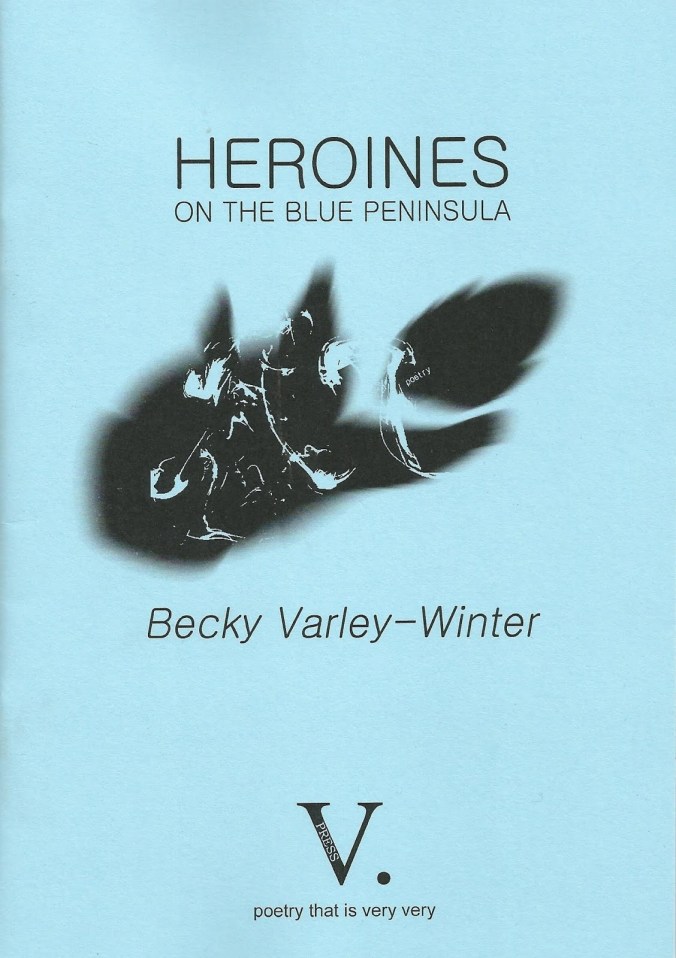
Heroines

Becky Varley-Winter

grew up on the Isle of Wight, lives in London, and teaches English Literature and Creative Writing for various universities. Her debut poetry pamphlet, Heroines: On the Blue Peninsula, (http://vpresspoetry.blogspot.com/p/heroines.html?m=1)is published by V. Press (May 2019); her poems have also appeared in Sidekick Books’ No, Robot, No anthology, FINISHED CREATURES, Lighthouse Literary Journal and Poems in Which, among others, and won the T. R. Henn and Brewer Hall prizes. Her academic book, Reading Fragments and Fragmentation in Modernist Literature, was published by Sussex Academic Press in 2018.

The Interview

1. What inspired you to write poetry?

I always wrote, but poetry took hold when I was a teenager, for several reasons:

I was in a band, so was originally trying to write song lyrics. I’m still influenced by lyricists, especially PJ Harvey and Joanna Newsom, and see poetry and song as closely connected.

One of my brothers was stillborn when I was thirteen, and poetry was a way of handling grief, as well as translating/transforming all of those immeasurable teenage moods. I grew up on the Isle of Wight, surrounded by a lot of natural beauty, and remember feeling almost drunk on the landscape, floored by beauty, love and longing – and sadness and death, too – writing constantly.

The first poets I connected with were Linda Pastan, T. S. Eliot, and Sylvia Plath. In Plath’s work, I loved the frostbitten horror of ‘Poppies in October’ and the thrill of dread reading ‘The panther’s tread is on the stairs, coming up and up the stairs.’ I also remember reading Eliot’s poems aloud to myself, loving his sense of music, rhythm, and mystery. On many things we’d disagree, but he had a strong influence. Linda Pastan was accessible without being simplistic, with a knack for capturing tangible sensations. I loved her poems ‘Carnival Evening’, ‘The Happiest Day’, and ‘Letter’. I also came across Edward Kamau Brathwaite’s work in the library; I found his island poems beguiling. At school I read Wilfred Owen’s war poetry (‘Futility’ and ‘Dulce et Decorum Est’), Shakespeare and Webster (Much Ado About Nothing, King Lear, The Duchess of Malfi), among others.

However, what allowed me to start writing was probably the discovery that other people my own age were writing poems. I was commended in the Foyle Young Poets of the Year competition and was aware of Helen Mort’s work from very early on.

2. Who introduced you to poetry?

My parents introduced me to Dr Seuss and Roald Dahl, and we had an anthology called The Island of the Children which I remember well. I also found my mum’s copy of Stevie Smith on the shelves and read ‘Not Waving but Drowning’. I studied Tennyson’s ‘The Lady of Shalott’ at school when I was seven; I felt confused by its sadness, but it must have made a strong impression on me, as I remember it so clearly. We collectively memorised Keats’ ‘To Autumn’ at my primary school – another poem heady with mortality, which I didn’t fully understand. However, I had no sustained sense of wanting to write poetry until my teenage years, and nobody particularly pushed me towards it.

3. How aware were you of the dominating presence of older poets?

If by this you mean THE DEAD / THE CANON, I was a keen reader and picked up poetry alongside everything else. However, I was almost totally unaware of female poets before the nineteenth century (though I’d heard of Sappho, if only through Nick Cave lyrics), and later felt some frustration at the fact that, for example, Emilia Bassano and Anne Finch had been there all along. We just didn’t read them. I knew that female poets existed, but didn’t have any sense of a long history of women’s voices.

If you mean older poetic mentors, they could be really encouraging – Roddy Lumsden invited me to participate in poetry events after I met him at a reading and sent him some of my work. He was really helpful in making me feel part of the poetry world. However, I was only able to write more fearlessly when I stopped seeking external validation. At some point, I stopped entering huge competitions (imagining that a win would ‘give me permission’ to write somehow) and started submitting work for publication instead. At the same time, my writing loosened up, as if that desire for approval was in itself destructive. I still take feedback from trusted readers and am not immune to criticism (it hurts!), but basically accepted my own authority.

4. What is your daily writing routine?

During term-time, I’m fully absorbed in teaching (and research towards teaching), so if I do write, it often involves scrawling something down on a train. Outside of term, I have more time to refine and edit, but still have other work to do. I try to spend one day on my writing each week, usually on Sundays.

5. What motivates you to write?

Restlessness, energy, reading something great and wanting to respond to it, the natural world, and other people, always. Poetry can feel solitary, but it’s really communal.

6. What is your work ethic?

I need to feel useful and have a sense of guilt if I’m not working. However, writing is a compulsion, not a duty. It eventually allowed me to teach creative writing, which does help me to earn a living, but I do it because some insane instinct drives me to. That said, writing of course takes focus and work, isn’t always fun, and I do want readers to get something from it, so I suppose my work ethic factors into it at some stage. However, sitting down to draft a poem always feels more like an act of disobedience or troubled pleasure.

7. How do the writers you read when you were young influence you today?

There might still be visible influence from Eliot, Plath, Pastan, etc, but I’ve gathered lots of other interests since then, so I’m not sure. Emily Dickinson is a big influence, and I studied Mallarmé and Mina Loy for my PhD, so they must have sunk in on some level; I love Apollinaire too, Audre Lorde, Whitman. Sometimes you find an odd affinity with a writer you’ve never read at all; I was told I was influenced by Elizabeth Bishop before I’d ever read her, and when I finally read Lola Ridge, she felt similarly familiar.

8. Who of today’s writers do you admire the most and why?

If we’re including writers of fiction, I’d add Elena Ferrante, but most of the writers I admire are poets. Recently: Fiona Benson, Liz Berry, Tishani Doshi, Scherezade Siobhan, Rebecca Tamás, Seán Hewitt, Arthur Allen, Rakhshan Rizwan, Sumita Chakraborty, Denise Riley, Emma Hammond, Ollie Evans, Marianne Morris, Nisha Ramayya, Fran Lock, Sarah Howe, Helen Mort, Rebecca Perry, Amy Key, Emily Berry, Will Harris, Mona Arshi, Ruby Robinson, Shivanee Ramlochan, Mark Waldron, John McCullough, Rachael Allen, Sophie Collins, Hera Lindsay Bird, Patricia Lockwood, this could go on… Some have been personally kind as well as being great writers, such as Sarah Leavesley at V. Press, Alex MacDonald, Abigail Parry, Tim Wells, Kirsten Irving, Jon Stone, Claire Trévien.

I’m drawn to poets who sound unabashedly like themselves, by which I mean that they might have influences, but they’re not just trying to emulate or write to an accepted trend. I tend to like work that has a kind of daring, though it might be a subtle daring. I’m not a big fan of poems that feel either completely sensible or calculatedly cool… something instinctive needs to happen.

To narrow this down – I most admire Fiona Benson, because Vertigo & Ghost speaks so fiercely and powerfully; Sumita Chakraborty, because ‘Dear, Beloved’ is one of the most extraordinary and ambitious poems that I’ve read in recent years; Denise Riley, because she’s got a flawless poetic instinct – no-one sounds like her; and Liz Berry, because every one of her poems I’ve encountered lately has been so good. I’d also say Ollie Evans (admittedly this one’s personal), whose work is as alive and inventive as he is. Finally, I really admire funny female poets like Hera Lindsay Bird and Patricia Lockwood, because they’re fearless and irreverent, and that makes me less afraid.

9. Why do you write, as opposed to doing anything else?

Because I’m ruled by my heart more than my head.

10. What would you say to someone who asked you “How do you become a writer?”

Write (and rewrite). READ as widely as possible. If you want to be published, learn to tolerate rejection; keep sending your writing out to publishers whose work you enjoy. Be interested in people. Be interested in everything. Set limits around your time online. Remember that other writers are your community, not your competition. Work at it, stay open, enjoy it.

11. Tell me about the writing projects you have on at the moment.

My debut pamphlet Heroines: On the Blue Peninsula came out with V. Press in May (2019), and is a collection of female-centred, fantastical and tender poems. You can read a sample poem and buy it here http://vpresspoetry.blogspot.com/p/heroines.html?m=1

I’m also working hopefully towards a full collection, trying to narrow down about 100 poems to 40-50. I know it will centre around themes of danger and anxiety, and some thrills too.

I also have a few short stories in progress, but if I try to publish them it might be under a pseudonym – so don’t look out for those, I guess!

Wombwell Rainbow Interviews: Sharon Coleman

Wombwell Rainbow Interviews

I am honoured and privileged that the following writers local, national and international have agreed to be interviewed by me. I gave the writers two options: an emailed list of questions or a more fluid interview via messenger.

The usual ground is covered about motivation, daily routines and work ethic, but some surprises too. Some of these poets you may know, others may be new to you. I hope you enjoy the experience as much as I do.

Sharon Coleman

Sharon Coleman’s a fifth-generation Northern Californian. She writes for Poetry Flash, co-curates the reading series Lyrics & Dirges, co-directs the Berkeley Poetry Festival. She’s the author of a chapbook Half Circle and a book of micro-fiction, Paris Blinks. Her recent publications appear in Your Impossible Voice, White Stag, Ambush Review.

She’s been nominated twice for a Pushcart and once for a micro award for blink fiction.

She’s taught composition, poetry writing, creative writing, and college success at Berkeley City College for 15 years and directs their art and literary journal, Milvia Street.

She was a finalist for the Luso-American Fellowship for the Disquiet Literary Conference in Lisbon.

https://bccvoice.net/2016/12/07/sharon-coleman/

The Interview

1. What inspired you to write poetry?

I simply gravitated to it.  As a young person, I loved the rhythms and sounds, compactness and surprise. My older siblings and I used to make up all kinds of things to describe our world and make fun of it in the way that many children do until language is more about conforming than inventing. I read a lot of novels as a teen but ultimately found writing fiction a bit boring and predictable, though I’ve more recently picked it up again. There are interesting experiments in fiction to explore and I don’t think that every story has already been told. But I still gravitate to poetry and then creative nonfiction (a popular second love for poets.)

2. Who introduced you to poetry?

I was first introduced through children’s books, most of which are written poetically. One such book was Spooky Rhymes and Riddles published by Scholastic. My older sister used to read that book to me with a different voice for the various poems and characters before I went to sleep.  In high school, I was introduced to e.e. cummings and Edgar Allen Poe by my freshman English instructor, who had us memorize a poem and present it in front of the class. I began writing poetry throughout high school on my own.

Poetry also entered my dreams: during an afternoon nap, I dreamed of reading a long poem I had written and woke up remembering only the last line, “When my shadows get up and go good-bye.” It was clear that my poetic task would be to re-create the entire poem in my waking life.

3. How aware were you of the dominating presence of older poets?

Older poets have never had a “dominating” presence for me. Most of the older poets I know and have known have been very encouraging, suggesting books to read and places to send work and other advice. I’ve learned a lot about our local Bay Area poetry history through them. I have become very aware of the dominating arrogance of some poets in academia, of some in-crowd poets outside academia, of careerists, of the poetry industry, of prizes and awards. But I’ve become more acutely aware of how poets who have had an upward battle against sexism and racism and the old guard in the 60s and 70s can replicate similar barriers against the next generation. Our poetry scenes are still marked, even structured, by tokenism and compartmentalisation. I just read a book of poetry by a young white male (nominated for an award and published by Princeton Press) that contains a poem condoning base sexual harassment of women—and those that nominated it either simply didn’t notice or didn’t care. Or maybe because they nominated an otherwise diverse collection of books and authors, they felt this was ok. Fifty years later, it’s still an upward battle.

4. What is your daily writing routine?

I wish I had a daily writing routine. I’ve tried to develop one, but I have too much other work teaching.  Mine is a weekly writing routine in which ideas marinate over the week, and Friday or Saturday evenings, I either write a new poem or do a deep revision for my Sunday workshop. I carry a small notebook for ideas that come to me at any time of day.

5. What motivates you to write?

The desire to put into tangible form the insolite of experience. This is a term used by surrealists to express the manifestation of the mystery of the subconscious and of the collective unconscious in daily life. It means being poetically attentive to one’s surroundings at all times, which because I work, I cannot always do, but I try to. I write for coming generations to know what it means to live in this place and time, filtered through my historical perspective. I write to complete projects, to have a book or other publication, to physically hand over to another to experience.

6. What is your work ethic?

I try to not replicate the subtle linguistic constructions of racism, sexism, ethno-centrism, ableism, etc. that linger in our language even when we take a stance against them. This requires never-ending interrogation, learning, deep listening. As George Oppen said, words are never wholly transparent, and this is the heartlessness of words.

7. How do the writers you read when you were young influence you today?

I began reading George Orwell when I was about thirteen, beginning with 1984. My writing engages the political on different fronts. From James Baldwin and Carson McCullers, I look for the psychological depths that form and are formed by social hierarchies. From Hunter S. Thompson, I learned to keep far away from highly entitled drug enthusiasts.

8. Who of today’s writers do you admire the most and why?

There are so many writers today whom I highly admire, most come from demographics that have not had much voice in the literary world.  They have a strong understanding of many elements that have made them who they are and have deep multicultural understanding of our communities. I admire writers who don’t stay in one aesthetic or genre, who explore form as much as meaning. In the 90s, there was a huge divide between experimental and more traditional poets. This was not about thinking but rather about waging war. Today on the West Coast, the divide has been crossed many times and is dissolving; on the East Coast, the divide is stronger. In the 90s, I just followed my own way and was not popular on either side, being too narrative for the experimental poets and too elliptical for the traditional ones. I admire the many other poets who have forged their own poetics through these two camps like Brian Teare, John Isles, Mk Chavez, James Cagney, and many others.

9. Why do you write, as opposed to doing anything else?

I write for mental clarity, to somehow put into words the almost inexpressible. I write to explore language(s) and their unexpected capacities.  I write for historical understanding. I write for the personal pride of seeing published pieces I’ve worked hard on and believe in. I also do other things that are very fulfilling.

10. What would you say to someone who asked you “How do you become a writer?”

Read. Write.  Learn craft, process, and technique. Really learn craft, process, and technique. Never stop exploring craft, process, and technique. Find or create literary communities. Give to those communities.

11. Tell me about the writing projects you have on at the moment.

I am currently finishing a book-length poetic sequence set in the house in which I grew up, the drama within the family, the transformation of the landscape and people of the area. When I was about six, my family moved into a wreck of a house in an otherwise idyllic suburban neighbourhood in a city south of San Francisco. It had been the farmhands’ house when the area had been a dairy farm.  And another house had been added to it, forming a two-story house. One of my sisters said it had the “public uglies.” Yet it provided all four siblings with their own small room, and my parents fixed it up very well. Later, my father was told this was the dairy farm he had work at when he was eighteen. The place had changed so much that he didn’t recognize it.

The series is written in ten to eleven sections of four to seven poems. Each poem is nine lines, justified both right and left and with many caesura or spaces within the line. The narratives are multiple and fragmented and flow according to association, braiding in and out of each other. This series has been an exciting and painstaking exploration of form. I am very thankful to my writing group, the Green Heart Collective, for being the literary midwives of this project. Here is an early version of series’ beginning: http://www.yourimpossiblevoice.com/spinning-vinyl/

Wombwell Rainbow Interviews: Neil Laurenson

Wombwell Rainbow Interviews

I am honoured and privileged that the following writers local, national and international have agreed to be interviewed by me. I gave the writers two options: an emailed list of questions or a more fluid interview via messenger.

The usual ground is covered about motivation, daily routines and work ethic, but some surprises too. Some of these poets you may know, others may be new to you. I hope you enjoy the experience as much as I do.


Exclamation-Marx-COVER

Neil Laurenson
is a stand-up poet based in Worcester. He has regularly performed around the country, including at Wenlock Poetry Festival, Ledbury Poetry Festival and Cheltenham Poetry Festival. His debut book Exclamation Marx! was published by Silhouette Press.

www.neillaurenson.com

@NeilLaurenson

The Interview

1. What inspired you to write poetry?

I started reading Philip Larkin in the university library and thought, ‘This is poetry I can understand!’ Shortly afterwards, I wrote dreadful, unintentional Larkin parodies in my grandparents’ house on the edge of Salisbury Plain while hearing bomber planes set off for Iraq.

2. Who introduced you to poetry?

One of my primary school teachers, I think

3. How aware were you of the dominating presence of older poets?

I was well aware of ‘older poets’ at university, especially as I was studying English Literature. In terms of occupation of bookshelves, I couldn’t deny their dominance. I vividly remember reading Larkin in a bookshop in Cambridge, and he was probably surrounded by Eliot, Tennyson, Auden, etc.

4. What is your daily writing routine?

I write a lot of emails at work! I don’t have a poetry writing routine. I can’t schedule poetry; it happens at random times.

5. What motivates you to write?

Making people laugh and letting off steam about politics. Fun and anger.

6. What is your work ethic?

Never give up. That’s it.

7. How do the writers you read when you were young influence you today?

In my 20s, which I now think is ‘young’, the poetry I read then made me realise that poetry can be about anything and doesn’t need to be obscure to be classed as poetry.

8. Who of today’s writers do you admire the most and why?

Brian Bilston – the pun master. His poem ‘Refugees’ is poetry at its most powerful and should be studied in schools. Elvis McGonagall is hilarious yet deadly serious. John Osborne is the sort of writer you want to keep as a secret with your friends. Amy McAllister is also hilarious and very rude. Steve Pottinger and Byron Vincent are brilliant performers and lovely people. I’ve only just found about Suhaiyma Manzoor-Khan (and ordered her book, which is out in September). She is the most exciting poet I have heard in a long time.

9. Why do you write, as opposed to doing anything else?

I like the phrasing of the question: it suggests that I write a lot, which unfortunately isn’t true! I do lots of things other than writing, but writing is what I most enjoy. I love writing poetry that makes people laugh, because what could be better than making a room full of people spontaneously happy?

10. What would you say to someone who asked you “How do you become a writer?”

The word ‘writer’ implies that one is constantly or regularly writing. If my identity is based on what I do most frequently, it would be more accurate to called me a dishwasher! As Miroslav Holub wrote in his poem ‘Conversation with a poet’ (1982): ‘If you’ve written poems it means you *were* a poet. But now? / I’ll write a poem again one day.’ Anyway, to answer your question properly: you become a writer by writing and write because you want to write.

11. Tell me about the writing projects you have on at the moment.

I have a collection of poems that is sadly unpublished and resting inside a memory stick. It’s been over three years since my book ‘Exclamation Marx!’ was published, so, referring to my previous answer, this makes me feel like I *was* a poet. Another project is a solo show called ‘To be Blair’, which is about me dressing up as Tony Blair (in protest not in tribute). I really should finish writing it and perform it.

Stoked to have seven poems in the electrifying company of other poets in this digital chapbook about poetry. Thankyou Jamie.

“a genesis with a Dada twist” and other poetic responses to the last Wednesday Writing Prompt

Wombwell Rainbow Interviews: Elisabeth Horan

Wombwell Rainbow Interviews

I am honoured and privileged that the following writers local, national and international have agreed to be interviewed by me. I gave the writers two options: an emailed list of questions or a more fluid interview via messenger.
The usual ground is covered about motivation, daily routines and work ethic, but some surprises too. Some of these poets you may know, others may be new to you. I hope you enjoy the experience as much as I do.

Elisabeth Horan

is an imperfect creature from Vermont advocating for animals, children and those suffering alone and in pain – especially those ostracized by disability and mental illness. She is Editor at Animal Heart Press and has several chaps and collections coming out this year. She is a poetry mentor and momma to Peter and Thomas. She recently earned her MFA from Lindenwood University and received a 2018 Best of the Net Nomination from Midnight Lane Boutique and a 2018 Pushcart Nomination from Cease Cows. She has books forthcoming with Fly on the Wall Poetry Press, Twist in Time Press, Rhythm & Bones Press and Hedgehog Poetry.

When not being poet, she works as a secretary and loves riding horses & dancing the salsa—

ehoranpoet.com / @ehoranpoe

The Interview

1. When and why did you start writing poetry?

I started writing poetry in 2016 while I was getting my masters in English online as a 40 year old grad student with two babies at home. i was really depressed and incredibly sleep deprived. i dont know why i tried to do that masters.. i was wanting a break from how hard my life felt at the time. and I also had it in my head that i didnt want to be a secretary forever. i wanted my kids to be proud of me when they grew up so I took a class in poetry near the end of the MA. and i found that I loved it. I had tried to write a little as a college student but didnt think I was any good and i didnt keep going then. i went right into an mfa after that.

1.1 Why Poetry?

Poetry matches how my head works
Rhythmically musical
Patterns and repetition
The pain in my head..  the sadness and rumination
Is like a poem. So when I found poetry… I finally knew how to tell the stories of my mind.

2.  Who introduced you to poetry?

https://chirb.it/kpEnvJ #audio via @chirbit

3. How aware are and were you of the dominating presence of older poets traditional and contemporary?

(1) https://chirb.it/k6H8Ak #audio via @chirbit

(2) https://chirb.it/NdPGA8 #audio via @chirbit

4. What is your daily writing routine?

(1) https://chirb.it/HBANKF #audio via @chirbit

(2) https://chirb.it/D4PNIg #audio via @chirbit

5. What motivates you to write?

(1) https://chirb.it/LqMGvG #audio via @chirbit

(2) https://chirb.it/xCef3O #audio via @chirbit

(3) https://chirb.it/wO6Kvf #audio via @chirbit

6. Whom of today’s writers do you admire the most and why?

(1) https://chirb.it/LyIJM9 #audio via @chirbit

(2) https://chirb.it/ansCAa #audio via @chirbit

(3) https://chirb.it/9k5rgE #audio via @chirbit

 (4) https://chirb.it/nAwy2d #audio via @chirbit

7. What would you say to someone who asked you “How do you become a writer?”

(1) https://chirb.it/FO7rsP #audio via @chirbit

(2) https://chirb.it/PBAHJL #audio via @chirbit

(3) https://chirb.it/00A7vF #audio via @chirbit

8. Tell me about the writing projects you have on at the moment.

(1) https://chirb.it/3z251n #audio via @chirbit

(2) https://chirb.it/sxhFzx #audio via @chirbit

Wombwell Rainbow Interviews: Grainne Tobin

Wombwell Rainbow Interviews

I am honoured and privileged that the following writers local, national and international have agreed to be interviewed by me. I gave the writers two options: an emailed list of questions or a more fluid interview via messenger.

The usual ground is covered about motivation, daily routines and work ethic, but some surprises too. Some of these poets you may know, others may be new to you. I hope you enjoy the experience as much as I do.

The Uses Of Silk

Gráinne Tobin

grew up in Armagh and lives in Newcastle, Co Down where she used to teach in Shimna Integrated College. She is involved in the Of Mouth reading series in the Linen Hall Library in Belfast. Her books are Banjaxed, The Nervous Flyer’s Companion (Summer Palace Press) and The Uses of Silk (Arlen House). She has contributed to the anthologies Word of Mouth (Blackstaff Press) When the Neva Rushes Backwards (Lagan Press) On the Grass When I Arrive (Liberties Press) Washing Windows (Arlen House) Something About Home (Geographies Publications) Metamorphic (Recent Work Press) and Female Lines (New Island).

The Interview

1. When and why did you begin to write poetry?

I sort of had several beginnings.

I wrote the first poem when I was nine, and mostly what I remember about it was that I approached it as a technical problem. Children often do this. I assumed poems had to rhyme and I knew there was something else but I didn’t know how it was done. I asked my mother ‘How do you write a poem?’ and she very sensibly said the minimum: ‘Some people give every line the same number of beats and some give them the same number of syllables’. It wasn’t to do with self-expression but experimenting with the form and the sound effects. I meant it as an ordinary how-to question like ‘How do you make toast?’ She was so easygoing about it, even though she knew plenty about poetry and could have been tempted into the trap – she was a teacher – of going too deep, too soon. No big fuss.

In my teens I had read more poetry, knew it was special for me and knew I needed to say complicated things to myself, so wrote poems in free verse when I was meant to be doing homework. And hid them, of course. When I was fifteen, a friend told me about her ‘seduction’ (we’d now say child sexual abuse) by her mother’s lodger, and the secret baby she had been forced to give up for adoption:  I was overwhelmed by the need to make a poem to contain the unbearable contradictions in her story and in my own response to it.

There was never a time when I didn’t want to write, and it was almost always poetry, not fiction. At university I gave up, swamped by a degree in English Literature and the shame of not being Yeats and the lads, but began again eventually and took it on properly later, when I was pregnant with my first child, and went on writing the odd wee thing, but kept it a bit private.

I began to accept my writing as necessary to me, and to work seriously on it, in my early thirties, when I became part of the Word of Mouth Poetry Collective, a women poets’ tough, warm self-help group that met for criticism and support every month for 25 years, in the Linen Hall Library in Belfast. (The Linen Hall now has the group’s papers in its literary archive.)

My husband Andy Carden cleared the way for a breakthrough when our children were 4 and 7: he took them on a canoe-camping trip to Scotland in order to leave me three clear weeks off-duty to write. I went to stay with a friend in Northamptonshire who was out at work all day. I wrote a longish poem in quite regular quatrains. It had been building in me for a couple of years. Again, it was set off by the contradictions in an experience, this time tutoring a community centre’s creative writing class in adult education during the Troubles.

If you read Tillie Olsen’s book Silences you’ll see why it sometimes takes so long to begin claiming your own writing.

2. Who introduced you to poetry?

My parents. And like many another atheist, the church.

My father used to put me to bed with a story and night prayers (it was a 1950s Irish Catholic family) in our top-floor flat in Abbey Street in Armagh where we lived until I was five. We had some excitement with the Lord’s Prayer said by my father in Irish, which to me sounded fantastic, very rhythmic and weird, and there was a terrific final ritual before actually getting into the bed, where I’d stand on the crushed velvet bedside mat someone had given as a present, which had a picture of a tiger on it, and we’d both chant ‘Tyger tyger burning bright/In the forests of the night/ What immortal hand or eye/ Dare frame thy fearful symmetry?’ which was like a rugby haka or an incantation. I didn’t know what else it was until I grew up.

My mother and father were both teachers and readers, who themselves came from families which unselfconsciously enjoyed wordplay and conversation in the Irish way. I was the first of their seven children, so for a while I must have had them at my mercy for chat and nursery rhymes and stories.

As for the church… The sounds and images of the liturgy and Bible readings do stick to you and I was in my teens before Mass stopped being in Latin, so I lived within the wordy mysteries. My missal had a parallel text, which in both Latin and English read like poetry, and was a kind of magic. The beginning of the book of Genesis gave me gooseflesh. (‘The word was with God and the Word was God.’) The Family Rosary was a feature of our home life in the evenings in one phase of my childhood, and that too works as a sort of chant.

In a cupboard at home, I found an old primary-school poetry book from 1928, belonging to my maternal grandmother, with poems like Hiawatha and Goblin Market and Dover Beach: I read this repeatedly for years by myself. At primary school, I had little association between school and poetry. It was a private pleasure. The poems we came across were off-putting and the worst bit was choral speaking when the teacher told us to use our ‘best Sunday voices’ which meant putting on false RP English accents, to recite what I still regard as oul’ blether from Wordsworth about that ‘hoost’ of golden daffodils.

Things improved in my convent grammar school because we had interesting class anthologies such as The Puffin Book of Verse for Young People, which at the back had a dizzying extract from Whitman’s Song of Myself, which I used to read on the sly. In my teens I must have been at least as odd as many people are at that age – I was in the habit of sneaking off into fields alone, to read aloud privately from whatever poetry I could find, usually textbooks like The Albemarle Book of Verse, which was a bit avant-garde for a school book. It had daring poems about modern war, and Louis McNeice’s Prayer before Birth. That was a great favourite when I was about 15 and I recited it with huge conviction in a verse-speaking competition in Portadown. The adjudicator gave me low marks saying that at 15 I should not be choosing to present poems I could not possibly understand, which left me silenced, and outraged.

Encouragement with poetry at school depended on which teacher you got. I had a particularly dreadful elderly nun once, who knew little about the A level poems she was meant to teach us, and censored anything she thought improper. I was desperate to hide my own poems from her and so rejected an offer to join a poetry-writing group formed by a nice teacher in the parallel Catholic boys’ school, because I wrongly believed that this nun would also attend it. This group included Paul Muldoon.

When I was 17 the new Arts Council of Northern Ireland funded a touring show called Room to Rhyme, which had Seamus Heaney, Michael Longley and the musician David Hammond doing poems and songs. This was electrifying. I think as a sixth former I may have been at this reading as part of a small school group but without nuns accompanying us, always a joy… Heaney’s poem Elegy for a Stillborn Child has remained with me all my life. It may have freed me to write my poem about that forced adoption. The stillborn child had been ‘a cartographer/charting my friend from husband to father’ and the stillbirth had left his friend’s wife ’Light as an empty creel.’ It was a woman-friendly poem, a version of my own friend’s story about the lost baby, and I think it was stored away for later in my mind. I’ve since come to acknowledge that for me, ideas about reproduction and fertility do hang around in the same messy mental attic space inhabited by poetry.

I don’t usually think of these things, so your questions are forcing me to see connections. I’ve had a lot of help, not just being introduced to the existence of poetry but also its lore and practice.  Back in 1980, I skived off a worthy few sessions considering exam syllabuses at a conference of the National Association for the Teaching of English to join the poetry workshop led by Rony Robinson from Sheffield instead. It felt like running away to join the circus: it opened the way for everything else. A few years later, the Word of Mouth Poetry Collective began and its dozen or so expert and demanding members spent 25 years introducing me to ever more issues in poetry, encouraging me to ‘fail again, fail better’ as Samuel Beckett famously recommended.  Later, the Arts Council of Northern Ireland gave me a Single Individual Artist Award, which sponsored me for some mentoring from Penelope Shuttle, which enabled me to stand back and look at my work from a different angle. Keeping the momentum going, persisting after you’ve got stuck at a standstill, is as important as starting.

3. How aware were and are you of the dominating presence of older poets?

When I was young, crushingly aware – and not just older poets, but male, and usually dead! Now I don’t feel dominated by even older poets (I’m 67 myself) or better poets, or even dead ones, because I am too grateful for what they give us, and I see them as pushing in the same direction as all of us, towards the understanding of life which can happen in poems. A biblical image recurs in my mind: we are all labourers in the same vineyard. Also, art is not all about levels of achievement. It’s something many people have to do, just to stay sane, whether what we produce is any good or not.

In my teens, I owned a couple of poetry books from Penguin, the Mersey Poets and Alvarez’s The New Poetry- requested birthday presents. I very much admired some of these poems, but they didn’t look like anything I could emulate. Urban, male and super-cool. At 17, when I went to my university entrance interview in Canterbury, I bought Brian Patten’s Notes to the Hurrying Man. It was the first time I became aware that such poems could be written. I felt liberated by the tone and language and subjects of those poems, Young Girl Raped at a Suburban Party for instance.

The poetry in my Eng Lit degree course was enticing but very male-heavy and all English degrees then were about criticism, not creation. I felt all the poems had been written already, and better than I could ever do it.  In the University of Kent at Canterbury circa 1970 the poetry society seemed full of very clever, confident men, although I realise now they were as young as I was and not much more than boys. They saw themselves as the inheritors of Charles Olsen and Robert Creeley et al. There was an imaginary boys’ club for them to join. I didn’t know much then about contemporary modern poetry, especially poetry by women, and had no sense of foremothers. This was just before the Women’s Liberation Movement started and although I’d always known myself to be a feminist I really did struggle to get free of the culture of the time: it meant a lot then that there was nobody whose poetry life I could imagine as like my own. Wordsworth? Yeats? Hardly. Michael Longley and Seamus Heaney were only ten years older than I was, but even then they seemed venerable, awe-inspiring and godlike. Inspiring, but not in my world exactly. I was in England at the start of the Troubles but was separated from life at home and the poetry of those times appeared to be happening in Boyworld.

Gender exclusion wasn’t something I could protest about then, because I hardly acknowledged it; I’d never agreed with the idea that women were not men’s equals and I didn’t look easily cowed, being gabby and opinionated ( I’ve had complaints) but this background level of humiliation was contaminating the very air I breathed. For a long time I was not writing, having internalised the prevalent misogyny and turned it into a sort of personal shame. It seemed you would need a big ego to pursue writing for publication. It’s a false belief.

The Word of Mouth Poetry Collective in Belfast was an antidote to this unjustified but persistent sense of not quite being entitled to make poems or seek publication. We were working against the unexamined societal belief that approval from women did not quite count, whereas approval from men was the real thing. In the 1980s and 90s it felt as if there was little respect for women’s poetry in Ireland, and Word of Mouth was often mistaken for a community group rather than a literary one. This attitude has changed, but only recently I was told by a woman who had taken part in a heavy-duty writing workshop that when she joined it and saw that participants were female, she had worried that it would be ‘full of housewives’ and not serious about poetry. We are the people we warn ourselves against.

I was cured of the shame by Joan and Kate Newmann, who set up Summer Palace Press and were also members of Word of Mouth. They approached me about publishing my first collection. I don’t think I would have had the brass neck to submit it, unsolicited, to publishers. The dominating presence of the imaginary older, male, legitimate poets took a while to fade, but I am very grateful that Joan and Kate had faith in my work when I wouldn’t have felt able to claim it against opposition.

4. What is your daily writing routine?

I usually feel terrible, thinking I have done nothing and written nothing and have nothing to show for my time. This turns out not to be true when I look in notebooks and find all the drafts waiting to be typed up and finished. It’s an occupational hazard and many experienced writers of poetry admit to something similar. I really admire the very productive types like Simon Armitage who wrote his Seeing Stars book in the rest breaks from plugging away at his version of Sir Gawain and the Green Knight.

It’s only now, after much experimentation, that I have got to the point of finding a workable routine which allows me some fixed writing time. On days when I’m at home I have a minimum of two hours, 11am to 1pm, which my beloved and I are referring to as Ringfenced Time, on the analogy of protected, ringfenced budgets for particular purposes in the public services where we both worked. I mix metaphors in thinking of it as an air-pocket of time. I do not want to call it writing time or poetry time in case I paralyse myself and jinx the whole thing, as I have done before. Having a routine involves having to trick my own dottier guilty tendencies into leaving me alone. Even mentioning the hope of doing some writing tends to make me sabotage myself and get into a tizzy in case I can’t write, or it’s not good enough, or taking this time means I am taking it from something or someone else. Ring-fencing 11am to 1pm means I have guaranteed time to be near my laptop, notebooks and poetry books. It feels invigorating even on days when I’m just reading poetry, or doing late revisions of poems, or poetry admin, like preparing to take part in a project such as Poetry Jukebox https://twitter.com/poetryjukebox. (Writing the answers to your Wombwell Rainbow questions counts as half-way to admin). At other times in the day I might go back to the work if I have the chance and inclination, but these two ringfenced hours mean guaranteed, uninterruptible poetry-thinking time.

After two hours of intense creative work I am often at the end of my useful writing energy anyway, because this kind of concentration can be like a trance state. I need breaks. I use the Pomodoro Technique, with an actual plastic tomato timer, to make myself move so my joints don’t stiffen from locking into position for too long. And I get very cold! I think it is because these bouts of hard thinking make me sit still as a hunting cat. I know a writer who sits in his sleeping bag, typing. I have extra woollies for writing, and occasionally a rug, like a Victorian invalid.

I envy those writers who have a daily routine starting ‘I get up at six and write seven drafts before breakfast’. Novelists seem to do much better with the daily routine – or that’s my excuse anyway. Lyric poetry means kindling a fresh fire in the grate every time. Although I’ve been writing for many years, most of these years have been very busy with teaching and family responsibilities, and even after packing in the day job I found I had to learn to claim my time as my own. There’s also laziness, of course, as poetry is like swimming in that I’m always entranced once I’m in, but the bit where I stop doing other things and set off with a swimsuit and shampoo and a towel seems off-putting. Even Yeats said, ‘All things can tempt me from this craft of verse.’

Since 2005 I have started every day by writing a journal in bed, because a bereavement counsellor insisted that this was essential for my continued emotional health. She was right, and it feeds my poetry because it allows me a daily moment to be selfishly but harmlessly introspective, to download the psychic detritus, and stay a bit saner. It also keeps me in the habit of writing.

5. What motivates you to write?

The unending weirdness of the world.

6. What is your work ethic?

Guilty, overconscientious. I tend naturally to be inefficient but if I agreed to produce something, I would feel very bad if I over-ran the deadline. Workshops and readings are a serious obligation and I prepare properly for them. I am distractable, so have to set up systems not to forget to do things. You do have to trick the Muse into visiting. She’s skittish with business talk and needs to stay playful. There is always a tension between duty and instinct.

I retired from my teaching job a few years ago so people who are not writers keep asking me how I am enjoying ‘doing poetry full-time’. It’s alarming as it sets off my mad guilt reflex: if I have retained one thing from my Catholic childhood it’s the tendency to a bad conscience, the sense of never having done enough. I write slowly. I edit to the twentieth draft. I’ve been on writing retreats when people have asked whether I ‘got a lot of writing done’ and the answer is always no. I can put in many hours for a single-page poem, and there have to be gaps in the work as well, so I can think about other things before coming back to take a different angle on it. I was delighted when I managed a whole finished poem in an intense week of full-time writing. I often need to look sideways, to sneak up on the poem while whistling and gazing in the other direction.

7. How do the writers you read when you were young influence you today?

I think the influences from poetry read before the age of twenty are so embedded they aren’t distinct. My head is full of quotations and rhythms from poems, but I don’t use much rhyme, for instance, though the poems I read as a child always did. The frisson from something like Browning’s Pippa Passes remains as a breeze behind poems of mine like Counting Children, I think.

8. Who of today’s writers do you admire the most and why?

This is the hardest of all your questions because there are so many current poets whose work I enjoy, and some whose work I am convinced is of good quality, but whose sub-genre of poetry is just not my cup of tea. I think a reader’s or listener’s response to poems is more a matter of preference than a competition for scorecard points. It’s like musical taste: if you are a traditional pub-session fiddle player you might respect experimental music without turning to it for pleasure.

I subscribe to the Poetry Book Society which means having work by someone fantastic like Raymond Antrobus or Andrew McMillan arriving through the letterbox, when I might not have come across them before. Scotland has loads of stars, such as Kathleen Jamie whose books are just dazzling.  I’ll mention a few obvious Irish favourites off the top of my head, though that makes it a rather white-faced list. Sinead Morrissey and Leontia Flynn and Colette Bryce come immediately to mind. Very different poets, all from a generation after mine in Northern Ireland, all with that lift-off quality where a poem quietly takes you up and somehow puts you down somewhere else by the end. From the other side of the border, Eilean Ni Chuilleanain, who’s just finished her stint as Ireland Chair of Poetry, writes terrific, properly levitated but grounded poetry. Vona Groarke can’t write a boring stanza. Her verbs alone are worth the detour. And of course, there is Eavan Boland, whose poems are strong and beautiful, and who has used her prestige to open up poetry for all women writers in Ireland, with or without academic credentials. Frank Ormsby from Belfast is writing better than ever now after a lifetime of publishing poetry, and seems to be doing a late-career Matisse, simplifying, playing, freeing his work from formality. And then there’s Ruth Carr, Moyra Donaldson, Damian Smyth, Paul Maddern, Jean Bleakney, Maureen Boyle, Matt Kirkham, Olive Broderick, Maria McManus, all within a 35-mile radius of where I live. The younger poets attached to the Lifeboat and the Tangerine magazines in Belfast are terrific too. This place is heaving with good poetry!

9. Why do you write?

In Heaney’s words from Personal Helicon: ‘to see myself, to set the darkness echoing’.

10. What would you say to someone who asked you “How do you become a writer?”

This is usually a beginner’s question, so I will answer bearing that in mind.

First, become a reader. And then, just start writing. These days you don’t have to get permission from any gatekeeper. You can put your work online and reach readers or listeners that way. You can be an outsider-art poet.

However, if you want serious feedback from experienced readers and tutors who know a lot about skill in writing, look for a creative writing course that suits and supports you. You can join a writing group, or study writing in weekly sessions in adult education, or do it as an undergraduate or postgraduate degree. When I started writing, these courses did not exist. (An academic/poet once discovered I had never done a degree in creative writing and exclaimed, in amazement, ‘So you’re completely self-taught!’)

However, if you want serious feedback from experienced readers and tutors who know a lot about skill in writing, look for a creative writing course that suits and supports you.

The spoken word poetry scene is generally younger and noisier than page poetry, and can be a great way to get into knowing what you enjoy. Many poetry readings are free of charge and you can poke around, trying them out to find what you admire and would like to emulate. Even if you don’t like some of the poems, it can be encouraging to realise you could do as well or better. It can give you confidence in your own taste and judgement. Literary festivals can be a chance to hear poets read their work. The Cork International Poetry Festival focuses entirely on poetry. The John Hewitt Summer School in Armagh in the last week of July invites excellent poets and encourages anyone on a low income to apply for bursaries. 

As soon as you can, begin sending out poems to magazines and competitions. The websites from the The Saison Poetry Library in London and Poetry Ireland in Dublin both list opportunities to submit work. Most poems sent are not accepted, so expect this to happen and don’t be put off. There is only so much space in a magazine. Keep sending out poems. What one editor doesn’t want, another might.

Read a lot, and look for ways you’d like to write, techniques that give you as a reader the experience you’re looking for. The anxiety of influence is a genuine concern, but you just have to live with it and reading is an apprenticeship. Being original is a dodgy post-Romantic notion; nobody is really outside all tradition, and every writer, even the most experimental, learns from reading. It makes me shudder when I hear someone say ‘I don’t read poetry but write it’. You wouldn’t start playing the fiddle without having heard anyone else play it! (It may help to think of your poetry as like music, possibly progressing from bedroom singing, to practising the guitar, to garage band level, then to gigs in pubs, a tour, a recording contract. Or nowadays, YouTube.)


Becoming a writer isn’t really a thing, in my opinion. Michael Longley was reported to have said that saying you’re a poet is like saying you’re a saint, which of course would paralyse your writing if you took it seriously. It’s about what you do rather than what you are. Maybe being a writer as a job can be a thing, but it’s not a job from which most writers can make a living. You do need to earn somehow, unless you have a patron or inherited wealth. (Hollow laughter. This is one reason working-class writers have such a hard time.)  I spent my working life as a teacher, which I loved, and which supported my family, but which tended to drain the same tank of energy and creativity I drew on for my poetry. Nearly everyone who writes has to earn money to eat and pay the bills in other ways than by writing. Some work in universities teaching other people to write. (Marking assignments isn’t being a writer, though.) Some deliberately choose work that doesn’t drain their writing tank; the poet Jean Bleakney’s day job was in a Belfast garden centre. Kevin Barry, who is a wonderful fiction writer, spent six months living in a small caravan, reading rings round himself to learn how to write well enough for publication, devising his own crash course in fiction and writing his first novel, which he says was dreadful.

11. Tell me about the writing projects you have on at the moment.

My third poetry collection came out six months ago and since then I’ve been recovering, getting my head straight, looking after the writing muscles, trying to be patient with myself while I accumulate poems for a fourth collection. I’ve been part of several poetry projects, such as Poetry Jukebox  http://www.irishnews.com/…/13/news/ireland-s-first-poetry-jukebox-launched-in-belfast-1161120 and that’s always exhilarating, so I hope to do more collaborations. I am planning to get a grip on the online evidence of my work and accept a friend’s offer of help with putting together a Facebook author page and a modest website. I don’t actively seek workshop gigs because the paperwork takes too much writing time, but I usually accept them when I can, so there may be some this year. And I want to send out some bids for readings in festivals, along with two poet friends.

Wombwell Rainbow Interviews: Kathy Pimlott

Wombwell Rainbow Interviews

I am honoured and privileged that the following writers local, national and international have agreed to be interviewed by me. I gave the writers two options: an emailed list of questions or a more fluid interview via messenger.
The usual ground is covered about motivation, daily routines and work ethic, but some surprises too. Some of these poets you may know, others may be new to you. I hope you enjoy the experience as much as I do.

Elastic Glue

Kathy Pimlott

Says on her website ” My second pamphlet with the Emma Press, Elastic Glue​, was published in February 2019. This follows Goose Fair Night which was published in March 2016, reprinted in 2017. I’ve been published in magazines including Magma, Mslexia, Brittle Star, The North,Poem, Under the Radar, Morning Star, Fenland Reed and South Bank Poetry and in anthologies, including Second Place Rosette (ed. Richard O’Brien and Emma Wright); Vaster then Empires (ed. Joy Howard); One For the Road​ (ed. Helen Mort); Urban Myths and Legends (ed. Rachel Piercey and Emma Wright) and Best Friends Forever (ed. Amy Key). On-line, I’m on The Stare’s Nest . And Other Poems and ​Proletarian Poet.​

You can read interviews with me on Pam Johnson’s blog site Words Unlimited, in Nottingham’s ace independent newspaper Left Lion and on the TCS Network site (on being a late-starter poet).

I am currently a member of poetry workshop groups led by Mimi Khalvati and Richard Price.

​​I was born and raised in Nottingham but have spent my adult life in London, the last 35 or so years in the Seven Dials corner of Covent Garden, home of the broadsheet and the ballad. I’ve been a social worker and community activist, worked on a political and financial risk journal, in arts television and artist development. I currently earn my living as the administrator of a charitable trust which undertakes community-led public realm projects. I have grandchildren. I make a lot of jam.”

http://www.kathypimlott.co.uk

The Interview

1. What inspired you to write poetry?

I grew up surrounded by chatty people and playful language: intricately and wittily rhyming songs from the music halls and big screen musicals; mysterious family dialect words, aphorisms and catchphrases; children’s books, nursery rhymes, linguistic challenges from my auto-didactic salesman father – sell me this pencil, six words that mean big. Language was a playground. I was obsessed with Greek and Roman mythology and so got a feel for the meaning and power of metaphor quite early on. And then, oddly, around 10 years old,  I saw a tv documentary about Jackie Kennedy which featured, and extravagantly praised, some poems she’d written as a child and I thought, I can do better than that.

2. Who introduced you to poetry?

I can’t pinpoint one person, it was just always there. Some of the first poetry I came across was probably the Rupert Bear cartoon in the Daily Express which featured a narrative in both prose and in verse. At junior school we would learn by heart and illustrate well-known children’s poems – Eleanor Farjeon, Percy Ilott, John Masefield are some I still remember almost 60 years on.  At home we had an LP of the actor Robert Donat reading, which included Wordsworth, Shakespeare and Kipling among others. By the time I went to my academic secondary school and did Eng. Lit, I’d decided – unilaterally it should be said – that I was ‘good at poetry’ so was very happy to soak up the usual canon as well as making my own forays into the contemporary poetry of the technicolour, class-busting 1960s.

3. How aware were you of the dominating presence of older poets?

Almost all the poets I willingly studied were dead men. But as well as the taught canon, in my case, from Chaucer through to the Georgians and Eliot, The Mersey Sound was a huge presence. And musicians and songwriters like Dylan and Leonard Cohen, who were not old then, talked about poets, opening the door to contemporary American and, to some extent, to European poetry. I think I was more aware of the dominating presence of MALE poets. I found it harder to uncover contemporary women poets in the 1960s. Perhaps I should say here that I dropped out of poetry writing and reading for many years and only really re-entered when I was in my fifties. I am an older poet. Nowadays I would say that I sometimes feel disheartened by the dominance of young poets but mostly I don’t have any sense of being in competition with anyone. I just write what I write as well as I can, learning from whoever I can – old, young, dead or alive – and hope that someone will enjoy reading it.

4. What is your daily writing routine?

I don’t write daily as I have a job and family commitments (and a lot of telly and social media to keep an eye on). In theory I set aside a couple of mornings a week for poetry – that might be writing from scratch and /or editing or it might be poetry ‘admin’, like submissions or homework tasks or reading. If I’m writing new work or editing, I can usually keep at it for four hours or so at a stretch, interspersed with putting on another load of washing or a quick hoover round – dedicated writing time is an excellent spur to doing housework. I write new work in bursts – starting by hand and then moving to the screen once I’ve built up momentum, a certain hard-to-define weight. I keep a poetry diary where I write, last thing at night, about readings I’ve been to, the two poetry workshopping groups I’m part of, what I’ve been reading, what acceptances or rejections I’ve had and my notional plans – this sometimes turns into proto first drafts as does my sporadic non-poetry diary in which I moan about life, work and people. And I aim to read some poetry every day, leaving books and magazines lying around to ambush and encourage me.

5. What motivates you to write?

I think it keeps me sane, keeps me afloat. I think without it I would be in danger of vanishing. I want to make my children and grandchildren proud of me as a person in my own right/write. I want to document my own disappearing world.

6. What is your work ethic?

Very poor indeed. I work for money to pay the rent etc. I don’t see poetry as work, though often it’s very hard. I like to have a lot of fallow brain time. I think it’s important – as is being bored. I need to noodle.

7. How do the writers you read when you were young influence you today?

I have a great weakness, which I caught from that John Keats, for sonically sexy, luxurious poetry. I have to rein myself in.  I admire the joyfully deft, witty rhyming and rhythms of the great songwriters – Cole Porter takes a lot of beating. I love the sardonic restraint containing despair and fear of Jane Austen. The Mersey poets gave me – young, provincial, working class – permission.

8. Who of today’s writers do you admire the most and why?

There are so many contemporary collections and individual poems, feted and obscure, that I love and admire but the writers that I admire most are those who contribute to poetry beyond their own (admirable) poems. I’m thinking of poets like Josephine Corcoran and her And Other Poems website – sadly just closed, but archived; Kate Clanchy and her phenomenal work with young refugees and migrants, resulting in Poems from a School; and Jacqueline Saphra who stirs our consciences to march and raise funds. But top of my list is Mimi Khalvati who is simply the best teacher there is – rigorous, passionate and steeped in poetry, only interested in ensuring that a poem is the best poem it can be. Working with her is exhilarating.

9. Why do you write, as opposed to doing anything else?

I do lots of other things. I make large quantities of jam. I manage public realm projects. I have family from 90 to seven as well as long-standing vital friendships to be maintained – all creative activities. I don’t paint or make music or shot-put because I have no native talent for these disciplines. I do have some facility and confidence with language, enough, inherently, to encourage me to look to get better at it through practise and study. And I love the doing of it.  The psychologist Csíkszentmihályi, writing about his theory of ‘Flow’ expresses it like this “being completely involved in an activity for its own sake. The ego falls away. Time flies. Every action, movement, and thought follows inevitably from the previous one, like playing jazz. Your whole being is involved, and you’re using your skills to the utmost.” Of course, it’s not like that even a quarter of the time, but when it is like that, it’s unbeatable.

10. What would you say to someone who asked you “How do you become a writer?”

I don’t think you should concern yourself with becoming ‘a writer’. Just pick up that pen or turn on the laptop and confront the empty space. To become better at it, you have to keep doing it, read, read and read, share your work with generous, like-minded people who are also reading and writing, keep an open mind, be rigorous with yourself and accept that a lot of what you write might not be worth keeping but is worth writing through to get to the good bit.

Tell me about the writing projects you have on at the moment.

My second pamphlet, Elastic Glue, came out in February from The Emma Press. The poems are drawn from two specific places – the much commodified Seven Dials and Covent Garden, where I live, and an allotment site. They are ‘about’ change over time, what’s lost and what remains, quite angry but, I hope, leavened by humour. The poems I’m writing now are more personal, about ageing and experience. I will probably try for a collection this year, but I do like a pamphlet – so manageable both as a writer and as a reader, and usually a quicker process.