Wombwell Rainbow Interviews: Stephen Claughton

Wombwell Rainbow Interviews

I am honoured and privileged that the following writers local, national and international have agreed to be interviewed by me. I gave the writers three options: an emailed list of questions or a more fluid interview via messenger or an interview on their most recent book, or a combination of these.

The usual ground is covered about motivation, daily routines and work ethic, but some surprises too. Some of these poets you may know, others may be new to you. I hope you enjoy the experience as much as I do.

Stephen Claughton

grew up in Manchester, read English at Oxford and worked for many years as a civil servant in London. His poems have appeared widely in magazines, both in print and online, and he has recently published two pamphlets: The War with Hannibal (Poetry Salzburg, 2019) and The 3-D Clock (Dempsey and Windle, 2020). He reviews regularly for London Grip and blogs occasionally at www.stephenclaughton.com, where links to his reviews, poems and pamphlets can also be found.

The Interview

1. What inspired you to write poetry?

I can’t remember what originally inspired me. I began writing poems in my early teens, but didn’t really get going until I retired from the Civil Service ten years ago. I like to think that I was held back by lack of time, but really it was a lack of confidence. Poetry was too important to me to risk failing. Then, once I’d reached a certain age, I realised I’d got nothing left to lose. You can’t write without taking risks; you have to accept every time the possibility of failure.

2. Who introduced you to poetry?

As an English teacher, my mother was very keen that I should like literature. I remember one wet holiday, when she insisted on reciting part of The Song of Hiawatha to me, but I wasn’t a bookish child and — much to her dismay — resisted her attempt to interest me in it. The 3-D Clock, my pamphlet about her dementia, reflects what always remained a difficult relationship. Poetry — and literature more generally — was something I had to discover for myself, encouraged by some excellent teachers at my school. It was, of course, a great help then to have books in the house. (I read Hiawatha again recently and for the most part I concur with my youthful judgement.)

3. How aware were you of the dominating presence of older poets?

English was my main interest at school and the subject I went on to study at university, so I was aware of the poetic tradition. But it was 20th century poets who first sparked my interest — Eliot, Auden and Dylan Thomas from school anthologies — and then the usual influences on my generation — poets such as Ted Hughes, Thom Gunn, R S Thomas, Philip Larkin, Seamus Heaney and Robert Lowell (all but one of them Faber poets). Robert Graves was also an influence, although I think The White Goddess made more of an impression at that time than the poems themselves.

4. What is your daily writing routine?

I’m ashamed to say that I don’t really have one. In the past, I tended to write when I felt like it, provided nothing more pressing needed doing. It probably explains why I got so little done! These days, although I’m retired, I have a number of other calls on my time — as a town and borough councillor and (before the pandemic lockdown) helping to look after our young grandson. It’s meant that in order to remain seriously committed to writing, I have to be more careful about managing my time. I’ve been surprised by how productive it can be just to sit down and apply yourself, although it can also be very frustrating. I work best in the late morning, late afternoon, or early evening.

5. What motivates you to write?

I can’t really explain the need to write poetry, other than that it’s been a compulsion I’ve had for most of my life. Even when I wasn’t publishing any poems, I was still planning them in my head and producing various, unsatisfactory drafts. There has to be something that sparks a poem off — an idea, a line, an image; I couldn’t write one to order. I’ve recently started reviewing, which is something I do for enjoyment. It helps that I have some say in the books I review and don’t have to work to deadlines. I like to take my time, so that I’m not influenced by any particular mood I’m in — I worry about being fair. Fortunately, I haven’t had to write any unfavourable reviews so far, although I do say what I think works and doesn’t work.

6. What is your work ethic?

Professionally, I used to have a strong work ethic, but when you retire people don’t expect it of you and you don’t expect it of yourself. (Thom Gunn stopped writing poetry after he gave up his academic job — he no longer had the motivation.) I get twitchy, if I haven’t been working on a poem for a bit. I wouldn’t want to write out of a sense of duty, but having started late, there’s always the sense of having to make up for lost time.

7. How do the writers you read when you were young influence you today?

I think it’s more in terms of subject matter than style. The War with Hannibal has two poems about Larkin, one occasioned by The Guardian reprinting an old article, “Poet on the 8.15”, and another about Larkin’s famous last words (‘I am going to the inevitable’), which I’d hoped to write as a cento, consisting entirely of lines by Larkin. That didn’t work out, but the poem includes references to several of his poems. Some of my early influences were unhelpful — Eliot in particular. I read him when I was too young to understand what he was doing and just thought that good poetry had to be obscure. It took me a long time to find my way out of that blind alley. I wrote one poem, when I was fourteen, that seemed to come out of nowhere and was highly praised, but after that my teenage career went rapidly downhill. I recently came across one of the poems I was trying to write then, still in the plastic writing case I used to use. It was so awful that I binned the lot without a second thought. ‘Inspissated’ is the only word to describe my style then.

8. Who of today’s writers do you admire the most and why?

There’s a long list of poets I admire and I’m always finding people I should have read years ago. Ciaran Carson, who died last year, is an example. Perhaps because of my early tangle with Eliot, I’m most attracted to poets who write accessible poems in a conversational style (though Eliot himself could, of course, adopt a conversational mode). Hugo Williams, in particular, helped me get back on track. Reading about the way he rewrote poems as a whole rather than line by line was an eye-opener. Before that, I’d put poems together in the painstaking, bit-by-bit way of the fictional poets, Gordon Comstock (in Orwell’s Keep the Aspidistra Flying) and Anthony Burgess’s Enderby. Some of my more recent poems have come easily, but a lot have been through multiple drafts — usually to try and make them sound more spontaneous! There’s something of the obsessive-compulsive about me.

Another, less well-known, poet who inspired me was Gareth Reeves. I particularly liked the moving series of poems about his father, the poet and critic James Reeves, gradually losing his sight. It intrigued me that you could convey so much in such a simple-seeming way. Of course, it’s only when you try to do it yourself that you realise how difficult it is. I also like the poems of Reeves’ Oxford contemporary, Grevel Lindop. Both are or were academics and Lindop has written biographies of De Quincey and Charles Williams, as well as producing an edition of The White Goddess.

9. Why do you write, as opposed to doing anything else?

Again, I can’t really explain why I’m compelled to write poetry, except to say that my life would be very empty without it. Poetry is a way of capturing something alive. What you do with it when you’ve caught it is another matter and one that’s always open for debate. For me, it’s principally a way of finding meaning and structure in an increasingly crazy world. Also, I like the concentration that’s required by any kind of writing. The same is true of reading, of course, but writing gives you the prospect of having produced something at the end of it. It’s mostly an unconscious process. The only real control I have is when I’m acting as my own editor. Writing and reviewing have given me a sense, for the first time, of doing something that feels ‘right’.

10. What would you say to someone who asked you “How do you become a writer?”

I’d say the usual things — practise your craft and read as widely as possible. Like most things, the more you do the better you become at it. As for reading, I’m lucky to be within striking distance of the National Poetry Library, which is an excellent resource, but other libraries are available. Most of all, don’t be afraid of failure. You can’t get anywhere without being prepared to take risks. And lastly, don’t give up: as long as the impulse is there, keep on writing.

11. Tell me about the writing projects you have on at the moment.

There are a few poems I’ve been working on about my mother’s dementia that didn’t make it in time for The 3-D Clock, although I hope that, when they’re finished, that will be it: I don’t want to keep writing about the same subject. I’m interested in ekphrastic poems. The War with Hannibal has two: one about a watercolour sketch by van Dyck and another about Munch’s “The Night Wanderer”. I’ve written others since and perhaps I’ll have enough for a small collection one day. I’m also toying with the idea of doing a ‘version’ of some incidents from The Aeneid, which I studied at school. And it’s hard these days not to write about the current pandemic, although it may not produce anything useable in my case. I don’t know if anything will come of any of these projects. I depend on poems approaching me rather than me them.
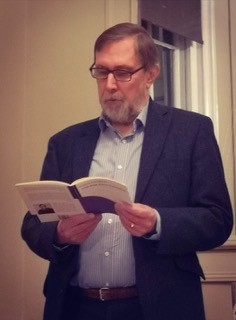
Stephen Claughton reading

New House in the Suburbs, an ekphrastic poem . . . and your next Wednesday Writing Prompt

Jamie Dedes's avatarJamie Dedes' THE POET BY DAY Webzine

New House in the Suburbs, Paul Klee
1924 – National Gallery of Art, Washington, DC

“Your house shall be not an anchor but a mast. It shall not be a glistening film that covers a wound, but an eyelid that guards the eye.”  Khalil Gibran, The Prophet


This clapboard suburban house is not like my Sidto’s, a
house with hydrangea blossoming below the front window,
purple and mauve, in a place where big maples gave us
their charming seed pods, those green whirlybirds
that quivered in the wind while determined dandelions
climbed their way to sunshine through breaks between
the cement squares that formed our sidewalks, a kind of
serendipitous geometry from the Office of City Planning

No, this suburban house is not a bit like Sidto’s where
air-raid sirens sounded at noon each day, disturbing
the otherwise peaceful hours of playing out front or
in the tiny…

View original post 696 more words

..day 40..

Sonja Benskin Mesher's avatarsonja benskin mesher

.day 40..

i hear them say that it is the solitude of lockdown
that brings these words

perhaps they are right
who knows really

there is that word again
even on my shopping card

a sticker so that i recognise that
it is not the other one though the

accounts merge into one these days

she takes it when she goes shopping
on tuesdays in the little coin purse
with the bow

it is that detail or dots which attracts me

she needed a more precise description than

buns

so i explained that not being fussy hot cross ones
teacakes or plain  will be nice
suffice
and she got extra large
some beans and tinned
peaches

left in a bag
in the shade

with the receipt
tucked neatly

you see james how deep the thoughts this
lockdown
said sarcastically
with careful spelling

i am still drawing joan now with summer…

View original post 45 more words

My annual National Poetry Month ekphrastic challenge has become a collaboration between Jane Cornwell (artist), and poets Susan Richardson, Samantha, Jay Gandhi, Ali Jones and myself. April 22nd

22 Twitter size

Sail Away

Sundown sails twirl,
at ballerina’s bow
the day dance ends.
Wake nudge turn home,
evening shadow calls.

Twilight shroud, sun
slides mouse quiet,
into dusk’s dim bowl.
A little death…it slows.

Under manta’s shadow,
thoughts leave the isles
and cold water corals.
Even solitude must end.

And coarse hands yearn
for warm water, soap
and a fish supper.
Sailor songs by the fire.

– © Dai Fry 21st March 2020.

Conveyances

I got your message.
It wasn’t tucked in a bottle, sealed
In the traditional way with cork and wax,
Set to sea
On the off chance of
Someday being found.

It was somehow more direct,
And yet, more subtle, written
In the sunshine
Reflections
On the vast waters
Of your soul.

It’s frustrating, at first,
When information’s not delivered
Where and how we’ve sought so long.
Sometimes though, it’s more important
To receive what’s freely given
Than fulfill the cliche’s of expectation.

-st

I Decide

whether sun on the horizon
rises or falls.

whether gust fills my sail
or empties it.

whether the signs
are a warning or a delight.

whether my rudder
is into or with the waves.

I trust in these hands, eyes,
strength to make it happen.

I make the day and night.

-Paul Brookes

Blink

I started making lists,
searching the horizon
and waiting for sunset
to pull me gently under.
I never believed in this
race against time or the
infinite nature of the sun.
Every moment is lost
before you can hold it
in the palm of your hand.
Every breath is a blade
when sorrow takes root,
and the heavy texture of
darkness weaves itself
into the blink of an eye.

-Susan Richardson

Evenings by the bay

Fishing in the deep sea
produce endorphins in me.

There is a rush
and then

there is a calm.

-Jay Gandhi

Bios and links

-Jane Cornwell

likes drawing and painting children, animals, landscapes and food. She specialises in watercolour, mixed media, coloured pencil, lino cut and print, textile design. Jane can help you out with adobe indesign for your layout needs, photoshop and adobe illustrator. She graduated with a ba(hons) design from Glasgow School of art, age 20.

She has exhibited with the rsw at the national gallery of scotland, SSA, Knock Castle Gallery, Glasgow Group, Paisley Art Institute, MacMillan Exhibition at Bonhams, Edinburgh, The House For An Art Lover, Pittenweem Arts Festival, Compass Gallery, The Revive Show, East Linton Art Exhibition and Strathkelvin Annual Art Exhibition.

-Susan Richardson

is an award winning, internationally published poet. She is the author of “Things My Mother Left Behind”, coming from Potter’s Grove Press in 2020, and also writes the blog, “Stories from the Edge of Blindness”. You can find her on Twitter @floweringink, listen to her on YouTube, and read more of her work on her website.

Here is my updated 2018 interview of her: https://thewombwellrainbow.com/2020/04/08/wombwell-rainbow-interviews-susan-richardson/

-Ali Jones

is a teacher, and writer with work published in a variety of places, from Poetry Ireland Review, Proletarian Poetry and The Interpreter’s House, to The Green Parent Magazine and The Guardian. She has a particular interest in the role of nature in literature, and is a champion of contemporary poetry in the secondary school classroom.

Here is my 2019 interview of her: https://thewombwellrainbow.com/2019/12/28/wombwell-rainbow-interviews-ali-jones/

-Jay Gandhi

is a Software Engineer by qualification, an accountant by profession, a budding Guitarist & a Yoga Sadhak at heart and a poet by his soul. Poetry intrigues him because it’s an art in which a simple yet profound skill of placing words next to each other can create something so touching and literally sweep him of the floor. He is 32-year-old Indian and stays in Mumbai. His works have appeared in the following places:
An ebook named “Pav-bhaji @ Achija” available in the Kindle format at Amazon.in The poem “Salsa; a self discovery” published in an anthology motivated by Late Sir APJ Abdul Kalam. The poem “High Caloried love” selected for an upcoming book “Once upon a meal” The poem “Strawberry Lip Balm” selected in the anthology “Talking to the poets” Four poems published in a bilingual anthology “Persian Sugar in English Tea” Vol.1 Two poems published in the anthology “Poets on the Run” compiled by RC James.

His poems have made it to the PoeTree blog and front pages of PoetryCircle.com & OpenArtsForum.com. In free time, he likes to walk for long distances.

Here is my 2018 interview with him: https://thewombwellrainbow.com/2018/09/23/wombwell-rainbow-interviews-jay-Gandhi/

-Samantha Terrell

is an American poet whose work emphasizes emotional integrity and social justice. She is the author of several eBooks including, Learning from Pompeii, Coffee for Neanderthals, Disgracing Lady Justice and others, available on smashwords.com and its affiliates.Chapbook: Ebola (West Chester University Poetry Center, 2014)

Website: poetrybysamantha.weebly.com
Twitter: @honestypoetry

Here is my 2020 interview of her:

https://thewombwellrainbow.com/2020/04/08/wombwell-rainbow-interviews-samantha-terrell/

-Dai-Fry

is an x social worker and a present poet. Image is all but flow is good too. So many interesting things… Published in Black bough Poetry, Re-Side, The Hellebore, The Pangolin Review. He will not stop.

Twitter                  @thnargg

Web.                       seekingthedarklight.co.uk

Audio/Visual.       @IntPoetryCircle #InternationalPoetryCircle Twitter
#TopTweetTuesday

-Paul Brookes

is a shop asst. Lives in a cat house full of teddy bears. His chapbooks include The Fabulous Invention Of Barnsley, (Dearne Community Arts, 1993). The Headpoke and Firewedding (Alien Buddha Press, 2017), A World Where and She Needs That Edge (Nixes Mate Press, 2017, 2018) The Spermbot Blues (OpPRESS, 2017), Port Of Souls (Alien Buddha Press, 2018), Please Take Change (Cyberwit.net, 2018), Stubborn Sod, with Marcel Herms (artist) (Alien Buddha Press, 2019), As Folk Over Yonder ( Afterworld Books, 2019). Forthcoming Khoshhali with Hiva Moazed (artist), Our Ghost’s Holiday (Final book of threesome “A Pagan’s Year”) . He is a contributing writer of Literati Magazine and Editor of Wombwell Rainbow Interviews.

YouTube; Poetry Is A Bag For Life

Twitter: @PaulDragonwolf1

WordPress: thewombwellrainbow.wordpress.com

Facebook: Paul Brookes – Writer and Photographer

Instagram: https://www.instagram.com/paulbrookes07/

My annual National Poetry Month ekphrastic challenge has become a collaboration between Jane Cornwell (artist), and poets Susan Richardson, Samantha, Jay Gandhi, Dai Fry, Ali Jones and myself. April 21st

21 twitter size

Faux Castle

Look at my glazed ruin
glass light, dry storm.
Rainbow’s home.

Anger sustains
though element gouged,
flag-wind, see my pride.

Faux castle, your ravens fly.
Plague’s sustenance,
last in the line.
Prepared for legend’s time.

Bone brittle, I crumble
brick powder, wormed wood.
Held in charms of
viral salts, corrosive winds.

My house is a closed mind
beyond the mildew line,
but at last it slowly opens
to lick and lash of stormy seas.

-Dai Fry

The Ruin

is a mask as you can see daylight
through the holes for your eyes,

Put the ruin on your face
when out in public
to avoid other folk being infected.

The ruin is reusable as it is washable
and there is plenty of room
for ventilation. Some ruins

are grander than others. Disposable
ruins pollute the oceans of good sense.

Use your ruin with due care and attention
to the needs of visitors. Don’t let them

get too close or you will lose your heritage.
Your voice may be muffled.

Paul Brookes

Adumbration

Queen Anne’s Lace
And black crows frame
My mental imagery,
Succumbing to the Rule of Thirds.
Until, there’s only room to run off the page.
But white cobwebs will remain

In the corner, and darkness will always flee
From the recesses
Of my mind,
As birds in flight,
Not unlike a militaristic
Rule of Thirds for deployment.

-st

The Violence of Sound

Parcels of darkness take to the sky,
storm warnings that strip the skin
from men’s bones and swallow
the blood of entire generations.
Heavy wings blacken the sun,
pulling fire into relentless beaks
that release screeches of doom.
The violence of sound scars agony
into stone, shatters windows that
slice into the marrow of families,
leaving their whispers scorched
and crumbling in the ruins of time.

-Susan Richardson

Duty is a Heavy Burden

It looks like a ruin,
But the spirit of the old king
Hung out for a long time,
If you can pardon the pun.

Now it is a skeleton
Of stone and beams,
Tower tops crumbled,
Though the foundations remain.

To be sovereign in to wear
The landscape like a cloak,
To adorn your body with
The hopes and desires

Of all the people and hear
Their cries with open ears.
They say it got too much for him,
The constant jibber jabbering,

So he took things with his own hands,
Literally. One day they found him,
Swinging in the great all, above
A gilded table, a king’s fit feast.

Afterwards, nobody else wanted
To take on the role, said it was
A poisoned chalice – power can
Sometimes go either way, as we know.

-Ali Jones

Freedom Returns

Now the caged birds are free
to sing & sway in the air.
The kind king has returned,
the fort has been seized—
the flag has been hoisted.

-Jay Gandhi

Bios and links

-Jane Cornwell

likes drawing and painting children, animals, landscapes and food. She specialises in watercolour, mixed media, coloured pencil, lino cut and print, textile design. Jane can help you out with adobe indesign for your layout needs, photoshop and adobe illustrator. She graduated with a ba(hons) design from Glasgow School of art, age 20.

She has exhibited with the rsw at the national gallery of scotland, SSA, Knock Castle Gallery, Glasgow Group, Paisley Art Institute, MacMillan Exhibition at Bonhams, Edinburgh, The House For An Art Lover, Pittenweem Arts Festival, Compass Gallery, The Revive Show, East Linton Art Exhibition and Strathkelvin Annual Art Exhibition.

-Susan Richardson

is an award winning, internationally published poet. She is the author of “Things My Mother Left Behind”, coming from Potter’s Grove Press in 2020, and also writes the blog, “Stories from the Edge of Blindness”. You can find her on Twitter @floweringink, listen to her on YouTube, and read more of her work on her website.

Here is my updated 2018 interview of her: https://thewombwellrainbow.com/2020/04/08/wombwell-rainbow-interviews-susan-richardson/

-Ali Jones

is a teacher, and writer with work published in a variety of places, from Poetry Ireland Review, Proletarian Poetry and The Interpreter’s House, to The Green Parent Magazine and The Guardian. She has a particular interest in the role of nature in literature, and is a champion of contemporary poetry in the secondary school classroom.

Here is my 2019 interview of her: https://thewombwellrainbow.com/2019/12/28/wombwell-rainbow-interviews-ali-jones/

-Jay Gandhi

is a Software Engineer by qualification, an accountant by profession, a budding Guitarist & a Yoga Sadhak at heart and a poet by his soul. Poetry intrigues him because it’s an art in which a simple yet profound skill of placing words next to each other can create something so touching and literally sweep him of the floor. He is 32-year-old Indian and stays in Mumbai. His works have appeared in the following places:
An ebook named “Pav-bhaji @ Achija” available in the Kindle format at Amazon.in The poem “Salsa; a self discovery” published in an anthology motivated by Late Sir APJ Abdul Kalam. The poem “High Caloried love” selected for an upcoming book “Once upon a meal” The poem “Strawberry Lip Balm” selected in the anthology “Talking to the poets” Four poems published in a bilingual anthology “Persian Sugar in English Tea” Vol.1 Two poems published in the anthology “Poets on the Run” compiled by RC James.

His poems have made it to the PoeTree blog and front pages of PoetryCircle.com & OpenArtsForum.com. In free time, he likes to walk for long distances.

Here is my 2018 interview with him: https://thewombwellrainbow.com/2018/09/23/wombwell-rainbow-interviews-jay-Gandhi/

-Samantha Terrell

is an American poet whose work emphasizes emotional integrity and social justice. She is the author of several eBooks including, Learning from Pompeii, Coffee for Neanderthals, Disgracing Lady Justice and others, available on smashwords.com and its affiliates.Chapbook: Ebola (West Chester University Poetry Center, 2014)

Website: poetrybysamantha.weebly.com
Twitter: @honestypoetry

Here is my 2020 interview of her:

https://thewombwellrainbow.com/2020/04/08/wombwell-rainbow-interviews-samantha-terrell/

-Dai-Fry

is an x social worker and a present poet. Image is all but flow is good too. So many interesting things… Published in Black bough Poetry, Re-Side, The Hellebore, The Pangolin Review. He will not stop.

Twitter                  @thnargg

Web.                       seekingthedarklight.co.uk

Audio/Visual.       @IntPoetryCircle #InternationalPoetryCircle Twitter
#TopTweetTuesday

-Paul Brookes

is a shop asst. Lives in a cat house full of teddy bears. His chapbooks include The Fabulous Invention Of Barnsley, (Dearne Community Arts, 1993). The Headpoke and Firewedding (Alien Buddha Press, 2017), A World Where and She Needs That Edge (Nixes Mate Press, 2017, 2018) The Spermbot Blues (OpPRESS, 2017), Port Of Souls (Alien Buddha Press, 2018), Please Take Change (Cyberwit.net, 2018), Stubborn Sod, with Marcel Herms (artist) (Alien Buddha Press, 2019), As Folk Over Yonder ( Afterworld Books, 2019). Forthcoming Khoshhali with Hiva Moazed (artist), Our Ghost’s Holiday (Final book of threesome “A Pagan’s Year”) . He is a contributing writer of Literati Magazine and Editor of Wombwell Rainbow Interviews.

YouTube; Poetry Is A Bag For Life

Twitter: @PaulDragonwolf1

WordPress: thewombwellrainbow.wordpress.com

Facebook: Paul Brookes – Writer and Photographer

Instagram: https://www.instagram.com/paulbrookes07/

..day 39..

Sonja Benskin Mesher's avatarsonja benskin mesher

.yes it is day 39.

whatever that feels when each day is taken
at a time. each task taken in order only there
is no order
no more

we find our own routines
our tasks for each day given

i heard the cuckoo yesterday
and swallows are up on the
rise

have i mentioned that already

in the garden white blue bells
amongst the blue blue bells

while cowslips reappear early
this year

tread carefully my dears

it is hard in the narrow lane
to distance and we edged
back into the nettles no
explaination the new normal
manners

i will like to make a bench
yet have no plank around

so i made signs for the house
for the delivery men who cannot
find me

i have ordered buns and he
need to know what sort he said

i explained any buns will do
a treat
i am not…

View original post 33 more words

Six Poems by Catherine Graham

robertfredekenter's avatarIceFloe Press

All My Blue Januaries


Three of the last minute Januaries sent me
backwards, dead father. What is there that shines

from another day? Night breathes, saturated
with nevered emptiness, cracks language

into a circle of Sundays. The sun
was something we managed.

Blue-roaming blood, a noose is a necklace
you never got out of. I don’t want stars.

Ash is not light. The story is there—
dream-cornered. Leave the necklace

unclasped for the dead. The river has your hands.

Inside Us a Bird Called Home


When the nearing nows, inner rings
expand, imagination.

So much growth standing still.
Sometimes a ghost slips into your

bloodstream, a plum-black abstract
with wildcats stalks.

Sing before pain.
The hour dusks a slow brief bloom.

Spirits bridge, the vanish—
Time-divided moths shake-shiver, silence.

Behind this bandaged path, sun maps. Gone
moonflower, maple artist, Florida

berries, the knowing baker, blown-over
dandelions with wanting faces.

A…

View original post 351 more words

Wombwell Rainbow Interviews: River Dixon

Wombwell Rainbow Interviews

I am honoured and privileged that the following writers local, national and international have agreed to be interviewed by me. I gave the writers two options: an emailed list of questions or a more fluid interview via messenger.
The usual ground is covered about motivation, daily routines and work ethic, but some surprises too. Some of these poets you may know, others may be new to you. I hope you enjoy the experience as much as I do.

River Dixon

River Dixon

has unknowingly found himself trapped in the incessant heat and beauty of Arizona. It is here, along with his family, that he finds solace stringing together words in an attempt to find a structure or sequence that may one day make sense of all this.

Links:

http://thestoriesinbetween.com
http://pottersgrovepress.com
http://amazon.com/author/riverdixon

Twitter @Potters_Grove

Interview

1. When and why did you start writing poetry?

It’s difficult to say when, exactly. Growing up, I was always writing something. Poems, stories, songs; whatever struck me. As to the why, I suppose I’ve just always had a desire, or motivation to try and create something worthwhile.  Along with that, I’ve always been quiet and withdrawn. Never comfortable around people. So, maybe, my attempts at the written word are a way to compensate for my failings with the spoken word. I think we’re all looking for something, and writing is my medium in the search.

2. Who introduced you to poetry?

Emily Dickinson. I’m not sure of my exact age, probably in the third grade, but I saw a list of famous people who had the same birthday as me. Her name was on the list and I was curious as to who she was. I went to the school library and found a collection of her poetry. I’m sure I didn’t understand most of it, but something in her words hooked on to me. From that day forward, I spent a lot of my recesses sitting under a tree reading her and Virginia Woolf.

2.1. What did you find in Dickinson and Woolf?

I think a lot of what fascinated me with them both was not just their work but each of them as a person. With Dickinson, the fact that so much of her poetry remained unknown until after her death. There’s always a certain romanticism associated with the artist who leaves behind such a literary legacy, having never achieved any recognition in their lifetime. Her reclusive nature. How she spent a great portion of her life in isolation. I wanted to know why. And the “darker” themes of her work appealed to me. And not just her poetry, but the collections of her letters that have been published. It’s possible that I have spent more time with her letters than her poetry.

With Woolf, I read about her life before I actually read any of her work. The sadness of her days, the manner in which she took her own life. I thought about that a lot. And I think that is partly how I eventually came to understand/believe that there is a certain beauty to be found in tragedy.

2.2. Why did the “darker” themes of Dickinson’s work appeal to you?

Hmm. That’s a good question. I’m not entirely sure. It’s just something I’ve always been drawn to. There’s a lot of hands reaching out of the darkness. I think there’s a part of me that wants to find a way to connect with even just one of those hands. And in acknowledging my own selfishness, perhaps that connection can help me to understand some of the things I carry with me. With so many voices screaming into the void, why is it we never seem to hear one another? I want people to understand that they are not alone. And with that, convince myself of the same.

2.3. So how is poetry a means to say to others that they are not alone?

Words have the potential to break through the belief that we are all alone in this. That nobody understands or cares. When we come across a piece that we can relate to, that feels as if the author were writing about us directly, then a degree of that loneliness falls away. Staring at a page of sequenced words and realizing that I am not the only one who feels a certain way is a powerful thing. I believe that we are all connected and that poetry has the ability to rekindle that connection.

3. How aware are and were you of the dominating presence of older poets traditional and contemporary?

A dominating presence in regard to what exactly? As far as personal preference, I’m definitely more interested in contemporary/free form styles. I realize there are some people who subscribe to the school of “proper” poetry, but I’m not one of them. Nothing against it though. I’m a believer in writing whatever you want, however you want to.

4. What is your daily writing routine?

I take advantage of any time that I am able to devote to writing. It varies. First thing in the morning is preferred but I often find myself scribbling into the night.

5. What subjects motivate you to write?

I rarely write anything starting off with a subject in mind. What happens is, I tend to get a word or line stuck in my head and I go from there.

5.1. Please could you give an example from a recent poem that you wrote how it developed from a word or line that stuck in your head.

There’s really nothing exciting or interesting to the process.  With my piece, I Understand Goodbye, it started with the line ‘my failures surround me’ and thinking of that, I just wrote it. For poems, I always jot down a rough draft in a notebook, and then I smooth it out while typing it up on the computer. That part varies from piece to piece, as some require very little editing while others require a lot. And quite a few of them end up getting deleted because they’re garbage.

6. How do the writers you read when you were young influence your work today?

I would say their main influence has been more on outlook than style. It seems to me that the writers I connect with have something to say. That’s what I strive for. Not merely to just say something. With people like Dickinson, Bukowski, Capote, Plath, Woolf, etc. I feel like the time I have given them has in return given me a substantial return on my investment. I would hope that some people feel the same when they read my work. I want it to be worth their time.

7. Who of today’s writers do you admire the most and why?

I don’t want to come across as rude, but I don’t care for questions like that. It’s too much of a rabbit hole. There are a ton of writer’s that I enjoy reading for various reasons. I respect their work and find value in it, but admiration? Not really.

8. What would you say to someone who asked you “How do you become a writer?”

Don’t compromise. Write what you want to write. Avoid trends. Be weary of anyone who tries to tell you there are strict rules that must be followed in order to be a writer. Don’t subscribe to industry standards. Don’t spend all your time talking about writing or thinking about writing, just write.

9. Tell me about the writing projects you have on at the moment.

I’ll have another poetry collection coming out later in the year and also a psychological horror novella.

My annual National Poetry Month ekphrastic challenge has become a collaboration between Jane Cornwell (artist), and poets Susan Richardson, Samantha, Jay Gandhi, Ali Jones and myself. April 20th

2

Revisiting

If we could go back, would you come too?
Here, let me take your hand and let’s slip
out of the car. It is probably a Ford Cortina,
or something similar, never a Ghia though.

Do you have your anorak? Yes, even though
It is summer, you will need it, if you want to follow.
And what about those shoes, are they grippy enough
to let you travel over the stream like a wee sprite
Bounding from rock to rock? Come. Isn’t it amazing?

How things are done here? No joins are needed
Because the whole is much stronger than the parts,
balanced in equilibrium, the story travels on past
that solitary elder, that must be bird strewn.
Trees don’t really grow here, and now I come to think

It is odd to try to claim any part of the earth as our own.
I always like the architecture of stone balanced on stone,
holding up like magic. But now I think of something else,
an attempt to announce our presence in a landscape
which barely notices that anything so small is here.

-Ali Jones

Stone Tears

This dry stone wall, a broken mountain.

-Dai Fry

False Barriers

Rock walls fitted together
Follow the slope of the land,
Aged bones
Leaning into one another,
A study of the past,
A barrier to the present.
Come, break down walls with me.
That we may run through
Unfettered fields, into the future.

-st

My Stone

The bones of earth are its stones.
decaying in their own slow time.
All my dead dears are marked by stones.
An Indian guru once gifted my dad black stones
he carried till his skin showed more of his bones.
My mam, sister and nanna are marked by stones,
Yorkshire stone in a graveyard of stones.
Speaking in one of her final breaths
My nanna told me where her breath
must be buried, the placement of stones.
My mam died on a day buffeted by gusts
and now I see the dead in every sweet gust.

=Paul Brookes

Chosen by Time and the Sky

I haven’t been sleeping,
stuck in the affliction of toss and turn,
thoughts tethered to the moon
and far away places.
I press my cheek to the window pane,
close my eyes
and imagine something beautiful
just beyond the glass.
A landscape with open hands,
offering itself as a canvas to the seasons,
succumbing to a palette of colors
chosen by time and the sky.
I see the rich reds and golds of Autumn
stretching to the edges of sound,
where everything falls into darkness.
I watch the colors transform
with strokes of charcoal and silver,
taste the first snowflakes on my tongue,
breathe in the scent of the soil as it freezes.
The winter in my mind
settles on barren branches,
and I remember my own emptiness,
my own silence.
I open my eyes to a scarred
window screen,
peer down at the filthy sidewalk
waiting with gaping jaws
to swallow my fantasy,
and remind myself,
it won’t be this way forever.
One day I will stand next to him,
reach out to touch the smooth grass,
take in the rolling fields with all my senses,
and know I am finally home.

-Susan Richardson

Episode

All that I can see
are parched trees
& yellow grasses.

They remind me
of the shooting pain
that follows mania.

Family confiscates
my phone & laptop—
no social life.

Pills pin me
down to my bed.
Waistline increases.

In retrospect I know,
this too did pass.

But then, at that
instance—

All that I can see
are parched trees
& yellow grasses.

-Jay Gandhi

Bios and links

-Jane Cornwell

likes drawing and painting children, animals, landscapes and food. She specialises in watercolour, mixed media, coloured pencil, lino cut and print, textile design. Jane can help you out with adobe indesign for your layout needs, photoshop and adobe illustrator. She graduated with a ba(hons) design from Glasgow School of art, age 20.

She has exhibited with the rsw at the national gallery of scotland, SSA, Knock Castle Gallery, Glasgow Group, Paisley Art Institute, MacMillan Exhibition at Bonhams, Edinburgh, The House For An Art Lover, Pittenweem Arts Festival, Compass Gallery, The Revive Show, East Linton Art Exhibition and Strathkelvin Annual Art Exhibition.

-Susan Richardson

is an award winning, internationally published poet. She is the author of “Things My Mother Left Behind”, coming from Potter’s Grove Press in 2020, and also writes the blog, “Stories from the Edge of Blindness”. You can find her on Twitter @floweringink, listen to her on YouTube, and read more of her work on her website.

Here is my updated 2018 interview of her: https://thewombwellrainbow.com/2020/04/08/wombwell-rainbow-interviews-susan-richardson/

-Ali Jones

is a teacher, and writer with work published in a variety of places, from Poetry Ireland Review, Proletarian Poetry and The Interpreter’s House, to The Green Parent Magazine and The Guardian. She has a particular interest in the role of nature in literature, and is a champion of contemporary poetry in the secondary school classroom.

Here is my 2019 interview of her: https://thewombwellrainbow.com/2019/12/28/wombwell-rainbow-interviews-ali-jones/

-Jay Gandhi

is a Software Engineer by qualification, an accountant by profession, a budding Guitarist & a Yoga Sadhak at heart and a poet by his soul. Poetry intrigues him because it’s an art in which a simple yet profound skill of placing words next to each other can create something so touching and literally sweep him of the floor. He is 32-year-old Indian and stays in Mumbai. His works have appeared in the following places:
An ebook named “Pav-bhaji @ Achija” available in the Kindle format at Amazon.in The poem “Salsa; a self discovery” published in an anthology motivated by Late Sir APJ Abdul Kalam. The poem “High Caloried love” selected for an upcoming book “Once upon a meal” The poem “Strawberry Lip Balm” selected in the anthology “Talking to the poets” Four poems published in a bilingual anthology “Persian Sugar in English Tea” Vol.1 Two poems published in the anthology “Poets on the Run” compiled by RC James.

His poems have made it to the PoeTree blog and front pages of PoetryCircle.com & OpenArtsForum.com. In free time, he likes to walk for long distances.

Here is my 2018 interview with him: https://thewombwellrainbow.com/2018/09/23/wombwell-rainbow-interviews-jay-Gandhi/

-Samantha Terrell

is an American poet whose work emphasizes emotional integrity and social justice. She is the author of several eBooks including, Learning from Pompeii, Coffee for Neanderthals, Disgracing Lady Justice and others, available on smashwords.com and its affiliates.Chapbook: Ebola (West Chester University Poetry Center, 2014)

Website: poetrybysamantha.weebly.com
Twitter: @honestypoetry

Here is my 2020 interview of her:

https://thewombwellrainbow.com/2020/04/08/wombwell-rainbow-interviews-samantha-terrell/

-Dai-Fry

is an x social worker and a present poet. Image is all but flow is good too. So many interesting things… Published in Black bough Poetry, Re-Side, The Hellebore, The Pangolin Review. He will not stop.

Twitter                  @thnargg

Web.                       seekingthedarklight.co.uk

Audio/Visual.       @IntPoetryCircle #InternationalPoetryCircle Twitter
#TopTweetTuesday

-Paul Brookes

is a shop asst. Lives in a cat house full of teddy bears. His chapbooks include The Fabulous Invention Of Barnsley, (Dearne Community Arts, 1993). The Headpoke and Firewedding (Alien Buddha Press, 2017), A World Where and She Needs That Edge (Nixes Mate Press, 2017, 2018) The Spermbot Blues (OpPRESS, 2017), Port Of Souls (Alien Buddha Press, 2018), Please Take Change (Cyberwit.net, 2018), Stubborn Sod, with Marcel Herms (artist) (Alien Buddha Press, 2019), As Folk Over Yonder ( Afterworld Books, 2019). Forthcoming Khoshhali with Hiva Moazed (artist), Our Ghost’s Holiday (Final book of threesome “A Pagan’s Year”) . He is a contributing writer of Literati Magazine and Editor of Wombwell Rainbow Interviews.

YouTube; Poetry Is A Bag For Life

Twitter: @PaulDragonwolf1

WordPress: thewombwellrainbow.wordpress.com

Facebook: Paul Brookes – Writer and Photographer

Instagram: https://www.instagram.com/paulbrookes07/

..day 38..

Sonja Benskin Mesher's avatarsonja benskin mesher

..it is day 38..

the numbers are not existing no more
just marks on paper and my brain explodes

we remember logarithms, sines and cosines

tables & music notes that melted away into

no understanding
whatsoever

yesterday cleared and we found a place to
read in the greenhouse
i was not prepared
not a good gardener
which means that i am not a good person
for it seems the lockdown law that all must
have plants and make fresh bread

the little house is tidy and painted now
she brought me the chair in secret now
she puts her life out there
on the ambulance so i

sit there and read
worry for her and
all the others for

all the good that worry does

later i drew all neat and precise
like as if that was important or
something
after hours
i did smudgy
and it much improved my…

View original post 16 more words