Wombwell Rainbow Interviews: Justin Jannise

Wombwell Rainbow Interviews

I am honoured and privileged that the following writers local, national and international have agreed to be interviewed by me. I gave the writers three options: an emailed list of questions or a more fluid interview via messenger, or an interview about their latest book, or a combination of these.

The usual ground is covered about motivation, daily routines and work ethic, but some surprises too. Some of these poets you may know, others may be new to you. I hope you enjoy the experience as much as I do.
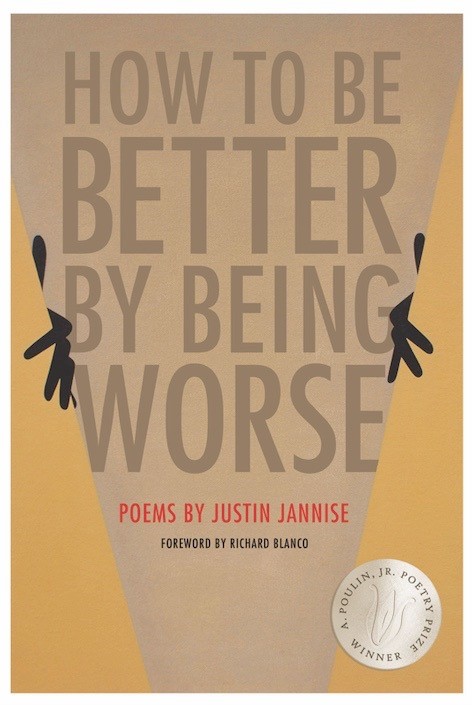
How To Be Better By Being Worse by Justin Jannise

Justin Jannise

is the author of How to Be Better by Being Worse, which won the A. Poulin, Jr. Poetry Prize and is forthcoming from BOA Editions, Ltd., in April 2021. His writing has appeared in Best New Poets, Best of the Net, Copper Nickel, Yale Review, Poetry Northwest, and New Ohio Review. Recently a recipient of the Inprint Verlaine Prize in Poetry and the Editor-in-Chief of Gulf Coast, Justin lives in Houston, where he is pursuing his Ph.D. 

The Interview

1. When and why did you start writing poetry?

The first poem I wrote, if I’m remembering correctly, was for church when I was 10 years old. Although we didn’t remain in that church for very long, my mother still has the poem framed and hanging up in her living room. Very embarrassing. I don’t recall having much of an interest in poetry between then and high school, when I became obsessed with Sylvia Plath. I don’t think I understood a word of Plath’s poetry, but I studied it, believing that if I read it enough times, eventually its secrets would be revealed to me.

2. Who introduced you to poetry?

In college, after flirting with becoming a sociology major, I soon realized that there were no classes I wanted to take more than literature and writing classes. I preferred fiction, however, since poetry seemed so difficult as to be virtually un-makeable. In the last semester of my senior year, I was told I’d have to take one creative writing class outside my fiction concentration, and I ended up in J.D. McClatchy’s introductory class. He was a tough teacher, and a stalwart formalist, but he opened the door to poetry – to understanding it better, as well as to writing it — in a way that nobody else ever had. I never looked back after that.

3. How aware are and were you of the dominating presence of older poets traditional and contemporary?

Personally, as a teenager, I was much more aware, and much more interested, in the classics of literature. Even in high school, I supplemented required reading with even more required reading. For some reason I believed that difficult literature would make me smarter, and what’s more difficult to a 16-year-old than Henry James, Faulkner, Virginia Woolf, Joyce, and so on? I had no idea that there were living, breathing poets or writers who were producing new literary classics. As far as I knew, back then, Sylvia Plath was the last poet ever to have lived. Very few poets passed through the small town where I grew up. If somebody back then had introduced themselves to me as a poet, I probably would’ve assumed that they wrote children’s literature.

4. What is your daily writing routine?

First, let me suggest that you never ask this question of any writer ever again. The only word in “daily writing routine” that doesn’t immediately make me wince is “writing.” I don’t do anything “daily” except eat and brush my teeth. I find “routine” anathema to the life of an artist.

Now that’s out of the way, I’ll answer the question in the spirit with which I think you meant it. I write by reading, listening, and paying attention. My mind is always doing two things at once: I’m doing my best at being present to the world around me, which usually means the people around me. I’m also tracking my attention, almost like a constantly running EKG scanner. When I get a signal that causes my EKG to spike, I stop what I’m doing immediately, and I write a note on my phone. The rest depends entirely on what is written down.

5. What subjects motivate you to write?

No subject interests me more than language itself – how it works, how it fails, how it is everything and nothing at the same time.

6. What is your work ethic?

I sing for my supper.

7. How do the writers you read when you were young influence your work today?

I think real influence is something much more mysterious and unconscious than we’re used to thinking. When Louise Glück won the Nobel Prize recently (news that I was absolutely ecstatic about, by the way, having long admired her work), I saw many poets on Twitter come forward to describe the specific ways that she had influenced them. I wouldn’t call that influence; I call that teaching. There needs to be a word for what happens when a poem or a book gets so woven into your DNA that you can’t even recognize it on your own anymore. It cannot be seen with the naked eye because it is the eye, the instrument with which things are seen. Anyway, I think T.S. Eliot and Harold Bloom have both showed how meaningful influence is often negative. As humans, and especially as artists, we yearn for freedom, and for some of us that means freedom from influence. Every time I get compared to another writer, it’s usually one whose work I did not read when young enough to be influenced by them.

8. Whom of today’s writers do you admire the most and why?

I think the word “admire” is interesting because it’s a synonym of “love” but it implies a distance, possibly even something like insincerity. Suffice it to say that I equally admire all today’s writers who swim upstream in a world that’s generally hostile to the kind of authenticity that writing demands.

9. Why do you write, as opposed to doing anything else?

Oh, I do plenty of other things. My friend D.A. Powell puts it this way: “I’m trying not to write.” I think what he means is that, with poetry especially, writing is a more-or-less safe place to act out one’s fantasies. The fantasy that one can live for ever, for example, or the fantasy of blamelessness, that all one’s problems have been created by outside forces. Don’t get me wrong: writing, when it’s going really well, is my number one favourite thing to do. When it’s not going well, which is really quite often, I start wishing I knew how to carve wood, or analyse the stock market, or make blockbuster movies from home.

10. What would you say to someone who asked you “How do you become a writer?”

If you can avoid becoming one, consider yourself lucky.  

11. Tell me about the writing projects you have on at the moment.

My first book, How to Be Better by Being Worse, is out from BOA Editions, Ltd., in April 2021. You may now pre-order it on Amazon.com. I’m working on a series of epigrams, as well as a collection of craft essays. I’ve done a fair amount of teaching, and I’ve noticed how often I repeat myself about certain things, that I’ve decided to write those things down.

The Martian’s Regress by J.O. Morgan (Cape Poetry)

tearsinthefence's avatarTears in the Fence

It’s the future. Earth, environmentally ruined and abandoned, has become the dead planet, and a martian – with the ‘m’ of species rather than the ‘M’ of locality – is sent back there by his unspecified supervisors to collect samples and seek for new life.

Life on Mars itself isn’t great, as we learn bit by bit: the radiation, the pollen-storms, the food that’s basically mould, the terrible sex. And the culture is brutal: even martian fairytales and lullabies are grim and sadistic, and the planet’s Adam and Eve are vengeful, genocidal children.

The martian, who’s small, fat and black, and his accompanying robot, who is tall, white and shaped with ‘overt femininities// all relics of an ancient era’, land and find a place to inhabit. They raid the shops and he goes out daily looking unsuccessfully for life. He casually destroys museum and cathedral artefacts, starts to think telephones…

View original post 369 more words

“Bloody Amazing” 123 taboo smashing poems…its about bleeding time

Bloody Amazing front cover

https://www.bloodyamazing.co.uk/

From their Website “Bloody amazing is what you are! You have back ache, front ache, headache, you’re weary and teary as hell, and still you go on. Pass exams, gleam at jobs, raise kids. All too bloody likely accidentally colluding in a taboo that says you shouldn’t talk about your periods or your menopause because you’re a nice girl. Woman. Heroine. Except, excuse me, we’re half the world, us women, more, and we’ve nothing to taboo about. And this anthology is the place to shout, yell, rant, rave, laugh -like drains – and cry. Why? Because if we wanna change the world we need to speak the unspoken. The manipulation by our cultures, their vultures and the sodding ad industry. The tax men. An anthology then. Of @ 123 poems because stack the weeks end to end, and that’s roughly how many months the average woman bleeds in her life. As if there was an average woman…

Highly Recommended.

“RETCHID” by Whiskey Radish

robertfredekenter's avatarIceFloe Press


“photo by Chuckie Closs

BIO: Whiskey Radish @WhiskeyRadish leads an uneventful (outer) life in an uneventful (real) town. Whiskey R. is seeking a crack agent to represent her work.

View original post

Eat the Storms – The Podcast – Episode 4

deuxiemepeau's avatarStorm Shelter

Podcast available on Spotify, Google Podcasts, Apple Podcasts, Anchor, Breaker and many more platforms

The 4th episode was a happy Host of Hoglets as I was accompanied by poets all with collections published by The Hedgehog Poetry Press who published my debut collection, also called Eat the Storms. On the show was Nigel Kent reading poems from his collections Saudade and Psychopthogen, Patricia M Osborne reading from Taxus Baccata, Gaynor Kane reading her from collection Venus in Pink Marble, Katie Proctor reading from Seasons, Brendon Booth-Jones reading from his collection Vertigo to Go, Zoe Sîobhan Howarth-Lowe reading from her collection I Have Grown Two Hearts and Margaret Royall reading from her forthcoming collection Where Flora Sings. In between I read poems from Eat the Storms and three extra poems based on my days living in Amsterdam.

Below is a link to The Hedgehog Poetry Press whee you can find all…

View original post 3 more words

Eat the Storms – The Podcast -Episode 2

deuxiemepeau's avatarStorm Shelter

Podcast is available on Spotify, Google Podcasts, Overcast, Anchor, Bleaker and Apple Podcasts and many more platforms.

The 2nd episode of Eat the Storms, The Podcast, aired on 11th September and featured my very first guest, Belfast born poet Gaynor Kane who joined me to share poems from her latest collection, Venus in Pink Marble, also published by The Hedgehog poetry Press. During this episode I also share poems from my collection Eat the Storms, read a poem of mine that appeared in the 1st issue of the Fahmidan Journal and read two poems which were inspired by the Cobh Readers and Writers Twitter poetry prompts during Lockdown.

Venus in Pink Marble, the latest collection from Gaynor Kane is available on her website…

View original post

Eat the Storms – The Podcast – Episode 3

deuxiemepeau's avatarStorm Shelter

Podcast is available on Spotify, Google Podcasts, Overcast, Anchor, Bleaker and Apple Podcasts and many more platforms.

The 3rd podcast on the 19th Sept 2020 was the 1st episode to feature bumper to bumper amazing guest artists from all around the world. From Aotearoa to Cobh in Country Cork, in Ireland, this almost hour-long feature was a delight to put together and listen to. On this show was Ankh Spice, Eilín de Paor, Aisling Keogh Catherine Ann Cullen, Kevin Bateman, Sarah Connor, Ruairí de Barra and Jane Dougherty (all available on Twitter). This was also the launch week for my debut collection Eat the Storms, published by The Hedgehog Poetry Press and I was so fortunate to be surrounded by the poets I love, respect and admire…

My debut pamphlet poetry collection Eat The Storms is available to buy here…

View original post

Eat the Storms- Damien B. Donnelly

deuxiemepeau's avatarStorm Shelter

My debut poetry pamphlet collection is called Eat the Storms and was published on the 17th September 2020 by The Hedgehog Poetry Press. In 2019, while still living in Paris, I was one of three winners of the White Label Debut Poetry Pamphlet Collection and this collection is that winning dream come to life.

‘I wanted to draw the sound of the moon on a sun-drenched beach…’ that is the 1st line from the 1st poem in this collection and that is what I was looking for; to capture those impossible moments when the senses are confused as to which one should be working. To stand in a darkened room and still see a spark of light so as to not completely disappear into only sadness. To see fragility as not something weak or wearisome but as something as precious as the marbled perfume of the ocean as its waves…

View original post 504 more words

Spectrum of Flight – David Hanlon

deuxiemepeau's avatarStorm Shelter

I can remember, creeping down the stairs, after midnight, my parents sleeping, my heart trying to break out of my ribcage, turning on the tv as the sound of my breath rose beyond control, turning down the volume and clicking on to Channel 4 to watch Derek Jarman’s Sebastiane as nerves stuck like knives in my belly and skin shivered like I’d been dropped in the middle of Antarctica, naked. But all this means I can completely relate to the line in David Hanlon’s debut collection that reads ‘the film held my hand like a parent holds the small child’s at the seaside as they take their first steps into vast unknown waters.’

And that water returns, throughout this collection, ‘I was the slow drip of a leaky sink faucet’ but its flow is not that of a steady stream, for nothing is that easy for anyone that ‘only came…

View original post 635 more words

Eat the Storms – The Podcast – Episode 6

deuxiemepeau's avatarStorm Shelter

Podcast available on Spotify, Google Podcasts, Apple Podcasts, Anchor, Breaker and many more platforms

This episode aired on 10th October 2020 and we shared poems about flights, dreams, strengths, coming home and dualities. I was joined by Julie Stevens, Steve Denehan, Mari Maxwell and Sharon Larkin. The links to their websites, blogs or Twitter pages are all listed below.

To buy Quicksand by Julie Stevens (@JulesJumping on Twitter) here is the link…

For more information on Steve Denehan (Twitter as @SteverinoD) his website is…

https://stevedenehan.wixsite.com/website

You can find Mari Maxwell on Twitter as @MariMaxwell17 or at The Galway Review…

For more info on Sharon Larkin…

https://sharonlarkinjones.com/

The opening poem I read We’ll always Have, What Exactly? was published by Impspired Magazine and can be found here…

My debut collection Eat the Storms is available here…

Until…

View original post 5 more words