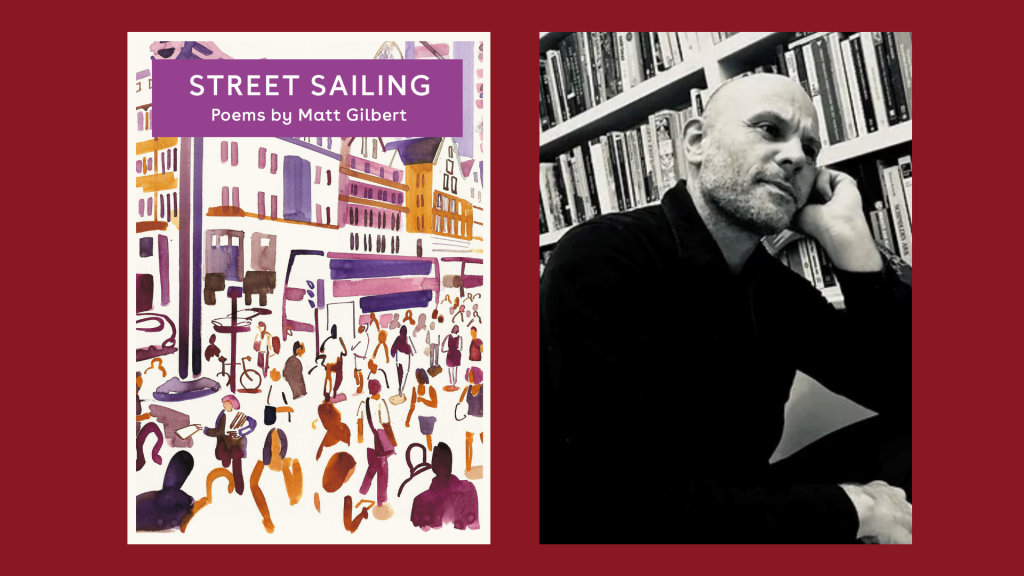
Matt Gilbert
is a freelance copywriter, who also writes a blog at richlyevocative.net about place, books, poetry and other distractions. Originally from Bristol, he currently gets his fill of urban hills in South East London. He has had poems published by Atrium, Anthropocene, Finished Creatures and The Storms among others. His debut collection ‘Street Sailing’ with Black Bough Poetry is out now.
The Interview
Q:1. When and why did you start writing poetry?
In a sense I started twice. First at about 12. We were studying the Tempest at school and we could either write an essay, or try to write a character’s speech in blank verse. So, imagining I’d avoid work, I tried that and found it tricky, but surprisingly satisfying. Michael Rosen also visited my school in Bristol and I remember being taken aback to see that poetry could be fun. Around this time, I started writing angsty doggerel in notebooks. Later, as a student in Nottingham I used to get the odd piece in a student poetry magazine called Pulp. Tom Paulin was one of my tutors and he used to give the odd poem to the mag. The idea that your work could sit alongside an established poet was quite exciting.
I stopped for a long time in my mid-twenties – partly because my job as a copywriter fulfilled a need to write, but I was also beginning to get frustrated with a poetry-scene that seemed full of referency, self-consciously difficult work.
I began tinkering with poems again towards the end of 2019. I got a poem accepted in Picaroon – which had a brilliant, inspiring call out about the kind of poetry they wanted to see and from there I began to be enthused once more.
Q:2. Who introduced you to poetry?
My Dad, I think. He was interested in ghosts and the supernatural and sometimes read us poems as well as stories. De La Mare’s ‘The Listeners’ was a favourite. I also had a copy of the Puffin Book of Magic verse – filled with folklore, strange creatures and ghosts, which I treasured.
My secondary school wasn’t great, but I was lucky to have had a few good, inspiring English teachers. One of them, Mr Savage (these days Mr Caroline Lucas), got the class to read a poem about a snake by D H Lawrence. We’d been reading Ted Hughes and assumed it was by him. That was a real awakening into the idea of style and influence.
Q:3. How did you decide on the order of the poems in Street Sailing?
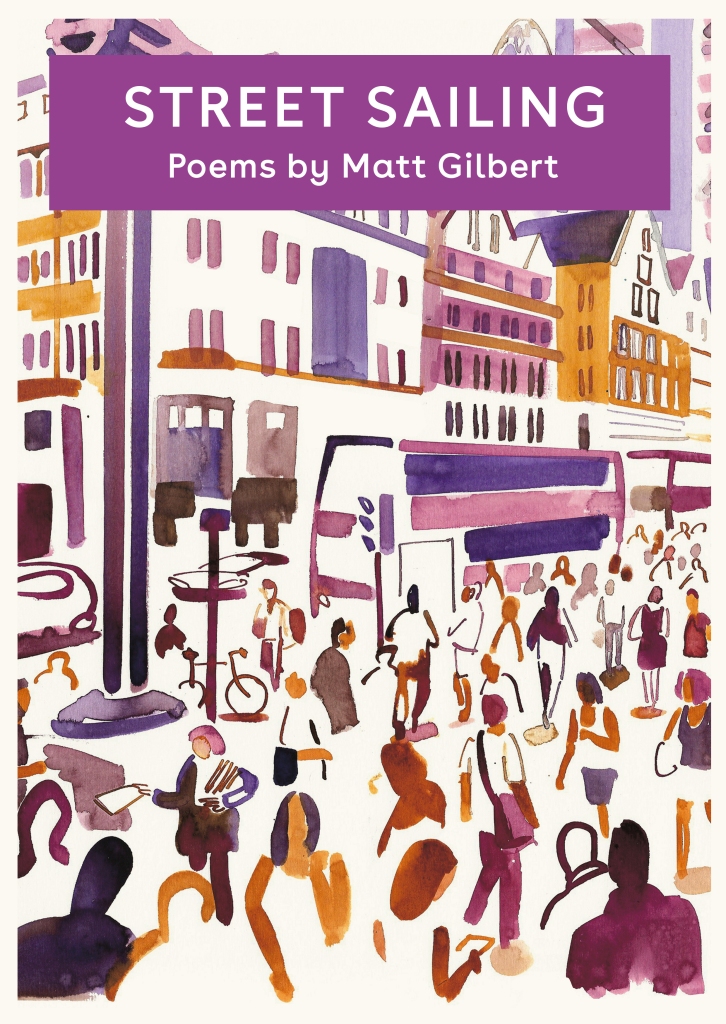
I didn’t set out with an especially detailed plan, but had some general thoughts or guidelines in mind. From fairly early on in the process I knew that I wanted to keep poems involving places near my home in South East London, separate from those set elsewhere. I was also keen for the poems to provide a slight feeling of a journey. In addition, I wanted to avoid the collection feeling like a random lucky-dip of poems without any sense of order. I quite like that when it comes to anthologies – seeing different poems by a range of poets rub up against each other in unexpected ways, but I felt the need for at least a sense of flow amongst mine here.
I thought a bit about favourite albums by various bands and the sequencing of those, which helped a little in terms of build and pace.
From there, to break the book up, I came up with a simple three section structure – Awake, Afoot and Acceptance. Very roughly these correspond with: openings, being close to home and becoming aware of something not right, or a slight unease. Then going out, off and further away, perhaps to reflect. Finally, returning to home turf, with a sense of having learnt something, or at least better understood it.
I did notice after putting the early drafts together, that the first four or five poems seemed to introduce an accidental narrative. Something is brought into the home, which perhaps shouldn’t have been. Something else is removed, again with unintended consequences and then some upset and domestic turmoil begin to unfold. However, this wasn’t a conscious effort, though I was pleased to note it later. It might be something only I see there though.
Very specifically, I did want certain poems to foreshadow others that followed, while some later ones were placed to perhaps suggest echoes of earlier lines or poems. For example, the last word of Aurochs, the final poem in the collection is the same as the title of the first. The opening poem ‘Awake’ with a fox crying out and the last in this first section with a dead fox on the tracks at a local train station were deliberately placed to bookend that part of the collection. There are a few other little things like that going on, but I’m happy for readers to find their own resonances, or not as they read.
Q:4. How aware are and were you of the dominating presence of older poets traditional and contemporary?
I wasn’t aware of Blooms notion of the Anxiety of Influence until much later, though, I think from secondary school onwards, I’ve been vaguely aware of the idea that certain, more often than not, dead white-male poets were regarded as the greats, or classics. Shakespeare, Milton, The Romantics and into the moderns with Eliot. I liked Keats most from the ones I was initially introduced to. As a young child I liked De La Mare, but as I got older, he seemed to be dismissed as for kids, or somehow non-serious.
When I was younger, the more contemporary poets we studied, at least the ones I remember, were Hughes, Heaney and Plath. We also read some Benjamin Zephaniah. All of which I enjoyed. At school, other than Plath I don’t remember reading much by women
I did a degree in English and American Studies, which broadened my poetic horizons considerably. Even then, certain figures seemed to loom larger than others – Whitman, Frost, Stevens and Ginsberg in particular
I’ve long liked Kathleen Raine and Frances Horovitz, though I can’t remember how I first came across their poetry
As I’ve got older and more deeply engaged with poetry, I’ve made a more deliberate effort to read a much wider, more contemporary pool of writers. Some fairly well established like Alice Oswald, Selima Hill, Don Paterson and Roger Robinson and a range of others – often poets with indies like Broken Sleep or Indigo Dreams. I try to keep it varied – most recently I’ve been reading Kim Moore’s ‘All the men I never married’ and I’ve also enjoyed Carl Philips New and Selected Poems
When it comes to my own writing, I try not to consciously mirror anyone in particular.
Of course, it’s hard for your own poems not to reflect your reading, so I’m sure influences are there to be found. A lot of my stuff tends to involve the natural world – trees, birds etc, so I often find myself wondering if it isn’t impossible to say something original at all. Kathleen Jamie’s ‘Lone Enraptured Male’ frequently nags at my inner thoughts, but if I paid too much attention to my inner imposter-syndrome demons, I’d never write anything at all.
Q:5. How important is the natural world to your poetry?
I’d have to say it’s central, in the sense that more-than-human creatures, plants etc are often at the heart of many of my poems. I try not to separate humans from other beings in an ‘us’ and ‘them’ sense, though of course, it’s hard to avoid a subject/object relationship if writing about, say, a tree, or a nuthatch
What I’ve always been fascinated by is a sense of place – what makes one spot, site, or area distinctive from another. Inevitably these places, from my street, to a Yorkshire Moor, or French riverside are going to have inhabitants or visitors, so the natural world in that way is always present
A lot of my poems, certainly in Street Sailing, try to address the natural world as it meets the city – really just another type of habitat. So, I try to get a sense of how the animals, plants and insects that anyone can encounter in their everyday urban surroundings, mix and interact
I try to avoid simply gushing about pretty goldfinches and not set up encounters in pristine environments as if all is well with the world. So there’s litter, congestion, habitat loss and other negative human behaviours reflected in the poems
Equally though, I don’t want to only bang on about tin cans and dirty old canals and how doomed we all are. Sometimes, if I see a peregrine on a church tower in my neighbourhood, a stag beetle on a paving slab, or even a rat bursting out of a composter, I can’t help thinking that existing alongside these other lives is pretty amazing.
Q:6. What is your daily writing routine?
I don’t have a fixed writing routine as such. Whenever I have a spare moment in a day, I tend to have a poke around in my Work in Progress folder on the laptop, or in another folder I call Sending Out Potential. I’ll then select a poem or two to tighten up, tinker with or edit.
If I have more time, I’ll review notes – some handwritten in a notebook, others on my phone. There may be the start of an idea, or potential poem there that I can develop.
Very occasionally, I get gifted, as if out of nowhere, the skeleton of an almost complete poem. Whole lines, even verses that survive all the way to the final poem sometimes occur this way. When this happens, I try to drop whatever else I’m doing and get something down on paper/screen (whatever’s to hand) as soon as I can.
Most days, I’ll at least note an observation, sketch or thought down somewhere.
At weekends, or evenings between my kids’ dinner and bedtime, I might look into submission opportunities and send a few things out.
On balance I probably spend more time revising, or reworking existing potential poems than writing entirely new work.
Q:7. How important is form in your poetry?
Although I do pay careful attention to form, my priority is usually content. Sometimes I’ll write a poem in formal stanzas from scratch, length can vary, but more often I’ll put something down first in a free verse jumble, then start toying with line breaks and line length. I quite like allowing a little double-ness in potential meaning, so that a line can be read one way if using line breaks to punctuate, but another if following the formal commas, full stops etc.
Whatever shape emerges, on the whole I avoid very long lines. If I’m writing a poem with a strong narrative element, I tend to go for four or even five-line stanzas, with slightly longer line length. When I’m doing something more imagist, or impressionistic, these tend to be shorter and punchier.
Mostly, I tend to busk it when it comes to form and rarely set out with a particular form or style in mind. I have nothing but admiration for poets who set out to write a sestina or terza rima from the get-go. My mind doesn’t work that way. I’m not an especially technical poet – though I’m not uninterested. I am currently ploughing through Don Paterson’s The Poem.
Q:8. What motivates you to write?
When I was little my grandpa used to call me ‘Yebbut’ because I’d always have another question. I’ve never really lost that childhood habit of asking why. I think I write poetry because I still have more questions than answers.
Q:9. What do you think of the white space surrounding your poems?
On one level, I think of that white space simply as a frame, or anchor, holding the poem in place and providing a focus.
I also think of that area as belonging to the reader – in a way it represents the remains of the blank page that first confronted the poet – a reader can use that space to drift off into their own impressions and reading of the poem that has only partially filled it.
Q;10. How do the writers you read when you were young influence your work today?
Mostly unconsciously. Lately I’ve spent far more time reading contemporary poets than going back to earlier influences, favourites or ‘classics’. That said, as I mentioned in an earlier answer, as a very young child, I liked De La Mare. Some of the odd, or even ghostly elements in my poems almost certainly owe a debt to that early introduction to the eerie and supernatural. These also stem from reading a lot of supposedly true reports of Hauntings by the likes of Peter Underwood and the Usborne Book of Ghosts.
Hughes certainly looms over my thinking often when I’m writing about birds or animals. Every so often I’ll read Heaney’s Postscript and it never fails to move me. I love the way he creates an emotional impression of a place and a moment, by talking about how he’s failed to catch it. There’s also a Frances Horovitz poem called Walking In Autumn and that’s one of the finest poems I know for conveying the atmosphere of a wood – both wanting to be in it and out of it.
I wish I could say something cooler, or more refined, but I suspect my love of certain landscapes, especially woods owes a lot to Tolkien and Robert Holdstock’s Mythago Wood – both of which I first read long before leaving school.
Q:11. What is about the idea of “place” that fascinates you?
I’m not sure where that comes from, but it began early. My Mum and Dad used to have a bookshop in the centre of Bristol. Behind it, when I was a kid, was a former hospital burial ground, overgrown with buddleia and ash and all sorts of other plants and shrubs. The idea that there was this wild, mysterious place, just over the back wall was at once enormously exciting and a bit scary. Having bookseller parents also gave me access to a lot of books. I used to read, inhale almost, volume after volume of books about ghosts, hauntings and local British and Irish folklore. I think the ranks of those white and green ladies, mad monks, lost children, drummer boys and hell hounds gave me a sense of a deeper human connection and history with the land they apparently sprang from.
The enormously varied place names of towns and villages across the UK where all these hauntings supposedly occured, intrigued me as well: Where do different names come from? Why do some places end with Thorpe, others By, or Chester, Ham etc. I also had a book about mysterious lost cities, which included Petra and various Inca or Aztec sites, now taken over by jungle. This gave me a sense of an even wider world, filled with more strange places, but also an uncomfortable feeling that nothing we create, or build, even whole cities, will last forever. So I guess a powerful awareness, even fear, of human transience, lost things and other, wilder lives retaking the space has stayed with me.
Q:12.Why do you begin and end the collection with the word “awake”?
I wanted to start with a short poem that snapped quickly into some of the recurrent themes to come. I thought it could also provide a jolt awake for readers too. ‘Awake’ seemed to me to neatly combine an interior domestic scene, with a jarring intrusion from the outside and delivers a hint of the preternatural – in this case an abrupt scream, ‘banshees out’ and through the house, waking up the sleepers inside.
The last poem, ‘Aurochs’ involves another awakening, or rather reawakening. I liked the idea of the final word, echoing and in some way looping back to the opening of the book.
Q:13: Who of today’s writers do you admire the most and why?
I’ve been reading a lot of contemporary stuff lately and there are some fabulous poets out there. Of more established names, I was reading a library copy of Kim Moore’s ‘The Art of Falling’ the other week and found it so full of brio – brilliant lines, conceits and inventive language, that I had to go out and buy it, so I had my own to keep. I also bought her latest ‘All the Men I Never Married’ which is cracking
I really enjoyed Zaffar Kunial’s England’s Green. ‘Foxglove Country’ – I think it’s the opener – is so delightfully clever, the way it really forces the reader to think about England and the English language, belonging and alienation, as it plays with words and the sonic quality of letter combinations and what they mean or even hide
I try to support my fellow poets and buy pamphlets and collections from smaller independents too when I can. I found Briony Collins ‘The Birds, The Rabbits, The Trees’ very moving, beautifully expressing some very difficult subjects. It has a stunning cover too
Stuart McPherson’s ‘Obligate Carnivore’ I found darkly compelling. Again, addressing complex issues, including toxic masculinity,
but with a wit and delicacy that brought beauty to bear on some ugly matters
My own editor Matthew M C Smith’s The Keeper of Aeons, is filled with brilliant descriptions, often joyful turns of phrase, along with deep reflective poems on memory, childhood, the world and the vastness of space beyond
Q:14. What would you say to someone who asked you “How do you become a writer?”
I’d say read, read, read. Take notes. Read some more, then write
Q:15. Tell me about the writing projects you have on at the moment.
I don’t have a firm project as such on at the moment. I do have about 18 poems that have some potential, to toy with, before maybe sending some of them out on submission. One of these is about a bus stop I used to wait at, frequently on Saturday nights in my twenties. I’m trying to see if there could be a poem in what is a bit of a non-place, that isn’t in any way obviously poetic
Q:16. Once they have read “Street Sailing” what do you hope the reader will leave with?
I’d hope some may want to go back and read at least a few of the poems again. I’d also love it, if in some way it achieved a little of that feeling you sometimes get from leaving a cinema during the middle of the day, where the world seems at once the same, yet changed. If after reading Street Sailing people felt an impulse look afresh at a paving slab, or a street tree, or even a bus stop, that would be very pleasing.


 The Wombwell Rainbow