I cannot remember better day out yet wait… perfect horror; who’s trapped in this cage?
Indistinct animal staring at victims behold selfish need own one, hashtag shot.
Whilst behind huddled mass burning, unhindered this problem themselves unfollowed, forgot.
-Sarah Reeson
Sky Spinners
You’re a whizzer, a woosher, a sonic swoosher, an air slicer, a low-flying bird dicer, an H2O ricer.
You’re a ghostly, three-armed angel standing at the gateway to the cloud kingdom. You’re waving, we’re drowning. You’re a trio of eyebrows – all frowning.
You’re a kinetic, kite-sifting light, a robot soldier in the sustainability fight. You’re a thin man with a fat plan, a small plug in a big dam. You’re a vibrating, vertical battering ram.
Armed, farmed and sometimes alarmed, you’re a three-headed snake, already charmed. You’re a flower power tower, an eco wower, weaving electricity streamers for ideological dreamers.
You’re a ghost ship made of air, a beleaguered beacon of NIMBY despair, a dangerous place for drying underwear. You’re proof we care. You’re propellers without planes, the champions of change, both comforting and strange, moving with magnetic grace across the Earth’s frenetic face.
You’re a semaphore warning, seen from space,
sent to save the human race, like a match is sent to save the dark.
You’re hope’s art,
an apple put back in an empty apple cart, a sail on the all new Noah’s Ark, a piece of Sellotape on a world torn clean apart.
You stop my heart. You start my heart. You stop my heart. You start my heart.
You’re clock hands on a ticking planet.
SOGGY TWAT
The breakdown man said he had to pull a £50k Mercedes out of the flood yesterday. They just drive into it , expecting it to part like the Red Sea, Bluetooth glinting off the storm surge, King Canute in cufflinks, an entitled Icarus with waxed wing mirrors, scoffing at the locusts in Africa, the burning bush kangaroos in Australia, as if nature was something that happened to other people, the UK now a polluted pond of bewilderment, full of fat frogs who should have seen it coming.
I don’t like to tell people bad news, but his car was a write-off, he said. Grim satisfaction and compassion warred with his top lip.
He had just loaded my Clio onto the back of his van. My wipers scraped across the screen, like petrified eyebrows. They just gave up in the storm, dragging their heels across my vision, until everything was spots and streams and frothing glass,
like the future was not worth seeing.
I sat up front and stared out the window. He had jazz on low. Water pooled excitedly along the roadside, a billion expectant royalists waiting for the Queen’s tsunami, a torrential ticker tape parade.
He wanted me to hook him up, tow him back to the garage, he said, but the water was over his bonnet and I’m only on minimum wage. I’m not getting up to my knackers in that, just because this guy’s a…
He didn’t say twat –¬¬¬ he was too professional –¬¬¬ but we both thought it.
I imagined the three-pointed star on the nose of his car winking like a 50p in a puddle, an emblem which once stood for world domination, no better than the flag on the Titanic. It’s not going to be peaceful rebellion, is it? We aren’t going to fade into the end of days, but sink into soggy despair. A perpetual camping holiday from the 1980s, forever trying to do a three-point turn in a cul-de-sac with a trailer tent in the rain.
Miserable, wet, eating cold tomato soup around burning oil cans. Relying on the kindness of neighbours and the Green Flag man, who earns less in a year than Mr. Mercedes earns in a month.
It’s the people on the ground in the waders who are going to have to save us, over and over and over again.
His engine must have flooded –¬¬¬ the electric’s poached, the brown water lapping the cream leather interior, reclaiming the carcass of consumerism.
I am still a God, he thought, as he sat waist deep in cow diarrhoea.
-Liv Torc
Bios And Links
-Liv Torc
is a poet, artist and ideas weaver who plunders the vast caverns and dormant volcanoes of the human and planetary condition. A Radio 4 Slam winner, a former Bard of Exeter, host of The Rainbow Fish Speakeasy and of The Hip Yak Poetry Shack. Liv runs the poetry stage at WOMAD, the Hip Yak Poetry School and the lockdown haiku and photography project, Haiflu – as featured on the BBC’s Radio 4 Today Programme.
In 2019 her climate change in the face of motherhood poem The Human Emergency went viral and she performed at Glastonbury Festival and represented Somerset for the BBC’s National Poetry Day celebrations. In 2020 she was chosen as one of four Siren Poets by Cape Farewell for a commission on climate change in the time of COVID and for the BBC’s Make a Difference campaign.
Her books include Show Me Life (2015) and The Human Emergency (2021)
[she/they] is 54, bisexual and married with two children: they have suffered anxiety for all of their life, and started telling stories as a ten-year-old in order to help them cope. Now, they write and record poetry, short stories and episodic fiction, whilst dissecting their unique creative process using both video and audio as the means to continue coping.
A considerable lived experience of mental health issues, a passion for niche arts and media and an undimmed enthusiasm for environmentalism combine, to allow creativity to emerge, and new stories and projects to be created. They love to experiment and push creative boundaries, and gain a huge amount of motivation and inspiration from talking about both the journey and continued evolution as a creative.
After winning a Poetry Society members’ contest (and reading that piece at the Poetry Café in Covent Garden) they attended the inaugural Mslexicon in 2019, chosen as their first ever participative literary event. In that same year they wrote 24 poems about their home town for the Places of Poetry online initiative, one of which is included in the official anthology published for National Poetry Day in October 2020 and subsequently reproduced by the Sunday Telegraph.
Globe-scattered stars, un-met in the most part. Yet word-chimes harmonise, gentle laments synchronise.
Soft songs of earth-angels eddy together, a river of elegy sighs.
Bards weep beside once-sweet streams, Lost crystal lakes of old tales In their lines and dreams.
-Polly Oliver
Urban Shade (“Amazon rainforest now emitting more CO2 than it absorbs” – The Guardian)
Under heat-weighted trees I try to remember how to breathe. Lungfuls seem thin, un-nourishing. (Anxiety, I chide myself doubtfully.)
Sweat trickles tickle like fly legs. Weary chipping of dusty sparrows dulled by engines.
Gasping leaves barely shift, drop dryly to asphalt. Sap retreats inwards to ride out crisis.
Searing sky the eye of God – Scorching glare on desert outside Eden.
-Polly Oliver
Disintegrated Seasons (Haiku)
Butterfly beating a frantic path through raindrops – climate out of joint.
-Polly Oliver
Apocalypse Prayer
How close to chaos heartbeat; hand’s bark coarseness embrace permanence, sky-touched guardian. Guide me, Gaia, green palmed destiny do not troll, be kind, define yourself; reborn phalanges branch broken promises forgive replanting billion boughs, stubborn minds must grow. Lift up life’s mossy plane; lux perpetua no longer, curvature in darkness, burns ungoverned villainy wrecks blessed mounds once all revered now farmed, destroyed, unchecked. Help us evolve; past helpless greedy children’s needs, ascendency beyond their selfish greed meat challenges, surmount rich grain sown better, life redefined all better within your Mother’s love forgive their arrogance before we are too late.
-Sarah Reeson
Bios And Links
-Polly Oliver is a Broadcast Journalist and Communications freelancer. Polly has featured work in publications by Black Bough Poetry, The Wombwell Rainbow, The Tide Rises, Falls and Spillwords. She is Pushcart prize nominated and was Poet of the Month and runner up for Publication of the Year on Spillwords.
-S Reeson
[she/they] is 54, bisexual and married with two children: they have suffered anxiety for all of their life, and started telling stories as a ten-year-old in order to help them cope. Now, they write and record poetry, short stories and episodic fiction, whilst dissecting their unique creative process using both video and audio as the means to continue coping.
A considerable lived experience of mental health issues, a passion for niche arts and media and an undimmed enthusiasm for environmentalism combine, to allow creativity to emerge, and new stories and projects to be created. They love to experiment and push creative boundaries, and gain a huge amount of motivation and inspiration from talking about both the journey and continued evolution as a creative.
After winning a Poetry Society members’ contest (and reading that piece at the Poetry Café in Covent Garden) they attended the inaugural Mslexicon in 2019, chosen as their first ever participative literary event. In that same year they wrote 24 poems about their home town for the Places of Poetry online initiative, one of which is included in the official anthology published for National Poetry Day in October 2020 and subsequently reproduced by the Sunday Telegraph.
I reached out to Andrew Hughes, who is my former student, while I was reading his short fiction collection Between the Music and the Sun and had a quick conversation with him about what he was doing in these stories, half of which are set in Nashville, Tennessee and half of which are set in Phoenix, Arizona. He told me that part of the project was to capture the new American South and desert Southwest and how the working class lives within it, which intrigues me of course. Like every other American, I was raised on a literary diet rich in the works of Southern authors, but only to a certain point in time. My Southern reading includes Zora Neale Hurston, Flannery O’Connor, and William Faulkner, and so my understanding of that region is limited to images that have become stereotypes. My knowledge of the desert Southwest is even more…
The theme for World Alzheimer’s Month in 2021 is ‘Know dementia, know Alzheimer’s’.
Swan Lake Memories
There were seven swans on the lake that day. One, head down, tail up, feeding in the mud while we, your hand slipped into mine, laughed at the thought that it was mooning us. Cygnets, grey-brown balls of fluff, resting on their mother’s back. A first-time kiss and other thoughts of future broods.
Sitting in this comfy chair I see, in not quite real-life, the white birds, now what are they? A thing inside is nagging me and, clear as day, I see a girl giggling at an upturned bird, and hear the sounds and smell the Spring. She looks a little like the woman who looks after me, makes drinks and gives me pills to take.
She comes in with a mug of tea and I gesture wordlessly towards the screen and she says Swans. I sigh, of course, I should have known. They’re important! I reply and a small smile flits across her face. Yes, they are and she looks sad but another word is better; melon?, melony? It shows the birds are flying now, I don’t know where, oh those white birds, what are they?
She looked up at me innocently, her soft blue eyes with their flecks of grey widening like a small child’s. She looked so mystified and innocent that I could hardly bear it.
‘One, two, three, seventeen, twenty-four, five.. Why am I counting?’ Sometimes she was aware she had just been acting strangely, almost like someone else commenting upon the antics of a stranger.
As the disease progressed my Mother changed mood frequently, sliding in and out of tune with her ‘self’ just like one of those old fashioned radios that require fine tuning to locate the correct frequency.
Shades of the woman I knew so well were still in evidence but now a new persona was emerging. If I felt frightened by her diagnosis I cannot imagine the extent of her terror.
‘Oh it is so nice to see you!’ Betty would say every now and again when her illness gave her a well earned rest. On really good days she would say my name and that felt like winning the lottery.
I first noticed that something was very wrong when she would repeat what she had just said about twenty times over the phone. I didn’t immediately understand this was an early sign of dementia. I naively assumed that memory loss was a natural sign of old age since she was in her eighties.
Over time she stopped doing things she enjoyed. She downed her needles decisively one day, announcing that knitting gave her a headache. She did the same with watching TV and listening to the radio. We later discovered she had had TIAs during these activities but believed they had caused her to feel unwell and decided that ceasing them would protect her from illness. An increasing lack of mental and physical stimulation only exacerbated the problem and a downward spiral ensued.
You learn a lot about your own strengths and weaknesses when you care for someone with Alzheimer’s full time. Sometimes I wouldn’t manage to shower until midday. It reminded me of how life was when our children were small.. the copious cold cups of tea, barely eaten meals and lack of sleep.
The responsibility was daunting and I can honestly say looking after my Mother is the hardest thing I’ve ever done. The experience was extremely challenging and stressful but also very humbling.
When someone you love descends into this often frightening and isolating journey it rips your world apart. The sufferer may be completely unintelligible, seem bewildered and frustrated but then out of the blue appear totally present, saying something reassuring and familiar.
My life was saved by music and poetry. By chance I discovered that the repetition of melody and rhyme possessed magical properties. Betty couldn’t remember what she had said five minutes previously but if you read the first line of a familiar poem she could recite the rest!
Poetry saved my sanity and brought me closer to my mom, who always loved it and could still recite many poems she had always loved.. and this revealed to me the miracle of poetry.
-Diane Rossi
The Unresolveables (An Heroic Crown Sonnet)
1. Sat At Tideline With Sat at tideline with all my belongings. Longings in belongings. No you can’t. Don’t Wave waxing pulls my stuff, drags it. Slipping. It can’t have it. I won’t give in. I won’t
Ripple recedes as it pulls away from me. Then it rises, swoops like bloody murder. Sucks at my frames, pictures of family. Don’t remember what I’ve lost. I suffer
from losing nothing. People tell me what I’ve lost. I’m none the wiser. I need my bag. They steal my bag. Then help me find it. That’s why I carry it with me. My keys they rag.
They lift up stuff, say It’s here. Discovered My photos, my ornaments, all gathered.
2. All Gathered
My photos, my ornaments, all gathered into me beside a sea that steals, hoards. I painted three cat pictures. I’m mithered, I can’t recall their names. Lose the cord.
Hoppy had only three legs. Long haired love. In life you collect things for a reason, then forget the reason. Heaven’s above. I need to write stuff down. Where’s my pen gone?
My pen is in my bag. Someone’s stolen my bag. “Let me help you look.” Says carer. In my pile of valuables, well hidden. What do I need my pen for? Waves closer.
We are steadfast and keen in preserving against receding waves that keep pulling.
3. Against
against receding waves that keep pulling. Everyday is new to me. Folk tell me something new everyday. I’m mulling over I belong here, here is not hell.
I have a husband who makes the tea, there behind the counter. Folk confuse me when they say so sorry but they need to share, my husband is dead. They don’t make sense.
Show photos of me with a strange cute man. I nod sweetly. Hold hands. They’re clearly mad. Steven, my husband, bring us tea, kind and sensitive. He goes along with their sad
news. Waves pull all value I have hoarded all away from me, memories tethered.
4. All Away
All away from me, memories tethered by fragility. Lacks strength of spider’s web, or ship’s anchor rope. Stranger blethered I have two sons. One no longer with us.
Competitive. Aspired. One capricious. Dead. Blue and white rope he used. My son, Brave. Bravest he ever was. Wouldn’t let us hug him. Let me put my hands on his brave
shoulders. Then he pushed away. As if to say I’m strong enough to stand on my own. Isn’t that brave? You know he had blue and white rope round his neck. He was known
as brilliant yachtsman. Memories slipped by my frantic grasp to prevent their drift.
5. Frantic Grasp
By my frantic grasp to prevent their drift I try to keep all safe. I have sons. O, how wonderful! These are them, are they? Sift through the photos. They’re cute. You have to go?
Please hold my hand just a little longer. Thankyou. I won beauty contests. Youthful. I sold microwaves to throngs as youngster. Managed teams, won prizes. Being truthful.
Do you like my hat? It’s a summer one. Please stay a bit longer. Don’t like it here. No, really. I don’t. Lonely when you’ve gone. Go then. See if I care. Don’t leave me dear.
Someone visited me? Photos. My minds into forgottenness. They are reminders.
6. They Are
into forgottenness. They are reminders. Photos remember what is forgotten. Who are these people? I wake from slumber to strangers smiling back at me. Fiction.
They mean nothing to me. Why are they framed, and in my room? These clothes aren’t mine. Someone’s swapped them! Mine had sewn cotton labels, named. I’m sure they did. In here they are all cons.
Come into my room in waves, steal what can. I know what they’re about. Won’t fool me blind. What do you mean what am I doing? Man, this is my room. It isn’t? Please help me find
my room. At seas edge I can feel waves lift. How did I find myself here, a spindrift?
7. I Find Myself
How did I find myself here, a spindrift? Not enough tea in this. It’s just water. Sugar. Can you put more sugar in it? What’s your name? Thankyou. That tastes much better.
I need the loo. Can you help me? Always somebody screams in here. You like my hat?. I need the loo. Where you going? Away? O, I know her she’s nice. Yes, love. Toilet.
She’s screaming again. I’m going to lie down on my bed, love. Will you stay with me? My clothes no longer fit. They need to buy me more, that aren’t so tight. I like pretty.
Carried coal in on his back. My father. Water’s edge or earth’s end? Which is kinder?
8. Edge or Earth’s
“Water’s edge or earth’s end? Which is kinder? What do words mean? Getting more like pictures. What are they showing me? What is this for? A pen. What do you do with it? Mixtures
of tiny lines. That’s pretty.” Because she can’t write, but enjoys the sounds I’m making these verses up for her. I read so she can listen, recording what she’s saying.
I have to report how she interacts with other people in here. Make sure she takes her medication else, she’ll fall back and her condition worsen more quickly.
Sentences she says really get to me: “Only strangers now, who say they know me.”
9. Only Strangers Now
“Only strangers now, who say they know me.” She says. I don’t want to add to her words, only take away some if she lets me. Her talk blooms with allusion, mystery.
Her son says she has books by Rod Mckuen, “Listen to the Warm” , Russian Yevgeny Yevtushenko, “Selected Poems”. When I mention names, she has no memory.
She sings “The sun has got his hat on. Hip, hip, hooray. The sun has got his hat on.” One hand on top of her summer hat lifts it in time so it flops to the rhythm.
Other times gentleness is hers, and yours “Hold my hand, take me down long corridors.”
10. Hold My Hand, Take Me
“Hold my hand, take me down long corridors.” All patients are locked in permanently. Each has their own en-suite room and their doors only open to their key cards. Toiletries
are extra fees we access from accounts set up by their loved ones. Sometimes we ask for relatives to bring in more clothes. Counts If we can email, text or phone with facts.
Loved ones updated with latest virus news, how can visit after negative test result. Before, windows clean glass to see them through. We think/act positive.
She waits for them while we show we care. “They have photos. It looks like me, Nowhere”
11. Nowhere
“They have photos. It looks like me, Nowhere” We try to make it somehow like a home from home. An opportunity to share their past lives. Their fresh animated tone
the event is in the here and now for them. It is never them for us. We use first names all the time. Hold it in great store as a family. Our wordsmith we’ll choose
to call Pam taps her shoulders when she talks of her dad who would carry packed sackfuls of coal on his back. Pam when she slow walks with you steadies herself against her falls.
Always walk pace of slowest ones. She roars: “I can recall. How did I reach these shores?”
12. These Shores
“I can recall. How did I reach these shores?” Pam was transferred from an emergency care place, after neighbour saw her outdoors pacing her front garden. Community
welfare came out with police to remove her, as a danger to herself and others. Her late husband had already been moved into a respite place to recover.
She had not been taking the drugs prescribed, so rapid decline inevitable. Back on regular medication, slide to a lower plateau less possible.
We can slow the process, not stop decline. “Did I come to this place with things of mine?”
13. I Come to
“Did I come to this place with things of mine?” Powered attorneys brought Pam’s belongings, her husband having died in the meantime. Soon, all will be unbelongings.
Belonging only in the heads of those who knew her. She will leave her words, art: sketches she made of her three cats of whose names: Hoppy and Missy, she knew by heart.
It is sad to talk of someone living as if they have already passed away. Some relatives are shocked to find filling body of one they knew is a strangers gaze.
Professional, you can’t help get close: her rhyme: “Is that wave for mine? Is it now my time?”
14. Wave For
“Is that wave for mine? Is it now my time?” Pam talks of ocean as taker away of value she’s gathered on the shoreline. Unaware others are with her each day.
A strange time for all, when keen avoidance of others has been the key to our health. We have felt loss sharply, hugs and street dance, a dosey do, a time outside ourselves.
Locked in Pam is a stranger to all this, perhaps she has noted the extra cleaning, masks so she can’t see our smiling faces. Her world smaller, stranger each new morning.
I’ll leave the final words to her: she sings “Sat at tideline with all my belongings.”
15. The Unresolvables
Sat at tideline with all my belongings. My photos, my ornaments, all gathered against receding waves that keep pulling all away from me, memories tethered
by my frantic grasp to prevent their drift into forgottenness. They are reminders. How did I find myself here, a spindrift? Water’s edge or earth’s end? Which is kinder?
Only strangers now, who say they know me. Hold my hand, take me down long corridors. They have photos. It looks like me, Nowhere I can recall. How did I reach these shores?
Did I come to this place with things of mine? Is that wave for mine? Is it now my time?
A knock at our front door. A Doctor has brought Grandad home. Grandad has gone into a Doctors believing he has an appointment.
Grandad goes for a paper, for the footie pages. As he does everyday, dressed immaculately, jacket, waistcoat, tie, black shoes shining.
Nana and he arrive a couple of days ago to help Dad again in caring for Mam, who is fighting Breast Cancer. Always a quiet man. Keeps himself to himself. Even when I am a child and we go to see the latest James Bond he says very little. He talks footie but I am not into that. He does Littlewoods Pools and Spot the Ball.
He comes in from sorting at the Post Office, walks through the lounge door, bangs the door with one hand as his other hand grabs his nose and laughs. He is good, we laugh too.
Grandad is very late. Grandad left three hours ago. Nana wants to call local hospitals fearing he has been knocked down. Dad drives around the village, pops into the newsagents. Grandad has not bought his paper.
My grandad suffers illnesses. Among my late Nanas belongings I discover a note he has written.
Ellesmere Port. Pneumonia May 1942 Dec 1942
When I had been in the army a year my health began to deteriate I had Pneumonia twice in six months The last time I almost lost my life They sent for my wife and sat with me alnight When I was twenty two I had mumps in hospital again I was never rid of styes in my eyes having to go in hospital again as Both my eyes closed. Had pains in my Back although I didn’t go in hospital I was put on light duties for a fortnight When I was on leave I saw my own doctor who gave me injection in my Back I have a disabled Badge in my car and am under hospital care as an outpatient for my stomach another specialist for my chest.
The note appears to have been written sometime later, perhaps as evidence for a new doctor.
In a 1993 poetry anthology ‘Rats For Love:The Book’ my poem ‘Bait’ describes the banter between Nana and Grandad. It describes how she felt about his forgetfulness before he was diagnosed:
Married forty years to the same man. Ate with her mouth open. Talked with her mouth full. Masticated his forgetfulness through two romantic lovers between the pages. Cut with some bloodless cold steel then tongued from cheek to cheek morsels of his past with her: Who lost his false teeth … … Ieft his pipe on the bin lid outside … kept new clothes unwrapped for years … did not like driving in the dark … ? She levered chewed events from good teeth, pushed them down to the acid below through shredding walls to feed blood and bile that formed into words goading him to grab the bait. And when he did she hauled him in to be filleted, iced and sold to others as good quality food to be eaten.
The title is a play on words that is not made obvious in the poem. My Nana is born in Sunderland and the North East dialect word for food is ‘bait.’
Especially after Mam dies of Cancer, Grandad gradually forgets how to care for himself. Nana looks after him until it gets too much for her too.
Nana buys packs of incontinence pants as Grandad loses control of his bowels. She puts new ones on, bins the old. Grandad does not help, as on one of many occasions he gets into bed, soils himself, takes off the pants while in bed, and throws them on the bedroom floor soiled side down.
A large man Nana has to bath him, then try to get him out of the bath when he will not move.
He has spells in local care homes, gradually stays longer and longer. A respite for Nana.
Nana ensures he has what she calls ‘decent’ clothes in his suitcase, each piece of clothing painstakingly labelled with his name. When he returns home she is forever phoning the homes about someone elses clothes in the returned suitcase. On one occasion, Grandad walks five miles from Care home to Nana’s.
Last time I see Grandad my wife and I treat both him and Nana to a Sunday pub lunch at Knox Arms. A stone built pub about two miles from Nanas.
Nana dresses Grandad immaculately, razor sharp trouser creases, spotless shirt, waistcoat, matching tie Throughout, our visit Grandad never speaks. We order a Taxi to the pub. At the Knox, Nana tucks a paper napkin into Grandad’s shirt, and when it arrives cuts his roast dinner up for him. Nana talks throughout about daily problems with Grandads incontinence pads and staff in the homes, the uselessness of Social Services. On the walk home I notice Grandads waistcoat and shirt gravy stained and ribbons of carrot cling to the underside of his lip.
I search his eyes for recognition of who I am, from the time I say hello to the time I say goodbye to him sat in his favourite chair at Nanas. My Grandad has disappeared..
After winter; bitter, wet, with days of hunger causing fret, bulbs came up to show the spring; all of us began to sing but, dissonant in our small patch, the crow called from its nest of thatch, Cease your noise, you stupid birds. Mine’s the voice which should be heard.
Others told him what they thought; in my nest, I felt I ought to keep out of his sight least he attack my mate for choosing me. Year on year, his heavy rain of
caws and clicks had filled my brain with thoughts of how I had done wrong — maybe taken way too long to build my nest or find my food and, somehow, he had found this rude.
Then one day a raptor flew into my tree and took a pew. This bird of prey stretched out its wings, pointed to the local spring, encouraged me to fly with him — I really thought my end looked dim — by gently tugging at my neck, led me over field and beck until we reached the stream he’d shown with clearer water than I’d known.
He stood, head up, right next to me, I felt so small I, helplessly, looked in the rippling swells, then felt that all my cards had not been dealt. Reflected in the water’s sight was not a sparrow, taught with fright; shining through the sun’s sharp glare, two sparrowhawks were standing there.
The thought then struck me to escape the world which I had thought my fate but the life I understood was suffering for my livelihood; what if I stood, breast to his, clenched my talons, stretched my wings but the crow just screamed at me You’re still a sparrow – mentally!
The raptor stretched, then gave a sigh, launched himself into the sky. I watched him go and then glanced back towards the crow’s straw-laden stack, not knowing which path to pursue:
the sparrowhawk’s
or what I knew.
Single ticket
As I leave the stop at the city’s General to take my seat I’m introduced through implements designed to hide to the half-eaten sounds of a song by Snap vibrating from the head of a man by the staircase, while behind me a figure who used to swing with her mother cheek to cheek now moans to her forbearing friend of how late today’s post arrives, and a group with a common interest in genetics debate across the back seat where science will be in ten years’ time, as a teenager engages his two year old with a pointed finger and excited ‘look!’ and I, still clutching my appointment letter, hear nothing, but one line from the headphones of the man by the stairs, in the song called Rhythm is a dancer.
-Jo Weston
Labyrinth (from “Broken Things and other tales” publ. Hedgehog Poetry Press 2020)
At the beating heart of the hospital the labyrinth path pulses only to you with small steps with wide eyes
Corridor clattering rattling a parallel universe of life wide purpose small routines
In here we are held by the holding of your hand the circling world fades in the small space outside wide time
We are at the heart of the labyrinth and we are stilled the wide world retreats and we become small together here I stay and then
you go
-Vicky Allen
Glove
Gloved hands against the glass the same hands Marigolded cleaned the dishes, dusted the house, shined windows with newspaper and vinegar, each task done to perfection, pride in work, a life of love hands that cuddled me, the breath of my life from the bed I watch helpless, breathless brittle and broken as they wheel me to ICU. I wish I wish I wish I could touch that hand once more.
-Leela Soma
Colour Palette
Post-box red, scarlet rage, angry heart, bright red eyes. Hatred spewing, sobs as one is left bereft, alone. Pearl white iridescent, oyster perfect, ocean foam. Clean slate, new life, new loves, a bouquet of white roses. Terracotta, amber, coloured bronze with emotion calligraphy of love words on bow-tied browned letters. Cerulean blue, age spots veined hands, grasping for breath, the blue, blue inside of the cancered breast. Coffined in oak.
-Leela Soma
Labyrinth (from “Broken Things and other tales” publ. Hedgehog Poetry Press 2020)
At the beating heart of the hospital the labyrinth path pulses only to you with small steps with wide eyes
Corridor clattering rattling a parallel universe of life wide purpose small routines
In here we are held by the holding of your hand the circling world fades in the small space outside wide time
We are at the heart of the labyrinth and we are stilled the wide world retreats and we become small together here I stay and then
you go
-Vicky Allen
Glove
Gloved hands against the glass the same hands Marigolded cleaned the dishes, dusted the house, shined windows with newspaper and vinegar, each task done to perfection, pride in work, a life of love hands that cuddled me, the breath of my life from the bed I watch helpless, breathless brittle and broken as they wheel me to ICU. I wish I wish I wish I could touch that hand once more.
-Leela Soma
Colour Palette
Post-box red, scarlet rage, angry heart, bright red eyes. Hatred spewing, sobs as one is left bereft, alone. Pearl white iridescent, oyster perfect, ocean foam. Clean slate, new life, new loves, a bouquet of white roses. Terracotta, amber, coloured bronze with emotion calligraphy of love words on bow-tied browned letters. Cerulean blue, age spots veined hands, grasping for breath, the blue, blue inside of the cancered breast. Coffined in oak.
-Leela Soma
The waiting room
Though you do not see me, I’ve been by your side, leaving home the moment you phoned.
I’ve been sitting here, tethered to time by a clear plastic line, each tear-drop second
hanging, hanging, before it drips, draining minutes into hours and days.
I’ve left tomorrow kicking its heels outside, though I told it not to wait.
I’ve watched you usher Silence in, who has no cotton-wool words to wrap you in;
no sentiments to treat your fears that swell and spread unseen, unchecked.
They call your name. You do not take my hand; you walk in on your own, not looking back.
-Nigel Kent (first published by Impspired.)
Aftershock
I came to see her immediately hurrying through the deserted lounge, its landscapes hanging askew, as if knocked off balance by the aftershock. I found her in the kitchen: breakfast abandoned, minutes dripping away, tremors still pulsing in her face. Our conversation scrambled uneasily over the day’s events and I reached out to steady her, as certainties slipped beneath her feet, feeling for her hands that shredded the letter, its pieces falling to the floor, like flakes of bone.
-Nigel Kent (first published in ‘Impspired’)
After the all-clear
When doctors declared him all clear there was no dancing in the streets, no confetti cannon fired in celebration, no bunting strung across the street.
Instead he retreated to his sickbed in the blacked-out room, unable to blink away the darkness that made shadows of the light.
Though they’d armed him with statistics, and said that he’d be fine, he couldn’t find the strength to make a truce with peace.
For hours he’d hide behind the bathroom door checking, checking, checking for the enemy within
and at night he’d lie awake, waiting, waiting, waiting; surrendered to the certainty that the attack would soon resume.
His body had betrayed him, threatened him with death, and now the sounds of sirens would never leave his head.
-Nigel Kent.
Spinning
I pedal, as if pursued, pulling on the handlebars to hasten the pace.
One more push to slow the flow of time.
One more push to waken wasted thigh and calf.
One more push to make days brake.
One more push to feel the embers burn in ashen cheeks.
One more push to to stop the seconds on the clock
One more push to leave the talk of tests and treatments in my wake.
One more push
until the stopwatch tells me time is up.
-Nigel Kent
Ring the Bell
There’s this tradition, to signify the end of treatment, to mark the new you, to ring in the new year: to ring the bell, Ring the all-clear.
“It’s not for me”, I say. “There’s others in this day unit who may never get a chance, and as much as they might be happy that the man with the headphones has finished his chemotherapy, The ringing may just break their hearts, as mine would if I heard that sound.”
But I live in fear that if I ring it, if I do a little speech and take some photos, that the cancer will come back. Then I’ll have done this to myself: gloating that I had it beaten, when it was still skulking in the dark, a wounded tiger, regaining its strength.
-Jamie Woods (commended in the Hippocrates Prize for Poetry and Medicine 2021) www.jamiewoods77.com
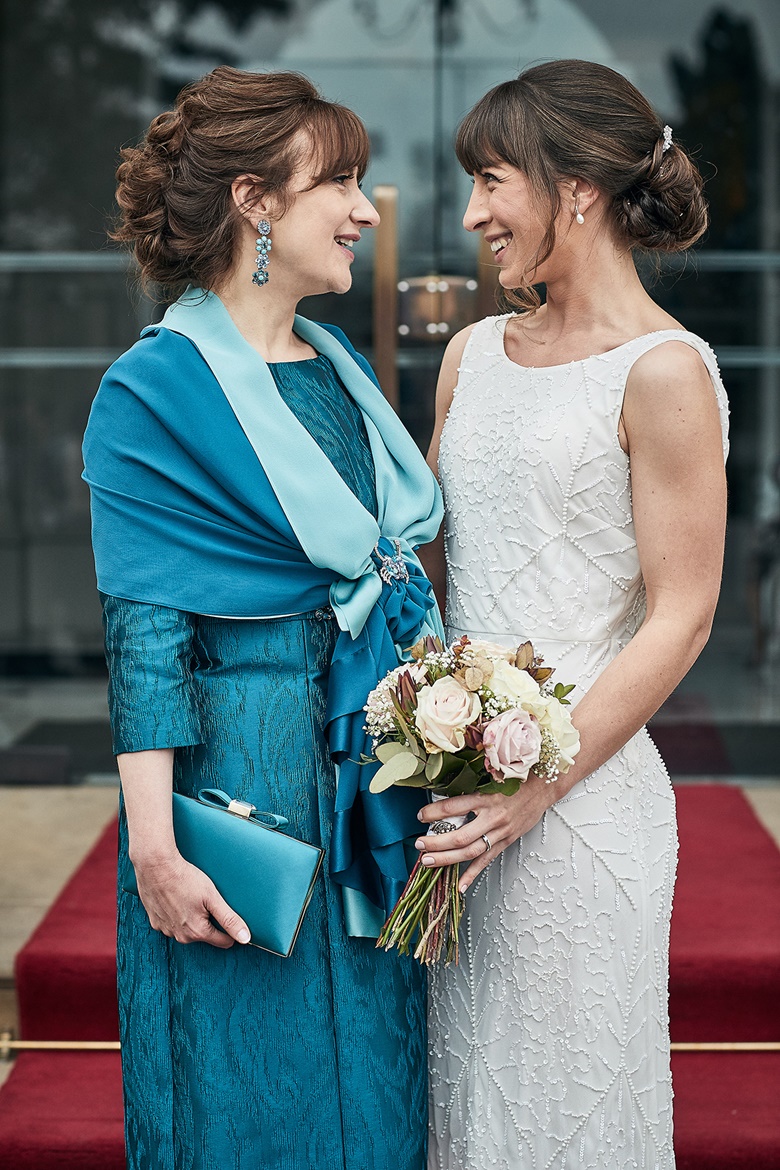
I watched my daughter walk down the aisle to marry her Italian boyfriend. There was a time when I seriously doubted if I would be present for such an important event or even live to see any of my three children become adults.
In 2004 my children were young teenagers and life was busy. I was teaching English in Italy, which was exhausting, poorly paid and frustrating but I loved it. Everything in my life appeared to be going well and in fact I felt extremely healthy and content.
I was saying goodbye to a class of Italian adult students of English on 29th July 2004 as it was the last lesson before the summer recess. I was mildly worried about the lump I had just discovered that morning after showering. I assumed it was a cyst as it was quite hard. Its discovery was an accident and a total shock. I am ashamed to say I never checked my breasts previously for lumps. I do now.
A week later a mammogram showed very clearly there was a tumour and a biopsy confirmed that it was cancerous. I was also told firmly that there was no time to waste. I was in the operating theatre before the month was out because at the rate the tumour was growing it was reckoned any later would be too late..
When I noticed my daughter’s radiant expression as she said ‘I do’ I remembered how I desperately ‘prayed’ to be present on future wedding days (should any of the children decide to get married.)
I felt so totally calm and present as I watched her smile and then found myself recalling the ‘third person’ moment, when as I sat in bewilderment in the surgeon’s office, I left my body behind. The moment I was told I had breast cancer it felt like the surgeon was talking to someone else. I almost looked over my shoulder in fact.
On the way home as the shock subsided my mind started to question.. ’What have I done to deserve this?’ I felt punished; Had I eaten the wrong things? I should have exercised more. Had I been exposed to radiation? Was it stress? I’d had quite a lot of that over the years for one reason or another. The pointless questions just went on on and on.
Then a sense of inner peace overwhelmed me and I felt my heart open, as if a ray of light had entered it from a place unseen. This sounds bizarre I know but this experience gave me the strength to face the fear.
I decided to place my fate in unseen but trusted hands. If my time was up I would accept it as bravely as I could. I wasn’t afraid of death as I have always believed that nothing and no one ever truly ‘dies’ but just takes another form.
Death is part of life. There is surely much more to the mysterious workings of the universe than our limited human brains could ever comprehend. I wasn’t afraid for myself but for those I loved.
So I unburdened my worries for them in an internally expressed plea to the force which is responsible for the endless cycle of birth and death. I have never given it a name when I have addressed it as such. ‘Love’ will do for want of a better word. I asked as humbly as I could manage for help. It went something like this, as I recall:
“I place myself in Your hands. If You feel I serve no further purpose here upon this earth, then I will gladly go, but I would really love the opportunity to accompany my children as they navigate their journey into adulthood. I love them with all my heart and soul. My husband is my true love, my once in a lifetime soul mate. I have so much love still to give, not only to my family but to the world. I want to make a difference in whatever way I possibly can. I would be grateful for the chance to live still, to be of use but if I am no longer needed here, if my work is done then I accept I have to leave for a journey I must make alone.”
I know this may seem really strange to some but it’s just the way I am and I was prepared to accept whatever would happen.
I did my best not to let the children see how hard the effects of the subsequent chemotherapy was upon my body. My gums bled even after gentle brushing and my scalp was so sensitive after the second round of chemo that I couldn’t physically stand the sensation of hair on my head. When it started to shed upon my pillow in clumps I asked my hairdresser to shave it all off and wore a fetching little cap.
I have so many people to thank and I do so with every fibre of my being on a daily basis but I am especially grateful, to ‘Love.’ In those days chemo was a lot more severe than it is now and I thought I wouldn’t be able to continue once cycle 5 came around.
But after six months of intense therapy and six weeks of radiotherapy I began to slowly get my energy back. My body had been so blasted that most days I could barely eat or walk. I lost a huge amount of weight and had to use a stick at first to help me walk in the early weeks. Five years of taking Tamoxifen followed and yearly mammograms and post cancer check ups, for which I am hugely grateful.
My husband and children were courageous throughout but I know they suffered deep down. I was determined not to add to their stress or whinge when I was in pain as I didn’t want them to worry. I had been given this chance to fight so I made friends with my juicer, maintained my sense of humour (which has always got me through most things) and lived each day with a sense of positivity and gratitude.
I still live in this spirit. Never a day goes by when I don’t say a silent ‘thank you’ for this gift we call life. I have been blessed to witness my two daughters and son grow into beautiful, intelligent, open hearted young adults. They each have a social conscience and great sense of humour. I am incredibly proud of their academic achievements but much more of who they are as people.
When my daughter beamed at me as she walked back down the aisle as a married woman my heart leapt up inside my chest – so very near to the breast that I miraculously did not lose. I had been granted my deepest wish. I was a Mother of The Bride and present at my own daughter’s wedding.
I have so many people to thank and I do so with every fibre of my being on a daily basis but I am especially grateful, to ‘Love.’
Labyrinth (from “Broken Things and other tales” publ. Hedgehog Poetry Press 2020)
At the beating heart of the hospital the labyrinth path pulses only to you with small steps with wide eyes
Corridor clattering rattling a parallel universe of life wide purpose small routines
In here we are held by the holding of your hand the circling world fades in the small space outside wide time
We are at the heart of the labyrinth and we are stilled the wide world retreats and we become small together here I stay and then
you go
-Vicky Allen
Glove
Gloved hands against the glass the same hands Marigolded cleaned the dishes, dusted the house, shined windows with newspaper and vinegar, each task done to perfection, pride in work, a life of love hands that cuddled me, the breath of my life from the bed I watch helpless, breathless brittle and broken as they wheel me to ICU. I wish I wish I wish I could touch that hand once more.
-Leela Soma
Colour Palette
Post-box red, scarlet rage, angry heart, bright red eyes. Hatred spewing, sobs as one is left bereft, alone. Pearl white iridescent, oyster perfect, ocean foam. Clean slate, new life, new loves, a bouquet of white roses. Terracotta, amber, coloured bronze with emotion calligraphy of love words on bow-tied browned letters. Cerulean blue, age spots veined hands, grasping for breath, the blue, blue inside of the cancered breast. Coffined in oak.
-Leela Soma
To Watch Athletics With My Mam
sit on her soft bed, rest an arm on a spare pillow. Mam’s pillows stack behind her as we watch a tv placed where her dress mirror stood.
Once she cried as her hair fell out. She cried as she gained each pound weight because she takes the chemicals to stop her dying, stop the spread.
Together we watch lithe bodies, sharp muscle tone dash for the end.
Once she was ‘petite’, now Mam’s fat
jowls, bingo wings slop on the bed.
Chemotherapy means she does not like reflective surfaces. All house mirrors have been removed.
Her home is spotless, a show home. Every day we polish, scrub, vacuum, she wants it welcoming.
She nods off half way through the 100 metres, I soft clap the winner as she would have done.
She looks forward to Oakwell match, a new fan of Barnsley FC.
She will sit in her hired wheelchair yell and clap at their confidence, vitality, their will to win.
I never go as I don’t like football, regret my selfishness and time not enjoying her life.
I remember good times, and smile at her laughter, gleam in her eyes when she sees another winner dash over the race finish line.
Note: Mum died of cancer in 1997
-Paul Brookes
Bios and links
-Z. D. Dicks
is a Gloucestershire Poet Laureate and widely published in respected journals.
-Jamie Woods
is a writer from South Wales, and has had short stories published in Evergreen Review, The First Line and Smoke.
He has an MA in Creative Writing from Cardiff University. He previously attended Swansea University, where he read the NME and Melody Maker, and then at the Open University, where he studied Literature.
He has been known to obsessively collect records, books, and random pieces of plastic tat priceless sentimental limited edition items.
–
Jo Weston
Jo’s work has been listed in the Bridport Prize, Mslexia Poetry Competition, and erbacce-prize. Her poetry, short fiction and memoir has been published/broadcast by Left Lion, Fortunate Traveller, erbacce-press, IOU Theatre, BBC Radio, Notts TV, North Manchester FM, at festivals and in seven anthologies. Her debut pamphlet How not to multitask is available from Five Leaves Bookshop and on Amazon. She will be reading at the Derby Poetry Festival on National Poetry Day (7 Oct) and at Gloucester Poetry Festival on 11 Oct.
Jo’s debut poetry pamphlet – How not to multitask – explores the difficulty of juggling issues in everyday life with those that arise when you’re faced with a life-threatening situation. Subsequently, the pamphlet also explores the struggle to conceive a ‘new normal’ in order to move forward in life.
Jo started writing some of the poems in this book after her cancer diagnosis in 2013 but it was during the pandemic that she found her years of experience with serious illness and chronic health conditions had given her tools for addressing challenges that Covid-19 brought – such as isolation, fear of the unknown and loss.
This short collection of 14 poems brings together these and other related themes (e.g. home, relationships and nature), making it a pamphlet which should appeal to both those who have experienced serious/long-term illness and anyone who is trying to find a ‘new normal’ way to live after the emergence of Covid-19.
“There are some wonderful poems in this short pamphlet. It is both uplifting and real, and full of wit and hope.” – Rory Waterman.
I was outside painting the walls green when the planes hit. First one and then the other Little planes? I asked the radio I thought of Dastardly and Muttley who were always flying into buildings cursing their luck and flying off again. I hoped against hope for minimum destruction. The walls of my shed so newly built and now, the green paint not even dry. We all scanned the skies for airplanes that day feeling ourselves to be the target– even my shed began to feel like a skyscraper. – Cheryl Moskowitz
To Commemorate
death when the two towers fell shine two beams of light into the dark
our tiny bones break against panes of glass thousands of us in the beams of light
a gram of fat, fuel for 120 miles migration lost in man-made light
-Paul Brookes
Bios And Links
-Cheryl Moskowitz
is a US-born writer and poet living in London. She works in a shed in her garden. www.cherylmoskowitz.com
How grateful I am to receive this ekphrastic collaboration, titled “Unexpected Mergers” published by Pski’s Porch, NY. It took me to the strange worlds of the poet/writer/editor, Jordan Trethewey and the artist Marcel Herms! I should admit that I didn’t come around this work cold, as I had already been familiar with their wonderful ekphrastic works through exploring in “Open Arts Forum”. Hard to say which work was my favorite among 40 different works of art and poetry. As I pass through the poems, each one stands alone and at the same time they go well with the pictures. Congratulations to both of them and hope to see more of such great works. So far my favorite poem/picture has been “I need a private world/ free from every living thing” but I am sure, my favorite will change from one to another when I read the book over and…
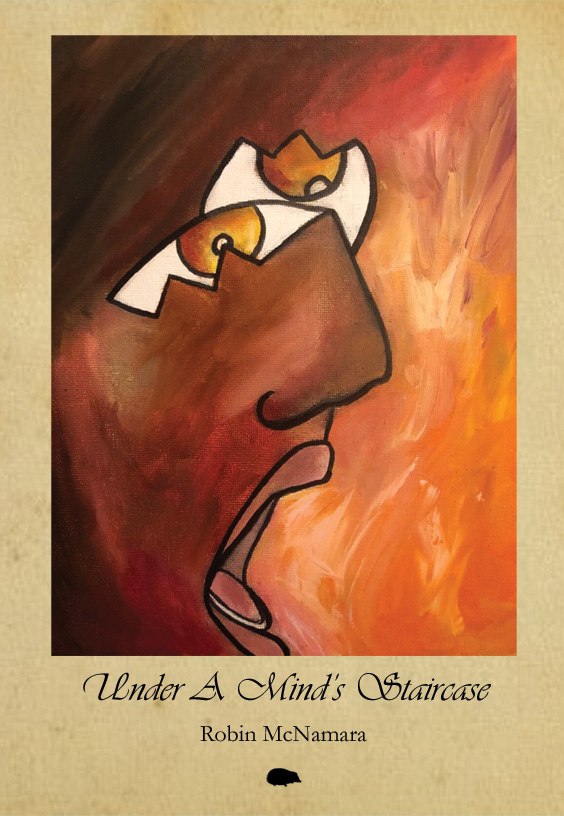
The debut pamphlet, Under a Mind’s Staircase, by Robin McNamara (Hedgehog Poetry Press, 2021) is another reminder – if we needed one – of Hedgehog Poetry Editor, Mark Davidson’s impressive eye for talent. Though widely published in magazines and anthologies, this is McNamara’s first collection and readers new to his work will immediately recognise its quality.
I begin this review, however, with some trepidation, more than usual. As always, there is my concern to do justice to the fabulous poetry, but today I feel more than that, for his fine poem, Autopsy of a Writer, provides a stark reminder to the reviewer of his (or her) responsibilities. Using the visceral image of a dissection, McNamara shows the reader how much poetry is part of a poet’s identity and purpose. An Editor’s rejection is portrayed as an act of butchery: ‘You reached in/ And pulled out/ My beating heart’ and…





 The Wombwell Rainbow