Happy #WorldPoetryDay2022 #WorldPoetryDay I will feature your published/unpublished poetry. Please include a short third person bio. Every day should be World Poetry Day.

world poetry day 2022

Postcards in a Paper Bag

On the last night of my stay
we went to Blackburn
to hear the Hallé orchestra play
Beethoven’s fourth symphony.
It’s not the music I remember,
but our drinks at the interval –
your tomato juice, my red wine;
your home-made pork curry we had for dinner
before we set off, washed down
with lemon barley; ham sandwiches
for supper hours later at the same table.
Mark Elder spoke before the encore,
I don’t recall what he said.
We hadn’t been far that day,
just into Burnley, to the market,
I bought us morning coffee at Asda –
‘elevenses’ you called it. I still have
the postcard I bought, in the tartan
paper bag from whichever shop I got it.
There was no point in sending it
on my last day. I don’t know
what happened to the poster
of Haworth Moor you bought me
at the Parsonage the day before,
why I didn’t frame it like those
of Charlotte and Emily, or even keep it
as I did the postcard of Anne
when its frame broke.
That’s in the same tartan bag
as the one of Burnley.

-Peter J. Donnelly


Honoured and delighted to have two of my poems bookend this marvellous reading by Wendy on the theme of “Ars Poetica”. Thankyou, Wendy.

Bios And Links

-Peter J Donnelly

lives in York where he works as a hospital secretary. He has degrees in English Literature and Creative Writing from the University of Wales Lampeter. He has been published in various magazines and anthologies. He recently won second prize in the Ripon Poetry Festival competition.

Featured Poet: Jude Nutter

The High Window Review's avatarThe High Window

Jude5

*****

Jude Nutterwas born in Yorkshire, England, and grew up near Hannover, in northern Germany. She studied printmaking at Winchester School of Art (UK) and received her MFA in poetry from The University of Oregon. Her poems have appeared in numerous national and international journals and have received over forty awards and grants, including two McKnight Fellowships, The Moth International Poetry Prize, The Larry Levis Prize, The William Matthews Prize, the Joy Harjo Poetry Award, and grants from the Elizabeth George Foundation and the National Science Foundation’s Writers and Artists Program in Antarctica. Her first book-length collection,Pictures of the Afterlife(Salmon Poetry), winner of the Irish Listowel Prize, was published in 2002.The Curator of Silence(University of Notre Dame Press), her second collection, won the Ernest Sandeen Prize and was awarded the 2007 Minnesota Book Award in poetry. A third collection,I Wish I Had a Heart…

View original post 3,032 more words

Reviews for Spring 2022

The High Window Review's avatarThe High Window

reviewer

*****

POETRY

Iain Crichton Smith: Deer on the High Hills: Selected Poems, edited by John Greening • Edna St Vincent Millay:  Poems and SatiresLouise Glück: Winter Recipes from the Collective  • Sheri Benning: Field RequiemHannah Lowe: The The Kids  • Annemarie Austin: Shall We Go?  • Tishani DoshiA God at the Door  •  Myra Schneider: Siege and Symphony  • Anne Ryland: Unruled Journal  • Frank Dullaghan: In the Coming of Winter  Omar SabbaghMorning Lit: Portals after AliaMichael Crowley :The Battle of HeptonstallRobin Thomas: Hum  • Barry Smith: Performance Rites  • Sarah Watkinson: PhotovoltaicHubert MooreOwl Songs  • Carole Coates: When The Swimming Pool Fell Into The Sea  • Candy Neubert

View original post 37,094 more words

The High Window Spring 2022: Final Instalment

The High Window Review's avatarThe High Window

Logo revised

*****

Welcome to the final instalment of the Spring 2022 issue of The High Window. You can now view all new content via the top the top menu.

1. A selection of homegrown and international Poetry from 37 poets.

2. Poetry by Lanny Ledboer, the Featured American Poet.

3. A Translation supplement devoted to a selection of Contemporary Hebrew Poetry which has been curated by Liat Simon.

4. An Essay by Hannah Parkes Smith on some of W.H. Auden’s early poetry.

5. A comprehensive selection of poetry Reviews.

6. A selection of poems and an essay on the UK Featured Poet, Jude Nutter.

7. An introductory feature from Rowena Sommerville, who will be The High Window’s Resident Artist for 2022.

There are also four new poems in the Editor’s Spot.

Enjoy!

David

View original post

City On The Second Floor by Matt Sedillo (Flower Song Press)

tearsinthefence's avatarTears in the Fence

Matt Sedillo’sCity on the Second Flooris a bit of a departure stylistically for Sedillo. Sedillo, who has worked with Los Angeles poets like Luis Rodriguez, David Romero, and Luivette Resto, often deals with the profound historical inequities of people, especially people of color, in the United States. This newest collection is less a discussion of how history affects us and how those forces continue to tread upon the poor and more of a sociological approach to these same factors. He looks at the ways in which the country is designed to keep marginalized people in a permanent state of poverty, and how the national morality is designed to denigrate those who need help.

The titular poem, “City on the Second Floor,” is a discussion of how Los Angeles is really two cities and those without wealth will never be allowed on the second floor where the power resides…

View original post 387 more words

The Wombwell Rainbow Growing Into: “Other Women’s Kitchens” by Alison Binney.

As a Growing Into review I will add to this over time as I sink into the book.
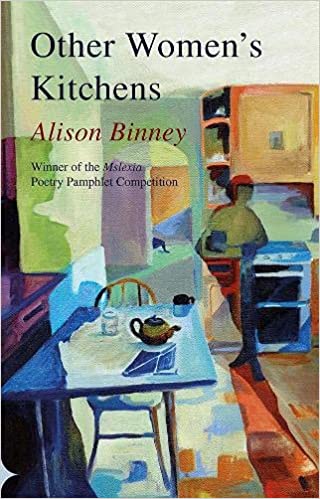
Other Women's Kitchen's by Alison Binney Front cover

-Alison Binney

teaches English in a state secondary school and to trainee teachers on the PGCE English course at the University of Cambridge. Since creating more space in her life for writing, over the last four years she has been widely published, including in The North, Magma, Under the Radar, Butcher’s Dog and Popshot. Her poems have been longlisted in the National Poetry Competition and Highly Commended in The Bridport Prize. She founded the Cambridge branch of the National Writing Project, which brings together teachers as writers, and occasionally leads one-day writing and walking courses in the Peak District.

The Review

“Other Women’s Kitchens” is a tender, sharp, telling of a world I do not know about. Thevoiems at the beginning of the book explore the narrators first encounters with the terms “Lezza”, “Lesbian” and how these are perceived in the wider world. It is a wonderful exploration as Alison guides us with wit and clarity into a celebration of relationships. From “the way you knew” excellent depiction of the insular world of school to “Grain” where two people in a mature relationship are described as trees growing together this collection stuns with its piquancy and will live for a long time in my blood, with every magical re-read.

More To Follow

Permission to Rest, Read and Grow as a Writer

wendycatpratt's avatarWendy Pratt

Photo by Thought Catalog on Pexels.com

The advice in my planner this morning, as I sat down at my desk with the window open, listening to the birdsong in the garden, was ‘Become less connected to the outcome and more committed to the work‘ attributed to Iman Europe. Strangely, this is something I had already been thinking about this week. I feel that stepping back a little from what was a frantic work schedule has given me the space and time to grow into my own writing. Seeing the advice in the planner felt very much like one of those fate moments in which a path that you are following is confirmed to be the right direction by something or someone stepping in to your life at just the right time. Chris and I have both been suffering with Covid this week. Not seriously, but enough to force…

View original post 562 more words

Why is Poetry Important to today’s society?

tearsinthefence's avatarTears in the Fence

Poetry, like music, can provide a kind of atmosphere to echo or assure a reader, share in their mood, or provide one. It can also, like novels, serve as a kind of escape, allegory, or humor as we face or need respite from life’s difficulties. But what I find I come back to poetry for are insights into the deeper questions—life, nature, connection, existence, the cosmos. It is not that poetry answers the great questions, but that it asks with us and participates somehow in our being.

I think of the deep reflective poetry of John Donne (“Death be not proud…”), poems by Gerard Manly Hopkins in moments of depression but also doubt about belief and then a reconnection with his God (ie “Carrion Comfort”) or Frost’s poems which are on one level simple observations of natural spaces he passes along in walks but on another level have to do…

View original post 340 more words

The Wombwell Rainbow Growing Into: “Writing On The Walls At Night” by Claudia Serea

As a Growing Into review I will add to this over time as I sink into the book.

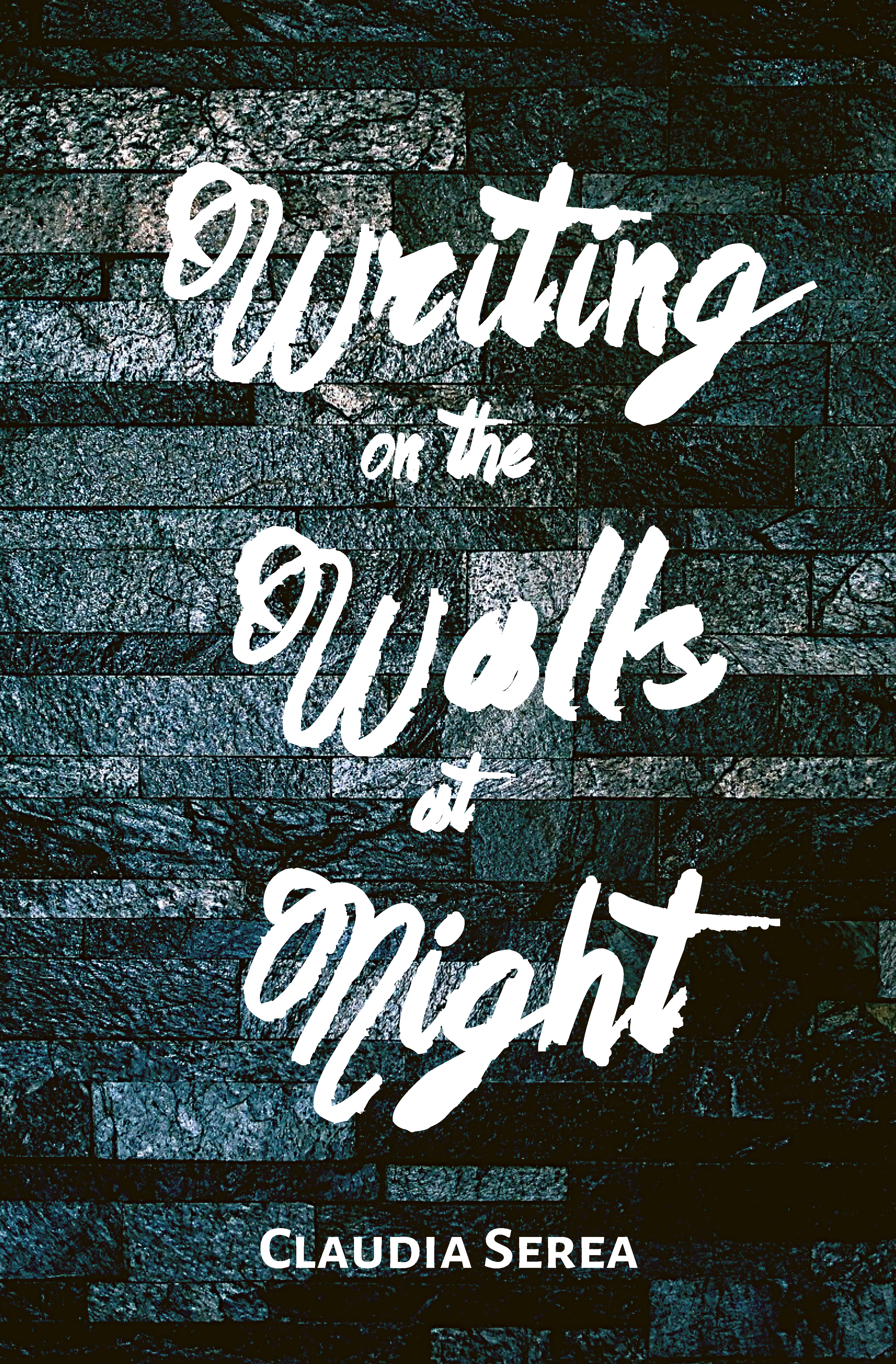
Writing On The Walls At Night by Claudia Serea front cover

-Claudia Serea (Her profile on Amazon)

is a Romanian-born poet, copywriter, editor, and translator who immigrated to the U.S. in 1995. Her poems and translations have appeared in numerous journals and anthologies from the U.S., Europe, Australia, Canada, and New Zealand, including Field, New Letters, Prairie Schooner, Oxford Poetry, Asymptote, Gravel, The Malahat Review, carte blanche, Going Down Swinging, The Lake, Ambit, Banshee Lit, among others.

Serea’s poem “My Father’s Quiets Friends in Prison, 1958-1962” received the New Letters Readers Award in 2013. She won the Levure Littéraire 2014 Award for Poetry Performance, the 2011 Franklin-Christoph Merit Award, and several honorable mentions and short lists for her poems and books. She was nominated 9 times for the Pushcart Prize and 5 times for the Best of the Net. Her poems have been translated in French, Italian, Arabic, and Farsi, and have been featured in The Writer’s Almanac.

Serea’s most recent book is Twoxism (8th House Publishing, Montreal, Canada, 2018), a poetry-photography collaboration with visual artist Maria Haro. Serea’s other full-length poetry collections

include Angels & Beasts (Phoenicia Publishing, Canada, 2012), A Dirt Road Hangs from the Sky (8th House Publishing, Canada, 2013), To Part Is to Die a Little (Cervená Barva Press, 2015) and Nothing Important Happened Today (Broadstone Books, 2016). She also has published the chapbooks The Russian Hat (White Knuckles Press, 2014), The System (Cold Hub Press, New Zealand, 2012), With the Strike of a Match (White Knuckles Press, 2011), and Eternity’s Orthography (Finishing Line Press, 2007).

Together with Paul Doru Mugur and Adam J. Sorkin, Serea co-edited and co-translated The Vanishing Point That Whistles, an Anthology of Contemporary Romanian Poetry (Talisman House Publishing, 2011). She also translated from the Romanian Adina Dabija’s Beautybeast  (Northshore Press, Alaska, 2012). In 2013, Serea co-founded and she currently edits

National Translation Month.

Serea’s poem “In Those years, No One Slept” was set to music for choir by composer Richard Campbell and the piece won the top prize at The Uncommon Music Festival Competition in Sitka, AK, in August 2018. Since then, the piece was performed by choirs in several states, most notably at an event at

the Pullo Center in York, PA, commemorating 100 years since the end of WWI.

Serea’s poem-photo collaboration blog with photographer Maria Haro is ongoing. 33 poem-photo selections from the blog were featured in an art exhibition that opened in New York City in April 2017.

In 2015, Claudia Serea was featured in the documentary “Poetry of Witness” alongside Carolyn Forché, Bruce Weigl, Duncan Wu, and others. The Economist featured an interview with Claudia Serea on its culture blog Prospero. Serea was short-listed for the 2015 Charter Oak Award for Best Historical poem, The Dictionary, and, in 2014, the poems from the sequence “My Father’s Quiet Friends in Prison, 1958-1962” were featured in several short videos presented at international movie festivals.

Claudia Serea belongs to the poetry group The Red Wheelbarrow Poets and is one of the curators of the Williams Poetry Readings at the Williams Center in Rutherford, New Jersey. She works as a copywriter and writes, translates, and edits on her daily commute between New Jersey and New York.

On Instagram: @Twoxism

YouTube channel: https://www.youtube.com/channel/UCgkxEStud-qxMKKTbYwDlTw?view_as=subscriber

From The Back Cover:

Claudia Serea’s world is as available to the senses as words can make it. Wheat, cement, earth, cities, and poppies pass through these poems steadily and true: you can trust them. This memoir is built on the unsparing consistency of Serea’s gaze. A loving gaze. Stop anywhere in this book, it will be a real place.

—Andrei Codrescu, author of No Time Like Now (Pitt Series, 2016)

Writing on the Walls at Night deserves to be marveled at. Whether describing the personal or the political, the magical or the real, the bitter or the sweet, Claudia Serea evinces a poetic sensibility that is achingly empathetic and thoroughly authentic. There is not a false note in the entire collection. Indeed, these prose poems are among the most sincere, inventive, and moving being written today.

—Howie Good, author of Famous Long Ago 

When I say Claudia Serea’s collection is fabulous, I’m using “fabulous” in the Latinate sense of fabula—“known through fable.” These fabulous prose poems conjure the best of fairy and folk tales:

This is the night when girls wash their faces with dew, and watch how the gates of the world open, and the spirits let them see their future.

We used to tie our rowboats to the lamp posts, and they floated all night next to our windows, waiting for us to jump in. 

These are the stories that saucer-eyed audiences gather to hear a poet-witch tell—in deep blue-green forests, under rainbows. These are the yarns our ancestresses spun on cold winter nights when the harvest was done. When I read these fabulae, I’m transported to that place where light weaves the goddesses’ dresses of gold. This is a magic book.

—Sharon Mesmer, author of Greetings From My Girlie Leisure Place (Bloof Books), professor of creative writing at NYU and the New School

Claudia Serea faces war with a poet’s heart. The explosions are green and they happen in spring /. . .trees shoot up bullet-shaped buds . . . / The magnolia amasses fat grenades . . . Yet in spite all of the violence of Revolution and genocide, there is beauty and power on every page. Like the statues of Lenin that were turned into something useful: wheelbarrows, / shovels, and spades for digging up the past, Serea transforms history into dark fairy tale, into survival, into pages that all of us should read and treasure.

—Shaindel Beers, author of Secure Your Own Mask, Finalist for the Oregon Book Award

Short Book Interview

How did you decide on the order of works in your book?

I worked on these prose poems since 2012. I work very slowly and build a body of poems over several years. When I think I have enough, I make a comprehensive list and print everything out. I read through them and see if any common themes emerge. Because these prose poems are written one paragraph at a time, and because I wanted this book to be more substantial, I consolidated several paragraphs on a page if they made sense under one title. Then I thought about the order and sequence to follow the thread of a story: the collection starts with childhood memories, nightmares and dreams, then it introduces some strange characters, then it addresses larger history themes, then the stories, memories, and dreams move to New York City and continue there. Of course, there is not one way to build a collection, but this way made the most sense to me.

How important is form in these prose poems?

There is a strong correlation between the surrealism of the poem and the prose poem form. I see these poems as peculiar mini stories, so the paragraph style fits perfectly. I choose this style for the strangest poems inspired by dreams because the runoff sentences have a fluidity that fits and builds the dream.

How important is the urban environment to these poems?

There are poems about the city of my childhood in Romania and the city where I emigrated as a young adult, New York. They have many things in common; they are populated by similar memories and nightmares, similar odd characters, They play off each other, they mirror each other. The Romanian city is the city of the past, darker and more mythical in a way. New York City is the city of the present, absurd and sometimes even funny. Two sides of the same coin.

What do you think is the role of the surreal in your prose?

Surrealism is the flashlight that explores nightmares, dreams, and the absurdity of certain situations. It allows me to understand history, especially our recent history which unfortunately is on full display today in all its dark glory. It allows me as a poet to offer a child’s perspective, dealing with incomprehensible realities—and trying to make sense of them. I would say, it’s equal parts a coping mechanism and a creative device. I love this tool and use it often in my poems.

The Review

Every blade has a hushed voice and a story to tell

Folkloric beginning where the blades of grass tell their tales in “hushed voices“.

A salt
tear sparkled and fell into my hand like a pearl. Soon, I had
enough for a new necklace.

Magical and wondrous. Inspirational imagination abounds in these prose poems.
Review of ‘Ticking’ by Ellie Rees

Nigel Kent's avatarNigel Kent - Poet and Reviewer

I have a shelf of poetry books that I call ‘keepers’, collections which under no circumstance will I send to the charity shop or pass on to poetry friends, because I want to read them again and again. Ticking (Hedgehog Poetry Press, 2022), the debut collection by super-talented Ellie Rees will be going on that shelf. Ticking records a journey along the South Wales coastline, through the seasons, from past to present to future, from childhood to adulthood, and as Rees says in her ‘drop in,’ from “inside” to outside. I have seldom read a collection so effectively structured and layered with meaning.  It would take more time and space than I have available to unpick those layers, so I intend to focus on a sample of poems to give you some insight into the features of this exceptional work.

The collection is split into four sections: House, Garden…

View original post 1,203 more words