Wombwell Rainbow Interviews: Billy Mills

Wombwell Rainbow Interviews

I am honoured and privileged that the following writers local, national and international have agreed to be interviewed by me. I gave the writers three options: an emailed list of questions or a more fluid interview via messenger, or an interview about their latest book, or a combination of these.

The usual ground is covered about motivation, daily routines and work ethic, but some surprises too. Some of these poets you may know, others may be new to you. I hope you enjoy the experience as much as I do.

The City Itself by Billy Mills

Billy Mills,

poet, editor, formerly literary journalist at guardian.co.uk

He was born Dublin in 1954. After some years spent in Spain and the UK, he currently lives in Limerick. He is co-editor (with Catherine Walsh) of hardpressed Poetry. His Lares/Manes: Collected Poems was published by Shearsman in 2009, and Imaginary Gardens and Loop Walks by hardPressed poetry in 2012 and 2013 respectively. Most recently, The City Itself was published by Hesterglock Press in 2017.

millsbiAToutlookDOTcom

The Interview

1. What inspired you to write poetry?

‘Inspired’ is a very heavily freighted word to use when speaking about poetry, isn’t it? I was led to writing poetry by reading it. I was fascinated by the way the sound of language was as important as the sense I poems. From very early on I was less interested in ‘self-expression’ than in poetry as a means to explore what the world is. I don’t think I was ‘inspired’, I think I was (and am) just doing something quite natural

2. Who introduced you to poetry?

I was a voracious reader from a very young age, reading everything from classic novels in children’s edition, very popular when I was young, to the backs of cereal packets when I was supposed to be eating breakfast. My father had a copy of Palgrave and a pocket edition of Fitzgerald’s Rubaiyat, both of which I read repeatedly, developing a fondness for 16th and 17th century lyrics and a distaste for the Romantics that have kind of stuck.
Then I discovered Bob Dylan and, via a school anthology called The Poet’s Tale, Eliot and Pound. These three, and the other songwriters and poets they led me too, were formative influences, I suppose. There was no one ‘formative’ influence; what I found, I found by myself, largely.

3. How aware were you of the dominating presence of older poets?

Most the poets I was reading were older, dead or alive, for a very long time. Really until my mid 20s, I suppose. I was absorbing everything I could read, especially early to mid 20th century Modernism, still am, really. But again, ‘dominating’ is a strong word. Enabling might be more apt. Take Lorine Niedecker, for instance. Reading her work opened up a whole new world, but dominating is not a word to use for her. She points towards a way to write ‘nature poetry’ without the old Romantic freight of the ego. There’s a couplet of hers that more or less sums up my idea of poetry, ‘the very veery/on the fence’; that is to say, the bird itself, not the birs standing for something else, the world, then thing in and of itself is, in my view, the proper aim of poetry. Lorine exemplifies this in her work.
Later on, Cid Corman was personally very kind and supportive. As was Brian Coffey, a great, still neglected Irish voice.

4. What is your daily writing routine?

I don’t have one. Most of my writing is done in my head, and then I have a notebook on the go where I write when I’m ready. I read poets talking about a daily routine with a kind of awed amazement. Poetry is just part of life, for me, and it fits in where it can.

5. What motivates you to write?

The possibly foolish belief that I can write something better than I’ve managed so far. It’s a kind of itch, writing, and you just have to scratch it.

6. What is your work ethic?

Non-existent. Writing poetry is work in a very specific sense. You’re not paid for it and nobody’s standing over you waiting for you to finish. You do it because you want to, or not at all. Or at least, that’s my approach. So, a work ethic would be highly misplaced.

7. How do the writers you read when you were young influence you today?

Largely by being the reason I write, and that I write the way I do.

8. Who of today’s writers do you admire the most and why?

There are a lot. Bill Griffiths was a genuinely great poet, as was Tom Raworth. Susan Howe is, too. And then there are the ‘experimental’ Irish poets, Maurice Scully, Catherine Walsh others, whose work I read with admiration always. These are poets who have taken that Modernist tradition off in interesting, individual directions. Indeed, a lot of British and American poets of that generation, Let’s say LANGUAGE and the British Poetry Revival, are writers I admire a lot.
Since I started reviewing on my blog I’ve encountered a lot of work I wouldn’t have seen otherwise, much of it very good indeed. It would be invidious to name names for fear of omitting anyone.

9. Why do you write?

Because I must, not being smart. I don’t have any instrumental reason, I’m not trying to change the world or communicate any great message, but the process of writing is something I feel compelled to do. It’s a process of raising questions, not answers. Or, as I wrote elsewhere, ‘If the role of philosophy is to inspire action, the role of poetry is to be in the world.’

10. What would you say to someone who asked you “How do you become a writer?”

Read, a lot, critically. Buy a notebook and pen, write.

11. Tell me about the writing projects you have on at the moment.

I have a book more or less finished called a book of sounds, consisting of three inter-related pieces, ‘Four’, which was set to music by David Bremner a while back, ‘Uncertain Songs’ and ‘Away’. Parts of the first two are available online and the third is completely unpublished. I’m now working on what may become a longish thing, bit it’s just some stuff in a notebook so far.

Exhilarated to have a poem “Dwelling in this place we breathe” featured at Visual Verse this month. Thankyou VV editors

https://visualverse.org/submissions/dwelling-in-this-place-we-breathe/

Khadija-Saye

All this week is #DragonflyWeek2020 . Have you written poems about dragonflies as these poets did for #NationalInsectWeek? Please submit via DM or my WordPress site “The Wombwell Rainbow”. Artworks welcome too.

https://thewombwellrainbow.com/2020/06/23/national-insect-week-poetry-challenge-join-yvonne-marjot-ali-jones-anjum-wasir-dar-and-myself-monday-spiders-tuesday-wasps-and-beeswednesday-ants-thursday-beetles-friday-butterflies-satu/

Here are some resources you may find useful:

https://www.dragonfly-site.com/meaning-symbolize.html

https://celticranch.com/blogs/celtic-culture/the-dragonfly-in-celtic-lore

https://www.thoughtco.com/myths-about-dragonflies-1968371

http://anniehorkan.com/legend-of-the-dragonfly/

Look forward to reading your work

(;)_______________(;)

P1100463P1100469P1100540

glassiness
of a dragonfly’s wings
things we forget

reflections
of Japanese maple
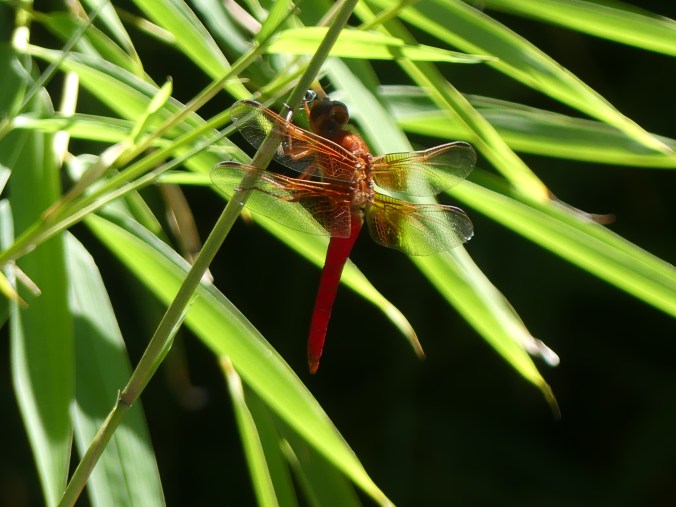
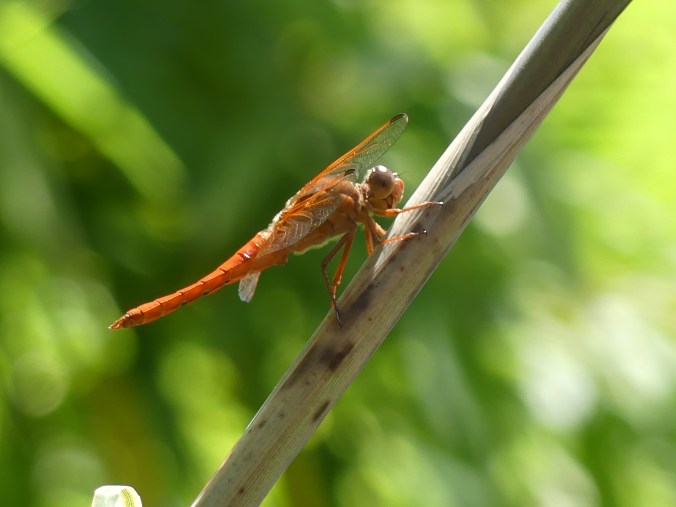
orange dragonfly

sun filtered through
a dragonfly’s wings
dog days

-images and poetry by Deborah P Kolodji

Misunderstood

Dragonfly
Misunderstood
The world over
Eye poker in England
Emulates øyenstikker in Norway
Take note: not the eyes
They seek to snatch
But flies that buzz and
Dance about

“Makes sense”

Sweden 1549
Was said trollslända
Used to conjure magic;
It’s true their shape is
Reminiscent of a witches wand

“Pencil Long”

Pencil long and thin as so
Different colours
Confuse and entice

-Lydia P Wist

cathedral glass
caught up in the light
of dragonfly wings

a placid lake
disturbed only by the flight
of a dragonfly

-Shane Pruett

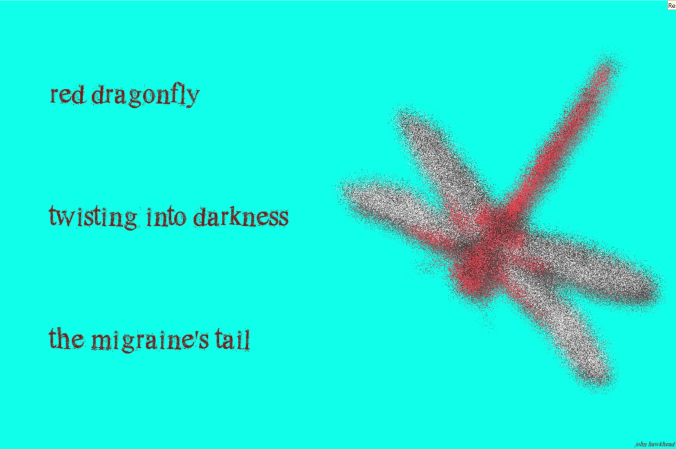
Red Dragonfly by John Hawkhead

red dragonfly
twisting into darkness
the migraine’s tail

Previously in Time Haiku #haiku

-John Hawkhead

Dragonfly by John Hawkhead

slow bend in the stream
in the heron’s still eye
blue-green dragonflies

Published in Presence #33

=John Hawkhead

One Free Dragonfly

The jail break brings our old man back
to his dwelling,
quarantine room, grilled window pane full of lunar revolution.
The path from his fenestra to the myopic blur
runs straight and clear with a pond here, a tree there.

We wait for the cops to arrive. We snoke,
broach, babble, lose control over our fervor
about the old man and his ways. And one dragonfly
sits on the sill of our hearts. Evening is almost delivered.
The bright green of the fly’s back and translucency
of the pondhawk, or may be it is a darner,
trill what we see, what we perceive and then reject
as something we should not comprehend
as if the buzzing music arises from playing on
the strings of our consciousness.

Then it, although gone, explodes into a full moon.
The skirt of the village lifts up, shows other houses.
Some windows blink. Some remains ebony.
The pestilence breezes down the country’s intestine.

“I missed this.” The old man says. Perhaps
he means us or demising from a plague.
Perhaps he means the dragonfly the proverbs
spin as a symbol of security and abundance.

-Kushal Poddar

The Other Dragonfly

It tilts the pool world.
I hold the railing rusting away.

The place has
a throng of used needles.
Rubbers. Thin and ribbed.

I stare at the dragonfly.
Why am I here in the mass of nothings?
The dragonfly touches the feet once

Do not think about what it thinks about you.
Do not think about how it perceives you. I keep saying.
Dusk hovers over a distant turret.

I and the fly draw a border
between the day and day’s end.

-Kushal Poddar

Rachel deering dragonfly

Transformation

A dragonfly is born to swim
dreaming of flight, each motion
towards self-actualisation
unfolds its own ache
of transformation, each stage
a fight to see the world
in bright notes of new colour
and themselves – to be seen.
A dragonfly emerges,
harbours the magic of water
within, sheds the last skin
of fear and safety of obscurity
to reveal an inner light,
to blaze with realisation,
to be what it was meant to be.

-Rachel Deering

Linda Ludwig Dragonfly

-Linda Ludwig

Dragonfly by Christina Chin

frog pond
flitting dragonflies
cruise the summer breeze

-Christina Chin

rice grains heavy
against sky blue
red dragonflies

~ Christina Chin
Plum Tree Tavern October 20 2019
https://theplumtreetavern.blogspot.com/2019/10/lines_20.html?m=1

frog on lily pad
patiently waits
dragonfly

~ Christina Chin

ChristinaChin_purple dragonfly_Wombwell Rainbow

– Christina Chin

ChristinaChin_dragonfly on the water_Wombwell Rain

-Christina Chin

Bios and Links

-Rachel Deering

lives in Bath with a cat. She loves history, folklore, nature, science, art and literature. She has been published in a few journals and anthologies here and there. Her debut collection, ‘Crown of Eggshell’, was published in January, 2020 by Cerasus Poetry. Rachel contributes regularly to ABCTales writing under the name of onemorething.

New poem: Australian Poetry Anthology

Thom Sullivan's avatarThom Sullivan

My poem ‘Buonanotte’ has been published in Australian Poetry Anthology, the annual anthology produced by Australia’s peak body for poets, Australian Poetry. The 2020 anthology (volume 8) was edited by Melinda Smith and Sara Saleh. It includes poems by Stuart Barnes, Anne Casey, Tricia Dearborn, Shastra Deo, Toby Fitch, Jane Gibian, Dominique Hecq, Paul Hetherington, Geoff Page, and fellow South Australian poets Jill Jones, Bronwyn Lovell, Rachael Mead, David Mortimer, Heather Taylor-Johnson, and Manal Younus.

View original post

We Were Not There by Jordi Doce Translated by Lawrence Schimel (Shearsman Books)

tearsinthefence's avatarTears in the Fence

When Jordi Doce considered the poems of Charles Tomlinson for an Agenda InternationalIssue some twenty-five years ago he noted the voice behind the poems as being ‘wholly unique in its ambition’ before going on to say that the English poet’s ambition and ability was ‘to match and express preoccupations which have remained largely consistent through the years, always expanding and expounding themselves through the workings of an alert, intelligent mind.’ Let me be bold enough to say that similar words may be used about the Spanish poet who wrote that and suggest that his volume We Were Not There, published last year by Shearsman Books , plots an ambitious journey of discovery in which we are challenged to examine not only our changing world but also those senses ‘the air interrogated questioned by a blank page’ (‘Guest’).

The blank page offers an invitation to the writer to pursue…

View original post 558 more words

Wombwell Rainbow Book Interviews: Kay Bell and “Cry, Sweat, Bleed, Write”

Wombwell Rainbow Interviews

I am honoured and privileged that the following writers local, national and international have agreed to be interviewed by me. I gave the writers three options: an emailed list of questions or a more fluid interview via messenger, or an interview about their latest book, or a combination of these.

The usual ground is covered about motivation, daily routines and work ethic, but some surprises too. Some of these poets you may know, others may be new to you. I hope you enjoy the experience as much as I do.

Kay Bell

is the author of the poetry chapbook, Cry Sweat Bleed Write (Lily Poetry Review Books, 2020). She earned a BA in English and an MFA in Creative Writing at The City College of New York (CUNY) where she also served as a poetry mentor in the Poetry Outreach program. Kay’s work appears in the book, Brown Molasses Sunday: An Anthology of Black Women Writers, and online in Moko: Caribbean Arts and Letters, The Write Launch, Pithead Chapel and various other venues. Kay is passionate about bringing the arts back into public schools and issues that affect marginalized communities. She lives in the Bronx and considers herself a bibliophile. Visit her here: www.iamkaybell.com

The Interview

1. When and why did you start writing poetry?

I started writing poetry in the sixth grade when my teacher, Ms. Nolan, introduced my class to the Haiku. I learned very quickly that I was not only fascinated with writing but with words. I was even known to have been an avid dictionary reader. Soon after sixth grade I started keeping journals. Some pages were filled with venting about my rough childhood but many pages were poems.

1.1. What was it that fascinated you about words?

I believe it was the power of words that fascinated me. I remember reading words like “rhapsody” and “exalt” and feeling what they meant before truly understanding their definitions. Words have the power to make you feel and move you to create and reimagine things. When I found writers like Nikki Giovanni, Sonia Sanchez, Warshan Shire, Claudia Rankine and Amiri Baraka etc. I started to realize what you could do with words. They could be shaped into messages. Important messages. Writers such as these wrote such powerful messages in their poems and for me that was empowering and inspired me to do the same.

2. How aware are and were you of the dominating presence of older poets traditional and contemporary?

When I first started writing it wasn’t that obvious but looking back I definitely see that I wasn’t exposed to that many younger poets. It’s only within the last maybe 5-7 years I have tumbled upon younger poets. I believe writers such as Toni Morrison, James Baldwin, Maya Angelou, Gwendolyn Brooks and Amiri Baraka definitely dominated the presence of Danez Smith, Evie Ewing, Claudia Rankine etc even a few years ago in my college courses.

2.2. How did they dominate?

I guess when I think of the question of domination I’m thinking about how they get more presence on the classrooms and they’re the writers most people are more familiar with because they get more exposure.

3. What made you tightly structure Cry Sweat Bleed Write round these words and their order?

People always ask me what do I write about. This title became the answer to that question. I think it was inspired by me hearing people say they accomplished victories by blood and tears. It made me think about what I choose to write about. I realized if it makes me cry sweat or bleed it’s worth writing about. That means nothing Is off limits. I write about all my experiences.

4. Seasons are an ongoing theme within the poetry., as in “smashes her face against the seasons”, “From the borders of winter”. Why are the seasons so important to you?

Seasons represent time and change but also they help you feel different emotions. Smashes her face against the seasons shows it happened all the time. As the seasons kept changing, this situation kept happening. Winter is symbolic of death or despair. When you emerge from winter you are emerging from dire circumstances.

So using these references to seasons helps me to convey a message about time and change that I hope will encourage the reader to understand something is changing and many times that includes a change in time, and a range of feelings.

I think mentioning the seasons also helps the reader reflect. This is important because for me, poetry should make you reflect. During reflection, that’s the moment you feel the time changing, and you feel the cold loneliness of winter, you smell the spring flowers, you jump in autumn leaves and you sweat in the heat of summer. You get immersed in the poem using this type of language.

5. What is your daily writing routine?

I do not write everyday. I think about things to write everyday but unless I feel an uncontrollable urge, I usually don’t stop to write. That urge guides me as to what should be on the page. Everyday I play with words, sentences, images, ideas in my mind. When I get a good combination of those things, that is when I feel the urge and start writing. For me this process is organic. I do not like to force myself to write unless I have a deadline. I think writing is like cooking. It takes time. Food has to simmer and absorb in it’s juices. I feel as though I must simmer and absorb the ideas, words etc. I need to let the poetry marinate within me and not rush the process or the result may not be as good.

6. What is the significance of the quotes at the beginning of each section of your book?

Each quote serves as a prologue for its chapter. I wanted to show the range of emotion and the connection to the title. The quotes work to do just this. I might add for each section except ”cry” I already knew from the beginning of creating the book, what quote I would use for that section because when I saw that word that quote popped in my head. For instance, sweat. Reading Hurston’s essay Sweat early on in college stuck with me and whenever I hear that word I think of the essay.

7. How do the writers you read when you were young influence your work today?

Nikki giovanni was one of the first poets that influenced me. Her writing is practical, bold, confident and revolutionary. Her work influenced me to write in a way that was accessible to non- poets/writers and she also taught me to write with confidence and courage by boldly speaking in ways and on subjects not always well received. I also think Ntozake Shange and Sonia Sanchez played a major role in shaping the structure of my poems. They were doing things with language and structure that I had not previously seen before reading their work. I am still working to incorporate more of that in my work but I definitely incorporate it. For instance the poems Untitled 6; Magic; and Liberation all play with the structure. These ideas would have not have not materialized in my work, had it not been for writers like Sanchez and Shange.

8. Who of today’s writers do you admire the most and why?

Today I’m really engrossed in Ocean Yvoung, Danez Smith, Warshan Shire, Camile Rankine, and Terrance Haynes. I mean there are others but these authors work lie next to me on my nightstand and I go back to them when I need inspiration. I love what they do with language, form, structure and imagery. They help me to envision what I’m going to write about and then my imagination and creativity finishes it off. I also love what they are writing about: Blackness, sexuality, religion, gender, family dysfunction etc. So many raw intense often taboo subjects. I have to say that even some traditional poets are on my nightstand for easy retrieval as well: Charles Simic, W.S.Merwin, Adrienne Rich and Amiri Baraka are names among those poets. These writers keep inspiring me.

8.1. What do Ocean Vuong, Danez Smith, Warshan Shire, Camile Rankine, and Terrance Haynes do with language, form, structure and imagery that really inspires you?

They create their own rules. For instance, Ocean Vuong’s poem Aubade with Burning City, he weaves lyrics to a song throughout the poem. The lyrics gives the poem movement. I can hear the song throughout the poem and each line becomes intensified. The poem becomes the song and the song becomes the poem. There is no beginning or end to this. The song also work to help facilitate this image of a perfect world where the images of the soldiers and war carry so many ugly secrets. Terrance Haynes reimagines the sonnet. He gives it life in his book, American Sonnet for my past and future assassin. This book actually inspired my poem: Work Sonnet. It gave me the permission to reimagine the sonnet and make it my own. Camille Rankine is thought provoking, as with all these poets, but there is something about her language and imagery that makes me stop and read her poems over and over again in one sitting. I’m constantly reflecting on her ideas and language choices. One poem that stands out to me is Vespertine. She says:

I’m an acre of empty
desert, anyway. A spent white flower. A pale
honey scent wilted away.

I have to take it all in.
I have to digest it. I ask myself what is an acre? A spent white flower? A honey scent wilted?
She is sparse but always fulfilling. She sends me searching for answers. Danez Smith and Warshan do some of these same things. Provoke me with language that forces me to reflect, search for answers, and lastly inspires me to write my own stories that bare some of the same pain, courage, love and resilience.

9. There is a loneliness in these poems, the sense of being abandoned, of being misplaced, distanced from everything, and an aching.

Absolutely. I was a foster child and not having my parents around always fostered a sense of loneliness and abandonment within me. I met my dad last year for the first time and my mom when I was 11 and never had a good relationship with her. The absence of a real patent child bond has always made me feel alienated. It has also affected all of my relationships, whether with my husband or my own children. I have always felt like people don’t understand me or I’m alone and I know now that the void I felt came from not having a healthy relationship with my mom and not knowing my dad. It has cause some to ache profoundly.

10. What would you say to someone who asked you “How do you become a writer?

There is no magical way to become a writer. Becoming a writer is easy. I think the mere desire to be one places you in position to become one. But becoming a good writer develops over time. Good writers learn how to be creative, they imagine, edit/revise their work and take criticism. Both good and bad criticism is good in my eyes. Even the bad criticism you can take the meat and leave the bones: there is always something to learn. Good Writers are not magicians. They’re critical thinkers, they read ALOT and they have opened themselves to a variety of writing styles and techniques.

11. Tell me about the writing projects you have on at the moment.

Right now I am working on a novel loosely based on my experience in foster care and how that shaped my life and relationships. I have another poetry book set to be published next year, Diary of an Intercessor.  It was actually my thesis in grad school and is based on my relationship with God and shares some of my struggles and victories with religion and church. I also just finished a book of poems I started writing around the time I met my dad, called Pilgrimage.

Four Poems & Visual Art – Anton Pooles

robertfredekenter's avatarIceFloe Press

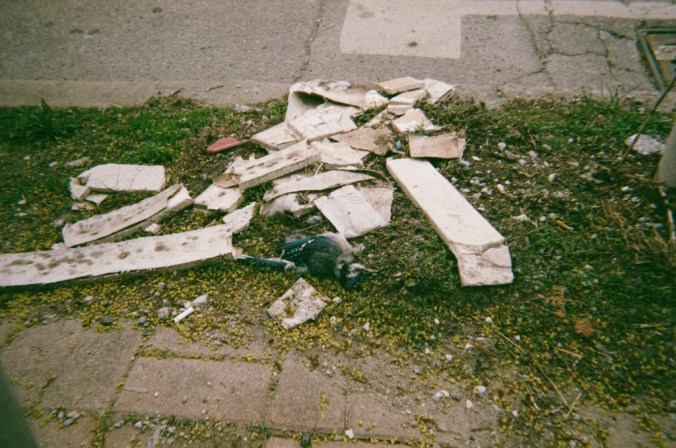
Blue Jay


A splash of blue amid the rubble
of wooden planks and rusty nails
like an underground lake
not yet seen by the naked eye.
Dive in, feel the sting of cold water.
There are no etchings on the walls,
no history revealed.

The Way Down to the Lake


has no obstacles except for five
bone-white trees reaching out
from the cold ground like fingers.
Hundreds of years ago he was
killed by the boy named Jack.

Moth Man


My grandfather
collected butterflies.

He kept them in oak boxes,
on a green wall.

I asked him once,
what’s the fascination?

They’re magicians,

he said, in love
with illusion.

Prove it.

He spread the wings
of the dead leaf butterfly.

Can you see the sunrise
over the ocean?

I cannot.

That’s because you have
a moth’s heart

Ant Man


A nickname
transformed me into
a metropolis of bone and blood-streams…

View original post 86 more words

Happenstance by Duncan MacKay (Muscaliet Press)

tearsinthefence's avatarTears in the Fence

In writing about Eleanor Perry’s ‘Pataquerical Imagination’ in issue 70 of Tears in the Fence last autumn Duncan MacKay suggested that close reading and close listening ‘function in tandem’ and that they are indeed the ‘two complementary poles of our experiential poetic whole’. That wholeness of response rings out of the pages of Muscaliet Press’s new selection of MacKay’s poems, Happenstance, and as we read the poem ‘HER WORDS HIS’ we recognise a quality of poetic response to ‘displacements of faulty memory’ where ‘in transposition we refigure the word’. In terms of that refiguring it is interesting to note how MacKay’s interest in the poetics of J.H. Prynne had led him to quote from an interview given in 2011 in which the Cambridge poet spoke of the difficulties of translating his own work at the time of the publication of a bilingual English-Chinese edition of his selected poems. MacKay’s…

View original post 502 more words