January 7th
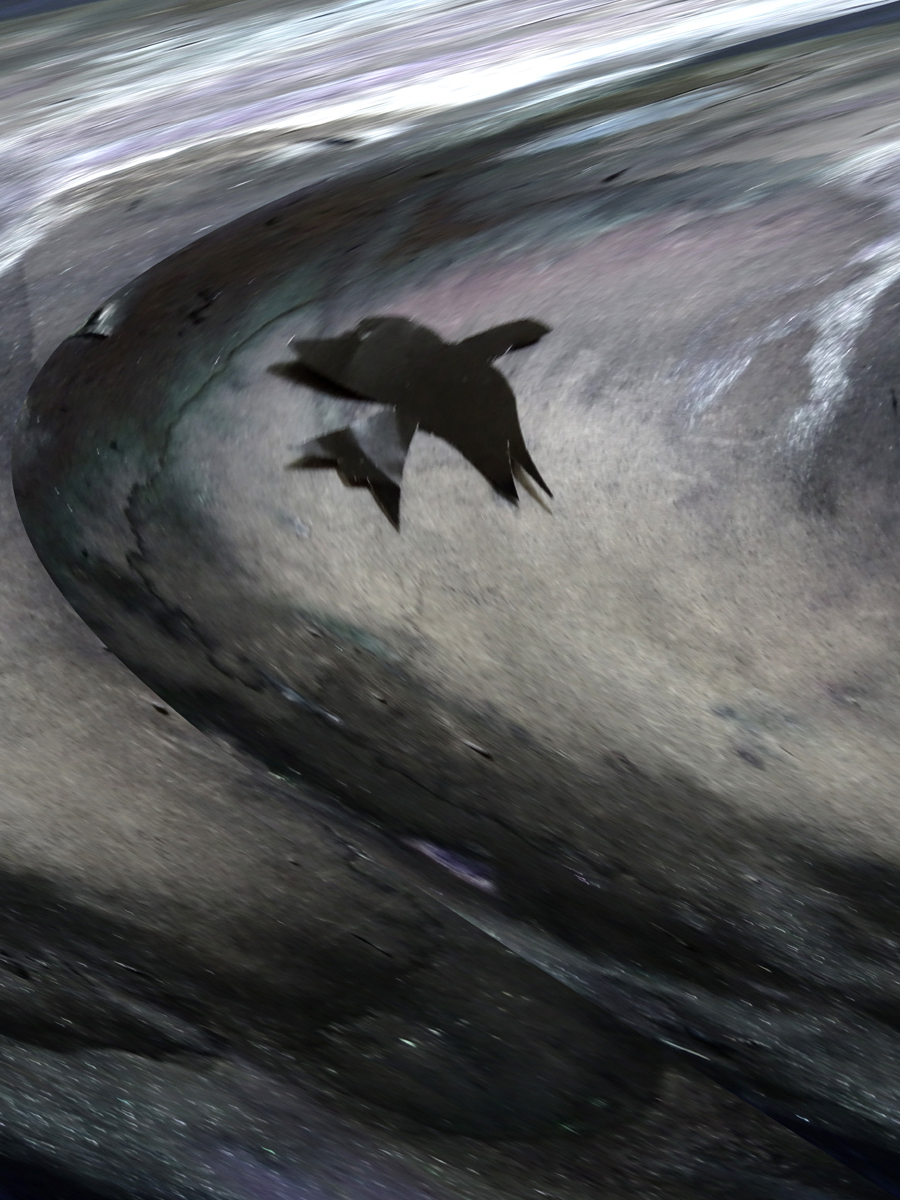
-Kerfe Roig “Acquainted with the night close”

-Chris O’Connor

-Marcel Herms “Cursed animal”
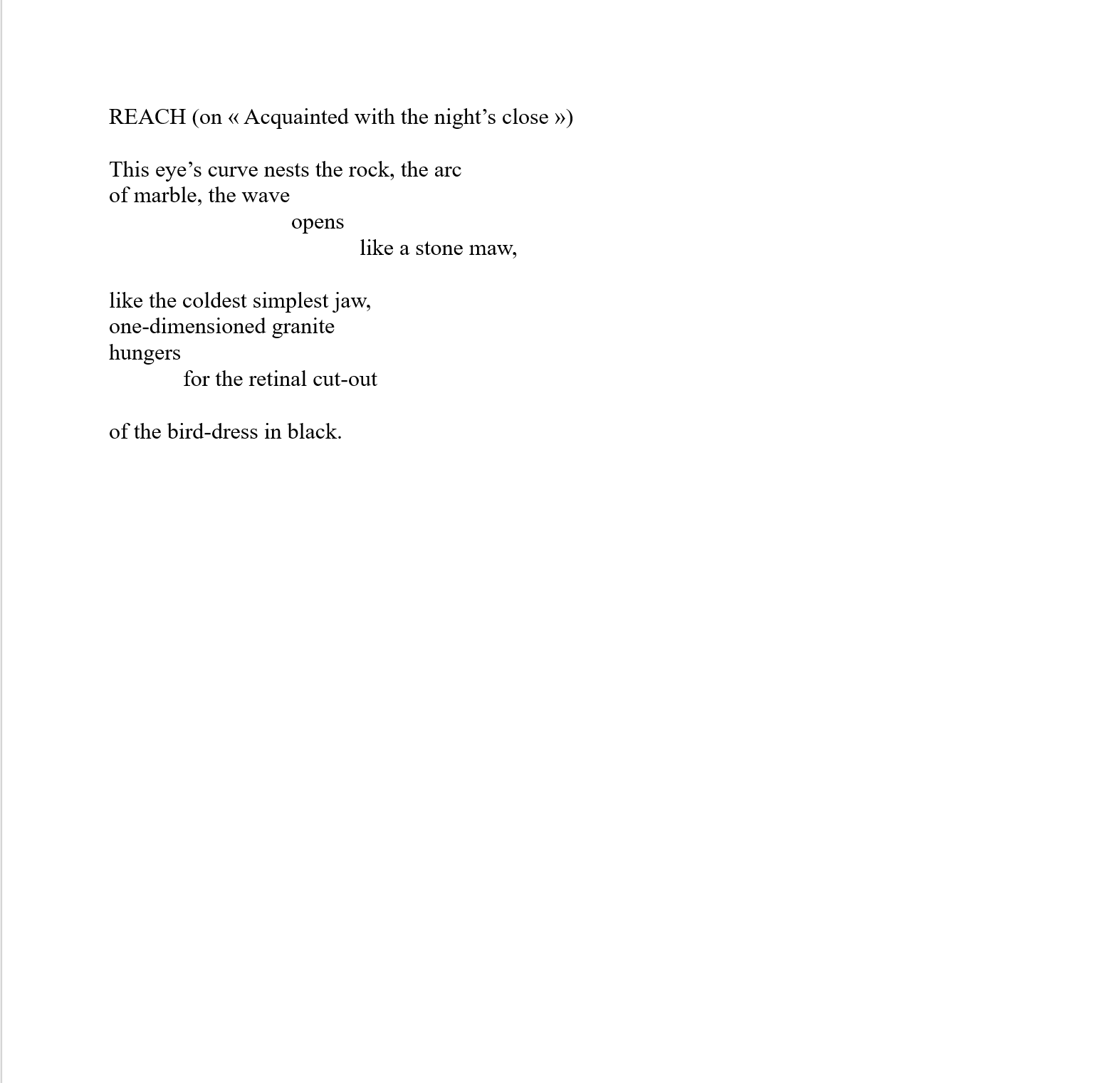
-Godefroy Dronsart
Kerfe Roig “Acquainted with the night close”
KR7
spinning laps close above the well
a shape dips past
arrow cut against the grey
it pits itself against the stone
the night is hovering
on the edge of grey
a line of light is all that separates
earth from sky
when they touch they will merge
there will be nothing more
a bird will be swallowed
and the night will exhale
CO7
Layers of my life are torn and pressed
upon my eyes like bandages.
Orange peel, wallpaper, strips
of my diary’s cover, the leaves
I pushed through to reach today.
Behind this abandon: the bricks,
the panelled door, the pavement.
The straight edges are waiting,
the concrete peeps through.
But for now I am swathes, trailing.
Marcel Herms “Cursed animal” MH7
the last thing I saw
was its white eye
no pupil, just emptiness
focused into a point of light
until it became heat
I remember crawling back
through parched land
towards the sea
searching for saltwater
to bathe my wounds
-Hilary Otto
“Acquainted with the night close—KR”
Night Seer
Crow soars through the brume, the leaden sky
awash with whirling dreams, spindrift from the sea of night,
and shiny-bright, he gathers them.
No trickster, he, but seer
of what might be in time with chance, he caws
a warning, laughs in love—there’s so much to be done—
in the rustling of ancient winds, he breathes
a break in darkness, drops omens in oceans
and hopes on moonbeams,
watches the stars. His eyes reflect their gleam.
-Merril D Smith
Nightly Travel Track (KR7)
Inky black, her nightly travel track
Hopelessness all luminescence lack
Ancient lore, by all who has gone before
Depression’s demons lonely souls adore
Cold sorrow, haunting dreams of tomorrow
Unloved child, cutting pain in bone and marrow
Fiery passion, smothered without compassion
No freedom to create in whatever fashion
Bright love, fading to embers without the care it behooves
Lost without the moon’s brightness above
Hope dart, as sudden kindness heal a hurt heart
Stars glimmer as dark clouds depart
Warm trust, swells in the arms of lust
Surrender to soul guidance we must
Sunrise’s clarion call, there’s hope for us all
Chance to rise again after a fall
Fear ended, trauma shattered mind mended
Rise like a true abuse ascender
-©RedCat
CO 7
ripped a strip
this road to nowhere leads me
everywhere
-Jim The Poet
KR 7 (night close)
extinction spiral
at the coldest volcano
the scorched bird falls
-Jim The Poet
MH7
what a fight it is
the highland and the scottie
terrible terriers
-Jim The Poet
At The Finish (Responding To All Artworks)
he would begin again, like Finnegan.
Born astride a grave a short distance
between womb and earth filled with a shock of air
brought colour to his cheeks, both face and arse,
tflash of life like a brief sunlight
on an horizon sunrise or sunset he was unsure,
a sharp blackbirdcall, nag of his second wife,
distant hip hop beat from a fair ground Wombwell feast
sweet salsa of her burgered lips,
sway of swinging boats swung high
he caught her breath in his mouth
and almost choked his mouth on hers a
nd both of his nostrils closed
in the tumble towards earth,
and heard screams like his daughter,
smothered by Finnegan, he found him again
throttled the start out of his smug face
and now rope around his neck,
as if he had to climb headfirst
back into Mam’s womb he felt a shock
of air the drop towards earth at the finish.
Cursed to an eternal return to this point in his life.
-Paul Brookes
Bios And Links
-Kerfe Roig
A resident of New York City, Kerfe Roig enjoys transforming words and images into something new. Her poetry and art have been featured online by Right Hand Pointing, Silver Birch Press, Yellow Chair Review, The song is…, Pure Haiku, Visual Verse, The Light Ekphrastic, Scribe Base, The Zen Space, and The Wild Word, and published in Ella@100, Incandescent Mind, Pea River Journal, Fiction International: Fool, Noctua Review, The Raw Art Review, and several Nature Inspired anthologies. Follow her explorations on her blogs, https://methodtwomadness.wordpress.com/ (which she does with her friend Nina), and https://kblog.blog/, and see more of her work on her website http://kerferoig.com/
-Christine O’Connor
is an artist working in glass, metal, fibre and paint. Sometimes her work is based on photographs, but more often, she creates in the moment. She loves to play with texture and colour.
-Marcel Herms
is a Dutch visual artist. He is also one of the two men behind the publishing house Petrichor. Freedom is very important in the visual work of Marcel Herms. In his paintings he can express who he really is in complete freedom. Without the social barriers of everyday life.
There is a strong relationship with music. Like music, Herms’ art is about autonomy, freedom, passion, color and rhythm. You can hear the rhythm of the colors, the rhythm of the brushstrokes, the raging cry of the pencil, the subtle melody of a collage. The figures in his paintings rotate around you in shock, they are heavily abstracted, making it unclear what they are doing. Sometimes they look like people, monsters, children or animals, or something in between. Sometimes they disappear to be replaced immediately or to take on a different guise. The paintings invite the viewer to join this journey. Free-spirited.
He collaborates with many different authors, poets, visual artists and audio artists from around the world and his work is published by many different publishers.
=Redcat
RedCat’s love for music and dance sings clearly in The Poet’s Symphony (Raw Earth Ink, 2020). Passion for rhythms and rhymes, syllabic feets and metres. All born out of childhood and adolescence spent reading, singing, dancing and acting.
Her writing spans love, life, mythology, environment, depression and surviving trauma.
Originally from the deep woods, this fiery redhead now makes home in Stockholm, Sweden, where you might normally run into her dancing the night away in one of the city’s techno clubs.
Read more at redcat.wordpress.com
-Merril D Smith
is a historian and poet. She lives in southern New Jersey, where she is inspired by her walks along the Delaware River. She’s the author of several books on history, gender, and sexuality. Her poetry has been published in journals and anthologies, including Black Bough Poetry, Nightingale and Sparrow, Anti-Heroin Chic, and Fevers of the Mind.
-Godefroy Dronsart
is a writer, teacher, and musician currently residing near Paris. His poetry has appeared in Lunar Poetry, PostBLANK, Paris Lit Up, The Belleville Park Pages, and Twin Pies Literary among others. His first chapbook, “The Manual” (Sweat Drenched Press, 2020), explores the space between poetry, prose, and gamebooks. He has a sweet tooth for all things experimental, modernist, and strange. Follow him on Twitter and his Bandcamp for electronic explorations.
-Joy Fleming
Born in County Down, Joy has studied, mothered and worked in Scotland since 1980. Brief excursions to follow her heart, back to NI mid-1990’s and England for first round Covid-lockdown ’19, Joy is currently back living in Glasgow. Joy’s first poem was accepted as part of the C. S. Lewis themed Poetry Jukebox curation A Deeper Country in Belfast in 2019. This poem, Ricochet was published in The Poets’ Republic Issue 8 Autumn 2020. A love of reading poetry is now accompanied by sporadic writing of poetic lines which spill out as an apparent by-product of processing dark and sorrowful days.
-Hilary Otto
is an English poet based in Barcelona. Her work has featured in Popshot, Black Bough Poetry, AIOTB, Ink, Sweat and Tears, and The Blue Nib, among other publications. She received her first Pushcart Prize Nomination and performed at the Cheltenham Poetry Festival. She tweets at @hilaryotto
-Jim young
is an old poet living in Mumbles on The Gower. He does most of his writing from his beach hut at Rotherslade – still waiting for the blue plaque





 The Wombwell Rainbow