


Robin Wright lives in Southern Indiana. Her poems, essays, and photos have appeared in Ariel Chart, Minnow Literary Magazine, Sanctuary Magazine, Black Bough Poetry, Spank the Carp, Muddy River Poetry Review, Rat’s Ass Review, Young Ravens Literary Review, Re-side zine, and others. One of her poems was nominated for a Pushcart Prize by Panoply, and her first chapbook, Ready or Not, was published by Finishing Line Press in October of 2020.
Second Day: Alcathoe bat (Myotis alcathoe)/ General Bat Poems/Artwork/Photos
Batfact:
There are eighteen species of bat in Britain and all are protected under the Wildlife and Countryside Act. One of these species, the Greater mouse-eared bat was officially declared extinct in Britain in 1990, but there were reports of sightings across 29 locations in the UK in the winter of 2011/2012.
Bats are quite remarkable animals worthy of our interest and respect. They are the only mammals capable of controlled flight – and their aerobatic skills have to been seen to be believed! British bats eat insects and nothing else. This makes them valuable friends and allies as many farmers and gardeners seek to reduce insect numbers, as some insects can cause damage to valuable crops and flowers.
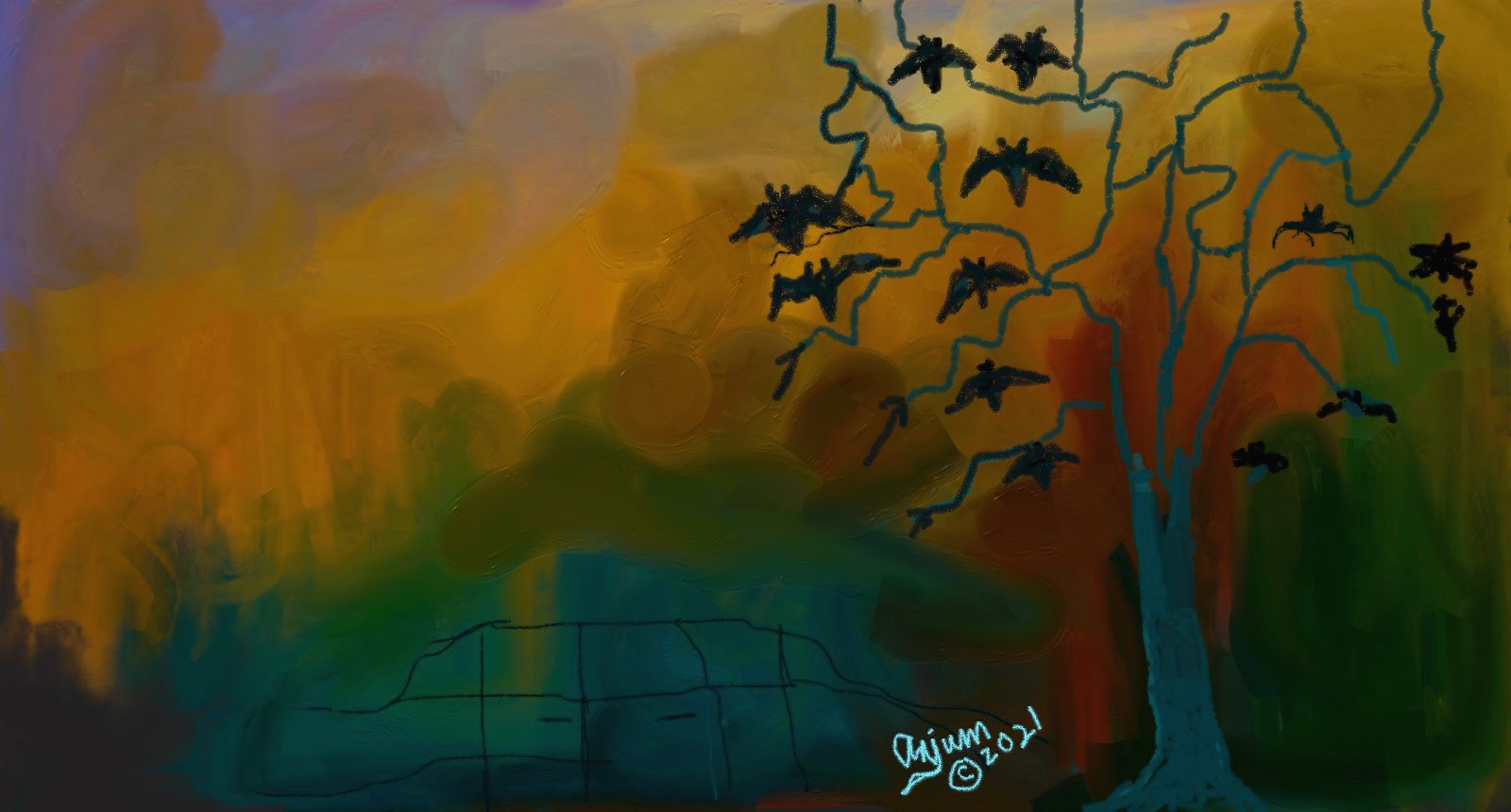
Bats by Anjum Wasim Dar
Poem
Evening shadows fell all over the lane
soon one could not discern the window pane
this one tree out of three we planted -gave
relief to heated pain, saved all from rain
but that evening it was pitch dark, the car
was parked in the shade, but wait -a sound
strange could be heard, the flurry rapid
flight of birds, small dark swooping round
left to right and right to left, flying in and
falling flat, disappearing from darkly sight
could hardly see them in the dim light-
not at full glare, wanted the birds to fly away scared.
But no, they kept coming and hovering around the car
preventing anyone from opening the door-what next
as fear increased -who had sent these bat-birds here?
small black sharp and shrill, recitation of holy verses
finally made the kill-all flew away as quickly as they
had come, and hoping that all had gone , we took the
back seat, the food basket in between us placed,
dinner to deliver at the hospital gate, trembling still
at the bat attack, cautiously moved on to the road
hardly a furlong had we gone, when sister let out
a loud scream-something shuffling, flapping dark –
Stop the car Oh Stop- Another scream, a loud screech
door crashed open-out flew a dark black bat,
somehow it had clasped the basket, and had
slipped inside -never ever so terrified was I
that night, Halloween or magic – wondered Why?
But then we knew Mother would not be with us
for long, doctors helpless signaled the Swan Song’
with food for Mother we were going, when Bats
flew around – Myths say they warn of Death –
soon soon Mother would be without life
without breath- to Heaven taken, to Heaven
gone-
-Anjum Wasim Dar
Bats
Let us begin at slant-light
with cut felt flickers,
unhooding cubic skulls,
furtive and hungry.
Trace our loopy symmetries
beneath the canopy as we feed,
follow our dance with open faces –
long diverged from the birds.
You cannot hear us but you’ll feel
our hunting song across your teeth
defiling the laws of physics
with frequencies beyond this.
Watch our velvet forms take on
three dimensions or four
as we vanish into sky space,
a filigree of apple tree
bursting into fret-work,
scraps of jinking balsa,
flicking the Vs, skimming
odd quick trajectories.
We are fickle as kits,
wombed and jewelled
with kidneys, ovaries,
rows of studded teats.
Born to kill, we are strung
on struts of steel; dissolve
in darkness to anti-matter,
turning widdershins,
bewilderingly separate,
a tapestry of gremlin flight
angling on planes of sound,
almost sightless, blind-to-green.
Turn your ears towards us,
bearing truths in our pitch and fall;
forest-worlds and gardens returned
in sonic negative, transformed.
Hold us in dry hands
when you find us in the woods,
stroke our underbellies
with something approaching tenderness.
(First published in Slant Light, Pavilion Poetry, 2016)
-Sarah Westcott
About Bats: The Chiroptera Sonnets
The Alcathoe
Home high in splits, cracks and loose tree bark,
near water. I hear it in two ways. Crash
of tumble. Soft echo in our Hunting Dark.
Trees are Hardnesses in our flying Dash.
I may swarm He may chase me. We may
retreat to Darker and make young. Suckles
in my pouch. Then let it hang, while away
I skim leaves, snatch prey mid flight, food rustle
crunchy backed echoes, always hunt echoes
bring
back. Amongst others know it’s cry and smell.
I hold it in my wings, soon its own wings
will learn flight in the Dark, it’s ears know well
a landscape of returning sound, nose scent
of prey, weathered woods, know home’s high ascent.
-Paul Brookes


White Eye of the Needle by Chris Campbell (The Choir Press) is a poignant collection of poems that captures so much about this unique time in our history. Although not all of the poems are written specifically about the pandemic, they function as a commentary on Lockdown by reminding us of the pleasures of everyday life that we are currently denied.
Many of Campbell’s Lockdown poems convey the insularity of lives during the pandemic which he shows persists even when the regulations have been relaxed. Take for example, his Careful what you touch. The bustle of the city’s streets has to some degree returned: ‘Where once was the odd stroller. Now restrictions have eased; //There’s ten.’ However, this is not normality. The shoppers maintain their distance: they remain suspicious and wary of contact with one another: the man in the brown boots ‘passes a couple…and picks up/The pace’. He is…
View original post 749 more words
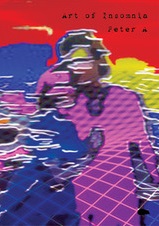
I remember back in the eighties reading Douglas Dunn’s Elegies, his profoundly moving collection of poems about the passing of his wife that were at times almost too painful to read. The same can be said of Peter A’s Art of Insomnia (Hedgehog Poetry Press, 2021), a chapbook of twenty-two direct, intimate, almost conversational poems through which he explores the loss of his partner.
Like Dunn’s Elegies, whilst Peter A’s poems are about grief, they are also about love. They honour a relationship which was cut tragically short. Take for example, his Found in France. We see the French rural retreat through the eyes of his wife. There is true affection and warmth in his amusing description of what she would not have liked. This is an affection derived from the intimate knowledge that comes through sharing a life with another and from an uncritical acceptance of what…
View original post 776 more words
Today I have the pleasure of welcoming Kitty Donnelly, prize-winning author of The Impact of Limited Time, toreflect upon a poem from her collection.
Thank you for letting me drop in to share one of my poems from The Impact of Limited Time. The collection was written over many years. When I found out it would be published by Indigo Dreams, I was just about to board a ferry back from the Isle of Arran in 2019. There is a wishing well at the ferry port and I threw some money in on arrival and swore to myself that if I went through with the reading for the McLellan Poetry Prize then good luck would come of it (I was trying to overcome my ridiculous shyness). I managed to read aloud to an audience for the first time, after a large brandy in the hotel room…
View original post 471 more words

I’m ashamed to say I had not read Kitty Donnelly’s prize winning collection, The Impact of Limited Time (Indigo Dream Publishing, 2020), before preparing for this review. Yet I only had to read the first few poems to appreciate what I had missed and to realise that Donnelly is an exceptional talent. The collection consists of 45 poems exploring a wide range of topics. Consequently it is difficult to give the reader a flavour of it in its totality, so I’ll concentrate on what made the collection distinctive for me.
As the title suggests, Donnelly reflects upon the effects of time on our lives. The collection begins with a short poem appropriately entitled Time. She begins, ‘So we plough each week/into a furrow of the past.’ This image of ploughing conveys a rather bleak view of life: there is no sense of rapture or pleasure here, just a grinding existence…
View original post 982 more words

This week it’s my pleasure to review Vicky Allen’s quietly resonant pamphlet Broken Things and other tales (Hedgehog Poetry Press, 2020) that invites us to step back from the hurly-burly of urban living and find significance in the ordinary things in our daily lives.
Her poem, Heron, is typical of her sparse, economical style and of her concerns. The heron ‘stands/ folded/ silent/ still’. Nothing happens: the heron does not move or attempt to strike at a fish, a point reinforced by the repetition of ‘folded, silent, still’ in the penultimate stanza. Yet Allen finds significance in the moment. She describes the bird as ‘a ghost/ watcher’, ‘bridging/ this solid/ world/ and/ its paler cousin’, portraying it as a sort of Grim Reaper and reminding us of the transient nature of life: death is never far away. Yet typically the poem resonates with other meanings for it concludes with the…
View original post 643 more words


