Day One

Day One

Day One

Previously appeared here Empty by Lesley James — Full House Literary
Lost & Found
You got up by yourself this morning,
put on your own knickers,
said you fancied eggs and bacon.
You went outside – first time in two years,
to breathe the dawn air and
survey the world since you left it.
In a few days, you remembered
your name, the dog’s, who I was,
that the postman wasn’t your Dad.
You exchanged pleasantries
with the woman next door, no longer
suspecting her of plotting your murder.
The hairdresser turned your flat feathers
into a helmet of curls, in the mirror
igniting a glimmer of recognition.
We chucked the grab rails and Complan
drove the zimmer to the tip, turned
your pill box into earring storage.
Weeks went by, you took the car out,
joined the library, had a stab at calligraphy,
tried your first chai latte.
Then on Sunday we came home and there
you were on hands and knees under the table,
looking for something. You didn’t know what.
From Lost & Found published by Hedgehog Poetry Press 2020
Vicpickup.com / @vicpickup
-Vic Pickup
Recognition
Black and white prints
cover creased hands.
Eyes narrow, dazed,
not seeing…
We slung satchels over knitted cardigans,
slammed the door,
grey pleated skirts hitched high above the knee.
We stood to attention at the bell,
split from my look-a-like,
a whistle insisted we march
into separate classrooms.
In the sixties we explored
Brighton Laines,
rummaged antique stores,
picked up gold leafed books,
bought treasure boxes
to hide shared secrets.
We sank into striped deckchairs,
flipped off our tops to reveal
psychedelic swimsuits-
plastic sunglasses concealed our faces.
We lazed by gull-grey waves,
pebbles chattered at our feet.
We sniffed salt from the sea,
cardboard cones on our noses,
read Jackie in the sun.
A transistor radio blurred Cathy’s
Clown, from the Top Ten charts.
I sit by the iron framed bed,
wait for a flicker of recognition.
Chubby Checker
blasts from the box
high on the wall
Lillie looks up,
whispers my name.
‘Freddie – The Twist.
you and me that day
down in Brighton.’
– Patricia M Osborne (previously published in Reach Poetry (2016) )
-Annick Yerem (First published in Dreich)
Audrey’s time
We wheel her into
the waning evening sun
as if the sunlight
would somehow restore her
like some wilting plant.
She does not speak.
Not now.
Words run away
from her,
slipping her grasp
like unruly children,
reluctant to come home
at dusk.
We fill her time,
with family photos
till we have earned
our leave;
filial duty fulfilled
for yet another week.
She looks at
our departure
with shuttered eyes,
mouth ajar,
memories escaping
with every feeble wheeze,
whilst her tissue soft hands
clench and unclench
in her lap,
as if anticipating
some last
decisive assault,
which we think
guiltily
can’t come
too
soon.
-Nigel Kent
(published in ‘Saudade’, Nigel Kent, Hedgehog Poetry Press, 2019)
First published by The Blue Nib
REQUIEM FOR A CELLIST
She rocks rhythmically in her chair,
Her eyes dulled by grief, skeletal fingers
clutching rosary beads. In despair she chants
‘Requiem aeternam dona eis, Domine’
The creeping evil nibbles away at her brain
She clenches her fists, howls
like a caged wolf, searching
desperately for her beloved ‘cello.
Then, as if by magic it appears, a Stradivari,
propped up by the Steinway grand,
pleading to be picked up and played again,
its bow sprawled across the piano lid,
resin box still unopened.
A sudden draft from the open window
breathes life back into the stale air.
Haunting sounds unlock iconic images,
transporting her to lovers’ beds, concert halls,
summer gardens and back-street alleys –
a heady rush of half-remembered liaisons,
ecstasy and pain intertwined.
Final chords crescendo then trail away
into the invading gloom of a winter twilight.
One last brave ‘da capo’- then peace descends.
Her weary frame crumples in dismay,
She attempts to rise from her chair, pleads
one last time: ‘Requiem aeternam dona eis, Domine’
-Margaret Royall
A Message
One of the best of minds
destroyed by dementia
does not howl on her knees
in the street, does not masturbate
in the magnolia living-room,
is not dragged off the roof-top,
naked; no, she leaves a message
on her daughter’s answer-phone
saying: there’s an echo,
an echo in my head.
-Olive M. Ritch
Bios and Links
-Lesley James
started submitting to journals in 2021. She has flash fiction in The Broken Spine and CafeLit, poems in Dydd Dylan Day anthology and writing for children in The Dirigible Balloon and Parakeet Magazine. ‘Empty’ was selected by Kathryn O’Driscoll for Full House LitFest’s Mental Health feature.
-Margaret Royall
is a Laurel Prize nominated poet. She has been shortlisted for several poetry prizes and won the Hedgehog Press’ collection competition 2020. She has two poetry collections:
Fording The Stream and Where Flora Sings, a memoir in prose and verse, The Road To Cleethorpes Pier and a new pamphlet, Earth Magicke out April 2021. She has been widely published online and in print, most recently: Hedgehog Press, The Blue Nib, Impspired & forthcoming in Sarasvati and Dreich.
She performs regularly at open mic events and facilitates a women’s poetry group in Nottinghamshire.
Website: https://margaretroyall.com
Twitter: RoyallMargaret
Instagram : meggiepoet
Facebook Author Page: Facebook.com/margaretbrowningroyall
–Annick Yerem
lives and works in Berlin. In her dreams, she can swim like a manatee. Annick tweets @missyerem and has, to her utmost delight, been published by Pendemic, Detritus, @publicpoetry, RiverMouthReview, #PoetRhy, Anti-Heroin-Chic, Rejection Letters, Dreich, 192, The Failure Baler and Rainbow Poems. https://missyerem.wordpress.com. https://linktr.ee/annickyerem
-Nigel Kent
is a Pushcart Prize nominated poet (2019 and 2020) and reviewer who lives in rural Worcestershire. He is an active member of the Open University Poetry Society, managing its website and occasionally editing its workshop magazine.
He has been shortlisted for several national competitions and his poetry has appeared in a wide range of anthologies and magazines. In 2019 Hedgehog Poetry Press published his first collection, ‘Saudade’, following the success of his poetry conversations with Sarah Thomson, ‘Thinking You Home’ and ‘A Hostile Environment’. In August 2020 Hedgehog Poetry Press published his pamphlet, Psychopathogen, which was nominated for the 2020 Michael Marks Award for Poetry Pamphlets and made the Poetry Society’s Winter List.
In 2021 he was shortlisted for the Saboteur Award for Reviewer of Literature.
To find out more visit his website: http://www.nigelkentpoet.wordpress.com or follow him on Twitter @kent_nj
-Olive M. Ritch
is a poet originally from Orkney. She was the recipient of the Scottish Book Trust’s Next Chapter Award 2020 and in 2006, she received the Calder Prize for Poetry from the University of Aberdeen. Her work has been extensively published in literary magazines, anthologies and websites including Poetry Review, Agenda, The Guardian, New Writing Scotland, The Poetry Cure (Bloodaxe) and the Scottish Poetry Library. Her work has also been broadcast on Radio 4.
Tears in the Fence 74 is now available at http://tearsinthefence.com/pay-it-forward and features poetry, prose poetry, fiction, flash fiction, translations and creative non-fiction by Seán Street, Mandy Pannett, Isobel Armstrong, Jeremy Reed, Andrew Mears, Anum Sattar, Ian Davidson, Joanna Nissel, Simona Nastac, Alan Baker, Lilian Pizzichini, Lucy Ingrams, Beth Davyson, Charles Wilkinson, Scott Thurston, Gerald Killingworth, Gabriela Macon, Kate Noakes, Peter Robinson, Kay Syrad, Huw Lawrence, Lesley Burt, K. V. Skene, John Freeman, Jane Wheeler, Tamsin Hopkins, Rachel Goodman & Elvire Roberts, Andrea Moorhead, Rebecca Althaus, Rachel Goodman, Mark Goodwin, Marina Tsvetaeva translated by Belinda Cooke, Alice Tarbuck, Alexandra Corrin-Tachibana, Adrian Clarke, Nigel Jarrett, Norman Jope, Steve Spence, Maddie Forest, Claire HM, Peter Larkin and Mark Russell.
The critical section includes Richard Foreman’s Editorial, John Freeman on Shelley’s Animism and Ecology, Alice Tarbuck on Thomas A. Clark, Carla Scarano on Margaret Attwood, Jeremy Reed on Yours Presently: The Selected Letters of…
View original post 82 more words
I simply love this book and could quote from it endlessly. Split into nine sections it’s playful yet serious and seriously playful at the same time. These are poems which sing and suggest, slip from idea to idea, confuse your thought processes yet delight the eye and the brain with an abundance of energy, skill and sheer brilliance. There is rhyme and assonance in abundance, all the traditional tricks of the trade yet done in such a way as not to overstate the case and even when this is the case to do it with such bravado and gusto that the reader is helplessly in thrall. Here, for example, are the first and final stanzas in the opening poem ‘Time is of the effervescence’:
Thenit’spopped.Likewiseapillarofwell-being – toomuchtaboo
contravenes the notion that all’s well. Many are non-believers confounding
the desire to know. An expansive watch tells it all.
Onthedot. Safetybehind the…
View original post 759 more words
F WORD WARNING
He has two versions of his biography
Paul Tanner
was shortlisted for the Erbacce 2020 Poetry Prize. He is the author of “Shop Talk” (Penniless Press, 2019), “No Refunds” (Alien Buddha Press, 2020) and “Working Class Zero” (Dreich Publications, 2021).
Paul Tanner
is barely qualified for minimum wage. He’s been earning it, and writing about it, for too long. His star sign is Libido. Hobbies include pillage and colouring in. “
The Interview
Maybe tomorrow. And why the hell not, eh?
2. Who introduced you to poetry?
If I could remember, I’d be doing time.
3. How aware are and were you of the dominating presence of older poets traditional and contemporary?
I try not to be.
4. What is your daily writing routine?
Hiding in the work cubicle, scrawling on bog paper, as one of the supervisors bangs on the door.
5. What subjects motivate you to write?
It’s revenge. Don’t believe the moral posers claiming they’re doing it for you, or this or that group – it’s always revenge.
6. What is your work ethic?
It isn’t.
7. How do the writers you read when you were young influence your work today?
Hemingway: Edit.
Irvine Welsh: Be honest.
Celine: Be even more honest.
Chuck Palahniuk: Have fun.
Bret Easton Ellis: Edit more. Be even more honest. Have even more fun.
Kafka: You’re not paranoid, you’re right.
Orwell: Actually, you are paranoid … but you’re still right.
Bukowski: Don’t try.
The Fantes: Keep trying.
Morrissey: Look around.
John Lydon: Look around.
Burroughs: Don’t look.
8. Whom of today’s writers do you admire the most and why?
All of us. None of us. I don’t know. Fuck it: let’s go down fighting, you crazy bastards!
9. Why do you write, as opposed to doing anything else?
I don’t know and I don’t want to know.
10. What would you say to someone who asked you “How do you become a writer?”
Write. As obnoxious as it sounds, just write. And if you can’t, or won’t, then congratulations: you’re not a writer.
11. Tell me about the writing projects you have on at the moment.
About 4,683 poems chewing through the inside of my skull, like an army of death moths trapped in a dusty old light bulb. You know, same as usual.
Day Seven
Ghost in an Empty Chair
Sometimes it is just a flap of wings in a lonely meadow,
or a child’s shoes and socks left by a pond
Sometimes it is the intensity of darkness
or the emptiness in the kitchen at harvest
Maybe the laughter ascending from the street below
or the ‘stepford wives’ promenading past with their pugs;
the elation of cheering crowds at a football match,
the vicar’s wife fraternising with the village elite…
Whatever triggers it, you instantly know,
that lonely ghost in the empty chair is you,
as though you are marked out with a blood-red bindi….
folk turn away, rejecting the discomfort of your grief
The world tumbles to wrong conclusions
and your sealed lips shout ‘I am still here!’
You cannot fight the inevitability of it;
you ask yourself why grief is such taboo….
Sometimes all it takes is the wind kissing your hair,
the cyclist turning to smile as he pedals past,
moonlight catching the svelte stem of your wine glass,
or an unexpected call from a complete stranger…..
Just small things, singular, unremarkable, yet they have
the power to transform your world…and you are grateful
First published in The Blue Nib journal
-Margaret Royall
Bios And Links
-Barbara Leonhard’s
work is published in Anti-Heroin Chic, Free Verse Revolution, October Hill Magazine, Vita Brevis, Silver Birch Press, Amethyst Review, PhoebeMD: Medicine & Poetry, among others. Barbara won prizes and awards for her poetry in the anthology Well Versed 2021 and Spillwords, where she was voted Author of the Month of October 2021, nominated Author of the Year for 2021, and recognized as a Spillwords Socialite of the Year in 2021. You can follow Barbara on her blog site, https://www.extraordinarysunshineweaver.com.
-Rachel Deering
lives in Bath with a cat. She writes poetry and takes the occasional photo whilst walking.
-Dana Clark-Millar
Over the past 2 years Dana has taken a deep dive into the world of haiku. When her fingers are not occupied counting out syllables, she is using them to weed and plant her garden. You can also find her cooking, canning and preserving foods, birdwatching, taking photos, playing out on the trails or enjoying a book while her 3 dogs and 2 cats attempt to out-cute one another.
-Cy Forrest
is state-educated, Manchester, now living in Wiltshire. MA Creative Writing, Goldsmiths, University of London. Elvis at the Golden Shovel appeared in February’s issue of The Honest Ulsterman, the first in a set of four sestinas using end words from Gwendolyn Brooks’ twenty-four word poem, The Pool Players, Seven at the Golden Shovel. Billy Collins longlisted another in the set of four for the 2021 Fish Prize. Poems have been placed at Icefloe Press and here in The Wombwell Rainbow. Two are due to appear in Stand Magazine later this year. A full collection reached stage two in The North’s March 2021 open call.
-Louise Longson
cleared enough space in her spare room and head to start writing ‘properly’ during lockdown 2020. She is published by One Hand Clapping, Fly on the Wall, Nymphs, Ekphrastic Review, Obsessed with Pipework, Indigo Dreams Publishing, The Poetry Shed and others. She is a winner of Dreich’s chapbook competition 2021 with Hanging Fire. A qualified psychotherapist, she works with historic trauma and the physical and emotional distresses caused by chronic loneliness. Lives with an orange cat and a silver Yorkshireman. In her head, sky is always blue, grass always green, leaves always golden. Needs to get out more.
Twitter @LouisePoetical
-Gillian Winn
is a mature poet, currently studying Creative Writing with the Open University. She worked as a nurse for the NHS for 40 years. She lives in North Yorkshire.
-Teresa Durran
was born in London and lives in Hampshire but has rarely felt less English; the blood of Celtic ancestors flows through her veins. Being the daughter of immigrants has entirely informed her world view and she has always instinctively empathised with the outsider and the ‘other’.
She writes delicate poems for fragile times because she has to. She wanders and wonders and dreams, and she is always lost in music.
-Sue Finch’s
debut collection, ‘Magnifying Glass’, was published in 2020. Her work has also appeared in a number of online magazines. She lives with her wife in North Wales. She loves the coast, peculiar things and the scent of ice-cream freezers. You can often find her on Twitter @soopoftheday.
–Margaret Royall
has six books of poetry published. She has appeared widely in print, in webzines and poetry anthologies. She has won or been short-listed in several competitions and her collection ‘Where Flora Sings’, published by Hedgehog Press, was nominated for the Laurel Prize in 2021. Her latest collection, ‘Immersed in Blue’ was published in January 2022 by Impspired Press. She leads a women’s poetry group in Nottinghamshire and takes part in open mic sessions online and in person. She is currently working on a third poetry collection.
Website: https://margaretroyall.com/ Twitter:@RoyallMargaret
-S Reeson [she/they] is 55, bisexual and married with two children: they have suffered anxiety for all of their life, and started telling stories as a ten-year-old in order to help them cope. Now, they write and record poetry, short stories and episodic fiction, whilst dissecting their unique creative process using both video and audio as the means to continue coping.
A considerable lived experience of mental health issues, a passion for niche arts and media and an undimmed enthusiasm for environmentalism combine, to allow creativity to emerge, and new stories and projects to be created. They love to experiment and push creative boundaries, and gain a huge amount of motivation and inspiration from talking about both the journey and continued evolution as a creative.
After winning a Poetry Society members’ contest (and reading that piece at the Poetry Café in Covent Garden) they attended the inaugural Mslexicon in 2019 and took part in their first ever Open Mic event. In that same year they wrote 24 poems about their home town for the Places of Poetry online initiative, one of which is included in the official anthology published for National Poetry Day in October 2020 by Bloomsbury and subsequently reproduced by the Sunday Telegraph.
Their work has been published by Flights / Quarterly ejournal, Green Ink Poetry, Fevers of the Mind, Acropolis Journal, Selcouth Station, Black Bough Poetry, Flapjack Press and Dreich, plus there have been performances at Gloucester Poetry Festival, Flight of the Dragonflies and the monthly event at Wordsworth Grasmere. They have read alongside countless poets, including Caroline Bird, Steve Camden, Deanna Roger, Jeremy Dixon, Julia Webb and Wendy Pratt, and in 2021 they read at the Essex Book Festival. They’ve also learnt and grown creatively via poetry courses run by Apples and Snakes, Kevin Higgins, Wendy Pratt and Jonathan Davidson. A self-produced poetry chapbook was produced in November 2020 (available to buy here).
In October 2021 they were nominated for the Best of the Net Award.
They enjoy living online, but also find great joy from lifting heavy weights, running and cycling in the meat-space.
Nigel Kent - Poet and Reviewer

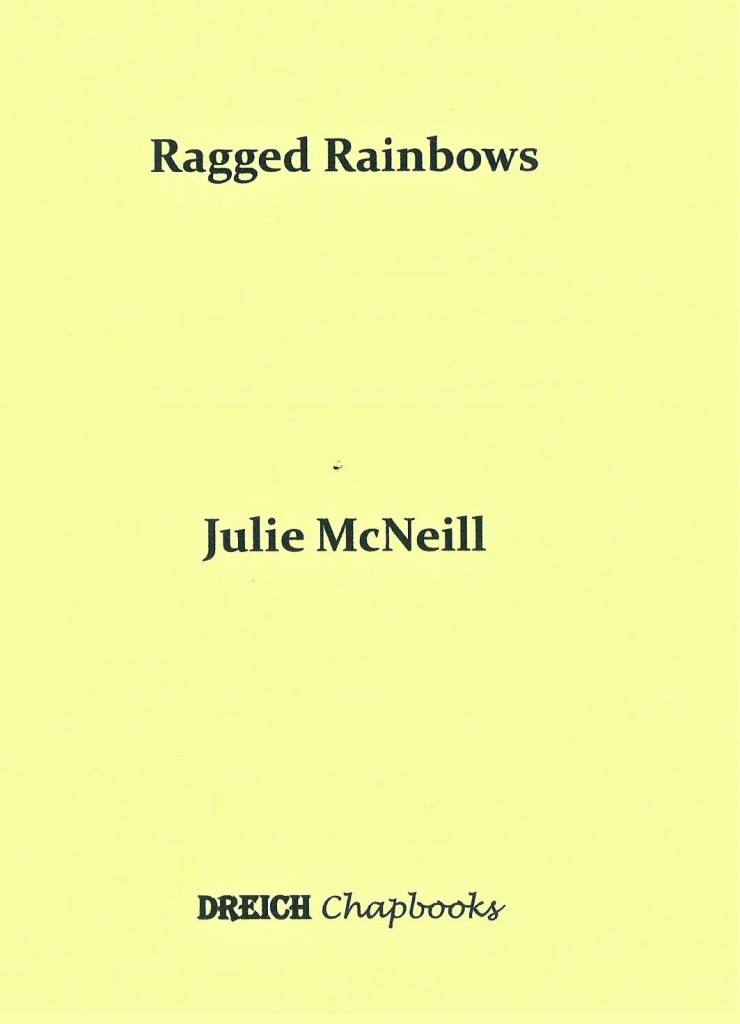
You know you’ve enjoyed a poetry pamphlet when you’re left wanting more. That was certainly my experience when I read debut talent, Julie McNeill’s Ragged Rainbows, for this is a compelling, reflective and ultimately optimistic collection of poems that prompts us to consider the challenges faced by the world around us and to think about our response to the issues she explores.
The world in Ragged Rainbows is precarious. It is beset by climate change, which threatens our existence to such an extent that the most the poet can hope for is to ‘leave,/ a smattering of trees,/ a slither of clean air/ and a tiny pocket-full of hope/ for my children.’ (Raising Environmentalists). It is a place where the cost of independence for women is sexual humiliation by misogynistic men, when the exchange for a few ‘coins’ in a fifteen year old girl’s pocket is ‘a friend of…
View original post 1,034 more words
Published May 14th 2018 for International Dylan Thomas Day. @DyddDylanDay
I’m grateful to the first of my heroes.
To Dylan Thomas I proffer my love.
For making me see the wonder of words…
Because of that I can’t thank him enough.
The poem’s more about me than Dylan Thomas…
1969 ANNO DYLANI
“To begin at the beginning…” he said,
Often supposed to be the best of starts;
But my being sent to technical school,
Would likely stifle a love of the arts.
No aptitude for wood or metalwork;
Out of place when it came to surveying
And Geometrical Machine Drawing.
Did Mum pick the wrong school? I’m just saying…
I might have supposed that Mr Beddows
Was some kind of agent provocateur;
But at our school, boys had to do German
And couldn’t do French until the fifth year.
Working in a school run on old-school rules,
Our new English…
View original post 783 more words
This book is a quartet of slow, accumulative, long prose poems that touch on landscape, personal experience, geography, and philosophy. Sectioned and/or paragraphed, they gradually build up encounters with ‘Landscapes. Subtle shiftings of reality.’ These shiftings come from attention to detail, consideration of change, the seasons, the weather, how the light falls, and of how humans engage with the world around them.
Moorhead is interested in her own place in things, and inplaceitself, willing to be both scientific and emotional, rational and speculative, and to grapple with the unknown, in an attempt to allow ‘this existence to be full’. This fullness of experience, of course, means dealing with ups and downs, winter and summer, light and dark, the desired-for and the unwelcome. Death and mortality are part of nature, as is longing, absence, memory and anticipation; our own stories make sense of our lives, and ‘[f]ables frame the…
View original post 301 more words