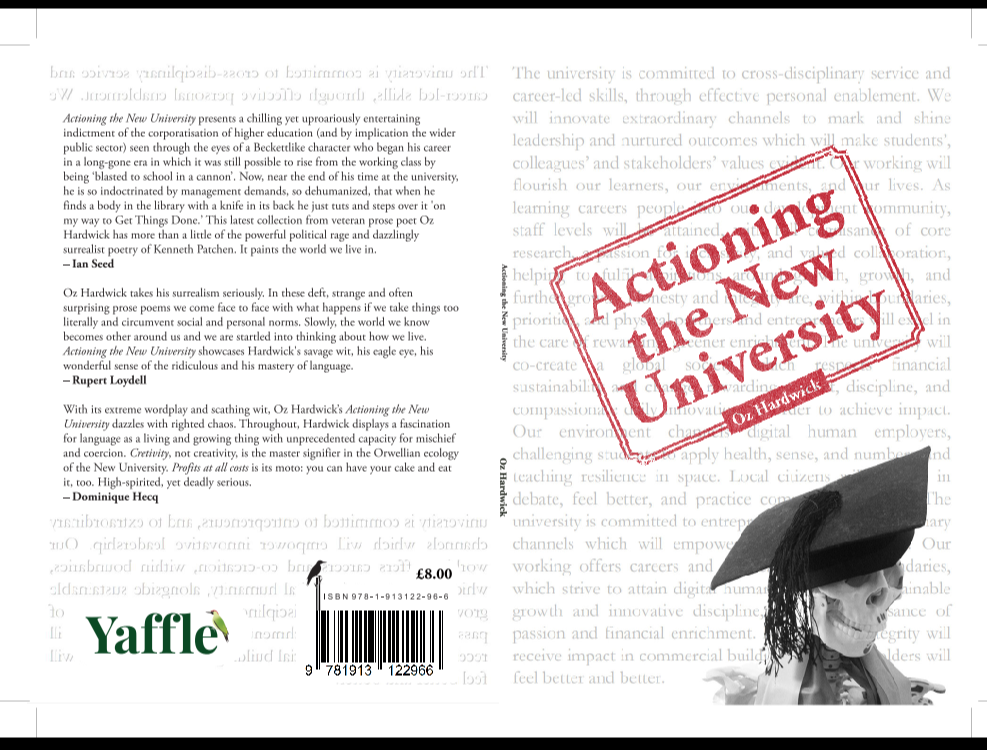
Oz’s new book can be bought here:
Oz Hardwick is an award-winning poet and photographer, who has been acknowledged as a “major proponent of the neo-surreal prose poem in Britain.” His work has been widely published in international journals and anthologies, and he has published “maybe fifteen?” solo collections and chapbooks, most recently Actioning the New University (Yaffle, 2026). Oz has held residencies in the UK, Europe, the US, and Australia, and has performed internationally at major festivals and in disreputable dives. Always keen to work with others across diverse media, Oz has collaborated on albums, films, art installations, and performances, as well as numerous collaborative poetic works.
Q:1. How did you decide on the order of the poems/poetic prose in your book?
That’s an interesting question but possibly not with the most interesting answer. The poems were written over a couple of years and sort of gathered themselves into a chapbook-sized huddle. I’m actually very partial to the focus of a sequence of 18-24 poems.
It made sense to begin with my own education, and the final poem announced itself, but those in the middle took a lot of shuffling. They kind of gesture towards narrative but also pull against it – partly because I have an inherent distrust of narrative, but also because the poems come out of a situation which is, sadly, anything but clear and linear.
Q:1.1. Why do you have an “inherent distrust of narrative”?
Writers like Jonathan Gottschall in The Story-Telling Animal have suggested that the urge to tell stories is a defining human trait, which helps us to make sense of a chaotic world, which is fair enough, but I think leaning too far into that – imposing too neat a narrative – is to turn away from the complexity and irresolution which is such a part of life. Art should disrupt things a bit, however seriously or playfully (or both), and I think disrupting narrative assumptions is one of the things it can do really well.
Q:2. What attracts you to poetic prose rather than other types of poetic form?
There are whole essays on this, but I think the first thing to say is that I write prose poetry rather than poetic prose. My writing impetus is always poetic, and to grossly oversimplify for reasons of brevity, what interests me is the frisson of language, rather than the more novelistic concerns of character, plot, and so on. And while I do write lineated verse, and have done since childhood, I find the prose poem particularly intriguing, and have written predominantly in that mode for the past decade. Those little boxes provide all the machinery of a sonnet, but without the expectation of resolution. For me, it’s the perfect form to embrace uncertainty.
Q:2.1. What do you mean by “frisson of language”?
Just the texture of it – the tactile experience of the language itself, beyond its semantic reference.
Q:3. How did you choose the collection’s title?
A few years ago, the phrase “new university” really took a hold in Higher Education. Initially, it wasn’t clear what this actually meant, but it soon became apparent that it didn’t actually mean anything at all – it was just a sort of market stall slogan selling something as a university, without the intellectual rigour or sense of purpose of a university … by way of analogy, think “New Labour”. And one of the common rhetorical tropes in this dodgy marketplace is feigning dynamism by using nouns as verbs. So, both “actioning” and “new” are wry signifiers of the glittering emptiness of what has largely replaced genuine and meaningful Higher Education.
Q:4. Why is uncertainty so attractive to you?
I think it’s because I don’t like to narrow down possibilities, but also most of what makes us human is uncertain, and I find that something to celebrate – or at least to embrace.
Q:5. Why do you like playing with corporate language?
It’s not something I do a lot, but I’m always interested in the tenuous and shifting relationships between language and its referents and – going back to what I was saying about the book’s title – corporate language is fascinating in the way that it is quite elaborate but often refers to nothing at all.
Q:6. What input did you have on the cover pf your new book?
The cover was very much my idea – and it’s my image and background. Way back when I left school, I trained as a photographer at Plymouth College of Art and that’s remained an enthusiasm of mine. I tend to think of my books as art projects, so every aspect is important to me. It’s one of the (many) good things about working with small presses – the amount of control I have over the whole book.
Incidentally, I feel that my prose poems and photographs are very similar in impetus, and they employ the same attention to arrangement of elements within a neat frame.
Q:7. Once they have read the book what do you hope the reader will leave with?
First off, of course, I hope the reader comes away having had a worthwhile aesthetic experience. For me, that’s the important thing about poetry or any kind of creative endeavour. Beyond that, it depends on who the reader is. I’ve had good initial responses from people who work in HE and other parts of the public sector, with a blend of recognition, anger, and very dark amusement – that sense of a shared Kafkaesque experience. Beyond these specifics, though, I hope any reader will take pleasure (however world-weary) in the absurd.

