Wombwell Rainbow Interviews: Tony Noon

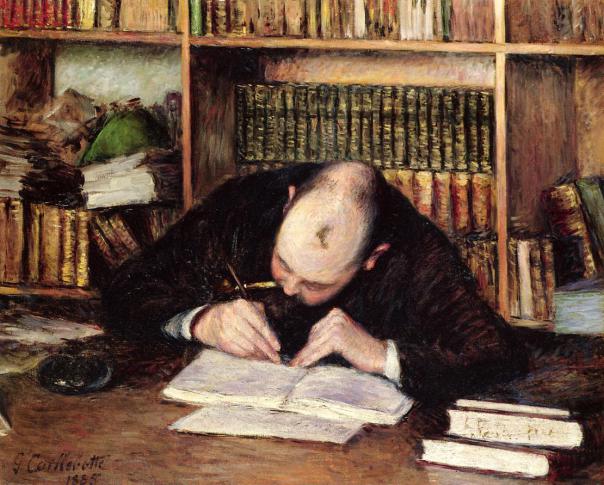
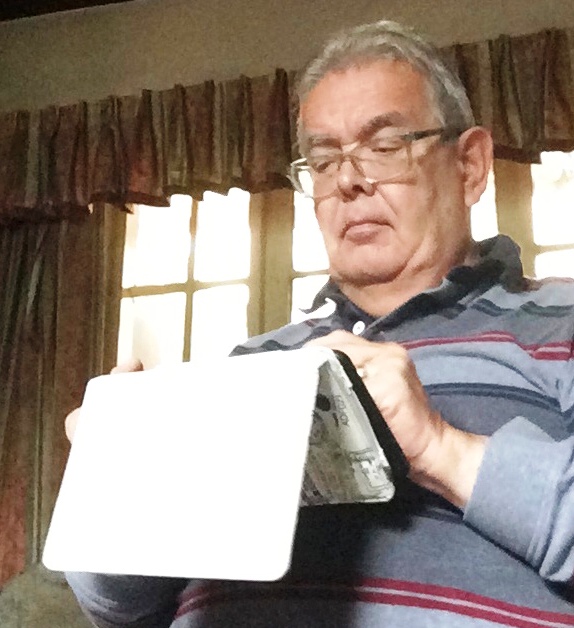
Tony Noon reading

-Tony Noon

Lives in Mexborough , South Yorkshire. Poems have appeared in magazines , anthologies and in local and national newspapers. As well as AllPoetry , work can be found on sites such as The Blue Hour and The Camel Saloon.

The Interview 

1. When and why did you start writing poetry?

I can be fairly explicit about this . The year was 1974.

I know this , because I remember putting a label on the front of a hardback exercise book
and simply writing 1974 in stylised numbers on the front.

It was not a poetry book , as such , but a book of meanderings.

Hopefully humorous articles , comedy sketches, and early poems both funny and “ serious”.

It was clear at this stage that I considered myself to be an “all rounder” rather than
specifically a poet, although my earliest performed piece was part of our Sixth Form
Revue .

Entitled “ Flaming Beans” , and parodied from a famous TV advert of the time
it went as follows:

I’m wearing mummy’s apron
I’m wearing mummy’s shoes
I’m smoking mummy’s cigarettes
And drinking mummy’s booze
‘Cos I’ve locked her in a cupboard
And we all know what that means…
It means we’ll get some proper food
Instead of flaming beans !

I should add that appropriate to the customs and humour of the time … the performer was a
student teacher dressed as a St. Trinian’s sixth former .

2. Who introduced you to poetry?


Flaming Beans owed more to The Two Ronnies than any true bard ,of course.
My real inspiration to write “proper” poetry was Roger McGough , who I first saw on a tv magazine programme reciting a poem about a coin. Not sure if it was one of his own, but Roger’s unique voice and stylishness stuck in my young mind.
This would have been late sixties and up to this point Roger was mostly famous for singing “Lily the Pink” and “Thank U Very Much” with Scaffold.
Much later I remember Roger reciting “At Lunchtime” on the telly and I became a full on fan.
I learnt a lot about the Liverpool Poets after this.
I particularly liked to hear Roger reciting his work to a musical accompaniment. I think I tried to emulate the Liverpool style and sensibility in a lot of my early work.
Some worked better than others.

I also remember many reflective hours in the library at Wath upon Dearne, probably 1972-3, reading poetry by Thom Gunn and others when I should have been working on Economics essays.

3.How aware are and were you of the dominating presence of older poets, traditional
and contemporary?

Dominating presence seems to be a dilute notion to me these days.

There are very famous names I have grown up with who gave a shape to English literature , running from , say, Milton and Shakespeare, to Dylan Thomas and Larkin. Their works have been reprinted countless times and distributed widely , and their work will always be held in high regard.

The paradox today is that although it is, perhaps, easier for poets to get their work into print , it is harder for relative newcomers to attract and maintain people’s attention.

Poetry is just one more information flow which readers process alongside soundbites, photos and music from myriad sources.

If we consider the post of Poet Laureate, as an example , a large proportion of the public would have known who John Betjeman was , even if they weren’t familiar with his work . A smaller percentage knew much about Ted Hughes. By the time we get down to Simon Armitage , marvellous as he is , I have a feeling that the average person in the street now would say Simon Who ?

My own template of what I might call a positive influence , rather than a dominating one, would be the late Dannie Abse. I had the great privilege of meeting him briefly at an awards ceremony.

A giant of the poetry world , he seemed a very unassuming person who was happy to speak to people he didn’t know. What impressed me most of all was that his undoubted poetic achievements were won whilst also working full time as a physician in a chest clinic for over thirty years.

4. What is your daily writing routine?

I’ve never been a blank sheet of paper and a pen kind of writer.
For years my work was an assortment of bits of poems scribbled on the back of envelopes and bus tickets. My mind would become preoccupied with a few words , maybe overheard ,or a snippet I had seen in the newspaper.
Somewhere in my unconscious mind, these would link up with other words and I would have to write them down on the nearest available piece of paper so that I wouldn’t forget them.
These would then sit in a shoebox until I knew what to do with them.
Eventually , I got hold of an electric typewriter and put the pieces together to make my first batch of poems. I was rather proud of them , and kept them in the box for another age, until I felt confident enough to show them to the outside world.
Nowadays, this whole process has collapsed to a few manoeuvres.
The creative part of the process is largely the same. I let ideas and phrases swing about and collide until a sort of sensible pattern emerges in my brain.
This could be 10 o’clock in the morning or sometime after midnight.
Depending on how much sense the words make depends on what I do next.
If I think there may be more to add , I will type the words into Google Docs , so I can play with it later.
If the poem feels fully formed , I may type it straight into the AllPoetry site and publish it. The beauty of sites like this is that you can quickly get a feel for whether people are reading your work , and you can always edit the work if you feel afterwards that a different word might work better…
This is something you could never do in the pre digital age. Once you had published a poem , that was pretty much it.
I should add that although the creation phase may take days , weeks or years in some instances , the actual process of typing can be early morning or late at night as the need arises.

5. What subjects motivate you to write?

Many years ago a well known poet from Sheffield ,on meeting me at a literature
festival ,asked what kind of poetry I wrote.

After racking my brains for what seemed an endless couple of moments , I said
“ Free Verse” as I couldn’t think of a better answer.

She didn’t actually roll her eyes, but the way she said “ Well , obviously …” implied
the roll, and the way she half turned to the next nearest person helped to put the
youngster in his place.

All these years later , the question is no less complex.

As I mentioned earlier , I don’t sit down with a blank sheet of paper and an agenda to
fulfil…which is not the same as saying I have no agenda.

It’s just that the agenda only emerges in hindsight …

What happens is that words coalesce at their own pace in my mind ,eventually
forcing themselves onto paper, sometimes fully formed but often like a half
fashioned clay sculpture that has to be moulded and teased into shape.

It’s at this point that I begin to recognise what the poem wants to say and I
consciously add and take away words until I have something which feels like it can
stand alone.

At the time of writing , each poem is an individual piece of work , but with hindsight I
can see preoccupations which could be construed as themes.

I can see maybe a dozen or so poems which have been shaped by the odd
constraints of the pandemic lockdowns.

Viewed over a longer period , they fit just as well into a perception of the UK as a
society which had been drawing the curtains early for over a decade prior to Covid.

Other pools of concern have been the social and economic decay arising out of
industrial decline .

A lot of other poems seem to relate to time and quantum physics…

Sometimes I’ll knock out a comic poem like “ Robin Hood and The Job Centre”

This kind of disjointedness makes it hard for me to label myself … but it is very like life …

6. What is your work ethic?

In a literal ,rather than a literary, sense I inherited a very strong work ethic from my father.
He always stressed the importance of two things.

These were , the roof over your head and the food on your table
.
Everything else was secondary from his point of view.

Accordingly , apart from one brief spell around twenty years ago , I was fortunate enough to find full time paid work which enabled me to fulfil my familial obligations.

During all this time , my writing has co-existed in the spaces between activities .

At the beginning of every day , and at the end , and on thousands of bus journeys , I was a poet.

The words seemed to distil themselves from everyday experiences and interactions.

Ultimately the worker and the writer became symbiotic. This process continues today.

I am often working just by walking about.

7. How do the writers you read when you were young influence your work today?

Not so much , I think.
What has happened over the years is that , like surfing the net , I have added to my mental library of styles that I admire and picked up a few bits and pieces of advice about writing poetry which I have allowed to mingle and simmer over time.
My preference is ,and always has been, for short poems and creative use of space , so my mindset has moved over time, I think , to a more American style of poetry.

8. Whom of today’s writers do you admire the most and why?

I probably don’t read enough new poetry , although I am hugely supportive of emerging talent when I see or hear it.
If we tweak the dial a little to include people who have been around for a while but can still do it , I like Brian Bilston and John Hegley , and of course anything by Roger McGough is added to my metaphorical bedside pile without further recommendation.
The why is fairly obvious to anyone familiar with these three. They all have the ability to take everyday life and twist it to show us all that our lives are multifaceted and wonderful

9. Why do you write, as opposed to doing anything else?

To be fair, I wear two hats, both invisible, but interchangeable as required .
One says “ Danger, Poet at Work” and the other one says “ Smile … I’m a Cartoonist” …
I don’t generally divulge to folk that I write poetry. This enables me to hoover up everything I see or hear and decide whether I can make use of any of it.
That’s why the invisible hat says “ Danger”…
Another reason I leave it off the table is that, like comedians, people either ask if you can write them a poem , or read them a poem you have written.
If you do have something you prepared earlier , they listen quizically , then smile apologetically as they tell you they don’t get it.
Cartooning is slightly different. Lots of people are familiar with my cartoons , and if they don’t get it , they don’t tend to say so … I’ve had a few emojis , but I don’t understand most of them ; )
Both these strands have been outlets for my self-expression since I was a child , and both are vital parts of the whole , but overall, writing has been the medium which shines a light on my deepest concerns and motivations.

10. What would you say to someone who asked you “How do you become a writer?”

“The road is long , with many a winding turn , that leads us to who knows where…”
So the famous old song goes…
My road has certainly been long and winding . So long that parts of it fell into the sea years ago.
When I was first looking for outlets for my work , the starting point was the local library and the most up to date version available of the ArtIsts and Writers Yearbook.
After reading and ignoring the advice of the poetry specialist , who always said times were hard and the prospects for new poets were grim , I would make a list of interesting sounding magazines and their addresses.
These would be called things like Bare Wires or Beyond The Brink. The more odd sounding , the better.
I would then begin a round of writing to editors and attaching five or six copies of my typewritten poems.
Many of these magazines were no more than stapled collections of typed poems with a photocopied thin board cover , but to have a poem published felt great. There was a kind of cult feeling to being in these mags which outweighed the low quality of the reproduction.
The downside of this approach was that the timescale was unpredictable. The work that you had sweated to compose and jarred your fingers to type then sent off in a brown envelope was now like the Voyager spacecraft , slowly making its way through deep space.
After what seemed like an eternity , you might get another brown envelope back saying that a particular editor would like to publish one or more of your poems, and sometime after that a complimentary copy of the mag might land on your mat.
Sometimes poems were returned unopened , which was hugely disappointing , or they disappeared completely and you never got any response.
At this point , it was back to the library and start again , and again , and again…
The last part of the last sentence is the important point.
Although electronic media have made it easier today to identify outlets , submit work and receive quick feedback , the potential for quick disappointment has also grown.
The important quality for the aspiring writer , though, is exactly the same.
The ability to pick yourself up and start again will pay off eventually.

11. Tell me about the writing projects you have on at the moment.


My site WAITING FOR THE ENCORE (tonynoon.blogspot.com) which I add to from time to time has lots of odds and sods including cartoons and articles.
The title ,Waiting For The Encore , refers to following poem

ENCORE

When Beethoven rolls me over
by some green pasture
and still water browns
with more tea, vicar,
you will find me last
in the pews at evensong.

Waiting for the encore
This was itself a reference to the habit a pal and I had when we were teenagers of shouting for encores for any act appearing at our local club.

It didn’t matter whether they were any good. The more encores we got , the longer we got to drink up after last orders.

Most of my latest work goes directly to TonyNoon642 – poet at allpoetry these days as I can easily see if people are viewing a particular poem and the culture of the site encourages an exchange of comments.
Tony Noon – Poet Tony Noon Poems (poemhunter.com) is also an ongoing project which contains some , but not all of the same poems as allpoetry.
Unique to this site is Poem for Synthesised Voice …which I wrote specifically because this site has a synthesised voice which reads a poet’s work aloud .
The poem is an attempt to capture the rhythm of the synthesised voice without it sounding odd…

I have also found it interesting to add a few poems to Places of Poetry . This attempts to show on a map where each poem was conceived.

Hope other readers may find it interesting too. Navigate the site by clicking on the three bars top right then put in Tony Noon in the enquiry box… The whole project was a tremendous piece of work and you can easily pass an hour by simply picking an area on the map and drilling down and down to see what emerges .

Jeff Gallagher: Tardebigge

The High Window Review's avatarThe High Window

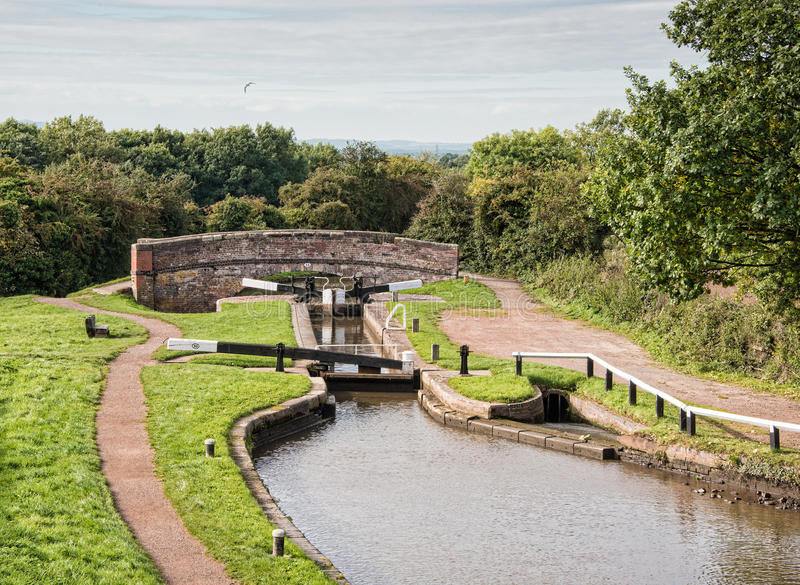
tardebigge 2

*****

Jeff Gallagher is from Sussex, UK. His poems have featured in publications such as TheRialto, Shooter, Dreich, Littoral and The Journal. He has had numerous plays for children published and performed nationwide. He was the winner of the Carr Webber Prize 2021. He has been a teacher of English and Latin. He has also appeared in an Oscar-winning movie. He has no handles.

*****

The origin of the name ‘Tardebigge’ is unexplained. It is the site of a flight of 30 locks on the Worcester and Birmingham Canal. The narrator entering this landscape desires to become unknown or at least to ‘begin again from nothing’ after a series of traumatic events. The canal, built by her ancestors, is the one straight and constant thing in her life. It provides for the fugitive a means of escape and a destination that enables her to bring her…

View original post 603 more words

Free Writers Resource #WritingCommunity. #Wombwell RainbowInterviews If you are interested in how other writers work, their inspirations, routines, visions you can find over a thousand international voices interviewed here, including names you will find very familiar: Ongoing Wombwell Rainbow Interviews

#Wombwell RainbowInterviews If you are interested in how other writers work, their inspirations, routines, visions you can find over a thousand international voices interviewed here, including names you will find very familiar:Ongoing Wombwell Rainbow Interviews Alphabetical Surna…. thewombwellrainbow.com

And if your name isn’t up herethewombwellrainbow.com/ongoing-wombwe…, and you would love it to be please contact me.Ongoing Wombwell Rainbow Interviews Alphabetical Surna… thewombwellrainbow.com

Wombwell Rainbow Book Interviews: “Love Poems” by Ian Parks

-Ian Parks

was born in 1959 in Mexborough and runs the Read to Write Project in Doncaster. He is the author of eight collections of poems, one of which was a Poetry Book Society Choice. He was the first poet-in-residence at Gladstone’s Library and Writing Fellow at De Montfort Leicester from 2012-2014. His versions of the modern Greek poet Constantine Cavafy were published by Calder Valley Poetry and shortlisted for the Michael Marks Award. He is the editor of Versions of the North: Contemporary Yorkshire Poetry and The Selected Poems of Harold Massingham. 

His new book can be bought here: http://www.fluxgallerypress.co.uk/

Here is a link to my previous interview with Ian:

https://en.wikipedia.org/wiki/Ian_Parks

The Interview

1. How did you decide on the order of the poems in the book?

The collection covers a period of thirty years from 1979 when I was twenty to 2009 when I was fifty. I wrote more love poems during that period but they didn’t find their way into this collection. Love Poems is a reprint and I did have the chance to include some love poems I’ve written over the intervening twelve years – but in the end I felt that the collection as it stands is complete and makes a kind of sense, in so far as any collection of poems makes logical sense. Apart from the first poem, Etched in Glass, and the final poem, A Last Love Poem the collection follows a roughly chronological order by date of writing rather than by initial publication. I didn’t think that the order was particularly important – as long as the poems demonstrated a sort of integrity – but people have approached me over the years in order to tell me that they can detect a ‘story’ running through the book. The revealing thing is that they all find a different ‘story’ – which goes to show that poetry is as subjective art and what is obvious to one person is obscure to another. I simply wanted them in an order where the sequence didn’t interfere with the theme which is, broadly speaking, an exploration of the nature of romantic love, and particularly of love which has been lost. 

1.1. Why lost love?

Good question. You get love poems that are celebratory and you get love poems that are elegiac. Writing celebratory love poems didn’t appeal to me. I felt very strongly that they didn’t open up the kind of possibilities I was looking for. Temperamentally speaking, I’m of a reflective disposition and the exploration of loss suited my poetic sensibility. I also wanted to push the limits of the love poem. Auden had showed that the love poem occurs in a context, a social and political one. That was something I wanted to pick up on and develop. when I started writing love poems they were unfashionable. Robert Graves, perhaps the greatest love poet of the twentieth century, was certainly out of fashion. His muse-ridden love poetry was very much at odds with what had happened in British Poetry in the 1970s. I didn’t want to be the South Yorkshire equivalent to the Liverpool Poets. Having said that, the poems of love and loss came unbidden and from somewhere deep inside. I don’t want to give the impression that I had an agenda or strategy. The poems were written to stand alone although the thematic core began to dictate the direction in which the poems were going. It’s true to say that they led me and not the other way around. 

2. How important is form to you in these poems?

The form is the life blood of the poem – it flows through it and gives it its energy. That’s as true now as when the Romantics were writing. The form and content, though, need to be inextricably linked; they need to be connected and meshed at a fundamental level. And so it follows that that the form of these poems is very important because the form influences the tone and the tone is something I was striving to get right. Angela Topping said these poems were ‘achingly tender while being devoid of sentimentality’ – and that’s certainly one of the things I was aiming for. Strictly speaking all the poems in this collection are free verse – that is, they don’t adhere to a pre-existing formal pattern. Having said, that they do reflect the natural iambic pulse of the speaking voice – and that is something I was consciously trying to achieve. The form these poems take evolved as I was writing them, during the process, giving me a sense of a beginning and, more often than not, an end. One of the things they have in common formally is that the last line almost always came first and the rest of the poem worked up to it. Most of the poems end on quite an emphatic rhyme (something I was also working towards consciously) although as many as ten or twelve lines intervene between the rhyming words. you can always tell when a poem has been contrived. 

3. How do you use the weather in your writing?

It isn’t so much how I use weather as how it uses me. Someone once said that the only time it doesn’t rain in my poems is when it’s snowing – and there’s some truth in that. I could, with some fairness, be accused of subscribing to what used to be called ‘the pathetic fallacy’ – that is the use of the outer weather to correspond to the inner weather. horror films invariably start on a dark and stormy night and even Shakespeare makes us of it in King Lear where Lear’s madness is represented by the storm. We mustn’t forget though that the storm is also a real storm, even though a corresponding storm is going on in the king’s head. Likewise, the rain and snow in my poems is really happening and not just there to emphasise a mood. So yes, it’s important and very perceptive of you to pick up on it. Rain for me equates with privacy and these poems ‘happen’ in private settings. When my first book came out a reviewer said that ‘Ian Parks is in danger of disappearing into one of his own misty landscapes’ – and there is some truth in that. It made me laugh at the time and it still makes me laugh now. 

4. What is the role of landscape in your love poems?

Landscape is central to my poems – and not just the ones in this collection. There’s an intimate connection between anything that happens and the place where it occurred. This is particularly true when it comes to my poems about history and politics. Revisiting places of (often painful) historical memory can often serve to ‘release’ them into a poem. A visit to Cable Street, for instance, or the site of the Peterloo Massacre, or the Towton Battlefield evokes the events that took place there and often the membrane between past and present thins and becomes transparent. Likewise with the love poem. I’m thinking here particularly about Hardy and the intimate relationship that existed for him between landscape and relationships. In Wessex Heights, for instance, he declares that there are specific places where he ‘dare not go’ because the recollection of a former love would be felt too acutely, too painfully. I think Hardy is a truly great poet – and I confess a debt to the sequence of great elegies he wrote about his wife and his attempt to conjure her back into his life by revisiting the places where they had been happy together. My At Boscastle addresses this debt directly. Looking back, I think the landscape my lovers inhabit is a northern one – the streets of post-industrial mining towns or the desolate stretches of the Yorkshire coast. 

5. Who introduced you to Hardy’s poetry?

I suppose i introduced myself. I remember going to see the Julie Christie and Alan Bates film version of Far from the Madding Crowd when I was about ten and it making a deep impression on me: the sensitivity to the landscape, the inevitability of the way things turn out in human relationships, and the indifference of the universe toward the individual. As a result of this I read every novel by him that I could lay my hands on, even the obscure ones such as A Pair of Blue Eyes and The Well Beloved. So, by the time i was fifteen I was familiar with Hardy the novelist. And then I discovered his poetry and found that the distinctive themes explored in his novels were there in his poems too, in a more intense and distilled way.  What attracted me to him was his tone, invariably elegiac, and his formal variety. He left around thousand poems to us and all of them are formally immaculate, and he very rarely repeats a form. it’s as if each experience he writes about needs to be expressed in a different form. The formal variety expresses itself in a musicality which is as sophisticated as it is piercing. He remains an abiding influence – so much so that Bob Horne and I are planning a reading tour based on Hardy’s poems. We hope to bring out some of the formal variety I’ve just mentioned together with an exploration of his range. It’s true to say that Hardy ploughs a narrow furrow. The important thing is that he ploughs it thoroughly. 

6. What is it about the “elegiac” that appeals to you so much?

It’s  temperamental really. From a writing point of view something in the past is, in a sense, watertight, although elements of it keep leaking into the present. I’ve mentioned Hardy’s love poems to Emma, but almost as piercing are Douglas Dunn’s elegies to his dead wife. I say ‘to’ in both these instances as the poems are, in both Hardy and Dunn, addressed directly to the lost person. This gives the reader – or this reader at any rate – the feeling that you’re looking over the poet’s shoulder or somehow overheating a private conversation. The personal address – ‘you’ – is very important in my love poems, creating a sense of immediacy and intimacy from the beginning. My Selected Poems is due out soon from Calder Valley. I hope, that seen in a wider context, the love poems will appear somewhat less obsessive than they do collected together and in close proximity to each other. 

7. “Windows” are a running throughout the collection. Why are they mentioned so often?

It’s no coincidence that one of my favourite poems is Windows by Constantine Cavafy, where he draws attention to their dual nature – and it’s this duality that fascinates me: they offer a (limited) view of the outside world (rain, snow, misty northern landscapes) while, at the same time acting as a barrier between the viewer and the view. They are a construct, a man-made thing, that allows us an insight into our surroundings while allowing us to maintain a distance. In that, they are very much like the poem itself. a tried and tested workshop technique is to encourage the participants to imagine they’re looking through a window and write what they see. I’m not sure about that. Auden turned his writing desk away from his window, turned his back on it, and looked at the blank wall in order to eliminate distractions. I think he was probably right. And just to emphasise the same point I made with regard to the weather in my poems: the rain and snow is real rain and snow and the (often high) windows are real windows. 

8. Congratulations on your forthcoming “Selected Poems“. Privacy and sealed experiences are very important to you. Poems themselves can be seen to embody these aspects. How is this what attracted you to poetry?

In a general way, yes. I’m also a political poet and no relationship exists in a vacuum – there’s always a wider, socio-political context to it. Overnight, in the Love Poems, is a brief and oblique narrative about two lovers being separated by circumstances beyond their control – in this case the ‘overnight’ building of the Berlin Wall, or something very much like it. The poem is a private moment between the poem itself and the reader and all ‘sealed’ experiences are full of the sorts of nuances and flickerings that poetry should be alert to. In Sky Edge, for instance, the speaker wakes up in ‘an unfamiliar bed’ and is aware that the hillside opposite is’ where the Chartists met’. The private is never far away from the public, something that I tired to convey in these poems. 

9. Why is using the first person perspective always used in these poems?

Generally speaking, the poems are autobiographical and it was important to me that they retained all the authenticity that comes from being true to the circumstances that gave rise to them. I did think about distancing myself by using ‘he’ rather than ‘I’ but my experiments with that generally ground to a halt after the first couple of drafts. I really did need to invest myself in the love poems in a way in which I might have avoided in other poems. I’ve written a further twenty or so love poems since I put this selection together and, looking back, I see that they’re all in first person too. You’ll find them scattered in individual collections. whether I bring them all together under one cover is something I’m not sure about. In theory I could go on writing first person Ian Parks love lyrics until the day I die – but I’ve learned how to do that and I feel very strongly that in order to write well you have to challenge yourself well too. And that means keeping alert to change.

10. How important is the white space on the page to you when writing poems?

The white page is the equivalent to the artist’s blank canvass. It presents you with the same problem every times and invites you to solve it in different ways. I still draft out my poems literally on a white page and only type them up when they reach the stage where I need a degree of clarity in order to see what’s needed to finish them. The shape a poem makes on the page is very important. When I start to read a collection of poems, I’m often drawn initially to the ones that make a shape that attracts me. The secret on the part of the poet is to ensure that the shape is inextricably linked to the content. 

11. Once the reader has finished, The Love Poems, what do wish them to leave with?

Difficult one.  I hope the Love Poems aren’t closed systems that speak only to me and out of my own experience; I hope they reach across the distance between public and private experience; and I hope that the reader returns to them. They aren’t an attempt to understand the nature of romantic love or to explore it in all its dimensions. They are moments of insight, kisses in the dark.

It’s been a real pleasure to do this interview with you Paul. Thank you for the questions, and for all the good you do for poetry. 

Links

Other online interviews with Ian:

https://roymarshall.wordpress.com/2013/08/14/ian-parks-its-always-a-good-time-to-be-a-poet/

Reviews for Summer 2022

The High Window Review's avatarThe High Window

reviewer

*****

POETRY

Raymond Antrobus: All The Names GivenDenise Riley: LurexKatharine Towers: OakGeorge Szirtes: Fresh Out of Sky Alison Brackenbury:ThorpenessPaul Batchelor: The Acts of OblivionVictoria Kennefick: Eat or We Both StarveKim Moore: All the Men I Never MarriedJohn McAuliffe:The Kabul Olympics • Gill Learner: ChangeLesley Saunders:This Thing of Blood & LoveFrances Sackett:The House with the Mansard Roof Chris Hardy: Key To The HighwayIlse Pedler: Auscultation Tess Jolly: Breakfast at the Origami CaféDominic James: Smudge •  Robin Davidson: Mrs. SchmetterlingMatthew Barton: DuskClive Donovan: The Taste of Glass Lynn ValentineLife’s Stink and Honey Eleanor Hooker:

View original post 27,452 more words

Wombwell Rainbow Interviews: John Wolf

-John Wolf:

Creative Writing Tutor and Career Environmentalist. Started out as a Park Ranger, finished my conventional career at South Yorkshire Local Authorities, managing building contracts and partnership projects. I’ve been a gardener, footpath ranger, conservation officer, home surveyor, salesman, environmental auditor and project officer working with schools. Before, during and after, I simply wrote. Stories for role-playing games; drafting a novel called Wildwood, or sci-fi stories like Symbiont. I converted to poetry through my association with Read To Write. The discipline and form of poetry suits the narrative approach I bring. For those seeking to learn and improve, it’s word-economy and refinement are a constant challenge. My path to becoming a writer: • Attended a WEA writers’ group, meeting inspirational tutor Ray Hearne. • Completed a Writers Bureau course. • Attended local library writer’s groups. Work published in anthologies. • Qualified as a teacher at Dearne Valley College. • Ran two library writers groups at Wath and Swinton for several years, securing community funding. • Worked as a Creative Writing Tutor for RCAT College Rotherham and Doncaster College, teaching poetry and short story writing courses. • Attended masterclasses eg. Langston Hughes, Derek Walcott, The War Poets. • Attended Open Mic evenings and readings of live poets like Brian Bilston, Ian Parks, Ian Macmillan, and Steve Ely. • Joined Write on Mexborough. Read poetry at the Ted Hughes Festival. • Wrote and performed children’s stories for RSPB Old Moor. • Joined Read To Write poetry group. Ran taught workshops on various poets, including Larkin, Frost, Beowulf and Homer’s Odyssey. • Read poetry on BBC Radio Sheffield – Dis Poetry, a tribute to Benjamin Zepheniah, • Read for CAST and The Little Theatre.

The Interview

1. When and why did you start writing poetry?

As a teenager originally, when I realised that I didn’t have time to write long stories, but ideas were flowing. The solution was to compress them into key words and write poems with the concepts in. I was impressed with performers who could memorise poems and entertain a crowd.

2. Who introduced you to poetry?

I got there through stories. As a child, I came across headings with short poems introducing each chapter and it made me want to explore the story. So I came up with the idea of writing a novel with twelve chapters (twelve seasons of the year) and called it Wildwood. What started as Robin Hood with a Viking invasion thrown in, evolved into Gaia, the spirit of trees and the wisdom of age. Poetry began to describe the emotions and connections of human beings to the environment better than action and dialogue, so I’ve converted to poetry.

3. How aware are and were you of the dominating presence of older poets traditional and contemporary?

In the beginning, I was aware of giants like Auden but it wasn’t until I studied poetry that I really understood the opportunity we have in terms of the pantheon of masters we have access to. I was fortunate in that in library writers’ groups I met really dedicated, kind and patient writers; some already published, like horror writer Stuart Turton, and the brilliant poet, Keith Garrett. Keith’s Cenotaph for an Ice Child rivals anything Seamus Heaney has written. They really encouraged me to experiment and try new techniques. I love McGough, Heaney, Armitage, Larkin and now a plethora of Hull poets. In the past five years my taste has expanded from epic poetry like Beowulf and Homer’s Odyssey to modernist masterpieces like Eliot’s The Wasteland, on account of the quality of Read To Write.

4. What is your daily writing routine?

If I haven’t written something each day it feels like there’s something missing. I often wake an hour or two before the rest of the world and sometimes channelled material reaches the page nearly perfect first time. These moments of clarity are wonderful. Even in the eye of the storm you can write, provided you have discipline to prevent life ordinaire interfering. When I worked in an office, I would keep core hours free when I’m most alert and effective; prioritise them for key tasks – which I still do for writing. You can warm up your brain to write just like a soft spin on an exercise bike before a gym session. When you read it back later you notice that when you begin its clunky and part-formed, whereas later a poem flows and feels more natural, because you’re connected, focused and concentrating. I use mood music – playing Bob Dylan, The Bushburys, or chilled sixties hippy sounds. Nature inspires me. I sit in a wood or garden, just listen and watch. Love on a Tightrope was written watching two courting damselflies, disturbed by a keen interloper tip-toeing along a washing line. Images help – paintings and photographs – I enjoy ekphrastic poetry because it lends itself to a narrative or finding a unique angle on a well known image. The Old Master was written that way. There’s a link between art and poetry – I enjoy documentaries about the lives and drives of great artists, writers, philosophers and scientists; because they’re interesting people. It’s a challenge to turn flat research into lively poetry; that takes composting time. Ideas come from observing ordinary life. Conversations in a cafe, a daft joke a guy in pub says. One word spelled incorrectly. One phrase a character says that triggers it. I’m a pantser – I write to explore what happens. When you’ve written enough poems, you know which form and style suits you best. For me, it’s free verse. Deadlines motivate me. Write for competitions. Otherwise I’d bumble along.

5. What subjects motivate you to write?

Wildlife and environmental, biographies, sci-fi, history – Dark Age, Greek, Roman, Wild West, World War Two, space and technology, psychology, current affairs – righting wrongs, and just getting to the truth of any issue. People interest me. Why they say and do what they do. I’m inspired by a wide range of things – a fascinating documentary on The Spitfire; a book called Chickenhawk, about the 1st Air Cavalry – which is where the poem Into the Happy Valley Flew the 450 came from (450 Bell Huey Cobras that started the Vietnam war). I’m searching for truth and authenticity in whatever I do. Just seen a brilliant documentary about Rocky Marciano, but what inspired me to write The Ring and The Draw was hearing Ian Parks’ awesome poem about Iron Hague, the barenuckle boxer from Mexborough. Arnold Schwartenegger’s autobiography – and it’s a real draught excluder – provided useful material for a persona poem called Mrs Terminator. Working at RSPB pond-dipping with children inspired me to write Axolotyl – its about a cute newt in a jar, but the poem considers the fascination kids have with new discovery; and its a kind of parody about that distinctly Victorian obsession of labelling things in jars. As if you know everything about its life by knowing its latin name.

6. What is your work ethic?

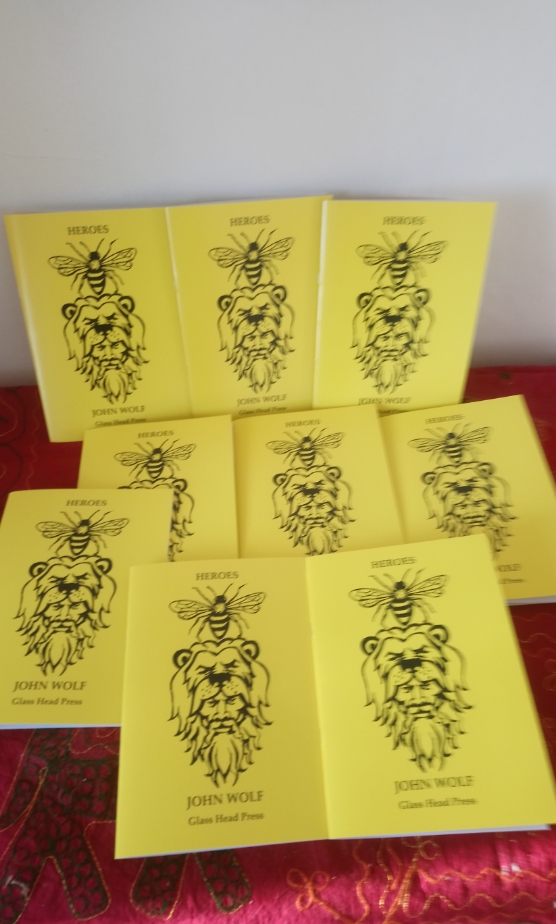
I write daily and stick at it. In the first draft, it’s unclear whether its diamond or coal. I was given some great advice years ago – the more professional an approach you take, the more professional you become. I started writing for enjoyment, which I’m still doing thirty years later. The only difference is, I’m dedicated to craft a poem to be the best I can make it. The covid lockdown period actually helped me to focus on producing the collection. I wrote a poem a day for two years. The first collection, Heroes comes out soon, which will be a massive buzz. It’s a real team effort – I’ve had nothing but help and support from Ian Parks, and many members of Read To Write, which is why I wanted an Open Mic session to follow it, because I love to hear everyone read. Every member of that group is writing better poetry than they did last year. You become a better writer when you teach, because you dedicate yourself to learning. Given the right opportunity, I would go back to being a Creative Writing Tutor because it runs in parallel with writing and it keeps me grounded.

7. How do the writers you read when you were young influence your work today?

I read Roger Lancelyn Green’s Robin Hood when I was about eight, so the love of myth and folklore is still there. In the school library on wet afternoons I read the trails of Heracles and Lord of the Rings. Now I’m writing alliterative verse, teaching Beowulf and Homer’s Odyssey. Stories like Robin Hood influenced me to become an environmentalist; initially a Park Ranger so I could work with woodlands then later a manager so I could help people and the environment. A lot of the jobs I’ve done have been advisory; communicating ideas and learning to clients. Many folktales are from that kind of moral perspective – from the wisdom of age to a young person. Even when really young I understood that there was a depth and truth to the experience of surviving outdoors and connecting with mother nature. One of my earliest poems was called Place Among The Stones – essentially about the pagan connection to land and spirit and where I’ll go when I die.

8. Whom of today’s writers do you admire the most and why?

The latest one I read is Dai Fry – his Under Photon Crowns is terrific; all about deep time and connection. I love Seamus Heaney’s bog bodies & Viking burial poems. We’ve recently being studying The Hull Poets – Larkin I loved, but now it’s Douglas Dunn’s Terry Street, which is an incredible social commentary of life in the Hull slums. Edward Thomas and Robert Frost have nudged their way up the leaderboard; whereas Uaden has always been there. Roger McGough has always been in season, and Brian Bilston makes me laugh. Simon Armitage’s Odyssey is brilliant. Stephen Fry’s Greek myths retold are bright, witty and his humour is hilarious – I’ve just bought Troy (2021). Akela’s Odyssey is an amazing achievement. Imagine remembering over 12,000 lines of verse.

9. Why do you write, as opposed to doing anything else?

I’m curious; really enjoy researching then writing, whether it be poetry or prose. Many of my jobs included writing reports and advising managers of the way forward, so you learn to think critically and ask questions about a subject. What if? Makes you a storyteller. What does that feel like? Makes you a poet. I’ve been a reader since I was eight and a writer, then a poet. When you read a poem out on Radio Sheffield dedicated to Benjamin Zephaniah, a day that started dressed up as a cowboy in Lesley’s Shed, you communicate with new people and that’s a golden moment. Politically, I’m championing people who have been trodden on by an uncaring society built by amoral capitalists; it’s tough at the bottom: Poets Win Prizes We are literate Ninja, sponges of the masterclass, champions of the underclass, willing to die a thousand times, just to be heard.

10. What would you say to someone who asked you: How do you become a writer?

By writing. By improving. By being who you are. I once had a business card printed that, instead of listing professional qualifications, it said : John Wolf Human Being, Writer and Poet. What’s the second thing you get asked at a Party? What’s your name, and what do you do? This label tells other people what you already know. But by putting it our there you pave the way to that future. Envision, manifest. Otherwise you might reply: “Err, I’m sort of farting about doodling poems, they’re not very good and I’ll never read them out. My husband says they’re crap but my sister says I’m great. I paid £5000 to have them published.” You’re not a writer, you’re an idiot! My publisher paid to publish my work, which means he took the risk it would sell and he believes its of the right standard. That’s something to be proud of. Life the conventional way didn’t work for me, but the life I live now, does. Buy Heroes, it’s worth reading. I have a great sci-fi short story called Symbiont too, if that’s your bag. You work tirelessly at things you love doing. In a previously dull life of duty and responsibility, I worked 22 jobs, which paid for material things but did not make me happy. I wrote before, during and after. You can study a Creative Writing degree but only dedicating your life to writing makes you a writer. Leave the ego on the roadside, read as much as you can and read your own poetry aloud. Listen to what the market wants rather what you think they want. People who edit and sell poetry books can tell you. Write for the love of it and do so in your own voice. It’s fine to imitate in order to learn but few impressionists are memorable. (Mike Yarwood, Monet, what did the Impressionists ever do for us?)

11. Tell me about the writing projects you have on at the moment.

My debut collection entitled Heroes launches on the evening of 9th July at Doncaster Brewery Tap. Following the success of last year’s Beowulf, I’ll be teaching Homer’s Odyssey for Read To Write in Doncaster. Then I’ll be part of the Glasshead Press Anthology, so that’s a few new poems to write. We’re having a tour soon, of the Hull Poet’s haunts with expert guide, Ian Parks, who studied at Hull University and knew many of the people whose poems we’ve been marvelling over. I’ll write off for a few competitions just to keep the fingertips sharp.

12. How did you decide on the order of the poems in your chapbook?

I had editorial control but took advice from Mr Parks on content and editing, I went with Ian’s recommendation as he knows poetry and the market, and were delighted with the end result

13. How important is form in your poetry?

I’m generally a free verse poet, largely because a sonnet is a straight-jacket to me.
The more great poetry I read and hear, the more I’m experimenting with form.
Content and message tend to drive choice of form.

14. How important is nature in your poetry?


As a career environmentalist, I have a strong connection to the land and nature.
I’m working on a second collection on an environmental theme. Many of its poems are about individual species, whether that be a response to Ted Hughes’ Jaguar, or a parody of Wallace Stephens’ Thirteen Ways of Looking at a Blackbird. In Heroes, there’s a poem called Love at First Bite, which is a fusion between finding a solution to the peril of plastic in the ocean and a snapshot of the odd creature who might be the solution; the Hagfish. Major eco-themes occupy much of my head – I’ve written poems like Bushfire, about the great fires that raged across Australia, or Bee Ing, which focuses on the humble industrious bee, responsible for pollinating 70% of the food crops we need. The bee is one of our world’s real heroes.

15. Why is performance vital to your poetry?


Spoken word and cadence, how a word sounds, is an ancient entity. I’m the modern descendant of those bards who toured the land entertaining and agitating, spreading folktale and rumour. We love to share a joke or a story, to shape words individually; they’re personality crafted. Communicating ideas and sharing visions is vital to building a future where diverse people work together for a better world. Look at the difference in children who have been read to and encouraged to read as opposed to those who grew up with ‘shut up and watch Spongebob’. For me, it’s about connecting with an audience. Literates, musicians and artists are a positive community who invest in people.
With spoken word, emotion transfers. Live stuff can always go wrong, so the buzz of adrenaline electrifies your veins.

16. What is the role of popular culture in your writing?


When Read To Write studied Terry Street, Douglas Dunn’s masterpiece about life in the slums of Hull, I felt empathy for real people and a genuine interest in their lives. It’s working class, warts-and-all, places I came from. I don’t support elitist poets like TS Eliot who write for a select few and expect you to have three degrees just to understand the references in his poem. A poem should communicate with ordinary people. That doesn’t mean it’s about popcorn and Love Island, just that the interests and lives of us ordinary people are just as valuable.
We live in very media-centric times, bombarded by advertising, opinion and misinformation.
Some self-appointed moral arbiter or opinionated Twitter influencer telling me how to live can jog on.

Pop music means nowt to me. I’m happiest with a crusty folk gig, sat round a campfire, or at a Poetry Slam enjoying the myriad of ways and wisdom that enlighten the life we live. I can still write poems about Ben Shaw’s pop, Campbell’s Soup Cans or how awful Love Island is.

17. How political is your poetry?


I was an angry young man for fifty years. I’m not party political but I lived through a Miner’s strike and a decade of austerity. When I see something that’s clearly wrong in the world – such as Boris Johnson and everything he stands for – deliberately manipulating market mechanisms to preserve mass poverty, retaining power and control in the hands of the few; then I label it tyranny. Ukraine and Putin – war crime. It’s hard to write poems about war if you have never been a soldier. Authenticity matters as does getting your facts straight.
Strong emotion and opinion is good in a poem – there’s something to engage or argue with – but I write better from an objective distance. I read out one political poem at a recent Ukraine benefit gig and it was well received.

18. After having read your book, what do you wish the reader to leave with?


I’d like them to be happy that they came to listen or buy the pamphlet.
I’d also like them to have learned something or taken that idea further forward.
When I’ve read great poetry, I’m enthused with ideas and start writing. But for others that might be painting, sculpting or playing a guitar,
so I’d like to inspire others to be who they are and create.
In terms of how we see the world, how we make sense of it, it’s great to connect with people.

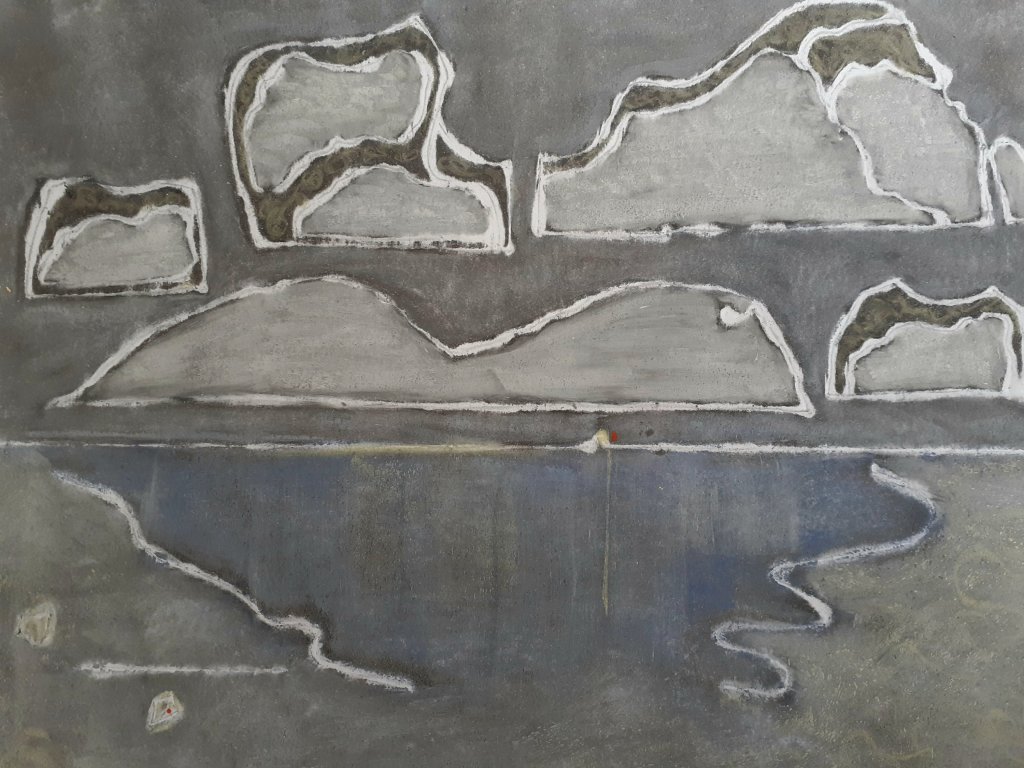
.untitled.

Sonja Benskin Mesher's avatarsonja benskin mesher

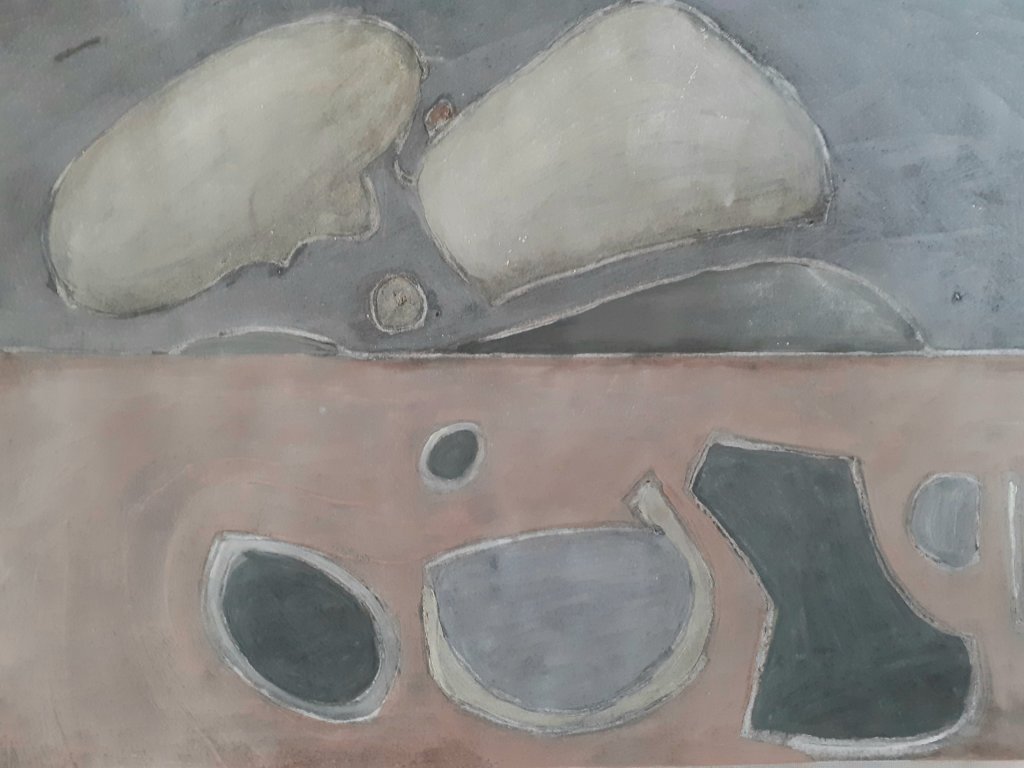
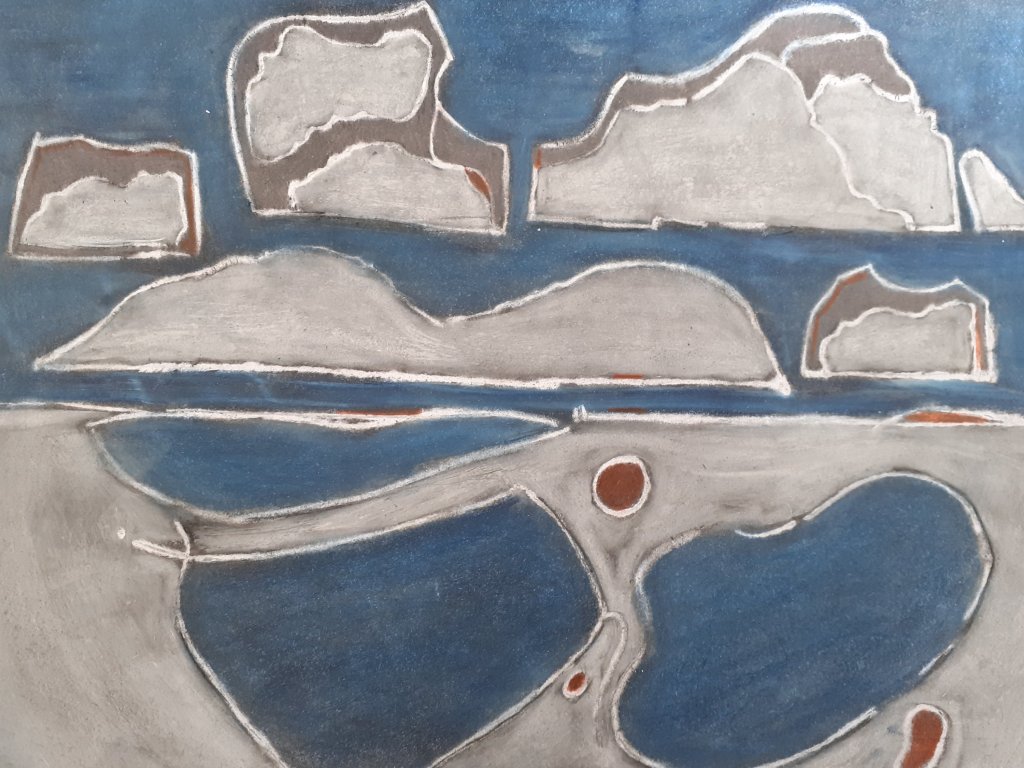
that feeling that arrives with the name of the county

the memory of your home and closeted life
now eroding slowly

that sense of belonging to the land

it is that feeling

View original post

.untitled.

Sonja Benskin Mesher's avatarsonja benskin mesher

that feeling that arrives with the name of the county

the memory of your home and closeted life
now eroding slowly

that sense of belonging to the land

it is that feeling

View original post