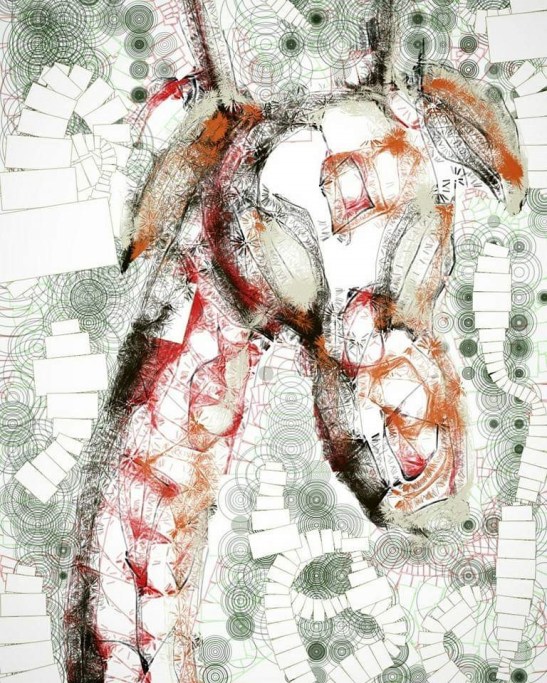
Four Poems, Three Art Works by Kushal Poddar

Kushal is a wonder.

robertfredekenter's avatarIceFloe Press

Aunt Elvis

Listening to Elvis cures my aunt’s ailments,
and she knows barely any English.

I never guess what’s been her suffering,
but she looks complacent

staring at large at nothing
that metastasizes across the corral of Jack Frost.

We listen to Presley. My hands hold
the universe of the weak tea;

she brews silence and smile;
two kittens she almost adopted play with the sun.

Wind blows brown.
Our lungs turn into clay models from a school abandoned.

The Most Rained

The most rained morning,
muted crackling, vapor rising
from the leftover riot of silence,

my siren hand pierces
your stupor of dream.
“South of being burns”, I say,
and you ask, “Where

will we find a leeway
for our offsprings?”
I know not. Rain tiptoes,

fails and falls midst

two icebergs melting apart –
the time we perceive and
the time that holds us within.

Australia 2019-2020


When…

View original post 319 more words

Two Poems by Antoni Ooto

Well worth a look.

The Bardo Group Beguines's avatarThe BeZine

Housebound

everything was so honest once
but more disappears

games in vacant lots
old haunts
all those loves

days tick down
the mirror considers what’s left

“I sit talking to myself
losing time.”

“I’m at the end of everything
barely existing.”

and my resolve?
that’s already hardening.

Minimal

How small can a life get?

Once with the strength of a Morgan
everything pulled uphill…
now, over time, resigns to cleverness of necessity.

Graceless age clutches my shirttail
dragging me everywhere.

I remember tricking my way.

In a book I read,
a bite of land was given toward the end
something—manageable to lose…

© 2020, Antoni Ooto

ANTONI OOTO has and still looks for answers which he shares at times with poetry. He finds pleasure in reading the works of many poets such as WS Merwin, Jane Kenyon, Donald Hall, Elizabeth Bishop, Margret Atwood, and the humor of James Tate.

“I read various poet’s first thing…

View original post 100 more words

iambapoet.com is a site I cannot recommend highly enough. You can hear remarkable poets reading stunning poetry. Thankyou curator Mark Antony Owen.

https://www.iambapoet.com/about-iamb

Iambpoet,com

Wombwell Rainbow Interviews: Nigel Kent

Wombwell Rainbow Interviews

I am honoured and privileged that the following writers local, national and international have agreed to be interviewed by me. I gave the writers two options: an emailed list of questions or a more fluid interview via messenger.

The usual ground is covered about motivation, daily routines and work ethic, but some surprises too. Some of these poets you may know, others may be new to you. I hope you enjoy the experience as much as I do.

NigelKent-Saudade

Nigel Kent

is a poet living in rural Worcestershire. He is an active member of the Open University Poetry Association and occasional editor of its workshop magazine. He has been shortlisted for several national competitions and his poetry has appeared in a range of publications. His poetry conversation pamphlet, ‘A Hostile Environment’, written in collaboration with Sarah Thomson, was published by Hedgehog Poetry Press in January 2019, and a second conversation, ‘Thinking You Home’ in June 2019. His poetry has been translated and appeared in the literary journals, Pro Saeculum and Banchetul. Saudade is his first collection. You can follow Nigel on Twitter @kent_nj

Nigel performs his poetry at iambapoet.com

https://www.iambapoet.com/nigel-kent

The Interview

1. When and why did you start writing poetry?

I was hooked on poetry in my teens after hearing the songs of Leonard Cohen and reading his poems. Cohen’s ‘Poems, 1956-1968’ was the first poetry book I bought. I was then introduced to the work of Adrian Mitchell, who was appearing at the Cheltenham Literature Festival, and was bowled over by his performance and the work. After that I couldn’t get enough: Wilfred Owen, D.H. Lawrence, Elizabeth Jennings and even Robert Herrick were early favourites!” I was attracted to the form because of its music, its economy, its inventiveness and its power. A friend of me showed me a quote by Sara Collins the other day: ‘A novel is like a long, warm drink but a poem is a spike through the head’. It captures for me poetry’s capacity to synthesise strong emotion and observation. I want to be moved by poems, but I also want poems to resonate with me long after I have put them down. That’s the sort of poetry I want to write.

2. What inspired you to write ‘Saudade’?

On a writing weekend I attended the tutor invited us to write a poem exploring an emotion. I had always been intrigued by the word ‘saudade’. It is a Portuguese word for which there is no direct English translation. It describes a profound melancholic longing for an absent something or someone that one has loved. Some define the word as the love that remains when one has accepted that the object of love has gone forever. The memories of the loved one elicit a deep sense of loss whilst simultaneously evoking the joy and happiness associated with those moments. The resulting poem was the title poem ‘Saudade II’. When I was asked to put together a collection, the word seemed to capture the mood of many of the poems I had selected: a sense of incompleteness, sometimes fostered by social media with its images of idealised lives (Pop-up Princess, Saudade II), sometimes because we have made life-changing mistakes (Saudade I, Saudade II, Breakfast Scene); sometimes because we are victims of events we cannot control (Dignitas, Sweet and Sour, Miscarried, The Maids, Separation). Furthermore, some of the poems acknowledged that what makes life fulfilling today will not last forever. Understanding that, however, doesn’t make its loss any easier to bear (Casting Off, Empty Nest, Home Truths, Clearing Out). The notion of ‘Saudade’ then was a vehicle for pulling together a collection of poems.

3. How aware are and were you of the dominating presence of older poets traditional and contemporary?

I’ve always been an avid reader of poetry. I try to read some poetry every day. I find that reading poetry feeds the imagination and motivates me to write more. I’m drawn to poetry that has a narrative element, that explores relationships and emotional states, that finds significance in the ordinary. For those reasons one of my favourite poets is Thomas Hardy. His ‘Collected Poems’ that I bought in 1973 is probably my most read book. I can think of no better sequence of poems than those he wrote after the death of his wife, Emma, in 1912-13: examples of saudade that I can only aspire to!

My favourite contemporary poet is Ted Kooser, author of ‘Kind Regards’, ‘Flying at Night’ and ‘Delights and Shadows’. He writes about every day, unremarkable experiences: a student walking along the road, a man tying a tie, a woman washing her hands. Yet he illuminates such moments with such empathy and compassion, finding beauty, dignity and humanity in them. Jonathan Edwards’ ‘My Family and Other Superheroes’ and ‘Gen’ has a similar appeal for me. I can see the influence of these poets and others like them in my work.

4. What is your daily writing routine?

I consider reading poetry as part of a writing routine. I will read poetry for at least thirty minutes per day. I keep three notebooks: one in which I note memorable lines from what I’ve read: one in which I note themes or ideas for poems; and one in which I’ll jot down lines, the development of ideas, the products of research etc. I use a word processor to draft, always saving each version in a separate file. I cannot start, however, unless I’m clear about what it is I want to say and how I’m going to end it, though inevitably this does evolve during the process. This involves endless staring into space; I’m a very slow writer. Clarity generally arrives through a shower, a walk or sometimes through writing out in prose my intentions. I find I’m most productive first thing in the morning, 8 till 10 and between 4 and 6 in the afternoon. I wrote most days, since retiring, though I might only produce 15-20 words. Most poems undergo at least 10 drafts, though interestingly my Pushcart Prize nomination, ‘Miscarried’ was the product of only 5 drafts; there may be a message for me there! When I can I’ll ask another poet to read what I’ve written. This was one of the benefits of the poetry conversations, ‘A Hostile Environment’ and ‘Thinking You Home,’ with Sarah Thomson, (published by Hedgehog Poetry Press): I believe that the poems were stronger for the honest appraisal we gave each other when we were writing. I have also used ‘Crits’ Corner’ on the Hedgehog Poetry Press website to engage with other poets about early drafts and I regularly receive useful feedback from the Open University Poets’ Society workshop magazine. Even then, however, I seem to have the annoying habit of suddenly thinking of how to improve the poem after I have submitted it for a competition or for publication.

5. What motivates your writing?

That’s a good question because I find writing poetry extremely demanding. Life would be so much easier if I didn’t. I suppose like most writers I’m trying to make sense of my experiences and those of people around me. It’s also the case that when I was at university, studying the literary canon, I seldom felt that the texts were about people like me. Characters from my sort of background were rarely foregrounded and if they were their functions were to advance the plot or to be the source of comic relief. I hope my work gives a voice to people leading unexceptional lives. Then, of course, there are the challenges of the form (the economical use of words, finding the right sound and rhythm, the choice of imagery etc.), the sense of satisfaction when you feel you have largely met those challenges and the feedback from readers when ‘they get it’.

6. In your poems there are lots of references to how we choose to frame our lives, such as cutting and pasting and painting.

Yes, in ‘Saudade II’ I do use imagery drawn from computer graphic programmes: ‘cut’, ‘paste’, ‘cropped’, ‘saturated’. I suppose what interests me about computer technology and software is that it gives us a sense of control but that control is illusory. The father in the poem wants to resurrect his relationship with his daughter, but he does not have the power to do so. The imagery evokes the futility of what he’s doing. It is also the case that I wanted to convey the way in which we construct alternative realities when life is just too painful to cope with. He has ‘cropped’ the summer sky, the sky is ‘saturated blue’: in doing so, he has created something artificial and delusional. This is similar to the way in which the speaker in ‘Depict’ paints out the ‘brooding clouds/with a bright summer sky/much too blue’. He cannot cope with the memories of childhood; they’re kept in ‘tubes/with caps twisted tight’, so he edits them out of his consciousness.

7. How do the writers you read when you were young influence your work today?

When I started writing I was intimidated by the classics, particularly when I studied them at university. My efforts paled in comparison and I wondered if in fact I was writing poems. They made me feel that I didn’t have anything to say and I didn’t have the tools to say it! Over time, as I read more, I began to realise the diversity of the genre: whilst there were poets such as Shakespeare, Keats, Shelley, Coleridge and Wordsworth, there were also writers like Brian Patten, Adrian Henri, Adrian Mitchell, Edwin Morgan, Elizabeth Jennings, Stevie Smith and Sharon Olds. I suppose initially many of my poems were imitations of the last poet I’d read. However, in a sense that served as a sort of apprenticeship in which I learned to find my own voice.

8. You have four poems ‘after’ painters: Walter Sickert, Paula Rego, Edvard Munch, and Roy Lichtenstein.

Yes, these are from a sequence of ekphrastic poems that I wrote last year in which I explore the relationships conveyed in the paintings. All the paintings have a narrative quality and I attempt to explore in words those relationships and mirror the very different emotional impact of each work.

9. Who of today’s writers do you admire the most and why?

There are so many. I’ve already mentioned Kooser and Edwards earlier so I won’t comment on them again. Stephen Dunn is a current favourite. He has written so much but is never repetitive. I like his accessible, conversational style, the sharpness of his perceptions and the precision of his language. I’ve just discovered Natasha Trethewey. In her collection ‘Monument’ she writes about working-class African American women, interweaving personal experiences with historical events, giving them an epic significance. On a lighter note I like the wit and inventiveness of Charles Simic and Brian Bilston.

10. Your prose poems have a distinctive character. Their titles are all in capitals and you have spaces in addition to punctuation. How and why did you decide this was the shape that they must take?

These poems are taken from a sequence I have written on austerity Britain. The titles are all quotes from Charles Dickens and seek to connect the poverty of Victorian society with the effects of the policy of austerity, challenging the reader to find the difference, if they can. Each poem tells a story illustrative of one or more effects of living in poverty today. The use of the second person is intended to connect the reader with the experience more directly. The poems combine the conventional syntax of prose with line spacing, which I hope lends emphasis to the emotional impact and meaning of each isolated phrase and clause. The capitalisation was an editorial decision.

11. What would you say to someone who asked you “How do you become a writer?”

I think the starting point for any writer is having something you really want to communicate. Secondly you need to know your genre; read as widely as you can and have a look at ‘The Way We Write’ by Fairfax and Moat and Kowit’s ‘The Palm of Your Hand’ which discuss the process of writing poetry. Allow ideas to incubate and draft, draft and draft again, leaving time between drafts so you can view your efforts more objectively. If you can, join a writing community to give you honest feedback on what you’re written. If you seek to get your work published, remember that all writers suffer rejection. Editors, like us all, have personal preferences.

12. Your work, especially the poems towards the end of the book, remind me of one of my favourite writers, the late Peter Reading. He also wrote powerful accounts of cruelty and poverty. Your poems engrave themselves on my mind.

Wow! I’m flattered by the comparison! In my personal and professional life I have experienced the corrosive effects of poverty on families and relationships. I like to believe that the arts can impact upon society and think of the way Paula Rego’s paintings changed the abortion laws in Portugal. I’m still idealistic enough to believe that poetry can also make a difference, if it good enough. Consequently, I admire the work of Fly on the Wall Poetry Press and its editor, Isabelle Kenyon, whose anthologies on social issues such as mental health, homelessness and the environment attempt to do just that both in terms of the impact of the poems and the money raised by sales.

13. The book is topped and tailed by descriptions of live performances, the first one on the inner struggle to control the words, the second on inviting the real world in. Is “The Urban Shaman” and deliberate reference to “The Urban Spaceman” song?

These two poems represent my hopes and fears for the collection. The first poem, ‘7.30 p.m. at the Arts Workshop’, conveys my nervousness of exposing my work for the first time on such a scale to the critical scrutiny of others. Despite your best endeavours, when you publish your first collection, you run the risk of humiliation and of your words dying on the page. I guess, therefore, it might be my subliminal attempt to secure a sympathetic reception by the reader! The final poem ‘The Urban Shaman’ was written after hearing a particular poet at the Poetry Café in London and captures my aspirations to be as successful as him in securing the attention of the reader and producing a set of poems that will linger in the consciousness long after the reader has put the book down. This is very much a development of my answer to your last question where I suggest the best poetry aspires to alter the consciousness of the reader.

14. What does narrative poetry do for you?

I suppose it depends on how you define narrative poetry. I like poems that tell stories, but I’m not a lover of ballads, because I prefer economical verse: the tighter the better. I do accept, however, that each of my poems tells a story, exploring the emotional significance for those involved: e.g. the dysfunctional family in ‘Breakfast Scene’, the father waiting for a text from his daughter ‘Faraway’, the teenage girl’s prom in ‘Pop-up Princess’. They have the elements of narrative poems (such as characters, exposition, complication and resolution) but I’m not sure you would describe them as narrative poetry.

15. Tell me about writing projects you’re involved in at the moment

I’m currently working on a series of poems about ageing. This year, however, I want to get out and about promoting ‘Saudade’, reading in as many poetry groups and festivals as possible. I am also delighted to have seen my work included in Mark Antony Owen’s excellent website ‘iambapoet.com

“The BeZine” February Blog Series on Illness and Disability begins today; Why “Disabled” not “Differently Abled”

Worth following.

Jamie Dedes's avatarJamie Dedes' THE POET BY DAY Webzine

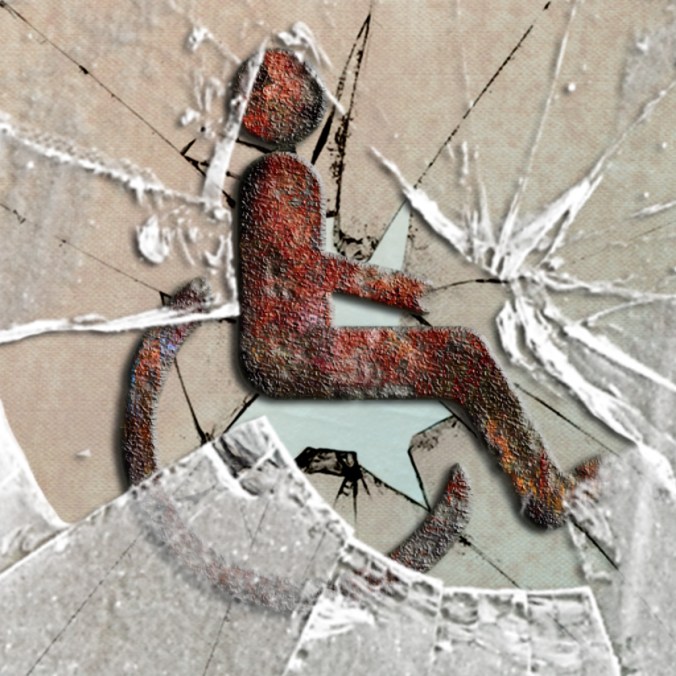
Courtesy of Tiago Moisés under CC0 Public Domain license via PublicDomainPictures.net

“My disability exists not because I use a wheelchair, but because the broader environment isn’t accessible.” Stella Young, was an Australian comedian, journalist and disability rights activist. She was born with osteogenesis imperfecta and used a wheelchair for most of her life. When she was fourteen she audited the accessibility of the main street businesses of her hometown.


Throughout the month of February 2020 The BeZine blog is featuring a range of material on illness and disability in concert with Kella Hanna-Wayne’s YOPP!, a social justice blog dedicated to civil rights education, elevating voices of marginalized people and reducing oppression. Our intention in doing this is to give voice to those with illness and disabilities, to raise awareness of the issues and outcomes, and to offer workable alternatives for those who have to manage in environments that are not…

View original post 514 more words

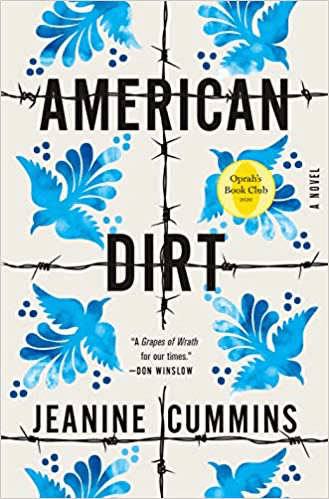
The “American Dirt” Controversy

Thought-provoking.

Jamie Dedes's avatarJamie Dedes' THE POET BY DAY Webzine

“The fact that we [Flatiron Publishing] were surprised is indicative of a problem, which is that in positioning this novel, we failed to acknowledge our own limits. The discussion around this book has exposed deep inadequacies in how we at Flatiron Books address issues of representation, both in the books we publish and in the teams that work on them. We are committed to finding new ways to address these issues and the specific publishing choices underlying this publication, and feel an obligation to our colleagues, readers, and authors alike. On a more specific scale we made serious mistakes in the way we rolled out this book. We should never have claimed that it was a novel that defined the migrant experience; we should not have said that Jeanine’s husband was an undocumented immigrant while not specifying that he was from Ireland; we should not have had a…

View original post 769 more words

Driving Aimlessly on Spanish Roads – Steve Denehan

Excellent Steve Denehan.

robertfredekenter's avatarIceFloe Press

Driving Aimlessly on Spanish Roads


The day started on the wrong side of the road
began with tears for friends lost
their holidays over
she folded herself into my arms
I told her that there would be more friends
even better friends
I felt her chest heave against me

I suggested we go, right away
and so
we ran to the rental car
hopped in
I drove
but she was in charge
we started on the wrong side of the road

“Dad!”

we came to a T-junction
I listened for the call from the back seat
“Left!”
we were away
the cracks in the roads got wider
got deeper
the buildings spread out
standing alone like lonely first teeth
the corn in the fields was high and talked to us in whispers
through the open car windows

“Right!”
we looked for signs of life but there were none
the urban…

View original post 285 more words

A the Storm’s Edge (PaleWellPress 2020) by Frank McMahon launches today; poetry sampler

Well worth a gander.

Jamie Dedes's avatarJamie Dedes' THE POET BY DAY Webzine

At the storm’s edge
always, never knowing if it will discharge
and overwhelm, or if it will relent,
recede as the season drags itself upstairs and round the cot …
At the Storms Edge, Frank McMahon


CHECKING IN

You’ve packed your bags and checked them in,
been processed through security,
bought some scotch at the duty-free,
then sit, a latte in your hand,
waiting for the final call to board.
When.

Your partner, family, friend exclaim:
The flight’s delayed. How long?
Who knows? Then all the screens go blank.
People mill and swirl, bark down mobile phones,
hover for announcements.
You let it all wash round and wait for news.
There will be news, so just sit still.

Sit still. Sounds evaporate, eyes
evade the strident lights. Deeper
you drift as if drowsing on a beach
or by a pool. Some time, who knows when,

you feel the gentle…

View original post 568 more words

Author Feature: ABIGAIL GEORGE

Intriguing read. recommend Don Beukes whole site.

Don Afrika-Beukes Chronicles's avatarDon Afrika-Beukes Chronicles

Who is Abigail George?


Background

Abigail was raised in a family of educationalists and schooled in Port Elizabeth in the Eastern Cape, South Africa, Swaziland and Johannesburg.

She is an author, essayist, memoirist, a feminist, poet and short story writer. She is an aspiring novelist and playwright. She contributes to a symposium that appears bimonthly on Ovi Magazine: Finland’s English Online Magazine.


Shura

My flesh, my blood and your stem ill and bitter
Sink deep into your grave my little bold skinned flower
So small with your weak limbs heiress in your mother’s arms
You killed an angel you filthy exotic paranoid foreigner
With your orange silks, bangles at your wrists.
Known beloved, known neurotic will you ever be forgiven?
In death both of you will thrive at Ted Hughes’s bone-clinic
And you will whisper that war your majesty is a crime.
My dreamer, love poem, sonnet and my shell…

View original post 3,303 more words

Wombwell Rainbow Interviews: Dom Conlon

Wombwell Rainbow Interviews

I am honoured and privileged that the following writers local, national and international have agreed to be interviewed by me. I gave the writers two options: an emailed list of questions or a more fluid interview via messenger.

The usual ground is covered about motivation, daily routines and work ethic, but some surprises too. Some of these poets you may know, others may be new to you. I hope you enjoy the experience as much as I do.

Don Conlon

Dom Conlon

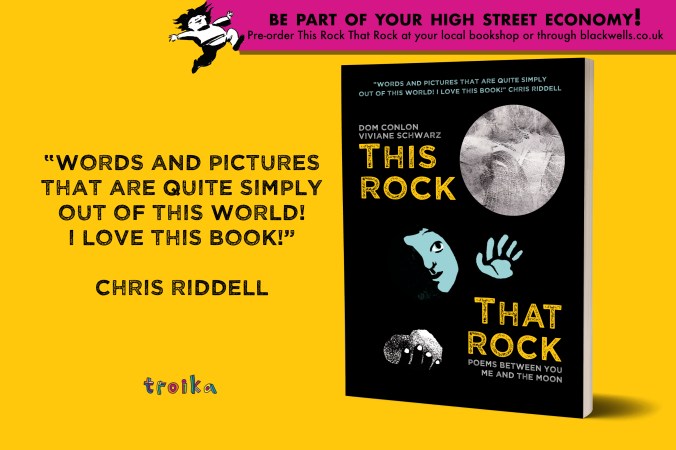
(@Dom_Conlon) is a poet and author. His collection Astro Poetica (illustrated by Jools Wilson (@JoolsAWilson) ) was praised as being ‘Insightful, thought-provoking and fun’. Dom is available to hire for school visits, as well as a copywriter for advertising and social media. His writing has brought him to the attention of BBC Radio where he is a regular guest, discussing science and poetry. Troika Books, a renowned publisher of children’s poetry, are releasing This Rock That Rock, a collection of fifty poems illustrated by Viviane Schwarz (@VivSchwarz). Dom has no cats, three pens, and a freezer full of ice cream. You can read more about him, including lots of poems and stories, at www.domconlon.com

The Interview

1. What inspired you to write poetry?

I am constantly inspired to write poetry. I listen to the pulse of daily life, watch the tiny seasons passing through each minute, and feel the turn of the earth in my step. How could I not write poetry with all of this flooding through?

2. Who introduced you to poetry?

There is no ‘who’ but there are many ‘whats’. Like the Moon, and music, and time, and my son, and so on. But I have been fortunate to be able to talk about poetry with people. My high school English teacher, my A-Level teacher, the lecturers and students at university. And of course everyone in my life today. We all introduce each other to poetry. It’s a constant process, renewing itself with every conversation so that it always remains fresh and vibrant. It’s a duty, I think, we have to one another in life.

3. How aware were you of the dominating presence of older poets?

When I first began reading poetry and writing it, every poet was older. I wouldn’t use the word ‘dominating’. I’d say ‘guiding’.

4. What is your daily writing routine?

I listen. Some days I do not physically write but every day I listen. There are things I heard years ago which will make it into poems when the time is right. Some days I have to write though. Some days I’m on a deadline to deliver a poem. That’s when I sit down and remember what I heard. I’ll put words onto my laptop or phone or notepad until I sense a shape of something. Then I’ll take that shape and guide it through drafts until I understand what I wanted to say. Sometimes I’ll know quickly, other times it takes a while.

5. What motivates you to write?

An itch. It might be a word or a phrase or a line or just a rhythm. But I have to respond to it. Sometimes I will have been asked to write something and (if I’m very lucky) sometimes someone will be paying me to write. All of these things are great motivators but really, I just have to write.

6. What is your work ethic?

I’m good at turning on the tap. I have always been faced with deadlines and so I know how long it will take me to write something. It’s better for me to take more time to write but I don’t always have that luxury. When I do I don’t always make the best use of the time though.

7. How do the writers you read when you were young influence you today?

They are always beside me. One book I loved when I was in my teens was Moon Whales, by Ted Hughes. I still have the book and was so pleased to get it signed by the illustrator, Chris Riddell. Both the words and the illustrations guide me when I’m thinking about poetry. The same is true of other poets I adore: E E Cummings, Sylvia Plath, Mary Oliver, Wisława Szymborska, and many other more recent poets.

8. Who of today’s writers do you admire the most and why?

None of them. They are all rubbish except me. I’m joking, of course. I admire so many: George Szirtes, Nicola Davies, Brian Moses, Joe Coelho, James Carter, Sue Hardy-Dawson, Tony Walsh, Rachel Rooney, Liz Brownlee, Chitra Soundar, Matt Goodfellow…I feel as though I’m listing friends and I am! So basically I love the poets today who I know and who have been kind enough to call me friend. And in addition there are so many because poetry is an endless and open forum for beauty.

9. Why do you write, as opposed to doing anything else?

I write because I can. And because I can I want to become better at it.

10. What would you say to someone who asked you “How do you become a writer?”

Write. Just write. I imagine this is a common answer but it’s no less true because of that. It’s the answer I give to children who say they want to write. There is nothing stopping you from becoming a writer. You don’t need permission to be one any more than you need permission to breathe. Write. If you are asking “How do I sell my writing, or make a living from it” then that answer is much harder but still begins with “write”. The better you become, the more you write, the greater the chance there is of earning some money from your work. It’s difficult and there are no fixed paths to earning a living as a writer but the one thing that is guaranteed to prevent you is not writing. So write.

11. Tell me about the writing projects you have on at the moment.

I’ve just finished a collection of poems called This Rock That Rock which is due out at the beginning of March (2020). I did that with the incredible artistic talent of Viviane Schwarz and I want everyone to buy a copy. I really do. I’m so proud of it and feel it is a good thing to put out into the world. I’ve also got another book out this year but I can’t say anything about that here. And of course, I’m writing more. More poetry, more stories, more things which delight me.

12. I love how the poems work in tandem with the illustrations.

That’s ALL thanks to Viviane Schwarz. The process of illustrating the book was extraordinary. Viviane has the most remarkable ability to shapeshift into the words, inhabiting them in a manner that makes it difficult to see where the two sides of this book start and end. It’s no longer as easy to say there are poems and pictures because the pictures are poems and vice versa. Viviane even helped the word parts of the poems to change, as I found myself wanting to re-write in response to her insights and style choices.

13. In that sense the poem and picture together become a poster that can be copied from the book and put on a wall.

Absolutely!

I began to create a series of postcards to help promote the book and as I did I saw how this book could be accessed in different ways. It took me back to how Viviane made a box and put each poem in it on its own piece of paper. She would reach in, take a single poem out, and carry that in her day until she knew what needed to be done.

14. In your introduction you spend as much time extolling the delights of poetry as you do the moon.

Isn’t reality incredible? The Moon, a river, a laugh. It’s all a delight. Poetry is the only way I know to show my incredulity and joy in a way that intensifies it.

15. How do you find the form to suit the poem? I’m thinking of the first poem which is like an Anglo-Saxon riddle.

It is an Anglo-Saxon riddle! That is made using kennings, one of my favourite poetry tools.

Sometimes the rhythm of a phrase dictates the form. Sometimes I know I want to represent ideas in a formal way (so I might choose a sonnet for that). I like to see where the idea takes me and usually that helps me find the form. There is a ghazal in the book which is a very old form of Arabic poetry. It took a great deal of research and I was grateful to an archaeologist called Rizwan Safir who told me about Ahmad Ibn Majid, a medieval navigator. Ibn Majid wrote about the relationship between Muslims and an understanding of the Moon—particularly when it comes to celebrating Eid ul Fitr and Eid ul Adha which rely on the sighting of a new moon (that’s when the moon is dark). Rizwan’s patience helped me to gain a small insight into the rich heritage of Arabic science and I tried to represent that through the ghazal.

16. How did the moon help you cope with the mysteries of the human heart, like grief?

The Moon is meditative. It’s a focus away from anything happening down on this planet and by looking up I am lifting myself away. I don’t need to think about grief or worries because the Moon helps me to reach a state of calm in which my unconscious brain does all the heavy lifting. Try it. Slip behind your curtains at night and look, or pause in the street and look up at the Moon during the day. It’s the full stop before the next sentence, the light at the end of the tunnel.