Wombwell Rainbow Interviews: Catherine Baker

Wombwell Rainbow Interviews

I am honoured and privileged that the following writers local, national and international have agreed to be interviewed by me. I gave the writers two options: an emailed list of questions or a more fluid interview via messenger.

The usual ground is covered about motivation, daily routines and work ethic, but some surprises too. Some of these poets you may know, others may be new to you. I hope you enjoy the experience as much as I do.

Catherine Baker


Catherine Baker

works as an editor, writer and consultant in primary educational publishing. She spends most of her working life thinking about how to make books that are both fun and appropriate for children who are learning to read. She posts very short poems on Twitter @CatBake. She lives in West Oxfordshire with her husband and two children.

The Interview

1. What inspired you to write poetry?

I was a poetry-writing and poetry-reading child, but I stopped writing completely in my early 20s. I was 48 when I started again, in October 2014, almost by accident.

The first thing that prompted me was a kind of experiment – I had been wondering for a while what Twitter was ‘for’, and I decided to give myself a month of daily tweeting to find out. I quickly realised (like lots of other people) that the old-style 140-character restriction on Twitter was perfect for a haiku, or a slimline tanka. So I started writing and posting a very short poem every day. At first I thought I’d run out of ideas within a few weeks, but that turned out not to be the case. I found lots of fascinating poets on Twitter, and I have learnt a lot from reading their stuff, too. Five years on, I’m still posting a daily poem on Twitter. I think I’ve found out one of the things it’s for!

The other thing that inspired me (and still does) was my daily run. This is another thing that I began in 2014. I’m not sure if it’s a coincidence or not, but that autumn I entered a period of quite severe depression, and I found that a combination of daily running and writing helped me to keep my head above water. Where I live (in a large semi-rural village not far from Oxford) there are plenty of good running routes. I like to run about 5 kilometres every morning, and I enjoy getting out into the fields and footpaths. I am a slow runner, and this gives me plenty of time to notice what’s happening around me. I try to notice something every day, and often this forms the spark for a poem. It means that a lot of my poems are about hedgerows, birds, trees, winter light, etc. Fortunately the world is different every day, so it doesn’t get boring. Or it hasn’t yet, anyway.

2. Who introduced you to poetry?

This might sound boastful, but I think I introduced myself. Neither of my parents was particularly interested in poetry, and I don’t remember any of my teachers specifically encouraging it. In fact I once got told off for copying down the words of a poem during an English class (when presumably I was really meant to be doing something else). The poem was ‘He who would valiant be’, by John Bunyan! I do remember finding a copy of Walter de la Mare’s anthology Come Hither in my primary school library, and reading it obsessively. Later I found another de la Mare anthology, Behold, This Dreamer, which I also loved despite finding it quite scary.

3. How aware were you of the dominating presence of older poets?

I’ve never really thought of myself as a poet in any professional way, so I don’t think I’ve ever felt dominated by older poets – possibly you have to feel they represent something you’re aiming for yourself, in order to have that feeling about them.

4. What is your daily writing routine?

I write at least one short piece every single day – I haven’t missed a single day since late October 2014. Even in times of stress, anxiety and illness, I’ve never gone to bed without writing a complete piece. You can tell from this that I am an obsessive person! At least I mostly tend to write 3- or 5-line pieces, not sonnets or epic poetry, so it could be worse. The reason for this persistence is that dailiness liberates me to write. If I had to wait for inspiration, I know that I would never write at all – I’d always be waiting for the perfect idea. This way, I often work with ideas I know are far from perfect, but the game is to make the best thing I can from them. I’m sure my writing is sometimes banal as a result, but the other plus-side of dailiness is that the pieces themselves are quite ephemeral. I don’t tend to look back at them much once they’re written. So if they are banal, I don’t spend long beating myself up about it. I’ll just work harder on the next piece I write, and hope for better ideas tomorrow.

The other thing that liberates me to write is a tight form. Unlike most true haiku and tanka poets, I work within rigid syllable-counting rules – sticking to 5/7/5 or 5/7/5/7/7. Most poets who write haiku and tanka in English nowadays don’t count syllables, and I do understand why – counting syllables can give a forced, artificial feel to a haiku and can detract from the more important elements, such as conveying a clear sensory moment to the reader, using ‘openness’ to invite the reader’s collaboration, etc. But I have found that counting syllables really helps me to find the best words. Without the constraint of form, I feel I’m floundering, and I don’t recognise my own voice in what I write. When I started writing these short pieces, I used to describe them as haiku and tanka, but as I’ve learned more about haiku and tanka I have come to realise that these are not actually what I’m trying to write. I am not interested in any of the ‘rules’ of haiku and tanka except for the syllabification – so in that respect I’m actually the opposite of a haiku poet!

I often start writing a piece as I’m running – I’ll be playing with words to express a visual idea, and often I stop running and type lines, or a whole piece, into the Notes function on my phone. Sometimes pieces start with the visual impact of something I’ve noticed on my run, and sometimes the start is a group of words that are sounding themselves out in my head. Quite often I’ve written the piece by the time I get home (I’ve got over 2500 of these small pieces on my phone now!). But sometimes it takes me all day to get it right. Of course I don’t think about it all day, but it’s as if I take it out of my pocket now and again throughout the day and just play with the words until they’re as right as I can make them.

Some days I have no ideas at all. Then (despite what I’ve just said about haiku) I turn to the classic haiku masters for inspiration. I love Basho and Lady Chiyo-ni, but the one I find most reliably inspiring is Issa (possibly because he writes very differently from me, with a warm and earthy humour, often juxtaposing the conventionally beautiful with something much more down-to-earth). Another really good thing about Issa is that all of his poems are available online, on the brilliant website haikuguy.com, where you can click to see a random haiku from Issa’s massive output.

5. What motivates you to write?

Partly it’s my obsessive nature, but I think I’m also trying to get better at writing, and that motivates me too. I feel as though I have a lot to learn, and the best way I can do that is through daily writing (and reading too of course). I do also want to communicate through my writing, which I guess is why I share it on Twitter. I’m always so pleased when someone comments that something I’ve written reminds them of something they’ve seen or felt.

6. How do the writers you read when you were young influence you today?

I think a lot of the poets I loved when I was young still have a huge influence on me. The main one is probably Gerard Manley Hopkins. I ‘did’ him for O Level and he has never left me since! I know two of his poems by heart (‘Inversnaid’ and ‘Spring and Fall’) and often think about and read his work. I admire the way he crafted a new and shining thing out of the language he used. It speaks very directly to me, and sometimes I consciously try to put words together in a way I think of as Hopkins-like. I loved the poems of Rudyard Kipling too (especially ‘The Way Through the Woods’). I’m not sure I consciously copy Kipling in any way, but I do love the way he uses rhythm and the importance of sound in his work. I try to make sound important too. As I child, I loved Dylan Thomas as well. These days, I don’t think I understand Thomas any more – I can’t quite recapture what I loved as a child. But again, the huge importance of the sound of words in his poems is something I still respond to. When I was at college, I discovered Jeffrey Wainwright and I read his Selected Poems so much that I think I completely internalised them! I still love his poetry, and I still have in my head some of his poems that I learnt then without even trying.

7. Who of today’s writers do you admire the most and why?

I love Alice Oswald for the austere beauty of her writing and her subtle use of form. I like to read her stuff out loud for the music it makes, and I was once lucky enough to hear her speak some of her poems at the Woodstock Poetry Festival – not all poets are brilliant at reading their own work, but she is! I love the work of lots of other contemporary poets too – including Imtiaz Dharker, Alison Brackenbury, Don Patterson, and Liz Lochhead. And Jeffrey Wainwright of course! There are many fine poets writing for children whose work I really admire, too, including James Carter, Sue Hardy-Dawson and Joseph Coelho.

8. Why do you write, as opposed to doing anything else?

I think it’s the best way that’s open to me of making art – it’s how I can communicate the itchy ideas that occur to me and try to make them into something that other people might want to share. I don’t think I could do this in any medium other than words, though I very much admire those who can!

9. What would you say to someone who asked you “How do you become a writer?”

I don’t really have much useful advice about that, except the very familiar exhortation to keep on reading and writing! I wish it were easier for new writers to get published. There are lots of brilliant voices out there who never get heard! I think persistence is probably the key, but realistically most of us will probably never be published. So I would also just say – please try to love the process of writing itself! Then it really can be a joyful end in itself.

10. Tell me about the writing projects you have on at the moment.

I’m keeping going with my daily short piece/s which I share on Twitter @CatBake and also archive on my not-very-whizzy blog, fromfourlanes.wordpress.com. I’m also experimenting with some longer forms, and at the moment I’m trying to write at least one piece per week that’s in a form other than haiku or tanka. It’s early days so far. I’ve written one ghazal that I’m pleased with, and one that definitely needs some improvement. I’ve also written a triolet that nearly managed to express what I wanted it to! I’m going to keep going with ghazals and triolets, and also have a go at some sonnets, maybe a rondel or two… I can confidently predict I’ll never write an epic, though.

I sometimes think about trying to get some of my pieces published in book form – for instance, I’ve probably got enough three- and five-line pieces for a ‘poem a day’ collection! But at the moment I’m concentrating most of my spare energy on just keeping going with the daily writing, and I’ll see where that leads me!
Wombwell Rainbow Interviews: Sue Kindon

Wombwell Rainbow Interviews

I am honoured and privileged that the following writers local, national and international have agreed to be interviewed by me. I gave the writers two options: an emailed list of questions or a more fluid interview via messenger.

The usual ground is covered about motivation, daily routines and work ethic, but some surprises too. Some of these poets you may know, others may be new to you. I hope you enjoy the experience as much as I do.

OutsideTheBox-1

Sue Kindon

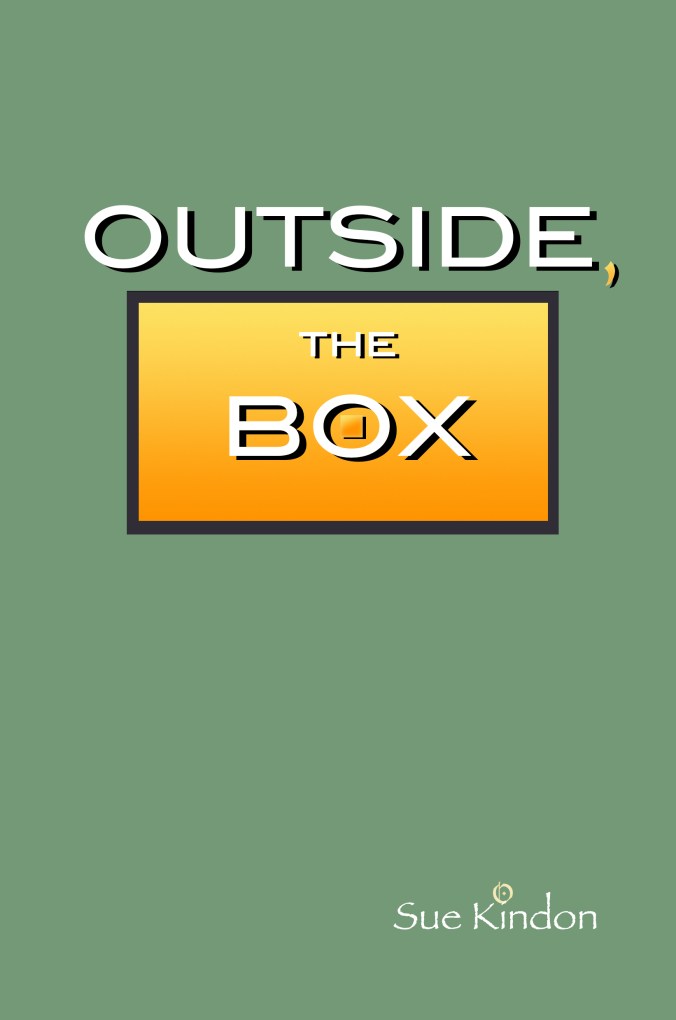
was born in Croydon when it was still in Surrey. She now lives and writes in the French Pyrenees, and helps run an online bookshop, Valier Illustrated Books, specialising in twentieth century and earlier limited editions. Her poems have recently appeared in Poetry Salzburg Review, Obsessed with Pipework, Picaroon, and Domestic Cherry. Her first pamphlet, She who pays the piper, was published by Three Drops Press in 2017, and her second, new from 4Word Press, is entitled Outside, the Box.

The Interview

1. When and why did you start writing poetry?

I’ve played with words and images for as long as I can remember. I have the notebooks from my teenage years, so I must have been writing things down by then, but I can’t place a particular trigger. Perhaps in response to discovering some great poems at school? We had a teacher who didn’t stick to the syllabus.

2. Who introduced you to poetry?

It would be that same teacher, Barbara Davies.

3. How aware are and were you of the dominating presence of older poets traditional and contemporary?

Do you mean, was I aware of the wealth of poetry that is our heritage? In which case, yes, because that was what I discovered at school. I didn’t go to any readings until I arrived at university, in fact poetry readings barely existed. All that has changed dramatically, with the growth of poetry and literary festivals as well as the Internet, which has put us all in touch with each other and means there is instant access to the writings of contemporary poets, great and small.

4. What is your daily writing routine?

I imagine it to be that I am woken by the alarm every morning at 6.30. I sit at my desk (which belonged to my mum) and set pen to paper for 2 hours before breakfast. I really did do this every day for some years, but now it probably happens 2 or 3 times a week if I’m lucky. These days, I’m more likely to compose poems in my head, as and when. If I can still remember them 24 hours later, they’re probably worth writing down. If I’ve managed to get up early and don’t feel like writing poetry, I read it.

5. What motivates you to write?

I take motivation to mean why I write. It’s a hunger, although I don’t always have the appetite for it. It’s an urge to put into words a fraction of the amazing sensations that bombard me, and to offer them unconditionally. It’s a fascination with pushing the language to its limits and playing with it to make new connections. It’s the satisfaction of being part of the word soup that is poetry and seeking that dash of magic that means the next poem could just be the best one ever.

6. What amazing sensations.. bombard you, and why?

Just everything about opening your senses to being alive. If you can quieten yourself enough, there is a wealth of stimuli out there.

6.1. So it isn’t contemporary political or social issues rather what stimulates your own senses?

They are the context, and because I’m not a total hermit, they influence my writing. I wouldn’t set out to write about a particular issue, but I might be jolted into doing so by a phrase used by a politician, for example, or by witnessing an incident.

7. How do the writers you read when you were young influence your work today?

I’m not aware of how those writers influence my work, although I’m sure they do. I hope my style is my own. Those I admired when I was starting out include Shakespeare, Blake, Keats, Yeats, Louis MacNeice, T S Eliot, Sylvia Plath, and Ted Hughes. I dismissed the work of Philip Larkin at the time, but I’ve now come to appreciate his direct diction and accessibility. I was delighted to discover the imagery and voluptuous language of Baudelaire, and the risks taken by Rimbaud in both form and subject matter.

It’s a tall order to put all that in a nutshell, but here goes: –
Shakespeare – mastery of the sonnet form, richness of language, imagery, conceits.
O, learn to read what silent love hath writ:
To hear with eyes belongs to love’s fine wit.
Blake – Songs of Innocence and Experience – the power of contrast, simplicity, song-like quality, use of symbols, mysticism.

To see a World in a Grain of Sand…
Keats – rich descriptions, the sensual imagery of the Odes.

With beaded bubbles winking at the brim.
Yeats – awareness of fragile beauty, lyricism, Celtic twilight.
Come away, O human child!
To the waters and the wild
With a faery, hand in hand,
For the world’s more full of weeping than you can understand.
Louis MacNeice – for Prayer before Birth, probably the poem that grabbed me most, with its bold voice and urgent rhythm. I’ve just read it again, and I still love it.
Let not the bloodsucking bat or the rat or the stoat or the
club-footed ghoul come near me.
TS Eliot – innovation of form, echoes of other works,

At the still point of the turning world.
Sylvia Plath – hooray, a woman. Plain speaking, bold imagery and subject matter.
Dying
Is an art, like everything else.
I do it exceptionally well.
Ted Hughes – observation of nature, constructing a feral world with imagery (especially the sequence that is Crow) and always with an awareness of the music of the poem.
With draped manes and tilted hind-hooves,
Making no sound.

I passed: not one snorted or jerked its head.
Grey silent fragments
Of a grey still world.

All these poets share an honesty of approach, and an, attention to how the poem sounds that I greatly admire (which was probably the answer you intended, Paul, rather than a survey of my cherry-pickings of English/Irish literature, but I’ve rather enjoyed doing it).

8. Whom of today’s writers do you admire the most and why?

Jacob Polley is my poetry hero: musical, using unexpected imagery to great effect, creating a dreamlike, sometimes nightmare-like world that hovers between nature and human encroachment, with all the emotions that tension plays out. Alice Oswald, for a fresh approach and a tremendous sense of rhythm. Michal Symmons Roberts for his quiet lyricism and gentle spirituality. Antony R Owen for taking on political subjects, especially war and oppression, so well that I don’t have to, because he’s done it for me (and how). Paul Muldoon for his weird take on things and for his delight in playing with the language. Billy Collins for his humour.

9. What would you say to someone who asked you “How do you become a writer?”

You give yourself permission to write. You write. You think How would I write this? You experiment. You have to be prepared to ditch the rubbish that will result, and to face the criticism when you put your work out there. And you read, to see how the writing is done and to feed your imagination.

10. Tell me about the writing projects you have on at the moment.

I’m resting at the moment, after recently completing a pamphlet. Having said that, I’ve already started translating those poems into French, as I would like to bring out a bilingual edition.

11. What inspired you to write Outside, the Box?

The comma in the title Outside, the Box is all-important, because the starting point for the poems is ostensibly the box-moth plague that ravaged this part of France last year, destroying both native and garden box bushes.

12. How important to you is the use of space in your poetry on the page?

Very. The white space equates to silence. I am interested in how this looks on the page and how it sounds (or doesn’t) when the words are read aloud. In my recent pamphlet I would say I’m always aware of this, and several poems have shaped themselves in unconventional ways as a result.

13. Among the themes in your book, I find one the humorous militaristic description of nature such as “hornet police”, and with sometimes off hand sometimes full on descriptions of Christian church-going.

I’m interested that you interpreted hornet police in that way, as I rather thought they were police helicopters, but either way, they are a threat.

I’m not surprised you spotted a religious theme, as I was brought up in a very Christian household. You are probably referring primarily to the poem Excommunicado ,which I wrote when the words of The Lord’s Prayer were modernised. I acknowledge that there is a spiritual aspect to my writing, but it isn’t exclusively Christian. I’m more of a pantheist.

14. Bathing in water in these poems seems to provide you with peace and solace.

There is definitely a search for peace and solace going on, and some watery images. The poem Learning to Swim is probably about trust. I often dream about water.

15. How important is it to have humour in your poetry? I am thinking of Outside The House Of Running Water.

I never start writing with the intention of being funny, but quite often things turn wry. Also, I am overblessed with a sense of the absurd. In the poem you mention, it is the voice of the speaker in an absurd situation that raises a dry smile, I think.

16. Your wry humour comes over in the poems where you contemplate the death of humankind. I am thinking of Eve and The Ultimate Green Thought.

The Ultimate Green Thought is jokey despite its serious subject matter. I’m not so sure about Eve – I feel that she makes a rather more serious statement about the catastrophic state of things, but that some hope is offered by the ending. I guess that might raise a smile.

THIS ASSEMBLY (2019)

Excellent post.

K Weber's avatark weber & her words

CADBFD6D-354B-4C8A-B40B-03CF9C2DB1D4

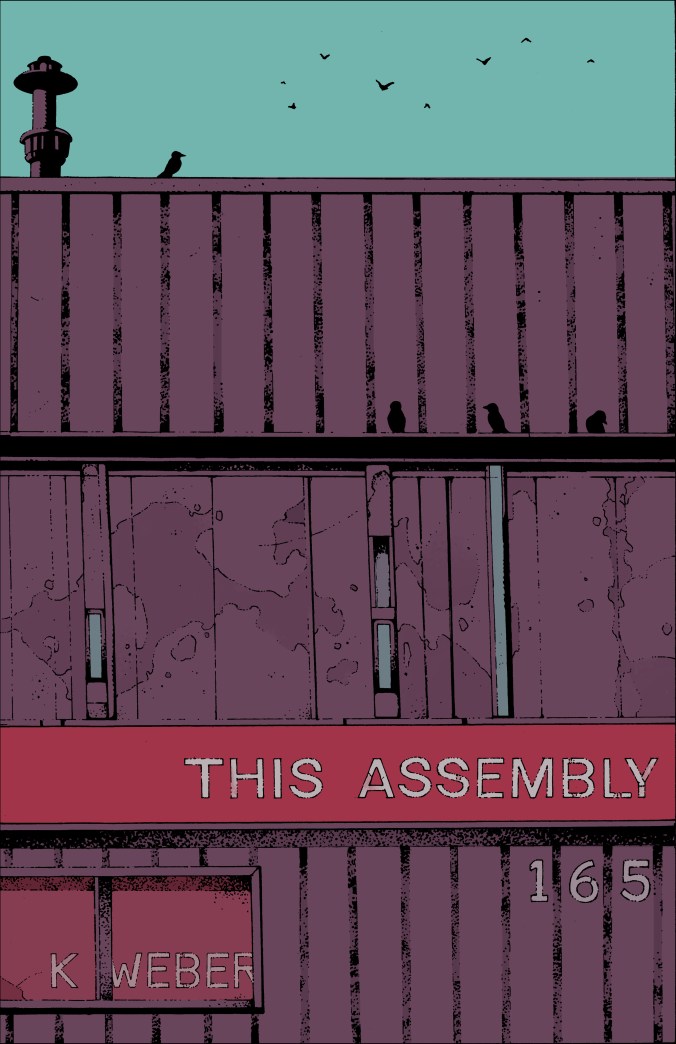
THIS ASSEMBLY is a collaborative poetry project. I wrote 21 poems using 160 words donated by 160 people. Additionally, there are bonus poems featuring other poets’ writing, unique additions to poems, poets reading their work in the audio, and more! Project was reviewed by a team of readers. Cover and interior art by Greg Lawhun incorporated color palette that won a poll open to the public. In total, 165 people participated in my latest effort!

PDF book layout
Stream audiobook on SoundCloud

View original post

Wombwell Rainbow Interviews: Sarah Cave

Wombwell Rainbow Interviews

I am honoured and privileged that the following writers local, national and international have agreed to be interviewed by me. I gave the writers two options: an emailed list of questions or a more fluid interview via messenger.

The usual ground is covered about motivation, daily routines and work ethic, but some surprises too. Some of these poets you may know, others may be new to you. I hope you enjoy the experience as much as I do.

Sarah Cave

is a writer and academic living in Cornwall. She is currently working on a practice-based PhD on the Poetics of Prayer at Royal Holloway. Sarah has published two pamphlets and an illustrated chapbook, like fragile clay, published by Guillemot Press. She has published two collections of poetry, An Arbitrary Line (Broken Sleep Books) and Perseverance Valley (Knives, Forks and Spoons Press) as well as a third, co-authored, collection A Confusion of Marys (Shearsman), forthcoming in February 2020. Sarah’s poetry and prose has been published in numerous journals and anthologies including Oxford Poetry, Poetry London, The Stand, Shearsman and Datableed.

The Interview

1. What inspired you to write poetry?

I started writing poetry while I was studying for an English with Creative Writing degree at Falmouth University. I was a mature student looking for my identity as a writer. I’d been writing notes and fragments toward poetry for years, but it took the degree, and the clearing that enabled, to work it out. While at Falmouth, I had time to develop a writing practice and focus on diversifying my influences. I can’t even begin to stress the importance of this ‘time to write’ and ‘time to discover’ aspect of academic creative writing.

2. Who introduced you to poetry?

I guess my mum would have been the first to read me poetry. Church & Sunday school would have been an early influence; psalms, hymns, Song of Songs etc. I’ve had lots of helpful input from people, my partner and I are constantly discovering and sharing new writing and my MA tutors and PhD supervisors have helped to diversify my reading. My undergraduate dissertation supervisor, Rupert Loydell, has always been very generous with his time, knowledge & vast book collection. One thing I love about poetry is that there is always more to read!

3. How aware were you of the dominating presence of older poets?

I’ve been largely untouched by this, but I think it can be a problem in poetry. I’ve mostly had good experiences with writing mentors and tutors. If you don’t agree with something someone’s suggested, you don’t have to do it; you need to know when to push back. Sometimes this is more of a problem when it comes to gatekeeping but, really, if an editor wants you to change something beyond recognition then that’s not the right place for your writing. Of course, that’s easier said than done when it’s such a touch publishing environment and even more people are writing and wanting to be published.

4. What is your daily writing routine?

I usually write & read for at least 6 hours a day, but always after coffee and a stroll with the dog.

5. What motivates you to write?

Honesty, clarity, critical exploration and, most importantly, a need for play.

6. What is your work ethic?

I’m both lazy & relentless. I don’t do much else other than writing, reading & making books, so I manage to be productive, but I do enjoy a good dawdle & a daydream along the way.

7. Who of today’s writers do you admire the most & why?

Susan Howe, Cole Swensen, Peter Larkin, Holly Pester, Luke Thompson, Callie Gardner, Thomas A. Clarke, Jen Hadfield & Luke Kennard all do something I consistently enjoy. They all take risks, but I think that list is eclectic in output. I’m constantly reading new people & enjoying poetry, non-fiction & prose. I want to mention more poets like Vahni Capildeo, Daisy Lafarge, Maria Sledmere and Colin Herd. Gosh, there are so many. There’s so much good writing being published, mostly by small presses. As an editor of a small press, I love supporting other presses and I feel like I’m part of a broader writing & publishing community through social media, readings & being on the edge of the creative writing programs at Royal Holloway & Falmouth.

9. Why do you write, as opposed to doing anything else?

Writing seems urgent to me. It’s an action that has the potential to change things. Also, I’m not sure I’m good at anything else.

10. What would you say to someone who asked you “How do you become a writer?”

Listen to other writers. Always be kind.

11. Tell me about the writing projects you have on at the moment.

I’ve just published a book about the Martian Rovers, called Perseverance Valley (Knives, Forks & Spoons Press). My latest book, A Confusion of Marys, is a joint effort with the poet Rupert Loydell. My contribution to the collection is called ‘An Autophagy of Mary’, which means ‘the self-eating of Mary’ & signals some of the regenerative dialogue around Mary.

I’m currently working toward a practice-based PhD on the poetics of prayer & this includes material that will become my third poetry collection.

3 Poems by Christine Strelan

Loved this

ReVerse Butcher's avatarBURNING HOUSE PRESS

Loving the Alien

Scales sliding over her heel wake her.
She springs to her feet, the snake scarpers.
The stars are molten silver chrysanthemums,

grains of light on the liquid mirrors of her eyes, widening under heavy, hominid brows.

View original post 932 more words

.mum.

Felt this.

Sonja Benskin Mesher's avatarsonja benskin mesher

when  i squeezed the bits of soap together

to one lump

i thought of you

doing it too and

realised what may be the reason why

besides

saving soap and money obviously

yesterday we talked about the war

the rationing that i with my ignorance

only learned about much later

may have become your way of life

derived from many sources

then we spoke of the amputees

the trouser leg fixed up with

a safety pin

51616442_2198908766839169_7556578929599840256_n

View original post

.holocaust remembrance day.

Brief, but possible.

Sonja Benskin Mesher's avatarsonja benskin mesher

i watched the film.

after.

i check the mirror to see if things still look the same.

night will fall.

16217074699_82674046ab_o

View original post

Wombwell Rainbow Interviews: Venus Davis

Wombwell Rainbow Interviews

I am honoured and privileged that the following writers local, national and international have agreed to be interviewed by me. I gave the writers two options: an emailed list of questions or a more fluid interview via messenger.

The usual ground is covered about motivation, daily routines and work ethic, but some surprises too. Some of these poets you may know, others may be new to you. I hope you enjoy the experience as much as I do.

Venus_Cover (1)

Venus Davis

is a 21-year-old queer writer from Cleveland, Ohio. She is the editor in chief of the Periwinkle Literary Magazine. She is also a former poetry reader for Random Sample Review and a podcaster for Prismatica Magazine. Her work has been featured in Marias at Sampaguitas, Royal Rose Magazine, Ayaskala, Dream Noir, Crepe and Penn, and many other publications. She is the author of Sensitive Divination, an astrology microchapbook as well as the microchapbooks, Blue and @ngel number(s).

You can find her on social media

@venusbeanus.


The Interview

1. What inspired you  to write poetry?

I was inspired by the works of Maya Angelou, Shel Silverstein, and Edgar Allan Poe. I was also inspired by those around me and frankly, the feelings that came from having many undiagnosed mental illnesses.

2. Who introduced you to poetry?

I was introduced to poetry by Cynthia Larsen, of Lake Erie Ink. She is my best friend’s mother and a teacher in the Cleveland area. When I was in the third grade, she taught my class about poetry. After years of writing fiction, I was intrigued by this new form that I’d never heard of or dabbled in.

3. How aware were you of the dominating presence of older poets?

Very aware. There was a sense of the youth poetry scene blooming in my hometown but at the time there weren’t many opportunities for us younger poets. Lake Erie Ink was pretty much the only resource available and it was amazing, don’t get me wrong. However, I wish that there were more opportunities available for young writers to succeed.

4. What is your daily writing routine?

Usually I work on as much as I can per day. Currently, I’ve been primarily freelancing as I look for a full time job. So, my entire day is dedicated to writing. I wake up at around ten a.m and I start working on editorials and then after I write about 2,000 words, I start working on my WIP, which is a full length of sad poetry.  I’m currently in the editing phase. So, I edit about three poems per day from my WIP.

5. What motivates you to write?

My writing heals me and it’s the only thing that has ever helped me grow as a person. Writing down my thoughts, feelings, and desires has changed the way that I look at the world. It’s almost like everything I write is a diary entry and the only difference between my poetry and my actual journal, is what I will allow others to read. So, writing for me is a chance to grow and a chance for others to relate to my work and grow as well. I also love the research that comes writing. Being able to learn new things while creating something new is a feeling unlike any other. The thought of it motivates me secondarily to growth.

6. What is your work ethic?

I’d say my philosophy behind work is that I try to work as hard as I can and do as much as I can per day. That’s what happens when you’re a capricorn, you just have no off button when it comes to work. I’m a complete workaholic when it comes to writing. Back when I worked first shift at a fast food place, I’d get home around four p.m. and just write and talk to other writers on twitter until around two or three a.m. Though, I definitely do not condone this behavior! A lot of this is also due to my ADHD diagnosis in that doing work immediately enhances the chances of it getting done whereas if I put my work off until later, I am likely to get overwhelmed and procrastinate even more.

7. How do the writers you read when you were young influence you today?

I find myself wanting to write little bits of humor in my poetry like Shel Silverstein had. I’m often drawn to darker imagery like Edgar Allan Poe. In fact, I had an entire phase where I tried to write gothic lit just to be like him. When I write about my body in my poems, I always channel a bit of Maya Angelou’s energy in Still I Rise – that kind of confident, black girl magic, no fucks given attitude.

8. Who of today’s writers do you admire the most and why?

Franny Choi! Not only is she a woman of color and amazingly talented, a wildly iconic duo. She is queer and she writes like she has no fears. I also love the amount of research that went into her collection, Soft Science. I want to be a writer that is unapologetically me and writes like so. Someone who can implement research in their writing without it being confusing or read like an eighth grade research paper. She also wears many hats which I greatly admire because I know how difficult it can be to work many jobs as a writer. Yet, she just seems fueled by her love for writing and that is so important. I come from a long line of people who hate their jobs and that’s all they say about work. So, to see a writer be so immersed and so in love with her craft, it’s admirable and I can only hope to continue to love my craft as much as Franny Choi does.

9. Why do you write, as opposed to doing anything else?

Writing is literally all I can do. I used to play Violin and Viola as a kid and it never once crossed my mind to be an instrumentalist. I tried to be a singer and I tried to be an actress but they just felt wrong. I absolutely loved performing but there was just something missing for me. I took about a two year break from taking my writing seriously and during that break, I felt like I had broken up with a partner of ten years. Literally because I had been writing since I was about nine, I basically had broken up with a partner of ten years. When I came back to writing, I worked harder than I ever had before. I started to pursue writing as a career other than what i thought it was at the time – a commitment to a quiet life backstage. Working on my first book really brought me back into the writing world in a way that I had never experienced before. It was so necessary for me, like a spiritual awakening but with my writing career. So, in short, I write because it’s what feels right. I write because it’s my calling.

10. What would you say to someone who asked you “How do you become a writer?”

I would say that you work hard to find your corner of the community, you write as much as you can, submit to journals, and don’t forget to make friends along the way! Take part in as many opportunities as you feel comfortable with because learning opportunities are the most valuable. Even if you don’t submit your writing anywhere, just continuing to write as often as possible is extremely important. Any opportunity to further your craft is one that you should take.

11. Tell me about the writing projects you have on at the moment.

Currently, I am working on a full length book tentatively called, Human Waterfall. It’s a bunch of sad girl poetry about being a twenty something year old navigating the scary adult world. I’m also working on releasing an extended version of my astrology chapbook, Sensitive Divination. In the extended version, I plan to explain the process behind writing each poem and the astrological references/meanings in certain lines. I’m also working on releasing a chapbook of poems about the phases of the moon and gemstones. So, be on the lookout for that!