Year: 2020

:: private land ::
yet there are paths,
walked, not just
by one or two.
or rabbits.
have young feet run here,
or solitary folk, thinking,
watching light hit water,
where monks crossed.
the abbey is swathed in snowdrops,
this time of year.
look for twigs.
walk sedately through the forest, a poem … and your next Wednesday Writing Prompt

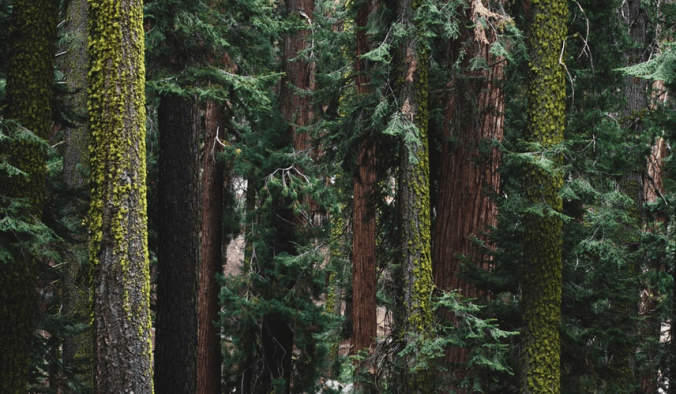 Courtesy of David Everett Strickler, Unsplash
“The sequoias belong to the silences of the milleniums. Many of them have seen a hundred human generations rise, give off their little clamors and perish. They seem indeed to be forms of immortality standing here among the transitory shapes of time.” American poet
walk sedately through the forest, ignore any storms and praise
these grave dignified giants, these meditative trees, such bliss
to walk their deep rich earth where sun stands sentry by day
and by night the moon, the stars gift their brightest smiles here
if not their warmth, sequoiadendron giganteum grow wise and vigilant
on their circles of history, the primeval years, the years of conflict
the matristic tribes, the patriarchal colonizers, the activists today
© 2020, Jamie Dedes
WEDNESDAY WRITING PROMPT
Nature is always watching, always baring witness to the human compulsion. Perhaps at times it reflects…
View original post 252 more words
Wombwell Rainbow Interviews: V. B. Borjen
Wombwell Rainbow Interviews
I am honoured and privileged that the following writers local, national and international have agreed to be interviewed by me. I gave the writers two options: an emailed list of questions or a more fluid interview via messenger.
The usual ground is covered about motivation, daily routines and work ethic, but some surprises too. Some of these poets you may know, others may be new to you. I hope you enjoy the experience as much as I do.

OLYMPUS DIGITAL CAMERA

OLYMPUS DIGITAL CAMERA
V. B. Borjen
is an author and visual artist currently based in the Czech Republic. His first poetry collection in Bosnian, Priručnik za levitiranje (en. Levitation manual), won the 2012 Mak Dizdar Award for the best first manuscript by a young poet. His work in English and his recent visual art have appeared in AZURE, Hypothetical: A Review of Everything Imaginable, The Esthetic Apostle, Not Your Mother’s Breast Milk, Chaleur Magazine and Honey & Lime.
Twitter: @Borjen
Instagram: samoniklo
The Interview
1. What inspired you to write poetry?
It goes a long way back, but I am not sure I would call it inspiration. I was eleven and I suddenly started writing poems. I have a vague memory of finding my father’s poem ‘Melancholy’ in one of the cabinets (he had perished some seven years before, during the Bosnian War). Perhaps that was what made me think I could write too? I don’t think he was ever serious about it though, I mean as I am.
2. Who introduced you to poetry?
Beyond that memory, I don’t remember poetry having much importance in my nearest surroundings in those early days. Nobody at home encouraged me to write, or discouraged me for that matter. My interests have always been many and quite various, so it must have been hard to see any one activity as worthwhile some significant engagement from my mother’s side. But as far as encouragement outside of home is concerned, I had a great teacher of Bosnian in the 5th grade of primary school, Murisa Jukan, and she would always end her lessons by saying: OK, and now Beganović will read us one of his poems. What she saw in those ridiculous little things, I cannot say. But it was the first encouragement from a person of some literary authority. So I kept at it.
3. How aware were you of the dominating presence of older poets?
Not at all for many years. I guess the first serious brush with other people’s poetry was in the secondary school and then later at university. Was there “anxiety of influence”, to quote Harold Bloom? I don’t think so. Early twenties are characterised by a strange, oblivious sense of unwarranted entitlement. This is not unusual, but as one gets to late twenties/early thirties one realises how strong a sway the past and tradition hold over us after all. It’s a humbling experience.
4. What is your daily writing routine?
I used to get up really early, at five or so, and write till 7 or 8. Now with the full-time job, the part-time jobs and the PhD dissertation pending, it is a bit hard to keep to a strict writing routine. But I am trying to get back to this regime. I’m at my best very early in the day. But I write whenever I can find the time.
5. What motivates you to write?
With me it’s a need. Kafka said it well: “A non-writing writer is a monster courting insanity.”
6. What is your work ethic?
Work is one of the most rewarding things, both for my physical and mental well-being. But it has to be meaningful. Like reading, writing, or painting. The corporate job is rather numbing and draining because I see no purpose in it, other than that it pays the bills. Could I transplant Dr Angelou’s title here and say I Know Why the Caged Bird Sings? I must.
7. How do the writers you read when you were young influence you today?
The books I read in my childhood and all the books I’ve loved since are very much alive inside me. They are like a protective circle of good friends. I do not find them threatening, I do not think I’ve outgrown any of them. I’ve learned to appreciate that all the books have their greatest meaning in their own time, which comes for each of us individually. It would be ideal if they could come to us always exactly when we need them, but even if I read Winnie the Pooh or Moominvalley in November only now when I am 33 it does not matter; they speak to the child in me and so are timeless.
8. Who of today’s writers do you admire the most and why?
From among the writers, I need Dubravka Ugrešić (for the beauty of her prose and the timely calibration of my moral compass), the late Toni Morrison and Ursula K. Le Guin for the same, then Jeanette Winterson, Chimamanda Ngozi Adichie, Zadie Smith…
As far as the poets are concerned, I love the work of Heather Derr Smith, Ferida Duraković, Julia Beach, Senka Marić, Anita Pajević, Todd Smith, Monika Herceg, Šima Majić, Mathew Yates, Lee Potts, Moira J. Saucer, Lidija Deduš, Kyla Houbolt… This is such an exciting time for poetry. The digital age has reinvigorated it.
9. Why do you write, as opposed to doing anything else?
To share the experience of being alive and out of the need to understand, everything and anything, or at least to try to. All writing is, among other things, an attempt at understanding.
10. What would you say to someone who asked you “How do you become a writer?”
If they must ask that, I would tell them: don’t bother. People write for different reasons, but I do not think this is a kind of work that should be done lightly, or because it seems cool. I mean, everyone is welcome to do it, but if one cares deeply about literature, one has also this sense of responsibility. If one is supposed to be the continuation of the great voices of the past then think of the responsibility. I would not want to publish something now that 10 years on I would be ashamed of.
11. Tell me about the writing projects you have on at the moment.
I am currently working on a poetry collection in English. My first collection in Bosnian, Priručnik za levitiranje (2013, en. Levitation Manual) won the Mak Dizdar, an important award in the region of former Yugoslavia. The second collection in Bosnian, Odjezd (roughly, Riding Out) is still waiting for a publisher. So this English collection is my third. I have another project going on, a hybrid of prose and poetry which could be published as a chapbook once it’s done. Meanwhile, I keep submitting, as most of us do, and talking literature and sharing my paintings with our inspiring literary community on Twitter. It’s a great time to be a poet.
Cabo da Roca, Portugal – Poem, Image & A Reading by V. B. Borjen

Cabo da Roca, Portugal
The end of one continent
is the end of them all.
Europe ends with Carpobrotus edulis,
an invasive species
which steals the ground, the sunlight and the air
from all the other species
— fitting, won’t you say?
Yellow-green, radiant against the white-blue
and the dabs of brown, red and black
— in the end, too, was a word
and the word was — colour.
(Europeans know an awful lot about that.)
‘Sit on a train and go to the end of the world,’
my friend Edina said.
But what does a poet write
and send from this here cape
to his friend or mother?
There is beauty here, even Carpobrotus edulis hurls
a most saturated hue
against the blue of the ocean.
Nature has no part in the blame
for what great waters
some of its species crossed
covering other grounds
stealing the air…
View original post 125 more words
Apologies to all those awaiting my questions about their books. I am a month behind in my reading. I will get to your work soon. I am not requesting any further interviews until I have dealt with this backlog. I will be with you soon. Again, my deepest apologies.
Apologies to all those awaiting my questions about their books. I am a month behind in my reading. I will get to your work soon. I am not requesting any further interviews until I have dealt with this backlog. I will be with you soon. Again, my deepest apologies.
I am gradually learning how to manage this new addition to my options. I hope you will stay with me whilst I regain myself. I am extremely embarrassed.
Two Spacescapes – Anthony Etherin
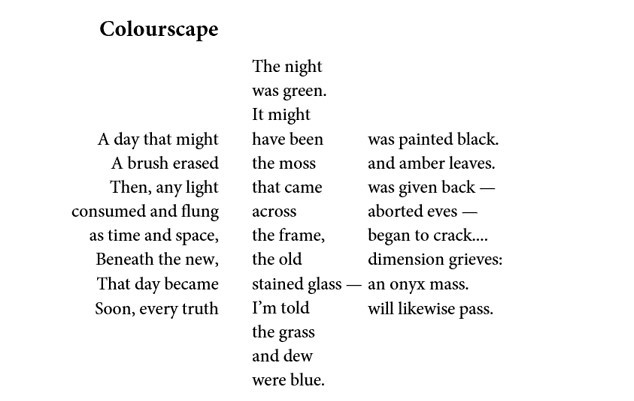
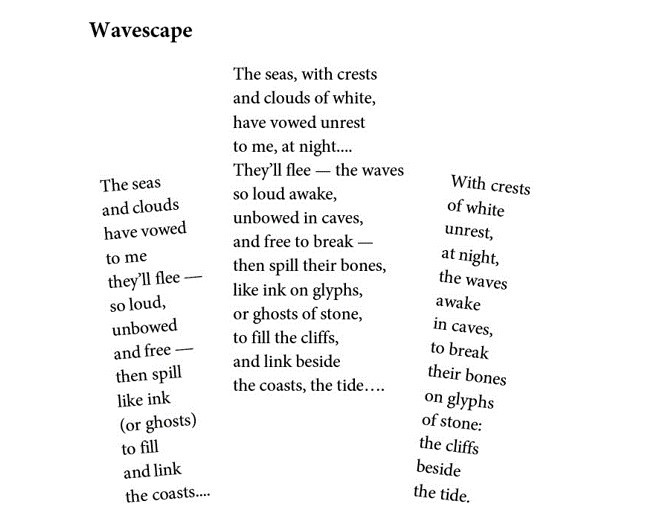
In each of these two “Spacescapes”, two different poetic forms occupy the same space, combining as one multiformal poem. In “Wavescape”, a Shakespearean sonnet, in iambic dimeter, breaks into two monometer sonnets — one Shakespearean, the other Petrarchan. In “Colourscape”, a monometer Shakespearean sonnet runs through a pentametric ottava rima — the third metrical foot of each line of the ottava rima thus being shared with the central eight lines of the sonnet.
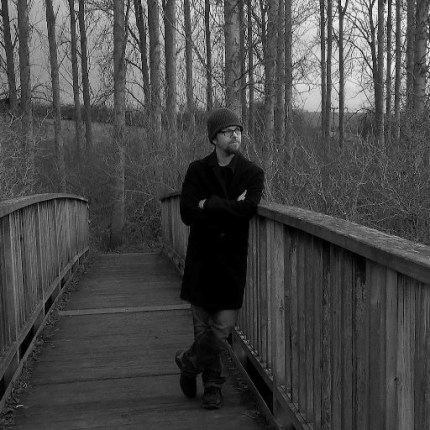
Anthony Etherin is a formalist poet, specialising in strict literary constraints. His latest book is “Stray Arts (and Other Inventions)” (Penteract Press, 2019). Find him on Twitter, @Anthony_Etherin and via anthonyetherin.wordpress.com
Banner: “Pattern” A Digital Art Work by Robert Frede Kenter
. cherries .
ants come in the kitchen usually in february
leave at easter. it has not happened this year
yet
they scurry
yesterday i looked out and thought how nice
i have always wanted to live near water.
there were floods as far as i could see, my
neighbour said we could have a boat.
wind skittered across the surface like it
did when he died
despite this beauty i feel for those damaged
with water this year
i live on the rise and look out across
some one wrote to enquire and we
agreed it seems this is all our own fault
i had cherries yesterday
real nice
i like ants
Wombwell Rainbow Interviews: Daniel Tobias Behan
Wombwell Rainbow Interviews
I am honoured and privileged that the following writers local, national and international have agreed to be interviewed by me. I gave the writers two options: an emailed list of questions or a more fluid interview via messenger.
The usual ground is covered about motivation, daily routines and work ethic, but some surprises too. Some of these poets you may know, others may be new to you. I hope you enjoy the experience as much as I do.
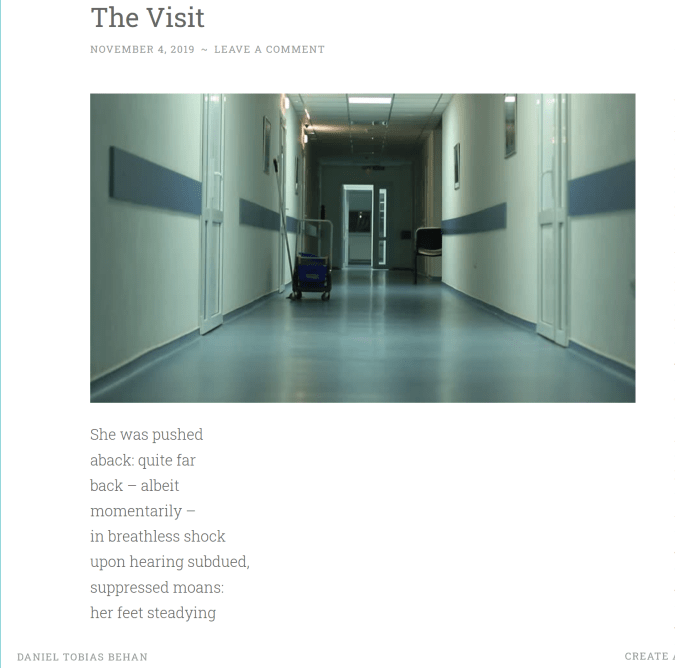
Daniel Tobias Behan
London-based writer, who has performed at the London Irish Centre regularly as part of their Celtic Craic events, and has been featured in the Irish Post’s London Calling podcast series, interviewed by Ryan Price. Poetry published online, and via Foxglove Journal (‘Love Of Mine’).
Websites / etc:
https://danieltobiasbehan.wordpress.com/
https://twitter.com/BehanTobias
https://www.facebook.com/dtbehan
The Interview
1. What inspired you to write poetry?
I come from a family of poets and writers – my great uncle was Peadar Kearney the Irish poet and author of the Irish National Anthem; other uncles were writers Brendan and Dominic Behan, and my father was the political activist and writer Brian Behan. My mother was also a talented fine artist. (Three more of my sisters have also taken to writing in the time since then!) So, whilst it wasn’t forced upon me as a child, I grew up surrounded by books, attending plays, and with the knowledge that writing was in the family, and so I was somewhat of an avid writer and poet as a young child.
However, as things go sometimes, in my teenage years I didn’t pursue it as much, until the death of both my parents within a two-year period rekindled the notion that it would be good to take it up again, possibly to continue in their memory. However, after a few bits of stopping and starting, it was in 2016 that I seriously made an effort to recommence. My sister Janet had had success with her play Brendan At The Chelsea, and it was published in an Irish academic journal by Edinburgh University Press, which impressed me, and probably excited me enough to give it another go.
2. Who introduced you to poetry?
I would have to say my father. He would make up these wonderful stories about the adventures of a mouse for me and my sister, verbally reciting them to us. I really wish he’d written them down and had them published, which is something I’ve reflected upon recently. Other than that, some of my earliest favourite poetry would have been Roald Dahl’s Revolting Rhymes, which is a wonderfully grisly collection of children’s poems based on fairy tales, which my mother introduced us to.
3. How aware were you of the dominating presence of older poets?
Well, having had poets in the family going back a few years, such as my great uncle who had begun writing songs and poetry during the Edwardian period, I felt somewhat of a connection with them, although even to this day I find the language of older poetry is often so mind-bogglingly precise and evocative. It’s certainly a presence to be reckoned with; there must have been something in the air or water back then which made people so adept with language.
4. What is your daily writing routine?
Ideally, get at least something written, but honestly, my pattern is more that I might take a break from writing, then get a sudden flush of inspiration which leads for weeks or months on end, during which time I could be working on pieces for protracted hours and rewriting obsessively.
5. What motivates you to write?
Inspiration. That sounds cliché and vague, but it has to come from passion, energy, and interest. It’s important to write for yourself, but also to consider the reader’s perspective, and also potentially the casual reader who might otherwise not have much of an interest. For me it’s about creating something sensual and engaging, which interests me, and hopefully others.
6. What is your work ethic?
I would say my main work ethic when it comes to writing is that you – or rather I – shouldn’t be afraid to rework, to rethink, and to be as creative as possible. I just love engaging writing.
7. How do the writers you read when you were young influence you today?
They laid the foundation. Whether it was a book we read over an hundred times times before sleeping, or something we were forced to study for school or university, the language bit of our brain is always taking it in and learning, which we can then unconsciously make use of in later writing; it’s the miracle of human culture that we have a shared learning experience across periods of time and great distances, including within our own lives.
8. Who of today’s writers do you admire the most and why?
I admire Irvine Welsh for what he did to shake up British writing from the 1990s onwards. I recall a quote about my uncle Brendan that he lit a bonfire under the arse of Irish literature – actually it might have been my father who said that, but others said the same thing in a less blunt way! I saw Welsh doing a similar thing. I recall hearing he was a fan of Brendan’s actually; you can see the connection particularly to Brendan’s book Borstal Boy.
9. Why do you write, as opposed to doing anything else?
I’ve dabbled in making some music (on a computer, not proper music!) – but, my strength is primarily with words, although I haven’t ruled out doing some more musical stuff in the future, possibly with some poetry worked in, in some manner.
10. What would you say to someone who asked you “How do you become a writer?”
Read, write, get involved! Keep at it. The only slow bit is the bit before you begin, before you get started.
11. Tell me about the writing projects you have on at the moment.
Presently, working on building up my collection of poems – as to what we’ll do with them, we’ll see. There will be a short filmed performance of a poem of mine called The Visit by a couple of friends which we did just before xmas, so maybe some more of that kind of thing too, audio / visual stuff.
12. Why sonnets?
Well, funnily enough, a friend had made a suggestion of a poetry exercise of writing a poem a day, which then lead on to me setting up the blog. Being a fan of Shakespeare’s sonnets, and also somewhat familiar with Donne, etc, I had thought it a good exercise to practise writing Shakespearian sonnets (in structure), but on whatever subject or theme I felt like writing about. I never quite managed a poem a day, but I do feel it was a good writing exercise nonetheless, and led on to the further poems which are more free-form in nature.
Rejections and the Business of Being a Writer
“I would go home in the evening and write short stories and mail them to magazine editors in New York. The stories, no matter how many times I rewrote them, were always returned, usually without comment, with unfailing promptness. I received so many rejection slips, and such an interesting variety, that I passed them neatly into a stamp collector’s album. The only consolation I ever got out of them for many years was in visualizing how big a celebration bonfire I could make with them when I had my first short story accepted and published in a magazine.” Erskine Caldwell, “Call it Experience,” in The Creative Writer
Many many years ago – circa 1964 – I read The Creative Writer (quoted above), which is out of print now. You can find old copies, not that you necessarily need to. Much is outdated but at that time, I found it…
View original post 423 more words
 The Wombwell Rainbow