..day 106..

Sonja Benskin Mesher's avatarsonja benskin mesher

..day 106..

sometimes i have to check my numbers
sometimes they run out of corn all together
and offer me peas

not the same james
a different colour
i like yellow

i place the bone
where the mouse once was

the other bodies are boxed now

murky this morning and possibly cool
outside
with promise of a social occasion possible

unless there are more gigantic congregations
with no worth other than to scatter their litter

they will come with fire here on the bridge
where he spent the day scraping tenfold
maybe gave up

i have not heard him since
told me he had obsessions
i tend to agree

excitement here over the boxes
due here soon, parcel force

do you remember my love

this is a new project

anyway

that is the way i get stuff now
no travelling
no stores

no hassle
only the joy of expectation james

View original post 46 more words

Where The Fog Has No Name – Poems and Images by Eliot North

robertfredekenter's avatarIceFloe Press

Where the Fog has No Name

Conceived in a sea fret, whilst resident artist for ‘Djerassi: Scientific Delirium Madness’, 2018

Elements of Paint


Barbara H. Berrie, grew into her name;
a scrap of a girl, all angles. She felt at odds

with the round sound on her tongue,
her name passed down through generations.

We walk and talk, about many things:
including where the sea ends and sky begins.

The chemist in her is so precise, she thinks carefully before
she opens the lid on the depth and breadth of her knowledge,

the elements of paint in sky:

Azurite,
Ultramarine,
Prussian Blue,
Cerulean,
Smalt.

The landscape speaks.

When asked to name the colour of sun
her answer is considered. By sun, you mean fire,
a sunset spectrum. Well now let me see.

You’ll need red oxide, deep orange, canary yellow
then something paler, diffuse sunlight:

Minium,
Gamboge,
Aureolin,
Litharge.

View original post 902 more words

National Insect Week Poetry Challenge: Take part with Yvonne Marjot, Anjum Wasir Dar, Alan Toltzis, Debbie Strange, Maryann Corbett, Stuart Buck, Dai Fry and myself. Monday: Dragonflies. Tuesday: Wasps And Bees, Wednesday: Ants, Thursday: Beetles, Friday: Butterflies, Saturday: Moths, Sunday: Flies. Email me and I will add yours to my daily WordPress posts, also posted to Twitter and Facebook. You can still add to all the posts already published. Here are today’s: Butterflies

Friday: Butterflies

Butterflies’ Finding Joy in Fluttering’

Delicate majestic royal
tiny fluttering  fragile flyers,
the fine beauty of  gardens
the butterflies-

multicolored, patterned winged
true and rare like Riodinae
the smallest Lycaenides, the
common family of Blues
little whites flying close to the
ground are ‘Psyche’-
And Great Mormon with
velvety wings found in forests thick.
Butterflies by day delight the eye
moths by night, with hairy antennae
tell the watchful, flight by dye-
Skippers Coppers even Tigers are
in, the metamorphosis of life-

what a fine lesson of adaptation
in times of pandemic change in nations
Man will always find nature glowing
showing courage, praying bowing.
Who best to be the change, without a
cry but the tender carefree tiny butterfly.

-anjum wasim dar
Copyright  CER  2020


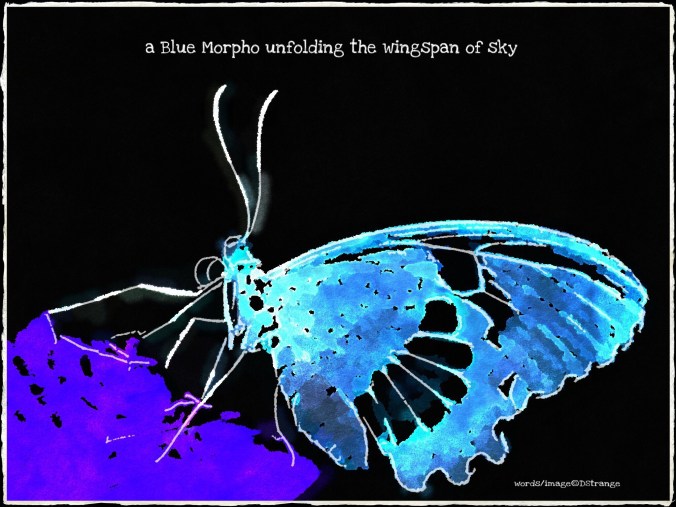
Debbie Strange Blue Morpho unfolding Butterflies

) “a Blue Morpho” – monoku, Otata 36, December 2018

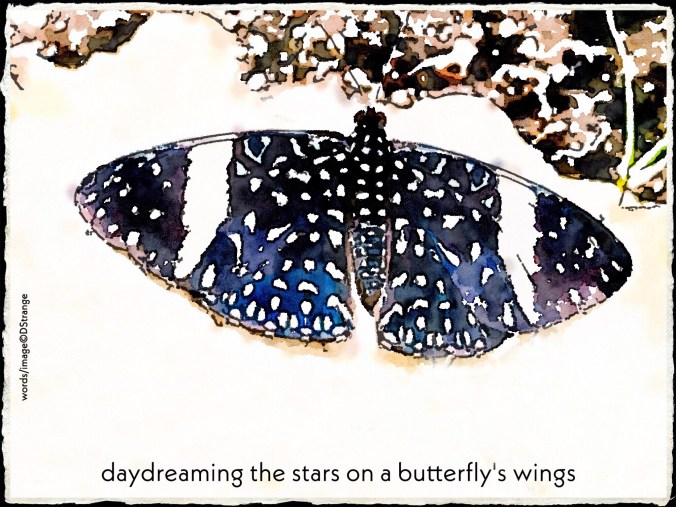
Debbie Strange a blue morpho butterflies

“daydreaming” – monoku haiga, Incense Dreams 3.1, October 2019

in my garden
a gatekeeper butterfly
basks in the sun
I cover my pale body
only coming out at night

Tanka published in Cattails, September 2016

it was
as if she were
a butterfly
the way words flew
from her open hands

tanka published in Cattails, April 2018

we once played
in this tangled garden,
enchanted
by the quiet fireworks
of bergamot and butterflies

tanka published in Atlas Poetica 36, February 2019

=Debbie Strange

Alan Toltzis Butterflies 1

Alan Toltzis Butterflies 2

-Alan Toltzis

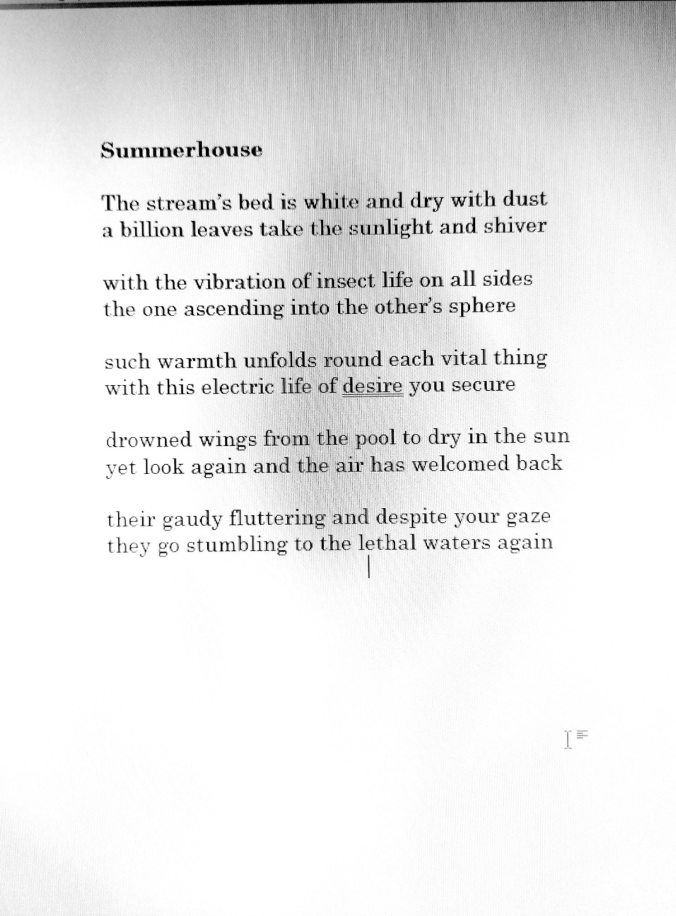
Summerhouse Tristan Moss

=Tristan Moss

Fritillary

Scrap of Turkish
carpet, October leaf;

airborne
dancer riding fragrant
currents

with skip and dart;
pearled slurper

of nectaries
of ragged-robin,
bugle, self-heal.
buttercup.

Not so bad then
an inchworm life

of toil and spin
heave and crawl,

if our reward
were this.

(The poem has been previously published in In The Cinema
( Playdead Press 2014 ) and is to appear in the forthcoming Emma Press,
Anthology of insects.)

-Stephen Bone

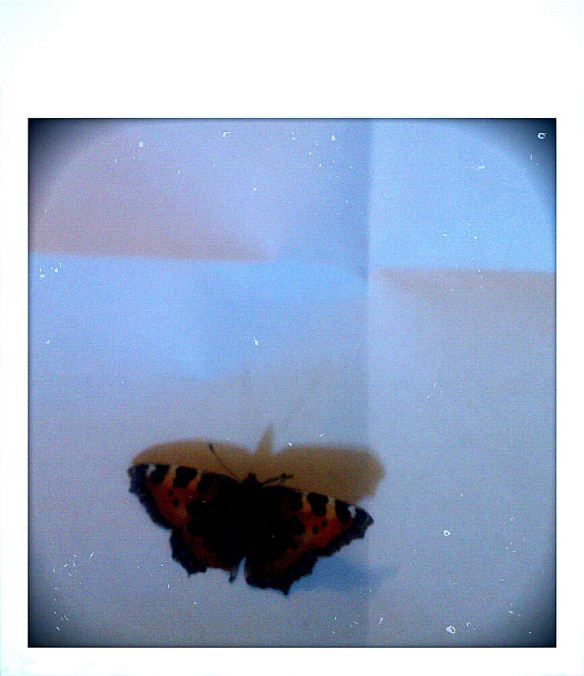
sonja butterfly

. black hearts .

black topics.
cause and effects,
the butterfly’s wing.
so here on the night watch,
all is quiet , no birds sing.
touched by the small thing,
softly, we drew together,
with words, and gestures
in air, in mind.
touched by the old things
i draw and weave
the ways of night.
upload the black heart,
later.
i write, edit, delete.
words here,
you cannot see,
do they leave a trace,
tell me.
do you sense their meaning?
and the rhyme,
are there codes
between the lines.
is there something
in words not said,
or is it here,
as clear,
as day.
when it comes..

sbm.

Butterfly Unit

Old equivalents:
insect metamorphosis
and the grade-school class

blundering with me
through a weed-choked patch along
railroad rights-of-way,

plucking milkweed plants.
On fat leaves, Danainae
bug-adolescents

hunch, gorging, brainless
motor-mouths on sixteen legs,
to be seized and press-

ganged to middle-schools.
Clown-clad and ridiculous,
writhing their own rules,

in the end they close
off all contact, lacquered to
one long, studied pose –

held, the way one holds
breath, waiting to see what form
so much thought unfolds.

Later, on school lawns,
whoops of pleasure will set free
gold-and-sable gowns.

Old, the lesson here.
Teachers stand and clap as lives
lurch, lift, disappear.

-Maryann Corbett (previously published in The Harlequin)

Clouds

There is a country path
bound by a country hedge
and a field of barley.
Blood splatter of poppies,
heads of hot crimson shame.

And early summer bakes
the fields and hills.
And you walk slow
and dusty.

And all the way
down the slope
to the wooden fingerpost.
Clouds of butterflies
erupt from the hedge
woven of bladder campion,
hazel, old mans beard,
scarlet pimpernel and
hogweed… a pretence
of cow parsley.

© Dai Fry 25th June 2020.

As The Butterfly Flies

A splash of colour,
hurricanes flutter.
Wind it its wings,
my heart sings.

A merry sight,
a silent flight.
A tedious existence,
duplication resistance.

My gut, my heart, my eyes, my art.
Cause and effect miles apart.
Over the flower and under the leaf,
serendipity to my sister’s grief.

This memory, a moment you and I share;
as the butterfly flies unaware.

-Ria Gupta

Christina_butterfly_bleachedbutterfly[84026]

butterfly
clings to a bluebell
broken wing

A haiga in the inaugural issue of Bleached Butterfly Magazine

deeper–
in the orchid
a butterfly

The Zen Space Spring 2020 Showcase

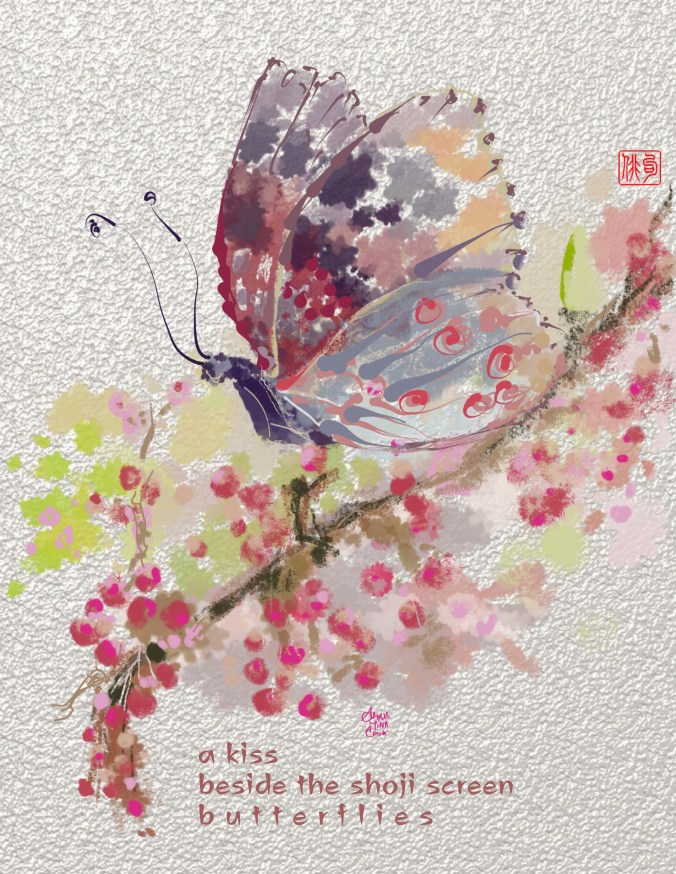
ChristinaChin_a kiss beside the shoji screen butterflies

a kiss
beside the shoji screen
b u t t e r f l i e s

Haiga published in Akitsu Spring issue March 2020.

stay home order
butterflies swarm
my fruit feeder

Pangolin Review, Covid-19 May 2020

-Christina Chin

Butterflies Are Flames

Flicker, white, red, blue,
Every butterfly takes away your loss
on fragile wings autumnal leaves
in flight.

Don’t say you wish to be a caterpillar
again. Do not say you want to lose
your wings, fold them into your body
hang by a string a chrysalis,
turn into an eating machine again.

Every butterfly takes the last flame
of your breath and carries it from your coldness,
carries your fire, brightens the day.

-Paul Brookes

Bios And Links

-Ria Gupta, a resident of New Delhi, India. Pursuing a Bachelor’s in English Honours, an aspiring writer and an artist by passion. She is currently exploring various avenues of content writing along with managing her personal blog https://candourandflavour.wordpress.com/ . At 21, she has polished her skills through experience in varied fields like teaching, writing, performing arts, and social media management. She is now working towards assimilating and sharing it all with the world in a creative way.

Instagram : @ria_gupta
Blog : https://candourandflavour.wordpress.com/

-Stephen Bone

Stephen Bone’s latest pamphlet Plainsong ( Indigo Dreams )
appeared in 2018. A Hedgehog Press Stickleback pamphlet
due in 2020.

-Dai Fry

is an old new poet. He worked in social care but now has no day job. A keen photographer and eater of literature and lurid covers. Fascinated by nature, physics, pagans, sea and storm. His poetry seeks to capture image and tell philosophical tales. Published in Black Bough Poetry, Re-Side, The Hellebore Press and the Pangolin Review. He can be seen reading on #InternationalPoetryCircle and regularly appears on #TopTweetTuesday.
Twitter. @thnargg
Web seekingthedarklight.co.uk

Audio/Visual. @IntPoetryCircle #InternationalPoetryCircle Twitter
#TopTweetTuesday

-Christina Chin

is from Kuching, Sarawak, Malaysia. Recently she won two of City Soka Saitama’s 2020 prizes. She is the 1st place winner of the 34th Annual Cherry Blossom Sakura
Festival 2020 Haiku Contest hosted by University of Alabama’s
Capstone International Center. Her photo-haiku won a Grand Prix Award in the 8th Setouchi Matsuyama International Contest in 2019. She is published in the multilingual Haiku Anthology (Volumes 3-5) and the International Spring Saijiki. Christina is published in Haikukai (俳句界) one of Japan’s biggest monthly haiku magazines. Her poems appear in many journals including AHS Frogpond Journal, the Red Moon Anthology, Akitsu Quarterly Journal, The Asahi Shimbun, ESUJ-Haiku, Presence, Chrysanthemum, The Cicada’s Cry, The Zen Space, Wales Haiku Journal, Prune Juice, Failed Haiku and Cattails (UHTS).
You can find Christina Chin online at WordPress: https://christinachin99blog.wordpress.com/. She also maintains an ongoing scheduled blog of featured and published haiku: https://haikuzyg.blogspot.com/.
Twitter:
https://twitter.com/Christina_haiku?s=09
Instagram:
https://instagram.com/zygby22

Paul Brookes

is a shop asst. Lives in a cat house full of teddy bears. His chapbooks include The Fabulous Invention Of Barnsley, (Dearne Community Arts, 1993). The Headpoke and Firewedding (Alien Buddha Press, 2017), A World Where and She Needs That Edge (Nixes Mate Press, 2017, 2018) The Spermbot Blues (OpPRESS, 2017), Port Of Souls (Alien Buddha Press, 2018), Please Take Change (Cyberwit.net, 2018), Stubborn Sod, with Marcel Herms (artist) (Alien Buddha Press, 2019), As Folk Over Yonder ( Afterworld Books, 2019). Forthcoming Khoshhali with Hiva Moazed (artist), Our Ghost’s Holiday (Final book of threesome “A Pagan’s Year”) . He is a contributing writer of Literati Magazine and Editor of Wombwell Rainbow Interviews.

..day 105..

Sonja Benskin Mesher's avatarsonja benskin mesher

..day 105..

the storm came last evening
well, late afternoon really. we

were talking as i watched the
water fall down the window

there was none the other end
though breezy with the doors

open

the studio was an oven of
oppression
skin pricked
while

i drew the tiny coat faintly
and left to sit outside to
think

to

then carry compost round
the back

filthy then i bathed, put on
cotton pyjamas
heard the heaviness of water
drops

we have cat slide windows
here

james

water runs down
water runs everywhere

that was last evening and it all steamed later

it is morning
the mist hangs
in the place i walk
each day

that place i lived was on the news
&
for that one day i am glad i moved
away

all the other days too
i have been here a while
now

softly

2

View original post

..day 104..

Sonja Benskin Mesher's avatarsonja benskin mesher

..day 104..

the wild thing entered the studio again
whilst
i was not looking

the dead things are missing
presumed eaten

years old
dried must
have tasted bitter

feathers left outside
in scatters

i had taken photos

the rat remains under glass

even at home small dramas occur

they had the drain issue
while i experienced non delivery
though they said they had
delivered

so today we talk of cows
now up behind the yard
where i can see them all

together

so pretty with differing patterns
james
with a chevrolet bull he said
he possibly will have spelled
it different

i don’t know

i see a lot while walking yet
still envy those that pass by
bike

i still pick up things that they
may not see going by so quick

like he did not see the objects
the idle artefacts in passing
so busy thinking of his own…

View original post 21 more words

National Insect Week Poetry Challenge: Join Yvonne Marjot, Anjum Wasir Dar, Dai Fry, Imogen Forster, Susie Wilson and myself. Monday: Dragonflies, Tuesday: Wasps And Bees,Wednesday: Ants, Thursday: Beetles, Friday: Butterflies, Saturday: Moths, Sunday: Flies and sundry insects. Email me and I will add yours to my daily wordpress posts, also posted to Twitter and Facebook. You can still add to all posts. Here are today’s: Beetles

Thursday’s post: Beetle

LOVE SONG OF A GROUND BEETLE TO NEPTUNE

Some beetles have fantastic colours which persist even across thousands of years as a fossil, retaining their iridescence, which they have even though they are nocturnal and which is counted, scientifically, as an enigma.

Beyond the sea of Madagascar,
our floating island prison,
he is more blue and far more lovely every night.

Beyond the dark blue evening
and the dusk men think we come to life in,
he hangs pulsating in the sky: cyan, cerulean.

His hardened wings he has made for himself:
ammonia, hydrogen, iced methane capes,
still iridescing in thousand-mile winds.

Each night we arrange our ridged back plates,
our blue and half blue horns and antennae
ready to send back a signal to you.

I will swim over the hills of the stars.
I will leave behind my desert isle ship.
No more will we wait here waving, waving

our arc’d antennae every endless dark evening.
Hydrogen, await me! Ammonia, embrace me!
Wild rocking of poles in each rotation until we meet.

Oh, Neptune! Beautiful bluest of blue,
Whose light we creep out to reflect each night,
Tell us the time to fly up to you!

-Susie Wilson

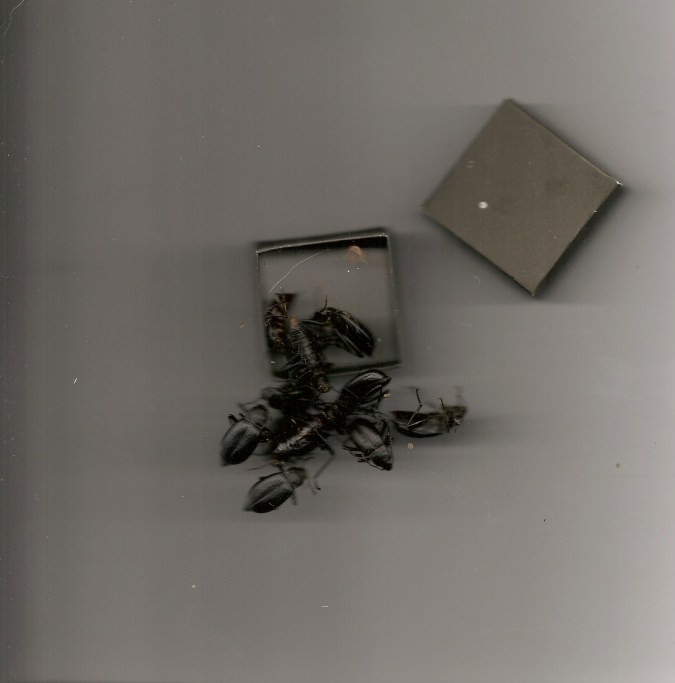
sonja Beetles


. water men and beetles .

there are a few, those who should tidy,
those who pump and clear, those who
investigate.
water beetles float their legs, paddle
the river, dimpling surface. hang on
the bridge , warming back and watch.

water men wear high visibility, while
the beetle shines black.

lately we have cut the paths
and planted bluebells.
sbm.

the graffiti
of firefly stars at dusk
we follow
until our eyes adjust
to the narrative of night

tanka published in Earth: Our Common Ground, April 2017

-Debbie Strange

611. black beetle

have you read of them before?
the beetles here turn over,
legs waving, we turn them back,
then,
it is all repeated.
empathy kicks in
for all small folk
who suffer, who cry
in dark corners.
we know he will die,
yet cannot save him.
all is in disorder.

sbm.
.

.288 beetle.
it was my beetle, dead, not buried.
i keep them, yet it fell
to the floor,
mysteriously lost.
we try to turn disasters round,
here, knowing it will be found,
some time.
my dear sweet sexton, the burying kind.
aptly the grave digger, it seems
you can buy dead insects on line.
sbm.

..harry lime..

i am a detective a bit
like
harry lime
looking for a beetle
blackened ; crusty with a smart serge suit from
foster brothers

went missing a week or so ago
the full moon following

reported by a family in the
cellar concerned

by its legs waving wildly ; sock dangling
backed on flagged floor

missing person

crisp printed poster
denoting

sbm.

Scurrying

There’s a lot
of to and fro
on the flat patio stones.

I lack their language
size and drive.
So consequently,
a world of mystery
exists under my feet.

The economy
lockdown and the NHS
are as strange to these
beetles as a distant
neutron star.

“Where’s my dung ball
I’m sure I left it over there”

© Dai Fry 24th June 2020.

Chrysolina Americana: Rosemary Beetle

Opportunists, night-arrivants
on some aromatic spoor,
in their bronze clusters
they chew the tough leaves
with relentless mouthparts,
leaving a dry grey ruin.

Under the microscope
they are beautiful: striped,
red and green, iridescent.

Crushed in my fingers
they have the dark
rosemary smell of sticky
pine resin, varnished pews
and the creosote dust
of old garden sheds.

I kill them, but I am
glad they come.
I should dislike them
much more than I do.

-Imogen Forster
Dung Beetles

Our lass and I often roll
away your dung ball together,
dig a nice hole for it,
drop it in, and cover it.

Below ground, our lass reworks
your dung into the shape of a pear,
leaves the top hollow,
where she inserts her eggs.

When the larvae hatch,
they have more than enough to eat,
eventually pupating
before emerging into the light.

-Paul Brookes

On Beetles ~ The Blister Beetle of Europe

I, the Blister Beetle of Europe am feeling so
proud to be named as “The Insect of the Year”,

Let the Ancient Greeks know that  I am  the
“endangered species”, and  I am still the best,


My healing properties are vital, deadly toxic
secretions Cantharidin  a healing salve , an

Aphrosidiac, the best of forty types of oil
beetles, my poison helps to kill enemies,

The Greeks know it, if I am threatened I
secrete more drops, my home is in sandy

Open spaces dry meadows and orchards
part of human culture for more than 4000

Years, watch out, my odorless  droplets
cause blisters,I use it to protect larvae

Though I am hardly 10 to 35 millimeters in
size,valued  high I am Crowned “Insect 2020”

My Cantharidin is enough to kill one adult
one blister beetle for one human, plenty.
 

-Anjum Wasim Dar
Copyright CER 2020

Bios And Links

-Imogen Forster

lives and works in Edinburgh. In more normal times she’s active in a number of reading and writing groups in the city. She has an MA in Writing Poetry from Newcastle University, and has published poems in various online and print magazines. She expects to have a pamphlet next year, and tweets as @ForsterImogen.

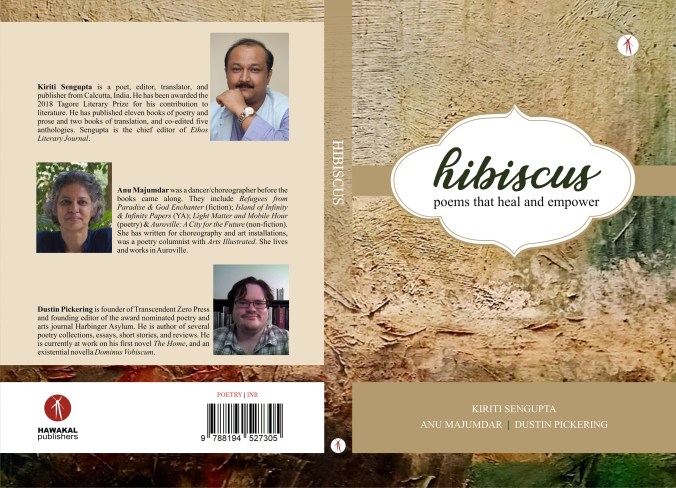
Wombwell Rainbow Book Interviews: “Hibiscus: poems that heal and empower”, edited by Kiriti Sengupta, Anu Majumdar and Dustin Pickering

Hibiscus Cover

1. How does poetry heal?

In the introduction to Hibiscus, I wrote: “Can poetry heal us? Of course, it does. The importance of healing and the power of the spirit can never be hyped or ignored, for it is as integral to our living as breathing.” So, I understand where the question comes from. Art heals in more than one way. It can disturb us, and thus, prepares us to address the concerns on our own. And at times, art makes us feel good.

Nevertheless, poetry, like other expressions of art and culture, stimulates our nerves, or the brain, to be precise. There is no point in explaining how the brain receives and processes the impulses. I’ll quote George Harrison: “It’s all in the mind!” Rhythm, not necessarily rhyming, and the contents of poetry help convey the stimulus to the brain. Let me cite an example: the Vedic verses (the shlokas) are chanted even now to boost mental and physical wellbeing.

Kiriti Sengupta

Poetry is capable of cauterizing wounds where the language is most pertinent. Language is the human capacity to challenge and evade reality on grounds of its unreality. It can create worlds where reality meets our expectations or where we are met with ourselves in such a light that we recognize Caliban’s face in the mirror of literature, Our hideousness is before us, as in Plath’s “Tale of a Tub” where “the stranger in the lavatory mirror” both encapsulates humanity in truth and also beautifies the ugly through sublimating its presence in life. Poetry is the sublime capacities of language, emboldened by fears and hopes held in human hearts, which serve as a kind of escapism but also as revelation. Poetry reminds us in so many ways that God is present within or that the divine spark within us can speak. Poetry confounds boundaries of the recognizable and intuitive reality shaped by forces beyond our control. It exists on the liminal dreamscape of communication and human yearning.

The feeling compelled in poetry speaks volumes more than much of what is written in prose. Because it can transcend storylines, plot barriers, restricted flow of thought, or the everyday process of life it has the ability to flood into the mind with subtle healing. The art of crafting poetry offers surprises and helps victims contextualize the things hurting them. People see things differently when they write about them. Writing helps trauma victims safely face their private tragedies, and as a form of self-communication poeticizing unveils histories and allows us to see things much differently than we had before. It also opens us up to discussing things we are afraid to discuss openly because it creates a distance between us and the subject at hand.

Even though the world holds the suffering of the greatest poets in front of us, might we consider that poetry became their armor rather than caused their turmoil? Plath, again, wrote from her domestication troubles and mythologized from histories and folklore to show us how deeply personal the human experience is. The most minute details of life can be memorialized in poetry, thus poetry acts as memory as well.

Dustin Pickering

2. How does poetry empower?

Empowerment precedes healing. Honestly, when I conceived Hibiscus, I was particularly keen on curating poems that addressed healing. Anu Majumdar, one of the associate editors, proposed “empowerment.” It was an eye-opening moment. Where does healing lead to? As a clinician, I can tell you, healing is not all about back to normalcy, or in other words, restoration of the state of being. Healing imparts strength. It renders authority. Post-extraction, the edentulous gum gradually turns hard to aid in chewing, and at times, it rejects prosthesis. Empowerment is a spontaneous phenomenon. It exposes us to more injuries—a lot more scratches. You know, wounds are impressive: they bleed, itch, ache, and enlighten. What about the laceration of the soul? It is invisible but never ceases to make its presence felt at every crucial juncture. The resultant scar is the real master who teaches us the essence of healing and, thus, empowerment.

Poetry empowers us the same way as it heals. One must remember, healing is an essential prerequisite to real empowerment.

Kiriti Sengupta

In lieu of my previous remarks regarding healing, poetry presents us with the specter of death, the prospect of Becoming, and reminds us of imminent loss. By wrestling with mortality, poetry restores the human mind to hope and dream while embracing the possibility of change. Heidegger, though a designated fascist, once remarked that the poet ushers in a new state of being.

On a personal level, poetry can empower the same way it heals. When a person reads poetry, they engage in a body of thought and learn to see the world anew. This is the very meaning of death– letting go, opening to the New.

Dustin Pickering

Anu answers both questions:

How does poetry heal?

Both questions move between the inner and outer territories, between darkness and light, In the case of healing, poems negotiate grey zones of illness, death, fear or anger and often pole vault through spirit space like this haiku by Issa: In this world / we walk the roof of Hell / gazing at flowers. Beauty discovered or recovered is often the source of that healing, through a deeper wellspring of the soul or of nature as with the Romantics once. Hibiscus missed a contribution from Arundhathi Subramaniam by two weeks unfortunately. Here is a touch from her collection, “When God is a Traveller” – Not scripture, no, / but grant me the gasp / of bridged synapse…/ that allows words / to spring / from the cusp of breathsong, / from a place radiant / with birdflight and rivergreen. The Hibiscus anthology abounds in such flashes of tat radiant space and a will to break out into a healing breath at a time besieged and suffocated by the Covid-19. In The Virus, April 2020, Steve Denehan writes: this universe is empty of stars / is walls and ceilings / that we push outward / upward / inward. Or, it is an acknowledgement of another power that propels healing through an inner assertion, as in Claudine Nash’s poem: someone holds our uncertainty / at a distance which allows the masses to lift the waves and search the sand for hope. This is echoed differently in Sanjeev Sethi’s Inducement: His omnipresence/ erases the offensive. For Raja Chakraborty, healing is freedom regained through a dive inwards: The earth is breathing / Can you hear her… / Go inside…/ And when this night ends / Count the fallen stars / It took you so many light-years / To understand freedom. A freedom that not just heals but empowers. empowers.

How does poetry empower?

The empowering word looks at the sun, holds the light, it is almost an act of will, an act of greater breath, one could say, like Dylan Thomas’ : Do not go gentle into the good night / Rage, rage, rage, against the dying of the light. It can summarize the work of poets throughout time. That’s “All it Takes” as in John Grey’s poem: Sure, the night rolls round again. / But not for us. / We’ve been there./ We won’t let go the light. For Usha Akella, empowerment comes from being a witness, an active will, uttered from a distance: Unbridge the latitudes that arise from hate…/ We are here, we do not come to stay…/ Let our steps be the flight of doves, and let our roads be incense. And finally, Michael R Burch’s “Peace Prayer” – Be one with the buffalo…/ Lift your face to the dawning light, feel how it warms / And be calm/ Be still/ Be silent, content. The buffalo is an invocation of spirit power, in a world clearly in need of peace, though not stated here. The poem stands in the full glory of light, Lift your face to the dawning light. And there it finds its seated poise and empowerment.

3. Why do you think there are more descriptions of the natural world, plants, trees, gardens in the poems than the interior experience of home, hearth and kitchen?

I believe Covid-19 and the ongoing climate crisis are interwoven. The lockdown globally seems to have more effect on the natural environment than on us individually at home. While we grow restless in our homes, economic activity harming the environment is relaxed. Major offenders are transportation and waste.

The anthology is a response to coronavirus generally, and the healing of Nature from our negligence is a primary observation in the course of events.

Dustin Pickering

Nature holds the keys to all disorders. In an extreme crisis, people tend to adopt a holistic approach to life. The COVID-19 has not only impaired the world economy and mobility as well as the positioning of people, but it has also cautioned us to become sensible and diligent.

In a recent review of Hibiscus, Prof. Mosarrap H. Khan writes: “A young, audacious Pushkin found in the plague a way to defy death, a way to steal life faced with an unprecedented crisis. [Hibiscus] is no less audacious in its claim that poetry has a role to play in moments of collective crisis, a pandemic. Poetry ought to not only heal but empower us in uncertain times, enable an inward journey of self-consciousness, and make us rethink our way of life. As Sengupta writes: “Our Hibiscus will bloom amid corona infestation, self-isolation, unemployment, famine, and suffering. This anthology will comfort and rejuvenate the readers to step into a world that might not allow reckless lifestyles we were used to. Self-restraint comes with a price.””

“You see, what we claim to be a “new normal” isn’t really the “latest.” In ancient times we maintained close contact with Nature: with the progress of civilization, we severed the connection. We forgot our camaraderie. The pandemic allowed us to revisit the togetherness. Thus, the inevitable descriptions of the natural world in the poems.

Kiriti Sengupta

4. Often in this collection the poets speak of the divine, and prayers and praise and lifting up. Why do you think poet;s turn to religion at times like these?

I’m not sure it is only poets who turn to religion during these times, and I don’t think it is only during these times that we seek divinity. People of various faiths believe God is the supreme good, a being with omniscient qualities who has a plan for humanity. Poets are great revelators as I previously mentioned. I think part of healing and empowerment is recognizing that something eternal is on our side in spite of obstacles and wrongdoing. It keeps us strong and healthy. Such things aren’t only a matter of religion, but of a positive outlook. Learning to appreciate and share gratitude for what one lives and understands of life.

Dustin Pickering

Now, there is the catch: why poets turn to religion at these times can only be answered by them. I can’t speak for others. Poets are human beings in the first place, and this is a general tendency to involve the gods when one is in danger. My poem, “Gateway to God,” will address your query, hopefully. Note, the poem first appeared in The Earthen Flute (Hawakal Publishers, Feb 2016):

Prayers carry lives within.
They are expressions
our desires take refuge in.

For all worldly pleasures and fulfillment
we remain scared, perhaps.

Wishes are chanted with closed eyes
and we continue to live being frightened.

Like an inevitable death
an enormous God steps in.

In “Inducement” (Hibiscus, p 142), Sanjeev Sethi writes, “… What’s my catalyst / to keep on truckin’? / His omnipresence. / He erases the offensive.” You know, faith blooms in quietude—in isolation. The pandemic gives us another chance to seek divine intervention.

Kiriti Sengupta

5. Despite the alphabetical structure there is the surprise of an underlying shape to the content: An introduction to the pandemic, the experience of the pandemic, then the vision of a time after the pandemic, a hope for change and renewal. How correct is this as a reading?

That’s an interesting question. Perhaps a divine hand took part there. I don’t think it was intentional.

Dustin Pickering

We, the editors, have jointly penned the introduction, named “The Silver Lining.” It has a well-planned layout, and we were sure of what we would write for the piece. We thought Hibiscus wouldn’t be just the poems we’d curate. It should provide future readers about the perspective of this collection. We would eventually forget the pandemic, these difficult times, the crisis, and the COVID-19 would find a tiny place in world history. As editors, we accepted our accountability to record the vantagepoints. So, even after a few decades, when someone would read Hibiscus, s/he would understand what made these 104 poets write on “healing and empowerment.”

I hope you are aware that I conceived the anthology. I found it apt to write a post for my blog, The Straight Bat, which will inform readers, critics, and media about my motives. I named it, “Hibiscus—a palliative measure.” I had no intention of including it in the collection. However, the publisher’s (Bitan Chakraborty) insistence changed my mind, and after a few minor edits, the post turned into a preamble.

-Kiriti Sengupta

6. How did you choose what poems to include and what to exclude?

That would be a question for Anu and Kiriti who did the bulk of selecting. I promoted and invited poets I felt were of the calibre needed for this important book in crisis literature. My role has been one of promoter and adviser. I did not have much of a role in final selection.

Dustin Pickering

We had a set of guidelines we shared with the calls for submission. We sought shorter poems: the length shouldn’t exceed 14 lines. Although we made a few exceptions, we politely declined all submissions that weren’t related to the theme of the anthology. One hundred and fifty-six poets from across the world submitted to Hibiscus. We selected 104 of them.

-Kiriti Sengupta

7. What do hope the reader will leave with after reading “Hibiscus“?

I expect them to leave the book with a sense of hope. I also anticipate that the reader will be challenged to see healing and empowerment differently than sentimental tales convey. Healing is an arduous task, one fit for a warrior, and it applies to our world, our friendships, our families, our societies, and our art. The anthology sought to encompass a wide array of aesthetics from all over the globe. I hope the reader will find commonality in their own life with the overall feeling of what is expressed across these aesthetics.

=Dustin Pickering

Paul, we did our bit and sincerely. Now, I’ll love to listen to the readers instead.

Kiriti Sengupta

*******

Copies of  “Hibiscus” may be bought here: Hibiscus: poems that heal and empower

National Insect Week Poetry Challenge: Take part with Hugh Dunkerley, Tom Harding, Debbie Strange, Stuart Buck, Zachary Payne, Tania Hershman, Peter Hughes, Dai Fry and myself. Monday: Dragonflies, Tuesday: Wasps And Bees,Wednesday: Ants, Thursday: Beetles, Friday: Butterflies, Saturday: Moths, Sunday: Flies. Email me and I will add yours to my daily wordpress posts, also posted to Twitter and Facebook. You can still add to all the posts already published. Here are today’s: Ants

Monday’s post: Ants

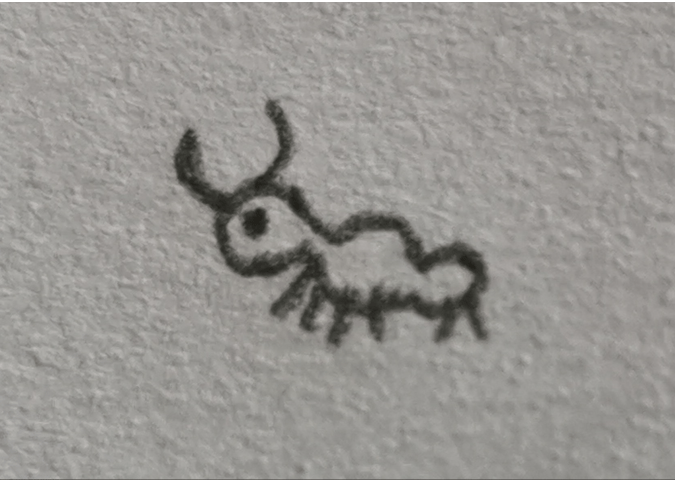
Ant

to the ants

i am sorry that i used to collect you in matchboxes
in my pocket, far away from the rest of your family

i was young and had yet to discover how cold life can be
without the soft crawling of other bodies

-Stu Buck

-Dr. Tania Hershman


METAMORPHOSES

Ants in their city of sisters
sing molecule lullabies

*

my animal heart
my nettle nerves

*

five years underground, four weeks on the wing
stag beetle, sing!

*

blind architects, boys and girls in desert towers
termites eat the world, peaceful little ones

*

does the butterfly remember
what the caterpillar knows?

-Anja Konig

The Ants

Perceive the ants
Toiling hard
Constantly collecting countless
Grains inside the Earth
Crawling in line,
Oblivious of time
Fearless of being crushed
Treading unawares,
Little creatures greatly great.
Presenting a lesson
Of unity and discipline.
Engrossed in their work,
duty they do not shirk.
If so little an insect
Can be so perfect,
I regret so say, that man
Has still a lot to learn
To earn, to live, to give and grant
To work and work like…
The little Great Ants.

-Anjum Wasim Dar
Copyright ©2020 Anjum Wasim Dar

Zachary conversation among pesticides

=Zachary Payne

an ant
pushing the universe
up this hill
in a water droplet
i find my inner strength

tanka published in Atlas Poetica 25, July 2016

a black river
of ants surges across
the pavement
they know their destination
long before I know mine

Honourable Mention, 2019 British Haiku Society Tanka Awards

-Debbie Strange

Ant 1 Hugh DunkerleyAnt 2 Hugh Dunkerley

-Hugh Dunkerley

Ant Peter Hughes

-Peter Hughes

Warrior Poet

My tribe the Dorylini,
we were there when
the continents broke.
I am an army ant.

My mandibles are strong
as is my armour
and if you believe
then I have wings.

Spiders and scorpions
sometimes my friends
other times prey.
Marching, hunting, resting.

We are nomads
destroyers…
Eating anything
that gets in our way.

I have loved queens
and fought armies.
When my legion rests,
I compose laments
of love and death
and the futility of marching.

My poems are formed
from chemicals
and pheromones.

Don’t loiter in my path,
listen for I am close.
My antennae will
know you and I will
take your life.

-© Dai Fry 23rd June 2020.

Must Rid

these mites and flies, unneeded
thoughts, prick painful memories,
as they sip my Corvid blood,
shit and sick beneath my wings.

Must sit in a nest of wood
abided ants, who alarmed
swarm all over me, and burn
off waste with formic acid.

Envy pheasants as dust in hot
ash from bonfires, and more so
the Jay as steals a lit fag
to fry their unwanted pests.

Ant Poem 1

Ant Poem

Here’s someone
broken free of wherever
they’re supposed to be,
venturing along your arm
as easy as a person
going out to buy the morning paper.
Pausing, perhaps to listen
to the wind in the poplar trees
shivering above you both;
his future, momentarily,
in the palm of your hand.

Ant Poem 2

Summer Wind

I wouldn’t be surprised
if a few of these ants
have begun to lose faith
what with the summer wind gusting
so wildly about them,
the tall grass sounding like a sea
preparing to part itself.
What’s to stop one or two
falling behind?
Forsaking what may come
for the pleasures
of this earthly afternoon,
sheltering in the shade
of a dandelion or curling
beneath the marble temple
of your naked arm.

-Tom Harding

Its Path

An ant wends
between my boots

Your trail unplanned, unkempt
unruly this way and that,

yet, looked back on
your path dignified,
august.You define

it by use. A search
for provisions others
may follow. An invisible
map to some.

Paul Brookes

Bios And Links

-Zachary Payne

is poet and translator who works as a Spanish Professor on the island of Oahu. Poetically he has published poetry chapbooks in Spanish in Peru and Spain and has published two full collections of poems in Spanish, the most recent being Robos, Setas & Sombras(Huerga y Fierro, 2014) and was included in the anthology: Disidentes: antología de poetas críticos españoles 1990-2014. (La oveja roja, 2015).
Zach continues to write in Spanish but on occasions will write in English. Termites: the illegal occupation of paradise is his first poetry collection written entirely in English. In late July 2020 his second English collection Beyond Heroin will drop with Hesterglock Press.

Twitter: @arteenlazanja

-Tom Harding

is a poet and illustrator based in Northampton, UK. His second collection of poetry and drawings, Afternoon Music, is available now from Palewell Press.

He is also the editor of the Northampton, UK poetry magazine Northampton Poetry Review

-Anja Konig’s

first collection “Animal Experiments” was published by Bad Betty Press in June 2020. Her first pamphlet “Advice for an Only Child” from Flipped Eye was shortlisted for the 2015 Michael Marks prize. She is obsessed with ants and always carries a magnifying glass.

-Hugh Dunkerley

has published two full collections, Hare and Kin, both with Cinnamon Press. He lives in Brighton and teaches at The University of Chichester.

Peter Hughes

is based in north Wales. He is a poet and the founding editor of Oystercatcher Press. He has produced innovative versions of several classic Italian texts. His most recent book is ‘A Berlin Entrainment’, from Shearsman.

-Tania Hershman’s

poetry pamphlet, How High Did She Fly, was joint winner of Live Canon’s 2019 Poetry Pamphlet Competition and was published in Nov 2019, and her hybrid particle-physics-inspired book ‘and what if we were all allowed to disappear’ was published by Guillemot Press in March 2020. Tania is also the author of a poetry collection, a poetry chapbook and three short story collections, and co-author of WritingShort Stories: A Writers’ & Artists’ Companion (Bloomsbury, 2014). She is co-creator of
@OnThisDayShe
, curator of short story hub ShortStops (http://shortstops.info) and has a PhD in creative writing inspired by particle physics. http://taniahershman.com

Wombwell Rainbow Book Interviews: “Twoxism” By Maria Haro and Claudia Serea

Twoxism

Twoxism

Link to https://store.8thhousepublishing.com/poetry/twoxism-by-claudia-serea-maria-haro.html
Poems by Claudia Serea. Photos by Maria Haro.
8th House Publishing, Montreal, Canada.
116 pages. Color. Paperback.


Maria Haro grew up in Madrid, Spain, where she studied fine arts and graphic design. She graduated from the School of Graphic Communications and moved to New York City in 1994. She has won several global awards as a Creative Director in pharma advertising. She collaborates with other artists on projects that inspire her, and you can find her photos on Instagram @mariavisualdesigner.

1. How did photography find you? Or, did you find photography?

I am a multidisciplinary visual artist, so photography is one of the communication channels I use. I am open to any way of visual expression to convey an idea, so photography found me.

2. How important is the strong use of primary colours in your work?

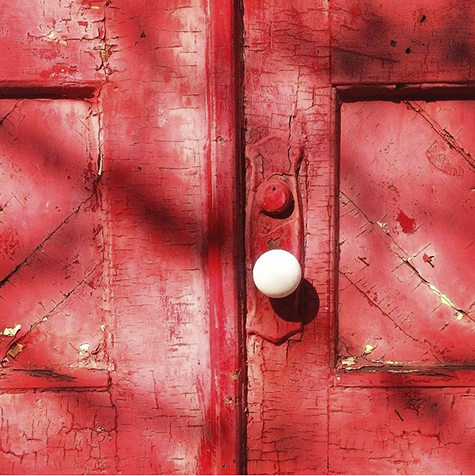
I am a big fan of vibrant primary colors, even neon. I often use vivid colors in my illustration work (see: blondyiscrazy.com), but Twoxism photography took a different turn. The photos for this project are quick and nimble takes of real objects. They are unedited and never art-directed, staged, or posed. Color is just incidental, but it finds its way in. In a few instances, color is essential to the poem it inspires, like in this photo of a red door from Alicante, Spain:

Twoxism red doors

Red and white

Tonight, I’ll wear a red dress,
crimson heart on my sleeve,

pulsing,
like the meat thrown to lions.

Tonight, I’m a flame
in high heels,

a locked door
you’ll open

with the purest
snow key.

3. What is your daily photography routine?

I take too many pictures, more than I can review and archive. I love the immediacy the camera gives me. I love taking photos of objects in the street, imagining the stories they could tell.

4. What inspired you to take photos of pairs?

I realized objects emulate humans and their relationships, the designs, colors… it was so surprising to notice. The more I looked, the more similarities I found. It felt like a fresh way to look at what surrounds us as if it was an extension of us.

I realized the objects often come in pairs, as if they don’t want to be alone. The pairs have stories to tell, just like couples who have been through so much. And I wanted to tell those stories visually, as well as in words—so I started collaborating with my friend Claudia who is a poet, to explore the life of these objects. Which mirrors our life. That’s how Twoxism started.

Take for instance this image of two chairs in a hallway at my son’s school. I titled it “Hot seat, cool seat,” and it inspired a poem about the difficulties we overcome in life:

Twoxism chairs

A chair is just a chair

It’s the hot chair you sit on
in the middle of the highway
that has become your life,
where trucks and cars swoosh by,
barely missing you.

It’s the school chair
you sat on as a child,
still as a statue,
and flew over rooftops, reading
a burning book.

It’s the cool chair on the ocean floor
where you sit and sip tea
your hair floating around your face
and sharks swim by, indifferent.

It’s the chair in the doctor’s office
where you sit, holding the hand
of your best friend,
waiting for the test results.

And everyone else admires
how calm you are
and how serene you sit
on your chair on the moon
and peel an orange.

5. How did you choose the photos by other people in your book?

One of the collaborators in the creation of the book, the Spanish designer and illustrator Koldo Miren Guinea Herran, was actually the one who started taking photos and who inspired me to take more and more photos to shape this project. In general, the criteria to choose photos from other collaborators are that the style and the story the image tells have to fit well with the Twoxism aesthetic.

Several years later, our project continues at www.twoxism.com where we always post new photos and the poems inspired by them. On Instagram too, you can find my work @twoxism and @blondyiscrazy.

Claudia Serea

Claudia Serea’s poems and translations have been published in Field, New Letters, Prairie Schooner, The Malahat Review, Oxford Poetry, and elsewhere. She is the author of five poetry collections, most recently Twoxism, a collaboration with visual artist Maria Haro (8th House Publishing, 2018). Serea received the 2013 New Letters Readers Award, the Levure Littéraire 2014 Performance Award, and several honorable mentions for poems and chapbooks. Her poems have been translated in French, Italian, Arabic, and Farsi, and have been featured in The Writer’s Almanac. She is a founding editor of National Translation Month, and she co-hosts The Williams Poetry Readings.

1. Who introduced you to poetry?

I grew up in communist Romania, and, believe it or not, I started by writing prose first, not poetry. I think I was in 6th or 7th grade when I wrote a sci-fi trilogy about three French orphans who had adventures in space. My best friend Ioana and I wrote to entertain ourselves. We read and corrected each other’s work, and it was lots of fun, better than what was on TV.

Poetry came a bit later, in high school. It was the next thing Ioana and I decided to do, probably influenced by her mom who was writing poems at the time. My first poems were terrible. When I was 16, I got a very short nature poem published in Limba si literatura romana (Romanian Language and Literature), a popular national journal for students and teachers at the time.

I wrote through my first 3 years of college but published very little. After the regime change in 1989, I went on a long hiatus. Life got in the way. Everything was changing very fast, and continued to change when I emigrated and started over. It wasn’t until 2002 that I started writing poetry again in Romanian, on and off. I switched to English in 2004 and published one or two poems per year for a few years. I never thought poetry was possible until 2007 when I joined The Red Wheelbarrow Poets. It’s because of the group and our weekly meetings that I can say I’m writing today.

2. What was it in Maria Haro’s photos that inspired you to write?

I love writing about New York City. I love its grittiness, strangeness, surreal at times, and the mix of the cold concrete jungle with the warmth of the people in it. I find that energizing, inspiring. When my best friend Maria started to shoot street objects, she emailed me her photos, saying, “This is a love story, this is Twoxism.” There were photos of pipes, manholes, chairs abandoned at the curb, trash cans—and she was saying: this is a love story, don’t you see? And I started to write love poems for those photos, to explore the life behind the discarded city objects, where have they been, what they have seen. That’s how Twoxism was born.

So Twoxism started as a poetry-photography collaboration blog (www.twoxism.com). We had a great response to this project, and our following grew on Instagram. In April 2017, 33 selections from the blog became an art exhibition that opened in New York. After that, Twoxism became a book published in December 2018 by the Canadian press 8th House Publishing.

Twoxism is an invented word for all things two—among them, love, friendship, and relationships. As a project, it finds beauty in unexpected places and sees the mundane with new eyes. As a book, it speaks of love and relationships, like this poem and photo:

Twoxism White handkerchiefs

Breeze for your sail

Tonight, the world is an abandoned lot
enclosed by chain link fences,
and us, trapped,

two helpless birds,
two fish caught in nets,
two knotted napkins.

But I’ll say to you,
Hang on, love,
hang on.

Don’t raise your white flags yet.
Don’t surrender.

I’m sending you
a breeze for your sail,
sweet wind of faith.

I’ll blow a lock of hair
off your pale forehead

and sing to you
from far away.

Don’t give up, mi amor.

Together, we’ll hang on
the wires of the world.

We’ll billow, sway,
and flutter.

Soon, the fence will crumble
and we’ll dance.

3. What is your daily writing routine?

Before the pandemic, I used to commute to New York City for work every day, so that was my daily routine: writing and thinking about poems on the bus. Now I work from home and I don’t have that time only to myself, so it’s more difficult to write. Now I think about poems when I garden, and I write them late at night when everyone is asleep. It’s crazy, but I miss my bus commute and half hour walk to work. And I miss the city a lot.

4, How do the authors you read when you were young influence your work today?

My writing changed a few times, both in Romania and in the U.S. I first got over my teenager mode and started to study post-modernist American poets in Romania in translation, which was my first revelation. Then, after I immigrated to the United States, I embraced a minimalist approach to poetry that mirrored my timid relationship with the English language in the beginning. After that, I got involved with The Red Wheelbarrow Poets and changed my style again, influenced by their aesthetic and by William Carlos Williams. For each one of those phases, there are certain writers whose work I admired and studied, but there is such a convoluted journey that I can’t trace a direct influence to my work. A mix of influences, rather.

Overall, I have many favorites. They are writers who just speak to me, there’s no other way to describe it. Writers from which I learn and who make me want to write better. From the Romanian poets, certainly Mircea Cartarescu, Ioan Es. Pop, Cristian Popescu, Svetlana Carstean, Ruxandra Cesereanu, to name a few. On the American side, my biggest discovery was Charles Simic. I just love him—and there is nothing better than “The World Never Ends.” Also, Anne Sexton, Sylvia Plath, James Wright, Stanley Kunitz, Jim Moore, Russell Edson, Frank O’Hara, and so many more. I always go back to them—I have a stack on my nightstand.

And I can’t forget some great international names: Anna Akhmatova, Marosa di Giorgio, Tomas Tranströmer, Federico Garcia Lorca (“Poet In New York” was a revelation), Rilke, Neruda (especially “The Book of Questions” and “22 Love Songs.”) I should add some novelists as well: Mircea Eliade, Gabriel Garcia Marquez, Milan Kundera, Vladimir Nabokov, Herta Muller. I could go on and on, really, but I’ll stop here.

5. What do you enjoy most about animating inanimate objects?

Ah, that’s such an interesting question. It has to do with the act of creation—why does anyone write? To tell stories, to entertain ourselves in the dark, to travel inwards and get to our true selves, to explore, to make sense of the world, to play God. All of these are possible answers, and all of them would be true.

But for Twoxism, it’s also about having fun with discarded objects; showing the reader the underbelly and the many hearts of the city; it’s also about contrasting the rough appearance with the warm soul; trying something new; exploring this endless concept of twoxism: the fact that we are made of twos, as in two eyes, two ears, two hands, two feet, etc. We live in a world made of twos. We are made of contradictions, and search day and night for our other half.

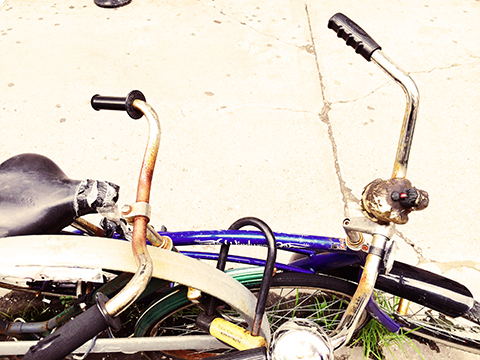
Writing these collaboration poems is also a way for me to get away from my other themes: history, immigration, Romania. In fact, Twoxism is the most “American” collection I wrote; my other books have just some sections dedicated to New York City, if any, but Twoxism is an entire book written only about the city. Here is one of my favorite poem-photo collaborations from the book, in which one of the two chained bicycles speaks about the city:

Twoxism bikes

We’ll always have summer

We’ll always have potholes,
dirt, and rust.

At some point,
my goddess wings will crumble.

Your vinyl seat
will tear apart.

Grass and moss will grow
through our missing spokes.

Duct-taped,
flat-tired,
paint chipped,

we’ll go through sun
and rain
and piles of snow,
thieves’ hands,
and pigeon shit.

Around us, the city will rise and fall
in screeching tides,

but we’ll always have the summer.

And the summer after that.


..day 103..

Sonja Benskin Mesher's avatarsonja benskin mesher

..day 103..

liking the format, liking the days
that come natural now without
no planning

evolving gradually

my trip out yesterday
there have been a few

1. for cash a long while back at early in the morning

2. for fuel
at a reasonable time of day

3. the garage for my mot; passed eventually

4. the tip yesterday with the garden trash
which all went smoothly, clearly they
are well organised and tidy minded

it was all damp, leafy & would not burn
there is that ampersand again & will they
notice?

he was there my old riding partner
remembering
those days in the back bar, most
are gone now

seems now my category is not mentioned
no more, become part of the general population
again

james

then i have the daily walk
as do the others while others
carry on as they have always
done
james

as if…

View original post 66 more words