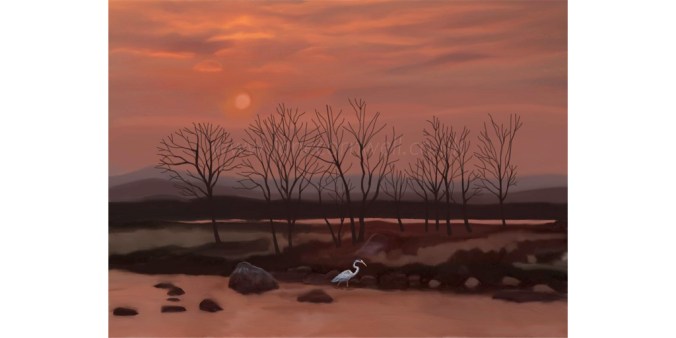
My annual National Poetry Month ekphrastic challenge has become a collaboration between Jane Cornwell (artist), and poets Susan Richardson, Samantha, Jay Gandhi, Ali Jones, Dai Fry and myself. April 24th

24 twitter size rannoch moor

Broken Heart Stone

The drovers road
ran through this moor,
stone people in their days.

Between times,raiders from
the west
just walked the beef away.

Railways came to check the lie,
on mattresses of wood and roots.
Took sleep on earth and ash.

Sheep in heavy jumpers
came aboard the train,
in a festive holiday mood
bound once, Firth of Moray.

When glaciers departed
the land breathed a relief
like proven bread raised
on bubbles of yeast.

At black woods edge
on Rannock Moor
the heart stone
marked the way,
glacial erratic.

Near there I saw a heron
take a rest from flight.

A heart is mended
in a dream this Isles way.

– © Dai Fry 23rd April 2020

Old Whistler

He has stalked the pool,
Statuesque for many years,
Wading with tattered wings
Through the shallows.

Once, a human took aim
And fired a shot, his wing
Bears the evidence, of a
Perfect O, that sings

When he dives into the wind.
Sometimes scars bring strength,
And the creatures down below
Still can’t hear him coming

-Ali Jones

The Sinking Sun

I am not a tree,
barren branches that stretch
through the sunset,
thirsty for morsels of light.
A tangle of veins
pressing into the sky
to keep night from falling.

I have no bloodline to the sun,
no call to warmth.
As the night chill falls at my feet
and the path in front of me
loses its texture,
the ache is wiped from my eyes.

I am free to wander
In the delight of my other senses.
The world comes alive
in the smell of satiated earth,
in the sound of rain tapping
a gentle rhythm against the sidewalk,
and the touch of my husband’s fingers
brushing the tears from my cheek.

With every sunset I collapse,
relief filling my breath
as I untether myself
from the rough touch of the day.
I find comfort in the darkness,
respite from the pain.
I am emancipated
in the sinking of the sun.
I am not a tree.

-Susan Richardson

Live On, Sweet Mother

In your serenity,
You offer more than
We proud humans can grasp,
Despite our categorizing,
Classifying, labeling.
Help us know our smallness
Before you, eventually, call us
To take us home.


-st

Change

Every day it’s the same scorching sun,
same moon, same trees & same birds.
The beach is same, same is the sand,
the waters are same, same are the tides.
I suffer same pain from heartbreaks.
Process of processing sadness hasn’t
changed. The excitement of a new
relationship and anxiety of whether
I will hold it together are still the same.
My mother loves me unconditionally,
my father cares about me, my brother
empathises with me — my support
system is the same. The time taken
by earth to rotate & revolve are same.
Springs & falls are cyclic. Rains, winter
and summer are cyclic. When a child
is born, the heart begins to beat.
Same is the heart which stops at death.
The cycle of life and death is cyclic.

-Jay Gandhi

Silence

Focus intently in the dusk.
You know what is to come,
but will not say it.

In your hall of mists
you know the secret knowledge
that moves beneath the waters.

Everyday you stab at that fact,
lift its writhe and wrestle
into the colours of day.

Swallow it whole, then raise
your vast wings and float
over moorland a white silence.

-Paul Brookes

Was is that thing that walks?

What is that thing that walks?
I can’t walk
Neither can I
But I can sway
You can sway?
I can’t sway
I can sway
But I can’t walk
I can’t shit either
Like that thing
It can shit as well?
It can also eat
It can shit and eat
And walk?
And you, you can sway?
Well, I can’t sway
By myself
It’s the wind that makes me sway
Oh well, that’s alright then
But I can grow
So can I
But you grow so slowly
Imperceptibly so
Well how do you grow then?
Up
I grow up
From the smallest of things
To the biggest of things
It’s just not fair
And that thing that walks
It can fly
Come on please
Stop with this
It can fly?
I shouldn’t have asked
But you always ask
Do I?
And then you forget
And ask again
I do?
You asked when I grew near you
And when the algae grew on you
And when the bug crawled over you
And when the fish swam round you
And then
When that thing walked past me?
Yes, the bird
I’m afraid so
You’re very kind
To repeat it all for me
Each time
You’re welcome old friend.

-The Fishpie Sky April 2020

Bios and links

-Jane Cornwell

likes drawing and painting children, animals, landscapes and food. She specialises in watercolour, mixed media, coloured pencil, lino cut and print, textile design. Jane can help you out with adobe indesign for your layout needs, photoshop and adobe illustrator. She graduated with a ba(hons) design from Glasgow School of art, age 20.

She has exhibited with the rsw at the national gallery of scotland, SSA, Knock Castle Gallery, Glasgow Group, Paisley Art Institute, MacMillan Exhibition at Bonhams, Edinburgh, The House For An Art Lover, Pittenweem Arts Festival, Compass Gallery, The Revive Show, East Linton Art Exhibition and Strathkelvin Annual Art Exhibition.

-Susan Richardson

is an award winning, internationally published poet. She is the author of “Things My Mother Left Behind”, coming from Potter’s Grove Press in 2020, and also writes the blog, “Stories from the Edge of Blindness”. You can find her on Twitter @floweringink, listen to her on YouTube, and read more of her work on her website.

Here is my updated 2018 interview of her: https://thewombwellrainbow.com/2020/04/08/wombwell-rainbow-interviews-susan-richardson/

-Ali Jones

is a teacher, and writer with work published in a variety of places, from Poetry Ireland Review, Proletarian Poetry and The Interpreter’s House, to The Green Parent Magazine and The Guardian. She has a particular interest in the role of nature in literature, and is a champion of contemporary poetry in the secondary school classroom.

Here is my 2019 interview of her: https://thewombwellrainbow.com/2019/12/28/wombwell-rainbow-interviews-ali-jones/

-Jay Gandhi

is a Software Engineer by qualification, an accountant by profession, a budding Guitarist & a Yoga Sadhak at heart and a poet by his soul. Poetry intrigues him because it’s an art in which a simple yet profound skill of placing words next to each other can create something so touching and literally sweep him of the floor. He is 32-year-old Indian and stays in Mumbai. His works have appeared in the following places:
An ebook named “Pav-bhaji @ Achija” available in the Kindle format at Amazon.in The poem “Salsa; a self discovery” published in an anthology motivated by Late Sir APJ Abdul Kalam. The poem “High Caloried love” selected for an upcoming book “Once upon a meal” The poem “Strawberry Lip Balm” selected in the anthology “Talking to the poets” Four poems published in a bilingual anthology “Persian Sugar in English Tea” Vol.1 Two poems published in the anthology “Poets on the Run” compiled by RC James.

His poems have made it to the PoeTree blog and front pages of PoetryCircle.com & OpenArtsForum.com. In free time, he likes to walk for long distances.

Here is my 2018 interview with him: https://thewombwellrainbow.com/2018/09/23/wombwell-rainbow-interviews-jay-Gandhi/

-Samantha Terrell

is an American poet whose work emphasizes emotional integrity and social justice. She is the author of several eBooks including, Learning from Pompeii, Coffee for Neanderthals, Disgracing Lady Justice and others, available on smashwords.com and its affiliates.Chapbook: Ebola (West Chester University Poetry Center, 2014)

Website: poetrybysamantha.weebly.com
Twitter: @honestypoetry

Here is my 2020 interview of her:

https://thewombwellrainbow.com/2020/04/08/wombwell-rainbow-interviews-samantha-terrell/

-Dai-Fry

is an x social worker and a present poet. Image is all but flow is good too. So many interesting things… Published in Black bough Poetry, Re-Side, The Hellebore, The Pangolin Review. He will not stop.

Twitter                  @thnargg

Web.                       seekingthedarklight.co.uk

Audio/Visual.       @IntPoetryCircle #InternationalPoetryCircle Twitter
#TopTweetTuesday

-Paul Brookes

is a shop asst. Lives in a cat house full of teddy bears. His chapbooks include The Fabulous Invention Of Barnsley, (Dearne Community Arts, 1993). The Headpoke and Firewedding (Alien Buddha Press, 2017), A World Where and She Needs That Edge (Nixes Mate Press, 2017, 2018) The Spermbot Blues (OpPRESS, 2017), Port Of Souls (Alien Buddha Press, 2018), Please Take Change (Cyberwit.net, 2018), Stubborn Sod, with Marcel Herms (artist) (Alien Buddha Press, 2019), As Folk Over Yonder ( Afterworld Books, 2019). Forthcoming Khoshhali with Hiva Moazed (artist), Our Ghost’s Holiday (Final book of threesome “A Pagan’s Year”) . He is a contributing writer of Literati Magazine and Editor of Wombwell Rainbow Interviews.

..day 42..

Sonja Benskin Mesher's avatarsonja benskin mesher

.day42.

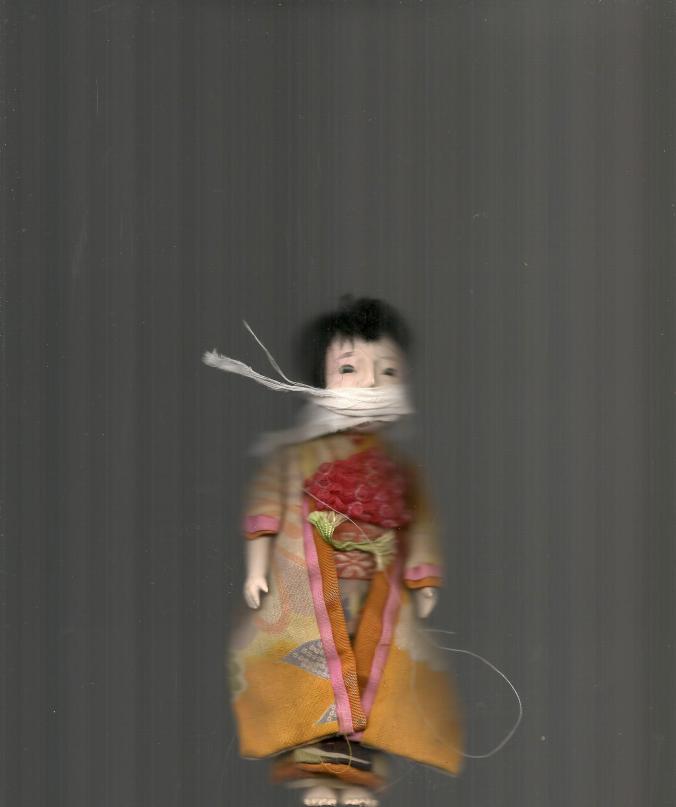
flowers are the fruit

corona

some years back i gagged

them speechless

scanned and photographed

them

now those bindings reappear

masks

controversial here

as were the bindings

back before

bound  words escape

masked flowers form

come free

things are slower now

deliberate

motion

across the page

graphic, the graphite is

in lockdown at the secondary

studio

so public that

it maybe done

for good

she thrives

no symptoms that they can see

yet the words escape disguised

the truth project

they know his name

341256_10150391744916177_194257928_o

View original post

.the bin word(s).

Sonja Benskin Mesher's avatarsonja benskin mesher

oh this  word springs to mind

to bin

when

they ask me how i am coping

how do you cope. when all is fine

and dandy

i am sure the word is more to do with roofs

Roofs is the plural of roof in all varieties of English. Rooves is an old secondary form, and it still appears occasionally by analogy with other irregular plurals such as hooves, but it is not common enough to be considered standard.

or religious outfits all gold and satin stitches

bin the word for           I am dealing with things

and adapting well, add the good word enjoying

they put their heads to one side and use that strange

inflection for coping, cope, to cope

how are you bearing up they said when he was dying

bear down they said when you were             …

View original post 19 more words

My annual National Poetry Month ekphrastic challenge has become a collaboration between Jane Cornwell (artist), and poets Susan Richardson, Samantha, Jay Gandhi, Ali Jones, Dai Fry, Megha Sood and myself. April 23rd

23 Twitter size

Generations

When you walk in the woods, it’s always best
to see everything, set your body to rewind,
in case you miss something. If you stay too long,
you might realise you are nowhere, the footprints
you deposit mean little to the tree’s arching body,
where nothing is off limits; is this what freedom is?

Held by four directions, form painted with earth
and held in its birth suit, the bone stag sees you,
every mark, every design, and trees reveal secrets
before we know them, the faceless year disappears,
like a once trusted friend, stealing away,
stuffing ideas into deep dark pockets.

When the sun wakes, you are older,
and count on things more, there is a new mother,
three flowers to the wind, and black skeleton branches
touch out for acceptance. The struck tree
sees years come and go like lightning,
the bone trumpet sounds the winter’s stretching
drum skin, and strips the body raw.

The stag waits in the thicket, knowing the ways
of wordless stories, dreaming to break ice again.

-Ali Jones

DARK HART

A red deer proud
on Colmers hill.
It was Cernunnos,
Wild Lord, ‘Horned One’

Bellowed hoar breath.
Intoxicated, the wild hunt
passed along oblivions way.
Far from reach of minds,
beneath dark forest web.

Shaman’s antler horn,
wild oaken branches.
Futures to foretell,
fairy cattle to milk and
wisdom myths to seek.

Deeper thickening forests.
In the hart of darkness,
a small truth lurks,
a flickering flame.
Far from habitations reach.

– © Dai Fry 22nd April 2020.

The Stag

You sculpt the ash tree of the world,
nibble its bark and branches.
One of the four gusts that prune clouds,
while another beast gnaws
at the roots of the world.

Every hart has a crown of antlers
that moves beneath the canopy of the world.
true bone fed by blood
in the outer velvet hot to the touch.

You are The Dead One,
The Unconscious One,
Thunder in the Ear,
or Thriving Slumber.
gust in the mind.

-Paul Brookes

Between Chaos and Silence

Today is not the day
to trespass into the dawn,
to leave your boot prints
ragged on the tall grass.

Today is not the day
to muscle your way in,
to bring the brutality
of your hands into the
serenity of the morning.

Today is not the day
to speak with your teeth,
to shred the delicate webs
that protect the boundary
between chaos and silence.

Today is the day
to lower your voice,
put down your weapons
and honor the delicate
moments of being alive.

-Susan Richardson

Safari

The density of the horns
on my head symbolises
my maturity —
my experiences of survival.

After running for life
from the chasing tiger,
there is always
some time to pose.

Lifting the chin up slightly,
pouting a little, creating
the aura of Godfather
there is always some time
to live the swag.

Grass is always better
on the other side of the jungle;

so are the number of lions.

-Jay Gandhi

Keeper of the Fields

Deep brown beast of
Folklore and modernity,
Your rubs frequently stole
The bark from small trees
Where we walked, religiously,
Each evening at sunset.
Routine and territory
Remind all creatures of
Our space, keep us
Properly in our place.

-st

A Frozen moment

The cobwebs of desire
intermeshed with hope
as it floats on the gentle petals
of the dandelion floating away to yonder
Sometimes silence takes the form
around us,
appears suddenly like a moose in a grassland
leaving footprints on the warm grass of the meadow
a supple reminder of its presence
Making its way silently to the gushing stream
sustenance as he knows it
taking the sip from the rushing stream
precariously;
aware and alive
a crowned head with antlers:
an intricate puzzle for beauty and survival
A startling presence in nature
a throbbing desire for an artist,
if only he could steal a moment
and freeze it in time.

–Megha Sood

Bios and links

-Jane Cornwell

likes drawing and painting children, animals, landscapes and food. She specialises in watercolour, mixed media, coloured pencil, lino cut and print, textile design. Jane can help you out with adobe indesign for your layout needs, photoshop and adobe illustrator. She graduated with a ba(hons) design from Glasgow School of art, age 20.

She has exhibited with the rsw at the national gallery of scotland, SSA, Knock Castle Gallery, Glasgow Group, Paisley Art Institute, MacMillan Exhibition at Bonhams, Edinburgh, The House For An Art Lover, Pittenweem Arts Festival, Compass Gallery, The Revive Show, East Linton Art Exhibition and Strathkelvin Annual Art Exhibition.

-Susan Richardson

is an award winning, internationally published poet. She is the author of “Things My Mother Left Behind”, coming from Potter’s Grove Press in 2020, and also writes the blog, “Stories from the Edge of Blindness”. You can find her on Twitter @floweringink, listen to her on YouTube, and read more of her work on her website.

Here is my updated 2018 interview of her: https://thewombwellrainbow.com/2020/04/08/wombwell-rainbow-interviews-susan-richardson/

-Ali Jones

is a teacher, and writer with work published in a variety of places, from Poetry Ireland Review, Proletarian Poetry and The Interpreter’s House, to The Green Parent Magazine and The Guardian. She has a particular interest in the role of nature in literature, and is a champion of contemporary poetry in the secondary school classroom.

Here is my 2019 interview of her: https://thewombwellrainbow.com/2019/12/28/wombwell-rainbow-interviews-ali-jones/

-Jay Gandhi

is a Software Engineer by qualification, an accountant by profession, a budding Guitarist & a Yoga Sadhak at heart and a poet by his soul. Poetry intrigues him because it’s an art in which a simple yet profound skill of placing words next to each other can create something so touching and literally sweep him of the floor. He is 32-year-old Indian and stays in Mumbai. His works have appeared in the following places:
An ebook named “Pav-bhaji @ Achija” available in the Kindle format at Amazon.in The poem “Salsa; a self discovery” published in an anthology motivated by Late Sir APJ Abdul Kalam. The poem “High Caloried love” selected for an upcoming book “Once upon a meal” The poem “Strawberry Lip Balm” selected in the anthology “Talking to the poets” Four poems published in a bilingual anthology “Persian Sugar in English Tea” Vol.1 Two poems published in the anthology “Poets on the Run” compiled by RC James.

His poems have made it to the PoeTree blog and front pages of PoetryCircle.com & OpenArtsForum.com. In free time, he likes to walk for long distances.

Here is my 2018 interview with him: https://thewombwellrainbow.com/2018/09/23/wombwell-rainbow-interviews-jay-Gandhi/

-Samantha Terrell

is an American poet whose work emphasizes emotional integrity and social justice. She is the author of several eBooks including, Learning from Pompeii, Coffee for Neanderthals, Disgracing Lady Justice and others, available on smashwords.com and its affiliates.Chapbook: Ebola (West Chester University Poetry Center, 2014)

Website: poetrybysamantha.weebly.com
Twitter: @honestypoetry

Here is my 2020 interview of her:

https://thewombwellrainbow.com/2020/04/08/wombwell-rainbow-interviews-samantha-terrell/

-Dai-Fry

is an x social worker and a present poet. Image is all but flow is good too. So many interesting things… Published in Black bough Poetry, Re-Side, The Hellebore, The Pangolin Review. He will not stop.

Twitter                  @thnargg

Web.                       seekingthedarklight.co.uk

Audio/Visual.       @IntPoetryCircle #InternationalPoetryCircle Twitter
#TopTweetTuesday


-Megha Sood

lives in Jersey City, New Jersey, USA. She is an Assistant Poetry Editor at Ariel Chart and Mookychick. Over 350+ works in journals including FIVE:2: ONE, KOAN, Kissing Dynamite, Dime show review, etc. and works featured in 38 other print anthologies by the US, UK, Australian, and Canadian Press. Two-time State-level winner of the NJ Poetry Contest 2018/2019. National level Poetry Finalist in Poetry Matters Prize 2019, Shortlisted in Pangolin Poetry Prize 2019 and in Adelaide Literary Awards 2019. Works selected numerous times in Jersey City Genre Nights and Department of Cultural Affairs. She blogs at https://meghasworldsite.wordpress.com/ and tweets at @meghasood16.

-Paul Brookes

is a shop asst. Lives in a cat house full of teddy bears. His chapbooks include The Fabulous Invention Of Barnsley, (Dearne Community Arts, 1993). The Headpoke and Firewedding (Alien Buddha Press, 2017), A World Where and She Needs That Edge (Nixes Mate Press, 2017, 2018) The Spermbot Blues (OpPRESS, 2017), Port Of Souls (Alien Buddha Press, 2018), Please Take Change (Cyberwit.net, 2018), Stubborn Sod, with Marcel Herms (artist) (Alien Buddha Press, 2019), As Folk Over Yonder ( Afterworld Books, 2019). Forthcoming Khoshhali with Hiva Moazed (artist), Our Ghost’s Holiday (Final book of threesome “A Pagan’s Year”) . He is a contributing writer of Literati Magazine and Editor of Wombwell Rainbow Interviews.

..day 41..

Sonja Benskin Mesher's avatarsonja benskin mesher

..day 41..

i dream of angel cake soft layers of colour
shop bought
like mum did

in the lockdown the law is that we must
bake it
at home

i don’t i mainly
walk and draw

as you know

the sleeve comes longer more stylist
different than the left one come too
long

i may be able to draw hands yet
like the empty sleeve better the
shape at the end

he rode on ahead on his bike
i ran to keep up the conversation
still distanced
as if i was in
training

the farmers drove by unsmiling
later down by the gate where
the ram was caught in the wire

they waved and smiled
i watched the sewing
i watched the stars
the seating all arranged

now in the corner
i listen to cohen
and the like

james

prefer fruit really
i feels happy with
it

20200421_1814063113072052908659855.jpgdefault

View original post

Al Asi: The Disobedient -A Poem by Dua Al Bostani Al Fattohi

robertfredekenter's avatarIceFloe Press

Al Asi: The Disobedient

I


How much does it take the City
to realize her river can’t be
her accessory?

How much does it take her
to know that He can’t be blamed
for the boat,

for the Fisher King,
for the thigh wound?

How much does it take the City
to believe the Fisher’s fishing
has nothing to do with her
infertility?

Stop spitting on my banks
every time the rain falls
to make you more barren
every time the raindrops
start tickling my aqua body.
Stop blaming the clouds for
not talking the sun into
coming out.
She won’t come.

The Orontes goes on.

II


Women would walk to the river
long ago covered in black
head to toe. They would

throw in him much of their
femininity not revealed to
the City’s men.

They would confide in him
their henna-dyed locks
their placentas after each birth.
The…

View original post 181 more words

“The Wombwell Rainbow” Interview

Wombwell Rainbow Interviews: Stephen Claughton

Wombwell Rainbow Interviews

I am honoured and privileged that the following writers local, national and international have agreed to be interviewed by me. I gave the writers three options: an emailed list of questions or a more fluid interview via messenger or an interview on their most recent book, or a combination of these.

The usual ground is covered about motivation, daily routines and work ethic, but some surprises too. Some of these poets you may know, others may be new to you. I hope you enjoy the experience as much as I do.

Stephen Claughton

grew up in Manchester, read English at Oxford and worked for many years as a civil servant in London. His poems have appeared widely in magazines, both in print and online, and he has recently published two pamphlets: The War with Hannibal (Poetry Salzburg, 2019) and The 3-D Clock (Dempsey and Windle, 2020). He reviews regularly for London Grip and blogs occasionally at www.stephenclaughton.com, where links to his reviews, poems and pamphlets can also be found.

The Interview

1. What inspired you to write poetry?

I can’t remember what originally inspired me. I began writing poems in my early teens, but didn’t really get going until I retired from the Civil Service ten years ago. I like to think that I was held back by lack of time, but really it was a lack of confidence. Poetry was too important to me to risk failing. Then, once I’d reached a certain age, I realised I’d got nothing left to lose. You can’t write without taking risks; you have to accept every time the possibility of failure.

2. Who introduced you to poetry?

As an English teacher, my mother was very keen that I should like literature. I remember one wet holiday, when she insisted on reciting part of The Song of Hiawatha to me, but I wasn’t a bookish child and — much to her dismay — resisted her attempt to interest me in it. The 3-D Clock, my pamphlet about her dementia, reflects what always remained a difficult relationship. Poetry — and literature more generally — was something I had to discover for myself, encouraged by some excellent teachers at my school. It was, of course, a great help then to have books in the house. (I read Hiawatha again recently and for the most part I concur with my youthful judgement.)

3. How aware were you of the dominating presence of older poets?

English was my main interest at school and the subject I went on to study at university, so I was aware of the poetic tradition. But it was 20th century poets who first sparked my interest — Eliot, Auden and Dylan Thomas from school anthologies — and then the usual influences on my generation — poets such as Ted Hughes, Thom Gunn, R S Thomas, Philip Larkin, Seamus Heaney and Robert Lowell (all but one of them Faber poets). Robert Graves was also an influence, although I think The White Goddess made more of an impression at that time than the poems themselves.

4. What is your daily writing routine?

I’m ashamed to say that I don’t really have one. In the past, I tended to write when I felt like it, provided nothing more pressing needed doing. It probably explains why I got so little done! These days, although I’m retired, I have a number of other calls on my time — as a town and borough councillor and (before the pandemic lockdown) helping to look after our young grandson. It’s meant that in order to remain seriously committed to writing, I have to be more careful about managing my time. I’ve been surprised by how productive it can be just to sit down and apply yourself, although it can also be very frustrating. I work best in the late morning, late afternoon, or early evening.

5. What motivates you to write?

I can’t really explain the need to write poetry, other than that it’s been a compulsion I’ve had for most of my life. Even when I wasn’t publishing any poems, I was still planning them in my head and producing various, unsatisfactory drafts. There has to be something that sparks a poem off — an idea, a line, an image; I couldn’t write one to order. I’ve recently started reviewing, which is something I do for enjoyment. It helps that I have some say in the books I review and don’t have to work to deadlines. I like to take my time, so that I’m not influenced by any particular mood I’m in — I worry about being fair. Fortunately, I haven’t had to write any unfavourable reviews so far, although I do say what I think works and doesn’t work.

6. What is your work ethic?

Professionally, I used to have a strong work ethic, but when you retire people don’t expect it of you and you don’t expect it of yourself. (Thom Gunn stopped writing poetry after he gave up his academic job — he no longer had the motivation.) I get twitchy, if I haven’t been working on a poem for a bit. I wouldn’t want to write out of a sense of duty, but having started late, there’s always the sense of having to make up for lost time.

7. How do the writers you read when you were young influence you today?

I think it’s more in terms of subject matter than style. The War with Hannibal has two poems about Larkin, one occasioned by The Guardian reprinting an old article, “Poet on the 8.15”, and another about Larkin’s famous last words (‘I am going to the inevitable’), which I’d hoped to write as a cento, consisting entirely of lines by Larkin. That didn’t work out, but the poem includes references to several of his poems. Some of my early influences were unhelpful — Eliot in particular. I read him when I was too young to understand what he was doing and just thought that good poetry had to be obscure. It took me a long time to find my way out of that blind alley. I wrote one poem, when I was fourteen, that seemed to come out of nowhere and was highly praised, but after that my teenage career went rapidly downhill. I recently came across one of the poems I was trying to write then, still in the plastic writing case I used to use. It was so awful that I binned the lot without a second thought. ‘Inspissated’ is the only word to describe my style then.

8. Who of today’s writers do you admire the most and why?

There’s a long list of poets I admire and I’m always finding people I should have read years ago. Ciaran Carson, who died last year, is an example. Perhaps because of my early tangle with Eliot, I’m most attracted to poets who write accessible poems in a conversational style (though Eliot himself could, of course, adopt a conversational mode). Hugo Williams, in particular, helped me get back on track. Reading about the way he rewrote poems as a whole rather than line by line was an eye-opener. Before that, I’d put poems together in the painstaking, bit-by-bit way of the fictional poets, Gordon Comstock (in Orwell’s Keep the Aspidistra Flying) and Anthony Burgess’s Enderby. Some of my more recent poems have come easily, but a lot have been through multiple drafts — usually to try and make them sound more spontaneous! There’s something of the obsessive-compulsive about me.

Another, less well-known, poet who inspired me was Gareth Reeves. I particularly liked the moving series of poems about his father, the poet and critic James Reeves, gradually losing his sight. It intrigued me that you could convey so much in such a simple-seeming way. Of course, it’s only when you try to do it yourself that you realise how difficult it is. I also like the poems of Reeves’ Oxford contemporary, Grevel Lindop. Both are or were academics and Lindop has written biographies of De Quincey and Charles Williams, as well as producing an edition of The White Goddess.

9. Why do you write, as opposed to doing anything else?

Again, I can’t really explain why I’m compelled to write poetry, except to say that my life would be very empty without it. Poetry is a way of capturing something alive. What you do with it when you’ve caught it is another matter and one that’s always open for debate. For me, it’s principally a way of finding meaning and structure in an increasingly crazy world. Also, I like the concentration that’s required by any kind of writing. The same is true of reading, of course, but writing gives you the prospect of having produced something at the end of it. It’s mostly an unconscious process. The only real control I have is when I’m acting as my own editor. Writing and reviewing have given me a sense, for the first time, of doing something that feels ‘right’.

10. What would you say to someone who asked you “How do you become a writer?”

I’d say the usual things — practise your craft and read as widely as possible. Like most things, the more you do the better you become at it. As for reading, I’m lucky to be within striking distance of the National Poetry Library, which is an excellent resource, but other libraries are available. Most of all, don’t be afraid of failure. You can’t get anywhere without being prepared to take risks. And lastly, don’t give up: as long as the impulse is there, keep on writing.

11. Tell me about the writing projects you have on at the moment.

There are a few poems I’ve been working on about my mother’s dementia that didn’t make it in time for The 3-D Clock, although I hope that, when they’re finished, that will be it: I don’t want to keep writing about the same subject. I’m interested in ekphrastic poems. The War with Hannibal has two: one about a watercolour sketch by van Dyck and another about Munch’s “The Night Wanderer”. I’ve written others since and perhaps I’ll have enough for a small collection one day. I’m also toying with the idea of doing a ‘version’ of some incidents from The Aeneid, which I studied at school. And it’s hard these days not to write about the current pandemic, although it may not produce anything useable in my case. I don’t know if anything will come of any of these projects. I depend on poems approaching me rather than me them.

Stephen Claughton reading

New House in the Suburbs, an ekphrastic poem . . . and your next Wednesday Writing Prompt

Jamie Dedes's avatarJamie Dedes' THE POET BY DAY Webzine

New House in the Suburbs, Paul Klee
1924 – National Gallery of Art, Washington, DC

“Your house shall be not an anchor but a mast. It shall not be a glistening film that covers a wound, but an eyelid that guards the eye.”  Khalil Gibran, The Prophet


This clapboard suburban house is not like my Sidto’s, a
house with hydrangea blossoming below the front window,
purple and mauve, in a place where big maples gave us
their charming seed pods, those green whirlybirds
that quivered in the wind while determined dandelions
climbed their way to sunshine through breaks between
the cement squares that formed our sidewalks, a kind of
serendipitous geometry from the Office of City Planning

No, this suburban house is not a bit like Sidto’s where
air-raid sirens sounded at noon each day, disturbing
the otherwise peaceful hours of playing out front or
in the tiny…

View original post 696 more words

..day 40..

Sonja Benskin Mesher's avatarsonja benskin mesher

.day 40..

i hear them say that it is the solitude of lockdown
that brings these words

perhaps they are right
who knows really

there is that word again
even on my shopping card

a sticker so that i recognise that
it is not the other one though the

accounts merge into one these days

she takes it when she goes shopping
on tuesdays in the little coin purse
with the bow

it is that detail or dots which attracts me

she needed a more precise description than

buns

so i explained that not being fussy hot cross ones
teacakes or plain  will be nice
suffice
and she got extra large
some beans and tinned
peaches

left in a bag
in the shade

with the receipt
tucked neatly

you see james how deep the thoughts this
lockdown
said sarcastically
with careful spelling

i am still drawing joan now with summer…

View original post 45 more words