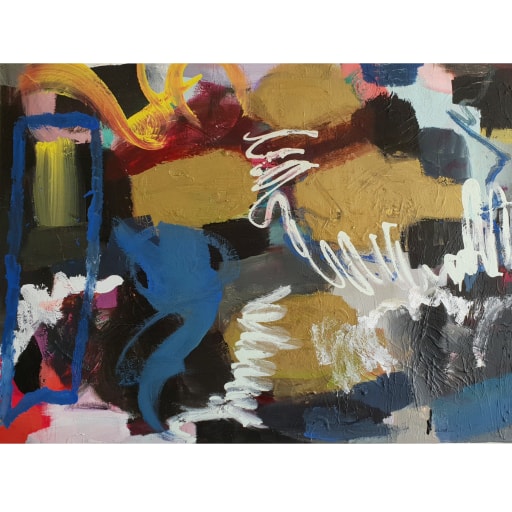
My National Poetry Month challenge to myself has become a collaboration between synaesthetic artist Sammy-John, myself, Anjum Wasim Dar and Jay Gandhi: Day Seventeen: Palette 1

Palette 1

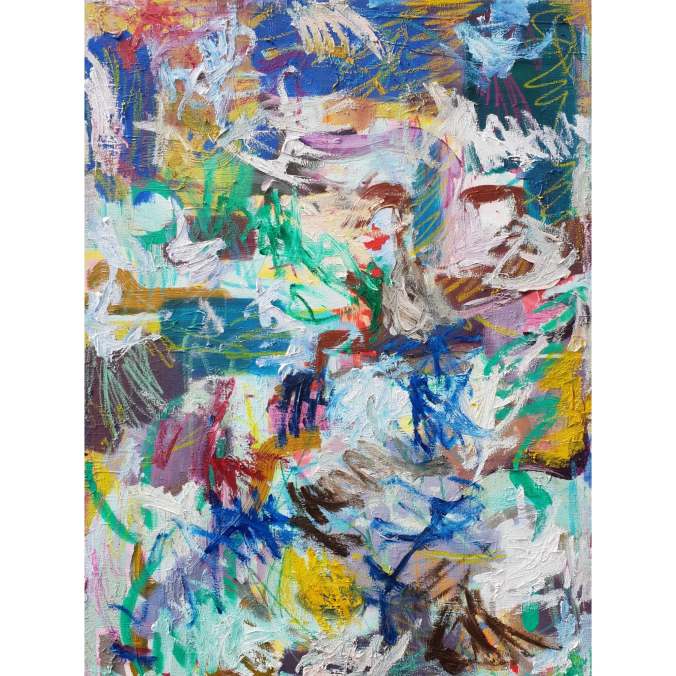
 “Palette 1”
Pastel on paper
Palette 1
Autumnal graces
visible still, blue skies peek
through greening foliage,Falling Grecian urn
ravaged classic, hold on, red
sea, will make the way-Crested quetzal sings
‘freedom, welcomes Spring, though caught
clipped hurt, let go’…Hope must never end…

2019 © CER  Anjum Wasim Dar

After World

fields unsowed
bear ripened fruit,
all ills grow better,
Bold Light comes back.

Earth rises again from sea,
beautiful and green.

Verve and Zest, lad and lass
hidden in the wood,
beneath earth’s ash
One Eye’s gallows
sup morning dew.

Sun has a daughter
who follows
same path
as her mam.

2019 Paul Brookes

Palette #1

summer is all about
ripe yellow mangoes
and scorching blue sky—
both, make me go red

By Jay Gandhi

Ali Whitelock, Some things you can never un-know

Exceptional

Dodging the Rain's avatarDODGING THE RAIN

scotland, winter, 2014

nobody knew what was wrong.

we sat around your bed every night in the vinyl chairs for four
hours that felt like four hundred in our far-from-expert white coats,
hypothesising, googling, guessing – lying, mostly, to ourselves and
to you.
i feared your thin; your evaporating legs; the blanket engulfing you;
the mattress you were disappearing into.
the thing was you seemed a little better that night. you even bobbed
your head in time to the jingle of the Cadbury’s chocolate ad blaring
from the telly in the corner of the shared ward.
your cousin tommy came that night.
the chocolate eclair your sort-of-wife brought the day before sat
on your bedside cabinet uneaten, its brown paper bag saturated
in the grease it had leeched. the tube of condensed milk i’d brought
to try to tempt you into eating something sat unsqueezed.
when the bell rang at…

View original post 2,448 more words

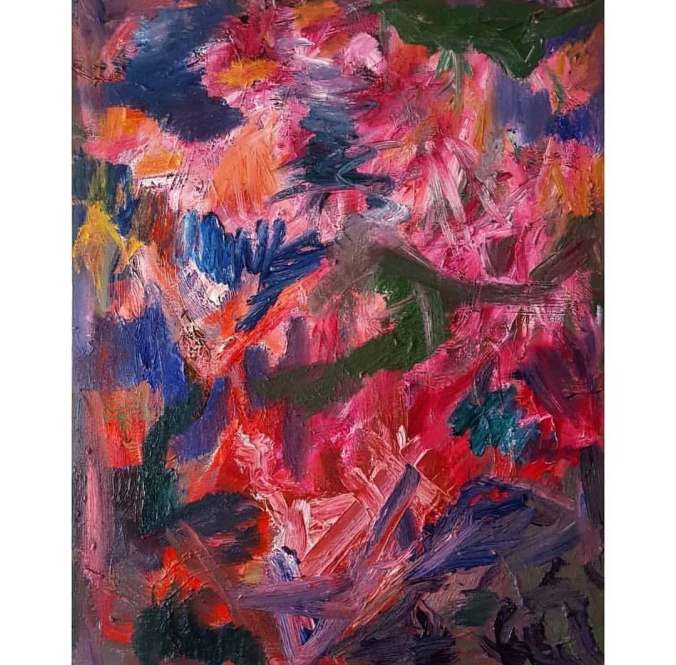
My National Poetry Month challenge to myself has become a collaboration between synaesthetic artist Sammy-John, myself, Anjum Wasim Dar and Jay Gandhi: Day Sixteen: An Unmusical

Unmusical

“Unmusical”
Mixed media on canvas

(Un)-musical

The day begins with loud ding-dong.
its milkman greeting with a song!
Bonjour, Good morning and a hi.
there goes a little bird fly, fly, fly!
my mom cleans the room — broom, broom, broom.
I ride my bike — zoom, zoom ,zoom, zoom!
at school I crunch and munch my lunch.
then play with colours with my bunch!
The evening brings the crows to nest.
they huff and puff before they rest!
At night, mom hums a lullaby.
Good-night my boy, Good-night my boy.

By Jay Gandhi

What melodious murmurs are heard all
over holt and heath, what rumbling grumbles
high up on the sky, what sonorous demons
in Dorian moods, play in depths underneath
O Eris’ Mother of Strife’, grown so tall in step
and sly intrusion,’ may you be graced for being
the patron Saint of Chaos and Aneristic Illusion
How unmusically you made the metallic strings
heavy, transformed white in patches dark,  joy to
‘the blues’ and poisoned all to a sleepy  stupor,
inciting a ‘ Battle of Magenta’  to‘Hail, Hail Horror’
But dissentive chaos cannot in dull hues remain
Sleeping Beauty will  wake up again,  the apple
of discord is stale , broken is Maleficent ‘s curse
the hiss and din of devils’pipes, will die out with pain.

2019© CER    Anjum Wasim Dar

I am the tuneless bucket
clangs

to myself without melody
beatbox doing the dishes,
make a joyful noise
of fretless bass and marimba.
It does not help my snoring.

By Paul Brookes

Wombwell Rainbow Interviews: Heather Derr-Smith

Wombwell Rainbow Interviews

I am honoured and privileged that the following writers local, national and international have agreed to be interviewed by me. I gave the writers two options: an emailed list of questions or a more fluid interview via messenger.

The usual ground is covered about motivation, daily routines and work ethic, but some surprises too. Some of these poets you may know, others may be new to you. I hope you enjoy the experience as much as I do.

Heather Derr-Smith

is a poet with four books, Each End of the World (Main Street Rag Press, 2005), The Bride Minaret (University of Akron Press, 2008), Tongue Screw (Spark Wheel Press, 2016), and Thrust winner of the Lexi Rudnitsky/Editor’s Choice Award (Persea Books, 2017). Her work has appeared in Fence, Crazy Horse and Missouri Review. She is managing director of Cuvaj Se, a nonprofit supporting writers in conflict zones and post-conflict zones and divides her time mostly between Iowa and Sarajevo, Bosnia.

The Interview

1. When and why did you start writing poetry?

I often say my inspiration to write poetry came from the movie Wings of Desire by Wim Wenders. I remember that film as instigating me to make a declaration of knowing how I wanted to live my life and what I wanted to “do.” It was an epiphany. I wanted to be one of the angels, listening and observing, but also I wanted to be like the angel who chose to become human to experience the world, fall in love even with all its pain. I realized I loved the world. I realized there was a world outside of myself to love. This was a coming of age moment for me, at about sixteen.

But also I was inspired all along by language, a fascination with words, a desire to create a self that had been fractured by trauma in childhood and into adulthood. I have early memories of writing every word I knew all over the church bulletin. There was scripture and gospel songs with weird images and the preaching. I hated my religious upbringing for its authoritarianism and it’s deep immorailty as it paved the way for what we see now in Trump. But the language of the scripture and the hymns I loved very much.

2. Who introduced you to poetry?

Our home had no books, no literature. My parents came from poverty, were the first generation to rise out of poverty, but were not college-educated.  My mother drove the right-wing religious climate in the home, and she and my stepfather drove the right-wing political in concert. I’d say the psalms were he first poems I heard. But I do remember an antique book my mother had called “A Child’s Garden of Verses” and I believe a poem I loved about having to go to bed early in summer when it’s still light out and the birds are singing and you want to play. But my first introduction to poetry in the sense we think of it had to have been the Smiths, with “Keats and Yeats are on your side–but Wilde is on mine.” which led me to ask who are Keats and Yeats? There was literature in school which I did love. The usual books we were required to read in middle school and into high school. I loved those. But I really loved the literature I found through the music I loved–The Stranger by Camus, from the Cure as another example. I found so much through references in the music of the time (the 80’s) but also I wrote poems based on song lyrics, impressionistic, associative, and to me these fragments which were based on song lyrics were my poems.

3. How aware are and were you of the dominating presence of older poets traditional and contemporary?

I had no older poets until I finally got to the University of Virginia. I ran away from home, was homeless for a while, got an apartment, waited tables, found my way to one year of Liberty University (the only way I could imagine going to college) then transferred after a year to the University of Virginia. Charles Wright, Rit Dove, and Greg Orr were teachers then. I had no idea who they were. You had to apply to get into their undergraduate workshops. I did and got in and started writing poetry. I knew nothing. I did not know the graduate students. I wasn’t very well educated because I had endured so much trauma in high school in and out of the home, that I really wasn’t learning much formally. I only knew my teachers, who I loved; my peers, who I also loved; and I got to know poets in books: Philip Levine, John Berryman, Sylvia Plath, Li-Young Lee. I applied to the Iowa Writers’ Workshop and had no idea what it was all about. I just knew if you were a poet you were supposed to go to Iowa, so I applied and went.

There I loved my teachers, Mark Doty and Marvin Bell especially, Jorie Graham. The ones I didn’t love I still learned from. I did not know any other poets outside of class. I didn’t got to AWP. There was no social media.

4. What is your daily writing routine?

I have notebooks I keep in a stack on a table in my bedroom. Each notebook is labeled  with projects I’m working on. One is “Arabic” for learning arabic, “Bosnian” for writing poems  in Bosnian, “french” for writing poems in french. Then titles of book projects “Heathen” for gender identity stuff. “Violence” for exploring ideas about violence in writing–boxing, war–resistance etc. I have a “commonplace book” which is fragments and notes from my reading. I do not write every single day, but I am mindful of always engaged in the process of writing. I trust my mind and heart to be absorbing, listening, taking in, attentive to the world. I take notes when I want to remember something specific, and I do my notebooks regularly enough–maybe just 15 minutes a day for a few days or a couple days out of the week, and over time I have a compilation of ideas, themes, lines, words, images, etc.  There’s always something connected to writing that I do every day because it’s all connected to writing–watching a film, reading the news, corresponding with friends or loves, looking at art, listening to music, loving my animal friends, al of it goes into my work. I just strive for balance like breathing–taking in and breathing out, active creation and restful re-creation.

5. What motivates you to write?

It seems to be something I have to do and was born to do. It feels inherent to me and myself. It feels like a whole way of being.

6. What is your work ethic?

I work hard. I love to work. I’m satisfied in my labor. At first I would have been driven to work in my home life with chores and a high level of parentification–a drive to meet the emotional and psychological needs of the adults around me, which meant trying hard to please and trying hard not to get in trouble. Then I revolted against the abuse at home and said “Fuck this!” and left. But with my friends who had also experienced a lot of trauma, were runaways, homeless etc. we created our own families and had to work. We were so young, 15, 16, 17 and up. And it wasn’t perfect and we retraumatized one another in many ways, but it was honestly better for my spirit and my mind and heart than homelife had been.

So I found a way to be proud of my own labor and that has stuck with me. Now I’m 48 and I am a big big believer in NOT doing things. I believe in canceling, saying no, not leaving the house, and not being “productive.”  I believe in naps, sitting quietly, and snuggling the dogs. I still like being productive and working hard but I do not like striving at all. Striving to “make it” that feeling that this could “lead to something” bigger, better. Nope nope nope.

I spent some time in an Amish-mennonite community and I liked the idea of work as sacramental, mopping floors, working in the garden, caring for children and animals and others as a way of connecting and loving, not trying so much to amass wealth or be “productive” in the capitalist sense. That has stuck with me.

7. How do the writers you read when you were young influence you today?

Sylvia Plath’s rage and violence are still something in my poems that I’m interested in exploring. Berryman’s weird syntax which also connects to Shakespeare and the Bible. Charles Wright’s similes and metaphors and stringing together images with a colloquial bit of diction, with a quote from a philosopher. Larry Levis’ “I” who is deeply empathetic and wanders ut from his own self into the wider world.Mark Doty’s ethics and authenticity of emotion. These are all things still with me.

8. Whom of today’s writers do you admire the most and why?

I admire so many. I think it would be impossible to name them, they just keep coming. Twitter has been a boon and a curse. I’ve managed to curate my twitter in such a way that I am surrounded by a really wonderful, diverse, generous, community of writers at all stages in their callings. I learn from all of them every day.  I hate to name names because then I will leave someone out. There are at least hundreds, if not thousands. It’s a little overwhelming. But certain books have been particularly groundbreaking for me in the last couple years. I would say Ilya Kaminsky’s Deaf Republic is one, Gabrielle Calvocoressi’s Rocket fantastic is another and Justin Phillip Reed’s Indecency. Those three have just blown open so many doors I want to hang out a while in those rooms.

9. Tell me about the writing projects you have on at the moment.

I keep working on my non-profit, Cuvaj se/Take Care. I’ve chosen to spend a great deal of my time and energy the last few decades facilitating poetry workshops in conflict zones and post-conflict zones and communities affected by trauma and violence. I started back in 1994 while I was learning about poetry and the war in Bosnia was culminating in genocide. I went over to volunteer in a refugee camp and I made a lifelong commitment to that country through more than twenty years of ongoing recovery. All of my earnings from poetry go into this work and all of the work has been self funded, and expanded to other countries, including Syria, and most recently Ukraine. I started the non-profit so that I could apply for grants to help build capacity and do more. We do poetry workshops that emphasize lgbtq rights, human rights, interethnic cooperation, migrant rights, critical thinking etc. and we also fund writers with grants to support their work, fundraise for emergency/critical financial support, and translation. Donations to Cuvaj se from individual donors always goes directly to writers or students in need to support their work. Running a non-profit is new to me, and I’m learning as I go and I’m taking it slow. https://cuvajse.org/

My fifth manuscript is to be published in 2021, but I can’t say anything more about that yet! There’s a lot in it about gender, seuality, violence, and God, my familiar themes (or demons? I like that use of a familiar) I remain obsessed with. But I am happy for the amount of time I have to really dig in hard with revisions and to make it the strongest book I can write. I don’t move on to the next book until I get the present one published–so every bit of my energy and strength will go into it.

I’m also having so much fun making poetry videos. I was hugely inspired by Agnes Varda and have been making these little clips of poems, readings, with sometimes goofy video. I love it and I want to take a film class and learn how to make more and better ones. I don’t care if they are amateurish or seem unpolished. I learned from Agnes varda just to do what you love and give your heart to it and learn as you go. I think this is the link to subscribe: https://www.youtube.com/channel/UChhjf1Vp_5o6siKsuhv_G0A?view_as=subscriber
My poetry website is here: https://heatherderrsmith.com/

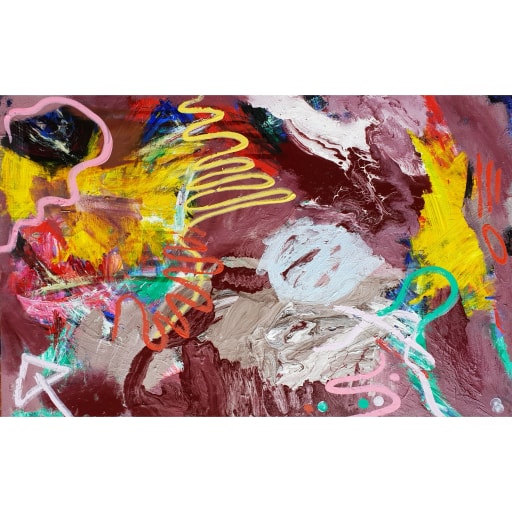
My National Poetry Month challenge to myself has become a collaboration between synaesthetic artist Sammy-John, myself, Anjum Wasim Dar and Jay Gandhi: Day Fifteen: The Untitled

Untitled

The Untitled

Untitled

there is a portrait which is locked
in my wrist. 2B Natraj pencil
often chokes on the Fido-Dido
sketchbook. Muse’s forehead
has many lines: distinct & countable
first line is a prayer for the health
of his wife battling breast cancer.
second line denotes the loans
taken to send his son abroad.
third line is for the well being
of the pregnant daughter.
His hair is grey but doesn’t
appear so when oiled.
the oil seeps through the head
and dissolves stress.
No Old monk. No Jack Daniels.
Daily when he returns home,
his wife opens the door
and greets him; that moment is Nirvana—
the precise reason to stay alive!
His knees no longer bend but he bends it
when bowing to the God. Even Picasso
would tremble to get the detailing right.
But I have taken up the challenge
and the running title is untitled.

By Jay Gandhi

The hillside appeared brown and black
burnt wildly, ravaged to the roots, yet
The dotted greens and reddish, muddy
streams had streaks of hope, sloping

down the valley would be the new vines
soon sprouting yellow buds into flowers
White roses following up through the
thorny bushes straining to bloom and

the trekking traveller looking, stepping
with care,  excited would find a path to
Reach the top and meet the joyful pride
would he survive  in time to see the sunrise?
2019    © CER    Anjum Wasim Dar

The Maws

of our two open graves
French kiss
through the juices
moved by worms
between them.

Swap black air
breath fill each other’s
lungs
climb between
each others
spread thighs
that are the sides
of our graves
waiting to be filled.

Wombwell Rainbow Interviews: Arturo Desimone

Wombwell Rainbow Interviews

I am honoured and privileged that the following writers local, national and international have agreed to be interviewed by me. I gave the writers two options: an emailed list of questions or a more fluid interview via messenger.

The usual ground is covered about motivation, daily routines and work ethic, but some surprises too. Some of these poets you may know, others may be new to you. I hope you enjoy the experience as much as I do.

Poems of the Mare Nostra

​Arturo Desimone,

Arubian-Argentinian writer and visual artist, born 1984 on the island Aruba which he inhabited until the age of 22, when he emigrated to the Netherlands. He later relocated to Argentina while working on projects related to his Argentinean family background. Desimone’s articles, poetry and fiction pieces previously appeared in CounterPunch, Círculo de Poesía (Spanish) Island, the Drunken Boat, The Missing Slate, EuropeNow, the Writers Resist anthology, Al Araby Al Jadeed (Arabic) and the New Orleans Review. This year he performed at the international poetry festival of Granada, Nicaragua. He blogs essays about Latin American poetry for Anomalous press under ”Notes on a Journey to the Ever-Dying Lands” and some of these pieces also appeared in the Latin American views-section of openDemocracy.

His website
http://www.hesterglock.net/p-008-arturo-desimone.html

The Interview

1. When and why did you start writing poetry?

The first attempts proved, of course, frustrating. As a young adolescent I had read novels and prose more often than poetry, and tried to write poems that seemed mostly fed by song and music lyrics. I wrote poems meant for girls at school. The worst were thwarted mystical attempts about drug experimentations (but at least in the bad poems I already saw my limitations in exploring space and time with language). At some point I got into debating in the schoolyard with other young people who were very religious Christians. They claimed no poetry could ever rival or approximate the meaning imbued in Biblical poetry, and that unique beauty in the Biblical verses sufficed to prove the Biblical poetry’s having divine inspiration. Things have changed a lot on the island Aruba where I grew up, but back then very few people I knew were avowed unbelievers. I took the claim very seriously, and started reading ancient and modern poetry, on the internet and in the library, hoping to find evidence to the contrary. I read translations of Sanskrit on the web, and read what I could find by William Blake, Robert Frost and Sylvia Plath. At the age of 16 I signed up for an online writing course. The sea also played a role!

1. 1. What role did the sea play?

I swam a great deal, swimming lengths alone in the sea replaced wandering, part of the process of coming up with poems or gathering them involves wandering, walking, to capitulate to a cliché which is nonetheless true, the collecting of information involves wandering. I cannot imagine a poet not having known the sea! The land is overrated, especially when it comes to the housing of history: the sea has more. The Caribbean sea is like no other I have known. One dimension that both poetry, and the sea, have in common, for a young or old person on a small island is that these, (the sea, the seaside groves, poetry) give a place that is beyond the village or beyond or outside the community. Even if the sea (and even if poetry) feeds the community. I believe the poet like a castle of salt and broken crustacean and coral builds and grows in poetry outside of the community, at its edges, and if not then he will be a counterfeit sand-dollar poet useless to the community. A cave might do as well, but the sea smells better.

3. How aware are and were you of the dominating presence of older poets traditional and contemporary?

Depends what you mean by dominating! My awareness shifted. As a younger poet I read broadly. Mandelstam, or the memoir written by Osyp Mandelstam’s wife Nadezdha stood for some reason on our bookshelf in Aruba. (It was surprising, as I was sure neither my parents, nor my grandparents knew of Mandelstam! Yet from the wear of it, it looked like someone had read the book.) Early on, mostly I read translated poetry in English, except the Beats, those related to the Beats, so hardly contemporary though Ginsberg still lived in the 1990s as I read interviews of him on the internet. Denise Levertov, for some reason, though I forgot all of her and I seldom forget what I read. I memorised poems from “Poema del Cante Jondo” by Federico García Lorca. Classics, Whitman, Robert Frost, Lorca, Shakespeare and Latin American poets, José Martí here and there, Caribbean novels like Jean Rhys. Sylvia Plath is a great ride for teenagers, and I engorged on her, especially Ariel. Only recently did I become more aware of the dominating trends in contemporary Anglo-American poetry, being led mostly by major academic poets, and I think I’ve read as much criticism of their dominance.

4. What is your daily writing routine?

Usually in the mornings I attend to other activities, practical matters, rambling, I read the world news, consumption of politics which might seem relevant though I doubt it really benefits writing! Writing poems happens in a less planned way than writing prose, I doubt anyone can actually sit down writing a planned anatomy of a poem. When I have a long prose project, I do make regular times and schedules, but these vary which each and every prose. As for articles, I just get those done with sufficient anger and because of that fuel I hardly notice the clock.
Maybe I forgot to add: poems, like my drawings and essays often begin in notebooks and journals of unlined paper. Later I type them, often sending these in emails to myself with a secret mailing list of recipients in the Blind Carbon Copy–the presence of many hidden eyes in the Blind Carbon Copy puts me under an additional pressure, to work the poem well, to attain clarity in the language, to make it function as a text before faxing it off to myself for archival keeping until I later send them to publications and editors and so on.

5. What motivates you to write?

A sense that what I have to communicate cannot inhabit more available means, and cannot inhabit the texts written or inherited by others (without that leading to much friction.) There is an urgency, and a sense of unfreedom only increases in strength, pulling up its shadow-horizon if I am not progressing while writing. I believe writing starts a strategy. I do not believe in writing or communication for the sake of the activity, but rather always as means. Love also weighs the aorta as a prime motivator-rotor-conductor.

6. What is your work ethic?

Not the protestant one in any case! I do it every day. It takes more discipline to not work on certain days at the moments I know that taking a break or distance are key. For years, decades, I’ve tried to find or build a ballast, I think relaxation from production and creating order and balance now seem as important to me now as the actual production. Work ethic as in how much do I produce? I don’t go by a daily-word-count. I write, I revise, I trash and burn some stuff.

7. How do the writers you read when you were young influence you today?

I suppose I learn more from them, after getting to a point of no longer having literary heroes. They affect how I read anything new to me, there is always a comparison I will make almost automatically when I read novels in other languages or poets I had not previously encountered, I will compare these to the writers I encountered early on, somehow, it is like the sediment that builds up layers. Literature of relevance transmits a search for new values to the young, new values the old order wants to prohibit, and I got those from reading certain poets and writers while living in a very limiting place. The writers I liked then all resisted censorship and moral opprobrium one way or another, which was instructive.

8. Who of today’s writers do you admire the most and why?

I like Paul Muldoon and his knack for weaving humour and history into poetry, and his independent spirit and vision as an editor. I greatly admired Frantz Wright, who died very recently, for his visions of spirituality pain and darkness, but having recently died young I guess knocks him out of the ”today’s” category.I must confess my foreign influences–foreign to the language I write most of my work in, though I am quite foreign too! I know which of my contemporaries writing in other languages have impressed me of late, such as Puerto Rican poet Jonatán Reyes, an autodidact poet, and a Peruvian contemporary poet and editor John Martinez Gonzalez impresses me so far, both express courage. At the international poetry festival of Granada, Nicaragua last year I had the honour of befriending a poet from El Salvador, Jorge Galán; he was politically persecuted by the state there for a novelistic memoir he wrote about the killings of priests in the 1980s, and I admire his poetry, what he says about the sun over El Salvador, and his ability to combine poetry with fiction and memoir-writing.
I like a Surinamese-Dutch poet and visual, Michael Tedja, whose poem “Everybody’s a Neonazi’’ should be translated into English. I like Breyten Breytenbach from South Africa and Salman Rushdie but they’re the past generation and I like contemporary Arab poets like Najwan Darwish, for his smirking music and tempering irony with hope. I have a difficult time finding the contemporary heroes writing in English who I truly admire, but I blame the academics, my favourite scapegoats, for that. I suspect my contemporaries, the ones who I will admire, dwell under debris in relative obscurity imposed by academia, which like never before has the upper hand in the literary field today,(even when it comes to antipodal writers.) I really want to name more poets and writers I greatly admire, but come up against a wide sargasso sea of young academic writers and theorists who wield too much influence on what gets published in a visible platform and who have denied me my comrades.

9. Why do you write, as opposed to doing anything else?

Visual artists often tell me the reason why they like my work is because I draw like a writer, the drawings seem, to them, made using a different part of the brain than what they involve to make a painting. Poetry of symbols and stories I generate appear to play a big role in my drawings. The drawings have always borne some kind of relationship to poems and stories and language. Other professions I’ve contemplated involve writing about politics. I still hope one day to be political advisor to a future Aruban Minister of Culture, and to wield such a pernicious influence that the local newspapers start to attempt a character assassination against the first heroic Minister of Culture of our island nation, slandering him as the mere puppet of my Rasputin-like influence convincing him to support decadence and sedition. But if that day comes,
I fear this interview answer may be employed against us.
At some point I started writing art-criticism and publishing reviews of contemporary art-shows. Later on I stopped all that when it seemed these magazines would not start paying me though they published some reviews I wrote. Rather than disperse more energy on unpaid journalism in the hope of annoying the art establishment, I returned to primary creative endeavours. There will be an exhibition of my drawings in Argentina somewhere in June of this year, in the city of La Plata, (during winter of the Southern hemisphere.) But these activities happen in relation to each other–writing and drawing. Painting, maybe stands further removed from the activity of writing.

10. What would you say to someone who asked you “How do you become a writer?”

Read around 900 books by non-contemporaries, from all continents and eras, subject yourself to ruthless travel, keep diaries and if your diaries bore you you are not living, engage with people who hold different beliefs and come from different backgrounds, don’t be afraid, don’t fear failure, risk humiliation, write offline, learn the history of art, of music and of the religions, translate as an exercise and experiment. IF you workshop, don’t make a religion or a temple out of the workshop, do it a few times while it works. Avoid the university, the world needs less not more academic writers.
Mix with people of different social backgrounds and classes, and have more interest in how or why people think the way they do, rather than in how and where political opinions differ from your own. Evolve into good amateur psychologist, bearing in mind that art is justified because and when it goes to places unreachable for sociologists, psychologists, climate activists, criminologists and cosmonauts.

11. Tell me about the writing projects you have on at the moment.

There are multiple projects now. Currently I am at work on a long prose about Aruba. But I should mention that this month, my first collection of poems and drawings in colour ”Poems of the Mare Nostrum /Costa Nostra ” just got published, with Hesterglock a UK independent press. I want to celebrate this development. The book takes its title from the ancient name of the Mediterranean, but the poems have themes ancient and modern and often and about politics and about love. Next month or so, an African publisher will release the collection ”Ouafa and the Thawra” poems I wrote and drawings I made, during and just after experiencing part of the Tunisian revolution some years ago. The editor, a poet and visual artist, lives in Zimbabwe, but the African Books Collective has an international outreach.
Over the past years I wrote articles and essays introducing influential Latin American poets and poetry movements to the Anglophone and Anglo-American readers who have mostly heard of well-known greats like Pablo Neruda and Jorge Luis Borges–who were phenomenal, but hardly a fraction of all there is to the continent. The name of that series is ”Notes on a Journey to the Ever-Dying Lands.’‘ I published these in Anomaly, formerly the Drunken Boat International Poetry Review, and in other journals like the Sydney Review of Books, and even in non-literary sites like Open Democracy’s Latin American views section. I will continue the series Notes on a Journey to the Ever Dying Lands for a while, towards a book-length project, a book, and then stop for a while. The most urgent is to keep the diary-chronicle of my travels, and to unite these narratives into artworks.

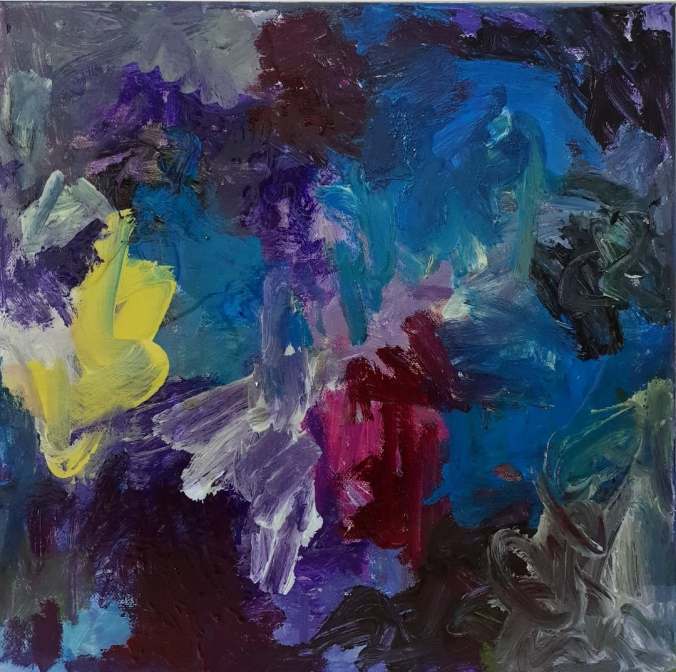
My National Poetry Month challenge to myself has become a collaboration between synaesthetic artist Sammy-John, myself, Anjum Wasim Dar and Jay Gandhi: Day Fourteen: Movement II

Movement II

Movement II

Movement II

I scribble along the path that joins our homes.

I sketch a scarecrow, make yellow paint marks

on Coconut trees, spray maroon on the Beer hoardings—

all in a hope

that if you do fall in my love,

you can follow my lead.

By Jay Gandhi

Sound Sculpture.

Look

at the noise.

Listen

to the yellow squiggle.

Kaleidoscope a still symphony.

Music is stillness.

When
your
eyes
move
over

its surface there are green bass notes,
red treble, wooden mallets on metal.

When your eyes focus on one part,
colour orchestration deepens, zooms

into oily white chord runs. When are you

alive?

Between the notes.

By Paul Brookes


Clutching her mother’s coat sleeve
holding on to the warmth and security,
of grey white and red checkered tweed,
a natural  bond, but a futile struggle,
someone larger than life led her aside,
slowly pulled away, she let go-
swept away by a figure,
clad in thick folded clothes, she
drifted along the blended figure’s
firm movements, brisk and balanced-
suddenly, all was quiet  as she tried to
look back, her mother’s painful silent
but determined gaze was no longer visible,
neither was she-

the figure’s movement went
on to a door marked ‘KG’
small chairs and tables filled the hall
a large black board stared at her
eyes now tearless, body obedient, mind
blank- she sat down and gazed back-

movement two had begun-
2019 © CER     Anjum Wasim Dar

My National Poetry Month challenge to myself has become a collaboration between synaesthetic artist Sammy-John, myself, Anjum Wasim Dar and Jay Gandhi: Day Thirteen: Commission For Pennie

Commission For Pennie

Commission For Pennie

Commission for Penny

I rob 2% of electricity
from the small villages,
I take away 2% sunlight
from the flourishing plants,
I snatch 2% rain,
2% water from lakes,
I steal 2% of flesh
from the lions;
I plunder 2% of prayers.
I sell 2% of my integrity
everyday

My ancestors are in pain;
the legacy that filled them
with pride has gone
to the dogs

But they will be alright:
I will transfer them 1%.

By Jay Gandhi

A Penny Drop

must never happen.
We must always be misunderstood
to communicate clearly and cogently.

Wrong end of the stick grasped firmly.
Vagueness is clarity.

If you let the penny drop confusion
and disillusion will result.

Please misunderstand me.

By Paul Brookes

Commission for pennie… Love bound architecture, lavish  mughal royalty, ancestral, poetry for pennies, ruined in dominions, colonised, two centuries to Shakespeare’s maturity, how many more to A. Iqbal’s?   Commissioned literature deliberate? Perhaps embedded falsehood, trusted legacy confirmed, but history often is but distorted. Repeats itself in vain.

Colors, in water, rare reflections of emotions, of efforts endless, often in darkness defined… Jaded pale stones, oils, a mixed media, priceless, commisioned for pennies, what pieces of art undiscovered, melodies unheard, for pennies in low moods maintained, painted, dabbed on eager canvases, hung on lonely easels, hidden in artrooms abandoned… Awaiting the sunlight of truthful recognition… Vain legacy in history

By Anjum Wasim Dar

Boston: ‘The Most Divided Place in England’

An excellent bloglog by Rowan the Door To Door Poet. Engrossing and well written. Highly. Recommended.

Rowan The Poet's avatarDoor-to-Door Poetry

Boston 2

When I told my friends I was doing Door-to-Door Poetry in Boston, they all thought I was going to America. In fact, the original Boston is a small town in Lincolnshire, known for the surrounding farming industry and for landmarks like ‘The Stump’, which is one of the largest parish churches in England.

Boston is also famous for being ‘the UK’s most Eurosceptic town’,

View original post 3,965 more words

My National Poetry Month challenge to myself has become a collaboration between synaesthetic artist Sammy-John, myself, Anjum Wasim Dar and Jay Gandhi: Day Twelve: September in E Flat

September in E Flat

September in E Flat

September in E flat
My goldfish hums a solo in its bowl.
I can hear it because I live alone
and more so because I am lonely.
Septembers can be very tricky—
some rain, some sunshine,
chilled mornings:
I can accurately measure
the warmth of the city
and more so because I am lonely.
September in an E flat chord and
an E flat chord in September
evoke the exact same emotion.
I feel a longing for a partner
and more so because I am lonely.

By Jay Gandhi

A Heady Burnt

fragrance
means autumn’s
soft E Flat footfalls can be heard.

Sun’s blaze warms my back
as I cut dry grass, autumn
breaks out a rumble overhead

By Paul Brookes

September in E Flat

During the senior school years, there were hardly any fears
the best I remember, song  ‘Come September’ in rhythm
and  dance,  I can still hear the silence of the summer, turn
to E Flat murmur in melancholy, half cool half  warmer

younger days when responsibility ensnares
but that September,   a war, felt in E Flat chord
the only outcome, smoke and oily smell of metal,
and falling leaves, an occasional falling petal-

when we could hear the drops of rain
light was the hurt  less was the pain
we could dance to the tune, but softly
now I hear the E  Flat octave tremble

what should I remember,
the melody or the number?
2019 © CER     Anjum Wasim Dar