Wombwell Rainbow Interviews: John D Robinson 

Wombwell Rainbow Interviews

I am honoured and privileged that the following writers local, national and international have agreed to be interviewed by me. I gave the writers two options: an emailed list of questions or a more fluid interview via messenger.
The usual ground is covered about motivation, daily routines and work ethic, but some surprises too. Some of these poets you may know, others may be new to you. I hope you enjoy the experience as much as I do.
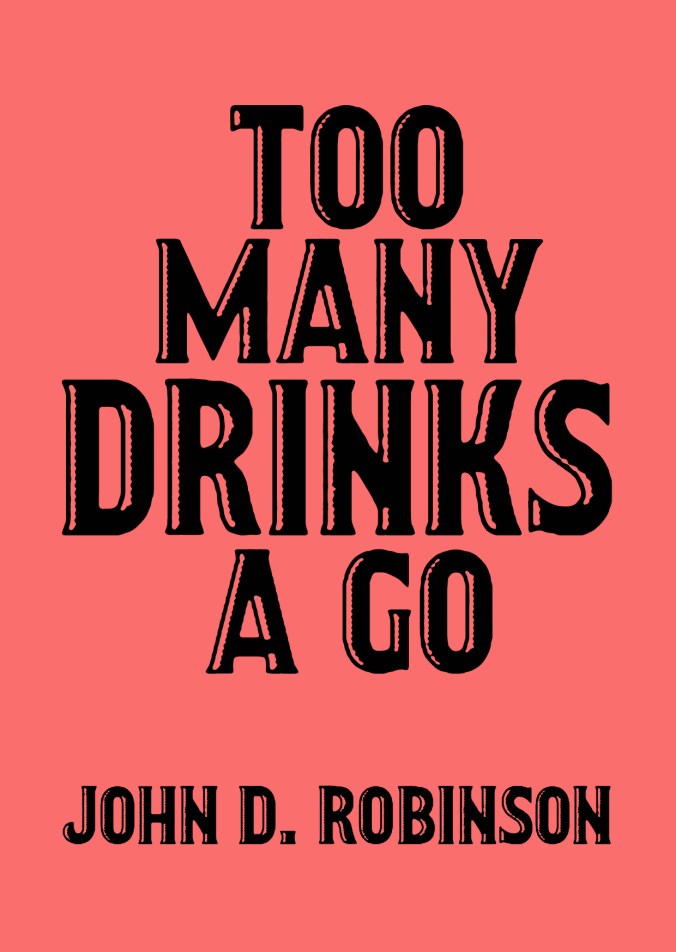
Too Many Drinks Ago Cover

John D Robinson

is a UK poet: hundreds of his poems have appeared in small press zines and online literary journals including : Rusty Truck: Outlaw Poetry: North Of Oxford: Tuck Magazine: Misfits Magazine: The Sunflower Collective: Winamop: Bear Creek Haiku: Chicago Record: The Legendary: Paper and Ink Zine: Algebra Of Owls: Full Of Crow: The Beatnik Cowboy: The Clockwise Cat:  The Scum Gentry: Message In A Bottle: Horror Sleaze ,Trash: Your One Phone Call: In Between Hangovers:  Rasputin: Revolution John: Vox Poetica: Hand Job Zine:  48th Street Press: Poems-For-All: Philosophical Idiot:
His published chapbooks are
‘Cowboy Hats & Railways’ (Scars Press 2016)
‘When You Hear The Bell, There’s Nowhere To Hide’ (Holy&intoxicated Publications 2016)
‘An Outlaw In The Making’  (Scars Publications 2017)
‘These Poems Stole Your Lunch Money’ with Bradley Mason Hamlin  (Holy&intoxicated Publications 2017)
‘Looking Down Both Barrels’ with Adrian Manning  (Holy&intoxicated Publications 2017)
‘Hitting Home’  (Iron Lung Press 2018)
‘In Pursuit Of  Shadows’  (Analog Submission Press 2018)
‘In Between The Curves’  with Charles Joseph  (Holy&intoxicated Publications 2018)
‘Echoes Of Diablo’  (Concrete Meat Press 2018)
Too Many Drinks Ago’  (Paper & Ink Zine Publication 2018)
‘Romance, Renegades & Riots’  with James Gwill Thomas  (Analog Submission Press 2018)

The Interview

1. What inspired you  to write poetry?

Aged 14 I began to learn to play the guitar: punk rock was about to crash its way into the world and it swooped me up: I was a lousy and lazy awful guitarist for sure and I was encouraged to give it up but I enjoyed writing lyrics: It was a wise decision that I put aside the guitar and take up the pen: my first poem was published when I was 17: it was a lonely and isolated place to be as I never shared the fact with anyone that I was writing poetry, I couldn’t do, it would have been dangerous to do so: I didn’t know anybody that wrote poetry or even read poetry or gave a shit about poetry:  it was all about booze, drugs and music and girls, it certainly wasn’t about poetry: I think the punk rock ethic of DIY has stayed with me to this day and although I don’t listen to this music anymore and haven’t done so for decades, the energy and the passion that initially set it on fire is still there for me and I hope this carries through into my work: so I guess punk rock initially inspired me to write poetry and later, to become a publisher: Holy&intoxicated Publications:

2. Who introduced you to poetry?

I found poetry myself: but it was the UK poet Josephine Austin (1934 – 2014)
Who introduced into the wider world of poetry and poets: Josephine had been published by the big UK publishers of the 1960’s and into the 1970’s: I’m not too sure what happened, but during the 1980’s she began publishing her own work and began a quarterly magazine ‘First Time’ which ran for 30 years or so: She was a beautiful person and became a good friend of mine: she was friend’s with Robert Graves and would visit him at his Spanish home: Josephine also organized an annual ‘Poetry Festival’ and small press poets would come from across the world to attend and through this I began publishing my work in magazines: Josephine was a huge influence and was always, endlessly encouraging me to write and to become a publisher:

At 17 years old and on the recommendation of a codeine swallowing , booze swilling lost lady of this world, I read ‘On The Road’ and this book has had a lasting and significant impact upon me, most of what I read will have a Kerouac connection of some kind: it opened up a searching and seeking sense within, a spiritual adventure that is unafraid to wander and experience: Kerouac broke down the intellectual restraints, broke free from the accepted formula of prose writing: he had self-belief and an enduring sense and commitment to his art:

3. How aware were you of the dominating presence of older poets?

I think I was probably ignorant of this fact: I saw these poets as so far removed from where I was coming from that they ultimately faded from view and I began discovering more localised poetry outlets and began engaging in regular readings and poetry workshops which I held in schools and colleges, which was a fun thing to do, particularly with the 7 – 9 year olds, imagination and sense of wonder and awe is still very much within them:

4. What is your daily writing routine?

A routine is exactly what I have: for 3 hours in the early evening I will work in my shed/studio on the computer: answering / sending emails: submitting poems: gathering poems for various projects from numerous poets : formatting chapbooks, broadsides, typing up some of my own work: afterwards, I retire in doors with wine and notebook and pen and I will write until the wine has gone: mostly I discard what I write, but every now and then it happens: I’ll make changes/revisions if needed: I like to submit work every three or four months to online journals and small press zines: as Bukowski said ‘Publish or perish’

5. What motivates you to write?

Everything motivates me: waking up in the morning is a good start: In my work I encounter a great deal of people who have lost their way in the world in one way or another: here there is sadness and loss: success and hope: despair and regret: love and beauty: the blood of poetry: I love life, I didn’t always love life and gave it a good beating for many years with alcohol and drugs: self destructive: these days are very different for me: I have made friends with my demons: drugs and alcohol: I keep them at a safe distance and do not use to  destroy but rather to celebrate and enhance my time and to tempt the muse:  Life is precious and fragile, sad and blissful, cruel and embracing  and every chance I have to write of it, I do.
‘If you Love life, then do not waste time, for time is what life is made of’
Lee Jun-fan  (Bruce Lee)

6. What is your work ethic?

To write everyday, no matter what: it is a big part of my everyday: I feel uncomfortable without a notebook and pen: If I haven’t written anything of worth for 3 or 4 days I begin to feel miserable and unsettled: but I keep on writing, of putting words down: the USA poet Frank Lima, (1939 – 2013 ) in the latter part of his life, would write a poem a day, always quality poems, despite his failing health and alcohol addiction he continued writing:  I couldn’t/can’t manage a quality poem a day but I give it my best shot.

7. How do the writers you read when you were young influence you today?

As a young man of 15 or 16 I read everything that I could: The UK poet: Lee Harwood (1939 – 2015) : advised me to read, read, read: and I did: Shelley: Byron: Keats: Whitman: Dylan Thomas: W H Auden: John Berryman: Robert Lowell: Rimbaud: Verlaine: Pessoa: Andre Breton: Paul Eluard: Villon: : Basho: Tristan Tzara: Ezra Pound: Lorca: Georg Trakl: Owens: Sassoon: Frost: Elliot:  Li Po: Pushkin: the ancient Greeks and Romans,
I read everything I could do , except , for some reason, I missed out Willy Shakespeare!!!!
I would spend hours in the local library, with a notebook and pen, making notes of the poets, sketches of biographies and books available:

And then the Beat’s came into my life and kicked my ass good:
I think that most of what I have read has had some kind of influence, varying in degrees and from moments to years.

8. Who of today’s writers do you admire the most and why?

The legend that is Catfish McDaris: Adrian Manning: Ryan Quinn Flanagan: Scott Wozniak: Bradley Mason Hamlin: Martin Appleby: Dennis Gulling: Marc Bruseke: Casey Renee Kiser: Arthur J Willhelm: India LaPlace: Gwil James Thomas: Joseph Ridgwell: Janne Karlsson: A D Winans: Pete Donohue: George Anderson: Wolfgang Carstens: John Grochalski: Rob Plath: Alan Catlin: Ally Malinenko:  Hosho McCreesh:  John Dorsey:
Because they are quality poets, find out for yourself:

9. Why do you write?

I don’t know anything else: don’t want to do anything else: couldn’t do anything else: it may be an obsession, an addiction: it may be one of my demons: I love poetry: it is who and what I am:  I can add no more.

10. What would you say to someone who asked you “How do you become a writer?”

I would say that this is a dumb ass question to ask: writers write so write: sitting around thinking of becoming a writer is no more than the space between your fingers: Dan Fante said something like ‘keep writing, no matter what, even if you know its crap, keep writing, write your way out of it, write through the walls: but keep writing’: I think a distinction can be made between writers and poets:  I rarely write prose these days: I have written a couple of un-publishable poorly composed novels and a couple of dozen short stories that have appeared in online journals: But prose is a different kind of beast and I find it can be very intense and demanding in a very different way to the writing of poetry: so I would not call myself a writer but rather, poet.
My advice would be just be honest and have faith in yourself, believe in yourself, write without question or hesitation, write what you feel no matter how raw and harsh or beautiful, write it down, express yourself: don’t be afraid to write your life, your time: don’t try and emulate others: sure, naturally accept influences but don’t replicate: it can take time to find your home, to find a style, a voice that is your own: I took the long way around, but I don’t have any regrets:

11. Tell me about the writing projects you have on at the moment.

Holy&intoxicated Publications have projects planned for the next 12 -18 months: including Chapbooks: Broadsides and the Poetry Card Series:

I have planned split Chapbooks with: Catfish McDaris: Janne Karlsson: Joseph Ridgwell: Ryan Quinn Flanagan: Arthur J Willhelm: Casey Renee Kiser/India LaPlace: Martin Appleby: Marc Bruseke:

Solo collections from
:Adrian Manning: Ally Malinenko: Pete Donohue: India LaPlace: Casey Renee Kiser: Janne Karlsson: James Gwil Thomas:

My chapbook: ‘Pushing Away The Hours’ will shortly appear courtesy of the wonderful and adventurous ass-kicking:  Alien Buddha Press.

I would like to offer my sincere thanks to Catfish McDaris and Paul Brookes for the opportunity to be a part of this wonderful interview series.
Wombwell Rainbow Interviews: Eliana Vanessa

Wombwell Rainbow Interviews

I am honoured and privileged that the following writers local, national and international have agreed to be interviewed by me. I gave the writers two options: an emailed list of questions or a more fluid interview via messenger.
The usual ground is covered about motivation, daily routines and work ethic, but some surprises too. Some of these poets you may know, others may be new to you. I hope you enjoy the experience as much as I do.

43625967_344569636348425_1009674647249092608_n


Eliana Vanessa

is originally from Argentina and moved to New Orleans, Louisiana at a young age. She recently participated 100,000 Poets for Change (2018) and served as part of a panel of poets in The Jane Austen Festival (2017 & 2018). You can find her work online at The Horror Zine, The Rye Whiskey Review, and The Sirens Call Ezine. She is Eliana Vanessa on Facebook at the following link: https://www.facebook.com/eliana.vanessa.7758.

The Interview

1. When and why did you start writing poetry?

I started writing poetry as a challenge. As a child, I equated it to song writing. The nursery rhymes and songs that I was exposed to ( both in English and Spanish) sparked my interest in the lyrical aspects of what i came to later recognize as another form of poetry.
Later, at about age 13, my English teacher at the time decided she was going to skip teaching “The Rime of The Ancient Mariner” to the class. I was appalled! She was happy to see that someone cared and explained that most of the students had gotten bored with it in the past. She said she too loved Coleridge and said that if I wanted to, I could teach it. She gave me two full days, and I couldn’t have been happier. Looking back, I wonder if this wasn’t her way of prodding me towards my passion, as she already knew I loved poetry. She introduced me to all the classics, Coleridge, Wordsworth, Poe,Keats, Blake, and, of course, Shakespeare. When i started to share my poetry with her, she took it very seriously and gave me great advice/critique as well as encouragement.
So, I continued to write, simply because I enjoyed it!

Also, my dad was and is a poet, but I didn’t know it Lol He did not share his work with me until I was considerably older, but he provided a great environment for creativity.

2. How aware were and are you of the dominating presence of older poets traditional and contemporary?

Very aware them, then and now. I lean towards the classics, so many more to mention, Emerson, Thoreau, for example.
Certain things I will never forget being introduced to, for example, stream of consciousness in the style of Faulkner. Those were things that directly affected, and still affect my writing.
Also, because of my Spanish heritage, I grew up with lots of exposure to Borges, Neruda, and whomever else my father might’ve been reading at the time. I was interested in reading whatever he was reading! He also introduced me to Rainer Maria Rilke, Sonnets to Orpheus, which I couldn’t put down.
It’s important, I think, to honor those who came before us, whomever we look up to, those poets who paved the way. Keeping them alive in conversation, and as guides, in my own work is comforting to me.
As far as contemporary writers, there are so many I enjoy, just having fairly recently joined Facebook, it is a joy to have so many talented acquaintances! Because of this, I am truly inspired even more, on a daily basis!

3. What is your daily writing routine?

I just write whenever I have a minute to stop! Sporadically, I guess, is the best way to answer that! No routine, I trust it will happen. My problem is not waiting for the muse, it’s turning the muse off lol. Sometimes it’s a phrase, a short poem, whatever comes to mind. That’s not to say that I don’t admire discipline, bc I do. I love sharing my work, having it critiqued by others, taking in suggestions for changes, seeing things from other people’s points of view, honing the craft so to speak.
I’ve always kept journals and I am a full pencil, pen, & paper freak!! I have always been intrigued with good penmanship as well. I love the feel of different textures of ink or graphite on various weight/ types of paper. I consider the actual act of writing an artistic act, if that makes sense. Also, the placement of the words of poetry on the page—-all of that has meaning. It is a process which unfolds aesthetically from the mind to its final presentation, and for me, I don’t stop until that vision looks, sounds, and “feels” right. I think this is probably the case for many writers.

4. What motivates your writing?

Everything and anything. whether it’s a commentary or observation about an everyday occurrence, or emotion, or a passionate stance, in favor or against something.
I love that poetry serves as a lens by which we learn about ourselves and others, the micro/macro attributes of it.
Poets bend and flex words, find their unique rhythm, in the hopes that the whole spectrum of human feeling and experience is expressed and shared, through countless sources of inspiration!

5. How do the writers you read when you were young influence you today?

Those writers I mentioned earlier (i.e. Coleridge, Wordsworth, Poe, Thoreau),
and the idea of a “Romantic Era” fascinated me as teenager. I spent hours upon hours reading, not only the works, but the biographies of so many authors. The fact that some of them came from such troubled backgrounds, and, how their epic works reflected the inner struggles they faced, impacted me greatly, no matter the genre, or form of art. Their works inform my writing now in that I tap into that inner intuitiveness and sense of wonder to express my thoughts about inner and outer emotional struggle, a theme that will always be relevant, the theme of human suffering at the core of everything.
Also, introduced to me through those same writers, was a deep sense of awe towards life, the perseverance of it, despite an inevitable sense of destruction. This attitude strongly influences my work today.
I would be remiss if I did not mention that, as a student of both psychology and cultural anthropology, I was influenced, in addition, in my twenties and up, by countless ethnographies and theoretical constructs on human behavior, stories that focused on culture—and the various psychological, sociological, genetic and spiritual factors—that accompany all of us, in one way or another, through life.
When I write, some of my poems are not at all autobiographical, but rather, the recounting of a story that may have occurred in a different place or time.

6. Which of today’s writers do admire and why?

As far as writers that I admire, everyone of my writer friends I’ve made on Facebook is inspiring to me. There are too many to name, but they know who they are. We read and encourage each other on a regular basis, and I love them for that!
When it comes to flash fiction, or longer works, I’ve recently enjoyed reading Jefferey Deaver and Charles Gramlich. They both have the unique talent of combining suspense and poetry in a way I have never experienced before, and that’s just it, reading their stories is an experience, a fully captivating one!
Where poetry is concerned, I am currently reading Billy Collins and Ocean Vuong.
How they weave life experiences with just the right balance of gentleness, wit and grit amazes me, always. Also, I do admire other styles of poetry, equally as gripping, writers like Bruce Boston, Diego Quiros, and Dionne Cherie Baker who transport me, effortlessly, into imaginative settings or situations, sometimes into other dimensions, weaving human emotion with a sense of otherworldliness.

7. Why do you write?

I write because of my muse.(eye roll)

8. What would you say to someone who asked you “How do you become a writer?”

I really believe that someone is just inherently a writer because he/she loves doing it, especially if they endeavor to keep doing it with any measure of longevity. To those who catch the bug, I would say, keep at it! Do it whenever you get a chance, whenever your heart and soul desire it, or, you can try to set a specific time of day to write, if that works best for you. Whatever you want, just keep at it, listen to others, but also, listen to yourself, keep a good balance between the two as you move forward, and your voice will find its place among other fellow writers.

9. Tell me about the writing projects you have on at the moment.

I am currently working on several projects: mainly my first collection of poems as well as participation in an upcoming anthology. I look forward to future participation with 100,000 Poets For Change and encourage all poets to be a part of this great movement. This past year, we focused on the Read A Poem To A Child initiative, headed by Michael Rothenberg, and every year there are new themes and issues, brought to the forefront through the art of poetry. Every voice does in fact matter, and it’s a great opportunity to band together and speak up towards social/ political/ environmental injustices. I do have poems coming out in The Sirens Call Ezine as well as in Fearless, a literary mag & ezine.

Wombwell Rainbow Interviews:  Brian S Gore

Wombwell Rainbow Interviews

I am honoured and privileged that the following writers local, national and international have agreed to be interviewed by me. I gave the writers two options: an emailed list of questions or a more fluid interview via messenger.
The usual ground is covered about motivation, daily routines and work ethic, but some surprises too. Some of these poets you may know, others may be new to you. I hope you enjoy the experience as much as I do.

0013828234_36


Brian S Gore

is a writer of short stories, poems, and songs. He currently resides in New London, CT and has published several collections of original works including “Barstool Ballads” and “Eleven Stories for Short … Attentions”, as well as coordinating a collaborative project entitled “A Collection of Poems by Various Poets Regarding the Line ‘10,000 Miles of Farewell’”. His newest book, “Tangled World”, is now available, along with his new album “Going, Never Stopping”, at briangoing.bandcamp.com.
https://briangoing.bandcamp.com/merch/tangled-world
https://briangoing.bandcamp.com/merch/barstool-ballads
https://briangoing.bandcamp.com/merch/10000-miles-of-farewell
https://briangoing.bandcamp.com/releases

The Interview

•    What inspired you  to write poetry?

Reading. As an art student, I enjoyed visuals and images, but as I began to read more I grew a desire to write an image rather than photograph or paint one.

•    Who introduced you to poetry?

It’s hard to recall. My class had a poetry lesson in Language Arts one week in 8th grade and this is when I really gripped the idea of self-expression as a considered release, as opposed to shouting and crying. I took a creative writing class in HS in my last semester. My teacher was fantastic and, where as she didn’t turn me on to any new poetry, she said one thing I will always remember. When I told her I liked one classmate’s poetry, she said, “He doesn’t write good poems. He uses big words.” So while I stumbled upon poetry on my own, she was the first guide along my path of writing. Later in college I took a poetry class, but did not like being taught how to write poetry, so I studied on my own. Assignments bore me. Like the Gene Autry song, “Don’t fence me in.”

•    How aware were you of the dominating presence of older poets?

Hardly. I knew who I was supposed to read and didn’t. Up until the following story, I was into Ovid’s “Metamorphoses”, Erasmus’ “In Praise of Folly”, and Shel Silverstein’s “The Giving Tree”. Then, one night in 2007, driving home, I listened to the oldies station. A snare snapped, gripped my attention, and for the duration of my drive (short for a drive, long for a song) I listened, for the first time, to Bob Dylan’s “Like A Rolling Stone.” This, late as it was, would be my real launching point. From here, it goes without saying, I learned about the beats, but I also learned that songs can be stories, poems can be songs, Hank Williams and heartache, Woody Guthrie American balladeer; it led me deeper and broader into old and new forms, and for the first time, I was truly hungry.

•    What is your daily writing routine?

I try to keep it steady, but don’t. Sometimes my words flow like a BP oil spill in the Gulf of Mexico. Sometimes it’s more like the steady leaking pipelines through the Dakotas, ya know? It’s happening, but not at a devastating enough rate.

•    What motivates you to write?

A fleeting feeling of deep affection. A lingering lust. Politics. Travel. Alcoholics waiting outside the liquor store where I open at 8am, and some who tell me “I’m supposed to be in detox”. My own habit for drinking. A passing image in my head. Quiet cold nights alone on the porch with gin and a cigarette. Stuffy rich people. Arrogant drug addicts. Desolate faces or maniacal drunks who think a fight is as good a connection as they can afford anymore. A desire for hopefulness. The need to show the world to people who don’t see it.

•    What is your work ethic?

I don’t work. I retired after college. It was 2007, the US was falling to bits, all my friends were finding jobs they would do for free until they had enough experience despite the degree they just purchased. It all looked like bullshit, so I got in my car and drove. I wrote my experiences and that’s still what I do. I’m a self-published, 34-year-old, retiree poet/musician.

•    How do the writers you read when you were young influence you today?

Poetry can be fun. A poet can say profound things without superfluous words. The day my HS teacher told me the other poet was not as good as he may sound, I had read my poem, of which I only remember, “This poem is not good. / It sounds like Dr. Seuss. / This poem is as bad / as grapefruit is juice” and I still write poems like this because poetry is not meant to take itself so seriously, and I like to challenge that notion. Anyone can act morose, but to write something people find humorous is hard as nails. For this, hats off to good comedians. George Carlin, for example, was a brilliant poet, e.g. “Modern Man.” Poetry is a form of expression, and of course we all express our sorrows and fears, but we also have the ability to share our joys and jokes. That’s what I carry with me from Shel Silverstein and Dr. Seuss. Herman Melville is hilarious. Kurt Vonnegut and John Prine, likewise.

•    Who of today’s writers do you admire the most and why?

I enjoy reading Seth Howard’s somewhat disjointed, free-associated poetry. His experiments with words and images fascinate me and rarely fail to stir some kind of feelings. Jake St. John’s poems are excellent because they are straight forward and avoid what I call hyper-poetics. It comes straight out of him. He references too many poets in my opinion, but I would tell him that, so I’m not afraid to mention it here – anyway, that’s my fault for not knowing them. John Greiner is another. His insights are spot on and hilarious with a casual flow, beat jazz nonchalance. His writing seems effortless and it’s my goal to write a better poem than he has.

•    Why do you write?

I write because I think it needs to be said. I turn it into a song because people don’t want to read it. What I can’t make songs out of, I make a book of poetry.

•    What would you say to someone who asked you “How do you become a writer?”

Write. You might be terrible, but you’re just a bad writer. You may surprise yourself and love what you write. There it is. You’re a writer. Publishing? I have no idea. I’m a writer.
One word of advice: put your thoughts in a journal before posting to the internet. Something about a journal is innately sentimental and you may realize your passing thoughts are either fucking stupid, or too important to use so flippantly. But at least you’ll have them to reference later down the road. Don’t give every thought away so easy.

•    Tell me about the writing projects you have on at the moment.

Currently, I’m working on a follow-up book to my recent release “Tangled World”. The project, in full, is planned as a triptych. Tangled World was a mostly aggressive look at current events with lighter shorts and poems scattered in. The book finishes with a hopeful view moving forward, and this next project will continue in that vein. I am filled with maddening depression and frustration and, at the same time, a transcendent understanding of the world’s cosmic insignificance. I am a mind caught between politicians and Buddhists. Making sense of this is how I will approach my project moving forward.

Wombwell Rainbow Interviews: Fiona Sampson

Wombwell Rainbow Interviews

I am honoured and privileged that the following writers local, national and international have agreed to be interviewed by me. I gave the writers two options: an emailed list of questions or a more fluid interview via messenger.
The usual ground is covered about motivation, daily routines and work ethic, but some surprises too. Some of these poets you may know, others may be new to you. I hope you enjoy the experience as much as I do.

Fiona Sampson

is a leading British poet and writer, published in thirty-seven languages, who has received international awards in the US, India, Macedonia and Bosnia. A Fellow of the Royal Society of Literature, a Fellow of the English Association and a Fellow of the Wordsworth Trust, she has received an MBE from the Queen for services to literature. She’s published twenty-nine books and has received the Newdigate Prize, a Cholmondeley Award, Hawthornden Fellowship and several national awards each from the Arts Council of England, Arts Council Wales, the Society of Authors, and the Poetry Book Society. She has held a number of international fellowships and served on many literary juries in the UK and abroad, is a prolific national newspaper critic, collaborates with visual artists and musicians, and is a frequent national radio presenter. Her recent books include the poetry collection The Catch (Penguin Random House 2016), studies of musical form in poetry (Lyric Cousins, Edinburgh University Press 2017) and of Limestone Country (2017), and the critically acclaimed biography In Search of Mary Shelley (2018).

The Interview

1. What inspired you to write poetry?

I like words, and music, and writing that thinks as it goes. All of these elements seem to me to point to poetry.

2. Who introduced you to poetry?

I don’t think anyone did. I just somehow knew it existed and went looking for it from quite an early age, around seven and eight. It seemed like a beautiful dream. And growing up in Wales I had wonderful teachers, in Wales: before we moved back to England, around the time I turned eleven. This was both in the village primary school and then in the local comprehensive. Those teachers admired poetry above all. Their enthusiasm for the genre made them generous in encouraging a pupil who loved it and wanted to try it out. They read us lots of examples, from Dylan Thomas to A.E. Housman. Most of these were glamorously hard to understand, yet strangely beautiful. And they themselves, writing poetry and reading it, were also our examples.

3. How aware were you of the dominating presence of older poets?

I’m very aware of the canon and always have been. For example, Percy Bysshe Shelley’s ‘Ode to the West Wind’ was one of the first poems I became obsessed by. When I was about nine, I used to chant it to myself (in my head). I’m glad I started to read widely before I understood much about gender: that very early reading didn’t seem to me to exclude me, even though so much of what I read was by men. The Metaphysical poets are a great influence on me. And in the world of contemporary poetry I have wanted from the outset to work on and learn from the verse being written today. Not by my pals, I mean: but by the key writers. I’ve spent lots of time reviewing, translating and editing/publishing poetry for this reason. I don’t really understand poets who don’t. Don’t they want to keep exploring the endlessly opening possibilities of our form?

4. What is your daily writing routine?

Well, It depends what I’m doing to earn my living on any particular day! But if I can be at home, then I work at my writing till about noon, then put in an 8-hour shift on job work.

5. What motivates you to write?

I enjoy it more than almost anything else, apart from my own home life. I’m very often desperate to write and unable to do so because I have other obligations. Life seems to conspire to ask you not to write. Do anything else – teach it, review it, talk about it – but don’t actually do it! Also, writing is the thing that I can do best.

6. What is your work ethic?

I see work as a kind of obligation to our community: without working how can you possibly be contributing the most that you could? I include in this working at caring and domestic roles, obviously. If it’s worth doing, it’s worth doing well! I am afraid I’m not very tolerant of people who can’t be bothered, who freeload on those around them…

7. How do the writers you read when you were young influence you today?

They completely furnish my mind. I read a lot of prose rather than poetry when I was young: because that’s what the public library had. Once I was 9 and allowed in the adult library, I consumed 6 books a week (the maximum allowed) every week for years. I found early on that I most enjoyed books by writers I’d heard of. I was bored by commercial fiction. And then Virago came along and I discovered there were lots more women writers as well as Virginia Woolf. I trusted the publishers’ brand, and let the dark green covers guide me to all sorts of writers I hadn’t heard of, but should have. Women like Elizabeth Taylor and Rosamund Lehmann. …They didn’t bore me, either!

8. Who of today’s writers do you admire the most and why?

It’s hard to name just a few because there are so many, and because my enthusiasms do change. At the moment, for example, I’m mad for life writing by women: Deborah Levy, Rachel Cusk, Maggie O’Farrell, Elif Batuman, Eva Hoffman, Drusila Modjeska – and I enjoyed Joyce Carol Oates’s memoir – and I always return to Woolf. Not just the novels, I mean, but the Writer’s Diary and the Letters are a kind of life writing, willy nilly. But that’s just this month. Ask me again next month and I’ll give you a completely different answer.

9. Why do you write?

See number 5!

10. What would you say to someone who asked you “How do you become a writer?”

I’d say it depends what you mean by ‘becoming a writer’. Is it having a book published? Having an enjoyable hobby and going to a writing group? Struggling to think or make art on the page? And what genre interests you? Because the answer is so different according to what your dream is. But there are two things that you have to do whatever you mean by ‘becoming a writer’. You have to read, and you have to write, and you have to do both unstoppably. It’s the 10,000 hours thing.

11. Tell me about the writing projects you have on at the moment.

I’ve just finished the libretto for Daedalus, a full-length chamber opera by Philip Grange, and a new collection of poetry which includes two long poems about my fathers. I’ve spent much of this year continuing to think about Mary Shelley, and I’m now working on a related biography of Elizabeth Barrett Browning. I’m fascinated by her, not least because her verse novel, Aurora Leigh, which was hugely influential when it appeared, especially on other writers (of both genders), is the first published account of how a woman becomes a poet. And however much it’s fiction, it is also reflexive. This year I’ve also been Co-Investigator on an AHRC-funded project researching poet to poet translation. There’s a three-way book to co-write as a result of that.

Wombwell Rainbow Interviews: Billy Reynard Bowness Writer-Poet (The Po Faced Poet)

Wombwell Rainbow Interviews

I am honoured and privileged that the following writers local, national and international have agreed to be interviewed by me. I gave the writers two options: an emailed list of questions or a more fluid interview via messenger.
The usual ground is covered about motivation, daily routines and work ethic, but some surprises too. Some of these poets you may know, others may be new to you. I hope you enjoy the experience as much as I do.

45144641_472341469921373_928259006667948032_n

Billy Reynard Bowness Writer-Poet (The Po Faced Poet)

Born in Lincolnshire but growing up and educated in Huddersfield, Billy considers himself a Yorkshireman at heart.
Billy is 47 years old, a Pisces, former Legal Executive, now mad scientist and sometime bit part actor. He lives in the wilds of deepest North Yorkshire with his partner, three dogs, ducks and countless chickens.
In any spare time, Billy enjoys walking in the Yorkshire Dales, travelling, gardening and boating.

“Humour and humility will see you through”
FB: https://www.facebook.com/PoFacedPoetry
BLOG: https://pofacedpoetry.wordpress.com/

The Interview

1. When and why did you start to write poetry?

I wrote some poetry when I was in high school after reading and memorizing a poem off the blackboard called “The Scarecrow” by Walter De La Mere! It really impacted on me and stuck with me. However, life and work took over and I didn’t write again seriously until this year. It was the 10th anniversary of my son drowning when he was just 19. Alex would have been 29 this year. I wrote a poem as catharsis and to commemorate the 10th anniversary of his death. I have been writing prolifically all year.
Thinking about it I guess throughout life I have been writing poetry on and off (even before I returned to it seriously this year). Whenever there was a family event, a wedding, funeral etc, people would ask me to write a poem to read out or perform.

1.1 What was it about “The Scarecrow” that impacted on you?

My dad’s side of the family were farmers so the story of the poem appealed, but it was the imagery I particularly liked, of childlike innocence juxtaposed with adult duty – of the scarecrow keeping watch, suffering for “his master, man”. The narrative of the scarecrow as storyteller, fixed and unflinching, but vital in partnership with the human being. The description of the winter & the cold mornings – “flame with glittering rime” I found so rich.

2. How aware were and are you of the dominating presence of older poets traditional and contemporary?

I think that, growing up in Huddersfield and attending an “ordinary” Secondary school little emphasis was placed on poetry as a genre. Wilfred Owen was mentioned as poet laureate/a war poet but not delved into with any depth. In English literature we were taught about the works of Shakespeare but not as a poet, strictly as a playwright. As an adult my interests have led me to become more aware of how a writer or music artist can be a poet without being 100% described as such. For example, my love of the maudlin music of Leonard Cohen led me to appreciate his poetry. Returning to the part of the question about “dominating presence” I think that the blank verse and poetic meter used by the likes of Shakespeare and Marlowe are prevalent/relevant today in their influence and continuing performance value. When thinking of the contemporaries such as Sylvia Plath and Ted Hughes I think their colourful lives and embellished personas define them as much as their poetry.

3. What is your daily writing routine?

It differs depending on how I have slept (how many times I am awake babbling words, ideas or lines into my dictaphone)! Most days after getting the coffee, feeding the animals (chickens, ducks, dogs) I go to my office and firstly type up anything from the dictaphone into my “ideas” folder. Depending on where I am with a particular piece, I may work on a poem or outline – editing – changing – playing with structure. If I have a firm idea for a new project I may spend the later part of the morning researching my theme, history, language. Mornings are more about focused work (as that is when I am most focused). After lunch, which is always accompanied by music, I will give the dogs a quick walk. Depending on how “in to” a particular piece of writing on a given day the afternoon may be spent working on a that poem. If not I will either read poetry, “fiddle with”/edit my growing portfolio…or both. I do have a “day job” as well, working as a biochemistry analyst, but I have described a typical days writing…Which I usually do 3 days a week. I try to read some poetry or prose every day as I feel it is as important to read as it is to write.

4. What motivates you to write?

Gosh – everything! Life. The ridiculousness of the human condition. Our peculiarities, insecurities, silliness, tendency towards superlatives. They are great fodder for somebody who likes to play with words! I think that, of the thousands of thoughts, feelings, emotions, interactions we have every day, at least some of them are worth using in the future. Recording them. Adapting them. Making a story out of them – so that they are eternal rather than fleeting. That is my main motivation, although sometimes simply a word or a couple of words will come into my head and I know that I have to create something around them – build a story wall around the foundation words. I think the drive to write is innate.

5. What is your work ethic?

Try to do even the smallest piece of work really well, and don’t rush. Quality over quantity. If that doesn’t work and you get stuck – maybe it is time to step back, take some time out and wait for the zest to come back.?

6. How do the writers you read when you were young influence you today?

I remember reading (and re-reading) a book called “Down The Bright Stream” by “B.B” when I was very young, and being blown away by how magical the language was. How the words combined made me feel warm, excited and created such rich imagery in my head. It was about the four remaining gnomes in Britain; Dodder, Cloudberry, Baldmoney and Sneezewort, and their quest to stop an ancient countryside brook from drying up. The seam of imagery sewed in my mind from that book remains with me to this day. It is something I try to embroider into my work – that immersive sense of being a part of the poem, the story – the words creating almost a “false memory”, as if you’ve been there and experienced what is being written about.
It was the same with a lot of my early reading – such as Tarka the Otter and the Brer Rabbit books. I liked to read about nature, and animals…using their stories as morality learning. I incorporate nature and animalistic terms into my poetry today, particularly when trying to describe certain human traits.

7. Who of today’s writers do you admire the most and why?

Gillian Flynn. Because of her unflinching bravery in her use of language – to shock – to repulse – to excite! She writes as you would dare to be able to speak. Her characters are rarely like-able, but extremely “readable”, and I appreciate how she transcends and upturns the gender stereotypes. Basically, she tells a damn good tale!

8. Why do you write?

Because it is not enough to have the ideas, thoughts, words, emotions in my head! I need to act on them, develop them. Share them! It makes me feel good to do so.
…and I LOVE words, and playing with them, twisting them, juxtaposing them. Writing lets me indulge in my “word play”.

9. What would you say to someone who asked you “How do you become a writer?”

“Start writing”

10. And finally, Billy, tell me about the writing projects you have on at the moment.

I am in the process of developing a poem I wrote into a “poetry play” – a mini epic! I want to tell the stories of the characters I introduced in the original poem from different perspectives over the course of a few years. My idea is to create a story, in verse, with a rich structure and the occasional plot twist, which could (and hopefully would) be developed into a piece of theatre or TV. I am also working on a manuscript of poetry observing the daily triumphs and tragedies in life, the micro-annoyances, laughs and irritants – humorous anecdotal poetry.


Wombwell Rainbow Interviews: Anne Casey

Wombwell Rainbow Interviews

I am honoured and privileged that the following writers local, national and international have agreed to be interviewed by me. I gave the writers two options: an emailed list of questions or a more fluid interview via messenger.
The usual ground is covered about motivation, daily routines and work ethic, but some surprises too. Some of these poets you may know, others may be new to you. I hope you enjoy the experience as much as I do.

wherethelostthingsgo_cover_2ndEdition_Oct2018

Anne Casey

Originally from west Clare in Ireland, and living in Sydney, Australia, Anne Casey is an award-winning poet and writer. Over a 25-year career, she has worked as a journalist, magazine editor, communications director and legal author. Anne is Senior Poetry Editor of Other Terrain and Backstory literary journals (Swinburne University, Melbourne). Her writing and poetry rank in The Irish Times newspaper’s Most-Read.

She has won or been shortlisted for poetry prizes in Ireland, Northern Ireland, the USA, the UK, Canada and Australia – including the Henry Lawson Poetry Competition 2018 – Traditional Verse (Australia); the Women’s National Book Association Poetry Competition 2018 (USA); Hennessy New Irish Writing 2015 and 2017 (Ireland); Cúirt International Poetry Prize 2017 (Ireland); and Bedford International Writing Competition 2018 (UK). She was longlisted for the University of Canberra Vice-Chancellor’s International Poetry Prize 2018.

Anne passionately believes that every poem, like all art, should leave you changed by the experience. Her poems feature internationally in newspapers, magazines, journals, anthologies, broadcasts, podcasts, music albums, a stage show and an international art exhibition – Entropy, The Irish Times, Cordite, Verity La Magazine, The Murmur House, Papaya Press, The Incubator, The Honest Ulsterman, The Stony Thursday Book, The Australian Poetry Collaboration, Into The Void Magazine, ROPES, Autonomy anthology, Plumwood Mountain, Abridged, The Monologue Adventure and the Poetry Pharmacy, among others.

Anne holds a Law Degree from University College Dublin and qualifications in Media Communications.

Website: http://anne-casey.com/

Book: ‘where the lost things go’ at Salmon Poetry Also available from bookshops including Kennys and Easons in Ireland, Angus Robertson, Dymocks and Gleebooks in Australia, and online via Amazon, Book Depository, Booktopia and Walmart.

Twitter: @1annecasey

The Interview

1. What inspired you to write poetry?

I think it was a kind of organic thing really. Growing up in a tiny seaside town in the west of Ireland, I was surrounded by poetry from birth. My Dad quoted lines of poetry to me every day of my growing up years, still does actually! At get-togethers, people would do ‘rounds’ – you had a choice of playing an instrument, singing, telling a story or reciting a poem. I was always the one slinking in the background hoping not to be called up (…little has changed – I still find getting up to read poetry challenging, though it is a regular part of life these days).

The thing l loved most about poetry growing up in Ireland was this idea that you had to always look beyond the surface. For centuries, poetry was used as a way of passing on coded messages. During times of war and subjugation, poetry became a vehicle to convey not just enemy intel but hope in the face of cruelty and oppression. Poetry has long been used in Ireland to embed legend, and to pass on folklore and local histories.

A very brilliant Irish poet friend of mine, Eleanor Hooker, recently shared the wonderful piece of ancient Irish folklore that poets possessed a poetry vein which filled with blood and pulsed with the metre of a poem as they wrote it. The ancient Celts, during times of interclan conflict, would send their Ard FilÍ or High Poets to the front line first. Their role was to attempt to bring about a peaceful resolution through a battle of word and wits. Failing that, they were to bring back enemy intel! Poets held a special place in the culture.

With so much intrigue surrounding poetry growing up – from spymasters to coded messages – how could I not be drawn to it? By the age of eight, I had started penning my own poems (horrendous verses about spiders and pets and suchlike!). I rapidly came to realise the power at my tiny fingertips… Here were words on a page that could convey an idea and meaning from one mind to another as if by magic! I realised then that all I ever wanted to do was write. That was when my parents bought me my first typewriter – a Lilliput – and I was off!

By eleven or twelve, I had discovered Emily Dickinson and there followed another spatial shift as I started to delve into the broader world of poetry beyond my Irish doorstep and to discover the vast inner landscape it occupies too. I continued to write through my teens, with the odd poem published in youth and community magazines. But by the time I was finishing school, with Ireland in deep economic recession, I caved to pressure and embarked on a more mainstream path.

Completing a law degree at University College Dublin, I was extremely conflicted. The call to write was profound. In the end, I found a compromise. I went on to study and work in Media Communications, which allowed me to write while following a career path that gave me enough money to eat and pay the rent – as a journalist and magazine editor. Later, I worked as a legal author/editor (*yawn! Apologies to any legal authors who might be reading.) and media communications director, which facilitated my other great love – travel! This is how I ended up living 13,000 miles from my beloved west coast of Ireland – in Australia.

All the while, poetry continued to ooze out of the pores – decanted in tattered notebooks, onto the backs of beermats, on napkins – whatever was at hand when the mood struck. All long since lost, almost certainly for the better! It was only after having children, rapidly followed by the loss of my beloved mother to cancer – when my world shifted seismically – that writing poetry became an unstoppable force. I balk at calling it ‘therapy’, but writing really does help me to process what is going on.

2. What is your daily writing routine?

I hear writers all the time say that writing is about showing up to work – you sit down at your desk every day and you write. My reality as a poet couldn’t be further from that! Writing poetry for me has to somehow weave its way into the warp and weft of a sometimes chaotic pattern of daily life… It happens somewhere in between raising two busy boys aged eleven and thirteen (…yes I drive the Mum-Uber), media consulting, being Senior Poetry Editor for two university literary journals, writing feature articles and various community volunteering positions (for some reason, communications people are always in demand…)… oh yes, and if you’re ever in need of a meat pie, you can catch me on school canteen duty! But that’s life and I love it, and it feeds into my poetry in the most glorious ways… well, my sons may not agree. I am regularly accused of ‘roasting’ them in my poetry readings!

So my daily writing routine goes something like this – wake>>shower [jump out of shower to jot down idea on phone]>>take kids to school (picking up four missing items on way to car)>>clear emails>>check deadlines>>do urgent work>>walk dog [start poem on phone]>>eat sandwich in car to school pick-up [jot another line at ‘Kiss and Ride’>>ferry kids between activities [pick up poem poolside at kids’ swim squad]>>supervise homework [add another line or two to poem]>>feed ravenous boys [delete a line of poem]>>don bio-hazard suit, unpack and decontaminate school lunchboxes, gym-bags etc>>find dog staring dejectedly at empty food-bowl>>feed dog [while adding back one line to poem]>>pack school lunchboxes>>pretend to watch the latest rave tv thriller on Netflix while actually dabbling on social media on my phone in between gasping over and retweeting stumbled-on poems alongside my husband who is also pretending to watch the latest rave tv thriller on Netflix while actually scanning headlines and reading sustainable energy research on his phone in between catnaps >>shoo child back to bed and rummage through house at 11 pm looking for impossible item urgently required for school tomorrow ‘but they only told us today’>>sleep [can’t sleep]>>finish poem>>sleep.

Not every day of course, but if a poem is happening, this is how. Over ninety per cent of my poems are written on my phone on the fly. They are usually in close-to-finished form by the time they get to my laptop. Meanwhile my husband and I ‘watch’ a lot of Netflix rave tv thrilllers by making up most of the plot twists when asked by the other what is going on. And, umm… maybe I do ‘roast’ my kids just a little bit…

3. What motivates you to write?

Perhaps unavoidably, due to my Irish roots, political resistance is a strong suit for me (Trump has given me quite a bit of material!). To a certain extent, the things that make me mad, make me write – human rights, the environment. I truly believe in the power of words to effect change.

Personal experience plays hugely into my writing. My first book, ‘where the lost things go’ published by Salmon Poetry in 2017 (with sincere thanks to Managing Director, Jessie Lendennie) and now going into its third print/second edition, was inspired by a single poem – In Memoriam II: The Draper. First published by Ciara Kenny, Irish Abroad Editor at The Irish Times in January 2016, this poem was driven by my grief at the loss of my mother and the eternal ache of the immigrant.

In fact, ‘The Draper’ was my first poem to be published as an adult. Despite having fallen in love with poetry so young, my career had taken off – life, travel and emigrating to Australia had intervened. Those idle scratchings in tattered notebooks and on scattered bits of paper had all been lost in the constant toing and froing of life – both work and family taking me back to Ireland up to five times a year and to all sorts of other places in between.

After ‘The Draper’ first appeared in The Irish Times, something extraordinary happened. It went a bit viral. It was the fifth most-read item across all categories in the paper that day. It resulted in a furore of social media and related commentary. I had people tracking me down via my website, email, LinkedIn, Google+, Twitter, Facebook… strangers from America, New Zealand, Australia, Ireland, the UK, Canada, Europe… all telling me the same thing. How they had connected with the grief, the guilt, the displacement in that poem. It still brings me to tears – that realisation that poetry can connect people so profoundly regardless of distance, time or culture.

Thanks to this and some surprisingly wonderful feedback around the same time from leading Irish critic, broadcaster and author, Ciaran Carty when he shortlisted me for Hennessy New Irish Writing (a key platform for emerging Irish writers), I thought I might be onto something. A 10-year book publishing contract from the legendary Jessie Lendennie at Salmon Poetry a few months later sealed the deal! By then, I had amassed the manuscript for ‘ where the lost things go’ – a place to hold the lost things – remembrances from my childhood in rural Ireland as well as the odd scream into the void at political, environmental and human rights affronts.

As a mother, I worry about what kind of world we are leaving for the children. This often plays as a backdrop in my writing. Another key dimension in my writing is a need to connect with the beauty in the present. Technology has brought us all sorts of benefits, but connectivity is so disconnecting in terms of our being in the moment. A crucial aspect of poetry, I feel, is that it connects us with that sense of presence with the greater world – with humanity, with beauty – whether through art, nature, landscape or human interaction. Was there ever a time when we needed this more?

4. What is your work ethic and how does it impact your writing?

Anyone who knows me knows that I am a ‘doer’. I tend to be goal-orientated. I like to analyse the situation, work out what needs to be done and do it. I’ve never been a procrastinator, particularly with writing – if anything, I might be accused of being a little impulsive!

When I was starting out in journalism in Ireland, I had the great good fortune to do some work with a Dublin journalist called Barry McCall. Barry was writing for all the big newspapers. He was a phenomenon – he just churned out the stories. One grey morning in a Georgian terrace office in Dublin in the early 1990s (which was rapidly clouding over from the repeatedly replaced cigarette stub stuck to Barry’s lower lip), as he assaulted a keyboard next to me, I asked him “How do you do it Barry?”. His reply has stayed with me through all my writing years: “Just remember – the blank page is the enemy! Fill it up. Fill it with everything you know that’s relevant. Once you have the bones, go back and tighten it up.”

I love that – it makes complete sense to me. Before I even start writing, I will usually jot down an idea, some key words, or a couple of lines, sometimes sketch an outline. And that’s it then – you’ve made a start. You’ve got the blank page on the back foot.

As a journalist, editor or communications consultant, it’s easy. I’m drawing on 25+ years of knowledge and experience. I am generally dealing in finite facts (no fake news here!). It’s a set formula – I sit down, do the research and I write. There is always a point when everything crystallises in my mind – let’s call it the ‘Aha!’ moment – that’s when I have the hook, the spin, the kernel, the angle around which the whole thing pivots. I edit a bit and it’s good to go.

So I guess all those years filling blank pages with what I know feeds into my creative writing too. The process is a little different as no-one assigns me a topic. Poems always start with a strong feeling about something – whether it is an environmental or political issue, or a personal moment or experience. Most of the time, it’s something close to my heart, so I tend to know the facts pretty well. Exit research stage. But there is always an ‘Aha!’ moment – when a line or a phrase drops into my head. And I think “That’s it!” – that’s the angle. But I know everyone is different, and that’s the great beauty about writing – the diversity. That joy of picking up someone else’s work and letting it blow you away.

The interesting thing about writing poetry for me is that once I start, as with writing an article, it just flows. If it doesn’t, then I either let it go or file it for later (aka ‘probably will never happen’). The exciting aspect is that I never know how a poem will take shape until it starts to emerge on the page (as I mentioned – nine times out of ten, this happens on my phone, on the run). In almost every case, I find that the content dictates the form. How the poem ultimately looks on the page is also very important to me.

Possibly because I was bi-lingual growing up and had a deep love of the Irish language and traditional culture (as a teenager, I spent summers speaking only Irish/Gaeilge on the Aran Islands off the west coast), my poetry tends towards the lyrical. I also write song lyrics from time to time – so there is certainly some cross-over. I’ve had songs recorded via collaborations with artists in the US and Australia, and there’s something brewing in Ireland too. I talk about form, the influence of my Irish heritage and my love of layering word meanings more in a podcast interview with Anna Forsyth, Founder of Girls on Key (includes poetry readings).

My background in journalism and other more formal forms of writing (including legal writing and environment reporting) also most certainly bleed into my creative writing. Sometimes I will use a poem to condense critical facts into the smallest space possible. I think this can be highly effective in ‘resistance’ writing. My poem ‘Recipe for a Giant Pickle’ is an example of this – it was published by Anne Elvey, Managing Editor of Plumwood Mountain press in Australia as part of an anthology to protest a proposed coal mine which would have devastating environmental consequences. The poem was recently performed by The Climate Guardians at the Biennale of Australia Art 2018. (You can read the poem via either of these links.)

Another example like this is my poem ‘In one hundred days’ published by feminist journal, ‘Not Very Quiet’ – thanks to founding editors, Moya Pacey and Sandra Renew and Anita Patel who was guest editor for that issue. There’s also my hybrid journalism poem presented as a till receipt, ‘Thank You for Shopping With Us’ published by Freya Marshall Payne at the innovative and edgy publishing platform, The Corrugated Wave.

I guess my political side also flows from the journalist in me – you can see this in poems of political resistance like the ‘Metaphoric rise’ micro-poetry suite (my gift to Mr Trump on his inauguration day) and ‘The emperor’s new nose’ – both published by Martin Doyle, Books Editor at The Irish Times.

Often also, I’ll be writing an article, and I’ll realise I have the perfect poem to cap that off. I included two poems at the end of ‘I barely recognise my hometown’ – an article about personal grief and the ache of the immigrant, first published by Ciara Kenny, Irish Abroad Editor at The Irish Times (another one that went a bit viral actually!). ‘Secrets, lies and home truths’ first published by Michele Seminara, Managing Editor at Verity La Magazine and ‘The Lock Up’ first published in The Irish Times are other examples where I did this. They have all since gone on to be republished in various other publications.

5. Who of today’s writers do you admire the most and why?

Now that is undoubtedly the toughest question! I read so much poetry – both for myself, and as Senior Poetry Editor of Swinburne University’s two literary journals, Other Terrain and Backstory (shout-out to our wonderful Managing Editor, Dr Wendy J Dunn!). So I will answer that question like this – who are the poets who rip my heart out of my chest and make me watch it pulsing in the palm of my hand?

Irish poet, most generous of spirits and dear friend, Eleanor Hooker is a truly remarkable poet. She stops me in my tracks every time. This stunning film poem, produced by her very talented film-maker son George Hooker, is a great example of her work: Insight. Sinead Gleeson’s poem ‘Kindling’ in Autonomy anthology edited by Kathy Darcy (New Binary Press 2018) is breathtaking too. I really admire the gut-wrenching honesty, but also the beauty, of Australian poet, Michele Seminara’s work – you can get a sense of it in this review by Cordite journal of her book Engraft.

Here is some other poetry that I love by poets who give me goosebumps (most of whom I have been privileged to publish!): ‘Dead Bug’ by American poet, Tiana Clarke; ‘Strand’ by Australian poet and critic, Felicity Plunkett, ‘bind’ – a brilliant new collection by Irish poet, Chris Murray who also runs Poethead where you can read a vast repository of contemporary women poets’ work; ‘Butterfly Lovers’ by Singaporean-Australian poet, Eileen Chong; ‘Transparent’ by American poet, Maggie Smith; ‘Exile’ by Australian poet, Michelle Cahill; ‘Ceremony’ by American poet, Chelsea Dingman and ‘I didn’t think I would die like this’ by Scottish-Australian poet, Ali Whitelock. I could go on and on. There are so many other extraordinary poets whose work whips the breath right out of me – if I’ve published your work, this almost certainly means you! I often retweet poems that slay me too.

6. Why do you write?

Because the alternative is inconceivable to me.

7. Tell me about the writing projects you have on at the moment.

My debut collection, ‘where the lost things go’, has recently gone out of print for the second time since it was first published in July 2017. The wonderful Siobhán Hutson at Salmon Poetry informs me the shiny new second edition will be out any day now.

My second poetry collection will be published by Salmon in mid-2019. I’m cutting back from over a hundred poems at the moment – my biggest issue is that, as I write more, the ones which fall within the theme get popped into the line-up, leaving me with the difficult task of selecting other sacrificial lambs! I know the point will come where I have to be ruthless, do a hard cull and close the chapter on that one.

Further along the horizon – possibly for the following book – I’m hoping to expand my research into Irish women and children who emigrated to Australia in the 1800s. I wrote a collection of twenty pieces as a collaboration with Australian artist, Jane Theau for an art exhibition. The writing was published as ‘Stitched Up’ by Swinburne University in Melbourne. I did quite a lot of background research – electronic archives, newspapers, official reports, births and deaths etc – and unearthed some extraordinary stories. I recounted a little of this in The Irish Times article mentioned earlier, ‘The Lock Up’.

Meanwhile there’s wake>>shower [jump out of shower to jot down idea on phone]>>…you know the rest.

On Fiction Wombwell Rainbow Interviews: Marcus Slease

Wombwell Rainbow Interviews

I am honoured and privileged that the following writers local, national and international have agreed to be interviewed by me. I gave the writers two options: an emailed list of questions or a more fluid interview via messenger.
The usual ground is covered about motivation, daily routines and work ethic, but some surprises too. Some of these poets you may know, others may be new to you. I hope you enjoy the experience as much as I do.

the-green-monk-cover1-e1539341386204

Marcus Slease

is a (mostly) absurdist, surrealist, and fabulist writer from Portadown, N. Ireland. He is the author of

The Green Monk (https://www.boilerhouse.press/product-page/the-green-monk#) (Boiler House Press),

The Spirit of the Bathtub (https://www.apocalypse-party.com/thespiritofthebathtub.html) (Apocalypse Party),

Play Yr Kardz Right (https://dostoyevskywannabe.com/original/play_yr_kardz_right)(Dostoyevsky Wannabe),

Rides (https://www.amazon.com/Rides-Marcus-Slease/dp/1291923381) (Blart Books),

Mu ( (dream) So (Window) (https://poorclaudia.org/book/mu-dream-so-window)(Poor Claudia),

and Godzenie (http://www.blazevox.org/index.php/Shop/Poetry/godzenie-by-marcus-slease-158/) ( (Blazevox),

among others. His writing has been translated into Danish and Polish, featured in the Best British Poetry series, and he has performed his work at various festivals and events in Prague, Madrid, London, Bristol, Manchester, North Carolina, and Ireland. He has made his home in such places as Turkey, Poland, Italy, South Korea, the United States, Spain, and the United Kingdom – experiences that inform his nomadic surrealist writing. Currently, he lives in Castelldefels, Spain and teaches high school literature in Barcelona. He is working on a trilogy of nomadic surrealist novels. Find out more on his website: Never Mind the Beasts.(https://nevermindthebeasts.com/)

The Interview

1. What inspired you to write fiction?

I tend to gravitate towards hybrids. A mix of poetry, fiction, and non-fiction. Blurring boundaries. Usually flash fiction, or interconnecting flash fiction in the form of novels. I am interested in consciousness in all its various forms and I think fiction can offer great transportation for the exploration of consciousness (along with music, visual art etc.)

2. Who introduced you to fiction?

Literature was for survival, alone in my room, a survivor of various traumas (who isn’t). Fiction offered, and still offers, portals to other worlds, other minds, other places and possibilities. My first love was probably James Joyce and Samuel Beckett, although I was never monogamous, I hopped around a lot. There is so much on offer.

3. How aware were you of the dominating presence of older writers?

I felt quite quickly that it was more about class than age. Who has the resources, networks, and connections. It starts early. You know, the birth lottery. Where you go to school and so on. The wealthy help the wealthy. It really is an uphill climb to achieve any kind of recognition without the right class connections. The awards and recognitions are usually given to upper middle class and higher, folks with mommies and daddies who graduated high school. But that’s not to say there isn’t great work, of course, it just get tedious seeing how literature, at least most of the more recognised literature, is often centred around upper middle class existence and made into universal human experience. And older writers, well, they are more and more excluded unless they achieve recognition early. Like most things in advertising, the emphasis is on youth and beauty. And yet, despite all this, I feel lucky to have some generous folks publish and mentor and help me. So it’s not like upper middle class, or middle class, if it still exists, is somehow inherently “bad.” The pie, if you like pies, is smaller and smaller for everyone.

4. What is your daily writing routine?

I usually write when I am not supposed to be writing. When I am supposed to be doing something else. That is the best time for writing. it is sneaky way to get around the pressure to produce something great, which seems to have gained in weight as I gotten older and older, and read more and more. Optimally, it is the evening, as the sun is setting, but now, with teaching high school and arriving home everyday at 8PM in the evening, that’s not possible. So I write on the weekends, or early morning, or most especially when I am supposed to be creating lesson plans or grading papers. When I lived in London I wrote a lot on public transportation.

5. What motivates you to write?

Freedom. To move outside the tyranny of the small self.

6. What is your work ethic?

To reconcile work and play is my work ethic.

7. How do the writers you read when you were young influence you today?

My active loves have changed of course. Samuel Beckett and James Joyce, for instance, although I still love them, have given way to the influences of Lydia Davis, Leonora Carrington, and others. Then again, I think all those experiences are still there. The sum of many influences, and it is ongoing, and not only in literature.

8. Who of today’s writers do you admire the most and why?

Lately, Jon Fosse and László Krasznahorkai for their epic poetic sentences, Tim Atkins for his generosity and expansive poetics, Lydia Davis for her brilliant brevity, absurdity, and humour. Ah. The list is long.

9. Why do you write?

It feels like a necessity for my well-being.

10. What would you say to someone who asked you “How do you become a writer?”

It seems, at least from my experience, the most common answer to this question from other writers is to become a writer you have to write. Just keep writing. However, to find an audience, or get published, that takes a lot of persistence and feeling of necessity, not to mention a ton of dumb luck. It is often helpful to find a community of interesting writers, whether virtually or in person, and go from there.

11. Tell me about the writing projects you have on at the moment.

I am working on a trilogy of nomadic surrealist novels. Interconnected flash fictions. Hybrids. Some excerpts from the novels are published online, if any folks are interested, over here (https://www.adjacentpineapple.com/marcus-slease) and here (http://five2onemagazine.com/from-the-autobiography-of-don-whiskers-by-marcus-slease/)