Wombwell Rainbow Interviews: David Pollard

Wombwell Rainbow Interview

I am honoured and privileged that the following writers local, national and international have agreed to be interviewed by me. I gave the writers two options: an emailed list of questions or a more fluid interview via messenger.
The usual ground is covered about motivation, daily routines and work ethic, but some surprises too. Some of these poets you may know, others may be new to you. I hope you enjoy the experience as much as I do.

NF cover

‘How interesting that one of the finest books on NIetzsche should be a novel’ – Jason Wirth (Seattle University)

David Pollard

has been furniture salesman, accountant, TEFL teacher and university lecturer. He got his three degrees from the University of Sussex and has since taught at the universities of Sussex, Essex and the Hebrew University of Jerusalem where he was a Lady Davis Scholar. His doctoral thesis was published as: The Poetry of Keats: Language and Experience (Harvester and Barnes & Noble). He has also published A KWIC Concordance to the Harvard Edition of Keats’ Letters, a novel, Nietzsche’s Footfalls (Self-published) and five volumes of poetry, patricides, Risk of Skin and Self-Portraits (all from Waterloo Press), bedbound (from Perdika Press), Finis-terre (from Agenda) and Three Artists (from Lapwing Publications). He has translated from Gallego, French and German. He has also been published in other volumes and in learned journals and many reputable poetry magazines. He divides his time between Brighton on the South coast of England and a village on the Rias of Galicia.
There is a substantial article on his work which appeared in Research in Phenomenology and which can be read here
Further information can be found at
davidpollard.net
http://en.wikipedia.org/wiki/David_Pollard_(author)

The Interview

1. What inspired you to write poetry?

I have written poetry all my life but think I might be a rather better critic than a poet. I used to put my scribbles away and come back to them a couple of months later only to be dismayed by their lack of promise and chuck them in the waste-paper basket. This continued until about a dozen years ago I sent a couple of pieces off to Simon Jenner at Waterloo Press who immediately came back to me with a promise to publish. With this encouragement I stopped throwing everything away.

2. Who introduced you to poetry?

Well I came to it late and have to thank my English teacher, John Middleton Murry, son of the famous critic, who made me love Wordsworth and Shakespeare at school and was a great encourager. I recall his immense patience as he read through my meandering teenage Romantic wanderings about sex and death – about which I knew precisely nothing – and quietly correct them. He finally put his arm round my shoulders and told me ‘David, go away and write a sonnet’. Good advice indeed.

3. How aware were you of the dominating presence of older poets? Not too much. I was schooled in the Romantics and did my PhD on Keats although T.S Eliot was there along with Emily Dickenson wordsmiths like Tennyson.

4. What is your daily writing routine?

I don’t really have one. Being retired and having a pension, I can please myself but I do sit at my desk and deal with questioneers like this and then look at an essay I am working on and write a few words. I am essentially lazy. I do some Book designing for Waterloo Press which also takes up time.

5. What motivates you to write?

This rather depends on the kind of writing. Poetry either comes or not. It is a question of inspiration. Poetic creativity is based in the failure of language. It is when the word withdraws itself that the poet can listen into the silence in the hope that the word will grant itself. This withdrawal of language is itself the greatest gift that language has to offer and it is this gift that the poet faces. The poet accepts gratefully the hint which language grants him in its withdrawal and, turning towards the hiatus thus given him, maintains himself within it. Refusing to accept any alternative, he recognises the fact (exactly the reverse of what is generally thought true of the poet) that, far from being a particularly gifted user of language – the one who, above all else, has language under his control – it is language that controls him.. I have to wait for this gift. Sometimes it comes, sometimes not.

6. What is your work ethic?

‘Work ethic is a rather WASP notion. I don’t really have an ethic relating to work. In the case of prose composition, reviews and such like (what I might consider work) I sit at my desk and think the subject over in the hope that something vaguely original might come out of it.

7. How do the writers you read when you were young influence you today?

Just as painting is looking so writing is reading. I read Shakespeare through T.S. Eliot and Dostoievski. I even read Dostoievski through Dostoievski. You bring your reading history to whatever you do. You can’t help it. Wordsworth was damned by Keats’ calling him ‘a poet of the egotistical sublime’ but I love him nonetheless and, of course, Keats himself to whom I devoted my doctoral thesis. I was resident Romanticist at the Hebrew University for a year.

8. Who of today’s writers do you admire the most and why?

It’s a pretty long list buts here are the headers: Carlos Fuentes, Alejo Carpentier, Marguerite Yourcenar, Edmund Jabès, Maurice Blanchot. For the beauty of their writing style and the depth of their thought. Earlier: Heidegger and Dostoievski, Thomas Mann, Hannah Arendt who all drag you back to yourself and make you think afresh at each reading. John Sallis is currently occupying me as a (what might you call him?) post-aesthetician. Of poets: Neruda, Wallace, Celan, Jabès, Oppen, Crane, Ashbery. It’s a long list.

9. Why do you write?

You write because the words are given and it would be such a waste not to write them down. I follow Keats in thinking that forced labour produces second-rate work. Without the 10% inspiration you are lost. Its all about negative capability.

10. What would you say to someone who asked you “How do you become a writer?”

If someone asks that question then they are, it seems to me, unlikely to become a writer. If you need to read my book, you will never understand it. If you understand it, clearly there will be no need to read it.

11. Tell me about the writing projects you have on at the moment.

I am currently working on two projects: one is my next book of poems provisionally called ‘Broken Voices’ which will hopefully be out early next year from Waterloo Press and the other is a prose text examining self-portraiture which is rather longer term and probably impossible to publish because of the number of costly illustrations. I wrote a book of poetry called ‘Self-Portraits’ which is a set of 88 artists imaging (imagining) themselves and each poem relates to a self-portrait. This new work is really a continuation of that interest but in prose. On the back boiler are work on Blake and Nietzsche (a continuation of my ‘Nietzsche’s Footfalls’) and on Shakespeare.
Wombwell Rainbow Interviews: Erin Vance

Wombwell Rainbow Interviews

I am honoured and privileged that the following writers local, national and international have agreed to be interviewed by me. I gave the writers two options: an emailed list of questions or a more fluid interview via messenger.
The usual ground is covered about motivation, daily routines and work ethic, but some surprises too. Some of these poets you may know, others may be new to you. I hope you enjoy the experience as much as I do.

Screen Shot 2018-11-03 at 12.45.58 PM

The illustration is the cover of her pamphlet “Spoiled Milk + Wet Specimen” from The Blasted Tree,

Erin Emily Ann Vance

holds a BA (honours) in English Literature and Creative Writing from the University of Calgary, and is nearing the end of her MA in English and Creative Writing under the supervision of Suzette Mayr. She will be pursuing an MA in Folklore and Ethnology at University College Dublin in 2019. Vance attended the Seamus Heaney Centre for Poetry summer course at Queen’s University Belfast in July 2018, and will be a fellow of Summer Literary Seminars in Nairobi in December 2018. She will be attending the Writers Guild of Alberta Banff Centre Residency in February 2019 and is a 2019 apprentice of the Writers Guild of Alberta Mentorship Program. Vance’s work has appeared in Contemporary Verse 2, Augur, In/Words, The Quilliad, Plentitude, and filling station. Her first chapbook, The Night Will Be Long but Beautiful was published by Lofton8th press in August 2016 and the Blasted Tree Publishing Collective published her leaflet, Wet Specimen + Spoiled Milk in 2018. Erin Vance was a recipient of the Alberta Foundation for the Arts Young Artist Prize in 2017 (nominated by Aritha van Herk) and a finalist for the 2018 Alberta Magazine Awards for her short story “All the Pretty Bones.” Her poems “the drag of the key in the lock,” and “Honey Cookery” were nominated for the 2018 Best of the Net Anthology. Her first novel, Advice for Taxidermists and Amateur Beekeepers will be released by Stonehouse Publishing in Fall 2019, and her latest poetry chapbook The Sorceress Who Left Too Soon: Poems after Remedios Varo will be published by Coven Editions in 2019.
http://www.erinvance.ca
@erinemilyann (Twitter/ Instagram)
Buy her latest pamphlet here: http://www.theblastedtree.com/store/spoiled-milk-wet-specimen

The Interview

1. What inspired you to write poetry?

My father is a musician and songwriter and he would write the most beautiful songs to commemorate events, like my great grandparents’ anniversary or the death of a loved one. I could see how the words and melodies connected to the moment and people better than a cake or a casket ever could. My parents read to me as much as they could and I devoured books. As a child I found myself both obsessively writing stories and singing to myself all day. We lived in the country and I would wander around the property, through the trees and jumping across the creeks, singing and telling myself stories. I enjoyed solitude and being outside where my words could fade into the wind.

For me, poetry was the bridge between stories and song. Poetry has an immense flexibility that I held onto while growing and evolving from a small child to an adult. The fluidity was something that I could not replicate elsewhere.

2. Who introduced you to poetry?

My father introduced me to the power of words through song writing and I’d grown up reading poetry, but my real induction into the realm of poetry occurred when I was ten years old. I attended a summer camp for ‘gifted’ children at the University of Calgary lead by Jennifer Aldred. For two weeks we journalled, wrote stories and poems, sang, watched films, made art, and read and recited poetry.

Later, I attended a summer camp called Youthwrite, where I met and was later mentored by Sheri D Wilson in spoken word poetry. I learned about the Beats and surrealist and contemporary spoken word artists. Later, I attended Wordsworth, a summer youth residency, where Lisa Murphy Lamb introduced me to Sandy Pool, whose instruction helped shape me into the poet I am today. During my undergraduate and graduate degrees at the University of Calgary, I had the unparalleled experience of working with Aritha van Herk, Suzette Mayr, and Larissa Lai. All of these writers had profound influence on me, but much of my philosophy on writing and craft is thanks to Aritha van Herk.

I spent a week this summer at the Seamus Heaney Centre for Poetry at Queen’s University Belfast, and I feel as though I was reintroduced to poetry. There is a difference, though it feels intangible, between my poetry education in Canada and my poetry education in Ireland. In Canada, I’ve shied away from any semblance of sentimentality altogether. In working with Doireann Ní Ghríofa, Ellen Cranitch, Stephen Sexton, and more unbelievably talented people in Belfast, I found not only was it okay to write with feeling and sentimentality, but that doing so often enriched my writing and helped me to further establish my own poetic voice.

3. What is your daily writing routine?

I don’t have a regular, structured routine right now, because my work and study schedule doesn’t allow for it. Some days I start work at eight in the morning, others at six in the evening. I write for about an hour each day, though often that time is also split between editing and submitting work for publication. Editing and submitting are just as important as the writing itself. I write at my desk, in bed, on the bus, in cafes, at the bar, and anywhere else I may be when I feel the itch. I work several jobs and am a graduate student, so while I have much more free time than most people, I don’t yet have the luxury of long stretches of daily scheduled writing time. I get a surprising amount done while my students write tests, however!

4. What motivates you to write?

Toni Morrison said, “If there’s a book that you want to read, but it hasn’t been written yet, then you must write it.” I am always trying to write the books and stories and poems that I want to read, so in a way, I write for myself. I want to see my thoughts and ideas realized.

5. What is your work ethic?

I have a fairly strong work ethic. I rarely go a day without writing, editing, or submitting, and often do all three in a day, however this work ethic is spread over multiple projects at once. I switch genres frequently, so sometimes it feels as though I’m working at a snail’s pace, though I really am working quickly, just on enough projects that each seems to progress rather slowly. I also try to read as much as possible, and include it as part of my writing practice.

6. How do the writers you read when you were young influence you today?

The first poets I became obsessed with were Sylvia Plath and Anne Sexton. I still read them nearly every day and collect editions of their work and various biographies. I never “grew out” of the confessional poets, and I am always aching to know more about them and read new work by them. I love reading their letters and diaries and collected works, over and over. It’s like crawling into bed with my childhood teddy bear. They are with me every time I sit down to write.

7. Who of today’s writers do you admire the most and why?

There are so many writers working today whom I admire for both their talent and their commitment to bettering the world. I admire all of the incredible poets and novelists out there fighting the good fight: Jen Sookfong Lee, Bola Opaleke, Billy Ray Belcourt, Joshua Whitehead, Bhanu Kapil, Carmen Maria Machado, Nikki Reimer, Vivek Shraya, Chelsea Vowel, Ian Williams, Alicia Elliot, Jordan Abel, A. H. Reaume, and so many more! I admire writers who work from a place of unease, who are stirring the waters with their words and careers all of the time.

I also love following writers who I’m just really excited about! Some of these are: Sonya Vatomsky, Vanessa Maki, Afieya Kipp, Effy Winter, Isabella Wang, Jenna Velez, Ailey O’Toole, Arielle Tipa, Hannah Kent, Annemarie Ní Churreáin, Miriam Nash, Milena Williamson, Stephen Sexton, Lauren Lawler, Paul Meunier, Doireann Ní Ghríofa, Jess Rizkallah, Sennah Yee, Susannah M. Smith, Catherine Garbinsky, and Sandra Kasturi.

9. Why do you write?

This question used to be simple—a clichéd answer about ‘making a difference,’ ‘being heard,’ or ‘it’s my passion.’ The more I write the more I realize that it is less of a choice and more of a compulsion—a wonderful, exciting compulsion, but a compulsion nonetheless. Simply put, I don’t know how to exist without writing and reading. I have so many thoughts and ideas that send me manic and restless and the only relief comes with writing them down. Writing is both pleasure and pain, but it is above all, a persistent knocking from the inside of my skull telling me to put that overactive imagination to use. I love writing, and rereading something I wrote after a time away is like greeting a messy, old friend.

10. What would you say to someone who asked you “How do you become a writer?”

This is a tricky question, because there are so many different ways to be a writer. Many will say that to be a writer one simply has to write. I disagree. My advice for those aspiring to be writers is always this: read voraciously and widely. At the risk of sounding redundant, you cannot be a successful writer if you do not read. Read outside of your comfort zone, and every day. Not only will it make you a better writer, but it is important to stay current in the genres you are working in, and writers have a certain level of responsibility to each other to read books other than their own. It sounds harsh, but if you do not read, you are not a writer. Full stop. Oh, and keep your day job. You’ll probably need it to pay the bills, and if you’re lucky enough not to, it’s important to get out of the house once in awhile.

11. Tell me about the writing projects you have on at the moment.

I am currently finishing my master’s thesis, The Art of Drowning in Haunted Waters under the supervision of Dr. Suzette Mayr; a hybrid gothic novel about a young epileptic woman told in poetry and prose. It is part fable, part mystery. That is my biggest focus until I hand it in on November ninth. I am also polishing my novel, Advice for Taxidermists and Amateur Beekeepers, which is set for publication in late 2019 (Stonehouse Publishing). This book is a meditation on grief and family dynamics following trauma, with a fair amount of ghosts and small town gossip thrown in. I am thrilled for it to be out in the world. In addition to these projects, I have a full-length poetry manuscript that I will be working on with Kimmy Beach as part of the 2019 Writers Guild of Alberta Mentorship Program. This collection focuses on women in folklore and history labelled as “hysterics” and interrogates their position in society and attempts to elevate their voices. My last ‘big project’ is a collection of short stories and flash fiction called No One Believes You Except for the Dead. The collection is slowly coming together, and I work on it when my motivation for my other projects diminishes. And, of course, I am always writing poems when an idea comes to me, regardless of whether they fit into a particular project or not.


Wombwell Rainbow Interviews Jean O’Brien:

Wombwell Rainbow Interviews

I am honoured and privileged that the following writers local, national and international have agreed to be interviewed by me. I gave the writers two options: an emailed list of questions or a more fluid interview via messenger.
The usual ground is covered about motivation, daily routines and work ethic, but some surprises too. Some of these poets you may know, others may be new to you. I hope you enjoy the experience as much as I do.

untitled (6)

Jean O’Brien

Jean O’Brien’s fifth poetry collection, New & Selected, Fish on a Bicycle was published by Salmon Publishing (2016). and has recently been reprinted. Her work is widely anthologised, most recently in The Lea Green Down, Ed. Eileen Casey. Eavan Boland: Inside History (Eds. Campbell and O’Mahony), Reading the Future, Ed. Alan Hayes. The Enchanting Verses (Irish Ed. Patrick Cotter), The Windharp, (Ed Niall MacMonagle), If You Ever Go, One City One Book (Eds. Boran and Smyth). She was featured writer for New Hibernia Review (USA).
Festival include: The Gerald Manley Hopkins, The Goldsmith, An Cuirt, Armagh Literary Festival, Dublin Book Festival, Five Lamps (2012), Leaves, (2015 and 2017) Dromineer (2013). In conjunction with the Polish Embassy she took part in the tribute readings for Nobel Laureate Wislawa Szymborska. This year she read at the Cork International Poetry Festival.
She works as a poet and tutor in prisons, schools, travellers centres, libraries and various County Councils. She tutors in the Irish Writers Centre in person and on-line with a USA university on their MFA programme.
Awards include:
She was a 2017/18 recipient of the Patrick and Katherine Kavanagh Fellowship. She was the winner of The Arvon International Award (2010) The Fish International Award (2008) She was highly commended in the Forward Prize and was awarded two residencies at the Tyrone Guthrie Centre and more recently at the Tin Jug Studios in Birr. She has just been shortlisted for the UCD competition ‘Voices of War’.
http://www.jeanobrien.ie

The Interview

Q. 1 What inspired you to write poetry?

I was originally moved to write poetry, like I suppose a lot of teenagers are, to explain the world to myself. You know that mournful adolescent phrase most of us go through where we are our own whole world. I had lost my mother to suicide the summer I turned fifteen, and my beloved grandmother a few months previously, and so had something to be mournful about.

Q. 2 Who introduced you to poetry?

Funnily enough my mother. She had a copy from her own schooldays of Palgrave’s Golden Treasury which I used to read a lot. In school I also liked poetry and liked learning it off by heart, which is frowned upon now, but I still remember snatches of poems I learned over 40 years ago and cannot remember any of my own writing. I wish I had had more drummed into me in the ‘sponge’ years.

Q. 3 How aware were you of the dominating presence of older poets?

Initially barely in the ‘home scene’, obviously I was very aware of the poets in Palgraves who were the likes of Keats, Wordsworth, Shelly, Byron etc. The Sylvian poets as Eavan Boland called them. Of living Irish poets I was barely aware, but loved Kavanagh and Yeats.
As I started publishing I became very aware of them and of the idea of having to do an apprenticeship before you could even dream of joining their ranks. Unfortunately the world changed and now it seems to be all the New Kids on the Block who get the attention and other than a handful such as Boland, Muldoon, Meehan, Longley McGuckian etc. the rest of us I think feel a little short changed, by the moving of the goalposts.

Q. 4 What is your daily writing routine?

Not good! I write in my living space, so it is hard to stop myself just ‘hanging out the wash’, ‘cleaning the draining board’. This of course is death to inspiration. Most writers also work at tutoring/reviewing/readings etc for a living, so the awaiting ‘work’ emails can take up a lot of time and things such as this questionnaire. When I have the bones of a poem down, I relax as I know it is there to go back to. Going to writing retreats really helps you to knuckle down and actually write.

Q. 5 What motivates you to write?
Feeling I have something I want to say, sometimes as much to myself as anyone else, but I suppose I have chosen a public platform to share my thoughts in. Occasionally if I write what could be regarded as a ‘public’ poem and I get good feed back from people, people do write and send cards etc. it is a great feeling to feel you have connected with someone and made even a tiny difference, if only for a short while. I have poems by others that I turn to for comfort and value them.

Q. 6 What is your work ethic?
I refer you to question 4 above! Not as strong as it should/could be, unfortunately I have a very strong work ethic to housework, which I know is silly, but I like things calm around me. I certainly go about the business of poetry every day and usually read other people work every day. Writing needs a lot of daydreaming time, which is often hard to achieve, going out for a walk helps.

Q. 7 How do the writers you read when you were young influence you today?

I read, as I have previously mentioned, a lot of Palgrave’s and loved the mournful poems of Byron, loved too Robert Frost, who is a terrific poet for younger poets to read, as he is a master of form and has much more going on that first appears. Who could fail to be moved by Tennyson’s Crossing the Bar or Coleridge’s rousing Kubla Khan? I certainly took away a sense of rhythm, rhyme and pacing from them, whether or not I still apply them today is a moot point.

Q. 8 Who of today’s writers do you admire the most and why?

Oh I have a few. I just love Paul Muldoon’s sparkle and flare, his amazing use of language and his wily wit . Mary O’Donnell’s honest and subversive work, Paula Meehan’s powerful use of mythology mixed with social concerns. Eavan Boland for leading the way. That’s just in Ireland, in the UK I love people like Carol Ann Duffy for her wit and tender use of words, Simon Armitage for his socially concerned well worked words and Gillian Allnut for her surreal and mysterious poems. In America people like Ocean Vong, Joie Graham and Billy Collins. I could go on all day. something in their work sparks and excites me.

Q. 1 Why do you write?

I have some deep need too, I get fairly antsy if I haven’t been able to write for a while, it is a sort of hum in the back of my head that needs to be attended to.

Q.2 What would you say to someone who asked you “How do you become a writer?”

I would say read, read, read, and then write, write, write. It is a muscle that will grow is exercised. But you must read widely and deeply this will help you improve your word-hoard. You cannot hope to play in the orchestra until you have heard the orchestra play. Join a workshop or writing group, get used to critiquing your own and other peoples work. When you have polished a piece and put it away for a week or two then look at it again and send it out, accept rejection and keep sending out.

Q. 1 Tell me about the writing projects you have on at the moment.

I am involved in something that I am not at liberty to say yet, My last collection my New & Selected Fish on a Bicycle has just been reprinted by Salmon and I tutor in prisons and colleges which keeps me fairly busy and I am always at the project of finding time for my own writing.

On Fiction Wombwell Rainbow Interviews: Julian Gallo

On Fiction Wombwell Rainbow Interviews

I am honoured and privileged that the following writers local, national and international have agreed to be interviewed by me. I gave the writers two options: an emailed list of questions or a more fluid interview via messenger.
The usual ground is covered about motivation, daily routines and work ethic, but some surprises too. Some of these fiction writers you may know, others may be new to you. I hope you enjoy the experience as much as I do.

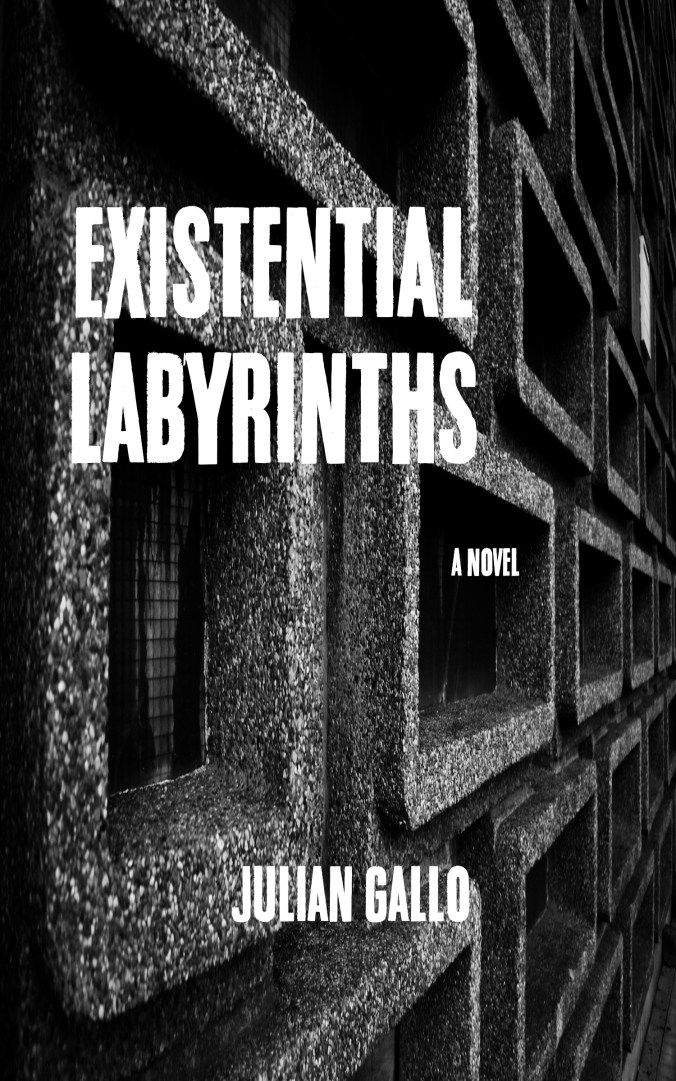
Existential Labyrinths 5x8 cover

Julian Gallo

is  author of ‘Existential Labyrinths’ and other novels. He lives and works in New York City.

My ‘author page’: https://www.amazon.com/Julian-Gallo/e/B004LZ298G
Website: http://www.juliangallo66.blogspot.com
Facebook: http://www.facebook.com/Julian.Gallo.Author

The Interview

1. What inspired you to write fiction?

It most likely stemmed from my love of reading, my love of books. I’ve always been a voracious reader, since I was a kid, and I suppose that was the stimulus for me wanting to write stories of my own — and I did, many of which are now lost to the ages. I’ve always written things, poems, stories, etc, but from my teens through my thirties, I was primarily involved in music. It wasn’t until I was about 30 years old when I started to actually try to seriously write something. Poetry exclusively, at first, which seemed to be the natural progression from songwriting, then I moved on to fiction, which is what I always wanted to write.

2. Who introduced you to fiction?

As a child I read a lot of adventure, science fiction, horror, things like that — Jack London, Jules Verne, Ray Bradbury, Stephen King, and so on. In my teenage years I discovered Jack Kerouac and Beat poetry and literature in general, as well as Milan Kundera, George Orwell, Kurt Vonnegut, Herman Hesse, and the Polish novelist Tadeusz Konwicki, who’s ‘Dreambook For Our Time’ had an enormous affect on me. Then came Henry Miller, Ernest Hemingway, Juan Goytisolo, Julio Cortázar, and too many others to mention, which opened up a new world for me and the various possibilities of the novel. Not only did I enjoy reading these authors but they all taught me there was no single way to approach the novel, that it was open to infinite possibilities.

3. How aware were you of the dominating presence of older writers?

They are always present, of course, but I never paid any mind to it except for their impact on literature, the enjoyment of their writing, and what they could teach me. We all approach the page in our own way and have to work with what he have. To think that I’d one day be among them is laughable nor was it ever a serious aspiration to stand along side them. With that said, this doesn’t mean one shouldn’t write. It’s like telling a young pianist to never play because they’ll never be Beethoven or Glen Gould. The younger generations have to forge their own path, do things their own way. Learn from the past but one doesn’t necessarily have to be beholden to it. We live in a very different time, with very different concerns and perspectives. It’s important that today’s writers find their own way.

4. What is your daily writing routine?

I try to make it a point to write every day, though that doesn’t always happen. If I can write anywhere between 500-1500 words, I feel as if I achieved something for the day. Some days are better than others. Some days there’s nothing at all due to other life responsibilities (even though I’ve been able to sell some books over time, let’s face it, no one makes money at this). I always try to carve out some writing time each day.

5. What motivates you to write?

The love of writing. That was always my motivation and probably always will be. I thoroughly enjoy it and would do it whether I had only a handful of readers or no readers at all. Writing for me is a way to explore questions I have about life, about my personal life, about society, about identity, about the so-called ‘meaning’ to life, though I don’t pretend to have any answers to any of it. All my work explores these issues in one way or another, and this is what motivates me more than anything else. I think this is true for most writers, whatever it is that brings them to the page. Publication and writing are two completely different things and I always felt the writing itself, and the process of writing, is far more important. Some people just want to be ‘famous’ but I think those writers eventually give up when they quickly learn it’s not as easy as they assume it is. Other writers write for their own personal reasons, whether that is the love of writing, the joy in the act of creation, or whatever personal journey the act of writing gives them — self-exploration/liberation, or to simply bring into life an idea, to see it come into fruition, like any artist, whether you’re a musician or painter. Most do it for the joy it brings them.

6. What is your work ethic?

Honestly, I’m not sure, except that I am determined for my work to be unapologetically my own and to do things in my own way, despite the so-called ‘rules’ others try to impose upon it. I always feel I’m still learning, always seeking to improve and to move forward. After I’ve written something (and/or published it), I tend to leave it behind and forget about it, move on to the next thing with that goal in mind. I’m not trying to *be* anything — or anyone — other than myself and the best writer I can be, for better or worse. I’ve always admired artists who approach what they do in this way, those who couldn’t care less about trends or who the ‘darling of the moment’ is; those who have a vision and see it through to wherever it may lead; artists who are unmistakably and unapologetically themselves.

7. How do the writers you read when you were young influence you today?

I think their influence is always there in some ways. For me, writers like Henry Miller, Ernest Hemingway, Jack Kerouac, to name just a few, are always lurking over my shoulder, I suppose. I try not to *be* them, of course, but to take what I learned from them and incorporate it into my own work in my own way. I think the writers who influence us always remain with us to some extent, some more than others, but they’re always present. These are the writers we learned from, those we tried to ape when first starting out, until we find our own voices. Even if we do, I think they’re always lurking in the background or in between the text. I think this is true for all artists, no matter what medium one works in. They’re always present in some form or another.

8. Who of today’s writers do you admire the most and why?

There are far too many to mention but I will name a few. I admire Cesar Aira and Alejandro Zambra, for the reasons stated above. They’re both unapologetically themselves, do what they want to do, in their own way. I also like Jean-Philippe Toussaint for much of the same reasons; Patrick Modiano for exploring the questions that haunt him; Youssef Rakha, who in my mind is a genius, whose work simply stunned me when I first read it. I also love Ariana Harwicz’s ‘Die, My Love’, which I found incredible; Sjón, for not only his talent and imagination, but, again, for being the writer he wants to be; Niccoló Ammaniti, who is a brilliant storyteller and I admire his explorations into the psychology of adolescence. Then there are the writers I’ve come to know either personally or through social media — Garry Crystal, who I feel I share a literary sensibility with, and is another writer who is unapologetically himself and writes very real stories which I think anyone can relate to; Fernando Sdrigotti, who is another writer who gets it and is consistently coming up with imaginative and thoughtful work; Jessica Sequeria, whose work I find highly imaginative; the list goes on and I don’t want to insult anyone by not mentioning them. The world is teeming with interesting writers doing highly interesting work. The notion that ‘the novel is dead’ is utter bullshit and those who believe that aren’t intellectually curious enough to make the effort required to seek out the wealth of talent there is out there.

9. Why do you write?

Two reasons, mainly. First and foremost, I just love to write, and secondly, to explore those questions that are of interest to me personally. Existential issues mostly — on identity, meaning, whether there ever was one single, all encompassing ‘meaning of life’ or if we give one to ourselves, and of course self-exploration, to try to find whatever ‘meaning’ there is to life in relation to my own, which I think is a universal thing. We all have these questions but I don’t and never claimed to have the answers. Sometimes, the journey itself is the whole point and writing allows that.

10. What would you say to someone who asked you “How do you become a writer?”

I would tell them to trust their own instincts and write about whatever it is they want to write about. Don’t get caught up in what I like to call the ‘literary bullshit’, which unfortunately is legion (the petty competition, the joy in hatchet jobs, slavishly obeying someone else’s arbitrary ‘rules’, etc). Do your own thing. Be in touch with who you are and allow your writing to reflect that; tell your story/stories, whatever they may be, in your own way. In short, be yourself. And of course, read — read, read, read, explore, keep interested and intellectually curious about life. Inspiration is everywhere and in everything. Be open to it.

11. Tell me about the writing projects you have on at the moment.

I have two (short) novels coming out by the end of this year. The newest, ‘Existential Labyrinths’, was just released, the other, ‘Juliette’, will be out by Christmas. I have other ideas for books I want to write. I want to take the next year to focus on that, take each day as it comes.

On Poetic Memoir Wombwell Rainbow Interviews: Christina Tudor-Sideri

On Poetic Memoir Wombwell Rainbow Interviews

I am honoured and privileged that the following writers local, national and international have agreed to be interviewed by me. I gave the writers two options: an emailed list of questions or a more fluid interview via messenger.
The usual ground is covered about motivation, daily routines and work ethic, but some surprises too. Some of these writers you may know, others may be new to you. I hope you enjoy the experience as much as I do.

wp_ss_20181106_0001

Christina Tudor-Sideri

lives and writes between Bucharest and Valletta.

The Interview

1. What inspired you to write poetry?

My first memories of writing come from the age of three, when my grandmother taught me how to write with midnight blue ink on freshly painted walls. She taught me to dip my fingers in bowls of ink and write on whatever surface I had in front of me. I course at the time I could only draw stick figures and write non-existent words, but that feeling stayed with me for a long time. The feeling of writing as a way of externalizing my insides. Anytime, anywhere, on any surface. A temporal foundation of what we sometimes call ‘being’. The transition from midnight blue stick figures to poetry happened a few years later, while visiting the local graveyard. I found myself surrounded by lilies, statues, and memory loss – erasure, traces of life leaving our collective body. Something didn’t feel right about the graves with faded names, about the tombstones lacking photographs, about all those people long-gone and now forgotten. I had this idea in my head that without a name or a photograph, without being alive at least as a memory, a person could not exist in the afterworld, expect for in the fires of hell. I know it was a peculiar thought, and it probably came from growing up in a culture influenced by death – and most of all by a fear of wrong-doing. But it was because of that thought about collective memory loss that I started writing poems on little pieces of paper and placing them on graves or tombstones without names. I would come up with stories, names, write lumbering verses about the dreams of those resting there in the cold ground, hoping that through my words they will keep on living. The opening lines of Barthes’ Camera Lucida talk about life consisting of “little touches of solitude.” If we can see history in photographs, we might be able to alter it in writing. With writing. I might be able to take all those absent faces, the negatives, the reproductions, and bring them back to life with my writing.

Looking back, not much of it makes sense. I was a child taking her first steps into a world I couldn’t explain, a world of failure, shock, and lost time. A world of which the adults around me were frightened. Writing offered me a way to understand all of it, long before reading provided me with such marvellous escapes.

2. Who introduced you to poetry?

The transitory. The fleeting beauty of everything around me. I believe I was aware of it long before I understood words. Veils. Crowds. Rays of sunshine. Everything I looked at. Touched. Tasted. The world was ending, and I knew it. I still know it. There was nothing else I could have turned towards but poetry. If I were to pinpoint a moment, it would perhaps be the time I started kindergarten. I was much too young for it, so my grandmother prepared me by teaching me thirty-seven short poems with which to astound my teacher. Some of the poems were her own, others were about death or mythical creatures from Romanian folk legends. Baudelaire lines about absence, Rimbaud, Minulescu, French and German songs from when she was a young girl, poems about mothers losing their children to the mercilessness of war. Poetry was her whole life. She would look at an object, a person, a small shadow on the wall and come up with a poem in a matter of seconds. She still does.

3. How aware are you of the dominating presence of older poets?

As time passed, and I found the joys of reading, as more and more philosophy and poetry books made their way into my life, I started to draw my own path, leaving behind some of the influences of my childhood and taking the shapes and voices of those who resonated with me at the time. I saw a poet in everyone I looked at, I saw a poem at every street corner. Yet I was not that aware of older poets, except of poets from different times, poets reaching out to me from the pages of their books. I had Paul Celan tell me about almonds, love, bitterness, and tulips. Arseny Tarkovsky accompanied my path showing me dark expressions of grief, which I so needed to find in writing, but also the beauty of nature, of new possibilities, of regenerating oneself over and over again. Georg Trakl, with his rhythm, structure, and colours. Marina Tsvetaeva. Borges. Anna de Noailles. There were older poets in my life. I studied and worked surrounded by poets, writers, philosophers. But somehow, I would always end up turning to those in my books, turning against the metaphysics of my surroundings.

4. What is your daily writing routine?

I don’t have a daily routine. I write whenever and wherever I need to. Sometimes I wish I could write more. Other times, I wish I could write less. My writing has a flow of its own, which is not always of much comfort.

5. What motivates you to write?

The unforgiving struggle of defining myself over and over again under the threat of erasure. There is this literary practice of placing words under erasure, ‘sous rature’ – originating from Heidegger, I believe – where you cross out a word within a text, yet the word remains both legible and in place. Without putting much emphasis on what the concept meant for the philosophy of deconstruction, this is what I do with my writing. Instead of words, I put memories, people, and pieces of the past under erasure, in the midst of poetical prose oftentimes shaped as journal entries. I need my memories there, on paper; I need my memories here, out in the world. I need them be able to cross out the imprint on my flesh, while allowing them to preserve their rightful place. So I guess what motivates me to write is the (sometimes inexplicable) hunger to become a story, to become something more than thoughts on their way to erasure.

6. What is your work ethic?

The one constant in my writing is that I need to keep doing it. And I try to always be faithful to that, to myself, and to the words that come from within. Even though I have given up so many times. Even though I burnt poems, pages, books almost, I need to keep writing.

7. How do the writers you read when you were young influence you today?

I spend a lot of time reading and writing. I also spend a lot of time considering the correlations between what I read and what I write. I have always been fascinated by the way my words transformed themselves in the light of things I’ve read. I also have a special relationship with film and philosophy, I’ve played with the idea of teaching for a while, and the films of Andrey Tarkovsky have had a major influence on my life. I don’t know how to explain this process, I can’t say with preciseness how books, films, and other works of art influence my life and my writing, yet I know that I would be a different person without them.

8. Who of today’s writers do you admire the most and why?

2018 has been an amazing year for me in terms of discovering new writers, a year that I will probably talk about for a long time, as it has brought back a hunger I had as a teenager of being surrounded by breathing artists. I am rediscovering European literature, and falling back in love or revisiting the work of Norman Manea, Romanian poet Nora Iuga, Serbian poet Jovan Zivlak (his poems are not yet available in English, which is something I hope will change soon), and Daša Drndić, who unfortunately is no longer with us. I have been reading a lot of journals and magazines, and am looking forward to new releases from some of the writers I’ve discovered this year and have grown very fond of, such as Tomoé Hill, Sussana Crossman, Fernando Sdrigotti, Rachael de Moravia, Joshua Rothes, Susana Medina, Jenni Fagan, and so many others. I found words, pages, whole books of stories, poems, and realities incredibly close to my heart. There are so many books on my shelves and in waitlists now, from all times and places, that I no longer know how I will be able to read them all. Oftentimes I think of myself more as a reader than a writer.

There is also the unceasing need of feeding my appetite for newness in terms of writers I’ve known and read since I was a little girl, which got me reading a lot of biographies, critical studies, and essays on the works and lives of those who have influenced my writing. I am in a never-ending quest to find out more about Paul Celan, Maurice Blanchot, Andrei Tarkovsky, Emil Cioran, Leonard Cohen – and the list could go on forever.

9. Why do you write?

I will let one of my favourite poems, by Arseny Tarkovsky, answer this question.

“I am a candle. I burned at the feast.
Gather my wax when morning arrives
so that this page will remind you
how to be proud and how to weep,
how to give away the last third
of happiness, and how to die with ease—
and beneath a temporary roof
to burn posthumously, like a word.”
10. What do you say to someone who asked you “How do you become a writer?”

You write. It is both simple and tremendously difficult. It is as if you are letting got a veil while the veil itself is gripping on tighter and tighter to your face. You retain the memory of everything you ever were, of everything you will never be, and you keep on writing.

11. Tell me about the writing projects you have on at the moment.

In the past two months my devotion towards writing has seen a significant change. After years and years of writing for myself, of burning, drowning, or erasing most of my words, I decided it was time to let some of those words live. I don’t know if I am doing it for myself, for someone dear to me, or for the words themselves, yet I do know that it is time to shelf The Little Match Girl. I am still trying to decide what to do with my old journals, thoughts, half books. Currently, I am working on a couple of essays, and putting together some ideas for a book of prose poems, memories, and battles of perception – other selves, other bodies, mirroring of residing fragments, a collection of gestures and sighs existentially present in my mind, which I would love to turn into words.


New Podcast: Rachael Boast on the Language and Sound of Poetry — Rachel Burns

Originally posted on READ: As a poet, if you cooperate with language you end up ‘saying things you didn’t know you were thinking.’ So claims the multi-award-winning poet Rachael Boast, in this interview with Suzannah V. Evans. But although poetry may emerge from somewhere unconscious, the course of their conversation draws to the surface Rachael’s life…

via New Podcast: Rachael Boast on the Language and Sound of Poetry — Rachel Burns

Wombwell Rainbow Interviews: Gillian Prew

Wombwell Rainbow Interviews

I am honoured and privileged that the following writers local, national and international have agreed to be interviewed by me. I gave the writers two options: an emailed list of questions or a more fluid interview via messenger.
The usual ground is covered about motivation, daily routines and work ethic, but some surprises too. Some of these poets you may know, others may be new to you. I hope you enjoy the experience as much as I do.

20180924_121420

Gillian Prew

Born Stirling, Scotland in 1966, Gillian Prew studied Philosophy at the University of Glasgow from 1984 to 1988.

Her chapbook, Disconnections, can be purchased from erbacce-press (2011) and another chapbook, In the Broken Things, published by Virgogray Press (2011). Her collection, Throats Full of Graves, has been published in 2013 by Lapwing Publications. A further collection, A Wound’s Sound, was released from Oneiros Books in April 2014. Her chapbook, Three Colours Grief, was published by erbacce-press in June 2016. Her latest project (a collaboration with the poet and artist, Karen Little) is a small booklet contributing to a series raising funds for an animal shelter.

She has been twice short-listed for the erbacce-prize and twice nominated for a Pushcart Prize.

Website: https://gprew.wordpress.com/

The Interview

1. What inspired you  to write poetry?

I had been writing a novel for well over a decade and decided to write a poem as a literary exercise. It wasn’t very good. I was 41 at the time, so came to it pretty late. Somehow I just didn’t stop writing them, especially when I found each one more satisfying than the last.

2. Who introduced you to poetry?

Like most people I had to study poems at school but wasn’t inspired at the time to keep reading poetry when I went to university. My interest didn’t develop until my 40s and was pretty much self-driven.

3. How aware were you of the dominating presence of older poets?

When I started writing poetry I didn’t give it much thought. The first poet I read in depth was Charles Bukowski, only because I had been reading his novel ‘Post Office’, and seemed to segue into his poems.

4. What is your daily writing routine?

I don’t have one. I have a job which requires that I work shifts and so depending on these and my level of tiredness I fit writing around it. Having said that, I am always reading poetry and thinking about the poem that I am writing, which I consider an integral part of the writing process.

5. What motivates you to write?

I look upon it as a tiny antidote to suffering.

6. What is your work ethic?

I don’t even like that phrase. Poetry isn’t Capitalsim.

7. How do the writers you read when you were young influence you today?

I have always read a lot and I’m sure some of those writers have influenced me subliminally but when I was young I read only novels.

8. Who of today’s writers do you admire the most and why?

I adore Les Murray. I love his use of language and his appreciation of the natural world.

9. Why do you write?

I write because I feel that I have something to say and I want to say it as beautifully as I can. I find writing poetry very liberating.

10. What would you say to someone who asked you “How do you become a writer?”

If it’s about money then don’t bother. The only two necessities are to read extensively and do some actual writing. The more you do of these the better your writing will become.

11. Tell me about the writing projects you have on at the moment.

I have just finished a little booklet, your verb is all water and light, which is part of a series of poetry booklets Karen Little is publishing to raise money for a couple of animal shelters. As an advocate for animal rights I jumped at the chance to be involved in this. It’s my 6th publication.

On Fiction Wombwell Rainbow Interviews: Nadia Dalbuono

On Fiction Wombwell Rainbow Interviews

I am honoured and privileged that the following writers local, national and international have agreed to be interviewed by me. I gave the writers two options: an emailed list of questions or a more fluid interview via messenger.
The usual ground is covered about motivation, daily routines and work ethic, but some surprises too. Some of these fiction writers you may know, others may be new to you. I hope you enjoy the experience as much as I do.

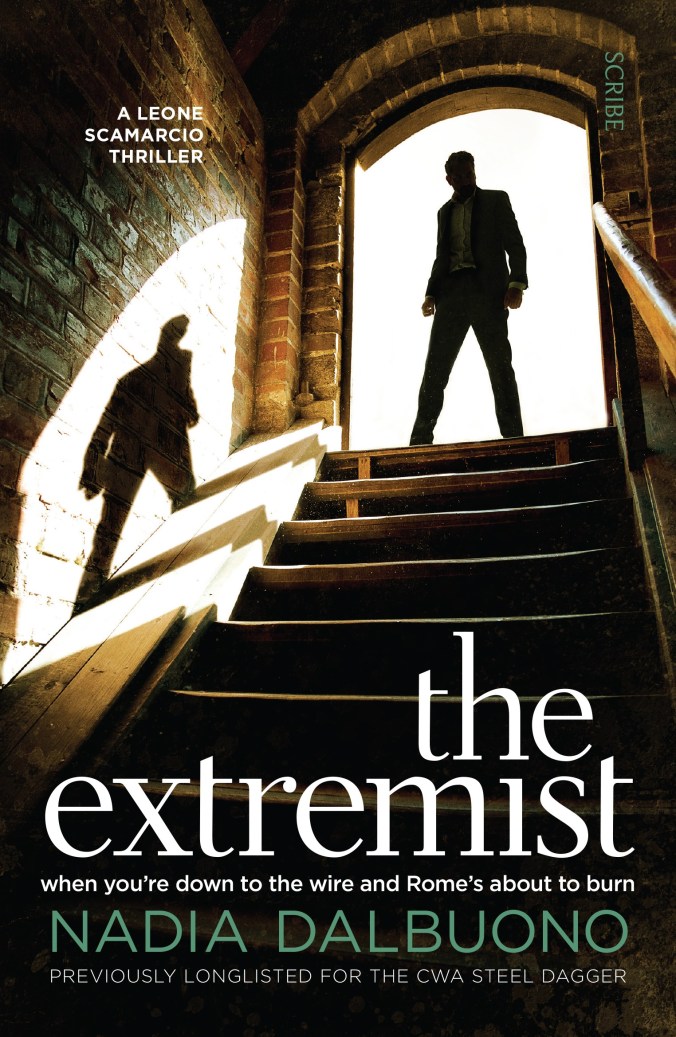
The Extremist

Nadia Dalbuono

studied at Queen’s College, Oxford where she read History and German. For the last sixteen years she has worked as a documentary director and consultant for Channel 4, Discovery and National Geographic. Her Leone Scamarcio crime series is set in Rome and follows the investigations of a Flying Squad detective struggling to escape his father’s mafia past. The second book in the series, The American, was longlisted for the CWA Steel Dagger. Nadia lives in Italy with her husband and two sons.

The Interview

1. What inspired you to write fiction?

I always loved to read and I loved to write stories growing up. In the end, a gap between jobs gave me the opportunity to sit down and write as an adult. I discovered that I really enjoyed it, much more than my job in television at the time.

2. Who introduced you to fiction?

My headteacher at primary school. We had to read 30 pages of a book three times a week and it instilled in me a love of fiction. Many of the other children who attended that state primary with me are also now avid readers.

3. How aware were you of the dominating presence of older writers?

I don’t think I was massively aware of it. When I stared writing, I’d read a lot of younger writers such as Bret Easton Ellis, Joshua Ferris and Dave Eggers. The fiction field didn’t feel massively dominated by older authors. That said, crime and thriller, my genre, did seem to have more of an imbalance with older writers such as Michael Connelly and Lee Child always out in front.
4. What is your daily writing routine?

I tend to write from 9am until 1230.  We live in Italy and schools finish at 1300 so my children are both home in the afternoons. I only have a narrow window of opportunity to squeeze some writing in – this means that I have to ignore the mountain of housework that needs to be done and deal with it later.  Not always easy as I write at the kitchen table and the mess is always in my line of sight!

5. What motivates you to write?

I feel that there are things that I want to talk about; stories I want to tell. After four books, my character Detective Scamarcio has taken on a life of his own and there are certain experiences I want him to have in order to grow and evolve. This means I must keep writing in order to keep up with all the twists and turns in his life.

6. What is your work ethic?

If I don’t feel like writing; if I’m not in the mood I just have to knuckle down to it anyway. If I only wrote when I felt like it, I’d complete a book every five years.

7. How do the writers you read when you were young influence you today?

I used to read a lot of Malcolm Saville adventure books as a child. I even wrote him a fan letter and was very upset when his publishers wrote back to tell me he’d died some years back. I think his plotting, pace and sense of atmosphere instilled in me a lifelong fascination with thrillers.

8. Who of today’s writers do you admire the most and why?

Michael Connelly is excellent and Don Winslow is a fascinating chronicler of our times. The Cartel is a superb piece of work. I have also read a lot of the Scottish author William McIlvanney and consider him to be one of the most interesting writers of detective fiction of recent times – his psychological insights are intriguing and enable some rock-solid characterisation. James Lee Burke and his extraordinary evocation of New Orleans also puts him right up there with the best.

9. Why do you write?

I think I answered that in 5.

10. What would you say to someone who asked you “How do you become a writer?”

Just write for yourself. Don’t worry about whether anyone will ever read it or whether you will ever find an agent etc etc. Write because you must; because you have a story you need to tell. Don’t give up, don’t doubt yourself. (But keep your day job: unless you’re extremely lucky, you’ll need the money!)

11. Tell me about the writing projects you have on at the moment.

I’m just trying to finish the first draft of Scamarcio 5 which needs to be delivered by Christmas. Once that is done, I’d like to try my hand at a standalone thriller, set in Trump’s America. The US both fascinates and disturbs me right now.


Wombwell Rainbow Interviews: Rishi Dastidar

Wombwell Rainbow Interviews

I am honoured and privileged that the following writers local, national and international have agreed to be interviewed by me. I gave the writers two options: an emailed list of questions or a more fluid interview via messenger.
The usual ground is covered about motivation, daily routines and work ethic, but some surprises too. Some of these poets you may know, others may be new to you. I hope you enjoy the experience as much as I do.

45558430_504569730023964_5104201926988267520_n

Rishi Dastidar

Rishi Dastidar’s poetry has been published by Financial Times, New Scientist and the BBC amongst many others. His debut collection Ticker-tape is published by Nine Arches Press, and a poem from it was included in The Forward Book of Poetry 2018. A member of Malika’s Poetry Kitchen, he is also chair of the London writer development organization Spread The Word.

http://­beingbeta.blogspot.co­m/

@betarish

https://medium.com/­me/stories/public

Rishi performs his poetry at iambapoet.com

https://www.iambapoet.com/rishi-dastidar

The Interview

  1. When and why did you start writing poetry?

So (and forgive me if this has the air of a well-polished anecdote) but I cam to poetry late-ish, about 2007, when I was 29, 30. I hadn’t studied literature, and my own real exposure to verse until then had been Vikram Seth’s The Golden Gate (a book I still love, by the way). Anyway, I was on Oxford Street in London one lunchtime (I worked just round the corner) and popped into the big Borders bookshop that was there then. As I was going up the escalator, I spotted this book called ‘Ashes for Breakfast’. Intrigued, I grabbed it, opened it and…. BOOM! A proper moment of revelation, damascene conversion if you want to get pretentious. I hadn’t realised – didn’t know – you could do this with words – not go to the end of the page, be all cool in tone, make classical allusions easily, talk about urban life…. I was entranced, and pretty much knew there and then this was the stuff I wanted to write. I had no clue how to write it of course, so I signed up to an introduction to poetry course at CityLit with Clare Pollard, and that was really the start of it all for me.

2. Who introduced you to Vikram Seth?

Again, this was a chance discovery – this time the Waterstones in Oxford when it was a Dillons – it was a Faber reissue with a lovely, moodily atmospheric pink cover, and it looked like it’d be a good follow up to Microserfs by Douglas Coupland, which I’d just finished. Little did I know the treats that lay in store!

2.1 How would you describe the treats that lay in store?

Oh, well – the musicality for one, the sheer joie de vivre with which he animates the Pushkin stanzas, the turns of phrase, the fact that it is actually a novel, with three dimensional characters… Whenever I re-read it, which is quite often, I’m struck by the fact that if I could pull of such a thing, I would die happy.

2.2 How did you get your love of book shops?

I guess it sort of emerged later… To be honest, most of my teenage years were spent hanging around record shops, especially Sister Ray in Soho; lost count of how many CDs I bought in there between the ages of 13 and 18.

3. How aware were and are you of the dominating presence of older poets traditional and contemporary?

Interesting that you use ‘dominating’ there… are you suggesting that there are perhaps a few poets, both living and dead, who take up a disproportionate amount of critical and wider public attention?

I wouldn’t necessarily disagree with the premise but: let’s start from the vantage point that our aim should be to learn from ‘the best’ poets, old and young, wherever and whenever they were writing. Now, does that and should that definition of ‘the best’ be radically wider than traditionally it has been? Yes absolutely – the idea that ‘the best’ can only be white heterosexual male poets is clearly daft; at least to me it’s self evident that there is plenty of brilliance to be found, that just happens not to arrive looking like how we might have once characterised brilliance to be.

Candidly I’ve never felt ‘dominated’ – what I have been is hungry to try and learn from why these voices might have been lionised, and then try and work out what I could usefully steal for my own ends. Plus I really feel it’s good to read as widely as you can; I love the metaphysicals especially, and have ranged back to Hafez and others… it’s healthy to want to be both part of a tradition… and then also want to tweak its nose a bit, right?

Instead of ‘dominating’ let’s say that I was very definitely looking for role models to learn from, not just in terms of how to write but also how to be a poet. Seeing people like you, writing, being heard is important I feel – it gives you a sense that not only should I be in this space, I can be too.

4. What is your daily writing routine?

Multi layered answer to this I’m afraid, as my day job is also as a writer, a copywriter in advertising / branding / design agency. So, I’m pretty much doing some form of ‘writing’ 5, 6 days a week, and every day the blank page will be fllled with something, and sometimes this might even be poetic. If I’m full on at work, then chances are that poems and other non work writing happens in stolen moments at lunch, on the commute home; when it’s quieter at work, I’ll try and steal some time in office hours; there’s a lot of compiling, revising and editing at the weekend, generally in a coffee shop.

5.  What motivates your writing?

The obvious ones are vanity, and a horrible realisation that I can’t do much else that is actually practically useful and or able to earn me much y way of coin.

Beyond that – everything starts with a phrase doesn’t it? Something that lodges, that sticks, that you want to talk for a walk and see what happens next… does it capture an image, a mood, a metaphor…? That process of finding out, that sitting down with a notebook and a coffee and for 30 minutes, an hour, seeing what happens – that’s generally pure pleasure, and I guess why I keep coming back to it. When you’re flying – when you’re flowing – there’s only a few better feelings.

And as I do this more and more, well I guess there are subjects I want to start to attack, to try and find out what I think about them; but I’m not the sort of writer who has a view and needs to express it; I need to write to find out what that view is.

6. What is your work ethic?

Ha! Stolen from an old creative director: “Be brilliant, do loads.” I struggle on both counts.

7. How do the writers you read when you were young influence you today?

Pass – and not out of a desire to be difficult, but a) I struggle to think of who I was reading when young apart from Aesop’s fables, Narnia… b) because I came to writing poems so late, I’m not sure I can track a straight line of influence through.

8. Why do you write?

For money, for fame (ha!), to trouble posterity (double ha!), because I can’t do anything else, because I don’t want to do anything else, because I’m a failed seducer and flailing intriguer, because I’m not handsome enough to be on telly, and I’m to lazy to do a proper job.

9. What would you say to someone who asked you “How do you become a writer?”

Read – Read more than you are right now, read more than you think you can, read what you like, read what you don’t like, read things that you do know, reads things that you don’t, read from first page to last, read only one page and then throw the book away… if you do not read you will never become a writer.

10. And finally Rishi, tell me about the writing projects you have on at the moment.

Well, there’s this – tinyletter.com/­betarish – flash fiction pieces, 90 of ‘em; a draft of book 2 is inching its way into the world, a long narrative poem; and I have a crazy idea to write something about American Football; but no one wants to read poems about sports, do they?
Cutscenes by Betarish
tinyletter.com