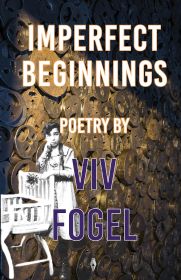
Review* of ‘Imperfect Beginnings’ by Viv Fogel

Nigel Kent's avatarNigel Kent - Poet and Reviewer

At a time when the discourse surrounding asylum-seeking, refugees and migration has become contentious, having been hijacked by nationalists and populist politicians, Viv Fogel’s Imperfect Beginnings is very welcome. Informed by her personal and professional experiences her collection gives a voice to the exiled and displaced. Though her poems are uncompromising in their exploration of their ordeals, these poems are ultimately about survival and repair, and the collection ends on a note of hope.

Imperfect Beginnings (Fly on the Wall Press, 2023) is split into five sections. The first two deal with the nature and effects of exile. The opening poem with that name allows us to experience directly the trauma and frustrations of displacement. Written in the first person, Vogel puts us in the place of a refugee and enables us to imagine: the sudden shock of separation (‘For one precious moment/ you were my whole world/ safe     holding…

View original post 1,210 more words

Wombwell Rainbow Interviews: Julie A Dickson


Julie A. Dickson is a poet and author of several books including, Bullied into Silence [Piscataqua Press 2014] and Untumbled Gem [Goldfish Press 2016] Dickson holds a BPS in Behavioral Science, is a Push Cart nominee, has served on two poetry boards, has coordinated 100 Thousand Poets for Change and served as guest editor for Jitter Press and Inwood Indiana, co-editor for My Funny Bones are Humor-us by R.M. Staples and as editor/curator of Prey Tell: Poems about Birds of Prey. Her work appears in over 50 journals, including Misfit, MasticadoresUSA, Girl God, Tiger Moth and Ekphrastic Review. Dickson writes poetry from many prompts such as art, nature, literature and animals. She advocates for captive zoo and circus elephants, and shares her home with two rescued cats.

The Interview

  1. When and why did you start writing poetry?

I began writing poetry as a young teen, although I had for several years prior to age 12 written stories. I was an early reader of books; my mother was a kindergarten teacher who walked me to the public library three times each week, where I was allowed to take out as many books as I could carry. I loved Dr.Suess, and many chapter books including Charlotte’s Web, Black Beauty and the Cricket in Times Square. As a teen I read novels, biographies and poetry. I took many creative writing classes in high school, entered contests and sent stories and poems into magazines. I was teen, whose mother did not drive, living in a rural area where babysitting and reading were my main past times. English, writing and history have always been my favorite subjects in both high school and college.

  1. Who introduced you to poetry?

I suppose that between the public librarian, school librarians and my mother were all an influence on me being introduced to poetry.

  1. How aware are and were you of the dominating presence of older poets traditional and contemporary?

By the time I entered high school, I had a 9th grade English teacher who encouraged me to write more, and I became aware of Emily Dickinson, Robert Frost, Edgar Allan Poe, Yeats, Keats and others.

  1. What is your daily writing routine?

I am an early riser and it is my routine to sit at my desk with tea or coffee and write each morning for a couple hours. I find that my mind is fresh this time of day, more so than later.

  1. What subjects motivate you to write?

I often write to prompts, such as art, music, literature, nature, memories, teen issues and environment. I find myself able to write about most topics, have attended countless workshops and retreats, have been a member of several poetry groups, served on two volunteer poetry boards, coordinated 100 Thousand Poets for Change for 5 years in my community and have done readings at open mics, poetry meetings, bookstores, schools and libraries.

  1. What is your work ethic?

I have always had a strong work ethic, whether I am in a paid position, a volunteer or simply writing and doing tasks on my own. Writing is not work to me, it’s what I do.

  1. How do the writers you read when you were young influence your work today?

My taste in books changes periodically, from mysteries, modern fiction, to poetry, non-fiction and historical books. My poetry has evolved from strict form poems to free verse and I often explore new forms when I write poetry now.

  1. Whom of today’s writers do you admire the most and why?

The contemporary poets I admire today include Maya Angelou, Billy Collins, Mary Oliver, Donald Hall, Richard Blanco, and Amanda Gorman. There are so many

I just admire their work, their writing talents. I once did a presentation on Maya Angelou at a Women Poets festival where I live. I took a workshop with Richard Blanco a couple years ago. Mostly I like their work.

The answer is different for each…in that Maya Angelou and Amanda Gorman’s work is more progressive, political, about world acceptance. Mary Oliver is a good model for people learning to write better. I like Billy Collins for the romance and humor.

  1. Why do you write, as opposed to doing anything else?

I write because I have been writing for most of my life. I cannot imagine not writing poetry, creative non-fiction, YA fiction. I have also written children’s books. I write what I know, what I feel, and what I remember.

  1. What would you say to someone who asked you “How do you become a writer?”

I’ve been asked this question a few times and my response has usually been, if you are a writer, you just write. I don’t know how to advise someone on how to become a writer. My suggestion is to do a journal or free-write each day, and take pieces that are meaningful from your words. They can become poems or stories about your life, your interests and the world.

  1. Tell me about the writing projects you have on at the moment.

I have concentrated for the past 5 years primarily on writing poetry, creative non-fiction and stories for submission into journals and magazines. In 2022, I had over 100 poetry acceptances. My work appears in over 50 journals now, and I often locate new journals to submit to. I have been a guest editor at 3 publications and have also edited two poetry collections and a book of memoirs. I have 2-3 poetry and chapbooks in-progress, as well as a new YA fiction book and a children’s book on deck. There are never enough hours in a day for me to do all that I want to with my writing.


Harald in Byzantium by Kevin Crossley-Holland Illustrations by Chris Riddell (Arc Publications)

tearsinthefence's avatarTears in the Fence

These poems are ‘not narratives but revelations’ says the author, and this seems a perfect way to describe the light of insight and discovery that shines, momentarily, on the forgotten or unknown. Here are fragments, scraps of stories handed down, examples of warfare, leadership and love, contrasts between worlds in the north and in the south, all of which come together to reveal the connections and interdependence among men that are needed for life. ‘If one man breaks the shield-rampart,’ says the narrator, ‘all his companions suffer.’

Harald Hardrada, we are told, was the greatest warrior of his age, true to his Viking reputation for courage, ferocity and ambition for ‘the golden crown, hard-edged fame.’ Several poems end with words of defiance:

‘I’ll brook no disobedience./None at all.’

‘I have no choice, only an imperative.’

‘Let me be blood and flames.’

Yet he is also a man of passion, capable…

View original post 398 more words

Poetry Showcase: Kristin Garth

davidlonan1's avatarFevers of the Mind

photo from pixabay (Cilvarium)

These 3 sonnets were previously published in the now defunct Mojave Heart.

A Feral Girl Belongs Between The Trees

You trespass, sodden footprints in your wake,
into a kitchen for purloined cake, crumbs,
a dollop, butter cream.  Clean pewter plate 
while an entire household dreams. You succumb,
to ritual, sneak upstairs, nimble toes,
where they sleep unaware.  Exchange soiled dress 
until your armoire’s bare, grosgrain ribbons, stowed 
in pockets, for your feral hair, still wet 
a little from the lake, your evening bath 
before your stomach ached for cake, clothes stuff — 
you’ll find, again, through the servant’s entrance at half 
past ten.  This house was never quite enough 
even when it contained your family — 
a feral girl belongs between the trees.


Nipple Pulls you to his chest, after all the rest to fall asleep the way that he desires. you suckling his right nipple…

View original post 252 more words

Happy #StDavidsDay . I will feature your draft, or published/unpublished poetry/short prose/artworks about this day and #dragons, #Welshness, #Wales. Please include a short third person bio.

Language and Music

It’s no surprise that I recognise it
whenever I hear it spoken
like I did that Boxing Day
at M&S in Bath, though I hadn’t
heard it for years, and couldn’t
pick out a word – diolch, diawn,
and not at that time of day nostar.

My dad thought it was Polish
but I knew it to be Welsh,
for I used to listen to it spoken
every day in the shops, on the bus,
in Sospan Fach. But it’s a mystery to me
how just recently, whenever Monteverdi
comes on the radio unannounced

or I tune in half way through,
somehow I guess it is him
and guess right as I learn
when the music ends
or from the text on the screen
or by saying to my phone
What’s this song?

The only tune I know is Pur Ti Miro,
perhaps not in fact written by him.
He’s on none of my CDs
or old tapes. With other composers
I often guess wrong.
What does this reveal about me
except how long I’ve listened to Radio 3?

Peter Donnelly

Bio and Links 

Peter J Donnelly

lives in York where he works as a hospital secretary. He has a MA in Creative Writing and a degree in English Literature from the University of Wales Lampeter. Thanks are due to the Dreich magazine, Writer’s Egg, Southlight and South Bank, where some of these poems have previously appeared. His poetry has also been published in other magazines and anthologies including One Hand Clapping, Black Nore Review, Ink, Sweat and Tears, Obsessed with Pipework, High Window and The Beach Hut. The 22 won second prize in the Ripon Poetry Festival competition in 2021 and The Second of August was a joint runner up in the Buzzwords open poetry competition in 2020.

Divine Blue Light (for John Coltrane) by Will Alexander (City Lights)

tearsinthefence's avatarTears in the Fence

Like saxophonist John Coltrane, who this book is dedicated to, Will Alexander improvises his way through noise and chaos to explore the furthest reaches of his source material and thought process. And sometimes, although I love the late music of Coltrane, I can’t but help be reminded of Miles Davis’ retort in response to Coltrane’s extended soloing‘Why don’t you try taking the horn out of your mouth?’

The contradiction is that the lengthier poems here are the most successful, as they catch the reader up in extended riffs of ‘Language / as scaled erisma / as amplification that burns’ with energy, confusion and the ghost of incantatory poets such as Allen Ginsberg, Gil Scott Heron or The Last Poets whilst also drawing on the bewildering radical politics and mysticism of black artists such as Sun Ra, Anthony Braxton and Amiri Baraka.

Shorter poems, such as ‘Under Corporate Worship, reproduced here in its entirety, don’t…

View original post 448 more words

Poetry Showcase: David L O’Nan from Cursed Houses pt 1

davidlonan1's avatarFevers of the Mind

https://amzn.to/3gknC3r the U.S. link to the book.

Twine Years Ever since I remember as a little boy my grandmother much younger than I actually thought She appeared to be lost and looking for the lost sunset all day Another cloud goes by, and she smiles and says "it is about to become really pretty out here." She would sit in on a knotted wood framed chair and watch her world disappear as the moon came out to remind her for a moment of who she is. As she twisted some twine together hoping to someday make more blankets and sweaters. The woman with style at the 1950's ballroom halls. The men would look and she'd flash her ring. A quick look back at her military man in a picture frame. Smiling in the dust that buries the room. Her yellow wedding dress sits in the attic. She remembers the walks…

View original post 3,285 more words

The High Winmdow Reviews

The High Window Review's avatarThe High Window

reviewer

*****

Derek Mahon: The Adaptations (1975–2020) • Helen Mort: The Illustrated Woman • Carole Satyamurti: The Hopeful Hat • Richie McCaffery: Summer/BreakRiver Wolton: Year Mark RoperBeyond Stillness 

*****
The Adaptations (1975–2020) by Derek Mahon. The Gallery Press, 2022. ISBN: 978-9-1133-8420. Reviewed by Sam Milne

adaptations

One of Ireland’s finest poets, Derek Mahon was also one of her finest translators of poetry, as this book from The Gallery Press clearly shows. In a very interesting Afterword to the collection, published posthumously, Mahon writes honestly that in his ‘translations’ he has ‘taken many liberties, in the hope that the results will read almost like original poems in English’ (his emphasis), an openness that is not always acknowledged by poetry-translators (as is the case in Robert Lowell’s Imitations, for example). He reinforces this point by stating that the poems ‘aren’t translations, in the…

View original post 7,812 more words

Wombwell Rainbow Interviews: Nolcha Fox


Nolcha Fox

Nolcha’s poems have been published in Lothlorien Poetry Journal, Alien Buddha Zine, Medusa’s Kitchen, and others. Her poetry books are available on Amazon. Nominee for 2023 Best of The Net. Editor for Open Arts Forum. Accidental interviewer/reviewer. Faker of fake news.

Website: https://bit.ly/3bT9tYu

The Interview

1. When and why did you start writing poetry?

I wrote some ghastly poetry when I was journalling in my 30s. I tossed all my journals in a trash bin (years and years of writing), and thought I was done with it. Unfortunately, I gave my mother copies of some of the poems. She sent them to me recently. I was so appalled, I wanted to blast out of the universe.

I started writing poetry seriously a little over a year ago, and was astonished that editors wanted to publish it. One of my dear friends (an incredibly talented poet herself) suggested that I try it because it wouldn’t strain my very soggy brain. I was recovering from 7 years of migraines and the medication that only made me feel worse, and I simply didn’t have the focus to go back to short story writing.

2. Who introduced you to poetry?

I don’t remember when or how it happened, but as a child, I fell in love with the rhythm/rhyme and pure silly fun of Dr. Seuss books. I graduated to Alice in Wonderland, and was enchanted by its poetry, some of which I can still recite by heart decades later.

3. How aware are and were you of the dominating presence of older poets traditional and contemporary?

I am aware enough of traditional poets, but I’m not much attracted to their work. Considering how much I loved the singsong rhymes in my childhood, it amazes me how difficult it is for me to read through much of it.

However, I love Edgar Allen Poe’s poems (I have a streak of dark in me) and Robert Frost poems. I don’t know if you’d call them traditional or contemporary. My sense of time is fractured, and I’m not at all scholarly about poetry.

I’m still discovering contemporary poets. I run across them in workshops and writing groups. First things every morning, I read works from other poets. Some motivate me to write a response poem.

4. What is your daily writing routine?

I usually write in the early morning. But it’s not unusual for me to write early evening and to get out of bed around midnight and write some more.

5. What subjects motivate you to write?

I prefer to write from prompts. Prompts can be images, a phrase, a word, another poet’s poem, or something that happened during the day. I can write about almost any subject, including dust bunnies, vampires, Big Foot, and penguins.

I’m a big fan of Medusa’s Kitchen, and I publish there at least twice a week. Kathy Kieth, the editor, has a great list of prompts. She also posts a new phrase or word prompt on Tuesdays, and an ekphrastic challenge on Fridays.

I always participate in the April NaPoWriMo (National Poetry Writing Month). Several sites post a new prompt every day in April.

In November, Writers Digest holding a Poem A Day challenge, posting a new prompt every day. At the end of the month, poets can submit a 10-poem chapbook to Writers Digest, culled from the poems written during the month. I’m so on it!

6. What is your work ethic?

I write like my hair is on fire. My poems are typically short, and once I get going on a poem, I can typically finish it within 10 minutes.

If a poem is truly bad but I might be able to salvage something from it, I put it aside. If it’s irredeemable, it goes bye-bye.

I do hit a slump sometimes, where no poem wants to associate with me and flees to another continent. Occasionally, writing about not being able to write gets me excited. Usually, I slump around and moan that I’ll never write again until the day the muse smacks me on the cheek, and I go back to poeming.

7. How do the writers you read when you were young influence your work today?

Seuss and Poe and Carroll burned rhythm into my bones. Most of my poetry, if read out loud, tastes like a heartbeat or a train clattering down a track.

8. Whom of today’s writers do you admire the most and why?

I don’t have a favorite writer, probably because I’m leery of writing exactly the same as that person (it’s easy for me to become a mimic). It’s taken me most of my life to write like me.

9. Why do you write, as opposed to doing anything else?

Writing is an obsession. I’ve written all my life. Even when I pretended writing wasn’t important, I was obsessed with it.

10. What would you say to someone who asked you “How do you become a writer?”

I would tell that person to just sit down and write. And write. And write.

11. Tell me about the writing projects you have on at the moment.

I’m currently collaborating with Ken Tomaro, and collaborating on and off with a previous co-worker who now is painting in watercolor. As I receive requests, I interview literary magazine editors, authors, and artists. I also have to work on more fake news flashes for The Gorko Gazette.

12. How did you decide on the order of the poems in the book?

Don’t laugh, I’m making life as easy as possible for my crazy brain – they’re in alphabetical order. Easier to keep track of.

13. How did you choose the photos for “How To Get Me Up In The Morning” or was that a collaborative effort?

My collaborator chose photos based on the poems. Jill typically gave me 1-3 photos to chose from.

13.1.  What ideas did you use to make the choice?

I chose the best photo based on how it related to the poem. I also considered colors and composition. And humor.

14. Why did you decide to use figures like Icarus from old myths and legends in this book?

I wanted to submit to Lothlorien Poetry Journal. My first read of the site was that Strider was looking for poetry with a classical theme, so I decided to work up some poems around myths and legends. At about the same time, a poetry prompt wandered across my computer screen, having to do with Icarus. Wings. Birds. Ah, Alfred Hitchcock’s “The Birds.” That’s how “Flight School” came about.

15. How important is white space to your poetry?

I see white space as breathing space, a frame of possibilities around the words.

When I read poetry that doesn’t have much white space, including prose, I have a physical reaction of claustrophobia, and I struggle to breathe as I read.

15.1.  White space as a reason for your preference for short form poetry?

White space is an important factor. My aim is to present one thought, one focus, using words that will make my readers think. Or at least laugh.

15.2. One thought, one focus, rather than an exploration of that thought or focus?

I leave it up to the reader to explore that thought or focus. I’ve been amazed at the varied responses to my poetry. People have considered things that didn’t cross my mind.

15.3. What appeals to you about this epigrammatic form?

It’s fun to write, and hopefully fun to read. Sometimes I can even wrap something important in the humor.

15.4. Why is it fun to write?

I love putting word images together in new (and often humorous) ways.

15.5. What is important about including humour?

As my husband says, we take ourselves too seriously. The world is so full of gloom and doom and conflict, why add more to the world? A smile is so much more pleasant.

16. After having read your book what do you wish the reader to leave with?

I want the reader to read it again. And again. Some of my readers contact me and tell me that’s what they do.

For people who don’t eat poetry with breakfast, I want them to lick their lips and say, “That tasted good!” and eat another poetry book. Perhaps one of my other books (shameless advertising). Perhaps a book by another poet.

Guest Feature – Alan Parry

Patricia M Osborne's avatarPatricia M Osborne

I’m delighted today to introduce poet, Alan Parry to Patricia’s Pen. Alan is also the editor of poetry press, The Broken Spine. Today Alan blogs about his own writing.

My Writing

Alan Parry

Writing about my own writing is something I often find challenging. But when Patricia offered me an opportunity to discuss my work, I figured I ought to give it my best.

Anybody who has followed my writing career, such as it is, may have heard me discussing my need to write before today as being born out of an inability to create anything of any worth in any other medium. What I’d give to be a talented singer-songwriter or painter! I write because I cannot do these things. What is more, I write poems because I cannot write good comedy. I have fallen into writing poetry, because I wanted to, no I needed to create…

View original post 433 more words