“Please Take Change”, Cyberwit. net, 2018 now released
Uncategorized

Now Fully Updated The Wombwell Rainbow Interviews Alphabetical Surname Index
Wombwell Rainbow Interviews: Graham Norman
Wombwell Rainbow Interviews
I am honoured and privileged that the following writers local, national and international have agreed to be interviewed by me. I gave the writers two options: an emailed list of questions or a more fluid interview via messenger.
The usual ground is covered about motivation, daily routines and work ethic, but some surprises too. Some of these poets you may know, others may be new to you. I hope you enjoy the experience as much as I do.
Graham Norman
After a career in Local Government as a chartered surveyor he retired in 2008 and pursued his lifelong interest in writing taking a higher national certificate in creative writing at Leicester University and an M A in Creative Writing at De Montfort University. He has written poetry for the last 20 years and it remains his first love. Now, he writes short stories, plays, essays, travel writing and blogs. He writes of man the animal, the evolved primate. His roots are deep in the good earth of science and the rational world and he strives to draw up truth to the airy branches of public perception where it may burst into the leaf and flower of poetic enlightenment. He really means this but lest he sound too pretentious, let him add that he writes with humour and satire sitting by him on the park bench. In no contradiction of his faith in Charles Darwin, he is a Christian in the Church of England and writer the poetry of the Passion as willingly as the poetry of Evolution.
He was chair of the Leicester Poetry Society from 2007 to 2009 and was a regular at Word! Leicester’s famous open mic event until he moved to Southampton in 2013.
He likes to share his ideas and skills and lead poetry workshops and has given talks to a number of social groups.
He was a panellist on the forum discussion ‘Page v Stage’ at the Lyric Lounge in 2009
The Interview
- What inspired you to write poetry?
More a ‘who’ than a ‘what’. Miss Rosevere my English and Latin teacher in sixth form, 1965, challenged our class to write a sonnet. Despite plagiarising Homer, ‘wine dark sea’, I wrote a passably good one which she got me to read out in class. The two drugs of praise and performance were then in my bloodstream.
2. Who introduced you to poetry?
My father, school and my curiosity. In my teens I discovered Robert Graves autobiography, Goodbye to All That, which led me on to his poetry and The White Goddess. Wilfred Owen and T S Eliot followed. I was daunted by their technical skill and had little confidence in my own writing as a result. I wrote for myself in my twenties and gave up in despair by the age of thirty. Funny that I have always considered my vocation is to be a poet!
I started writing again in 1998, humorous verse to amuse my work colleagues. The drug addiction kicked in and I was soon being asked to write and perform for special work occasions, leaving dos, Christmas parties, Carol Services etc. At the same time, I was going on long weekend walks in the Leicestershire countryside and composing perambulations and reflections. In 1998 I joined the Leicester Poetry Society and put my work forward for scrutiny by peers. I survived that! When I retired in 2008 I decided to study Creative Writing and achieved an MA in 2012, with a poetry collection, Swerve. Thank you, Dr Kathy Bell of de Montfort University for making me jump higher and higher hurdles!
3. How aware were you of the dominating presence of older poets?
Dead poets have been a huge influence: John Donne, John Keats, Emily Dickinson, John Clare, Robert Graves, T S Eliot, Sylvia Plath to name some favourite companions. I am an older poet aged seventy and three quarters – not a dominating presence though.
4. What is your daily writing routine?
I don’t have one. I write when the poem jumps out of the bushes and startles me. I write when life let’s me. I write when I am commissioned to write. I write when the withdrawal symptoms become so painful that I need a hit of poetry and nothIng else will do.
5. What motivates you to write?
Mortality, the state of the world, curiosity, conversations with God and Charles Darwin, being alive.
6. What is your work ethic?
I have, by accident of upbringing and personality, been at service more than self seeking and have always enjoyed hard physical work and found mental effort easy and rewarding. I follow a Benedictine rule of life which balances physical labour, spiritual endeavour, service to family, friends and society, cemented with love. Poetry is the word of God. Luckily, she’s a lazy cow who gives herself duvet days and not just on Sundays either.
7. How do the writers you read when you were young influence you today?
I am beyond influence but open to persuasion.
8. Who of today’s writers do you admire the most and why?
How many poetry writers are there in the world today? Too many to read, that’s for sure. I don’t find admiration comes easily to me, preferring the companionate equality of travellers on the dusty road. We meet, walk a while, part, slip back into our quiet thoughts. I think that admiring and being admired is a rather juvenile thing that I’ve grown out of. If I had to name someone it would be George Szirtes, a Facebook friend whom I bought a pint for about ten years ago. He doesn’t know that I admire him.
9. Why do you write?
Bad question, but here’s an answer.
Drift mine
This eye that is the outside;
this mind that toils at rock face,
lusts for the golden seam.
The adit, though, elides
open day, its gleam.
These hands that scrabble, break nails,
not to escape, but take,
should stop, ease and release their pick,
drop, pause to balm that face
with a dry wash of unrequited palm.
then fingers turn their tips,
unpocket pencil, poise,
feel, though blind to light,
the upland breeze, scented,
soft on those sullen lips;
sneer, if you must, but write
what you have seized, here,
inside the mine and out.
10. What would you say to someone who asked you “How do you become a writer?”
If you have to ask the question you are probably not a writer. On the other hand I might pass on the joke:
The maestro was racing up New York’s Seventh Avenue to a rehearsal, when a stranger stopped him. “Pardon me,” he said, “can you tell me how to get to Carnegie Hall?”
“Yes,” answered the maestro. “Practice, practice, practice.”
11. Tell me about the writing projects you have on at the moment.
I am currently completing a set of poems for performance in a meditation experience called POESIE. It’s a reflection on Genesis.POE SIE flyer[18445]
I am developing (slowly) a self-publishing venture with my friend Trevor Amos – https://writerunlocked.co.uk we intend to publish more work in 2019, in my case two novels already written, a play, and several collections of poetry.
Wombwell Rainbow Interviews: Robert Garnham
Wombwell Rainbow Interviews
I am honoured and privileged that the following writers local, national and international have agreed to be interviewed by me. I gave the writers two options: an emailed list of questions or a more fluid interview via messenger.
The usual ground is covered about motivation, daily routines and work ethic, but some surprises too. Some of these poets you may know, others may be new to you. I hope you enjoy the experience as much as I do.

Robert Garnham
is a comedy spoken word artist based in Devon. Over the last few years he has performed all over the UK, headlining at such nights as Bang Said the Gun in both London and Manchester, Milk and Raise the Bar in Bristol, and Poetry Island in Torquay. He has worked with both Apples and Snakes and Hammer and Tongue as both host and headliner at events from London to Brighton, Bristol to Exeter. His last two comedy spoken word shows have toured the UK appearing at festivals and fringes. Last year he was mentioned in The Guardian and The Telegraph, as well as BBC Radio Two, and interviewed on BBC Radio Five Live, as having one of the funniest jokes at the Edinburgh Fringe. He has lately been seen in TV adverts for a certain Building society.
He has recently headlined at the legendary Duplex cabaret in New York, and has been longlisted for the last three years as Spoken Word Artist of the Year in the Saboteur Awards. His last two books have both been published by Burning Eye Books, and he has won slams everywhere from Exeter to Edinburgh. He is the current host and promoter at Big Poetry, the biggest night of spoken word in the south west, and has supported John Hegley, Paul Sinha and Arthur Smith at comedy nights.
And here’s a link to his website
https://robertdgarnham.wordpress.com/
The Interview
1. What inspired you to write poetry?
I’d always written when I was younger. I wrote comedy short stories and silly little bits which made me laugh, and I continued writing these into my adult years. I then went through a phase where I wanted to be a deeply serious literary author. By the time I got to my thirties, it was obvious that this wasn’t going to happen!
I did literature at both A Level and at university and the courses covered poetry but most of it bored pme rigid. It’s probably better to read such things for pleasure rather than to write an essay. The only poet who appealed to me was Frank O’Hara, who I didn’t even see as a poet, as his work seemed to talk to me.
When I finished my postgraduate degree, I decided that I needed to see more culture. The only problem with this is that I live in Torbay, so really there wasn’t much around. I looked in the local paper and it said that there was a night of performance poetry at the Blue Walnut Café. I went along, and Byron Vincent was the headliner. The whole night inspired me to have a go myself. I asked the host and he gave me a slot for the next week. Which meant that I had to go home and write something.
I wrote a couple of comedy poems and the next month, the audience laughed at all the right places, and that’s when I thought, wow, this is what I want to do!
2. Who introduced you to poetry?
As a kid my only knowledge of poetry was Pam Ayres, who my mother loved and whose books were in our house, and John Hegley, who I had seen on television. I also liked the poetry of Robert Service, as I was obsessed with anything to do with the Yukon.
My father was in to music and comedy and by some kind of osmosis, I got in to them too at an early age. The wordplay associated with comedy and stand-up informed my writing, and when I started writing poetry, it was to music that I turned, to pop groups especially and their succinct use of language. Neal Tennant, David Byrne, Bob Dylan, Morrissey, Kirsty Maccoll, Kate Bush, Jerry Seinfeld, Alan Bennett, Bob Newhart, these were the people who introduced me to poetry.
3. How aware were you of the dominating presence of older poets?
My knowledge of the poetry scene has always been somewhat sketchy. Naturally at college and university we studied a good array of poets, but the canon was always a bizarre array of straight, white old men.
However, as a performer on the national spoken word scene, I find it to be dominated overwhelmingly by much younger poets. Spoken word is a relatively new art form with its basis in YouTube and Slam or battle rap culture. I go to poetry events around the Uk and find myself, at forty five, to be the oldest person in the room.
However I have also been to events where I am the youngest person in the room, particularly those aimed more at page poets. I am often booked at such events as some light relief!
4. What is your daily writing routine?
I get up early and I try to do an hour of writing between seven and eight. This is just playing around with words and ideas. I have used the same cartridge pen for everything creative I’ve written since 1995, mostly because I write out everything Long hand. At nine o clock I might do some reading or research, which is just a flimsy pretext to watch comedy or listen to music. At ten o clock I will have a very specific writing session for a couple of hours, working on whatever my project is at the moment. At lunch time I might go to the gym and when I’m walking there, on the machine, or in the sauna or the pool, I’m trying to memorise poetry or my show. The afternoon is for more performance related playing around. This can be the most rewarding time. My hero is the performance artist Laurie Anderson and she suggests being loose, going in to a session with an idea of being creative and playing around with props, ideas, words, performance aspects. From four till six I will work on admin, emails, submissions, online forms, all that kind of stuff.
If I have a gig in the evening I get very nervous and I have to lie on the floor for a bit or shut myself off from the world. If I have to travel to the gig, I’ll listen to music, in particular, Pet Shop Boys, or Sparks. Something that matches the effect I want to have on the audience.
If I haven’t got a gig, then there will be another writing session in the evening, which lasts until around nine PM.
5. What motivates you to write?
Even after all these years, I love writing. The feel of the pen in my hand, and having bits of paper scattered everywhere with snatches of poem on them, which I then have to somehow glue together, and the really good feeling when you make that connection. My biggest motivating factor I to write something which hopefully I will find funny.
The weather also plays a factor. There’s nothing better than a rainy, gloomy day, and sitting at my desk with the rain streaming down, a window open, and being in the middle of a really creative period. Time seems to stand still and the words flow smoothly.
6. What is your work ethic?
It’s very rare that I have a day off from writing, rehearsing, performing or admin. I think my work ethic is mainly to know that I’ve done a good job, or as much as I could. I do have lazy days, though!
7. How do the writers you read when you were young influence you today?
I would read absolutely anything when I was younger, from Jack London to Dickens, Mark Twain, Douglas Adams, biographies of comedians or astronauts, non fiction books about Canadian history or motor racing. I am influenced today mostly by the comedy books, from cartoons such as Garfield, which gave me a wonderful sense of suburban ridiculousness from an early age, to Woody Allen, Les Dawson, Ivor Cutler and the aforementioned Pam Ayres. I didn’t care who wrote the book, so long as it was funny, and this has translated to my work today, the urge to use the wonderful tools language and it’s effects to make people have fun.
8. Who of today’s writers do you admire the most and why?
I love to read contemporary novels, particularly Haruki Murakami, Ali Smith, David Mitchell and Paul Auster. Recently I read Dan Rhodes’ book, Gold, and I thought it was so funny that I was rationing the number of pages I read a day so as to prolong the process! The writers I like are those that take you away from the present moment but always ground their fantasy in the normal, recognisable world. The Spanish writer, Juan Goytisolo, who passed away last year, wrote the most mind boggling humorous yet political novels which played with language and the form of the novel itself.
I read a lot of contemporary spoken word artists, such as John Hegley, naturally, but also Monkey Poet, Byron Vincent, Vanessa Kisuule, Dominic Berry. It just so happens that too of my best friends are also amazing contemporary poets, Samantha Boarer and Melanie Branton, and both have amazing books published in the last year.
9. Why do you write, as opposed to doing anything else?
Writing is a form of artistic expression. I believe that most people wish to express themselves in creative terms. My sister paints pictures and plays the flute, and my mother is a flower arranger who dabbles in ikebana. My dad used to paint, too, and my grandad was an inventor who would toil away in his workshop like some kind of comedy mad professor.
I can’t sing, dance or play an instrument, though I have tried all three. Writing and performing are the two things which bring me joy and, in a funny sort of way, help me to make some kind of sense of the world and the human condition.
10. What would you say to someone who asked you “How do you become a writer?”
The moment you pick up a pen and write something, then you’re a writer. There’s no ceremony or procedure. If you want to be a writer, then write.
My advice would be to keep writing and rehearsing, watch other poets, play around, be comfortable with your material, have fun as you’re rehearsing, try to be different, and most of all, write and perform to please yourself first and foremost. Don’t worry about what other people are doing, or what success it might seem they’re having, or what you think the audience might like. Just play your own game. And have fun. If you’re having fun while you’re performing, then the audience will have fun, too. And play around, and be loose.
11. Tell me about the writing projects you have on at the moment.
I spent the majority of last year working on my first purpose written solo show, In the Glare of the Neon Yak, an hour long poem which I performed all over the Uk. I’m currently making a film of this with a filmmaker friend of mine, who is making his own interpretation of my work. At the same time, i am working with a jazz band to make a new stage version of the show, which is currently being written and will be rehearsed and finally performed probably towards the end of 2019.
My father passed away a couple of months ago, and I have written an hour long poem about his time working in the Australian outback, which I hope to perform just once, accompanied by a friend who is a violinist, it should be a good evening.
My new solo show for the festival and fringe circuit next year will be called Spout, and if is a set of poems and comedy material about the subject of tea.
On top of all this, as if I’m not busy enough, I’ve been working on two collections, one of serious pagey poetry, the other of upbeat comedy poems.
My new poetry collection “Please Take Change” is now available on Amazon. I would love you to review it. If you wish to do so please private message me. Thankyou.
My new poetry collection “Please Take Change” is now available on Amazon https://www.amazon.co.uk/Please-Take-Change-P…/…/ref=sr_1_1…
Collected Poems by Peter Riley (Shearsman Books) Part II
I am hoping to buy this as a present to myself.

About three-quarters of the way through the first volume of Peter Riley’s Collected Poems we will find the long piece of poetry and prose Lines on the Liver which had originally been published by Andrew Crozier’s Ferry Press in 1981. Re-reading this piece I am struck by echoes of Charles Olson:
“To the west, beyond Stoke, are Welsh hills and the sea, and eastward behind me stretches a simple and wide monotony to the coast, perhaps the most blessed condition of all land: unexciting and open. But the past I dwell in is not so distant, and the distance that worries me is not so extensive. West and East stay with me as I move around like a left and a right, while also beyond me and fixed. It is not a problem of extent but of accuracy, and the only true spatial index to that is the night sky.”
View original post 748 more words
Wombwell Rainbow Interviews: Anna Forsyth
Wombwell Rainbow Interviews
I am honoured and privileged that the following writers local, national and international have agreed to be interviewed by me. I gave the writers two options: an emailed list of questions or a more fluid interview via messenger.
The usual ground is covered about motivation, daily routines and work ethic, but some surprises too. Some of these poets you may know, others may be new to you. I hope you enjoy the experience as much as I do.
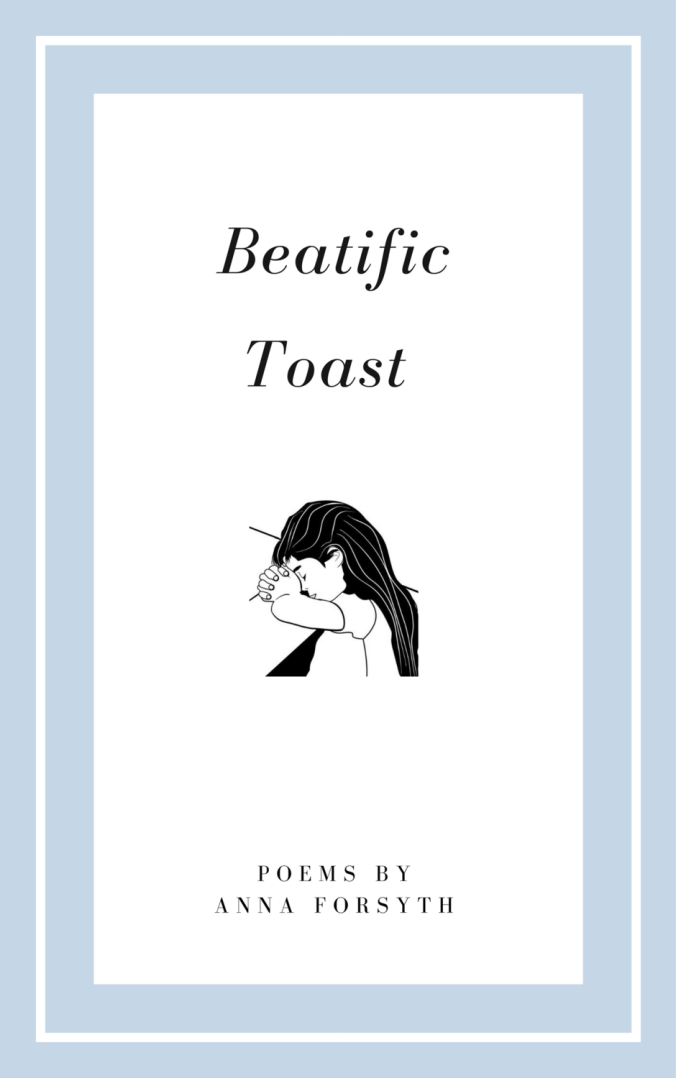
Anna Forsyth
is a writer and editor from New Zealand, currently living in NSW Australia. She is the founder of feminist poetry organisation, Girls on Key providing opportunities in publishing and performing for women and non-binary poets. Her work has appeared in journals online and in print and her latest poetry collection, Beatific Toast is available now.
https://www.girlsonkey.com/poetryportalshop
https://www.girlsonkey.com/poetryportalshop/Beatific-Toast-Anna-Forsyth-p106347890
The Interview
1. When and why did you begin to write poetry?
I never read or thought about poetry until my last year of university in Auckland, when I was playing a lot of music. I was asked to be the guest musician for a local regular night called Poetry Live and I was really struck by the art form. My first feeble attempts were more like bad lyrics, but I soon found that I loved crafting poems more than I liked song writing. That was in 2004 and I have been actively writing and performing poetry ever since.
2. Who introduced you to poetry?
If I look back now I can see that my mother is a poetry lover (and lover of literature in general) and I think that instilled in me a love of words. She loved James K Baxter, a New Zealand poet and we both share a mutual love of Wordsworth. I have a beautiful print of his poem, On Westminster Bridge that we purchased when we visited his house and the area in the UK on a family trip. It’s been a prized possession. She has also written small poems for me that are treasured. I have a running joke with her, because one of her dreams was to get up on a microphone and recite a poem and I asked her to do it once for my birthday. I still haven’t got my present. So I’m hoping that will happen one day. She is one of my first readers and I can hear it in her voice when the poem needs work and having her like my poem means everything.
3. How aware were and are you of the dominating presence of older poets?
I don’t find the older generation dominating at all in poetry. In fact, I wish there was more appreciation and respect between the generations. We can all learn from each other in so many ways and I think to discount any poet or their work because of their age would be a foolish thing to do. The Maori of NZ have a word for lineage or ancestry called Whakapapa and I think it’s important to acknowledge your genealogy as an artist of any type because it grounds you. It reminds you that you don’t have all the answers but at the same time, you realise how many people have taken the same journey before you. Hopefully we can learn from each other. I don’t believe in pitting generations against each other. It seems to be a distinction that people make in the poetry world. With the work I do with Girls on Key, that’s one of the things I try to directly combat, firstly to break some of the isolation that older poets encounter and secondly, to show the broad spectrum of what poetry is and can be. I think it’s vitally important in a day and age that glorifies youth and ephemerality.
4. What is your daily writing routine?
Journaling is an essential part of my life and has been ever since I was a child. It does something for my soul that nothing else can. I have to have a beautiful notebook and a pen and I am actually a ridiculous morning person, even though I haven’t always been getting up early lately. That solitude and personal time really makes a huge difference to my life in terms of my mental health and dealing some of the challenges of being an empath and sensitive, slightly introverted person dealing with lots of other similarly inclined people on daily basis through my work.
5. What motivates you to write?
When I have a philosophical idea or a problem that I’m gnawing at intellectually, writing is my go to. It’s my way of processing or allowing ideas to take shape and of finding a unique spin on whatever is on my mind. I have a very active imagination, so I use metaphor a lot to cope with navigating challenges. I’ll make up a story about it or transform it into something poetic that often has a slant to it. It’s an alchemical process that I’m really fond of. I was a very shy child who lacked confidence. Writing gave me a way to own my own unique way of viewing the world and to validate difficult feelings. It’s a great tool, that I highly recommend. I love that if you have a voice, a pen or even just your imagination, it’s something that anyone can take advantage of, regardless of their personal circumstances.
6. What is your work ethic?
My day job is editing, so I’m quite pedantic in re-writing and checking my work. That said, I trust my intuition to know when a poem is complete. I’m not one to keep adding to a poem or working on it for years, I think poems can get really overcooked that way. A lot of my poems have a brevity to them, which I’m fine with. Often, the kernel of the idea has already sprouted and germinated before I get to the page, as I only write when I have a seed that I know is interesting to me. It could be anything, from an image to a person’s quirk or a life experience and the subsequent fresh metaphor or creative slant. So when I get to the page, I’m just exploring that. Then there is a little ding and I just take it out of the oven and don’t keep going over it, for fear of ruining it or over-thinking it.
7. How do the writers you read when you were young influence you today?
I only ever read fiction really (and a lot of it) as a young person. It’s difficult to know how that has influenced my poetry. It definitely inspired me to write fiction, which I also do regularly and sometimes enjoy more than poetry, if I’m honest. There was one poet, a New Zealand man called Sam Hunt, who I think had an impact on my poets of my generation. He is a real character and he was popular in the 70s and 80s when poetry was having its democratic shift and moving out of academia and the halls of the elite and becoming more accessible. He made it look like fun. He also has a very idiosyncratic style of reading and a cheeky approach. It’s very endearing.
8. Whom of today’s writers do you most admire and why?
Many New Zealand poets are doing great work, especially Pasifika poets such as Karlo Mila, Serie Barford, Tusiata Avia, Grace Taylor, Courtney Sina Meredith and Selina Tusitala Marsh. There is something so spellbinding and I think quintessentially New Zealand about their work. I also love the way they combine performance and page craft.
I mostly connect with oceanic poets and I’m very inspired by poets working in Australia too, such as Anne Walsh, Robbie Coburn, Eileen Chong and Amanda Anastasia in particular. There are just too many incredible poets to name!!
Outside of Australasia I’m a sucker for the work of Dylan Thomas, e e Cummings and Wordsworth.
9. What would you say to someone who asked you “How do you become a writer?”
I don’t think you ever do. It’s a gradual process that unfolds as you start writing and keep writing, even when the end product seems ridiculous or others disapprove. I don’t really think of myself as a writer, I’m just someone who really, really enjoys writing. I think there are weird mythologies around what it is to be a poet or a writer (in quotes). When the idea becomes loaded, for example, you have to be an intellectual, or young, or drunk…anything that dictates what that should be, I think is a kind of distraction from the work to be honest. It can be difficult to untangle from cultural expectations though, as art goes through fads and fashions. With the younger generation currently, spoken word is equated with poetry and many wouldn’t engage with the written form. So it’s all about finding what you like and creating your own path. To me, that’s the most authentic thing you can do.
10. Tell me about the writing projects you have on at the moment.
I always have a lot on the go but I have a couple of film scripts I’m working on, a YA novel series and a new collection of poetry, The Unknown Great, for when I have enough fresh material. I have a radio play that has been finished for a while, but I’d love to take it off the shelf and have it produced at some point.
Three Drops from a Cauldron: Midwinter 2018
Honoured and privileged to have my poem “Bruised” and photo “Furrows” in excellent company in the Midwinter edition of “Three Drops From The Cauldron”. Many thanks to Kate and her editors.

Welcome to our final seasonal special at Three Drops from a Cauldron – the simultaneously icy-frosty, warm-and-cosy, comforting-yet-unsettling Midwinter 2018.
View original post 347 more words
AN INTERVIEW WITH POET LINDA E. CHOWN & A SAMPLER OF HER POETRY, PART II
More riches.

“Poetry refreshes who we are and opens our eyes. It is a second sight on all that we’ve known and done. It penetrates into the invisible world we don’t speak of often and thus can bring us together . . . Poetry is the biggest surprise. It can be our double, echo, enhance our solitudes and tell us how the world is in its mysterious questioning ways. Poetry is a beautiful agent of radicalism in all ways.” Linda E. Chown
In Part I – published yesterday – we served up two of Linda’s poems along with her interview. Today, we share six more of Linda’s poems. A rare and rich treat for all of us. Thank you, Linda Chown.
POETRY SAMPLER
Uncle Sasha
Dear Sasha. Great Sasha.
You were something very special.
In Moscow’s somber streets, flagellated
and smothered by summer’s heat
and simmering peat bog fires,
you in…
View original post 1,210 more words

