Excellence from Peach Delphine
Five Poems by Peach Delphine
Excellence from Peach Delphine
Wombwell Rainbow Interviews
I am honoured and privileged that the following writers local, national and international have agreed to be interviewed by me. I gave the writers two options: an emailed list of questions or a more fluid interview via messenger.
The usual ground is covered about motivation, daily routines and work ethic, but some surprises too. Some of these poets you may know, others may be new to you. I hope you enjoy the experience as much as I do.
Sue Kindon
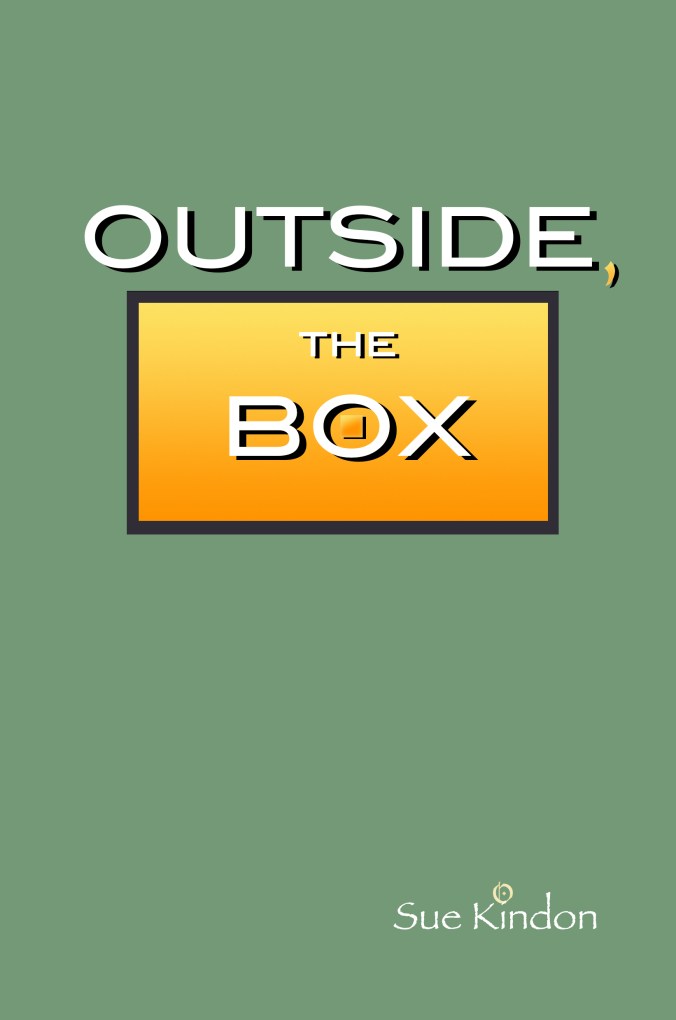
was born in Croydon when it was still in Surrey. She now lives and writes in the French Pyrenees, and helps run an online bookshop, Valier Illustrated Books, specialising in twentieth century and earlier limited editions. Her poems have recently appeared in Poetry Salzburg Review, Obsessed with Pipework, Picaroon, and Domestic Cherry. Her first pamphlet, She who pays the piper, was published by Three Drops Press in 2017, and her second, new from 4Word Press, is entitled Outside, the Box.
The Interview
1. When and why did you start writing poetry?
I’ve played with words and images for as long as I can remember. I have the notebooks from my teenage years, so I must have been writing things down by then, but I can’t place a particular trigger. Perhaps in response to discovering some great poems at school? We had a teacher who didn’t stick to the syllabus.
2. Who introduced you to poetry?
It would be that same teacher, Barbara Davies.
3. How aware are and were you of the dominating presence of older poets traditional and contemporary?
Do you mean, was I aware of the wealth of poetry that is our heritage? In which case, yes, because that was what I discovered at school. I didn’t go to any readings until I arrived at university, in fact poetry readings barely existed. All that has changed dramatically, with the growth of poetry and literary festivals as well as the Internet, which has put us all in touch with each other and means there is instant access to the writings of contemporary poets, great and small.
4. What is your daily writing routine?
I imagine it to be that I am woken by the alarm every morning at 6.30. I sit at my desk (which belonged to my mum) and set pen to paper for 2 hours before breakfast. I really did do this every day for some years, but now it probably happens 2 or 3 times a week if I’m lucky. These days, I’m more likely to compose poems in my head, as and when. If I can still remember them 24 hours later, they’re probably worth writing down. If I’ve managed to get up early and don’t feel like writing poetry, I read it.
5. What motivates you to write?
I take motivation to mean why I write. It’s a hunger, although I don’t always have the appetite for it. It’s an urge to put into words a fraction of the amazing sensations that bombard me, and to offer them unconditionally. It’s a fascination with pushing the language to its limits and playing with it to make new connections. It’s the satisfaction of being part of the word soup that is poetry and seeking that dash of magic that means the next poem could just be the best one ever.
6. What amazing sensations.. bombard you, and why?
Just everything about opening your senses to being alive. If you can quieten yourself enough, there is a wealth of stimuli out there.
6.1. So it isn’t contemporary political or social issues rather what stimulates your own senses?
They are the context, and because I’m not a total hermit, they influence my writing. I wouldn’t set out to write about a particular issue, but I might be jolted into doing so by a phrase used by a politician, for example, or by witnessing an incident.
7. How do the writers you read when you were young influence your work today?
I’m not aware of how those writers influence my work, although I’m sure they do. I hope my style is my own. Those I admired when I was starting out include Shakespeare, Blake, Keats, Yeats, Louis MacNeice, T S Eliot, Sylvia Plath, and Ted Hughes. I dismissed the work of Philip Larkin at the time, but I’ve now come to appreciate his direct diction and accessibility. I was delighted to discover the imagery and voluptuous language of Baudelaire, and the risks taken by Rimbaud in both form and subject matter.
It’s a tall order to put all that in a nutshell, but here goes: –
Shakespeare – mastery of the sonnet form, richness of language, imagery, conceits.
O, learn to read what silent love hath writ:
To hear with eyes belongs to love’s fine wit.
Blake – Songs of Innocence and Experience – the power of contrast, simplicity, song-like quality, use of symbols, mysticism.
To see a World in a Grain of Sand…
Keats – rich descriptions, the sensual imagery of the Odes.
…With beaded bubbles winking at the brim.
Yeats – awareness of fragile beauty, lyricism, Celtic twilight.
Come away, O human child!
To the waters and the wild
With a faery, hand in hand,
For the world’s more full of weeping than you can understand.
Louis MacNeice – for Prayer before Birth, probably the poem that grabbed me most, with its bold voice and urgent rhythm. I’ve just read it again, and I still love it.
Let not the bloodsucking bat or the rat or the stoat or the
club-footed ghoul come near me.
TS Eliot – innovation of form, echoes of other works,
At the still point of the turning world.
Sylvia Plath – hooray, a woman. Plain speaking, bold imagery and subject matter.
Dying
Is an art, like everything else.
I do it exceptionally well.
Ted Hughes – observation of nature, constructing a feral world with imagery (especially the sequence that is Crow) and always with an awareness of the music of the poem.
With draped manes and tilted hind-hooves,
Making no sound.
I passed: not one snorted or jerked its head.
Grey silent fragments
Of a grey still world.
All these poets share an honesty of approach, and an, attention to how the poem sounds that I greatly admire (which was probably the answer you intended, Paul, rather than a survey of my cherry-pickings of English/Irish literature, but I’ve rather enjoyed doing it).
8. Whom of today’s writers do you admire the most and why?
Jacob Polley is my poetry hero: musical, using unexpected imagery to great effect, creating a dreamlike, sometimes nightmare-like world that hovers between nature and human encroachment, with all the emotions that tension plays out. Alice Oswald, for a fresh approach and a tremendous sense of rhythm. Michal Symmons Roberts for his quiet lyricism and gentle spirituality. Antony R Owen for taking on political subjects, especially war and oppression, so well that I don’t have to, because he’s done it for me (and how). Paul Muldoon for his weird take on things and for his delight in playing with the language. Billy Collins for his humour.
9. What would you say to someone who asked you “How do you become a writer?”
You give yourself permission to write. You write. You think How would I write this? You experiment. You have to be prepared to ditch the rubbish that will result, and to face the criticism when you put your work out there. And you read, to see how the writing is done and to feed your imagination.
10. Tell me about the writing projects you have on at the moment.
I’m resting at the moment, after recently completing a pamphlet. Having said that, I’ve already started translating those poems into French, as I would like to bring out a bilingual edition.
11. What inspired you to write Outside, the Box?
The comma in the title Outside, the Box is all-important, because the starting point for the poems is ostensibly the box-moth plague that ravaged this part of France last year, destroying both native and garden box bushes.
12. How important to you is the use of space in your poetry on the page?
Very. The white space equates to silence. I am interested in how this looks on the page and how it sounds (or doesn’t) when the words are read aloud. In my recent pamphlet I would say I’m always aware of this, and several poems have shaped themselves in unconventional ways as a result.
13. Among the themes in your book, I find one the humorous militaristic description of nature such as “hornet police”, and with sometimes off hand sometimes full on descriptions of Christian church-going.
I’m interested that you interpreted hornet police in that way, as I rather thought they were police helicopters, but either way, they are a threat.
I’m not surprised you spotted a religious theme, as I was brought up in a very Christian household. You are probably referring primarily to the poem Excommunicado ,which I wrote when the words of The Lord’s Prayer were modernised. I acknowledge that there is a spiritual aspect to my writing, but it isn’t exclusively Christian. I’m more of a pantheist.
14. Bathing in water in these poems seems to provide you with peace and solace.
There is definitely a search for peace and solace going on, and some watery images. The poem Learning to Swim is probably about trust. I often dream about water.
15. How important is it to have humour in your poetry? I am thinking of Outside The House Of Running Water.
I never start writing with the intention of being funny, but quite often things turn wry. Also, I am overblessed with a sense of the absurd. In the poem you mention, it is the voice of the speaker in an absurd situation that raises a dry smile, I think.
16. Your wry humour comes over in the poems where you contemplate the death of humankind. I am thinking of Eve and The Ultimate Green Thought.
The Ultimate Green Thought is jokey despite its serious subject matter. I’m not so sure about Eve – I feel that she makes a rather more serious statement about the catastrophic state of things, but that some hope is offered by the ending. I guess that might raise a smile.
Excellent post.

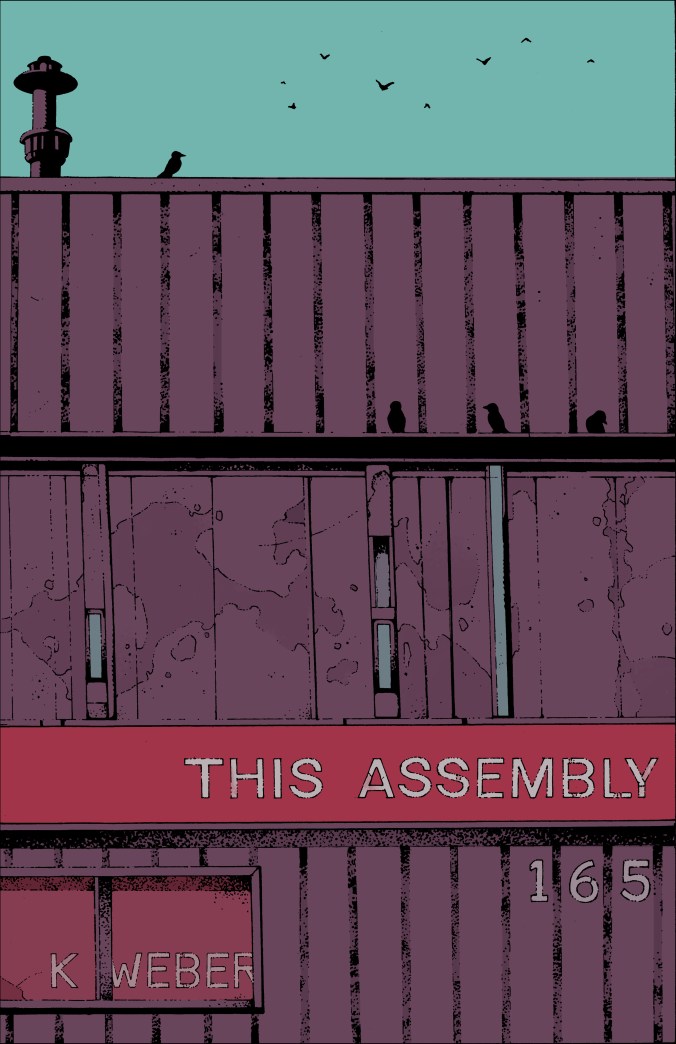
THIS ASSEMBLY is a collaborative poetry project. I wrote 21 poems using 160 words donated by 160 people. Additionally, there are bonus poems featuring other poets’ writing, unique additions to poems, poets reading their work in the audio, and more! Project was reviewed by a team of readers. Cover and interior art by Greg Lawhun incorporated color palette that won a poll open to the public. In total, 165 people participated in my latest effort!
Wombwell Rainbow Interviews
I am honoured and privileged that the following writers local, national and international have agreed to be interviewed by me. I gave the writers two options: an emailed list of questions or a more fluid interview via messenger.
The usual ground is covered about motivation, daily routines and work ethic, but some surprises too. Some of these poets you may know, others may be new to you. I hope you enjoy the experience as much as I do.
Sarah Cave
is a writer and academic living in Cornwall. She is currently working on a practice-based PhD on the Poetics of Prayer at Royal Holloway. Sarah has published two pamphlets and an illustrated chapbook, like fragile clay, published by Guillemot Press. She has published two collections of poetry, An Arbitrary Line (Broken Sleep Books) and Perseverance Valley (Knives, Forks and Spoons Press) as well as a third, co-authored, collection A Confusion of Marys (Shearsman), forthcoming in February 2020. Sarah’s poetry and prose has been published in numerous journals and anthologies including Oxford Poetry, Poetry London, The Stand, Shearsman and Datableed.
The Interview
1. What inspired you to write poetry?
I started writing poetry while I was studying for an English with Creative Writing degree at Falmouth University. I was a mature student looking for my identity as a writer. I’d been writing notes and fragments toward poetry for years, but it took the degree, and the clearing that enabled, to work it out. While at Falmouth, I had time to develop a writing practice and focus on diversifying my influences. I can’t even begin to stress the importance of this ‘time to write’ and ‘time to discover’ aspect of academic creative writing.
2. Who introduced you to poetry?
I guess my mum would have been the first to read me poetry. Church & Sunday school would have been an early influence; psalms, hymns, Song of Songs etc. I’ve had lots of helpful input from people, my partner and I are constantly discovering and sharing new writing and my MA tutors and PhD supervisors have helped to diversify my reading. My undergraduate dissertation supervisor, Rupert Loydell, has always been very generous with his time, knowledge & vast book collection. One thing I love about poetry is that there is always more to read!
3. How aware were you of the dominating presence of older poets?
I’ve been largely untouched by this, but I think it can be a problem in poetry. I’ve mostly had good experiences with writing mentors and tutors. If you don’t agree with something someone’s suggested, you don’t have to do it; you need to know when to push back. Sometimes this is more of a problem when it comes to gatekeeping but, really, if an editor wants you to change something beyond recognition then that’s not the right place for your writing. Of course, that’s easier said than done when it’s such a touch publishing environment and even more people are writing and wanting to be published.
4. What is your daily writing routine?
I usually write & read for at least 6 hours a day, but always after coffee and a stroll with the dog.
5. What motivates you to write?
Honesty, clarity, critical exploration and, most importantly, a need for play.
6. What is your work ethic?
I’m both lazy & relentless. I don’t do much else other than writing, reading & making books, so I manage to be productive, but I do enjoy a good dawdle & a daydream along the way.
7. Who of today’s writers do you admire the most & why?
Susan Howe, Cole Swensen, Peter Larkin, Holly Pester, Luke Thompson, Callie Gardner, Thomas A. Clarke, Jen Hadfield & Luke Kennard all do something I consistently enjoy. They all take risks, but I think that list is eclectic in output. I’m constantly reading new people & enjoying poetry, non-fiction & prose. I want to mention more poets like Vahni Capildeo, Daisy Lafarge, Maria Sledmere and Colin Herd. Gosh, there are so many. There’s so much good writing being published, mostly by small presses. As an editor of a small press, I love supporting other presses and I feel like I’m part of a broader writing & publishing community through social media, readings & being on the edge of the creative writing programs at Royal Holloway & Falmouth.
9. Why do you write, as opposed to doing anything else?
Writing seems urgent to me. It’s an action that has the potential to change things. Also, I’m not sure I’m good at anything else.
10. What would you say to someone who asked you “How do you become a writer?”
Listen to other writers. Always be kind.
11. Tell me about the writing projects you have on at the moment.
I’ve just published a book about the Martian Rovers, called Perseverance Valley (Knives, Forks & Spoons Press). My latest book, A Confusion of Marys, is a joint effort with the poet Rupert Loydell. My contribution to the collection is called ‘An Autophagy of Mary’, which means ‘the self-eating of Mary’ & signals some of the regenerative dialogue around Mary.
I’m currently working toward a practice-based PhD on the poetics of prayer & this includes material that will become my third poetry collection.
Loved this
Loving the Alien
Scales sliding over her heel wake her.
She springs to her feet, the snake scarpers.
The stars are molten silver chrysanthemums,
grains of light on the liquid mirrors of her eyes, widening under heavy, hominid brows.
View original post 932 more words
Felt this.
when i squeezed the bits of soap together
to one lump
i thought of you
doing it too and
realised what may be the reason why
besides
saving soap and money obviously
yesterday we talked about the war
the rationing that i with my ignorance
only learned about much later
may have become your way of life
derived from many sources
then we spoke of the amputees
the trouser leg fixed up with
a safety pin

Brief, but possible.
i watched the film.
after.
i check the mirror to see if things still look the same.
night will fall.

Wombwell Rainbow Interviews
I am honoured and privileged that the following writers local, national and international have agreed to be interviewed by me. I gave the writers two options: an emailed list of questions or a more fluid interview via messenger.
The usual ground is covered about motivation, daily routines and work ethic, but some surprises too. Some of these poets you may know, others may be new to you. I hope you enjoy the experience as much as I do.

Venus Davis
is a 21-year-old queer writer from Cleveland, Ohio. She is the editor in chief of the Periwinkle Literary Magazine. She is also a former poetry reader for Random Sample Review and a podcaster for Prismatica Magazine. Her work has been featured in Marias at Sampaguitas, Royal Rose Magazine, Ayaskala, Dream Noir, Crepe and Penn, and many other publications. She is the author of Sensitive Divination, an astrology microchapbook as well as the microchapbooks, Blue and @ngel number(s).
You can find her on social media
@venusbeanus.
The Interview
1. What inspired you to write poetry?
I was inspired by the works of Maya Angelou, Shel Silverstein, and Edgar Allan Poe. I was also inspired by those around me and frankly, the feelings that came from having many undiagnosed mental illnesses.
2. Who introduced you to poetry?
I was introduced to poetry by Cynthia Larsen, of Lake Erie Ink. She is my best friend’s mother and a teacher in the Cleveland area. When I was in the third grade, she taught my class about poetry. After years of writing fiction, I was intrigued by this new form that I’d never heard of or dabbled in.
3. How aware were you of the dominating presence of older poets?
Very aware. There was a sense of the youth poetry scene blooming in my hometown but at the time there weren’t many opportunities for us younger poets. Lake Erie Ink was pretty much the only resource available and it was amazing, don’t get me wrong. However, I wish that there were more opportunities available for young writers to succeed.
4. What is your daily writing routine?
Usually I work on as much as I can per day. Currently, I’ve been primarily freelancing as I look for a full time job. So, my entire day is dedicated to writing. I wake up at around ten a.m and I start working on editorials and then after I write about 2,000 words, I start working on my WIP, which is a full length of sad poetry. I’m currently in the editing phase. So, I edit about three poems per day from my WIP.
5. What motivates you to write?
My writing heals me and it’s the only thing that has ever helped me grow as a person. Writing down my thoughts, feelings, and desires has changed the way that I look at the world. It’s almost like everything I write is a diary entry and the only difference between my poetry and my actual journal, is what I will allow others to read. So, writing for me is a chance to grow and a chance for others to relate to my work and grow as well. I also love the research that comes writing. Being able to learn new things while creating something new is a feeling unlike any other. The thought of it motivates me secondarily to growth.
6. What is your work ethic?
I’d say my philosophy behind work is that I try to work as hard as I can and do as much as I can per day. That’s what happens when you’re a capricorn, you just have no off button when it comes to work. I’m a complete workaholic when it comes to writing. Back when I worked first shift at a fast food place, I’d get home around four p.m. and just write and talk to other writers on twitter until around two or three a.m. Though, I definitely do not condone this behavior! A lot of this is also due to my ADHD diagnosis in that doing work immediately enhances the chances of it getting done whereas if I put my work off until later, I am likely to get overwhelmed and procrastinate even more.
7. How do the writers you read when you were young influence you today?
I find myself wanting to write little bits of humor in my poetry like Shel Silverstein had. I’m often drawn to darker imagery like Edgar Allan Poe. In fact, I had an entire phase where I tried to write gothic lit just to be like him. When I write about my body in my poems, I always channel a bit of Maya Angelou’s energy in Still I Rise – that kind of confident, black girl magic, no fucks given attitude.
8. Who of today’s writers do you admire the most and why?
Franny Choi! Not only is she a woman of color and amazingly talented, a wildly iconic duo. She is queer and she writes like she has no fears. I also love the amount of research that went into her collection, Soft Science. I want to be a writer that is unapologetically me and writes like so. Someone who can implement research in their writing without it being confusing or read like an eighth grade research paper. She also wears many hats which I greatly admire because I know how difficult it can be to work many jobs as a writer. Yet, she just seems fueled by her love for writing and that is so important. I come from a long line of people who hate their jobs and that’s all they say about work. So, to see a writer be so immersed and so in love with her craft, it’s admirable and I can only hope to continue to love my craft as much as Franny Choi does.
9. Why do you write, as opposed to doing anything else?
Writing is literally all I can do. I used to play Violin and Viola as a kid and it never once crossed my mind to be an instrumentalist. I tried to be a singer and I tried to be an actress but they just felt wrong. I absolutely loved performing but there was just something missing for me. I took about a two year break from taking my writing seriously and during that break, I felt like I had broken up with a partner of ten years. Literally because I had been writing since I was about nine, I basically had broken up with a partner of ten years. When I came back to writing, I worked harder than I ever had before. I started to pursue writing as a career other than what i thought it was at the time – a commitment to a quiet life backstage. Working on my first book really brought me back into the writing world in a way that I had never experienced before. It was so necessary for me, like a spiritual awakening but with my writing career. So, in short, I write because it’s what feels right. I write because it’s my calling.
10. What would you say to someone who asked you “How do you become a writer?”
I would say that you work hard to find your corner of the community, you write as much as you can, submit to journals, and don’t forget to make friends along the way! Take part in as many opportunities as you feel comfortable with because learning opportunities are the most valuable. Even if you don’t submit your writing anywhere, just continuing to write as often as possible is extremely important. Any opportunity to further your craft is one that you should take.
11. Tell me about the writing projects you have on at the moment.
Currently, I am working on a full length book tentatively called, Human Waterfall. It’s a bunch of sad girl poetry about being a twenty something year old navigating the scary adult world. I’m also working on releasing an extended version of my astrology chapbook, Sensitive Divination. In the extended version, I plan to explain the process behind writing each poem and the astrological references/meanings in certain lines. I’m also working on releasing a chapbook of poems about the phases of the moon and gemstones. So, be on the lookout for that!
Wombwell Rainbow Interviews
I am honoured and privileged that the following writers local, national and international have agreed to be interviewed by me. I gave the writers two options: an emailed list of questions or a more fluid interview via messenger.
The usual ground is covered about motivation, daily routines and work ethic, but some surprises too. Some of these poets you may know, others may be new to you. I hope you enjoy the experience as much as I do.
Michael H. Brownstein
has had his work appear in The Café Review, American Letters and Commentary, Skidrow Penthouse, Xavier Review, Hotel Amerika, Meridian Anthology of Contemporary Poetry, The Pacific Review, Poetrysuperhighway.com and others. In addition, he has nine poetry chapbooks including A Period of Trees (Snark Press, 2004), Firestorm: A Rendering of Torah (Camel Saloon Press, 2012), The Possibility of Sky and Hell: From My Suicide Book (White Knuckle Press, 2013) and The Katy Trail, Mid-Missouri, 100 Degrees Outside and Other Poems (Kind of Hurricane Press, 2013). He is the editor of First Poems from Viet Nam (2011). His book, A Slipknot Into Somewhere Else: A Poet’s Journey To The Borderlands Of Dementia, is published by Cholla Needles Press (2018). He presently resides in Jefferson City, Missouri where he lives with enough animals to open a shelter.
The Interview
1. What inspired you to write poetry?
In elementary school, I began writing silly rhymes for no reason at all—mostly around the holidays, but in high school a Ms. Perkins—my history teacher—encouraged me to write because she liked the way I experimented with the essay form. At one point every sentence in any essay I handed in could not be more than five words. She thought it would be interesting to see if I could write poetry. I did, thought my stuff was OK—it really wasn’t—but I found I actually liked writing—so I kept on and on and now it’s many years later and I’m still writing.
I don’t remember, but I do remember Ms. Perkins and Archie Lieberman who thought I was creative enough with my short stories—in retrospect were not very creative or very good—to write poetry—and he liked my work enough to take them around with him when he was doing high profile photojournalism stories for magazines such as Look, Life, and Playboy. Of course, those editors knew my work was not that good, but I kept on writing mostly for myself until I fell playing hockey in my thirties, found myself in traction and then in bed rest bored out of my mind. That’s when I became serious, started writing better and began sending stuff out. FactSheet 5, (a magazine that listed hundreds and hundreds of zines, journals, and books with simple one to two paragraph reviews) was around back then and I used it as my go to reference to submit work.
I always liked Mary Oliver. Read everything she wrote. Rita Dove is another poet I admire very much. Carolyn Forche because, well, because she’s Carolyn Forche. I always admired Henry Wadsworth Longfellow and Robert Louis Stevenson.
I write every day for about an hour, usually in the morning, and then come back to poems I wrote earlier in the day, months, even years, and make revisions in the evening.
I feel I have something to offer. Sometimes I write just to write, other times I have a particular audience in mind, other times I feel I have something important to say and so I say it with poetry. I have a series coming out, for example, on the blog of Moristotle (https://moristotle.blogspot.com/), for example on reparations. I wrote it for African-American history month. Here’s a sample stanza:
If we go another thirty miles over, we arrive in Columbia,
a lynching–there were more in Missouri, many more–
and this one was no different–James Scott was lynched
as more than a thousand white bystanders looked on–
and he was innocent–the real rapist discovered after the fact–
too late again–and no whites paid for the crime–
Do we not owe Scott’s family reparations? A sincere apology?
I submit to a publication every other day throughout the year. I never miss a day. I go to two poetry programs to workshop my poetry—and I am the co-host of the local library’s poetry program.
I spend every day with some writing exercise. No exceptions. I also carry around a notebook if an image hits my fancy.
Here’s an image that came to me when I saw the sunlight come out behind gray clouds and light up a field along the highway:
We knew each other by the spotlight on wild flowers,
the bath of prairie sage and the colors blue and green,
Later, I turned it into a longer poem utilizing the first line at the beginning of each stanza.
I don’t rhyme too often, but when I do I look back to the work of Longfellow. He is still stuck in my mind. I even have one of his volumes in one of my boxes in the attic to this day—along with more than a hundred other poets—but he’s the one I remember.
Safia Elhillo. She writes with a power that is incredible. Her poem “Girls That Never Die” is so brilliant, when I reread it—and I do reread it—I have to take deep breaths because this poem, for example, is that deep.
Martin Espada is another contemporary poet. When he wrote about the hurricane that took out Puerto Rico, you were there. You felt the pain of the people. You became one of them. He has a way with line and image that is just magnificent.
Then there’s June Jordan whose political poetry is made of magic.
Then there’s Carolyn Forche who’s book, Twentieth Century Poetry of Witness, inspired me to write an e-book, Firestorm: A Rendering of Torah (http://booksonblog35.blogspot.com/).
And, of course, Mary Oliver who recently passed away and Rita Dove.
I write because it makes me happy; it’s the most satisfying thing I do now. I used to teach in the inner city of Chicago. That was the most satisfying thing I did. I’m retired now. Writing has taken its place as most satisfying.
Write. Write what you know. Write what you want to know. Just write.
Put it in a drawer. Take it out days, weeks, even months later and read it again.
Revise. Revise. Revise.
I tell individuals who want to become writers to worry about audience and publication after you have what you feel is a completed work. Even then I invite them to workshop it with one of the groups I am in.
I also tell them it doesn’t hurt to read a lot of poetry.
I’m working on a book of prose poems and poems, The Tattoo Garden of Capella. So far I’ve revised it twenty times or more, but I keep coming back to it. It’s about a place that is magical and safe, a place full of color and love. At one point, dangerous people enter the garden only to have poetry destroy their weapons.
I’m also hard at work on a prose poem that’s rather long. In it, a poet with writer’s block gets help from a very eccentric man who sounds more like as tuba than a human being:
The odd looking man looked at him as if he had never seen him before—and perhaps he had not—and answered with soft moans, climatic yelps, silence, the sound of a tuba, and then an oomph. Ahh, he said, and then ohh. He paused. The rent is paid up, you know, but a long time ago I lost my way in…