
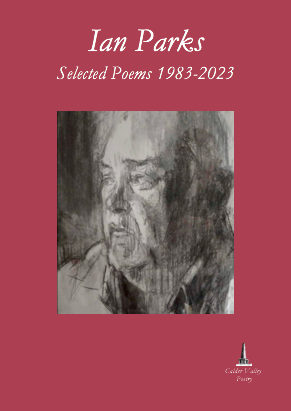
Ian Parks
was born in 1959 in Mexborough, South Yorkshire where he still lives. His collections include Shell Island, Love Poems 1979-2009, The Landing Stage, and The Exile’s House. He received a Hawthornden Fellowship in 1991. His poems have appeared in Poetry Review, The Times Literary Supplement, Modern Poetry in Translation, The Independent on Sunday, The Observer, and Poetry (Chicago).
He was writer in residence at Gladstone’s Library in 2012 and Writing Fellow at De Montfort University, Leicester, from 2012-2014. He is the editor of Versions of the North: Contemporary Yorkshire Poetry. Citizens is published by Smokestack Books.
Here is a link to the 2018 general interview I did with Ian:
Wombwell Rainbow Interviews: Ian Parks
Selected Poems can be purchased here:
Selected Poems (1983-2023) – Ian Parks
The Interview
Q:1. How did you decide on the order of the poems in your Selected Poems?
I felt there were two options open to me: either I attempted some sort of thematic approach or published them in chronological order. In the end I decided against grouping them broadly in themes because that didn’t really demonstrate any development or change over the forty years that the Selected covers. I’ve published eight collections of my own work in that time (excluding three pamphlets of Cavafy translations) and the selection follows the order in which they appeared. Within that framework I tried, wherever possible, to arrange the poems by order of composition rather than publication. Not including the Cavafy poems freed up some space for me to include about twenty new and uncollected poems at the end which brings the whole thing up to date. It was quite an experience – a bit like a drowning man watching the whole of his life flash by. And it’s true to say my life is in the poems; that this Selected is my life.
Q:2. How did you balance the two strands of love poetry and political poetry in the collection?
I started out as a love poet – although it was never my intention to write conventional love poems. I wanted to use the intimate address of a love poem to explore other issues too. I guess my main model in attempting this was a poem like Ly Your Sleeping Head by Auden which begins as a poem about the fragility of romantic love and ends up by saying something profound about human relationships generally. I’ve always been concerned as a poet with ideas of social justice. There’s not a clear dividing line or a point where I stopped writing love poems and started writing political poems – they merge into and hopefully reinforce each other. I wanted to revisit specific places and events which resonate within the national consciousness. Or to introduce them even to a readership that is becoming less aware of our common heratage: the Levellers, the Chartists, and the Trade Union Movement. A poem like Sky Edge tries to subsume the political into a love lyric.
Q:3. How important is poetic form in your collection?
Form is always important. It’s what makes poetry distinctive. I like to think of my poems as being informed by form rather than using it in an obvious way. So you won’t find any sonnets or other obsessive forms in the Selected – but you will find the inner workings of rhythm and rhyme which are integral to them. I think that rhythm especially is inseparable from the poem – it’s the lifeblood really and what makes one poem distinctive and distinct from another. Form is something J had to work hard at early on and I think some of the earliest poems bear evidence to that struggle. At one point I did consider revising the early poems but in the end I decided to let them stand. I was proud of them when I wrote them and if I started meddling now it might never stop!
Q:4. Most of the poems that combine love and politics move from personal to public. How deliberate is this?
All poetry, in a sense, is public poetry regardless of how private the subject matter might be. We imagine a love poem to be somehow less private than a political poem because it deals with an intimate situation – but it becomes public the moment it’s shared. But I do know what you mean. My poems aren’t concerned with politics so much as social justice – or injustice. I try to avoid polemics although it is a difficult thing to do. I like to think that the love poems helped me to arrive at a point where I can write a public poem that retains the intimacy of a private one. But there’s always a challenge and there always has to be. Poetry arises out of tensions within ourselves and those tensions will find a language eventually. When I sit down to write a poem I try to resolve those tensions. I hope the Selected shows a clear line in that regard. It’s not as if I suddenly stopped writing love poems in order to write political ones. The last poem in the book, Mermaid’s Hair, is nothing if it isn’t a love poem.
Q:5. Light is often “fading” or “diminishing”, especially towards the ends of your poems. Why is this?
I’m aware that my poems are intensely visual – and it’s very perceptive of you to pick up on an aspect of that. I read ‘light’ as ‘insight’ in my poems and physical shifts of light often correspond with intellectual or – more often – emotional ones. Moving into or out of light is a powerful notion. And yes, it does occur at the end of poems as something that is fading or disappearing. I’m very sensitive to the shifting quality of light as a person so it’s not surprising that it crops up so often as a metaphor in my poems. But as a metaphor for what exactly I’d be at a loss to say.
Q:6. What importance do you put on describing a sense of place in your poetry?
Place is very important. Whether we’re poets or not it’s impossible to separate an event from the place where it happened or to extricate an emotion from that place. This is why we so often associate a poet with the place they I’ve and wrote in. Think of the great sequence of elegies that Hardy wrote about his wife all of which are set in and around Boscastle. It’s clear that Hardy was unable to write about Emma without returning to the places where they discovered their love for each other. Landscape is important to all art forms. It informs them at a very deep and fundamental level. In my historical, political poems I try to identify locations such as Cable Street, Blackstone Edge, and Marston Moor where what happened there is still imprinted in the air. So yes, place and landscape feature strongly in the collection, binding the poems together.
Q:7. In the launch you mentioned the poetry of Robert Graves and Edward Thomas. How much of an influence do you think these poets have been on your poetry?
I could also have mentioned Elizabeth Bishop and Thom Gunn because they’ve been an abiding influence also. I read Graves and Edward Thomas in my teens, just as I was starting out and trying to find a voice. Graves was still alive and writing then but was and still is, to some extent, unfashionable. But I wasn’t interested in writing fashionable poetry – only poetry that was true. And it seemed to me that there was something about Graves that was authentic, even though some of the ideas he explored in The White Goddess were questionable and controversial. He made a very strong case for the importance of poetry in the world in that book but also in his own example as a poet. He was easy to admire and still is. Edward Thomas, I think, is the better poet although comparisons aren’t really possible with two highly distinctive and idiosyncratic writers. In a practical sense Thomas showed me the way clearly in his approach to form. I was fascinated by the fact that he’d been a prose writer for most of his life and only turned his hand to poetry a couple of years before he died and at the urging of his friend, the American poet Robert Frost. Frost encouraged him because he detected in his writing and sensibility a true poet. Thomas often walks a very fine line between prose and verse, and his poems are undemonstrative but deep, conversational and yet exquisitely shaped. But both Graves and Thomas were mavericks and pursued their own calling. I think the death of Thomas in the Great War at the age of thirty nine was tragic in more than one way in that it robbed us of an outstanding poet. Influences are interesting aren’t they?
Q:7.1. How would you say Elizabeth Bishop and Thom Gunn have influenced your writing?
Elizabeth Bishop, one of the finest American poets of the twentieth-century, because of her way with free verse; the way you can trace the trajectory of the poem as it creates its own possibilities out of the natural rhythms of the speaking voice. A poem like The Fish would be a good example of this where she allows the images to speak for her without any attempt to describe or direct the reader. Thom Gunn moved to West Coast of America in the late 1950s when he was still a young man and never came back to the UK. It was partly a lifestyle choice and partly due to the openness of the poetry establishment in the US to new and experimental forms. He had very little in common with the Movement poets in this country. I’m confident that Gunn’s reputation will grow with the passing of time. He’s a very ambitious poet, both formally and in the (often controversial) subjects he chooses to address. I read him all the time.
Q:8. What is a “true poet” to you, what is “true poetry”?
Difficult one. a true poet is someone who isn’t influenced by fashion; someone who listens to the rhythms of their own heart rather than to what’s dictated by the poetry establishment. The current prize and competition culture has done a lot to draw attention to poetry – but it’s also done a lot to damage it. Poets are hurtled into the limelight, promoted vigorously, and then neglected as the search for the next new name begins. True poetry gets written despite all this, and often as a way of raging against it. Poetry is an art form and not a commodity. It can’t be marketed. But you can be sure that the real thing will always surface.
Q:9. How much is a “selected poems” an autobiography?
I suppose that depends on how much the poet is concerned with the events of their life – by which I mean the events of their inner life as well as the things that occur around and influence them during their lifetime. As time has gone on and I’ve accrued a substantial body of work to look back on I’ve come to realise increasingly how heavily I’ve leaned on my own life in writing the poems and just how autobiographical they are. So, for instance, the poems about the Miner’s Strike are both autobiographical and political at the same time because my father was involved in the struggle (as was I to a lesser extent) so it would have been impossible to separate them out even if I’d wanted to. And so there are poems about my grandfather who was wounded on the Somme and my mother and son. All the inextricably links to ourselves and the world that are formed by simply being human. Having said that, the autobiographical strand you might detect only became evident as a strong theme when I was going through the process of deciding which poems to include. I have an accute sense of the past and I’m sure it informs everything I write. In a sense, the widest possible sense, all the poems are autobiographical. As my publisher Bob Horne pointed out to me ‘this collection is your life’ – and he was right.
Q:10. Why is historiography present in your poetry?
Because it is present in my life. I’m aware of the strands that connect me with the past, and the way those strands come together in the present moment. When I say I’m passionate about history I don’t mean the history of the rich and powerful – although they have shaped the world we live in by their greed and violence. I mean the history of the ordinary people who are our ancestors; the people wh0’e been largely forgotten but whose voices still resonate today: the Diggers, the Chartists, and the Levellers. It seems to me that poetry is a powerful way of rediscovering and articulating their voices. That’s why I’m currently engaged in editing an anthology of poetry written by members of the Chartist movement, due shortly from Calder Valley Poetry. My long poem, Elegy for the Chartist Poets tries to explore this interface imaginatively.
Q:11. Why do you prefer narrative to imagistic poetry?
I think it’s something to do with the way my mind works. I think in pictures – a person, a landscape, a particular location – and the poems grow out of the sequence in which they’re placed within the poem. I do sometimes write narrative poems. Something like The Figurehead would be a good example. But, if I’m anything, I’m a lyric poet by sensibility and inclination. The poems tend to bring together ‘lyric episodes’ into a bigger fame – a frame which the narrative provides. None of this happened by design though – but through serendipity and accident. I’d like to think the Selected Poems shows the trajectory of this development. Needless to say, I don’t understand it fully myself – but all that is part of growing as a poet.
Q:12. What is your preferred point of view in your poetry, first, second or third person?
First person mainly, but that doesn’t mean the first person speaker is necessarily me. First person sets up the expectation of intimacy, that the speaker is telling the truth. It is, for me, the natural place to start if you’re writing a love poem. I like to think that the intimate address, ‘you’, encourages the reader to listen in to a conversation and to be complicit in it. Poems happen when the reader engages. I always try to make my point of view or, more broadly speaking, my point of empathy, one that draws the reader into this complicity. I try to express complex ideas or emotions in a language which is lucid and accessible. Giving readings of my own work helps to in that it makes me think seriously about engagement. You want to be accessible but you don’t want to insult the hearer’s intelligence either. It has to be a collaboration.
Q:13. How would you describe the “collaboration” between poet and page, page and reader, poet and live audience?
Q:14. Once they have read the book what do you hope the reader will take away with them?
The sense of a whole life lived through poetry – by which I mean a life where sensitivity to the possibilities inherent in language is recognised, respected, and cultivated. Of course you don’t have to be a poet in order to live that kind of life. I would like the reader to feel as if they’ve been deeply engaged with the imagination and experiences of another individual. If the readers come away with that I will be happy and have done what I set out to do.








 The Wombwell Rainbow