In this vital pamphlet, Hannah Hodgson, who lives with a life-limiting illness, addresses disability, hospitalisation, and isolation at a time when the disabled and unwell are frequently treated as voiceless statistics.
With no romance or affectations, this pamphlet painstakingly examines what the ill want from the well. One often reiterated wish is for no self-pity; a demand of able people to not ‘hijack tragedy’ with their tears. In ‘Dear Visitors’, the speaker has ‘become a tiger’ and the ward ‘a zoo’, who asks of those who have ‘paid their entrance fees at the nurse’s station’: ‘Don’t maudle, as the captive here that’s my job.’ The speaker goes on to tell the visitors to be themselves, ‘Reveal a little / of your flesh, trust I won’t rip you apart.’ – to bring the things that the speaker loves into the sterile clinical setting – ‘Talk of the wild, talk of home’…
You got up by yourself this morning, put on your own knickers, said you fancied eggs and bacon.
You went outside – first time in two years, to breathe the dawn air and survey the world since you left it.
In a few days, you remembered your name, the dog’s, who I was, that the postman wasn’t your Dad.
You exchanged pleasantries with the woman next door, no longer suspecting her of plotting your murder.
The hairdresser turned your flat feathers into a helmet of curls, in the mirror igniting a glimmer of recognition.
We chucked the grab rails and Complan drove the zimmer to the tip, turned your pill box into earring storage.
Weeks went by, you took the car out, joined the library, had a stab at calligraphy, tried your first chai latte.
Then on Sunday we came home and there you were on hands and knees under the table, looking for something. You didn’t know what.
From Lost & Found published by Hedgehog Poetry Press 2020 Vicpickup.com / @vicpickup
-Vic Pickup
Recognition
Black and white prints cover creased hands. Eyes narrow, dazed, not seeing…
We slung satchels over knitted cardigans, slammed the door, grey pleated skirts hitched high above the knee.
We stood to attention at the bell, split from my look-a-like, a whistle insisted we march into separate classrooms.
In the sixties we explored Brighton Laines, rummaged antique stores, picked up gold leafed books, bought treasure boxes to hide shared secrets.
We sank into striped deckchairs, flipped off our tops to reveal psychedelic swimsuits- plastic sunglasses concealed our faces. We lazed by gull-grey waves, pebbles chattered at our feet.
We sniffed salt from the sea, cardboard cones on our noses, read Jackie in the sun. A transistor radio blurred Cathy’s Clown, from the Top Ten charts.
I sit by the iron framed bed, wait for a flicker of recognition.
Chubby Checker blasts from the box high on the wall
Lillie looks up, whispers my name.
‘Freddie – The Twist. you and me that day down in Brighton.’
– Patricia M Osborne (previously published in Reach Poetry (2016) )
-Annick Yerem (First published in Dreich)
Audrey’s time
We wheel her into the waning evening sun as if the sunlight would somehow restore her like some wilting plant.
She does not speak. Not now. Words run away from her, slipping her grasp like unruly children, reluctant to come home at dusk.
We fill her time, with family photos till we have earned our leave; filial duty fulfilled for yet another week.
She looks at our departure with shuttered eyes, mouth ajar, memories escaping with every feeble wheeze, whilst her tissue soft hands clench and unclench in her lap, as if anticipating some last decisive assault,
which we think guiltily can’t come too soon.
-Nigel Kent
(published in ‘Saudade’, Nigel Kent, Hedgehog Poetry Press, 2019)
First published by The Blue Nib
REQUIEM FOR A CELLIST
She rocks rhythmically in her chair, Her eyes dulled by grief, skeletal fingers clutching rosary beads. In despair she chants ‘Requiem aeternam dona eis, Domine’
The creeping evil nibbles away at her brain She clenches her fists, howls like a caged wolf, searching desperately for her beloved ‘cello.
Then, as if by magic it appears, a Stradivari, propped up by the Steinway grand, pleading to be picked up and played again, its bow sprawled across the piano lid, resin box still unopened.
A sudden draft from the open window breathes life back into the stale air. Haunting sounds unlock iconic images, transporting her to lovers’ beds, concert halls, summer gardens and back-street alleys – a heady rush of half-remembered liaisons, ecstasy and pain intertwined.
Final chords crescendo then trail away into the invading gloom of a winter twilight. One last brave ‘da capo’- then peace descends.
Her weary frame crumples in dismay, She attempts to rise from her chair, pleads one last time: ‘Requiem aeternam dona eis, Domine’
-Margaret Royall
A Message
One of the best of minds destroyed by dementia
does not howl on her knees in the street, does not masturbate
in the magnolia living-room, is not dragged off the roof-top,
naked; no, she leaves a message on her daughter’s answer-phone
saying: there’s an echo, an echo in my head.
-Olive M. Ritch
1. Sat At Tideline With (A Crown Sonnet Sequence)
Sat at tideline with all my belongings. Longings in belongings. No you can’t. Don’t. Wave waxing pulls my stuff, drags itl Slipping. It can’t have it. I won’t give in. I won’t.
Ripple recedes as it pulls away from me. Then it rises, swoops like bloody murder. Sucks at my frames, pictures of family. Don’t remember what I’ve lost. I suffer
from losing nothing. People tell me what I’ve lost. I’m none the wiser. I need my bag. They steal my bag. Then help me find it. That’s why I carry it with me. My keys they rag.
They lift up stuff, say It’s here. Discovered. My photos, my ornaments, all gathered
2. All Gathered
My photos, my ornaments, all gathered into me beside a sea that steals, hoards. I painted three cat pictures. I’m mithered, I can’t recall their names. Lose the cord.
Hoppy had only three legs. Long haired love. In life you collect things for a reason, then forget the reason. Heaven’s above. I need to write stuff down. Where’s my pen gone?
My pen is in my bag. Someone’s stolen my bag. “Let me help you look.” Says carer. In my pile of valuables, well hidden. What do I need my pen for? Waves closer.
We are steadfast and keen in preserving against receding waves that keep pulling.
is a Laurel Prize nominated poet. She has been shortlisted for several poetry prizes and won the Hedgehog Press’ collection competition 2020. She has two poetry collections:
Fording The Stream and Where Flora Sings, a memoir in prose and verse, The Road To Cleethorpes Pier and a new pamphlet, Earth Magicke out April 2021. She has been widely published online and in print, most recently: Hedgehog Press, The Blue Nib, Impspired & forthcoming in Sarasvati and Dreich.
She performs regularly at open mic events and facilitates a women’s poetry group in Nottinghamshire.
lives and works in Berlin. In her dreams, she can swim like a manatee. Annick tweets @missyerem and has, to her utmost delight, been published by Pendemic, Detritus, @publicpoetry, RiverMouthReview, #PoetRhy, Anti-Heroin-Chic, Rejection Letters, Dreich, 192, The Failure Baler and Rainbow Poems. https://missyerem.wordpress.com. https://linktr.ee/annickyerem
-Nigel Kent is a Pushcart Prize nominated poet (2019 and 2020) and reviewer who lives in rural Worcestershire. He is an active member of the Open University Poetry Society, managing its website and occasionally editing its workshop magazine. He has been shortlisted for several national competitions and his poetry has appeared in a wide range of anthologies and magazines. In 2019 Hedgehog Poetry Press published his first collection, ‘Saudade’, following the success of his poetry conversations with Sarah Thomson, ‘Thinking You Home’ and ‘A Hostile Environment’. In August 2020 Hedgehog Poetry Press published his pamphlet, Psychopathogen, which was nominated for the 2020 Michael Marks Award for Poetry Pamphlets and made the Poetry Society’s Winter List. In 2021 he was shortlisted for the Saboteur Award for Reviewer of Literature. To find out more visit his website: http://www.nigelkentpoet.wordpress.com or follow him on Twitter @kent_nj
-Olive M. Ritch
is a poet originally from Orkney. She was the recipient of the Scottish Book Trust’s Next Chapter Award 2020 and in 2006, she received the Calder Prize for Poetry from the University of Aberdeen. Her work has been extensively published in literary magazines, anthologies and websites including Poetry Review, Agenda, The Guardian, New Writing Scotland, The Poetry Cure (Bloodaxe) and the Scottish Poetry Library. Her work has also been broadcast on Radio 4.
Andrea Ross’sPloughshare’sarticle “A Feminist Look at Edward Abbey’s Conservationist Writings” details the way that Abbey sexualizes the landscape in his many writings of the American Southwest, taking a racist and misogynist approach to the wild world. Ross has a complex relationship with the natural world of the west as a former ranger and current English professor.She often works with writers of this area, people like Abbey, Jack Kerouac, and Kenneth Rexroth, so I was excited to see her take on the landscape, how she would use it in this memoir about finding her birth family while trying to find a home within the natural world. What she finds in her relationship to the land is exceptional. Ross, unlike these other writers, is able to see the natural world as a place of rest; in her long journey to find her birth parents and herself, she finds…
“Catch Up” is a series of posts in which I discover what the writers I previously interviewed have been up to.
This slideshow requires JavaScript.
Catch-up – 4th May 2021
When Paul Brookes interviewed me in 2018 it must have been just before or just after the Carmarthen Book Fair, where I met David Norrington. I actually bumped into him in the town car park, where he was panicking over not having change for the parking meter and needing to get along to the book fair and get set up. I leant him change enough for the meter, told him to pay me back later as I would also be at the fair. (Over the years, going to book fairs and the like, I’ve learnt that there is more friendly cooperation between publishers, especially us indies, than competition. We tell one another of printers that might suit, pass on tips re websites, venues, etc.)
Later that day David sought me out at The Journal stall, repaid me, and looked over my display, which had some of my own books as well as Original Plus publications. He didn’t seem so much interested in my recent novels and collections as in those few out of print titles that I had looking for a buyer. He also asked what I was working on and talked of his own press, Wordcatcher Publishing, and what he was hoping to achieve with it. There were two of my out of print titles that he seemed particularly interested in – a Boho copy of Problems and Polemics and the SF series, the unMaking of Heaven.
When I got home I sent David the MS of my latest SF novel, Once Were Window Once Were Doors and of my eco-novel, Trees. A week or so later there began an exchange of emails which culminated in me taking along, as requested, copies of various out of print titles to David’s garden office. David explained how he was endeavouring to build up Wordcatcher’s backlist and that he wanted to put out new editions of some of my titles.
I have met up with many enthusiasts in publishing, not all of them able to deliver on their promises, along with more than a few wanting to make money out of me rather than with/for me. David though was running no vanity press, all would be standard royalty contracts. No advance, but I didn’t expect one. A few weeks later three books arrived, Problems and Polemics, Rooms and Something’s Wrong. All with brand new glossy covers.And it didn’t stop there. I turned up at a Cardiff hotel for a meeting of Wordcatcher authors to find David unpacking two more of my titles, The Secret Report of Friar Otto and The Care Vortex.
I had not anticipated anything like this happening to me. And it carried on all through 2019, when David brought out all five books – Balant, Happiness, You Human, Not Now and (renamed) The Eternals – of the unMaking of Heaven SF series. The covers for them, of his own design, were exceptional.
How quickly we adapt to new circumstances. Because, although gratified by all these new editions, I was impatient to see my eco-novel, Trees, in print. David though wasn’t confident what genre Trees should be in, and didn’t seem to understand my urgency. So I found myself quietly pushing for it to be published. On 4th March 2020 Trees finally made it into print. Guess what happened next?
Before I could arrange a proper launch for Trees we were in lockdown. And that’s been it more or less since. I’ve entered my mini-collection of Mock Sonnets & Other Lives for a couple of US competitions. Unsuccessfully. I thought of seeking publication through competitions would guarantee some publicity. But one has to win for that.
As the lockdown wore on and Wordcatcher was forced into abeyance I put aside book promotion and concentrated on each of The Journal issues and on my new detective series. I now have almost 3 novellas under the umbrella of Disclosures. Their titles are The Bride Vetter, Donny’s Puzzles and A Woman Wronged. Still unsure how best to publish them – as one book or 3 separate novellas. Now that Wordcatcher is slowly coming back to life I’m waiting to see what happens next there. David always has plans. How will my books figure in them? Once Were Windows Once Were Doors still languishes in his slush pile.
writes poetry, fiction, and occasional essays from her home in New York. She has published four chapbooks of poetry and three full-length collections, the most recent being MEDUSA’S DAUGHTER from Animal Heart Press. Her novel, SISTERHOOD OF THE INFAMOUS from New Meridian Arts Press, was inspired by the life of her sister, a one-time punk rocker and prodigy in mathematics. She also is the author of the novel, THE HAWKMAN: A FAIRY TALE OF THE GREAT WAR (Amberjack Publishing 2018) and an experimental memoir, AN UNSUITABLE PRINCESS (Jaded Ibis Press 2014). More information is at jane-rosenberg-laforge.com
-Jo Fearon
Is Public Sector Administrator and hobby poet. Second of Ian McMillan’s guest Hear My Voice Sonnets on You Tube. Soon to be published in HMV Barnsley 2020 competition anthology. Passionate about live music especially rock/blues/punk. Aiming to devote more time to what I love. Rediscovered love of writing the past 2 years.
-Maxine Rose Munro
writes in English and her native Shetlandic Scots. She is widely published in the UK and beyond, both in print and online. She runs First Steps in Poetry, which offers feedback to beginner poets. More here http://www.maxinerosemunro.com
—Kathryn Southworth was born in Blackpool, Lancashire, and now lives in Camden Town, London and Prinknash, Gloucestershire. She is married with three surviving children and three grandchildren.
She has always written poetry but returned to it in earnest only after a long career as an academic in midlands universities. She was a founding fellow of the English Association, Head of English and Cultural Studies at the University of Wolverhampton and held senior management posts there and at Newman University and also worked for the Quality Assurance Agency. She has been a governor of the Camden and Islington Mental Health Trust and is currently a governor of Rose Bruford College of Drama and Theatre Arts.
She has published poetry and reviews in several magazines and anthologies and reads at a number of London poetry venues, including the Poetry Café and Torriano Meeting House. The literary canon informs her writing, as does her Catholic faith, surreptitiously.
-Dr Sara Louise Wheeler
has Waardenburg Syndrome Type 1, a genetic condition which affects her physical appearance as well as her hearing. She writes the column ‘O’r gororau’ (from the borders) for Barddas Welsh poetry magazine and her poetry, belles lettres and artwork has been published by Unique Poetry Journal, Dark Poets Club, Fahmidan Journal, Cloverleaf Zine, and 3am Magazine. Sara is currently writing an autobiographical bildungsroman opera called The Silver Princess, funded by Theatr Genedlaethol Cymru. Originally from Wrecsam in North East Wales, she now lives on the Wirral peninsula with her husband Peter and their pet tortoise Kahless
Anthologising is, assuredly, a contentious art, not just a little like canon forming, despite numerous protestations. The mere act of including someone and leaving others out, with its corollary to granting book publication, seems nonetheless indispensable. We need to try to get a better flavour of the times, to put worthy contributions within the same pages of a collaborative volume, just to digest and try to sample what has been going on. In contrast to the BloodaxeStaying Aliveseries, which began in 2002, Carcanet’sNew Poetrieshas just reached its eighth volume, having commenced in 1994, with by the standards of the series more contributors, some 24, than usual this time out. A slight bias is doubtless inevitable in that we find here Carcanet authors as well as Manchester associations. Nonetheless the range of poetries is highly diverse.
Aside from the high calibre of the various poets, presentation wise…
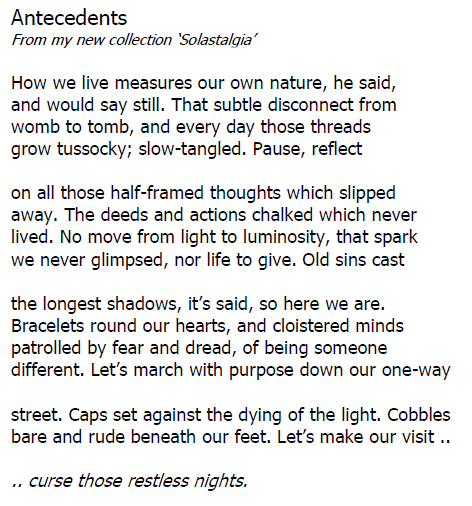
Today I welcome Hedgehog Poetry Press poet, Brian McManus to reflect upon a poem from his new collection, Solastalgia
Definition of Antecedent (Cambridge English Dictionary)
‘Something existing or happening before, especially as the cause or origin of something existing or happening later.’
How important, or otherwise, are our antecedents? How, if at all, do they impact, colour or shape that which follows, comes later? We are all guilty of sometimes castigating ourselves for missed opportunties, beomaning what might have been if we had acted differently, or indeed simply just acted at all.
Philip Larkin, one of post-war Britain’s most popular and famous poets, opined that the way in which we live, the actions we take or fail to take do absolutely colour and shape our lives. A failure to seize opportunity when it presents itself he would call ‘time torn-off unused’.
-Masquerading As Rocks, written and performed by Kathryn Cowley
Muses
Here are her muses, ocean borne, beach combed. Her teenage confusions and mumbling frozen tongue that can win no arguments bring her out here, where stories are written in a language she understands.
Endless tourists snap their picturesque romance of seals and seabirds, the painted clinker-built boats. She doesn’t talk to them, hooded parka pulled tight, alone on beach below ancient stone pier, touching base with her realm.
Among the Sulphur perfumed seaweed, things speak to her. Blue, blue, fishing nets twisted into gordian knots. Barbed wire, rusted orange and no friend of the unwary. A yellow fish-box. A clear bottle of Klondyker’s vodka – a mostly empty message.
Excited tourists photograph a pod of orcas, she sees oil rigs, trawlers netting vast subsidies, a white sheep skull poking ridiculous teeth through the weed. She pockets a lava rock from Iceland, maybe sell it to a tourist after, maybe not.
And here, a bird with a broken neck, bright feathers catching sun, dead eye pinned to the sky perhaps homesick. If she could only speak to others as this bird speaks to her, say all that matters, ever matters, is to honour the world before you.
Originally published The New Shetlander
-Maxine Rose Munro
STRAY DOG IN THE RAIN
It has been wet for days. The sun is a fading memory, squeezed beneath these swaddling clouds. Compressed,
her outline smudges blood and mud across the sodden sky. Her skin turns black and blue under the violence of the storm.
The weather is dictating terms. Invading ocean roars, heaves its bulk onto the land, drowning out the little cries of birds.
Her throat shapes anxious sounds beneath her tattered coat. No-one here will hear her prayers. Stone deaf in its rage,
the supine land will lie in wait. Soon it will have its say. It coils its spring. It does not care what becomes of her.
-Clare O’Brien (First published by Lunate, March 2020)
TO A SINGER, FROM HER SONGS
You have driven us for years. Counting our notes like sheep, urging us over storm-weathered hills.
Our cries are nothing to you. Some you catch, stretching them beyond your rhythm, into the dark.
Some of us you call, softly at first; Some you flay alive, the sound reverberating as you feed.
Sated, you are tender then; caressing our bones, draping our wet skins over the chords to dry.
-Clare O’ Brien (first published by Nightingale & Sparrow, May 2020)
-Jane Rosenberg LaForge from her collection, Medusa’s Daughter, Animal Heart Press
(untitled)
I’ve strayed too far from this mud, this earth to which we all belong, I will plunge my hands into the cool soil and feel fresh roots strike forth from my fingertips anchoring this trembling heart deep within the land.
-Charlotte Olivet
I Create
Something to care for, saved on this blessed earth. A poem’s words walk into wilderness. A painting is a deep focus, unearths details, how trees frame, repairs brokenness.
Folk in my head seem quieter in woods, and in the cemetery. I usually only hear the loud mouthy ones, the no goods. Now, I listen to quiet ones slowly.
Some are no goods too, but most, not. Listen, They tell me woodland air is sacredness. Keen, I write and sketch, all senses sharpen. I never knew here, in my inwardness.
Outside of myself there are outside selves. Too many is a burden, all is wealth.
-Paul Brookes
Bios and Links
-Jane Rosenberg LaForge
writes poetry, fiction, and occasional essays from her home in New York. She has published four chapbooks of poetry and three full-length collections, the most recent being MEDUSA’S DAUGHTER from Animal Heart Press. Her novel, SISTERHOOD OF THE INFAMOUS from New Meridian Arts Press, was inspired by the life of her sister, a one-time punk rocker and prodigy in mathematics. She also is the author of the novel, THE HAWKMAN: A FAIRY TALE OF THE GREAT WAR (Amberjack Publishing 2018) and an experimental memoir, AN UNSUITABLE PRINCESS (Jaded Ibis Press 2014). More information is at jane-rosenberg-laforge.com
-Jo Fearon
Is Public Sector Administrator and hobby poet. Second of Ian McMillan’s guest Hear My Voice Sonnets on You Tube. Soon to be published in HMV Barnsley 2020 competition anthology. Passionate about live music especially rock/blues/punk. Aiming to devote more time to what I love. Rediscovered love of writing the past 2 years.
-Maxine Rose Munro
writes in English and her native Shetlandic Scots. She is widely published in the UK and beyond, both in print and online. She runs First Steps in Poetry, which offers feedback to beginner poets. More here http://www.maxinerosemunro.com
—Kathryn Southworth was born in Blackpool, Lancashire, and now lives in Camden Town, London and Prinknash, Gloucestershire. She is married with three surviving children and three grandchildren.
She has always written poetry but returned to it in earnest only after a long career as an academic in midlands universities. She was a founding fellow of the English Association, Head of English and Cultural Studies at the University of Wolverhampton and held senior management posts there and at Newman University and also worked for the Quality Assurance Agency. She has been a governor of the Camden and Islington Mental Health Trust and is currently a governor of Rose Bruford College of Drama and Theatre Arts.
She has published poetry and reviews in several magazines and anthologies and reads at a number of London poetry venues, including the Poetry Café and Torriano Meeting House. The literary canon informs her writing, as does her Catholic faith, surreptitiously.
-Dr Sara Louise Wheeler
has Waardenburg Syndrome Type 1, a genetic condition which affects her physical appearance as well as her hearing. She writes the column ‘O’r gororau’ (from the borders) for Barddas Welsh poetry magazine and her poetry, belles lettres and artwork has been published by Unique Poetry Journal, Dark Poets Club, Fahmidan Journal, Cloverleaf Zine, and 3am Magazine. Sara is currently writing an autobiographical bildungsroman opera called The Silver Princess, funded by Theatr Genedlaethol Cymru. Originally from Wrecsam in North East Wales, she now lives on the Wirral peninsula with her husband Peter and their pet tortoise Kahless