Spring Journal by Jonathan Gibbs (CB Editions)

tearsinthefence's avatarTears in the Fence

One of the most memorable seminars on my Creative Writing MA* several decades ago was the first on the Long Poem and Poem Sequence module. We were divided into small groups, mostly with people we didn’t know, and asked to start a translation of Beowulf from the original text. In the second half of the session we read and discussed Louis MacNeice’s ‘Autumn Journal’, and were set the task of writing our own journal for the duration of the module.

Whilst I’ve always liked MacNeice’s poetry, and used several phrases from his poems for some early paintings of mine, ‘Autumn Journal’ had eluded my attention. What a wonderful text it is, each canto offering a different perspective and take: a mix of the personal, political, social comment along with observations of the changing seasons, all in a relaxed, conversational metre, with deft use of full, near and off rhyme throughout.

View original post 988 more words

#TheWombwellRainbow #Poeticformschallenge last week was #MercurialVerses. Enjoy examples by Tim Fellows and read how they felt when writing one.

photo by Paul Brookes

Jane Dougherty

Here are three rewrites of my poem Ogreave, which you can find here. https://timfellows13.blogspot.com/2018/05/orgreave.html

Acrostic

Old film of bloodied men, bare chested,
Run from horses, clashing shields
Green stained with red plays in my mind
Round turned the wheels until they slowed
Each stopping as the film stops now
And turns to turbines, offices and homes.
Victory was theirs; it crushed to dust
Each memory of those that fought.

Nonet

They charged as one, blue-clad cavalry
drew blood on unarmed working men.
We see old film, memories
fade now to black and white
flicker, flicker slow
and stop, replaced
by picture
perfect
homes.

Magic9

I weave through narrow winding streets
where men once ran from punch and kick;
caught on film, this army in retreat
scattered like our memories that fade
into these perfect houses, clean and neat;
my car wheels turn, the pit wheels stopped
a brutal and insidious defeat
lost in time and rendered obsolete.

How Did It Go?

None of them fully reflect the original, but have slightly different angles on it.

Tim Fellows

Bios And Links

Tim Fellows

is a writer from Chesterfield in Derbyshire whose ideas are heavily influenced by his background in the local coalfields, where industry and nature lived side by side. His first pamphlet “Heritage” was published in 2019. His poetic influences range from Blake to Owen, Causley to Cooper-Clarke and more recently the idea of imagistic poetry and the work of Spanish poet Miguel Hernandez.

A Poetry Showcase: Jerome Berglund

davidlonan1's avatarFevers of the Mind

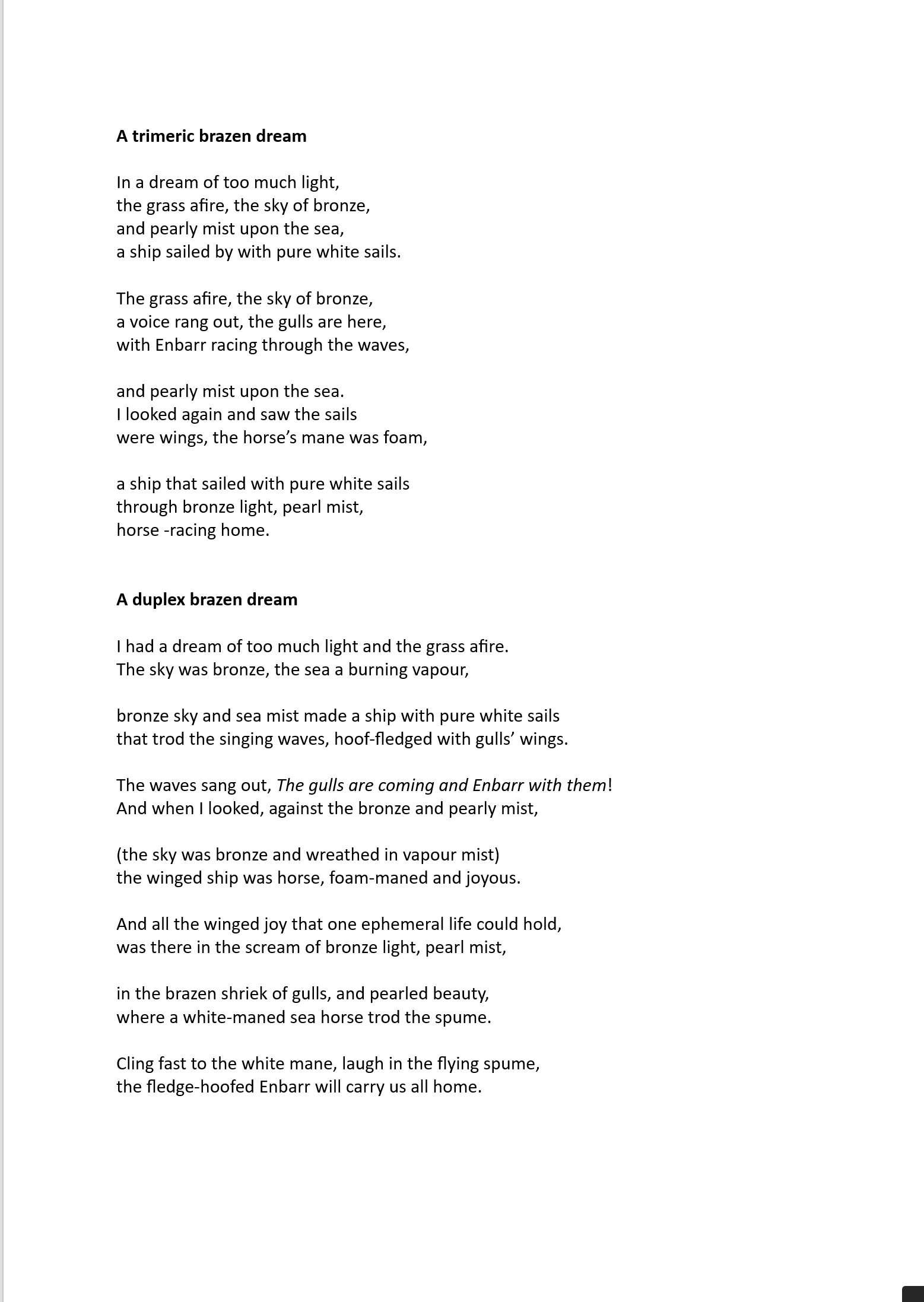
Bio: Jerome Berglund has many haiku, senryu and tanka exhibited and forthcoming online and in print, most recently in the Asahi Shimbun, Bottle Rockets, Fevers of the Mind, Frogpond, and Modern Haiku. His first full-length collections of poetry Bathtub Poems and Funny Pages were just released by Setu and Meat For Tea Press.

https://flowersunmedia.wixsite.com/jbphotography/post/haiku-senryu-and-haiga-publications

Socials ————— 

TWITTER:https://twitter.com/BerglundJerome

BLOG:https://flowersunmedia.wixsite.com/jbphotography/blog-1/

INSTAGRAM:https://www.instagram.com/lespectrepoliteraryjournal/

FACEBOOK: https://www.facebook.com/JeromeBerglundPhotography/

 Brüt
         
pong-pong tree
that bit of space
left to expand when freezes

slicing scallions
kids move not an inch:
avalanche area

Out-of-control semi
weaving back and forth...
Chariot spikes!

not suggesting 
you take lithium…
needle keeps poking me

tooth fairy
lifts pillow…
expungements

Four Stars bird meets wind — equally matched… flaps furiously, moves not an inch break fast on carrots again, by the quarry planted too early grows up too fast, while trusting – flowers becoming cold can’t write way out of a collapsed coal mine…

View original post 489 more words

Drop-in by David Estringel

Nigel Kent's avatarNigel Kent - Poet and Reviewer

Today the blog goes international with a drop-in by David Estringel from Texas to talk about a poem from his shortly-to-be-published new collection, Blind Turns in the Kitchen Sink (Anxiety Press).

Black Flies skim the surface of the screen door— deathly spirits in timeless dance— among rusty catches and long-forgotten captures of smears and smiles, looking for a tear to let the world rush in (in whispers and screams) like credos of newborns’ philosophies. No, they don’t bother me much those errant twings and twangs that pull my eyes away from the magnetic hum of hard plastic fruit, ripening on Frigidaire doors, and the bloody meat of strawberry slices, souring in a bowl of milk, under the frosted glow of my 60-watt suns Is it the creak of floorboards under wooden legs (or bones) that heralds their come to call, circling like a wreath, at my kitchen door? Or is…

View original post 414 more words

Music themed poetry showcase from Ian Mullins

davidlonan1's avatarFevers of the Mind

Bio: Ian Mullins ships out from Liverpool, England.

The music-themed poetry collection Laughter In The Shape Of A Guitar (UB) struck few chords in 2015. The chapbook Almost Human (Original Plus), concerning his ongoing battle with Asperger Syndrome, was released into the care of the community in 2017. The novel Number 1 Red, a tale of pro-wrestling and property wars, was self-published the same year. The superhero-themed collection Masks and Shadows (Wordcatcher) took to the skies in 2019. Take A Deep Breath (Dempsey & Windle) took its first gasp in November 2020. The haiku and photo collection White Masques (Secret House) came out in 2022 on his own label and is available free online. Dirty Sweet (Anxiety Press) was released in 2023.

Each To His Own

Tom Petty and the Heartbreakers live/If I Were A King sometimes men make love to each other without swapping spit or semen: one…

View original post 652 more words

Poem “Come Possess Me in the Rain” by David L O’Nan (from the Cartoon Diaries)

I

davidlonan1's avatarFevers of the Mind

Come Possess Me in the Rain

The conduits all say that I invented myth And magic all in one breath. There is a mist in the cold air On a Greenwich Village Halloween night I cannot feel the electricity Only the forceful druids, and the chanting wish of death They hold me up and say Come Possess me in the rain Licks the cold steel to my skull Possess me, with me Real and muted by the shame In an execution style parade What is the impression of a concrete stain? They are practicing Shakespeare They are faux Warholas and Bohemians in sunglasses Without a notion of care And I’m in this shadow that you feel at the River Cold to the touch, blood like paste The arrows kill the stars in the nuclear waste In the air, decaying the ground Now I’m expected to love all As I’m pierced…

View original post 317 more words

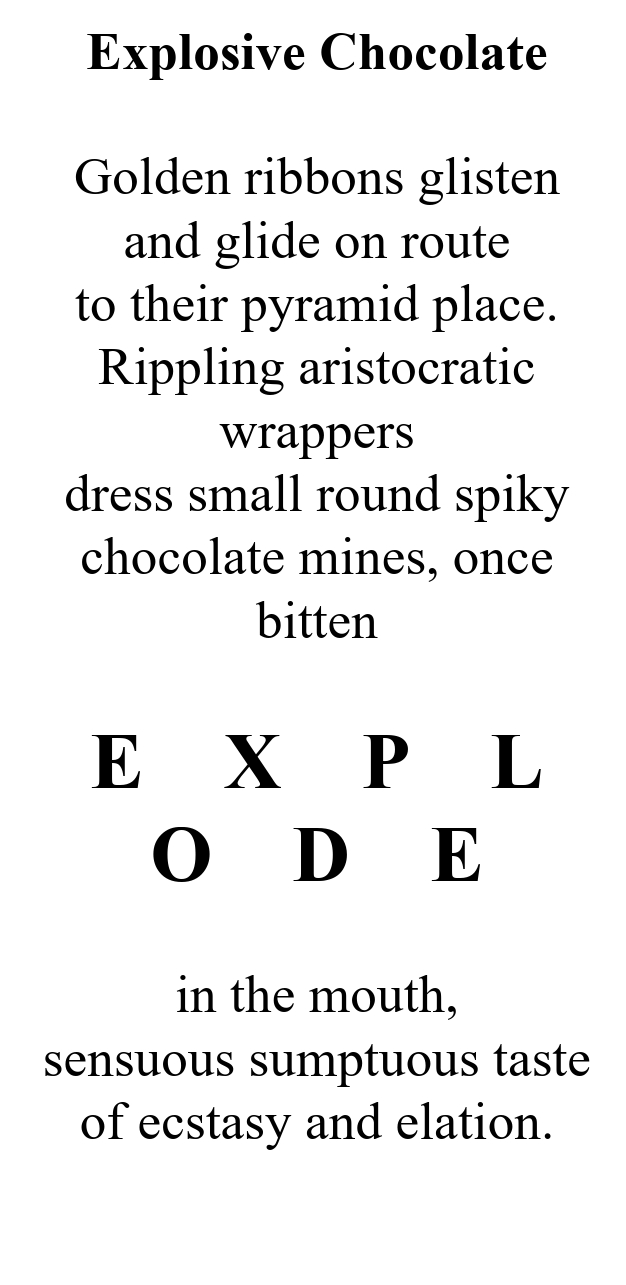
Celebrate #WorldChocolateDay2023 Join Patricia M. Osborne and The Wombwell Rainbow will feature your draft or published/unpublished poetry/short prose/artworks about chocolate. Please include a short third person bio.


Patricia M. Osborne

Bios and Links 

Patricia M Osborne is married with grown-up children and grandchildren. In 2019 she graduated with an MA in Creative Writing. She is a published novelist, poet and short fiction writer with five poetry pamphlets published by The Hedgehog Poetry Press, and numerous poems and short stories appearing in various literary magazines and anthologies. Her debut poetry pamphlet, Taxus Baccata, was nominated for the Michael Marks Pamphlet Award.

Patricia has a successful blog at Whitewingsbooks.com featuring other writers. When Patricia isn’t working on her own writing, she enjoys sharing her knowledge, acting as a mentor to fellow writers


.


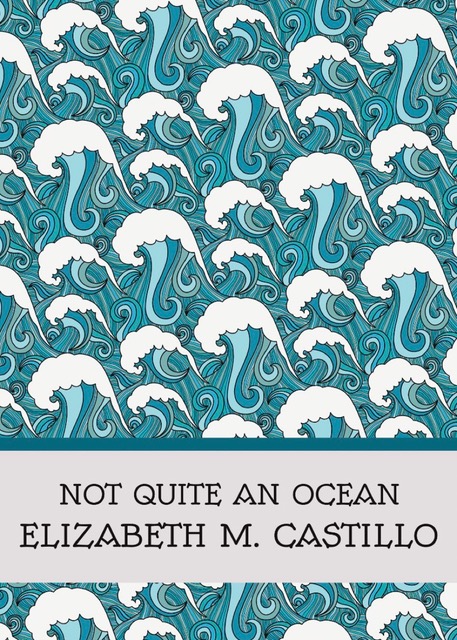
A Poetry Showcase: Elizabeth M. Castillo get Elizabeth’s new book “Not Quite An Ocean” with Nine Pens Press

davidlonan1's avatarFevers of the Mind

EMC Bio:Elizabeth M. Castillois a British-Mauritian poet, writer, indie-press promoter, and a two-time Pushcart Prize nominee. She lives in Paris with her family and two cats, where she writes a variety of different things, in a variety of different languages, and under a variety of pen names. In her writing Elizabeth explores the different countries and cultures she grew up with, as well as themes of race & ethnicity, motherhood, womanhood, language, love, loss and grief, and a touch of magical realism.

Her writing has been featured in publications and anthologies in the UK, US, Australia, Mexico and the Middle East. Her bilingual, debut collection “Cajoncito: Poems on Love, Loss, y Otras Locuras” is for sale on Amazon, You can connect with her on Twitter, IG and TikTok as @EMCWritesPoetry, or on her website www.elizabethmcastillo.net.

Book purchase link: https://ninepens.co.uk/shop 

Book Blurb :

‘Not Quite an Ocean’

View original post 630 more words

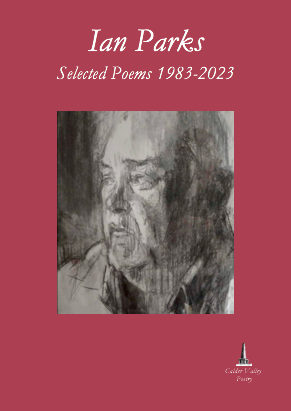
Wombwell Rainbow Book Interviews: “Selected Poems, 1983-2023” by Ian Parks


Ian Parks

was born in 1959 in Mexborough, South Yorkshire where he still lives. His collections include Shell Island, Love Poems 1979-2009, The Landing Stage, and The Exile’s House. He received a Hawthornden Fellowship in 1991. His poems have appeared in Poetry Review, The Times Literary Supplement, Modern Poetry in Translation, The Independent on Sunday, The Observer, and Poetry (Chicago).

He was writer in residence at Gladstone’s Library in 2012 and Writing Fellow at De Montfort University, Leicester, from 2012-2014. He is the editor of Versions of the North: Contemporary Yorkshire Poetry. Citizens is published by Smokestack Books.

Here is a link to the 2018 general interview I did with Ian:

Wombwell Rainbow Interviews: Ian Parks

Selected Poems can be purchased here:

Selected Poems (1983-2023) – Ian Parks

The Interview

Q:1. How did you decide on the order of the poems in your Selected Poems?

I felt there were two options open to me: either I attempted some sort of thematic approach or published them in chronological order. In the end I decided against grouping them broadly in themes because that didn’t really demonstrate any development or change over the forty years that the Selected covers. I’ve published eight collections of my own work in that time (excluding three pamphlets of Cavafy translations) and the selection follows the order in which they appeared. Within that framework I tried, wherever possible, to arrange the poems by order of composition rather than publication. Not including the Cavafy poems freed up some space for me to include about twenty new and uncollected poems at the end which brings the whole thing up to date. It was quite an experience – a bit like a drowning man watching the whole of his life flash by. And it’s true to say my life is in the poems; that this Selected is my life.

Q:2. How did you balance the two strands of love poetry and political poetry in the collection?

I started out as a love poet – although it was never my intention to write conventional love poems. I wanted to use the intimate address of a love poem to explore other issues too. I guess my main model in attempting this was a poem like Ly Your Sleeping Head by Auden which begins as a poem about the fragility of romantic love and ends up by saying something profound about human relationships generally. I’ve always been concerned as a poet with ideas of social justice. There’s not a clear dividing line or a point where I stopped writing love poems and started writing political poems – they merge into and hopefully reinforce each other. I wanted to revisit specific places and events which resonate within the national consciousness. Or to introduce them even to a readership that is becoming less aware of our common heratage: the Levellers, the Chartists, and the Trade Union Movement. A poem like Sky Edge tries to subsume the political into a love lyric.

Q:3. How important is poetic form in your collection?

Form is always important. It’s what makes poetry distinctive. I like to think of my poems as being informed by form rather than using it in an obvious way. So you won’t find any sonnets or other obsessive forms in the Selected – but you will find the inner workings of rhythm and rhyme which are integral to them. I think that rhythm especially is inseparable from the poem – it’s the lifeblood really and what makes one poem distinctive and distinct from another. Form is something J had to work hard at early on and I think some of the earliest poems bear evidence to that struggle. At one point I did consider revising the early poems but in the end I decided to let them stand. I was proud of them when I wrote them and if I started meddling now it might never stop!

Q:4. Most of the poems that combine love and politics move from personal to public. How deliberate is this?

All poetry, in a sense, is public poetry regardless of how private the subject matter might be. We imagine a love poem to be somehow less private than a political poem because it deals with an intimate situation – but it becomes public the moment it’s shared. But I do know what you mean. My poems aren’t concerned with politics so much as social justice – or injustice. I try to avoid polemics although it is a difficult thing to do. I like to think that the love poems helped me to arrive at a point where I can write a public poem that retains the intimacy of a private one. But there’s always a challenge and there always has to be. Poetry arises out of tensions within ourselves and those tensions will find a language eventually. When I sit down to write a poem I try to resolve those tensions. I hope the Selected shows a clear line in that regard. It’s not as if I suddenly stopped writing love poems in order to write political ones. The last poem in the book, Mermaid’s Hair, is nothing if it isn’t a love poem.

Q:5. Light is often “fading” or “diminishing”, especially towards the ends of your poems. Why is this?

I’m aware that my poems are intensely visual – and it’s very perceptive of you to pick up on an aspect of that. I read ‘light’ as ‘insight’ in my poems and physical shifts of light often correspond with intellectual or – more often – emotional ones. Moving into or out of light is a powerful notion. And yes, it does occur at the end of poems as something that is fading or disappearing. I’m very sensitive to the shifting quality of light as a person so it’s not surprising that it crops up so often as a metaphor in my poems. But as a metaphor for what exactly I’d be at a loss to say.

Q:6. What importance do you put on describing a sense of place in your poetry?

Place is very important. Whether we’re poets or not it’s impossible to separate an event from the place where it happened or to extricate an emotion from that place. This is why we so often associate a poet with the place they I’ve and wrote in. Think of the great sequence of elegies that Hardy wrote about his wife all of which are set in and around Boscastle. It’s clear that Hardy was unable to write about Emma without returning to the places where they discovered their love for each other. Landscape is important to all art forms. It informs them at a very deep and fundamental level. In my historical, political poems I try to identify locations such as Cable Street, Blackstone Edge, and Marston Moor where what happened there is still imprinted in the air. So yes, place and landscape feature strongly in the collection, binding the poems together.

Q:7. In the launch you mentioned the poetry of Robert Graves and Edward Thomas. How much of an influence do you think these poets have been on your poetry?

I could also have mentioned Elizabeth Bishop and Thom Gunn because they’ve been an abiding influence also. I read Graves and Edward Thomas in my teens, just as I was starting out and trying to find a voice. Graves was still alive and writing then but was and still is, to some extent, unfashionable. But I wasn’t interested in writing fashionable poetry – only poetry that was true. And it seemed to me that there was something about Graves that was authentic, even though some of the ideas he explored in The White Goddess were questionable and controversial. He made a very strong case for the importance of poetry in the world in that book but also in his own example as a poet. He was easy to admire and still is. Edward Thomas, I think, is the better poet although comparisons aren’t really possible with two highly distinctive and idiosyncratic writers. In a practical sense Thomas showed me the way clearly in his approach to form. I was fascinated by the fact that he’d been a prose writer for most of his life and only turned his hand to poetry a couple of years before he died and at the urging of his friend, the American poet Robert Frost. Frost encouraged him because he detected in his writing and sensibility a true poet. Thomas often walks a very fine line between prose and verse, and his poems are undemonstrative but deep, conversational and yet exquisitely shaped. But both Graves and Thomas were mavericks and pursued their own calling. I think the death of Thomas in the Great War at the age of thirty nine was tragic in more than one way in that it robbed us of an outstanding poet. Influences are interesting aren’t they?

Q:7.1. How would you say Elizabeth Bishop and Thom Gunn have influenced your writing?

Elizabeth Bishop, one of the finest American poets of the twentieth-century, because of her way with free verse; the way you can trace the trajectory of the poem as it creates its own possibilities out of the natural rhythms of the speaking voice. A poem like The Fish would be a good example of this where she allows the images to speak for her without any attempt to describe or direct the reader. Thom Gunn moved to West Coast of America in the late 1950s when he was still a young man and never came back to the UK. It was partly a lifestyle choice and partly due to the openness of the poetry establishment in the US to new and experimental forms. He had very little in common with the Movement poets in this country. I’m confident that Gunn’s reputation will grow with the passing of time. He’s a very ambitious poet, both formally and in the (often controversial) subjects he chooses to address. I read him all the time.

Q:8. What is a “true poet” to you, what is “true poetry”?

Difficult one. a true poet is someone who isn’t influenced by fashion; someone who listens to the rhythms of their own heart rather than to what’s dictated by the poetry establishment. The current prize and competition culture has done a lot to draw attention to poetry – but it’s also done a lot to damage it. Poets are hurtled into the limelight, promoted vigorously, and then neglected as the search for the next new name begins. True poetry gets written despite all this, and often as a way of raging against it. Poetry is an art form and not a commodity. It can’t be marketed. But you can be sure that the real thing will always surface.

Q:9. How much is a “selected poems” an autobiography?

I suppose that depends on how much the poet is concerned with the events of their life – by which I mean the events of their inner life as well as the things that occur around and influence them during their lifetime. As time has gone on and I’ve accrued a substantial body of work to look back on I’ve come to realise increasingly how heavily I’ve leaned on my own life in writing the poems and just how autobiographical they are. So, for instance, the poems about the Miner’s Strike are both autobiographical and political at the same time because my father was involved in the struggle (as was I to a lesser extent) so it would have been impossible to separate them out even if I’d wanted to. And so there are poems about my grandfather who was wounded on the Somme and my mother and son. All the inextricably links to ourselves and the world that are formed by simply being human. Having said that, the autobiographical strand you might detect only became evident as a strong theme when I was going through the process of deciding which poems to include. I have an accute sense of the past and I’m sure it informs everything I write. In a sense, the widest possible sense, all the poems are autobiographical. As my publisher Bob Horne pointed out to me ‘this collection is your life’ – and he was right.

Q:10. Why is historiography present in your poetry?

Because it is present in my life. I’m aware of the strands that connect me with the past, and the way those strands come together in the present moment. When I say I’m passionate about history I don’t mean the history of the rich and powerful – although they have shaped the world we live in by their greed and violence. I mean the history of the ordinary people who are our ancestors; the people wh0’e been largely forgotten but whose voices still resonate today: the Diggers, the Chartists, and the Levellers. It seems to me that poetry is a powerful way of rediscovering and articulating their voices. That’s why I’m currently engaged in editing an anthology of poetry written by members of the Chartist movement, due shortly from Calder Valley Poetry. My long poem, Elegy for the Chartist Poets tries to explore this interface imaginatively.

Q:11. Why do you prefer narrative to imagistic poetry?

I think it’s something to do with the way my mind works. I think in pictures – a person, a landscape, a particular location – and the poems grow out of the sequence in which they’re placed within the poem. I do sometimes write narrative poems. Something like The Figurehead would be a good example. But, if I’m anything, I’m a lyric poet by sensibility and inclination. The poems tend to bring together ‘lyric episodes’ into a bigger fame – a frame which the narrative provides. None of this happened by design though – but through serendipity and accident. I’d like to think the Selected Poems shows the trajectory of this development. Needless to say, I don’t understand it fully myself – but all that is part of growing as a poet.

Q:12. What is your preferred point of view in your poetry, first, second or third person?

First person mainly, but that doesn’t mean the first person speaker is necessarily me. First person sets up the expectation of intimacy, that the speaker is telling the truth. It is, for me, the natural place to start if you’re writing a love poem. I like to think that the intimate address, ‘you’, encourages the reader to listen in to a conversation and to be complicit in it. Poems happen when the reader engages. I always try to make my point of view or, more broadly speaking, my point of empathy, one that draws the reader into this complicity. I try to express complex ideas or emotions in a language which is lucid and accessible. Giving readings of my own work helps to in that it makes me think seriously about engagement. You want to be accessible but you don’t want to insult the hearer’s intelligence either. It has to be a collaboration.

Q:13. How would you describe the “collaboration” between poet and page, page and reader, poet and live audience?

Q:14. Once they have read the book what do you hope the reader will take away with them?

The sense of a whole life lived through poetry – by which I mean a life where sensitivity to the possibilities inherent in language is recognised, respected, and cultivated. Of course you don’t have to be a poet in order to live that kind of life. I would like the reader to feel as if they’ve been deeply engaged with the imagination and experiences of another individual. If the readers come away with that I will be happy and have done what I set out to do.

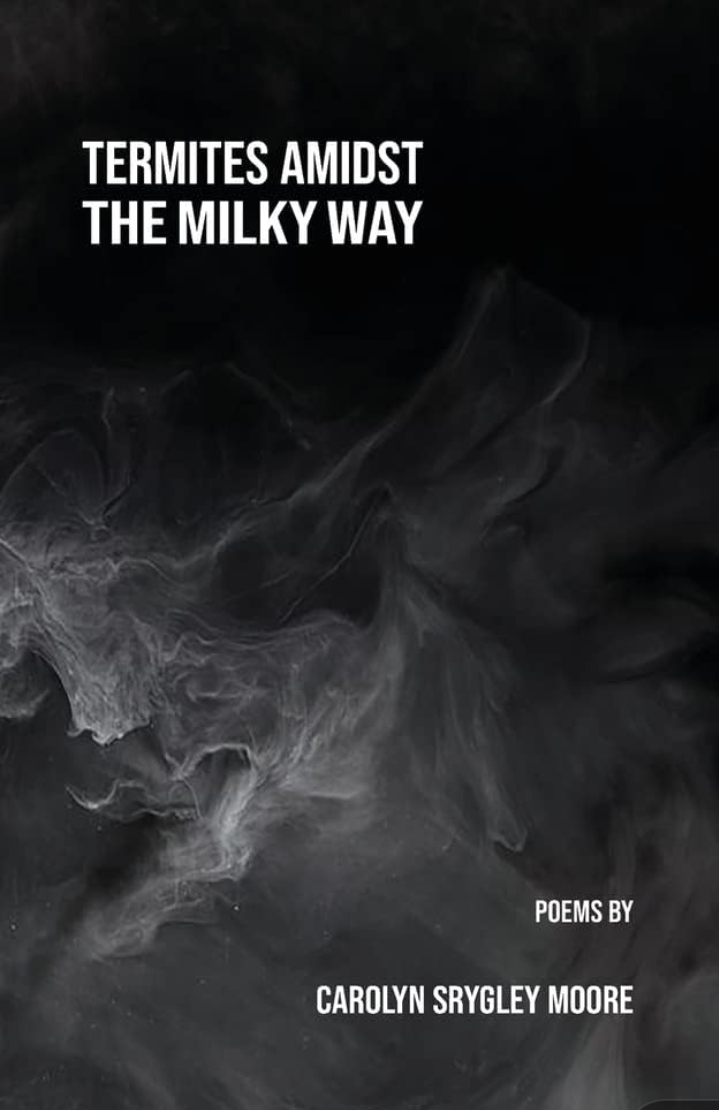
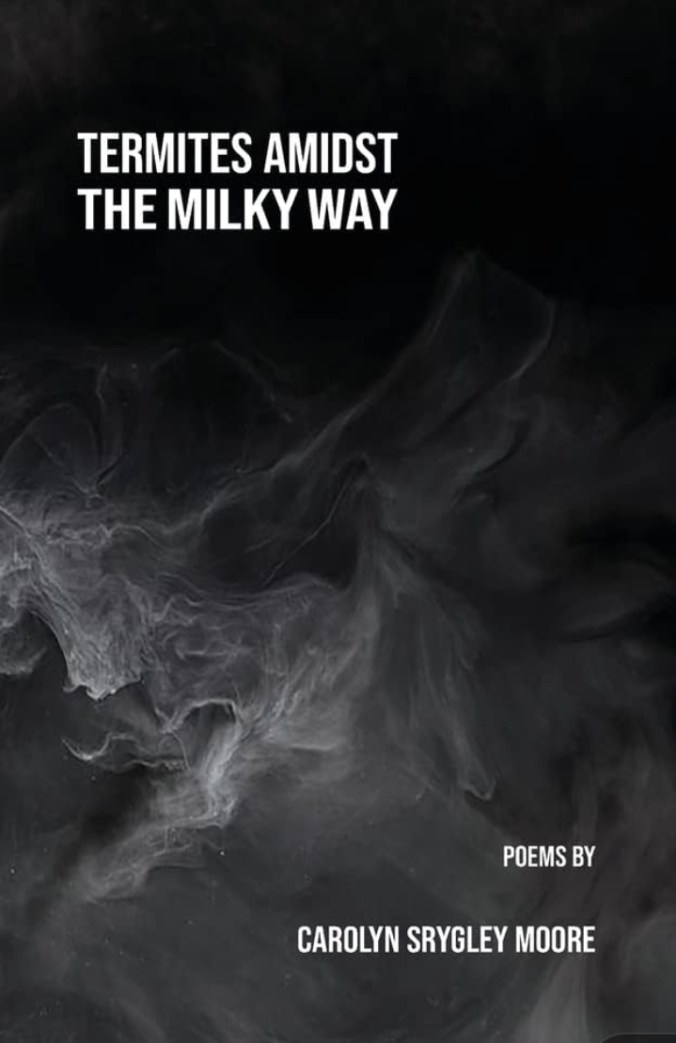
Wombwell Rainbow Book Interviews: “Termites amidst the Milky Way: a collage” by Carolyn Srygley Moore

Carolyn Srygley Moore

is the author of 7 poetry volumes, to include Ode to Horatio & Other Saviors (Crisis Chronicles Press (2020); Termites Amidst the Milky Way (Kung Fu Treachery Press (2022) & For All of my Beautiful Ghosts (Posthuman poetry(2023). She has been published in many journals over the years; most recently Wolf at the Door, nobody home.
Carolyn is a two times pushcart nominee; a best of the net nominee & graduated from Johns Hopkin University with two Kenan poetry awards. She participated in Real Stories Gallery’s outing of various cultural pathologies but is —regarding love —, an optimist.

She resides in Upstate New York with her husband, dogs, & Cat Groot, in a very old yellow farmhouse suspected to be a haunt by some. She writes book reviews, as well,

Termites Amidst the Milky Way can be purchased here: https://www.amazon.co.uk/Termites-Amidst-Milky-Carolyn-Srygley-Moore/dp/1958182257/ref=sr_1_4?crid=12JHOP3GPTK0J&keywords=srygley+moore&qid=1688585439&s=instant-video&sprefix=srygley+moore%2Cinstant-video%2C405&sr=1-4

The Interview

Q:1. How did you decide on the order of the poems in the book

The poems are ordered primarily
In response to (what I garnered as) the historic
Sequence of Putin’s invasion of the
Ukraine. Response, I mean, as both subjective & seemingly objective —:
Best I, distant witness, could do.
However, some are simply random responses to an image or idea without sequence.

The first few poems
(Barring the initial “what would you
Grab”, placed at the beginning due
To resonance & relevance) convey
Not the active invasion per say,
But various intimations quiet or blatant
Of Putin’s plan.

The book traces the process ( of
Invasion ) —: portent, action, etc, & finishes
With reports of war crime —
bodies dead & violated by
Hands of Russian troops. This
Concluded & proved as evidence, to
Many,
That Putin’s aim was genocide of
The Ukrainian people & their extensive & integral
Culture.

The final poem of the book
Is a song, for the hope of liberation
Evidenced in Kherson; these
Songs these flowers borne &
Tucked in buttonholes, however
Ephemeral, demonstrated a
Celebration at least of the spirit
By which the war was / is fought &
The intent to keep their land,
Moral infrastructure, & integrity in the face of tyranny alive. Brevity
& the fact that the opposition
Was known to camp across the
River, did not matter.

Q2: How important is white space in your poetry?

I’ve utilized white space differently in different poetry series.

In Termites, white space
Is an interruption of the flow, the fluidity
I attempt to write by. Or an enunciation of that cadence.

Perhaps, for those poets raised by a body of water, our poetry is on some
Level infused by our memory of that water. (Montague). I was raised with a backyard creek until my mother’s remarriage & spent early childhood summers
By the Susquehanna. Our dad owned
A small marina nestled there, in the
Shadows of Three Mile Island’s nuclear
Towers.

& in my early philosophy of
Poetry, my aim was to flow parallel to a
Chopin nocturne. (My mother was
An accomplished pianist. She
Played, I listened. That too is a
Cadence that informs me.)

In Termites. I see the pause as significant, more than significant.
What does one do in homage
To the dead, especially the dead
Of a fascist-inflicted carnage.
One takes a pause. Lowers the
Flag. Interrupts the cadence of
Day to day ritual. Halts stride when
Walking to purchase tea. Break
Bread in solidarity with a friend.

*****

Q3: what place does narrative flow have in your poetry?

Termites is my first poetry volume linked specifically
To the narrative of history.

I believe the text traces layers of
Telling a (nonfiction) story. But
Details are often conjured, empathetic
Fiction.

The timeline is enabled from flashes of concrete fact (bodies,
Gutted buildings) & parallels with other violated cultures/
Peoples.
Sometimes a Meal, supper shared with a news correspondent,
Or amongst those forced to render metro
Underground a safehouse — conveys
Solidarity, a crosshatch & network
Humanitarian, however muted by
Bombs exploding. ( per the poem
“Catacombs Speak.”)

‘’’

Fluidity is always imperative to my work; to this end, in Termites I chose
To leave most of the included poems undated.
Only three — date of actual invasion / date first war
Crimes discovered / date liberation of Kherson — are
Dated, in this way sequenced.
This book was written in the period of time
Current to the events., ie., about 5 weeks.

The story told of this war is of course (partially) subjective. I chose
The course I felt most true. (I excluded the anti-Nato
Stance.). I put the blue & yellow bows on our wooden mailbox rather quickly, to
The dismay of some progressives. But the moral compass, in this battle,
Seemed to
Me self evident —: the Ukrainian culture, streets, bone structure, existed
Centuries before Russia declared itself as charted entity.

(I’m of course humbled by those
Inhabitants of the country, who live with ash of
Wood & stone & bone inhaled by their very pores,
& their art & poetry. I smell the napalm as a distanced witness only.)

Q:4. Why do you call Termites a Collage?

(“Collage describes both the technique and the resulting work of art in which pieces of paper, photographs, fabric and other ephemera are arranged and stuck down onto a supporting surface.”(Dictionary
Definition.)

TERMITES is of course a book of words. Images, which are presented as integer or fraction, cohere via a narrative flow, in this case referencing the course
Taken, in history, by Putin’s invasion of the Ukraine (& what as view as the attempted extermination of a people, blood/bone/culture.)

I believe Termites was conceived as collage. There is one photograph, on vestibule of the book, offered by a biologist acquaintance ; a photo from South America of a
Termites nest. In that photograph exist a collusion: the grotesquerie of the nest , visceral, jarring. Nothing beautiful about it.

An image I saw of a girl in pigtails facing the sun. & others also
Glimpsed human figures within the literalism of that nest.

This (which I see as the Milky Way of the title, would be hope.)

“”

I work — on occasion — in collage, visually. Parts of the poems break off into tangentiality, small italicized marginalized text, which is envisioned as the pasting of an image.

Collage is rarely strictly fluid. Although it works as a whole, it is fashioned of what is broken. & what is war —
The perception of, the experience of — war but an ongoing fracturing? Of soul, of buildings, of bone & psyche?

My niece did snap a photo of the Milky Way one cold Montana night, but the sky was too cloudy that evening for clarity of image. Hence the Milky Way
Of title was not included to reference the termite nest.

Q:5. Why ‘Termites”?

“Termites amidst the Milky Way” is a direct reference to the excerpt from Czeslaw Milosz’
“Song of a Citizen.” a poem written in Warsaw, 1943, year of the Warsaw ghetto uprising, one of the most
Around resistances by the Jewish people during the course of the Second World War. This excerpt proves the most
Concise introduction.

“And I can think only about the starry sky,…
About the tall mounds of termites.”

In the parallel drawn, termites are the fascists transgressing,/ trespassing / barreling into the Ukraine. Perversion
Of what is — comparatively— sacred?

The Milky Way, in my mind, is the order of light, the order of stars overhead. Constellations, as far as I’m aware, do vary in manifestation world over, especially as they are named; but
Perhaps parallels thrive in the way
Stories are passed down & home
Themselves in a cultural heart.

(I asked my niece, as I’ve said, to catch a photograph
Of the Montana night sky. Suiting—: a girl of 15 stepping out in a peaceable area to catch
A picture of what was once seen as the end of the galaxy, beyond which we now know
There is so much more.)

“”

Ever look at a termite? I never had.

The nest that marks the book’s beginning is a termite nest. But within that nest
Are squiggly white things, kin to the cockroach, (of which I have a huge phobia), that destroy all things
Structural that they can infiltrate.

Q:6. In previous collections you explored the world wars. What draws you to write about conflict?

(My response is a very personally resonant reflection)

To write neutrally about conflict
One writes I think from a nave of
Peace. Van Gogh surmised, in his letters to Theo I believe: “ less from hatred than
Love, more from serenity than passion.”

I was raised in a home of — at times —extremes in
Expression. There was an undeniable presence of love.

However, due to a six year period
Of service to our country during WW2 ,
My father suffered greatly. How does a hero return home to a condition of being only human, & broken to some degree.
VAs lack of comprehensive education
Of what war (even wars supported by
The country’s citizens) can do to a man.
&, to the people & country
Of the homecoming.

What was then
Called Shellshock is now, so I
Understand, PTSD, a conflagration
Of deep distress. This evolution in awareness must ease the
Serviceman’s desperation, & the
Desperation of families & loved ones.

My dad left our home when I was 8.
Summers, while briefly
Visiting my father, granted me an oftentimes unwanted view. He drank to numb.

On occasion
He would call me to him, point to
Various areas where shrapnel still
Remained in his body; or, where
There was present only the mark in flesh
Of wound.

These were
Perhaps our most personal conversations; neither of us spoke
Much, one to the other. Those
Nights, I was helpless; in retrospect I am honored, that he spoke of
His world to me thus. “I am damaged “
He slurred, with clarity.

“”

I (we) mark the conduits where personal & a greater history intersect. I’ve been writing since I was a young child of age 7 or so. It is my moral imperative
As an artist to use the voice, for which I’ve struggled, for a greater good.

I’ve tried
To write not only for the silenced
Of world wars. Their are many cultural
Pathologies to address.
But let’s not forget those who
Suffer greatly simply because they
Are forced to exist without parameters
Of safety. Safety is aligned
On the first tier of Maslow’s Pyramid of
Needs.

I am so fortunate to be living in a
Country where I can write draw collage speak: everything. This is not
A fact I take lightly. While we still
Enjoy freedom of expression in the
states, let’s use it. Speak up
While we still can.

“”

Q:7.

What is the significance of this quote at the beginning of your book?

And I can think only about the starry sky,…
about the tall mounds of termites.
Czesław Milosz, Song of a Citizen,
Warsaw l943

I really found myself webbed in this
Question. I felt I’d answered it above
(The “why termites” question) however
That response defied the truly
Simple answer. The quote is of course
Very visually evocative, very
Photographic. Termites; stars.
The hollow mounds parallel the vast
Potential within galaxies. Contrast & collision.

///
The book is not a recitation of
“Current events.” As one man
Blurbed & as the reviewer (“LinkedIn
Online book club / termites received
A 5/5 rating) the book is conceptually
The intersection of war with
Every day life. Insects, stars.
Many versions of each, yet each the
Same. All human beings are compelled to be both squiggly termite & gorgeous
Fixed yet unpredictable star.
Light from matter already dead.
Yet not breathless at all.

Black & white thinking is
Dangerous. Cesaire said we are,
Each of us, others, & perhaps
That awareness yields a knitting
Together of what is human in
Us. Not too-human; but the day
By day.

“”

“Song of a Citizen.” We are each of us “a Citizen,” meaning, world over, we have the moral opportunity
To speak out, even against what is not occurring in our homeland. As a citizen of this world.
Although I am not a citizen of the Ukraine, I am a citizen of the world, I am a human being;
& these human rights violations, these war crimes, affect me as well.

Who is next?

Milosz witnessed. He was right there, when the Warsaw ghetto was burned, its sky gone crimson.
He was no Jew, but he was same in that he was also a human being. He is one of my favorite poets for his incomparable essence
Of moral compass. Empathy, expressed in image sourced via intellect & compassion, which of
Course coexist & overlap.

Q:8. In your poetry you use the symbols “//” and “///” a lot. What is the purpose of these?

Q:9. At the end of some poems the last expression is in italics? What are you trying to achieve with these?

8. /. 9

“//“ and “///“ are symbols I use in the course of composition to indicate
Emphasis. As in pause / staccato/
More jagged in sensibility than a
Space between words.

The italics tend to remark a somewhat
Dissociative mode of transition one
Point or poem to the
Next. This was an endeavor to
Collect the collage motif.
Blocked italicized bold: these
Phrases are hopefully the grasshopper
Bly invoked when speaking of the
Successful image.

“”

At this point I must give a great deal
Of credit to Termites’ editor: Jason
Ryberg of both Kung Fu Treachery
press & its kin, Spartan Press.

A mutual colleague suggested that I contact Jason regarding possible
Publication of my manuscript.
He said sure, he’d look at it. Within
A relatively short time, he returned
To me a manuscript that, with
Masterful editing, was a better book.

In the course of this translation I found
Myself, as author, in a situation of
Choice: to yield to — or argue — such
A transition in the manifestation.
Excess was cut away (carefully) like
Locks of hair, or leaves. It
Left me amazed. Mr Ryberg did
Consult with me; we collaborated, but
His edits compelled a more adept
Vision. // In the process, elements of
Narrative became more subtle,
Less provocative, more seamed.
(Overt didacticism can be a turnoff
To the reader; no matter what Brecht
Said.)

I immediately sensed that editor/author visions were
Symbiotic, not divergent
It was a profound collaboration.
It really expanded my sense of what
Teamwork is. Contrary to the
Writer-solitude myth/reality.

(Yet —: integrity of the initial manuscript
Presented — vision, choreography—:
Was not, I felt, compromised.)

Robert Gottlieb, the US editor who just died after a legendary career — exemplified, or so I read, the editorial presence in
Final prose works. But here I’m speaking
A book of poems. Just my reflections of course.

Q:10. What role did media play in the writing of Termites?

I would like to respond with
“Very little,” but of course — especially given my physical proximity (lack
Thereof) to the country invaded / to
The invading country —: that would
Be a lie.

My mind is swirling with reflections
From what I’ve researched, regarding
The relationship between
War & media & their consumers. I read primarily
About the wars of the 20th & 21st centuries;
The involvement media was granted by the political forces at large. It is a dance of intimacy given / taken back / given.

The word I stumble upon, genuflecting
Suspiciously each time (I’m not religious), most often
Is “propaganda.” Interesting word, red
Onion layers, thick stinky fragile.
Dangerous// often quickly dismissed or misunderstood.

What, one might ask — when one
Attempts to write of war from a neutral stance —: what is not propaganda?

“”

Himmler perhaps more than anyone contorted propaganda
To the modern conception we have of what
“It” means. What drove the
Reich to the idea called “the final
Solution “ & how the hell did they
Sell that idea/action to the German
(& etc) population as a whole?
How did the Resistance manage to
Retain a moral compass & integrity of
Purpose, despite the nooses of such
Grotesquerie? There is propaganda
That is “good” —: & this facet extends into the Middle East, Somalia, etc.

World over forces &organizations exist to ease human suffering, the sort
That can be avoided, at least mitigated.

Propaganda ( traceable to origins of
Catholic centrist control of
Missionary workers); has always been a term involving power & struggle.

Even if “everything is propaganda”
All is nuanced, & even evil can be
Flip flopped into energy toward a
“Greater good.” Itself of course
Subjective & culturally effected term.

“”

The question you ask concerns
The role media takes in the
Writing of Termites. Below, an
Example from the text in question.

“Catacomb Speak”
Tries to convey an evening in which
I interacted with the evening news
Like a call & response. It’s the
Volition & intensity & immediacy of
Response that keeps the guesswork
Fresh—: by reader & writer. I had watched Lester Holt anchor an
Engaging if disturbing series of
News segments set in the freshly
Bombed areas of Ukraine.
Richard Engle, reporter, reported
I believe from the underground, the
Metro at that time believed to be
Safe from the onslaught of terror.

The entire poem is a response to
That newscast. Sensual detail,
Some girl, a violin. Something
In Holt & Engles parallel work
& sign offs to the audience (consumer?)
Reminds me still of Cronkite
Who I watched as a child, bringing
To us the war in Vietnam.

Here came Walter Cronkite: “and that’s the way it is.” Such assurances in his
Sign off. Promise of real experience
Handed over to the consumed like
The Baptist’s head on a platter.

I remember the fresh blood, battles,
Ambivalences —: & have read about the dance war / agenda / media have
Engaged. It’s a flirtation with
Great consequence.

“”

I like to believe that I can process information without bias. I can’t.
But I am careful to filter best as able. Along with a zillion other writers I found myself
Compelled to communicate my
Own intersection with what
Was happening—: & so quickly —: while
The world orders sat & discussed
Furtively
& shuffled their papers. To me
The wait was just unbearable. It
Seemed senseless.

(I do inform myself via other news sources & love the New Yorker
For its very intimate depictions of
Things far & near. Several online
Sources post the “facts” & then
The “spins “ on those facts.)

“”

Truth, Williams etc said, is called
Out by “the thing itself.” But I
Believe it is much more than that.
To engage the human capacity to
Embrace the possibility that such
A thing as truth exists —: after the
Death of it, in deconstruction —: is
A profound reclaiming. Can we have conversations about that —

After Nietzsche it was rendered
Unspeakable to have a discussion about God. After Auschwitz’s (mind blanks)
Can we reclaim human decency? Can we
Argue vehemently against indifference.
By writing the poem that to some
Survivors should not be written. For
There is only silence?

Can we have conversations about that.

I’m a victim of & survivor of crime
Like many many people.

First, let there be silence, in homage.

Secondly let there be Voice, by
Which to take back what’s been taken!

One must have the opportunity to speak, engage, believe wholeness
Is possible. It’s the only option
Available to some. Language is essential. In all mediums —:
“Art is communication “ my friend
Charles said to me, thus altering my sense of what writing means to me.
He was a retired anthropologist & a good friend.

Telling one’s story has proven, personally, the
Paramount means toward integration.
How my story intersects the story of
Others, & the world around me, is an awareness necessary to survival.

& let me endeavor that the voice I’ve fought to find is not polluted. Let it be neutral. I try.

Q:11. Once the reader has read Termites, what do you want them to come away with?

That we are all of us vulnerable.
It is this vulnerability that makes
Us shine. It teaches us not only
What war is //
But what love & safety are as well.
& these truths cross whatever
Border, today, exists — between
Countries, counties, people.
Where the void lies the tactile
Grounds us. Feed your dogs

If you don’t have your safe person
Safe place —: get one. It aids
The resistance. Which
Lies in every detail however
Trivial of every day. & it is in resistance
Alone that human decency & freedom can
Be salvaged, indeed, saved.

“”

*

I have purposely omitted the invasion on Moscow by Russian forces. The book is focused on the invasion of
The Ukraine by Russia & Putin’s
Forces

**