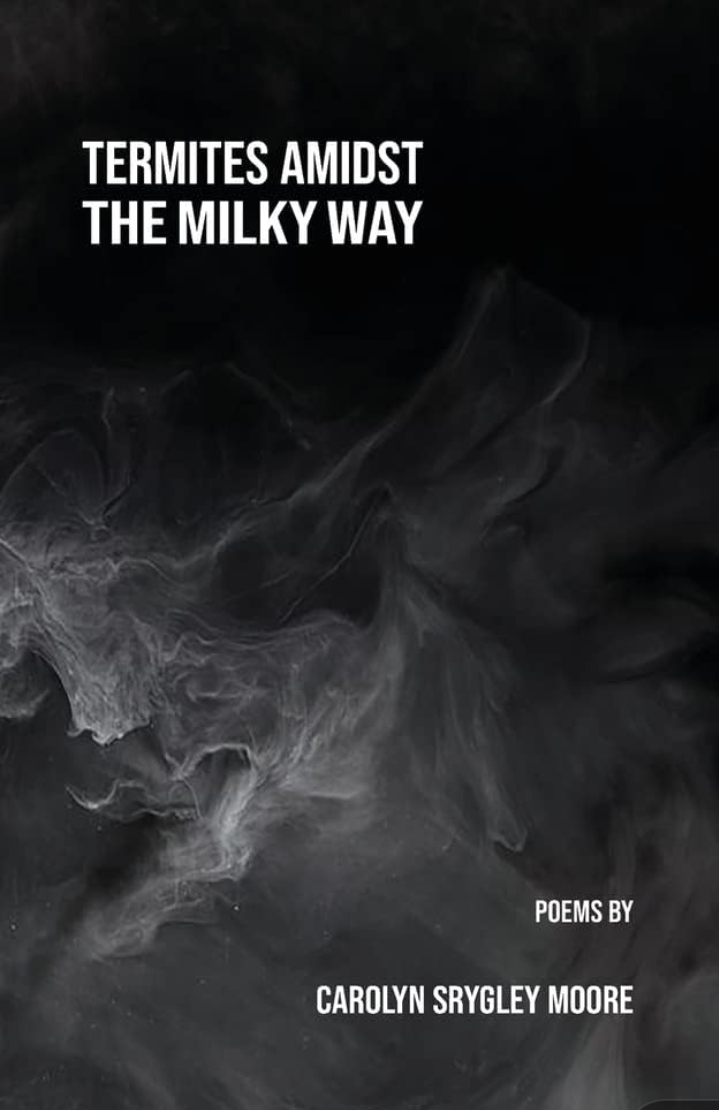
Carolyn Srygley Moore
is the author of 7 poetry volumes, to include Ode to Horatio & Other Saviors (Crisis Chronicles Press (2020); Termites Amidst the Milky Way (Kung Fu Treachery Press (2022) & For All of my Beautiful Ghosts (Posthuman poetry(2023). She has been published in many journals over the years; most recently Wolf at the Door, nobody home.
Carolyn is a two times pushcart nominee; a best of the net nominee & graduated from Johns Hopkin University with two Kenan poetry awards. She participated in Real Stories Gallery’s outing of various cultural pathologies but is —regarding love —, an optimist.
She resides in Upstate New York with her husband, dogs, & Cat Groot, in a very old yellow farmhouse suspected to be a haunt by some. She writes book reviews, as well,
Termites Amidst the Milky Way can be purchased here: https://www.amazon.co.uk/Termites-Amidst-Milky-Carolyn-Srygley-Moore/dp/1958182257/ref=sr_1_4?crid=12JHOP3GPTK0J&keywords=srygley+moore&qid=1688585439&s=instant-video&sprefix=srygley+moore%2Cinstant-video%2C405&sr=1-4
The Interview
Q:1. How did you decide on the order of the poems in the book
The poems are ordered primarily
In response to (what I garnered as) the historic
Sequence of Putin’s invasion of the
Ukraine. Response, I mean, as both subjective & seemingly objective —:
Best I, distant witness, could do.
However, some are simply random responses to an image or idea without sequence.
The first few poems
(Barring the initial “what would you
Grab”, placed at the beginning due
To resonance & relevance) convey
Not the active invasion per say,
But various intimations quiet or blatant
Of Putin’s plan.
The book traces the process ( of
Invasion ) —: portent, action, etc, & finishes
With reports of war crime —
bodies dead & violated by
Hands of Russian troops. This
Concluded & proved as evidence, to
Many,
That Putin’s aim was genocide of
The Ukrainian people & their extensive & integral
Culture.
The final poem of the book
Is a song, for the hope of liberation
Evidenced in Kherson; these
Songs these flowers borne &
Tucked in buttonholes, however
Ephemeral, demonstrated a
Celebration at least of the spirit
By which the war was / is fought &
The intent to keep their land,
Moral infrastructure, & integrity in the face of tyranny alive. Brevity
& the fact that the opposition
Was known to camp across the
River, did not matter.
Q2: How important is white space in your poetry?
I’ve utilized white space differently in different poetry series.
In Termites, white space
Is an interruption of the flow, the fluidity
I attempt to write by. Or an enunciation of that cadence.
Perhaps, for those poets raised by a body of water, our poetry is on some
Level infused by our memory of that water. (Montague). I was raised with a backyard creek until my mother’s remarriage & spent early childhood summers
By the Susquehanna. Our dad owned
A small marina nestled there, in the
Shadows of Three Mile Island’s nuclear
Towers.
& in my early philosophy of
Poetry, my aim was to flow parallel to a
Chopin nocturne. (My mother was
An accomplished pianist. She
Played, I listened. That too is a
Cadence that informs me.)
In Termites. I see the pause as significant, more than significant.
What does one do in homage
To the dead, especially the dead
Of a fascist-inflicted carnage.
One takes a pause. Lowers the
Flag. Interrupts the cadence of
Day to day ritual. Halts stride when
Walking to purchase tea. Break
Bread in solidarity with a friend.
*****
Q3: what place does narrative flow have in your poetry?
Termites is my first poetry volume linked specifically
To the narrative of history.
I believe the text traces layers of
Telling a (nonfiction) story. But
Details are often conjured, empathetic
Fiction.
The timeline is enabled from flashes of concrete fact (bodies,
Gutted buildings) & parallels with other violated cultures/
Peoples.
Sometimes a Meal, supper shared with a news correspondent,
Or amongst those forced to render metro
Underground a safehouse — conveys
Solidarity, a crosshatch & network
Humanitarian, however muted by
Bombs exploding. ( per the poem
“Catacombs Speak.”)
‘’’
Fluidity is always imperative to my work; to this end, in Termites I chose
To leave most of the included poems undated.
Only three — date of actual invasion / date first war
Crimes discovered / date liberation of Kherson — are
Dated, in this way sequenced.
This book was written in the period of time
Current to the events., ie., about 5 weeks.
The story told of this war is of course (partially) subjective. I chose
The course I felt most true. (I excluded the anti-Nato
Stance.). I put the blue & yellow bows on our wooden mailbox rather quickly, to
The dismay of some progressives. But the moral compass, in this battle,
Seemed to
Me self evident —: the Ukrainian culture, streets, bone structure, existed
Centuries before Russia declared itself as charted entity.
(I’m of course humbled by those
Inhabitants of the country, who live with ash of
Wood & stone & bone inhaled by their very pores,
& their art & poetry. I smell the napalm as a distanced witness only.)
Q:4. Why do you call Termites a Collage?
(“Collage describes both the technique and the resulting work of art in which pieces of paper, photographs, fabric and other ephemera are arranged and stuck down onto a supporting surface.”(Dictionary
Definition.)
TERMITES is of course a book of words. Images, which are presented as integer or fraction, cohere via a narrative flow, in this case referencing the course
Taken, in history, by Putin’s invasion of the Ukraine (& what as view as the attempted extermination of a people, blood/bone/culture.)
I believe Termites was conceived as collage. There is one photograph, on vestibule of the book, offered by a biologist acquaintance ; a photo from South America of a
Termites nest. In that photograph exist a collusion: the grotesquerie of the nest , visceral, jarring. Nothing beautiful about it.
An image I saw of a girl in pigtails facing the sun. & others also
Glimpsed human figures within the literalism of that nest.
This (which I see as the Milky Way of the title, would be hope.)
“”
I work — on occasion — in collage, visually. Parts of the poems break off into tangentiality, small italicized marginalized text, which is envisioned as the pasting of an image.
Collage is rarely strictly fluid. Although it works as a whole, it is fashioned of what is broken. & what is war —
The perception of, the experience of — war but an ongoing fracturing? Of soul, of buildings, of bone & psyche?
My niece did snap a photo of the Milky Way one cold Montana night, but the sky was too cloudy that evening for clarity of image. Hence the Milky Way
Of title was not included to reference the termite nest.
Q:5. Why ‘Termites”?
“Termites amidst the Milky Way” is a direct reference to the excerpt from Czeslaw Milosz’
“Song of a Citizen.” a poem written in Warsaw, 1943, year of the Warsaw ghetto uprising, one of the most
Around resistances by the Jewish people during the course of the Second World War. This excerpt proves the most
Concise introduction.
“And I can think only about the starry sky,…
About the tall mounds of termites.”
In the parallel drawn, termites are the fascists transgressing,/ trespassing / barreling into the Ukraine. Perversion
Of what is — comparatively— sacred?
The Milky Way, in my mind, is the order of light, the order of stars overhead. Constellations, as far as I’m aware, do vary in manifestation world over, especially as they are named; but
Perhaps parallels thrive in the way
Stories are passed down & home
Themselves in a cultural heart.
(I asked my niece, as I’ve said, to catch a photograph
Of the Montana night sky. Suiting—: a girl of 15 stepping out in a peaceable area to catch
A picture of what was once seen as the end of the galaxy, beyond which we now know
There is so much more.)
“”
Ever look at a termite? I never had.
The nest that marks the book’s beginning is a termite nest. But within that nest
Are squiggly white things, kin to the cockroach, (of which I have a huge phobia), that destroy all things
Structural that they can infiltrate.
Q:6. In previous collections you explored the world wars. What draws you to write about conflict?
(My response is a very personally resonant reflection)
To write neutrally about conflict
One writes I think from a nave of
Peace. Van Gogh surmised, in his letters to Theo I believe: “ less from hatred than
Love, more from serenity than passion.”
I was raised in a home of — at times —extremes in
Expression. There was an undeniable presence of love.
However, due to a six year period
Of service to our country during WW2 ,
My father suffered greatly. How does a hero return home to a condition of being only human, & broken to some degree.
VAs lack of comprehensive education
Of what war (even wars supported by
The country’s citizens) can do to a man.
&, to the people & country
Of the homecoming.
What was then
Called Shellshock is now, so I
Understand, PTSD, a conflagration
Of deep distress. This evolution in awareness must ease the
Serviceman’s desperation, & the
Desperation of families & loved ones.
“
My dad left our home when I was 8.
Summers, while briefly
Visiting my father, granted me an oftentimes unwanted view. He drank to numb.
On occasion
He would call me to him, point to
Various areas where shrapnel still
Remained in his body; or, where
There was present only the mark in flesh
Of wound.
These were
Perhaps our most personal conversations; neither of us spoke
Much, one to the other. Those
Nights, I was helpless; in retrospect I am honored, that he spoke of
His world to me thus. “I am damaged “
He slurred, with clarity.
“”
I (we) mark the conduits where personal & a greater history intersect. I’ve been writing since I was a young child of age 7 or so. It is my moral imperative
As an artist to use the voice, for which I’ve struggled, for a greater good.
I’ve tried
To write not only for the silenced
Of world wars. Their are many cultural
Pathologies to address.
But let’s not forget those who
Suffer greatly simply because they
Are forced to exist without parameters
Of safety. Safety is aligned
On the first tier of Maslow’s Pyramid of
Needs.
I am so fortunate to be living in a
Country where I can write draw collage speak: everything. This is not
A fact I take lightly. While we still
Enjoy freedom of expression in the
states, let’s use it. Speak up
While we still can.
“”
Q:7.
What is the significance of this quote at the beginning of your book?
And I can think only about the starry sky,…
about the tall mounds of termites.
Czesław Milosz, Song of a Citizen,
Warsaw l943
I really found myself webbed in this
Question. I felt I’d answered it above
(The “why termites” question) however
That response defied the truly
Simple answer. The quote is of course
Very visually evocative, very
Photographic. Termites; stars.
The hollow mounds parallel the vast
Potential within galaxies. Contrast & collision.
///
The book is not a recitation of
“Current events.” As one man
Blurbed & as the reviewer (“LinkedIn
Online book club / termites received
A 5/5 rating) the book is conceptually
The intersection of war with
Every day life. Insects, stars.
Many versions of each, yet each the
Same. All human beings are compelled to be both squiggly termite & gorgeous
Fixed yet unpredictable star.
Light from matter already dead.
Yet not breathless at all.
Black & white thinking is
Dangerous. Cesaire said we are,
Each of us, others, & perhaps
That awareness yields a knitting
Together of what is human in
Us. Not too-human; but the day
By day.
“”
“Song of a Citizen.” We are each of us “a Citizen,” meaning, world over, we have the moral opportunity
To speak out, even against what is not occurring in our homeland. As a citizen of this world.
Although I am not a citizen of the Ukraine, I am a citizen of the world, I am a human being;
& these human rights violations, these war crimes, affect me as well.
Who is next?
Milosz witnessed. He was right there, when the Warsaw ghetto was burned, its sky gone crimson.
He was no Jew, but he was same in that he was also a human being. He is one of my favorite poets for his incomparable essence
Of moral compass. Empathy, expressed in image sourced via intellect & compassion, which of
Course coexist & overlap.
Q:8. In your poetry you use the symbols “//” and “///” a lot. What is the purpose of these?
Q:9. At the end of some poems the last expression is in italics? What are you trying to achieve with these?
8. /. 9
“//“ and “///“ are symbols I use in the course of composition to indicate
Emphasis. As in pause / staccato/
More jagged in sensibility than a
Space between words.
The italics tend to remark a somewhat
Dissociative mode of transition one
Point or poem to the
Next. This was an endeavor to
Collect the collage motif.
Blocked italicized bold: these
Phrases are hopefully the grasshopper
Bly invoked when speaking of the
Successful image.
“”
At this point I must give a great deal
Of credit to Termites’ editor: Jason
Ryberg of both Kung Fu Treachery
press & its kin, Spartan Press.
A mutual colleague suggested that I contact Jason regarding possible
Publication of my manuscript.
He said sure, he’d look at it. Within
A relatively short time, he returned
To me a manuscript that, with
Masterful editing, was a better book.
In the course of this translation I found
Myself, as author, in a situation of
Choice: to yield to — or argue — such
A transition in the manifestation.
Excess was cut away (carefully) like
Locks of hair, or leaves. It
Left me amazed. Mr Ryberg did
Consult with me; we collaborated, but
His edits compelled a more adept
Vision. // In the process, elements of
Narrative became more subtle,
Less provocative, more seamed.
(Overt didacticism can be a turnoff
To the reader; no matter what Brecht
Said.)
I immediately sensed that editor/author visions were
Symbiotic, not divergent
It was a profound collaboration.
It really expanded my sense of what
Teamwork is. Contrary to the
Writer-solitude myth/reality.
(Yet —: integrity of the initial manuscript
Presented — vision, choreography—:
Was not, I felt, compromised.)
Robert Gottlieb, the US editor who just died after a legendary career — exemplified, or so I read, the editorial presence in
Final prose works. But here I’m speaking
A book of poems. Just my reflections of course.
Q:10. What role did media play in the writing of Termites?
I would like to respond with
“Very little,” but of course — especially given my physical proximity (lack
Thereof) to the country invaded / to
The invading country —: that would
Be a lie.
My mind is swirling with reflections
From what I’ve researched, regarding
The relationship between
War & media & their consumers. I read primarily
About the wars of the 20th & 21st centuries;
The involvement media was granted by the political forces at large. It is a dance of intimacy given / taken back / given.
The word I stumble upon, genuflecting
Suspiciously each time (I’m not religious), most often
Is “propaganda.” Interesting word, red
Onion layers, thick stinky fragile.
Dangerous// often quickly dismissed or misunderstood.
What, one might ask — when one
Attempts to write of war from a neutral stance —: what is not propaganda?
“”
Himmler perhaps more than anyone contorted propaganda
To the modern conception we have of what
“It” means. What drove the
Reich to the idea called “the final
Solution “ & how the hell did they
Sell that idea/action to the German
(& etc) population as a whole?
How did the Resistance manage to
Retain a moral compass & integrity of
Purpose, despite the nooses of such
Grotesquerie? There is propaganda
That is “good” —: & this facet extends into the Middle East, Somalia, etc.
World over forces &organizations exist to ease human suffering, the sort
That can be avoided, at least mitigated.
Propaganda ( traceable to origins of
Catholic centrist control of
Missionary workers); has always been a term involving power & struggle.
“
Even if “everything is propaganda”
All is nuanced, & even evil can be
Flip flopped into energy toward a
“Greater good.” Itself of course
Subjective & culturally effected term.
“”
The question you ask concerns
The role media takes in the
Writing of Termites. Below, an
Example from the text in question.
“Catacomb Speak”
Tries to convey an evening in which
I interacted with the evening news
Like a call & response. It’s the
Volition & intensity & immediacy of
Response that keeps the guesswork
Fresh—: by reader & writer. I had watched Lester Holt anchor an
Engaging if disturbing series of
News segments set in the freshly
Bombed areas of Ukraine.
Richard Engle, reporter, reported
I believe from the underground, the
Metro at that time believed to be
Safe from the onslaught of terror.
The entire poem is a response to
That newscast. Sensual detail,
Some girl, a violin. Something
In Holt & Engles parallel work
& sign offs to the audience (consumer?)
Reminds me still of Cronkite
Who I watched as a child, bringing
To us the war in Vietnam.
Here came Walter Cronkite: “and that’s the way it is.” Such assurances in his
Sign off. Promise of real experience
Handed over to the consumed like
The Baptist’s head on a platter.
I remember the fresh blood, battles,
Ambivalences —: & have read about the dance war / agenda / media have
Engaged. It’s a flirtation with
Great consequence.
“”
I like to believe that I can process information without bias. I can’t.
But I am careful to filter best as able. Along with a zillion other writers I found myself
Compelled to communicate my
Own intersection with what
Was happening—: & so quickly —: while
The world orders sat & discussed
Furtively
& shuffled their papers. To me
The wait was just unbearable. It
Seemed senseless.
(I do inform myself via other news sources & love the New Yorker
For its very intimate depictions of
Things far & near. Several online
Sources post the “facts” & then
The “spins “ on those facts.)
“”
Truth, Williams etc said, is called
Out by “the thing itself.” But I
Believe it is much more than that.
To engage the human capacity to
Embrace the possibility that such
A thing as truth exists —: after the
Death of it, in deconstruction —: is
A profound reclaiming. Can we have conversations about that —
After Nietzsche it was rendered
Unspeakable to have a discussion about God. After Auschwitz’s (mind blanks)
Can we reclaim human decency? Can we
Argue vehemently against indifference.
By writing the poem that to some
Survivors should not be written. For
There is only silence?
Can we have conversations about that.
“
I’m a victim of & survivor of crime
Like many many people.
First, let there be silence, in homage.
Secondly let there be Voice, by
Which to take back what’s been taken!
One must have the opportunity to speak, engage, believe wholeness
Is possible. It’s the only option
Available to some. Language is essential. In all mediums —:
“Art is communication “ my friend
Charles said to me, thus altering my sense of what writing means to me.
He was a retired anthropologist & a good friend.
Telling one’s story has proven, personally, the
Paramount means toward integration.
How my story intersects the story of
Others, & the world around me, is an awareness necessary to survival.
& let me endeavor that the voice I’ve fought to find is not polluted. Let it be neutral. I try.
Q:11. Once the reader has read Termites, what do you want them to come away with?
That we are all of us vulnerable.
It is this vulnerability that makes
Us shine. It teaches us not only
What war is //
But what love & safety are as well.
& these truths cross whatever
Border, today, exists — between
Countries, counties, people.
Where the void lies the tactile
Grounds us. Feed your dogs
If you don’t have your safe person
Safe place —: get one. It aids
The resistance. Which
Lies in every detail however
Trivial of every day. & it is in resistance
Alone that human decency & freedom can
Be salvaged, indeed, saved.
“”
*
I have purposely omitted the invasion on Moscow by Russian forces. The book is focused on the invasion of
The Ukraine by Russia & Putin’s
Forces
**
 The Wombwell Rainbow
Thank you Paul!
Always a pleasure working with you.
So patient!
I loved the series of questions.
Each was not only relevant but required a vigorous revisiting of the book’s
Creation &contents.
Another hearty thanks to editor Jason Ryberg.
To be included in this wonderful series is.
a privilege for any writer
Carolyn S
Thanks Paul. A privilege to be part of this wonderful series. Your words invite introspection. I appreciate the depth
Of your questions.
It is always a pleasure to work with someone who is
On the side of art/imagination/ words
Again thanks,
Carolyn S