Religion – A Poem w/voice by Tom Lagasse. Art by Josie Vie.

rfredekenter's avatarIceFloe Press

Religion

The
United
States
says
it
loves
Jesus

As
it
bombs
the
Middle
East.

Iran
says
it
loves
Allah

As
it
bombs
Iraq.

Iraq
says
it
loves
Allah

As
it
bombs
Iran.

India
says
it
loves
Krishna

As
it
bombs
Pakistan.

Pakistan
says
it
loves
Allah

As
it
bombs
India

What
a
shared
love

For
the
religion
of
bombs.

Title: Montreal Rainbow (For Leonard Cohen), an image by Josie Vie (c) 2022.
A vibrant rainbow falls over a hilly street in downtown Montreal, early 2th century buildings, an 18th century Cathedral tower, a modern glass skyscraper juxtaposed -- cars with headlights on waiting at a stoplight, front of cars facing the viewer.

Tom Lagasse reads:


Tom Lagasse’s poetry has appeared in Poetically Magazine, The Feminine Collective, Black Bough’s Poetry Freedom & Rapture and Dark Confessions; Faith, Hope, and Fiction; Silver Birch Press Prime Movers Series, Freshwater Literary Review, Word Mill Magazine, The Monterey Poetry Review, a half dozen anthologies and more. He lives in Bristol, CT.  Twitter: @tomlagasse. Facebook:  www.facebook.com/tjlagasse, Instagram:  https://www.instagram.com/tom_lagasse


Art: Montreal Rainbow (For Leonard Cohen), an image by Josie Vie (c) 2022. Josie Vie is just a soul passing through. She resides in Quebec, Canada.

View original post

Mathnawi

Jane Dougherty's avatarJane Dougherty Writes

Paul Brookes’ chosen form last week was the mathnawi. This form of rhyming couplets has a good rhythm, and the internal rhymes give cohesion to the long lines of 10/11 syllables. Traditionally, the mathnawi gave long religious or mystical poems, so I decided to go with nature. The first poem has 11- syllable lines, rhyming couplets with the same internal rhyme. The second poem has 10-syllable lines and the half lines have their own rhyme. It would be interesting to try another one using consonance rather than full rhyme for the half-lines.

Dreams of flight

Heart and mind are one with the wind and no-sun,
rivers that run and run till the world is done,

and beneath this grim grey canopy of day,
we who’d choose the wild way, tread the tame byway.

I’d run with dainty deer and nimble hare, here
where rain and mere make mirrors of pewter…

View original post 73 more words

Changes are Afoot

wendycatpratt's avatarWendy Pratt

Photo by Simon Berger on Pexels.com

This time of year always makes me itchy to move forward. Is it the snowdrops, and the green shoots of daffodils bravely spearing through the frost? perhaps. Perhaps it’s the subliminal effect of blackbirds beginning to sing in the morning, the way I now sit at my desk in the early morning writing hour and see the sunrise, rather than the dark. And it is writing that I am doing now, every day. A while a go (a year? Two?) I began to change practice. I wanted to move away from so much workshop facilitating and teaching, and work on progressing my own writing career, but I wanted to do it in a way that meant that my life had a slower pace, I wanted to grow into myself, grow into my work. Focussing on my own work over facilitating and helping to develop…

View original post 559 more words

Neal Mason: Sonia’s Philosophical Positions

The High Window Review's avatarThe High Window

female philosopher

*****

SONIA’S PHILOSOPHICAL POSITIONS

Attracted to a particular type – somehow familiar,
yet strangely dissimilar – I seek
a certain satisfaction one-night-standers
tend to dislike, not only oral, anal or vaginal,
but also intellectual, anything less not priapic
but droopy, my needs insatiable, for I’m
the philosophers’ passionate groupie.

Democritus made me laugh. Atomic theory?
At that, I nearly split
my sides, but then he explained the stars.
In no way daft, he shone, sublime. He studied biology,
including mine, and maths, and I was his disciple in our private
college, even to wanting his child,
whether bastard or legitimate knowledge.

I readily agreed to a threesome, only surprised
by those it comprised: Plato
and Socrates stimulate – or should I ignore
a sense-object’s frisson? Reality’s eternal, not change-led,
hopping, as I do, from bed to bed, carnal knowledge
just porn. But Platonic love left an empty
orifice, an unfulfilled…

View original post 1,016 more words

#TheWombwellRainbow #Poeticformschallenge last week was a #Masnavi. Enjoy examples by Jerome Berglund, Marian Christie, Tim Fellows and Jane Dougherty and read how they felt when writing one.

Bird Signs

Birthing pains seeing red claws way from his head.
Glimpsed bathing in a spring, sics hounds on new thing.
Men’s armor could not match, her wit no less scratched.
FAMILY WOULD HAVE HIS HIDE SO LIFELINE SUPPLIED.
Raining down on her gold around legs takes hold.
A judgement ill contrived, took one, countless lives.
HE HAD SLAIN THE WRONG STAG, SO LEFT POT IN BAG.
When discovered in full, transformed into bull.
SHE HELPS HIM TO DRY LAND, LEFT ON AN ISLAND.
Her face brought in sailors took cut off jailers.
Requires ear protection, strong rope’s selection.
Prefer it were other, buries her brother.
From stool that moocher foretold the future.
Fain betrayed her own tribe, and let that belt slide.
Developed taste for fruit, nether world recouped.
Suitors thick as head lice matron names her price.
Occasionally home when allowed to roam.
Finds foundling through lotto, raises in grotto.
Wriggles beyond compare, when caught unawares.
Dipped him in best waters, false comforts brought her.
Find gaze could not withhold, yet that broke the mold.
Each does own discrete part, assembly line’s art.
This monster actions brung must gorge upon young.
Entrapped by handsome lid looses all there hid.
Oft bestows ideas, would rather she see us.
On way home from the war retrains until sore.
In life maintains presence, sends birthday presents.
Set out enviable spread, made beasts handily led.
In honoring her lord against own side scored.
Determined to have way loads issue on sleigh.
Three hair styles equal fluffed, by hearth long enough.

How Did It Go?

This form was a trickier one to get a feel for, but once you get the hang of it proves quite enjoyable and potent. There’s something of a hip hop or blues sensibility to the quick flashing rhymes occurring in rapid succession. Instead of proceeding in a linear fashion relating the content I ended up going one thought at a time and then rearranging as coherently as possible at the end the different lines exploring similar theme, in the fashion of haiku or senryu strings I’m more familiar and comfortable working with. Really an interesting and valuable form to add to the toolbox, enormously grateful to Paul and Wombwell for this continuing initiative, so look forward as always to reading talented practitioners from community boldly applying their own unique takes to, thank you!! (For you Greek mythology buffs, I challenge you to guess which specific legend each phrase is alluding to…)

Jerome Berglund

February’s Garden

The days are lengthening. Harbingers of spring
pierce through resistant soil; spikes of daffodils

and early tulips mingle, tight buds sprinkle
thin syringa stems. A few oak leaves linger,

crisp-curled and dead, rasping in the flowerbed –
but death is a stranger now. Pale hellebore

blushes shyly, fern fronds prepare to unfurl.
Clouds lift. The air is clear and bright. All winter

I have dug hard cold ground, hoed, mulched, dreamed of growth.
Now, accompanied by bird song, I plant words.

How did it go?

There seem to be several variations of this form, including heroic couplets, isosyllabic rhyming tercets and the variation I have chosen here, which has eleven-syllable lines each containing an internal rhyme. Initially I found it challenging not to lapse into pastiche or doggerel, and I had several false starts. In ‘February’s Garden’ I have employed caesurae, enjambment and occasional metrical disruption to focus (hopefully!) the reader’s attention on the sense and the images rather than on the underlying pattern. I’ve also used alliteration, in keeping with the form’s tradition.

Marian Christie

Night Fox

In the cold light of day, troubles fade away
but when you try to sleep, from your soul they creep
and claw into your brain, drizzle turns to rain
your confidence will crack, grey dissolves to black.
Ticking like a clock, stalking like a fox,
this creature of the night won’t draw blood or bite;
its terror is far worse than a witch’s curse
the future that it shows causes fear to grow
and when you think it’s done, here’s another one
more heinous than the last; in whose grip you’ll twist.
You’re praying for the sun, dawn’s relief to come
but then you think again; that just brings more pain,
problems in its wake, the cycle you can’t break.

How Did It Go?

This is the first format I’ve actively disliked. I’m not a fan of couplets at the best of times but the relentless nature of these makes the poem seem childish. It’s also really hard to end. Maybe it works for long narratives that have to be remembered but I’d still prefer Anglo Saxon alliteration for that purpose. I shall not be revisiting it for future use.

Tim Fellows

Dreams of flight

Heart and mind are one with the wind and no-sun,
rivers that run and run till the world is done,

and beneath this grim grey canopy of day,
we who’d choose the wild way, tread the tame byway.

I’d run with dainty deer and nimble hare, here
where rain and mere make mirrors of pewter drear,

and up above with black crow and turtle dove,
over the foxglove fields we’d fly and find love.

In the woods

In the dark of winter woods, runs the deer.
We watch and hark, red arrow leaping clear

through slanting sun, trees straight as spears. Moss green
boughs in the breeze hide secrets left unseen,

the flight, the set, the nest and hollow tree.
By bramble barbs beset, we leave them be.

How did it go?

Another form with a good rhythm and internal rhymes to give cohesion to the long lines of 10/11 syllables. Traditionally, these would be very long, religious or mystical poems, so I went with nature. The first poem is of 11 syllable lines, rhyming couplets with the same internal rhyme. The second poem has 10 syllable lines and the half lines have their own rhyme. I will try another one using consonance rather than full rhyme for the half-lines.

Jane Dougherty

Vulnerable

1.

If we could wait for that which grabs us in turn.
Terror’s grip at the throat/ the anxious blue burn.
Back of neck, cold-stone winter’s steps /blasted out
Beneath the door, I saw the shadow’s flee. Drought
conditions on the radio antennae
in this City following the dust, intense.

2.

We heard rumors everywhere /Rumours every
shadow roaming beneath the door’s reverie,
back alleys front lanes lights\out broken hearts, long
Danger in windows, wine stores \ ledges along.
Taps of red /light over shoes /searchlight’s routine.
Findings: shortness of breath /fosters exhaustion.

How Did It Go?

11 syllables, aa/bb/cc/ – couplets that can be laid out into long poetic sequences. I felt it as a restless, narrative form, story-like, which invites description and intertwining action. Originally from 4th-10th c. Persia, masnavi could present opportunities for an extended drone-like piece, a mystical scoring (as exampled by Rumi) with both repetition and creation of a ‘world.’ I separated my lines with some punctuation to create rhythmic breaks – commas, slashes, period, 2 sections. Would be interesting to explore this further.

Robert Frede Kenter

– Robert Frede Kenter, author of EDEN (visual-poetry hybrid collection, 2021). Publisher, Ice Floe Press, http://www.icefloepress.net. Works in journals, print and online, published widely, internationally, grant recipient (Canada), Pushcart nom, 2nd prize winner, experimental drawing show, John B. Aird Gallery, (Toronto, 2004), etc.

Bios And Links

Jerome Berglund

has many poems in a variety of forms (including haiku, senryu and tanka) exhibited and forthcoming online and in print, most recently in the Asahi Shimbun, Bear Creek Haiku, Bamboo Hut, Bottle Rockets, Cold Moon Journal, Daily Haiga, Failed Haiku, Frogpond, Haiku Dialogue, Haiku Seed, Japan Society, Poetry Pea, Ribbons, Scarlet Dragonfly, Time Haiku, Triya, Under the Basho, Wales Haiku Journal, and the Zen Space. 


Marian Christie
was born in Zimbabwe and travelled widely before moving to her current home in Kent, southeast England. Publications include a chapbook, Fractal Poems (Penteract Press), and a collection of essays, From Fibs to Fractals: exploring mathematical forms in poetry (Beir Bua Press). Her new collection, Triangles, is forthcoming from Penteract Press in April.
Marian blogs at http://www.marianchristiepoetry.net and is on Twitter @marian_v_o.

Robert Frede Kenter,

author of EDEN (visual-poetry hybrid collection, 2021). Publisher, Ice Floe Press, http://www.icefloepress.net. Works in journals, print and online, published widely, internationally, grant recipient (Canada), Pushcart nom, 2nd prize winner, experimental drawing show, John B. Aird Gallery, (Toronto, 2004), etc.


Tim Fellows

is a writer from Chesterfield in Derbyshire whose ideas are heavily influenced by his background in the local coalfields, where industry and nature lived side by side. His first pamphlet “Heritage” was published in 2019. His poetic influences range from Blake to Owen, Causley to Cooper-Clarke and more recently the idea of imagistic poetry and the work of Spanish poet Miguel Hernandez.

Jane Dougherty

lives and works in southwest France. Her poems and stories have been published in magazines and journals including Ogham Stone, the Ekphrastic Review, ink sweat and tears, Nightingale & Sparrow and Brilliant Flash Fiction. Her poetry chapbooks, thicker than water and birds and other feathers were published in October and November 2020.


The Wine Cup: Twenty-four drinking songs for Tao Yuanming by Richard Berengarten (Shearsman Chapbook)

tearsinthefence's avatarTears in the Fence

I haven’t engaged with any of Richard Berengarten’s poetry for some time and I’m glad to say that my re-encounter has been a pleasant one. These poems have a wide cultural background aside from the obvious Chinese connection and I’m straightaway reminded of Berengarten’s technical abilities as these are very skilfully put-together poems and strict forms suit his kind of poetry. He’s old-school and I don’t mean that a criticism but these poems, although concerned with mortality, a constant theme in his work, are full of life and musical vigour. Each villanelle is prefaced by an italicised quotation translated into English from Tao Yuanming as indicated in the postscript:

Dusts

My gaze drifts over the west garden

Where the hibiscus blooms – brilliant red

Now this thatched cottage is my hermitage,

Following quiet woodland paths seems best.

Against oncoming night, why rant or rage?

When young I was half-blinded in…

View original post 620 more words

Drop in by Katy Mahon

Nigel Kent's avatarNigel Kent - Poet and Reviewer

I don’t know what it is about Northern Ireland culture that results in the creation of so many talented poets. However, it’s my pleasure to introduce yet another, Katy Mahon, to reflect on a poem from her pamphlet Some Indefinable Cord, (Hybriddreich, 2022).

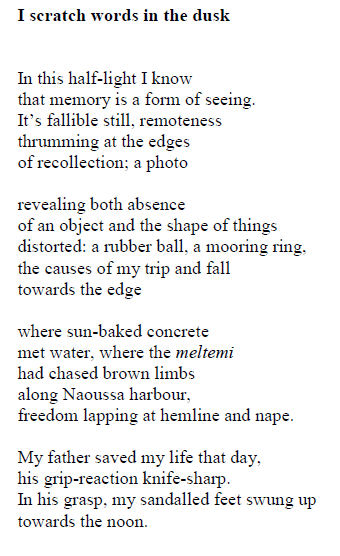
Memory as a form of seeing

Despite claiming in ‘Dust and Order’, the opening poem in my debut chapbook, that I don’t do elegies/ nor inwardly lament the passing of being/ from skin and bone to earth again, many of the poems in ‘Some Indefinable Cord’ contain an elegiac, mourning quality. This would be a nod to myself as musician, if it weren’t for the fact that it was subconsciously done. However, my chapbook title is a purposeful play on the homophones ‘cord’ and ‘chord’, and indeed, either could have worked. In the end I chose ‘cord’ as the essential element of the collection was…

View original post 586 more words

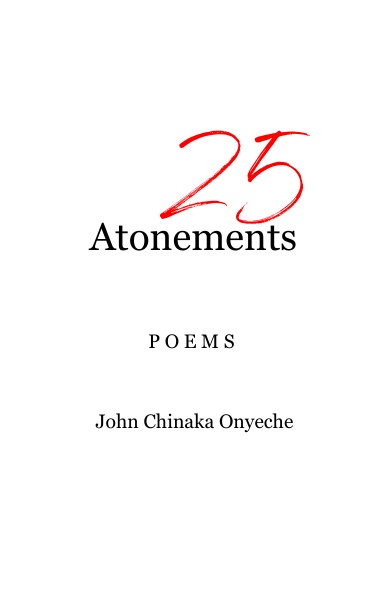
Book Review of “25 Atonements” from John Chinaka Onyeche (reviewed by Aondonengen Jacob Kwaghkule)

davidlonan1's avatarFevers of the Mind

GRIEF IN CONTEMPORARY POETRY: AN AFTERMATH OF MALADMINISTRATION OF MOST 21ST CENTURY SOCIETIES; A GLANCE AT JOHN CHINAKA ONYECHE’S 25 ATONEMENTS.

BY: Kwaghkule Aondonengen Jacob.

25 Atonements is a forty paged poetry book penned by John Chinaka Onyeche. It is embedded with a lot of literal and figurative accurately engineered aesthetics. All the poems in the said collection are stylistically titled and numbered in Atonements from one to the twenty-fifth Atonement. Of a truth, all these poems are wow-stricken as well as mind-blowing considering the tone and the era in which they have been rendered.

Grief, according to English Dictionary means suffering, hardship. Grief is also defined as pain of mind arising from misfortune, significant personal loss, bereavement, misconduct of oneself or others, etc.; sorrow; sadness. Grief is the cause or instance of sorrow or pain; that which afflicts or distresses; trial.

In the poetry book, 25 Atonements

View original post 855 more words

Poetry inspired by Joni Mitchell from Diane Elayne Dees

davidlonan1's avatarFevers of the Mind

For Joni

The canyons echo the coyote's mournful cry
of loneliness, for which there are no words,
yet suddenly, like graceful home-bound birds,
the words appear as written on the sky.
The painted ponies dip, then leap so high,
they startle us. In silver-bridled herds,
they bear us through the grand and the absurd;
at journey's end, we still do not know why.
And yet the music calls us to go on,
amid an often misty atmosphere
that tends to blur the darkness and the light.                                     
The melodies remain after we've gone,
as glorious reminders we were here,
though we are stardust scattered in the night.

Originally published in the anthology, Poeming Pigeon: Poems About Music 

BIO:

Diane Elayne Dees is the author of the poetry chapbooks, Coronary Truth (Kelsay Books) The Last Time I Saw You (Finishing Line Press), and The Wild Parrots of Marigny (Querencia Press). Diane…

View original post 44 more words

Postcards To Ma by Martin Stannard (Leafe Press)

tearsinthefence's avatarTears in the Fence

You have to take a deep breath before you dive into this pamphlet, which is actually a single twelve page long poem. Not only because of its length, but because you will need as much oxygen in your brain to cope with digressions, lists, and the unreliable, perhaps even irrational, narrator.

Stannard is adept at keeping a straight face, however weird his poetry gets, and for taking language on long, surreal walks. He’s also good at using repetition and near-repetition, to help structure his work. In this long poem, which starts with the narrator noting that he ‘Sent a picture postcard to Ma “Arrived Safe”‘, this involves variations of the theme of how people see him and similes for how he sleeps,irregular reoccurrences of phrases such as ‘Special Offer!!!’ and a kind of chorus to break up the flow:

Crack of dawn Swam in
ocean Frolicked on sand Sent postcards…

View original post 616 more words