Wombwell Rainbow Interviews: Sunil Sharma

-Sunil Sharma

Toronto-based author-academic-editor, Sunil Sharma has published 23 creative and critical books— joint and solo. He edits the Setu journal: https://www.setumag.com/p/setu-home.html

For details, please visit the website: https://sunil-sharma.com

The Interview

1. When and why did you start writing poetry and fiction?

Some 12-13 years ago, poetry happened as a way of expressing the mood, idea/s and the world in words and imagery. 

Fiction preceded the beginner- poetry phase by a few years. 

I was freelancing for a top daily of India, apart from being a regular college professor. Teaching, freelance journalism and then creative writing and editing—these happened in a day’s work, so to say, and were all tools of processing the immediate contexts in language codes, specific to the fields. 

Teaching undergrads the essentials of communication, for example, tutorials on writing and speaking—thus guiding the learners about the grammar and rules of written and spoken English for a young audience for whom it was a second language; then, composing short poems on certain ideas or a striking image seen in Mumbai—or elsewhere; filing news reports; working on a short fiction or a novel—these things were mutually reinforcing and dealt basically with communication as a creative process in a linguistic medium that was the legacy of the Raj and subsequently, nativized as as an official form of social conversation on daily basis in a multilingual nation.

Ultimately, you were dealing with the complex realities of a developing economy through a language not your own, yet your own through usage.

If journalism reported about the news-worthy incidents through news stories, the same prosaic realities were conveyed imaginatively by fiction and poetry for different audiences.

The former carries an expiry date.

The latter did not have any such deadlines.

So, deep down, it was all about communication only—conveying of various truths and facts through varied forms of narration and genre, within their own rules and limitations.

In brief, about your place in history—about human condition.

2. Who introduced you to poetry?

Life ! A middle-class loving home. My parents were teachers. Father taught Hindi Lit. and  introduced me to the uplifting worlds of art and culture of the world in Hindi, English, Urdu, Punjabi and translations. Ma was a drawing teacher and taught me the value of colours.

Rest was a continual discovery— a personal life-long odyssey; a ceaseless quest for new continents and regions—spirit homes; realms; kingdoms—visual and verbal; totalizing aesthetic units, wholesome, nutritious, enriching.

Forging new alliances.

Finding fresh epistemes and meanings in a dialectical process.

Witnessing summits on clear sunny mornings.

Life—revealed in its complete mystery and splendour.

One encounter with the Bard on a stormy afternoon in the monsoon-soaked Mumbai or with Tolstoy or Gorky or Picasso or Brecht or Prem Chand or Ghalib—enough for many life times!

3. How aware are and were you of the dominating presence of older poets traditional and contemporary?

I inherited a liberal background. The seventies and eighties were open, democratic and pluralistic in orientation—the pre-globalization, pre-Brexit times. The Berlin Wall came down in 1989. The mood was celebratory everywhere.
We were born into certain dreams nourished by democracy and its sister—art.

As a nation, the alert public was largely aware, among others, of deep impact of the Classics and Neo-classics; Romantics, Symbolists, Impressionists, Expressionists, and Modernists and Postmodernists; Wagner and Bach; the Beatles; Elvis and Dylan Thomas and Thomas Mann, not in this order but these movements and names were appreciated for their lasting cultural influence across the world.

As a student of literature, I, too, followed the arts and updated my knowledge, keeping current.
Learning a lot from Charles Simic or Les Murrey or Constantin Cavafy or Seamus Heany or Derek Wacott—to name randomly influences, of looking at the world in a certain way.

We were, as the children of the liberal humanism, eager to consume culture in those innocent times without the turbulence of social media and Internet-induced, Internet-mediated landscapes of viral celeb status and subsequent drowning in chatter—and toxic wars.
Print media was respected and radio was a good medium.
We learned a lot from the print medium. From the magazines and journals.
Everything changed post-nineties.

4. What is your daily  writing routine?

—Not fixed. Earlier in Mumbai, when working as a principal, two-three hours in the evenings, after returning from college.

These days, in Toronto, often in the mornings and late afternoons. 

A lot depends on the inspiration and genre—poetry can be finished easily, while a short story or a novel is spread out over many sessions across months. Most demanding is the short-and long-form fiction. If a poem is sometimes done in one sitting— later revisions apart— short fiction takes weeks. The big-canvas novel requires more attention, concentration and thinking. 

Currently I am engaged with my second political novel and it has taken me almost two years to finish 280 pages–hiatus apart.

Still, it is not complete and might take a 100 or so pages.

It is a kind of deep meditation.

The challenge is more for writers who are obscure and do not have big-name agents or publishers rooting for them. It is a lonely journey and rejections make it painful and tough.

You keep on working in the dark—surprising, this tenacity! —but your brain, it seems, is wired for that creative job; an occupation that does not pay in a mercenary culture and renders you as suspect in a reified world!

I raise these issues in my humble way.

And then the self-doubts!

Are you headed in the right direction?

5. What motivates you to write?

The same compulsions that make organic creatures communicate in a group or collective; a well-regulated and ordered collective or social formation. Communication is sine qua non of living breathing acting moving as a whole, a unit; a state of being; producing complexes of productive meanings and relationships; a signing system of being alive—writing/singing/painting/sculpting/movie-making, these are all code creations and necessary for existence and sense of animation. Silence, coma, speechlessness—all worrying symptoms of withdrawal, decay, of a retreat into a shell…and final cessation, this embracing of the condition being incommunicado. Anti-social.
Lack of communication signifies being comatose.

Remember Eliot?

When the evening is spread out against the sky
Like a patient etherized upon a table.

Writing is a stance against stasis; impending death; a strategy of resisting stagnation and atrophy in a homogenizing culture. it is coming alive in the storms of life, and singing eloquently about the logic, absurdity, beauty of certain feelings, situations, moods that continue to haunt the succeeding generations:
Blow, winds, and crack your cheeks! rage! blow!
You cataracts and hurricanoes, spout
Till you have drench’d our steeples, drown’d the cocks!

It is writing life into art. Documenting the Unsaid and the Unseen and Seen.
It is like breathing. Lucky, if it is pure air.
Unlucky, if it is damp and stinking on a smoggy day—but breathe you have to.
Writing is about living…and beyond.
Great writers and artists are high summits of civilizations that guide humankind forever.
In their shadows, plebeians like me continue to slog, joining the long caravans with their small and humble gifts… .

6. What is your writing work ethic?

Not a fixed one. More of a gardening style—you go out on an urge to work the yard, feel the earth, smell the soil and flowers and the grass including the sheared weeds and see the insects and butterflies—a brief labour, outdoors, that rejuvenates and re-connects you with the mother earth.
Working full time earlier left little scope for a dedicated schedule of writing. Two-three hours a day for creativity, whenever the urge overtook. Fallow period.
Being an unsolicited writer (generally) has its own charm and autonomy.
No deadlines.
No pressure.
Like planting roses and trimming them as per your wish.
Commercially successful writers or celeb ones keep on following a work ethic— as I read some place: Stephen King producing 2,000 words a day; Haruki Murakami, up at three in the morning or so and working six-seven hours; Hemingway getting up at the first light and writing till mid-day and many others.
For anonymous writers like me, it is not a grilling regimen but an avocation and its attendant freedom is liberating.
Often, now, I will say—three-four hours a day, followed by a long hiatus sometimes, as you have no pressures of the market and can afford to go by your heart.
For that to happen, an idea must compel you to write on.
It gives you joy!
That is enough!

7. How do the writers you read when you were young influence your work today?

Not exactly an influence but some of them continue to be fellow-travelers on a complex journey called Life and make me understand its richness, paradoxes and contradictions, and finding hope in bleak landscapes. The most enduring is the Bard whose work is a complete encyclopedia of human actions, motives, emotions and relationships; about power, loyalty, family, friendship, betrayal; darkness and light; islands, kingdoms,tempests and magical resolutions, both tragic-comedic—and so many other aspects of human condition. You go back to Tolstoy for moral growth and resurrection; Gorki for finding hope and optimistic humanism, even in the lower depths; Dostoevsky for an inner illumination and outstanding religious and political debates essential for civilizations; Turgenev for understanding hypocrisy of the landed aristocracy of feudal Russia and prose lyricism;Chekhov for the psychological understanding and creating art in the mundane; O’Henry or Mauspassant for surprises that stay on for decades, despite the time-lines being Other; Hemingway for a heroic code in war-ravaged lands, bull-figting, big-game hunting and climbing our own Kilimanjaroes and finding some clean well-lit places there, even though you are neither an ambulance-driver, boxer, climber or hunter; these are but some icons, in a long career as a learner and apprentice to the canonical artists and life, with its myriad challenges and beauties and surprises; its suns and moons, rains and summers, winters and springs.

Writers. Not all. But some, as the souls of cultures.
Sacred texts!
They are the source of glorious light.
You come to find echoes of your own times and stories in them—so forward-looking their vision is!
Influence can lead to a copy, a bad copy, a fan moment only: Who can copy a Kafka, Gogol, Pushkin, Faubert or Lu Hsun?

They are the Eternal Masters: the bright stars guiding their devoted seekers on the long and tortuous paths of right action and conduct.

They are an integral part of your organic whole, irrigating arid-scapes of Homo-cultura.
You discover your own masters and choose to learn from them—assimilation and synthesis in a dialectical form and thereby, out of this intertextuality, further evolution and growth, leading to your own distinct voice, in a din of the market.

8. Who of today’s writers do you admire the most and why?

To name a few for a reader in a hurry:
—Elena Ferrante for writing Neopolitan realities into her by-now cult books that are not only about Italy but also about us as a society; her resistance to the literary markets; refusal to become a commodity as an author by adopting anonymity; not to seek any celeb status in mass culture—much like J.D.Salinger avoiding unwanted publicity. Very few writers have this courage these days, when every writer wants to be on the best-selling lists and a celeb. Here, listen to this unique voice: “You see? In the fairy tales one does as one wants, and in reality one does what one can.”
—Toni Morrison for exposing grim facts about the American experience and what it means to be black and a woman amid poverty and violence—things that resonate across other cultural geographies, and a quick reality check: “In this country American means white. Everybody else has to hyphenate.”
—Maya Angelou for giving hope for the broken caged birds: “…for the caged bird
sings of freedom.”
—Margaret Atwood for dystopias that look familiar in pandemics and totalitarian times: “Don’t let the bastards grind you down.”
—Haruki Murakami for making real other worlds plausible, including talking cats for an age seeking parallel worlds, and finding meanings in struggles and storms: “When you come out of the storm, you won’t be the same person who walked in. That’s what this storm’s all about.”
The list can go on…

9.

9 What would you say to someone who asked you “How do you become a writer?”

f I am lucky enough!
If a reader cares to ask, after stumbling across one of my humble offerings, I will quote Flannery O’Connor: “I write to discover what I know.”
If the reader still insists on amplification, I would say: “Well, to express some compelling ideas, I write. By chance. Rest, not on chance!”
Humans are born as writers—some work on that faculty. Deep down, we all are storytellers!

10. Tell me about the writing projects you have on at the moment.

Trying to finish my second political novel. Fifth book of short fiction being published soon. Revising my eighth poetry collection. Editing of Setu goes on …Looking for a publisher for my novel.
And dreaming of equitable worlds…

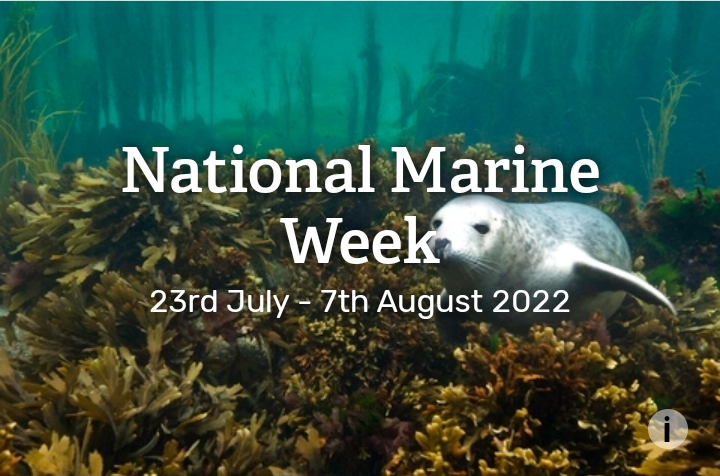
Celebrate #NationalMarineWeek 23rd July 7th to August 2022. Day Seven of Fourteen Due To Tides. Join Larissa Reid, Margaret Royall and I. A challenge for you. Write or design a response to the imagistic daily poetry about the marine written by Larissa Reid. Send me your own responses to her work or your own responses to the marine theme via poetry/artworks/short prose. Please contact me with your work, plus a short third person bio.

Otter

He streams,
Running the shore like ink over paper
Before pausing to crack a crab claw
And gnaw his way through to flesh.
Replenished, he dives,
Melds into green waves.
In honour of this liquid creature
Who twists between worlds
Blending shadow and light;
I must turn my jealousy in on itself
Loosen it and shake it off
Like a selkie’s skin shed onto sand
Then I’ll return to the water
Swim effortlessly, tirelessly, endlessly
Learn to bend the waves to my will
Before I meet him again, one day,
In the sea’s sliding shadows.

-Larissa Reid


Love on a Hebridean Beach

She straddles the hull of an upturned fishing boat,
sunburnt toes dipped carelessly in the rock pool below.

Early morning haze clings to the halo of mermaid curls
framing a face wise before its time. Flicking the wayward

strands behind her ears, her focus travels across the Sound
to the far shore, framed by an outcrop of stark lewisian gneiss,

looming mysteriously, its edges glinting through drifting mist,
evoking the gentle mood of paintings by Peploe or Caddell

On the incoming tide a silent rip current curls furtively ashore,
white spume pulling back fiercely from the rock-strewn beach.

Far across the Sound a boatman is launching his weathered craft;
snaked coils of rope secure the rusty lobster cages to the bulwarks.

As yet he is invisible to her and she to him; only the chug chug
of the reluctant motor audible, groaning as it toils across the inlet.

He waves across to her, shielding his brow with youthful hand,
the allure of her beauty hot in his head, lips plump with promise.

She carves a love-heart in the bleached sand, mindful of the time…
they only have a scant hour of Cupid’s grace for their first tryst.

A frisson of sweet anticipation courses through her veins …
the first flush of innocent love riding high on the morning tide.

-Margaret Royall

Bios And Links

-Larissa Reid

A freelance science writer by trade, Larissa has written poetry and prose regularly since 2016. Notable publications include Northwords Now, Silk & Smoke, Green Ink Poetry, Fenacular, Black Bough Poetry Anthologies, and the Beyond the Swelkie Anthology. She had a poem shortlisted for the Janet Coats Memorial Prize 2020. Larissa is intrigued by visible and invisible boundary lines in landscapes – geological faultlines, myth and reality, edge-lines of land and sea. Based on Scotland’s east coast, she balances her writing life with bringing up her daughters. Larissa is a founder member of the Edinburgh-based writing group, Twisted::Colon.

Margaret  Royall

has six books of poetry published. She has appeared widely in print, in webzines and  poetry anthologies,  has won or been short-listed in several competitions and her collection ‘Where Flora Sings’, published by Hedgehog Press, was nominated for the Laurel Prize in 2021. Her latest collection, ‘Immersed in Blue’ was published in January 2022 by Impspired Press. She leads a women’s poetry group in Nottinghamshire and takes part in open mic sessions online and in person. She is currently working on a third poetry collection.

Website: https://margaretroyall.com/ Twitter:@RoyallMargaret Instagram: meggiepoet

Celebrate Wombwell Rainbow Interviews with me over 26 Days. Today is Letter T. One letter a day displaying all the links to those interviews. We dig into those surnames. Discover their inspirations, how they write, how did they begin. Would you love to have your name featured here? Contact me.

Aplollinaire and other horses by VVBT

T, VVB https://thewombwellrainbow.com/2019/02/11/wombwell-rainbow-interviews-vvbt/

Tabaka, Anne Christine https://thewombwellrainbow.com/2018/09/10/wombwell-rainbow-interviews-anne-christine-tabaka/

Tarbard, Grant https://thewombwellrainbow.com/2018/10/22/wombwell-rainbow-interviews-grant-tarbard/

Tannam Anne https://thewombwellrainbow.com/2019/10/20/wombwell-rainbow-interviews-anne-tannam/

Tarkelly, Timothy https://thewombwellrainbow.com/2019/07/08/wombwell-rainbow-interviews-timothy-tarkelly/

Taylor, Jonathan https://thewombwellrainbow.com/2018/12/27/wombwell-rainbow-interviews-jonathan-taylor/

Thayil, Jess https://thewombwellrainbow.com/2019/08/12/wombwell-rainbow-interviews-jess-thayil/

Thistleton, Clay https://thewombwellrainbow.com/2019/06/11/wombwell-rainbow-interviews-clay-thistleton/

Thomas, Gwil James https://thewombwellrainbow.com/2018/11/24/wombwell-rainbow-interviews-gwil-james-Thomas/

Thomasino, Vincent St Gregory https://thewombwellrainbow.com/2018/10/30/wombwell-rainbow-interviews-gregory-vincent-st-thomasino/

Thompson, Gill https://thewombwellrainbow.com/2019/07/25/on-fiction-wombwell-rainbow-interviews-gill-Thompson/

Thompson, Pam https://thewombwellrainbow.com/2019/06/26/wombwell-rainbow-interviews-pam-thompson/

Tobin, Grainne https://thewombwellrainbow.com/2019/06/12/wombwell-rainbow-interviews-grainne-tobin/

Toltzis, Alan https://thewombwellrainbow.com/2018/12/14/wombwell-rainbow-interviews-alan-toltzis/

Topping, Angela https://thewombwellrainbow.com/2018/09/28/wombwell-rainbow-interviews-angela-topping/

Trethewey, Jordan https://thewombwellrainbow.com/2018/09/22/wombwell-rainbow-interviews-jordan-trethewey/

Trevien, Claire https://thewombwellrainbow.com/2018/12/07/wombwell-rainbow-interviews-claire-trevien/

Tuatha, Wren https://thewombwellrainbow.com/2018/09/19/wombwell-rainbow-interviews-ian-parks/

Tuboson, Kola https://thewombwellrainbow.com/2018/11/25/wombwell-rainbow-interviews-kola-tubosun/

Tudor-Sideri, Christina https://thewombwellrainbow.com/2018/11/06/on-poetic-memoir-wombwell-rainbow-interviews-christina-tudor-sideri/

Tyrrell, Thomas https://thewombwellrainbow.com/2018/12/30/wombwell-rainbow-interviews-thomas-tyrrell

Trumpets Stuffed With Cloth by Ralph Hawkins (Crater Press)

tearsinthefence's avatarTears in the Fence

This is a beautifully put-together chapbook filled with beguiling poems/texts which appear to combine found materials with non-sequiturs and aleatory work which is full of surprise and wit. You’ll never get bored reading this stuff.

There’s a sense of the hermetic about these pieces insofar as they feel self-enclosed and often generated by a thought, some vocabulary, an artwork (Hawkins is very influenced by visual art-forms) which then becomes the wandering focus of the whole. At the same time there are political references and nods to ‘the outside world’ which keep you very much on your toes.

de chirico

in the paintings there are few signs of people

yet there is evidence of creation

in the towers and squares, the sun

being the centre of it

I am running into the distance

attached to shadow

afraid they will catch me

I hold up his baby daughter and smile at her…

View original post 452 more words

Covodes 1-19: An Interview with Robert Hampson by Belinda Giannessi

tearsinthefence's avatarTears in the Fence

BG: I have just finished reading (and listening to) yourCovodes.[i]I found them very interesting because they catch not just the historical events that mingled in our memories but also the emotions, the fears and the frustration that we all experienced. If you don’t mind, I would like to ask you some questions. First, do all the references to music give a sort of frame to the collection, keeping together and giving order to all the fragments of the last two years of plague?

RGH: I think I would see the musical references as a motif rather than a frame. There were various motifs I was conscious of developing as the writing proceeded. The musical references were also to be taken with the references to poetry and the visual arts as a celebration of the value of the arts in the context of the British Government’s attacks…

View original post 660 more words

Celebrate #NationalMarineWeek 23rd July 7th to August 2022. Day Six of Fourteen Due To Tides. Join Larissa Reid, and I. A challenge for you. Write or design a response to the imagistic daily poetry about the marine written by Larissa Reid. Send me your own responses through poetry/artworks/short prose. Please contact me with your work, plus a short third person bio.

Shells

The conversation opened and closed
Cold and blue as a mussel shell,
Despite the dancing fire
That made the sand around us
Flash like fireflies.
But the sea salt scours us clean;
A swim in the curving green swell
Prises open enough to glimpse a gleam,
A mutual love of the fold of arm through water,
And the rhythm of breath matching waves;
Naked in that tattooed ocean
Two among many;
A party brought to the lip of the land
And kissed by the northern solstice.

From the rock|salt art and poetry collaborative project, 2022 – follow us on Instagram @rocksaltproject

-Larissa Reid

Bios and Links

Larissa Reid

A freelance science writer by trade, Larissa has written poetry and prose regularly since 2016. Notable publications include Northwords Now, Silk & Smoke, Green Ink Poetry, Fenacular, Black Bough Poetry Anthologies, and the Beyond the Swelkie Anthology. She had a poem shortlisted for the Janet Coats Memorial Prize 2020. Larissa is intrigued by visible and invisible boundary lines in landscapes – geological faultlines, myth and reality, edge-lines of land and sea. Based on Scotland’s east coast, she balances her writing life with bringing up her daughters. Larissa is a founder member of the Edinburgh-based writing group, Twisted::Colon.

Celebrate Wombwell Rainbow Interviews with me over 26 Days. Today is Letter R. One letter a day displaying all the links to those interviews. We dig into those surnames. Discover their inspirations, how they write, how did they begin. Would you love to have your name featured here? Contact me.

Radhakeeson, Vatsala https://thewombwellrainbow.com/2019/01/23/wombwell-rainbow-interviews-vatsala-radhakeesoon/

Ravenwood, Sage https://thewombwellrainbow.com/2019/08/19/wombwell-rainbow-interviews-sage-ravenwood/

Rawlinson, kerry https://thewombwellrainbow.com/2020/01/06/wombwell-rainbow-interviews-kerry-Rawlinson/

Ray, Ben https://thewombwellrainbow.com/2019/01/29/wombwell-rainbow-interviews-ben-ray/

Raynard, Peter https://thewombwellrainbow.com/2018/09/24/wombwell-rainbow-interviews-peter-raynard/

Reeve, Camilla https://thewombwellrainbow.com/2018/12/05/wombwell-rainbow-interviews-camilla-reeve/

Reeves, Amanda https://thewombwellrainbow.com/2019/08/28/wombwell-rainbow-interviews-amanda-reeves/

Richards, Victoria https://thewombwellrainbow.com/2019/05/03/wombwell-rainbow-interviews-victoria-Richards/

Ridgeway, Kevin https://thewombwellrainbow.com/2019/01/21/wombwell-rainbow-interviews-kevin-ridgeway/

Riley, Peter https://thewombwellrainbow.com/2019/09/25/wombwell-rainbow-interviews-peter-riley/

Riley, Wayne https://thewombwellrainbow.com/2019/01/05/wombwell-rainbow-interviews-wayne-riley/

Rio, Isabel del https://thewombwellrainbow.com/2019/06/24/wombwell-rainbow-interviews-isabel-del-rio/

Rivers, Bethany https://thewombwellrainbow.com/2018/09/24/wombwell-rainbow-interviews-bethany-rivers/

Robbins,John Patrick https://thewombwellrainbow.com/2018/10/06/wombwell-rainbow-interviews-john-patrick-robbins/

Robinson, John D. https://thewombwellrainbow.com/2018/11/04/wombwell-rainbow-interviews-john-d-robinson/

Roe, David https://thewombwellrainbow.com/2019/04/28/wombwell-rainbow-interviews-david-roe/

Rojas, Andres https://thewombwellrainbow.com/2019/08/06/wombwell-rainbow-interviews-andres-rojas/

Rose, Evrah https://thewombwellrainbow.com/2019/08/03/wombwell-rainbow-interviews-evrah-rose/

Rosenstock, Gabriel https://thewombwellrainbow.com/2019/01/24/wombwell-rainbow-interviews-gabriel-Rosenstock/

Ross, Debra Sasak https://thewombwellrainbow.com/2018/09/16/wombwell-rainbow-interviews-debra-sasak-ross/

Roskos, Dave https://thewombwellrainbow.com/2018/09/13/wombwell-rainbow-interviews-dave-roskos/

Rossi, Mark Anthony  https://thewombwellrainbow.com/2018/09/19/wombwell-rainbow-interviews-mark-anthony-rossi/

Royall, Margaret https://thewombwellrainbow.com/2020/06/06/wombwell-rainbow-interviews-margaret-royall/

Ruggieri, Helen https://thewombwellrainbow.com/2019/06/21/wombwell-rainbow-interviews-helen-ruggieri/

Russamano, David https://thewombwellrainbow.com/2019/08/28/wombwell-rainbow-interviews-david-russamano/

Russell, Ryan https://thewombwellrainbow.com/2019/08/23/wombwell-rainbow-interviews-ryan-russell/

Wombwell Rainbow Interviews: Peter Clive

-Peter Clive

lives on the southside of Glasgow, Scotland with his wife and their three children. He is a scientist who has worked in the renewable energy sector for nearly two decades. As well as poetry, he enjoys composing music for the piano and spending time in the Isle of Lewis and St Andrews with family. His first poetry collection, “the end of the age of fire,” about climate change, was published to coincide with COP26 and is currently available. “stowaway” is his second collection.

Links to collections

stowaway: https://www.lulu.com/en/us/shop/peter-clive/stowaway/paperback/product-qm8qjd.html 

the end of the age of fire: https://www.lulu.com/en/us/shop/peter-clive/the-end-of-the-age-of-fire/paperback/product-vnr4kd.html

The Interview

1. When and why did you start writing poetry?

I started writing when I was a teenager, however I was aware of my limited experience at the time and chose to focus more on music as a creative outlet. I play and compose for the piano and have played keyboards and bass in various bands. I’d say my piano composition was what I was most invested in until I returned to poetry in my late 30s and early 40s. I’d have to admit that there was a practical reason at first: it is easier to write poetry when you have a young family than it is to write music, as you are generally not disturbing anyone or keeping them awake. However, I quickly came to appreciate writing poetry as a means for introspection and personal growth.

2. Who introduced you to poetry?

I’ve always been aware of poetry since I can remember. My gran wrote poetry in large hardbound foolscap notebooks, which was often humorous observations on individuals or life in general, and she would entertain my sisters and I with it as children. She was a great animal lover and so animals and birds often provided subjects for her writing. There were more serious poems that she wrote during periods of insomnia and depression which we discovered later. She had a very keen sense of social justice and so some poems expressed a strong sense of righteous indignation.

3. How aware are and were you of the dominating presence of older poets traditional and contemporary?

There was always a certain sense of reverence in my family about Robert Burns and Omar Khayyam when I was growing up. I can still recite sections of the Ruba’iyat from memory from hearing my father launch into it when I was a child. Coleridge and Shelley were present too: I recall my mother reading me the Rime of the Ancient Mariner when I was 4 or 5, and my father very dramatically reciting Ozymandias. There was also Palgrave’s Golden Treasury. In addition, we were exposed as children to British imperial poetry to stir our patriotic zeal, the likes of The Charge of the Light Brigade and Casabianca and so on, in a way that seems utterly alien and incomprehensible now, thankfully. At the same time the poets of the Scottish Renaissance, the mid-20th century literary revival, were read. My father was particularly fond of William Soutar, whereas I probably gravitated more towards Norman MacCaig. A lyric sense was probably derived from folk song. My mother sang professionally with her sisters, and Scottish and Irish folk music was a constant presence.

4. What is your daily writing routine?

I find there isn’t a routine. I have periods during which I seem to be quite productive, producing more than one poem a day, and other fallow periods where I just don’t seem to have a conducive mindset or the necessary energy. At the same time, I do think it is often important to let things develop slowly at the back of your mind over a long period of time, especially the longer poems. These can take shape over a matter of weeks as a result of long periods of reflection on the subject on trains and buses, or while walking to work. There is a gestational process for some subjects. Other poems emerge almost fully formed immediately and are ready after a day’s revision and polishing.

5. What subjects motivate you to write?

I have noticed certain themes I return to. I produced a collection called “the end of the age of fire” that was concerned with climate change. But beyond that what it was concerned with was taking a very longitudinal view of the human situation, looking at our presence in the broadest possible context, the sum total of our impact as a species over the entire duration of its presence on Earth, and what that means, what it tells us about ourselves.

This is consistent with other pre-occupations I have, such as the metaphysical reflections about the universe and our place in it which I will cover in the forthcoming collection “Moonsong”. Poetry allows us to discuss the world from a place where ethics and aesthetics, physics and metaphysics, are all one and the same thing, deriving from a perspective, a viewpoint, that one has when one stands apart from quotidian urgencies into that other time and space created by poetry. I think that unity, and trying to find a voice for it, to express the inexpressible experience of it, is a powerful motivation for me. All creative endeavour should aim to achieve the impossible. A poet is concerned with finding the miraculous in the meaningless. This is the fundamental act of creation we seek to emulate.

6. What is your work ethic?

I cannot claim to have much of a work ethic. I wish I did. I find myself either responding to ideas on an impulsive basis or poring over the material I have produced as a result late at night.

7. How do the writers you read when you were young influence your work today?

I am not sure I can really attribute an influence to the writers I admire. An appreciation, but not necessarily and influence, as that would suggest it is within my power to absorb and express that influence. The achievements of the poets I admire seem impossible to me. For example, I recall discovering Paul Celan for the first time when I was young. I was completely blown away. It’s difficult to describe the effect. At the same time there is no way I could or would ever attempt to emulate anything about his work. I would not insult the impossible by suggesting it could be repeated. Similarly, I remember when I first read Rabindranath Tagore’s Gitanjali, which just seemed utterly miraculous. At the same time, I don’t think you could find two things more different than the work of Celan and Tagore.

I like to think the main influence on my poetry is still music, which has been my main creative outlet for most of my life. I think of poems, especially longer pieces, in symphonic terms, composed from ideas rather than melodies and harmonies, to engage the reader and progress them through states of mind. This inevitably places some distance between me and a reader who is looking for something else, the spoken word staples of emotional honesty and relatable content. I see myself as more of a page poet rather than a stage poet. I’m trying to achieve a different kind of impact.

8. Whom of today’s writers do you admire the most and why?

This is such a difficult question, as there are so many! Off the top of my head I would say David Ross Linklater, Jane Lovell, Mary Ford Neal, Morag Anderson, all people who made me think “wow, this is the real deal” when I first encountered their work, Louise Glück (I remember picking up Averno for the first time and simply being unable to put it down, it was so compelling), Andrea Gibson (I recall reading her for the first time in a bar in Boulder, Colorado, being moved to tears by The Madness Vase, and getting thrown out for ruining people’s enjoyment of the ice hockey game). I admire directness and concision, I admire work that penetrates to the essence of something and reveals it deftly.

9. Why do you write, as opposed to doing anything else?

It certainly is a compulsion. On the one hand there is the feeling that some things need to be said, but that raises the question of why I should be the one to say them, and whether I contaminate them with my ego by doing so. Therefore, there is also a sense in which writing is a search for beauty that exists independently of the self. I have said previously that beauty is the experience of seeing what the world is like when you’re not in it, the attenuated terror and relief, the cliff edge from which one surveys the breath-taking landscape, the duality of annihilation and transformation. There is a destructive as well as a creative urge, which is inevitable when we as humans attempt to emulate the divine. There is a sense of picking at a scab, of exposing something festering to the light of day. Therefore, many of my poems are quite angry and indignant, but when we consider the evils we have brought into the world and continue to tolerate, I think that is reasonable.

10. What would you say to someone who asked you “How do you become a writer?”

I would say “write”. Begin. Writing is a personal journey, and to become a writer, all one needs to do is take the first step, and to remain a writer, all you have to do is to continue. You don’t even know what needs within yourself you are satisfying when you start. You will develop a deeper awareness of this as you go. Don’t try to answer any questions, don’t prematurely place any burden of expectation on yourself, just start. The rest comes later.

11. Tell me about the writing projects you have on at the moment.

I’ve got a bit of a pipeline of poetry collections in various stages of preparation. Each collection has a degree of thematic coherence, tries to address a particular set of issues or experiences, and has been assembled from work I have accumulated over the years. I think the next two collections I will produce will be “Moonsong,” which reflects on more esoteric, mystical, metaphysical questions, and “Crossing the Minch,” which is more rooted in time and place, being concerned mainly with poetry associated with the Isle of Lewis, where my mother is from, and where I have spent my summers since childhood. I think these may even come out at the same time, sort of like a double album. After than I am considering a collection of poems that include mythological and contemporary themes in which the main protagonist is female, called “19 women”. I also have some reflections on love called “love remains” in preparation, and some more personal poems I might gather into a collection called “feral”.

Celebrate Wombwell Rainbow Interviews with me over 26 Days. Today is Letter Q. One letter a day displaying all the links to those interviews. We dig into those surnames. Discover their inspirations, how they write, how did they begin. Would you love to have your name featured here? Contact me.

Sessions by Lesley Quayle

Quayle, Lesley https://thewombwellrainbow.com/2018/09/21/wombwell-rainbow-interviews-lesley-quayle/

Celebrate #NationalMarineWeek 23rd July 7th to August 2022. Day Five of Fourteen Due To Tides. Join Larissa Reid, and I. Send me your own unpublished/published poetry/artworks/short prose about/mentioning the marine. I am looking to feature your poems/artworks about the shore, shoreline, its inhabitants, the waves, flotsam, jetsam and so on. Please contact me with your work, plus a short third person bio. Let’s celebrate the shore!

Screenshot_2022-07-14-21-07-55-17_40deb401b9ffe8e1df2f1cc5ba480b12

Footprints
For Martin, and Hugh Miller, geologist, 1802-1856

This is where my God resides
Safely embedded in deep time
Surrounded on three sides by tides;
I make my own footprints in age-old sand.
The jellyfish languish on the strand-line;
Perfectly rounded stained-glass windows
Into multicellular souls.
A darkness of basalt cradles crystals
Along shores where eternity crumbles
And remakes itself anew;
Where time is a saviour and I snatch a glimpse
Of past, present and future.
Here, under a vaulted sky,
I will close my eyes, focus in
On sea sounds and the peewits’ cry
And I will say hello and again goodbye
To those I have lost;
Whisper my regrets to those I have wronged;
And dare to hope for those I hold dear.
For this is where my God resides;
Here, beneath slanting rocks
And alongside beckoning tides.

Published in my first poetry pamphlet, In February, 2019

-Larissa Reid

Bios And Links

Larissa Reid

A freelance science writer by trade, Larissa has written poetry and prose regularly since 2016. Notable publications include Northwords Now, Silk & Smoke, Green Ink Poetry, Fenacular, Black Bough Poetry Anthologies, and the Beyond the Swelkie Anthology. She had a poem shortlisted for the Janet Coats Memorial Prize 2020. Larissa is intrigued by visible and invisible boundary lines in landscapes – geological faultlines, myth and reality, edge-lines of land and sea. Based on Scotland’s east coast, she balances her writing life with bringing up her daughters. Larissa is a founder member of the Edinburgh-based writing group, Twisted::Colon.