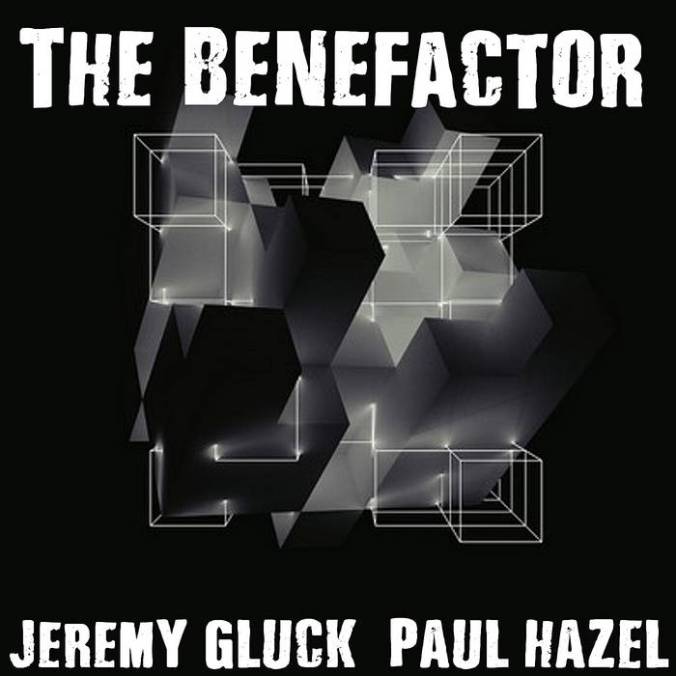
https://youtu.be/Zf8KEYzL-tc
The Benefactor on Bandcamp
-Jeremy Gluck M.A. (Hons)
works as a fine artist in NFT art, postdigital visual and sound art, installation, and performance. In July 2019 he presented his paper on Gustav Metzger at the UWTSD Nexus Conference in Swansea, Wales. He has exhibited in London, Sydney, Bath, and Swansea, is a member of Non-Place Collective based at Fringe Arts Bath, and is a co-founder of Swansea-based Axe Head Collective. A film created by him is now part of the BFI archive.
Part of a growing body of postdigital work built, not born, of “no-production” (the artist’s neologism referring to the phenomenon of the action of unmaking or the process of being so unmade, that point at which the liminal collapses without hope of progression), Gluck’s current practice is an NFT interrogation incorporating live coding, glitch, writing, spoken word, and photography. With its soothing yet unsettling atmosphere, Gluck’s work responds to the world within, the non-place of the subconscious, and its diverse expressions.
Twitter
Instagram
NFT
Facebook
The Interview
Q From your perspective, it will be good to explore how you were introduced to electronica.
A My primary musical influences are actually quite orthodox and considering the character of my electronica tends not to fall into the more predictable categories. I grew up with rock music and with rock music, I largely remain. However, I adore ambient music, especially at the moment the many Solfeggio frequencies and similar video pieces that claim to have therapeutic and holistic benefits; I can listen to these works for hours on end each day. And, also as a keen devotee of Advaita (non-dualism), I love to listen to Indian sacred music, especially mantras.
Part of my motivation for living online from 1995 was, after many reversals offline, the fact that I could control and create without limitation, with no middlemen and no editing. I have operated in the offline recording and publishing worlds with some success, but annoyance with the offline valuation of creative work – ie how much money it makes – pissed me off. I love the virtual arena because it is less concerned with that orientation. Having said this, I have had some satisfaction working offline and value physical products, be it a book, CD, or written article.
I suppose that my first exposure in depth to electronica accompanied my own venturing into (at first very primitively) creating electronic music using samples, loops, and my own voice. Having been a lyricist and singer for many years but never a composer, I found the sudden ability to solely compose very exciting and liberating. My capacities on the machine improved and little by little I became more and more ambitious with my compositions.
So began the years of lonely tinkering. Fascinated by the dynamics and skewed spirit of cyberspace, I used crude PC audio tools to create lateral mutant sound collages that aspired to capture the energy of cyberspace. Chat rooms, cheesy religion, Microsoft, and whatever else I could find pieces of floating around online sound file archives, plus my own cut-up texts, were juxtaposed over abused generic dance music. Everything flowed from that sonic abscess. Twenty or more years later I’ve already had a fantastic creative adventure and sense it is only just beginning.
I rarely write “songs” now, though for years I did. I write poems or texts and record them as spoken words, give them to mixers and stand back. However, depending on the project, I can work quite conventionally on song-structured material. I can spend a lot of time editing my words.
I listen to very little electronic music like my own. One is only so strong…in fact, once I was mixing a track for hours on headphones and at the end of it found myself totally disassociated and neurally damaged. So that mix was a success.
And then, one day, I made a fantastic discovery: If I archived my mixes other people would remix them. I’ve never looked back. And so now, vicariously, I often use other people’s software. People who know how to use it.
For a while, I thrived on an online electronica community named Tapegerm. The standard of work there is very high and the buzz is tangible. I decided, skeptical of my chances, to post an archive of files for “When I Die” from the Div Joyvision album I created with Canadian artist Michael Dent and wait and see. I expected nothing. Shortly, remixes began to come in. Amazing remixes. Michael had worked with Mick Harvey; he ended up doing one. Eric Debris of legendary Paris punk pioneers Metal Urbain did one. Most importantly, it’s how I came across the late Dave Fugelwicz, who did some incredible work with my spoken word material.
I uploaded more archives. More remixes flowed in. I began to see the power and beauty of this idea. How it reinvents your work through others. I was always two people. Now I could see I can and will – must – become a dozen, more, a thousand, a legion. I wasn’t lonely anymore.
Q It will be interesting to know about your collaboration with Paul. How it came about, and so on. Fascinating way to enhance and comment upon the spoken word. How were you introduced to spoken word performance?
A Thinking about it, my spoken word performances were a part of my recorded work from the beginning. Even on my legacy band The Barracudas’ first single, released in 1979, I created a spoken word section, and again on further material with the band. In my solo work that followed spoken word – I have always written poetry and experimented intensively with language, usually using Burroughs and Gysin’s cut-up technique (Burroughs’ debut album from 1966, Call Me Burroughs, is a cornerstone influence of mine) – often featured. Around the turn of the century, although I had been aware of him since my teens, I really discovered Allen Ginsberg, whose early poetry readings, particularly America, and Kaddish, were a catalysing spur to push further into spoken word. Over time several distinct bodies of work tied in with my spoken word emerged, one being The Carbon Manual, an ambient Krautrock trio, and the other of significance being Plasticon, the latter in collaboration with LA Grammy-nominated mastering engineer, and ambient composer, Don Tyler. When I attended Swansea College of Art as a (very) mature student I did a lot of spoken word as well, incorporating it into installations and other media. Lately, through my co-founding of SWND Records I came across the work of Paul Hazel, who founded a label named Bamboo Radical.
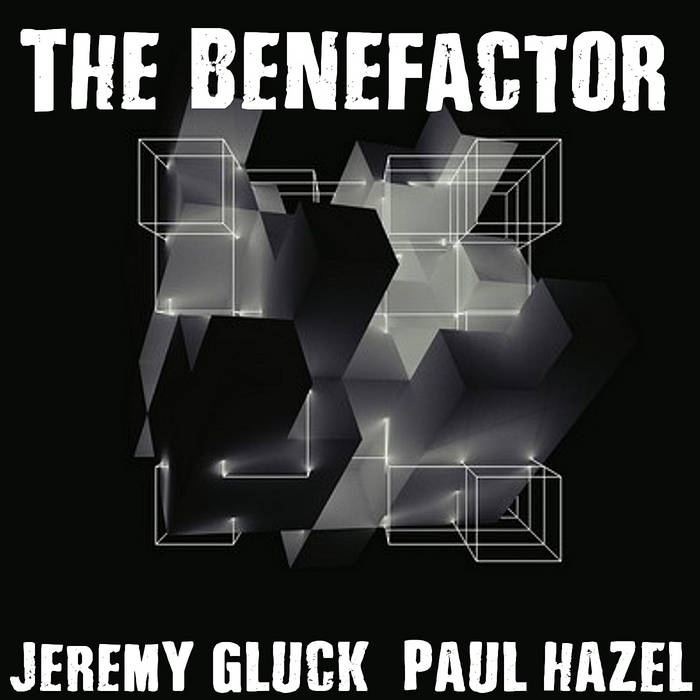
We found we share a lot of common ground and decided to experiment with my spoken word on his very accomplished electronica and it has been a very successful collaboration, that is in progress as I write; we have released a single, Love/I Left the Left Page Blank, and prior to that Paul did a mix for my Plan for a Performance that is on my last album The Self, and that had its debut at Plas Bodfa Continuum on Anglesey in April. This month we have released a single, The Benefactor, the precursor to a further single, both trailing an album to be released early in 2023.
Q Who introduced you to the spoken word, and encouraged you to experiment with it?
A In fact, I would have to say myself. As a writer all of my life of prose, poetry, and much else, the spoken word is something that came to me naturally as means of expression. Also, I suppose that using samples a great deal in my early electronica mixes. past a certain point, it became too predictable and I wanted to introduce my own voice and words into my mixes. Constant experimentation with cut-up led me in 1999 or so to a text entitled Surrendered To My Function that became a sort of standard for what I could achieve with text, and then when performed became a breakthrough. I had already had a lot of experience as a performer, of course, in the studio, and on stage, before I arrived at the spoken word as such, I was given to a lot of spontaneous interaction with an audience verbally, and my voice is good for spoken word, it was a natural evolution. Over the years my, so to speak, “palette” has expanded gradually and my ways of approaching spoken word have diversified. Art college gave me many opportunities to explore how I could widen my usage of spoken word, including an installation I created one year where I had speakers suspended from the ceiling over a maze-like structure, blasting Surrendered To My Function, obligating people to navigate the maze while being bombarded by my voice and dissonant ambient sound. I am very interested in what I call “unlanguage” and using “words as things”, deconstructing language and performance, and incorporating elements of minimalism and auto-destruction. A piece such as Less Poverty Is Needed employs sound art behind a quite deliberately staged spoken word performance, and I do work with a fine balance of spontaneity and intuition to deliver spoken word performances I feel are powerful. Am I my own influence? Perhaps!
Q Why do you find the “cut-up” technique so inspiring?
A From the time when at 16 I was introduced to cut-up, it has compelled me. William S. Burroughs said, famously. “When you cut into the present the future leaks out”, and it is this fact that makes the use of cut-ups so powerful. At first, I used hard copy for cut-ups, employing scissors and sticky tape, but with the arrival of online cut-up machines the process has become much easier and faster.
Many years ago, in a period of relative isolation, I enjoyed a six-month period of intensive creative exploration centered on cut-up and making “unlanguage”. I recall vividly a moment that came when I suddenly saw before me a vista of collapsed reality constructs that waited to crunch and reduce to me zero minus one no limit. I knew for a fact at that moment that given another six months – or weeks even, maybe – the world of dreams we call real would for me be deleted and I would freefall into nothing. Our reality construct is rooted largely in language, which comprises our thoughts that determine our actions. Making the pattern lateral rather than literal – to, as Burroughs said, “Smash the control images” – forces a disruption, a tear, in the fabric of what we call reality and releases a great deal of energy thereby; the cut-up technique throws up endless possibilities for mutating text and challenging text to express aspects of being and explode constructs and contexts in a way that never ceases to intrigue and inspire me.
In recent years, I have relented somewhat, preferring to take a more conventional approach to work with text that is more literal, but I do often revisit cut-up to see what possibilities exist in a text to liberate and deconstruct it.
Q What does electronica give to your spoken word performance?
A Electronica and ambient music have been such a mainstay of my spoken word work for so long that it is now hard to imagine one without the other. I have done spoken work over more organic backing, such as guitars, but it is the collision of the human voice and the machine mind that keeps electronic music the backbone of my spoken word recordings. I don’t play any instruments, so I have always relied on collaborative work to build my spoken word sound art, and this has been the key to its artistic and aesthetic success: the magical and unpredictable nature of working with trusted and talented creatives who I can rely on to surprise and delight me with their interventions. The human voice is very unique and mutable in how it expresses as speech; the electronic mind and voice obey very different rules, and when a conversation takes place between them there is a catalytic conversion, transporting the work through what Burroughs termed The Third Mind. Strictly speaking, as one summation has it, “Burroughs, known to have worked more productively in collaboration with others, wrote that the title stemmed from Think and Grow Rich, a twentieth-century guide to salesmanship by Napoleon Hill, who counseled that when two minds work together there is always a third one that results. Others have interpreted the third mind as coming from the interaction of writing and visual art.” Now, the interaction of spoken word and electronic music is an equally valid trigger for the emergence of a Third Mind, and when working with electronica composers it does appear, that there is a synthesis of the two energies or forces that spits up something that binds and is beyond both. Performing spoken word to an electronic backing calls forth a very different performance to that done acapella or with more organic instruments. The sterility and rigidity of electronic music, born of binary, in collision with the human voice, with all of the latter’s delicate dynamics, never disappoint me in its ability to challenge and lift my performances out of the predictable.








 The Wombwell Rainbow