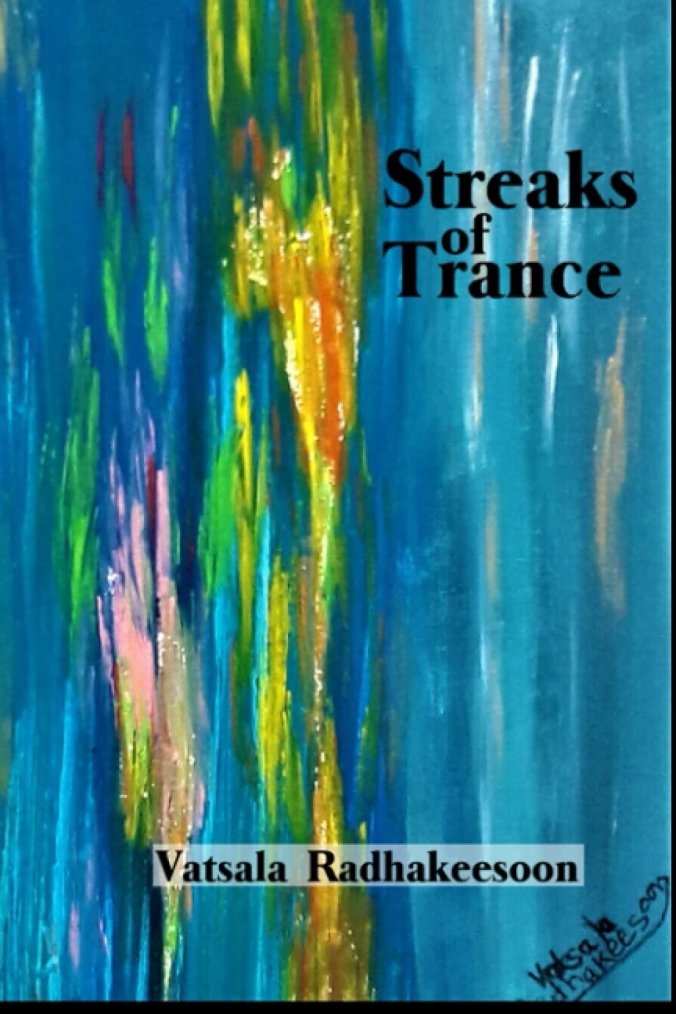
In this unique collection of poetry, including Haiku as well as an eclectic art collection, Radhakeesoon certainly succeeds to put the reader in a welcome poetic and artistic literary trance, whilst never allowing us to look away, even just for a brief moment. We are invited to immerse ourselves in each aspect of this diverse gem of creativity, as we flow with the author in a river of poetry, as well as willingly journey through a gallery of original, timely and revelatory artworks, which somehow fits in with the overall and encompassing essence of this hybrid tour de force.
In the first part of three in this collection; ‘Flow, flow the Words’, Radhakeesoon leaves no stone unturned…
has been writing stories, poems and verses since she was a child. It’s not always what is considered poetry by some, as she isn’t a lover of sweet, schmaltzy rhymes! She is currently writing her first novel. A psychological thriller with a paranormal element, and she hopes to bring out a poetry collection one day! She lives on the Isle of Skye. While some of her poetry is written from personal experience, others are written from her slightly dark and twisted imagination.
I suspect people who know my work might expect the answer to be ‘it isn’t’, because I’m a free-verse kind of spirit who rarely writes to strict form. (One notable exception would be haiku/senryu – writing these is a sort of meditative distillation for me and often a seed/focus for other flow-from-image work, or like catching a passing moment/thought in a butterfly net exactly the right size).)
I greatly admire poets who do write in strict forms, but my brain tends to gravitate to open-ended space rather than absolute rules, unless they’re extremely condensed. What that doesn’t mean is that form isn’t important to my work in the broader sense of its elements. I absolutely do use line length, shape, space (including surrounding space), internal rhyme, cribbed rules of metre in ways that don’t adhere to prescribed patterns, but are crucial to the feeling-translation that I want to hand to a reader, so are very consciously crafted. Probably the elements I apply most deliberately are enjambments and rhythm, they’re enormously important to me – the former so often allows a ‘twist’ of multiple meaning to creep in in the space between breaths, and the second
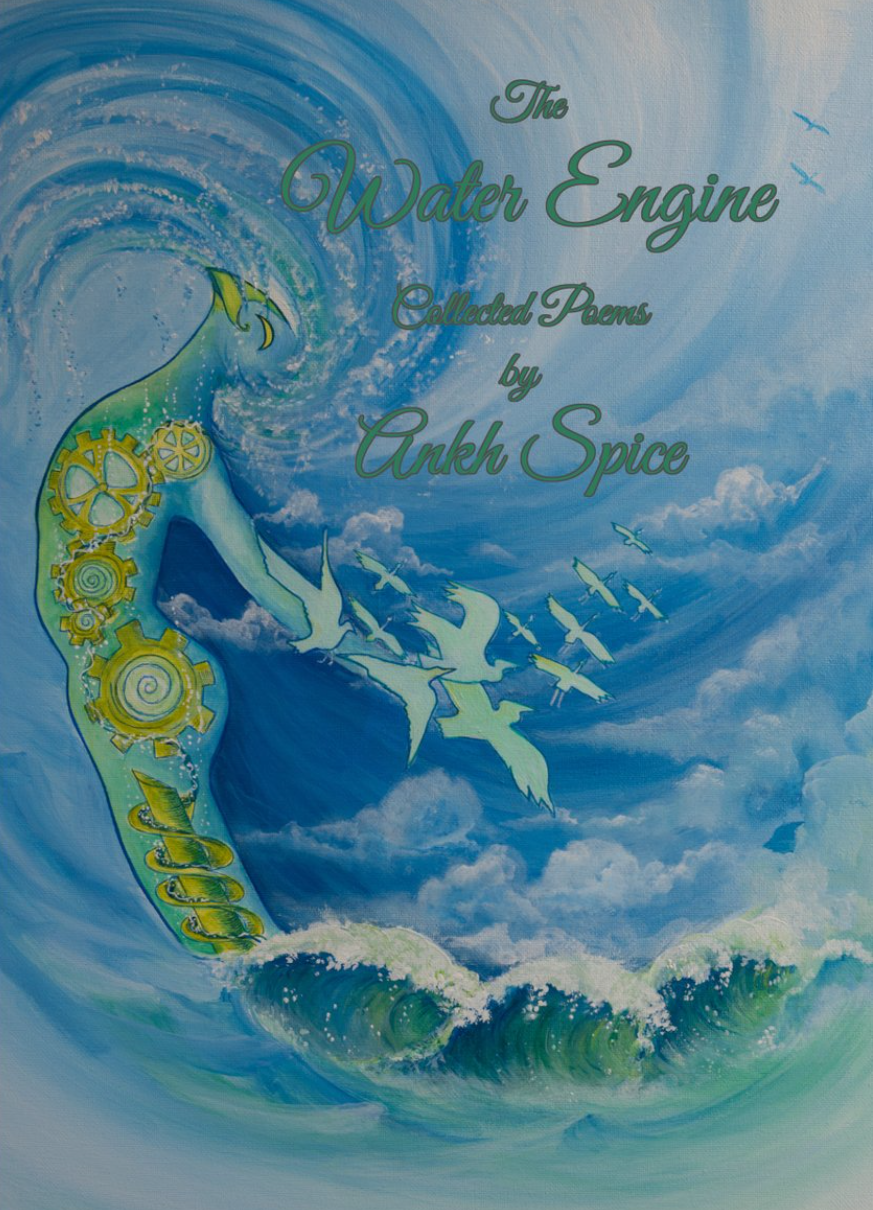
makes a poem lodge in the body, the breath, the heartbeat, not just stay in the eye. In The Water Engine there are quite a few poems that have been editedto differ from their original publication, and most of those edits were a refining of the translation for one of those elements. I also love the idea that you get to do that in a book – to hand people a map that has a very slightly different name for a place they thought they knew on it.
A shorter way to answer this might be that I think some poets gravitate to making the journey of writing a poem by following internal GPS directions, and some navigate by a general sense of the compass, knowing they need to pass the lone fairy-tree or the rocks shaped like a dog’s head. Both types of poet are ultimately using east/west/north/south, but for me the landmarks are more the big pins than the ABC. Either way, it’s a trip.
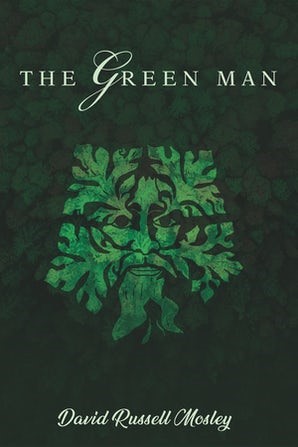
is a poet and theologian living in Washington state. When he’s not teaching or writing, David enjoys getting lost in the woods, drinking a nice scotch, and smoking a pipe. His debut book of poetry, The Green Man, is out now with Resource Publications.
Q.1. How did you decide on the order of the poems in your book?
I knew early on that I wanted to organize my poems around the 4 seasons. But even there, I had to think about what season I wanted to start with, which would control which one I ended with. So, I decided to start with Autumn so I could end in Summer. From there, I added the other three sections, Creation, Fall, and Saints and Other Songs of the Church. I also knew I wanted to end with a poem I thought would tie up the whole collection, which is why the final poem is “The Holy Grail.”
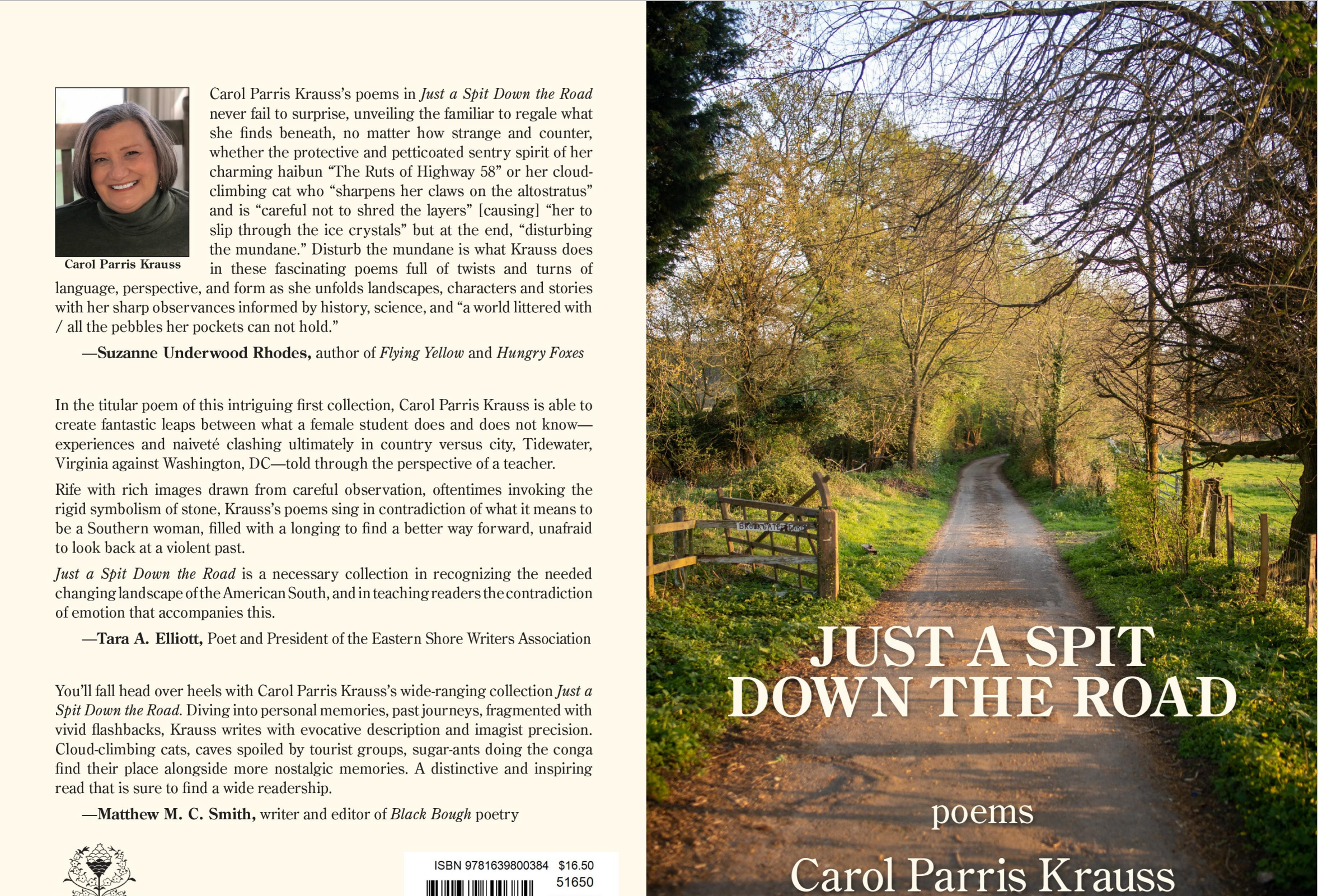
lives in the Tidewater region of Virginia. Her work is distinctly Southern, with a strong sense of time and place. This high school English teacher is a watcher, and is not afraid to tackle current issues and concerns.
Q.1.: How did you decide on the order of the poems in the book?
The first poem is the title poem. I wanted to begin with a young girl questioning herself and the South she lives in, and wanted to express her desire to see beyond where she was, even though the places beyond her home were not perfect. After picking that poem, I then printed all the other poems and began to play the emotion shuffle game. I wanted to deliver the poems by order of emotion and not have too many of the same emotional tugs in a row.
Q:1. How did you decide on the order of the artworks in the book?
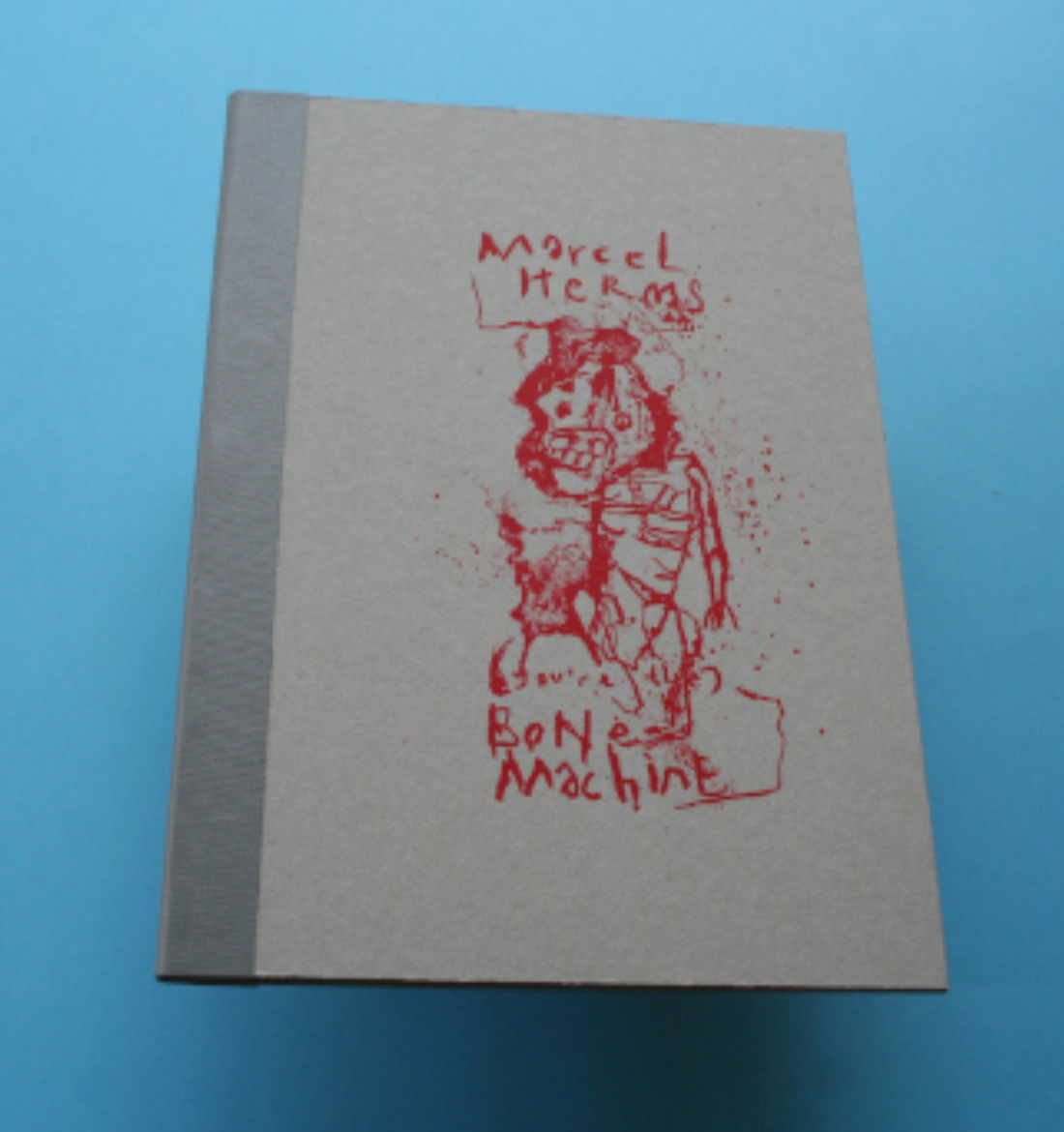
The whole book is actually a result of unconscious decisions. I printed drawings on pages from an anatomy book. That is why every copy is different. I didn’t know in advance what the result would be and that made it exciting for me. I allowed the coincidence. Also regarding the order of images. I haven’t thought about that. The book was, as it were, “created” during the making.
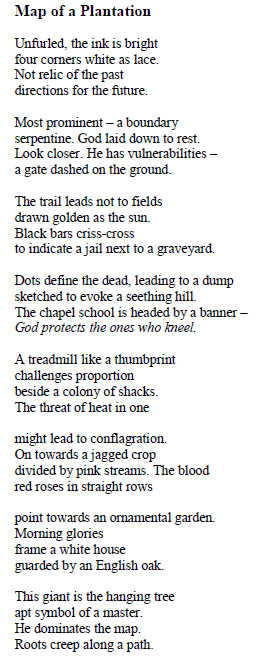
Today we have a real treat: a drop in by talented, prize-winning poet, Jenny Mitchell to reflect on a poem from her amazing Map of a Plantation(Indigo Dreams Publishing, 2021).
It won’t be easy for me to write about Map of a Plantation, the title poem of my second collection, mainly because I don’t know where it came from or why I decided to write it. I think that happens with lots of poems – they simply appear unbidden and, apart from a few tweaks, seem to write themselves.
I can say that the poem Map of a Plantation and the collection come out of my many years of research into British transatlantic enslavement. The research not only changed my outlook on this country’s history, but increased my confidence and led me on a path back to poetry, a form I really thought I had abandoned forever.
It’s pivotal. I can’t write a poem where it isn’t, because a wide-open awareness of the natural world is my default state. When you have no skin, everything sings to you, for good or ill, and nothing keys more true than the natural world. It’s also the very seat of my own spirituality – yes, I absolutely do believe in old incarnations of forest and wave and wind and dirt and star and stone. Perhaps it’s because I’m fortunate to have been born as a guest in a place where natural beauty is legendary, nature has a living mythological voice right there in the landscape you’re walking on, but honestly I think the singing happens everywhere. Once you open your eyes and ears to it, realise that you’re an intimate part of season and cycle and elemental ebb and flow, you’ll carry that forever, and I do think that to view ourselves as somehow separate from our environment is a tragedy. My poem ‘A shell returns to the sea’ was written for a friend in hospital in the middle of a very big city, where two kids from Aotearoa both felt as far from the ocean as we’d ever been, and my realisation in a moment desperate to reassure him was that even the glass in the windows, the concrete in the corridor, was born on a beach. So, not just us in our animate arrogance, but almost everything we process as artificial, owes its debt to the old origins somewhere along the line. And living in a place that is literally all coastline, where weather likes to be extreme, and a place that’s really vulnerable to environmental change, also gives my poems a duty to carry that weight – as a poet I don’t get to celebrate the marvel without also being aware of the toll. If you’re the sort of person who can ignore what we’re doing to the cradle that sustains us, then what’s in your chest works differently from what’s in mine. If you’re the sort of person who can ignore that this cradle is some kind of ridiculous miracle all the way back to that first puff of gas, then likewise. But as a poet I really want you to feel that too, so I guess I’m constantly drawing on that awe-sense to share it, like a kid with an incredible beetle – ‘See? Oh my gods, do you *really see this* though?’
The scope of this quite modestly pitched book of reviews and essays is actually quite considerable, it takes in quite a wide compass in a relatively unassuming way in some 440 pages. Robinson has authors he likes, but he is not into score taking or arguing canonically. I suppose this could have been called a collected or selected prose. But Robinson is not the kind to hammer his points, there’s a considerable openness here to many varieties of poetic expression.
So the book is bold but lacking in ostentation, which makes a curious combination of assertion and humility. There are a great many reviews here and I’d say they’re all pretty insightful, and the final section is given over to some autobiographical essays. Among things to prioritise are perhaps, a vicar’s son,Robinson’s 18 years of living and teaching in Japan. Also with considerable candour he discusses his surgery for a…
Q1: How did you decide on the order of the poems in your book?
This is a great question, Paul. It took a lot of doing, particularly for a full collection, and for one this size, and because I’d never done this before. At the start, I had no idea how I was going to approach it – or even what exactly I was looking at in terms of this manuscript, because its history was quite chaotic. I’d put it aside for over a year, apart from intermittently adding new poems that seemed to fit. So I began by printing out the whole thing as it then was. I used startlingly-coloured paper tags stuck to the pages to identify overarching/recurring themes, and cheated a bit by using my strange flavour of synaesthesia, to also identify the poems by their colour-feel in my brain. That’s about emotional resonance, the musical key of their language, their shape, their weight, all sorts of things that probably wouldn’t connect them to anyone but me, but that process gave me threads to follow. At that stage I also loosely coded the manuscript into what I believed might be three different books. I’d had the idea for the sections based on the parts of the fountain before Femme Salvé approached me, and had drawn up a sheet of words, sensations, feelings, themes, keys, and colours that belonged to each of the sections, which really helped me start to sort the poems in earnest. I gave that sheet to Amanda McLeod once she had the very first messy draft of the manuscript, and she did a great deal of work on ordering the poems based around those key ideas. She used a floor-to-ceiling whiteboard with poem titles and shifted them around visually, which sort of matched my own process, but writ large. She also followed some of the same threads from poem to poem, picking up matching words, themes, or complimentary ideas within lines across poems. It helped that Amanda is frankly a wizard at this part, and we agreed that because of the sections and those threads this could work very well as one book, that it didn’t need to become three more obviously-themed chapbooks. Once we were generally happy with the poems and the way they fit within sections, I was hugely fortunate to work with Eli Horan, who has done this for numerous books, in video sessions over several weeks. We swapped some newer poems in, removed quite a few more, and carefully followed each thread to retain continuity while we did all that. We also looked, at that stage, at following a bit of a voyage in the sections, but using more emotional chiaroscuro than anything as solid as plot. Thinking about how the reader, if they did happen to read continuously (though I don’t believe many people do for a full collection) would need to have a softer sort of rest/breath after a piece that demanded a lot of them, like islands to land on for a while when the sea has been a bit rough. We also carefully evaluated the beginning and end poems in each section for their feel as opening or closing windows illuminating the intent of the section, and changed quite a few of these.
I think you could probably do this forever and still not feel it was complete, because it is absolutely not a science or formula, a lot of it is intuition. I shifted one very key poem the night before this book went to first proof print, it always sounded a little discord in my head where it was, and I couldn’t truly explain why, but I’m glad I did. The shorter answer is that ordering isn’t that dissimilar to following the intuitions that tell me one word fits better than another when writing a poem, or that one line follows another. It’s the same kind of lateral leaping after threads, but the scale of it meant I was very grateful to have the editors’ expertise on my side. Without them the task would have felt so monumental I may never have felt able to complete it.





 The Wombwell Rainbow