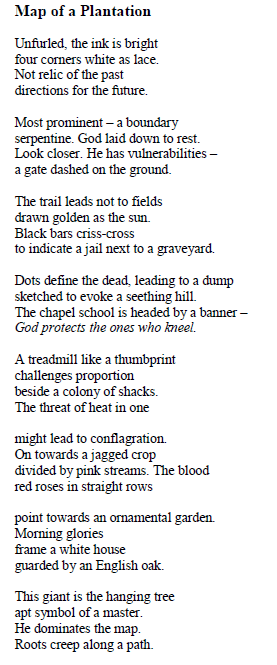
Today we have a real treat: a drop in by talented, prize-winning poet, Jenny Mitchell to reflect on a poem from her amazing Map of a Plantation(Indigo Dreams Publishing, 2021).
It won’t be easy for me to write about Map of a Plantation, the title poem of my second collection, mainly because I don’t know where it came from or why I decided to write it. I think that happens with lots of poems – they simply appear unbidden and, apart from a few tweaks, seem to write themselves.
I can say that the poem Map of a Plantation and the collection come out of my many years of research into British transatlantic enslavement. The research not only changed my outlook on this country’s history, but increased my confidence and led me on a path back to poetry, a form I really thought I had abandoned forever.
It’s pivotal. I can’t write a poem where it isn’t, because a wide-open awareness of the natural world is my default state. When you have no skin, everything sings to you, for good or ill, and nothing keys more true than the natural world. It’s also the very seat of my own spirituality – yes, I absolutely do believe in old incarnations of forest and wave and wind and dirt and star and stone. Perhaps it’s because I’m fortunate to have been born as a guest in a place where natural beauty is legendary, nature has a living mythological voice right there in the landscape you’re walking on, but honestly I think the singing happens everywhere. Once you open your eyes and ears to it, realise that you’re an intimate part of season and cycle and elemental ebb and flow, you’ll carry that forever, and I do think that to view ourselves as somehow separate from our environment is a tragedy. My poem ‘A shell returns to the sea’ was written for a friend in hospital in the middle of a very big city, where two kids from Aotearoa both felt as far from the ocean as we’d ever been, and my realisation in a moment desperate to reassure him was that even the glass in the windows, the concrete in the corridor, was born on a beach. So, not just us in our animate arrogance, but almost everything we process as artificial, owes its debt to the old origins somewhere along the line. And living in a place that is literally all coastline, where weather likes to be extreme, and a place that’s really vulnerable to environmental change, also gives my poems a duty to carry that weight – as a poet I don’t get to celebrate the marvel without also being aware of the toll. If you’re the sort of person who can ignore what we’re doing to the cradle that sustains us, then what’s in your chest works differently from what’s in mine. If you’re the sort of person who can ignore that this cradle is some kind of ridiculous miracle all the way back to that first puff of gas, then likewise. But as a poet I really want you to feel that too, so I guess I’m constantly drawing on that awe-sense to share it, like a kid with an incredible beetle – ‘See? Oh my gods, do you *really see this* though?’
The scope of this quite modestly pitched book of reviews and essays is actually quite considerable, it takes in quite a wide compass in a relatively unassuming way in some 440 pages. Robinson has authors he likes, but he is not into score taking or arguing canonically. I suppose this could have been called a collected or selected prose. But Robinson is not the kind to hammer his points, there’s a considerable openness here to many varieties of poetic expression.
So the book is bold but lacking in ostentation, which makes a curious combination of assertion and humility. There are a great many reviews here and I’d say they’re all pretty insightful, and the final section is given over to some autobiographical essays. Among things to prioritise are perhaps, a vicar’s son,Robinson’s 18 years of living and teaching in Japan. Also with considerable candour he discusses his surgery for a…
Q1: How did you decide on the order of the poems in your book?
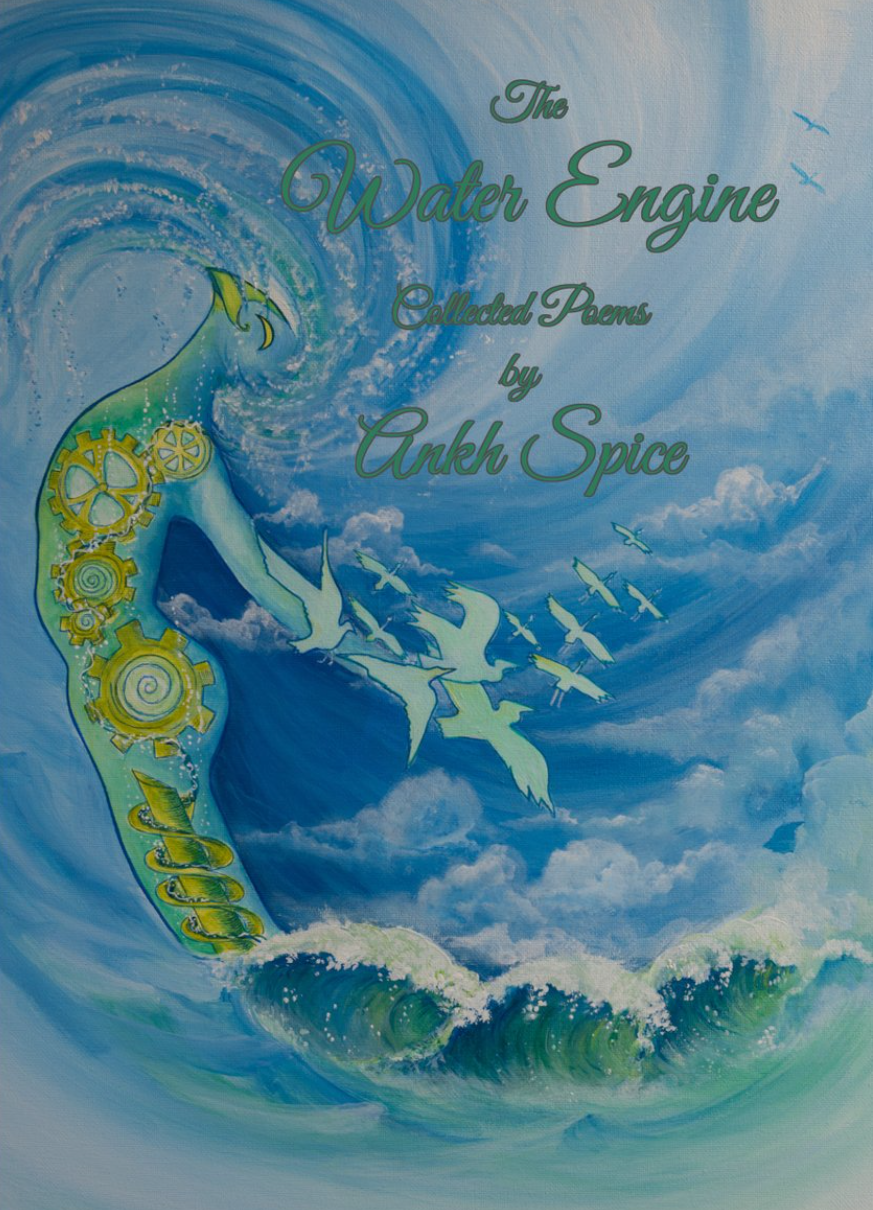
This is a great question, Paul. It took a lot of doing, particularly for a full collection, and for one this size, and because I’d never done this before. At the start, I had no idea how I was going to approach it – or even what exactly I was looking at in terms of this manuscript, because its history was quite chaotic. I’d put it aside for over a year, apart from intermittently adding new poems that seemed to fit. So I began by printing out the whole thing as it then was. I used startlingly-coloured paper tags stuck to the pages to identify overarching/recurring themes, and cheated a bit by using my strange flavour of synaesthesia, to also identify the poems by their colour-feel in my brain. That’s about emotional resonance, the musical key of their language, their shape, their weight, all sorts of things that probably wouldn’t connect them to anyone but me, but that process gave me threads to follow. At that stage I also loosely coded the manuscript into what I believed might be three different books. I’d had the idea for the sections based on the parts of the fountain before Femme Salvé approached me, and had drawn up a sheet of words, sensations, feelings, themes, keys, and colours that belonged to each of the sections, which really helped me start to sort the poems in earnest. I gave that sheet to Amanda McLeod once she had the very first messy draft of the manuscript, and she did a great deal of work on ordering the poems based around those key ideas. She used a floor-to-ceiling whiteboard with poem titles and shifted them around visually, which sort of matched my own process, but writ large. She also followed some of the same threads from poem to poem, picking up matching words, themes, or complimentary ideas within lines across poems. It helped that Amanda is frankly a wizard at this part, and we agreed that because of the sections and those threads this could work very well as one book, that it didn’t need to become three more obviously-themed chapbooks. Once we were generally happy with the poems and the way they fit within sections, I was hugely fortunate to work with Eli Horan, who has done this for numerous books, in video sessions over several weeks. We swapped some newer poems in, removed quite a few more, and carefully followed each thread to retain continuity while we did all that. We also looked, at that stage, at following a bit of a voyage in the sections, but using more emotional chiaroscuro than anything as solid as plot. Thinking about how the reader, if they did happen to read continuously (though I don’t believe many people do for a full collection) would need to have a softer sort of rest/breath after a piece that demanded a lot of them, like islands to land on for a while when the sea has been a bit rough. We also carefully evaluated the beginning and end poems in each section for their feel as opening or closing windows illuminating the intent of the section, and changed quite a few of these.
I think you could probably do this forever and still not feel it was complete, because it is absolutely not a science or formula, a lot of it is intuition. I shifted one very key poem the night before this book went to first proof print, it always sounded a little discord in my head where it was, and I couldn’t truly explain why, but I’m glad I did. The shorter answer is that ordering isn’t that dissimilar to following the intuitions that tell me one word fits better than another when writing a poem, or that one line follows another. It’s the same kind of lateral leaping after threads, but the scale of it meant I was very grateful to have the editors’ expertise on my side. Without them the task would have felt so monumental I may never have felt able to complete it.
Trigger WarningPEOPLE OF A SENSITIVE NATURE ARE ADVISED THAT THE FOLLOWING EXTRACTS EXPLORE FAMILY DYSFUNCTION AND ABUSE ISSUESZero Gravity
Gayle J. Greenlea
Excerpt for 12 November, 2021
<chapter> Twocontinued
Hilary rang the bell and was buzzed in. The interior was dimly lit with black decor, leather furniture, and crystal-cut chandeliers spindling from the ceiling. The floor was Italian ceramic tile. A bored-looking receptionist sat behind the desk. Hilary suspected she was trans. Her hair and makeup were exquisite and she had cheekbones to die for. “Welcome to Secret Desire,” the woman said, “where your most secret desire is fulfilled. What can we do for you today, pet?”
Hilary said she was looking for Penelope and the receptionist raised a delicate eyebrow. “Oh, yes. Penelope’s one of our best. You want an hour or her special?” she inquired in a faintly husky voice.
-Gayle J. Greenlea
YOU’RE THE DEAD TO ME
Second week – Growing – Day Eleven
Day Five
Dead leaf says to the earth:
“There are so many others”
“Forget till later.”
Bios And Links
-Gayle J. Greenlea
is an American-Australian poet and counselor for survivors of sexual and gender-related violence. Her poem, Wonderland”, received the Australian Poetry Prod Award in 2011. She shortlisted and longlisted for the Fish Poetry Prize in 2013, and debuted her first novel, Zero Gravity, at the KGB Literary Bar in Manhattan in 2016. Her work has been published in St. Julian Press, Rebelle Society, A Time to Speak, Headline Poetry and Press, The Wombwell Rainbow, Fevers of the Mind, Kalonopia and The Australian Health Review.
If ever a poet was the ‘priest of the invisible’then it is Li He. Li He is the ‘wild man’ of poetry who disappeared into the wilderness of his own imagination. In Gabriel Rosenstock’s beautiful poetic dialogue, Conversations with Li He, we hear him call back to our own age from across the millennia. We retrace the steps of his artistic journey. We follow the paths of the breeze and the moon.
Dr Mícheál Ó hAodha, University of Limerick
*****
Copies of Conversations with LI He are available here
*****
Gabriel Rosenstock: Eight Poems from Conversations with Li He translated by Garry Bannister
BOSOM PALS
How pleasant for me to be so close to you
Even though there stands a thousand-year abyss between us.
Here we go, drinking again together tonight
I know where there’s a pub
And no one will bother us there We could do some…
PEOPLE OF A SENSITIVE NATURE ARE ADVISED THAT THE FOLLOWING EXTRACTS EXPLORE FAMILY DYSFUNCTION AND ABUSE ISSUES
Zero Gravity
Gayle J. Greenlea
Excerpt for 11 November, 2021
<chapter> Twocontinued
While Siobhan was nipping the hair of the dog on Oxford Street, Hilary took the train to Kings Cross. She’d found some clothes she kept in her stash at Ryan’s place: brown skirt with turquoise threads running through, turquoise blouse and pale brown and teal batik-print scarf which she tied around her neck. Boots finished her off. Showered and dressed, she felt almost human. Thank God for coffee. It gave her mind some semblance of order and calmed the headache. Hilary had a lead she wanted to follow. It may be the weekend, and she wasn’t assigned, but that had never stopped her. In fact, if her boss Martin Goundry at the Sydney Morning Herald knew what she was up to, she’d have some explaining to do. She exited the train station and walked the short half-block to an innocuous charcoal-coloured building on Kellett Street. There was no sign to mark its identity. Only a large number “52”.
-Gayle J. Greenlea
YOU’RE THE DEAD TO ME
Second week – Growing – Day Eleven
Day Four
Dead leaf asks the Earth: “Have I ever been stone dead? “No, just recycled.”
-Paul Brookes
Bios And Links
-Gayle J. Greenlea
is an American-Australian poet and counselor for survivors of sexual and gender-related violence. Her poem, Wonderland”, received the Australian Poetry Prod Award in 2011. She shortlisted and longlisted for the Fish Poetry Prize in 2013, and debuted her first novel, Zero Gravity, at the KGB Literary Bar in Manhattan in 2016. Her work has been published in St. Julian Press, Rebelle Society, A Time to Speak, Headline Poetry and Press, The Wombwell Rainbow, Fevers of the Mind, Kalonopia and The Australian Health Review.
PEOPLE OF A SENSITIVE NATURE ARE ADVISED THAT THE FOLLOWING EXTRACTS EXPLORE FAMILY DYSFUNCTION AND ABUSE ISSUES
Zero Gravity
Gayle J. Greenlea
Excerpt for 10 November, 2021
<chapter> Twocontinued
Half an hour later, Siobhan was smoking a cigarette and nursing a gin and tonic in the umbrellaed outdoor seating area of a pub on Oxford Street, mobile phone in hand. “Hilary? It’s me. Will you meet me at Interlude in Newtown in an hour? And Hilary. I’m sorry. Let’s talk.” She snapped the phone shut and managed a smile for the bartender who was collecting empty glasses and glancing appreciatively at her cleavage, snugly framed in a low-cut emerald green top. Just as well she was only at the first stop of her pub run for the evening. Better to avoid further complications, she thought, sighing over the man from behind as he headed back to the bar with a leaning tower of chinking bar glass.
-Gayle J. Greenlea
YOU’RE THE DEAD TO ME
Second week – Growing – Day Ten
Day Three
Earth says to Dead Leaf.
“What takes you into itself.”
“Someone take me in”
Bios And Links
-Gayle J. Greenlea
is an American-Australian poet and counselor for survivors of sexual and gender-related violence. Her poem, Wonderland”, received the Australian Poetry Prod Award in 2011. She shortlisted and longlisted for the Fish Poetry Prize in 2013, and debuted her first novel, Zero Gravity, at the KGB Literary Bar in Manhattan in 2016. Her work has been published in St. Julian Press, Rebelle Society, A Time to Speak, Headline Poetry and Press, The Wombwell Rainbow, Fevers of the Mind, Kalonopia and The Australian Health Review.
PEOPLE OF A SENSITIVE NATURE ARE ADVISED THAT THE FOLLOWING EXTRACTS EXPLORE FAMILY DYSFUNCTION AND ABUSE ISSUES
Zero Gravity
Gayle J. Greenlea
Excerpt for 9 November, 2021
<chapter> Twocontinued
The sense of achievement Siobhan had expected to feel when she bedded Ryan eluded her. Not that he wasn’t a good lay. In fact, he was. Sensational, in fact. God, he was a great fuck. And a spunk to boot. Brooding Heathcliff-good looks and Roma charm. But somehow, the idea that she could seduce him with her sister watching, and even participating, which had seemed exhilarating before, now depressed her more than ever. Why did she keep doing this to herself? Get one up on Hilary, show her she could have what she has, even take what she has — and why stop there – bloody hell, she could be Hilary if she wanted to. Each time she succeeded at one small self-indulgent triumph, she’d feel like she’d summited Everest — for about five minutes — then came the big plunge: the downward spiraling, quick-sand-sucking, soul-destroying black dog barking up her ass. No, not even modest flats would be adequate penance today. Perhaps a little therapeutic self-mutilation later. Siobhan sighed, pulled out her purse and made her way to the cash register.
-Gayle J. Greenlea
YOU’RE THE DEAD TO ME
Second week – Growing – Day Nine
Day Two
Dead leaf says to Earth: “I’m not tree, I’m something else. What am I to be?”
-Paul Brookes
Bios And Links
-Gayle J. Greenlea
is an American-Australian poet and counselor for survivors of sexual and gender-related violence. Her poem, Wonderland”, received the Australian Poetry Prod Award in 2011. She shortlisted and longlisted for the Fish Poetry Prize in 2013, and debuted her first novel, Zero Gravity, at the KGB Literary Bar in Manhattan in 2016. Her work has been published in St. Julian Press, Rebelle Society, A Time to Speak, Headline Poetry and Press, The Wombwell Rainbow, Fevers of the Mind, Kalonopia and The Australian Health Review.



 The Wombwell Rainbow