Wombwell Rainbow Interviews: Diane Rossi

Diane Rossi kofi front page

Diane Rossi

Writer of stories, poetry, monologues, articles and wedding ceremonies. Writing is my compulsion and people are my passion. Buy Diane Rossi a Coffee. ko-fi.com/dianerossi14930 – Ko-fi ❤️ Where creators get donations from fans, with a ‘Buy Me a Coffee’ Page.

Interview

1. When and why did you start writing poetry?

My earliest memory of writing poetry was as a teenager. I would vent frustrations and make observations about relationships and experiences in poetry and diary form. It was self indulgent rubbish and I didn’t keep any of it! It was definitely a form of therapy and way of making sense of adolescent confusion. It was also part of what I would refer to as ‘seeking for the truth.’

2. Who introduced you to poetry?

I was fortunate to have had inspirational English Literature teachers at school. English was my favourite subject and one I excelled in. I loved hearing poetry read aloud and enjoyed opportunities to read in class.

3. How aware are and were you of the dominating presence of older poets traditional and contemporary?

I don’t think consciously aware. When I write poetry or prose I don’t have other poets in mind. My earliest memories were of the Romantic and Metaphysical poets. The themes must have influenced me as an intense young adult though!

4. What is your daily writing routine?

I haven’t led a life which has allowed me to stick to a strict writing schedule for years. I prefer to write when there are relatively few distractions. I find it more difficult to concentrate when there is background noise but if there’s no choice I am able to. Some days I write for several hours almost without a break and others barely at all. I envy writers who adhere to a strict routine and produce a set number of words per day.

5. What subjects motivate you to write?

I enjoy exploring human relationships and what makes people behave the way they do. There is no greater satisfaction than someone telling you that something you wrote moved them or made them see things in a different way.

Spirituality and relationships interest me. Other people’s love stories initially motivated me to write romantic/spiritual verse and prose. I began writing for couples choosing to marry in Italy back in 2005. Naturally the main theme is romantic love but also familial.
I am in awe of Nature and fond of celestial imagery: stars and the moon. The Romantic and Metaphysical poets must have played some part in shaping my thematic interests but also living in Tuscany it is impossible to ignore the influence of Renaissance writers.

Writing creatively about my experiences in Italy and growing up in Sheffield are subjects which interest me at the moment. I’ve explored my feelings about love, family and relationships in poetry, monologues and short stories/flash fiction. Several pieces have recently been featured on BBC Radio Sheffield’s Upload Show presented by Ellie Colton.

6. What is your work ethic?

Travelling throughout Italy and other parts of Europe to conduct ceremonies and writing them has and still does consume most of my time. However Lockdown meant that I could concentrate more on writing for myself and explore more personal thoughts.

I am a spontaneous writer mostly and when something really speaks to me I am compelled to write immediately. It’s important to me that what I write resonates with others. Form tends to take on a life of its own rather than being planned out methodically in advance.

7. How do the writers you read when you were young influence your work today?

When I was younger (teens and twenties) I was drawn to the passion and imagination of the Bronte sisters. So much of the psychology of their writing is connected to the landscape they knew so well and their frustrations as women trying to make their mark in a world which wouldn’t allow them.

I try to write honestly and with emotion but maintain restraint. I think also many Victorian writers influenced my interest in the undercurrents of emotion and their effects on those who repress them.

8. Whom of today’s writers do you admire the most and why?

I have read every novel by David Nichols. I love his humour and insight into the complexities of falling in love, trying to be a good parent and just how hard it is to be oneself and fit in.

I am also a great admirer of Twitter’s ‘Poet Laureate’ Brian Bilston for similar reasons. He is one of the wittiest poets around. He too makes me laugh out loud but there is also much sensitivity and social conscience in his poetry, which I really admire.

When it comes to dialogue and script writing Sally Wainwright is in a class of her own. She possesses a rare talent for showing how and why people make the choices they do. She wrote a fabulous drama about the Bronte Sisters called ‘To Walk Invisible’ which as a Bronte fan was a revelation to me and made me love them and her even more!

9. Why do you write, as opposed to doing anything else?

I cannot imagine doing anything that didn’t involve creative writing. I write because it’s all I’ve ever wanted to do. It might sound pretentious to call it a compulsion but that’s how I feel.

I very much want to connect with others on a deeper level and play some small part in bringing people together. If I can write something that resonates on an emotional level or touches someone else then I will have achieved something positive.

I like to observe people and try to understand their motivations and choices. Empathy is very important to me. I don’t think there is enough of that right now. Writing for me is an attempt to put myself in someone else’s predicament and imagine how that influenced their lives.

10. What would you say to someone who asked you ‘How do you become a writer?’

I have no idea other than just write. If you write then by definition you are a writer!

11. Tell me about writing projects you have on at the moment?

At the moment I am writing a series of monologues inspired by the lives of family members and ancestors. My connection to South Yorkshire stretches back many generations and I’m currently trying to flesh out the details of those who came before me and whose DNA I have inherited. This is part of understanding where I come from and who I am. Family research is a slow and frustrating process. Travelling to Sheffield is not an option right now so I have to rely on phone calls and family tree research. I much prefer being physically in a place in order to write about it.

#Lefthandersday Anybody written poetry about being left handed? I will feature it on today’s blog.

liefthandersday slide

One Arm Tied

I was born with
Fingers outstretched
Leading with my left;

Mother sighed
At elbows clashing
Told me right was best;

At table, she
Would lace my arm
With string
Behind my back

I learned the chopsticks
Handicapped
To make up what I lacked

I learned to wait
To hunger
Never overcome
With greed:

It’s harder, though,
With one arm tied
To reach
For what you need.

-Shani Cadwallender (She says of this poem: “This poem is about a friend of mine, whose aunt went through this experience when learning to use chopsticks.”


Bios And Links

-Shani Cadwallender 

salutes magpies, keeps left, drinks pints, contains multitudes, and is comfortable writing about herself in the third person. Born in a house full of cats and raised in a town full of seagulls, she now lives in a city full of foxes, where she spends the day teaching about words in a high school, and the evening learning about them at Birkbeck College. She can be found hanging around the cemetery, eyes skywards. Among her compulsions are petting the dogs of strangers and writing poems, of which A Crow’s Diet, published by Dreich press,  is her first improper collection.

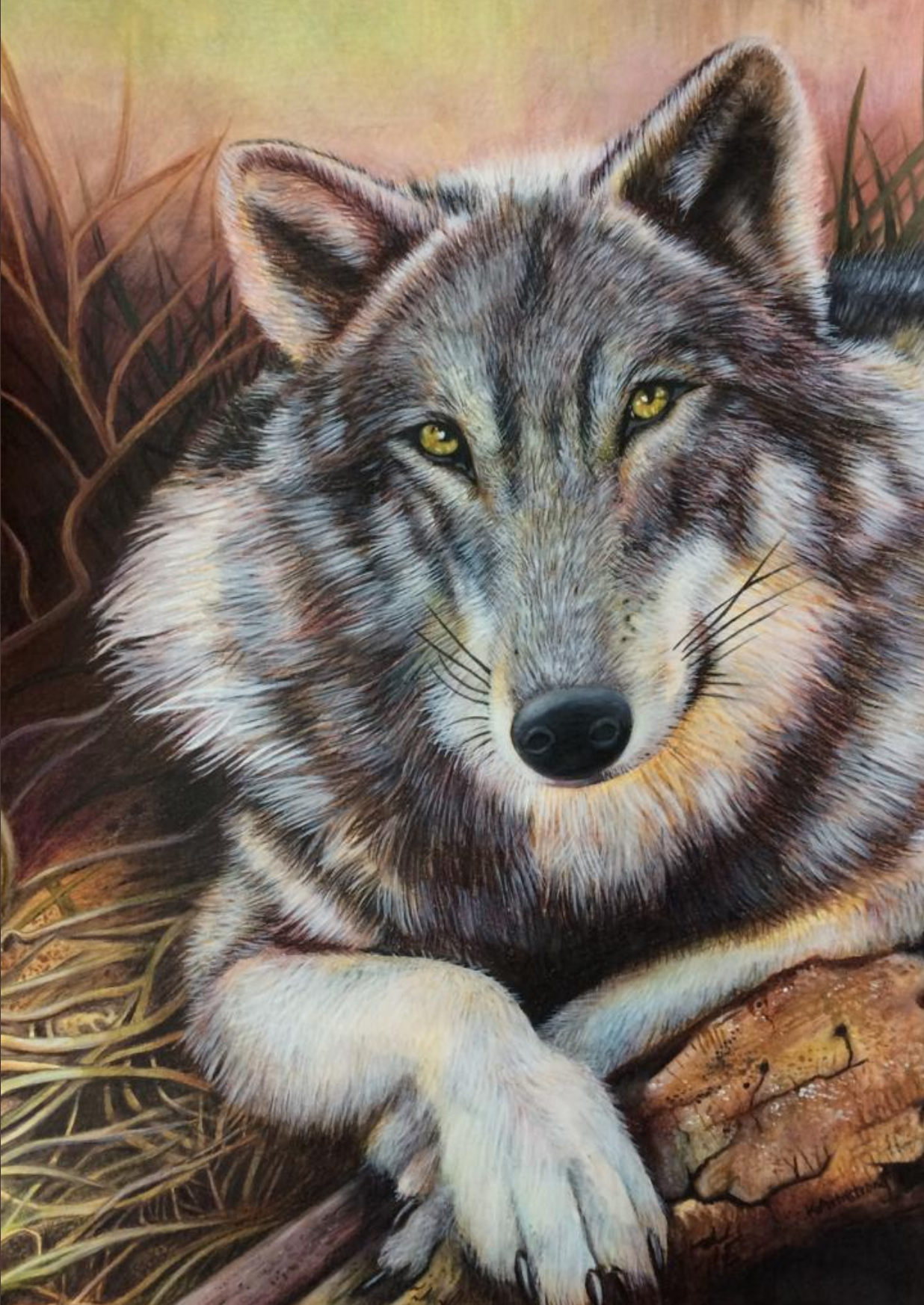
#WorldWolfDay, #InternationalWolfDay Anybody written poetry unpublished/published, made artworks or have photos of wolves? I will feature all contributions in today’s blog post.

World. Wolf Day

wolf 3wolf 2

wolf 1

All wolf artwork by Kirstin Armstrong

She-Wolf

She arrives in dreams
The white she-wolf
Nipping and yipping
Around the Soul
Until it’s fully awake
Conscious of the surrounding Wildwood

One eye shines with sky-wisdom
The other, by now ferocious ruby red
Colour of mega-fires
Shade of blood for all the fallen animal-kin

Her howl echoes with pain
Grief
Rage
A billion souls burnt

Call that reverberate to the bone
Dream-sound break the hush
Stir archetypes awake

Nature are poisoned
Hurt
Ravaged
Out of balance
A continent burning

The wild howl will break sleep
Until the fallen are remembered

©RedCat

the wolf bites

the wolf bites the moon
wisp clouds mask red nakedness
shadows on my mind

-Simon Salento January 16, 2020 


On Being Pursued By A Wolf

Their nattering had gone on long enough.  The wolf crooked its enormous head suddenly, and they ducked down lower behind the boulder. 

 They quietly listened for its next move; but heard nothing.  Stinson turned and eyed up the pathway, but Littlewood gripped him by the arm, shaking his head dismissively.

The silence was broken by growls like an engine rehearsing; the wolf had started to advance, slowly, with methodic composure.  Littlewood peeked up to see where the beast was and when he saw it had clocked the boulder they were hiding behind, he let go of Stinson’s arm, and whispered, ‘Run.’

They upped quick and made for the pathway, and the motion blasted up a geyser of dust which half-screened their escape, an inadvertent covering manoeuvre; however it was a narrow passage they had come through, and in the scramble to get there, they forgot that both of them couldn’t fit through the entry at the same time; so Stinson, in the last second, halted and said to Littlewood, ‘After you.’  There was no time for competitive politeness, so the Captain hurried on first, and Stinson slipped through after him. 

The wolf howled aloud when its eyes caught the obscured figures of fleeing men, but it was so hyperbolic a howl – a public display it wasn’t used to giving anymore – that it brought on a fit of coughing, and it had to take a moment to gather itself before beginning the chase; this gave Littlewood and Stinson some time to make tracks.  And plenty of tracks they made.  If that pathway had been starving for footsteps before, it was now enjoying a banquet as the absconders thundered along its surface. 

 Stinson had never run so hard in his life.  He had never been athletic.  His teachers at primary school thought him highly batty when he declined to join the cross country team saying he had all of St. Alphonsus’s Theologia Moralis to finish reading.  And he did finish it…eventually.  That was a form of long distance running, he had forever told himself, though it hardly set him up for this undertaking.  If only St. Alphonsus had included a tenth volume: On Being Pursued By A Wolf.  For Stinson was short of breath fairly fast and he had nothing but all that faith and learning to support him.  He thought he would be fitter.  He was young, apparently healthy, had lived a pure life; but a delicate life unquestionably.  Had he squandered purity returns on this trip?  He’d wager yes if he was so debauched as to place a bet.

Littlewood, on the other hand, had been more than willing to sign on with the cross country team and won medal after medal throughout adolescence, so he was now making headway.  He kept looking back at the angel-faced one and shouting, ‘Faster!’  But Father Stinson couldn’t go any faster. 

A maelstrom of wolf-noise resounded as they ran.  But it came from above, not behind, for the wolf had opted to pursue them in the hills overhead.  They could hear it making great leaps and landings on the rocks.  Growls and scrapes.  Thuds and rasps.  And the occasional wheeze.

Littlewood made it out of the hills first.  The heads of those ridiculous sunflowers were a sight to behold when he got there, sticking out of a recently-come fog like bright and perky periscopes, mustard stares on their endless father in the sky – like wee ones watching their old man leave for work – as it slinked away again into the cloud.  Littlewood checked on Stinson who was still chugging along in the passage behind him like a man three times beyond that age.  Then he looked to the hills for the wolf.  But saw no sign.  All he could see and hear were signs of bankruptcy in the panting young priest.  Maybe the creature had chosen to go back to its cave because it was tired and ill and wanted to sleep.  Or maybe it had fallen and broken its neck.  Chance would be a fine thing, but there had been a notable lack of fine things over the course of this journey.  Apart from Katrine.  Yes, she was a fine thing alright, he knew that well.  Granted, he had tried to suppress the feelings he had towards her for a while, but it was in situations like this the fine things always sprang to mind, bold and transparent.  Right when they looked to be lost. 

He turned to see if he could make out the others in the distance.  They must have that grave dug by now. 

But it was hard to see anything.  They had come rather a long way and the haze had grown thicker and what light there was had dimmed to some extent.

When Stinson finally reached him, all haggard and weak, he said, in a ruptured voice; ‘Why…have…we…stopped?’

-Sean McNulty (Extract from his novel, Excavatum)

Lament Of The Wolf

Watching the ripples splaying into an unending circle, made by the landing of the Grebe, until the wavelet gently reaches the shore dying on the lush ground, already sopping up the blood of my mate and young, I pray for forgiveness.  The sunlight reflects the surrounding beauty of the wilderness.

We came stealthy in the night, carrying the babes, soothing, hushing, communicating the danger that pursued us.  These woods are our home given by the Great Spirit for our use, for our welfare, to live in harmony.  My family circle has spiraled, through many eons, to arrive upon this day of sorrow.

The great thunder of the massive birds that spit forth death found us as we flattened ourselves to near invisibility, forgetting these demons can see through the dark while gleefully meting out death.  My mate riddled with holes as she tried unsuccessfully to cover the babes beneath her. I, her mantle as the end of my blood slithers off my muzzle, pooling at the feet of the hunter.

“This is the last of the wolf pack men.  Good night’s killing.”

As my spirit rises, joining my ancestors, I call the Great Spirit to forgive our killers, allowing them to understand His love for all creatures.

-Paula Shene

Bios And Links

-Kirstin Armstrong

is an artist and teacher from near Glasgow. is an artist and writer based near Glasgow in Scotland. Inspired by Scottish landscapes, myths and legends, and a whole variety of wildlife, her artwork has been exhibited nationally, including RSW and the Paisley Art Institute. She enjoys working with watercolour, gouache and mixed media.  Her writing and short stories have been commended for their rich historical detail and vivid imagination. https://www.kirstinarmstrong.com/

-RedCat

has contributed to The Anthropocene Hymnal – Songs of a self-defining era. A poetic response to the joint crises of climate change and biodiversity loss. (An Experiments in Fiction Publication, 2021)
Through The Looking Glass: Reflecting on Madness and Chaos Within (Indie Blu(e) Publishing, 2021), and The Poet’s Symphony (Raw Earth Ink, 2020)

Her poetry spans love, life, folklore, mythology, environment, depression and surviving abuse and trauma. This fiery redhead makes her home in Stockholm, Sweden.

redcat.wordpress.com
www.facebook.com/RedCatWrites

Cajun Mutt Press Reviews: Hesitancies by Sanjeev Sethi

James D. Casey IV's avatarCajun Mutt Press

Intelligent Water

★★★★★

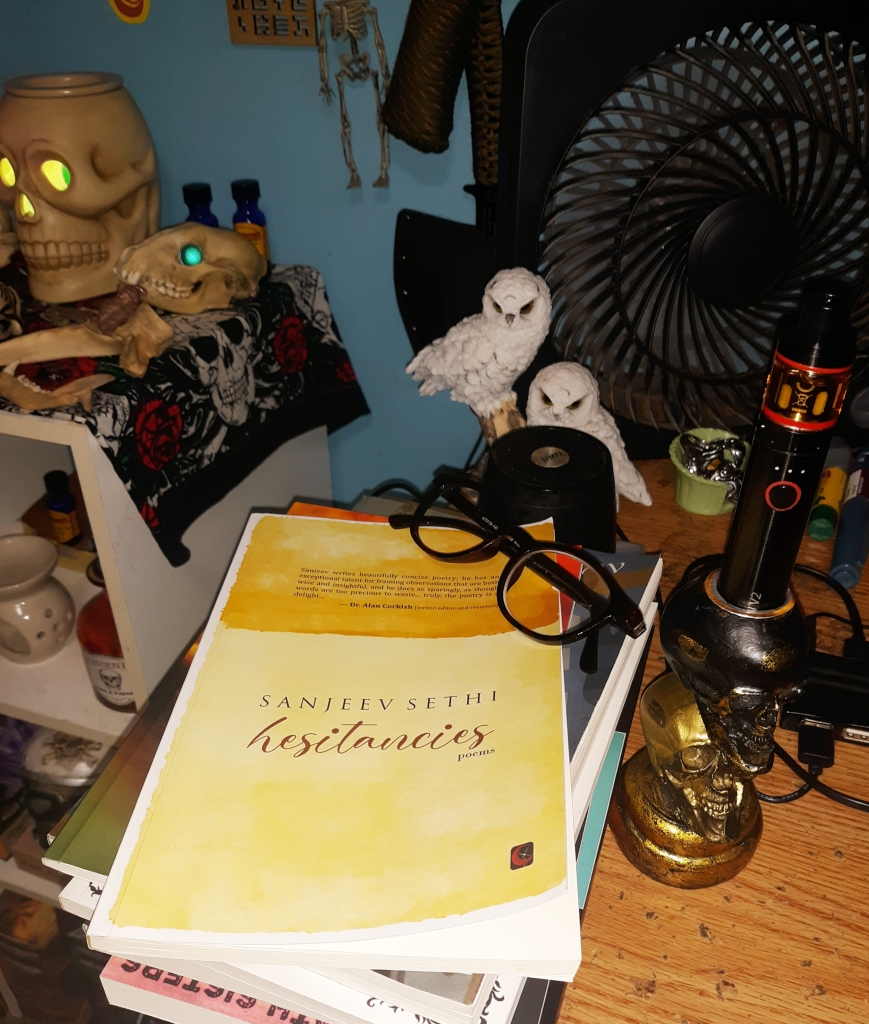
Sanjeev Sethi’s poetry has the ebb and flow of intelligent water. ‘Hesitancies’ is a river of words that will take you on a journey to the far corners of the poet’s mind. Sanjeev packs enormous emotion into small spaces within this collection, some poems being only 5 lines long, and he is a true wordsmith. This book is a beautiful representation of the craft. Seamlessly shifting between the subjects of childhood, family, life experiences, and simple observations written from a philosophical point of view. This is an incredible collection of poetry, highly recommended.

Hesitancies by Sanjeev Sethi

Hesitancies on the desk at C.M.P. Headquarters

Sanjeev Sethi

Sanjeev Sethi has authored five books of poetry. Hesitancies by CLASSIX, an imprint of Hawakal, in July 2021 is his latest. A month before it, he released Bleb from Hybriddreich in Scotland.  He is published in over thirty countries. He…

View original post 31 more words

Your Right to Express Yourself Versus My Right to Feel Safe

wendycatpratt's avatarWendy Pratt

Photo by Kat Jayne on Pexels.com

Firstly, a trigger warning: the content of this blog post includes quotes from something that I received in the inbox of the magazine that I edit, and whilst I have done my best to not be too graphic, I don’t want to shy away from the nature of this message. It’s important that this sort of thing is brought to light, in my opinion. If you feel you may be triggered by mention of murder, rape and murder rape fantasies from the male point of view, you might want to prepare yourselves. No one can ever know the trauma that others have suffered, or what is going on behind their outward appearance.

There’s a lot of rubbish spoken about how trigger warnings create overly safe environments around creative subjects; not allowing readers to experience the emotional impact of the creative work, but for me…

View original post 1,652 more words

#WorldElephantDay Anybody written poetry that features elephants? Artworks and photos welcome, too. I will feature all submissions on my blog today. According to the World Elephant Society. “It is a day to honor elephants, to spread awareness about the critical threats they are facing, and to support positive solutions that will help ensure their survival.”

World Elephant Day

Elephant Ethical poster

is observed every year on 12 August. The day is observed to raise awareness, and bring attention towards the plight of elephants

World Elephant Day is an international initiative co-founded by the Elephant Reintroduction Foundation and Patricia Sims, the Founding President of World Elephant Society. On this day, they encourage individuals and organizations around the world to work towards elephant conservation.

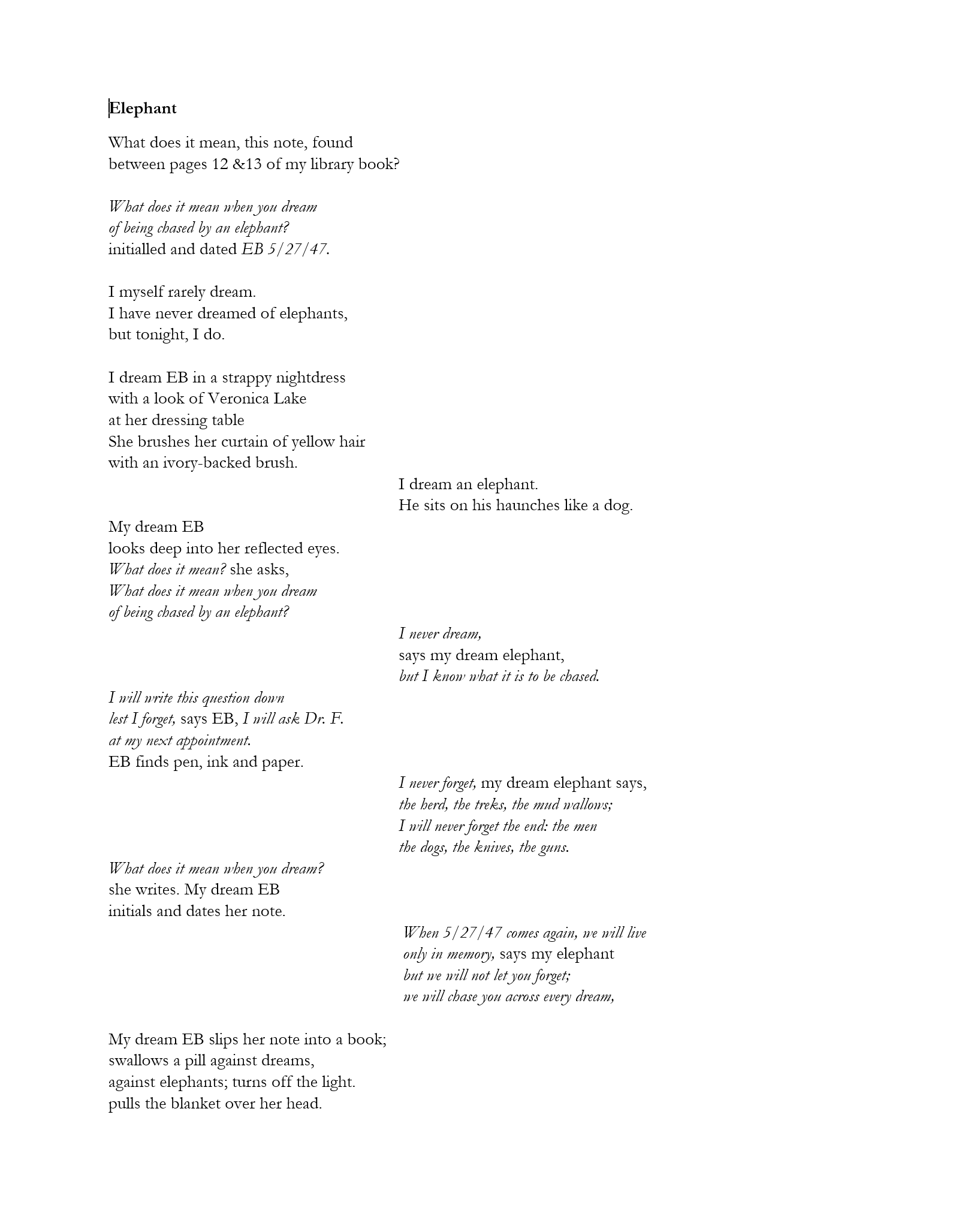
elephant note stephanie bowgett

elephant stephanie bowgett

-Stephanie Bowgett


Lessons from Elephants

much to learn
from pachyderms

who listen, not knowing,
but hearing, understand

and despite giant size,
display proportionate grace

with seemingly
infinite memory,

make pilgrimages
to show compassion

ignoring time’s sand,
journeying to distant lands
-st

40 elephant Alex

-Alex Guenther

The Room of Cards

Welcome to the Room of Cards –
my favourite room. I’ll show you round.
See all the faces, looking out,
not smiling. No, we’re not sure why.
Maybe a teeth thing? Teeth were
threatening?

All plastic? Yes. Yes, I know –
such wealth. Imagine how it must have been.
All found by plastic miners, and brought here
for their historical significance.

They are significant. And beautiful.

This case puts them into context:
a bag. Yes, plastic, hasn’t lasted well.
Inside, a smaller bag, a purse –
all plastic. Lots of cards, but only
this one with a face on it. A plastic pen.
A plastic wrapper, contents unidentified.

I know. They must have bathed in plastic,
frittered it, squandered it.
Unimaginable wealth…

Anyhow: this is my favourite. See?
A little girl. We don’t get many children here,
but there she is. The word is “zoo” –
who knows what that means? Yes!
Well done. A place for animals.

Think what she must have seen.
An elephant. A lion, perhaps.
Giraffe. And now we look at her,
across the centuries.

It makes me tingle, just to think of it.

-Sarah Connor

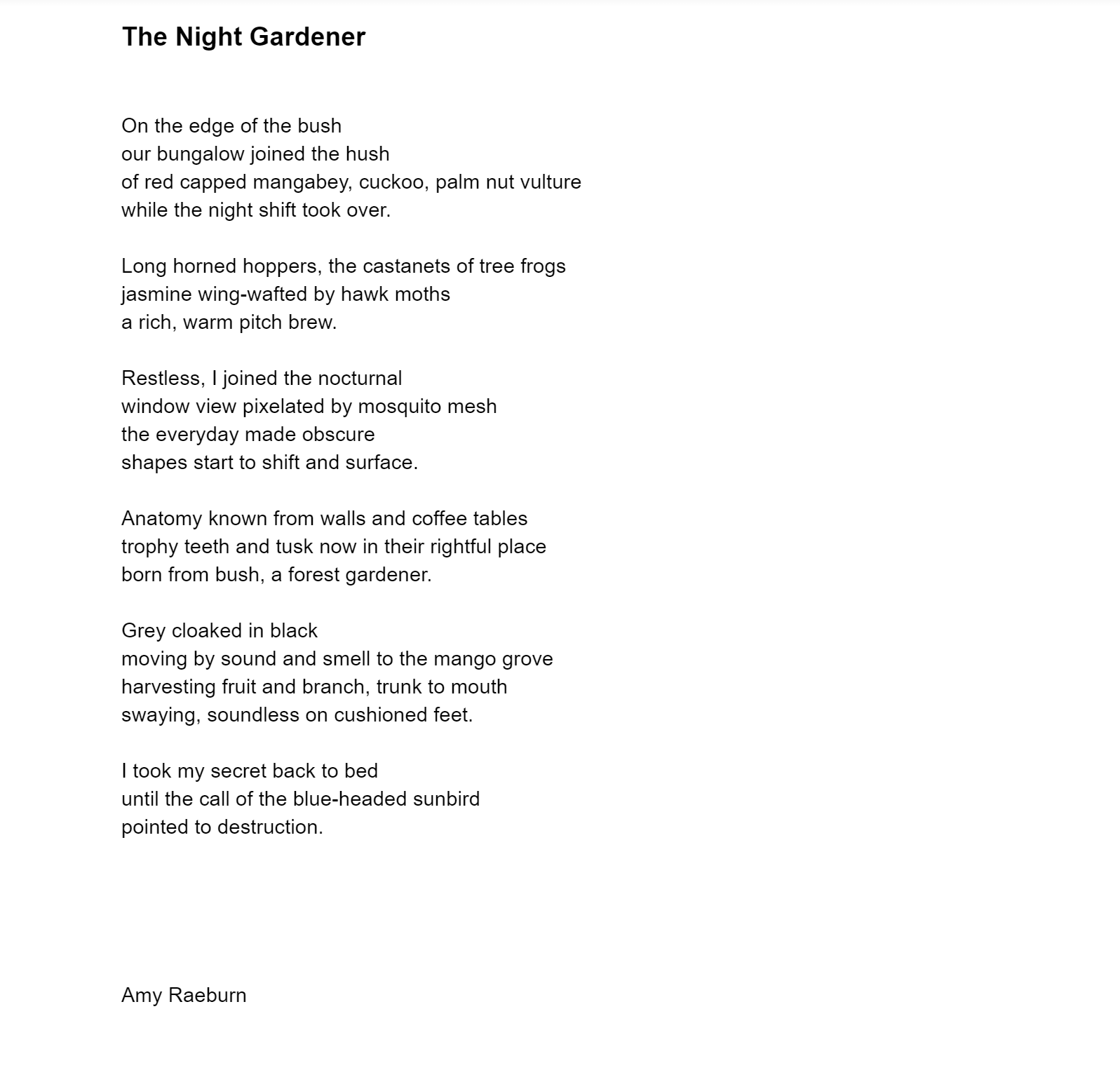
The Night Gardener by Amy


The Elephantquake

Elephantquake bossed a vast forest.
no rain, all lakes, tanks, ponds,
water holes arid. It thirsts
It searched for water.

It knows of a hidden lake
always full and goes there
to save itself. After five nights
it revelled and splashed in the lake.

Daily it marched upon moonhares,
maimed and wounded them,
on its route to the lake.

One day moonhares met
to save themselves
from the elephantquake
Some said “Abandon this place.”

Others “It’s our ancient home.
Let’s find an alternative.
Let’s see if we can scare off
rampage of elephantquake.”

Some of them said, “We know
of a trick that works
with elephantquake.
we need a sharp person.

A moonhare has a message
for elephantquake. It says
“I come from Moon who doesn’t
want you supping lake as bound

there you kills and maim hundreds
of hares. Lake is forbidden.
Return to your forest home.
“But where’s this Moon, your home? asks

elephantquake “In this lake.
It consoles the survivors
of your rampage.” “Then, let me see him,”
requests the elephantquake.

“Come alone with me, I will
show you.” Moonhare takes it one
night to shows Moon’s silvery
reflection in the lake, says

“Here it is, my home, the Moon.
Lost in meditation.
Move quietly, salute it.
Don’t disturb it and bring wrath.”

Elephantquake sees it as real,
salutes it, leaves quietly,
returns to its forest home.
Hares heave sigh in relief.

-Paul Brookes

Bios And Links

-Amy Raeburn

is originally from north-east Scotland and studied English at the University of Aberdeen. Amy’s poetry has appeared in publications including Cencrastus, Three Drops from a Cauldron, The Poetry Shed, Re-side and Southlight. Amy works and lives in Cheshire in the UK and is a member of the Blaze Poetry Society Stanza in Mid-Cheshire.

-Stephanie Bowgett

is one of the founder members of The Albert Poets in Huddersfield. They have been organising monthly readings and a variety of workshops for twenty six years till temporarily halted by COVID. Her most recent book, “A Poor Kind of Memory” was published by Calder Valley Poetry  https://caldervalleypoetry.com

I’ll Splinter by Tom Branfoot (Infernal Editions)

tearsinthefence's avatarTears in the Fence

My grandparents’ house is called ‘Tod Cot’. I had never really thought about it much – a random arrangement of sounds and syllables, it simply was. But the first poem in Tom Branfoot’s debut pamphlet,I’ll Splinter, gave me pause. The title of the poem, ‘Cotlight’, is a lovely word which, I learnt, refers to the light shining through windows after dark, from ‘cot’, a rural dwelling, now ‘cottage’. Tod is an old country term for fox, and now the two pieces of the puzzle fit together – Tod Cot, fox cottage, den, holt, home, the words unfurling themselves before me.I’ll Splinterencourages this kind of reframing of the everyday, as Branfoot’s sharp eye picks out the poetic in the pebbledash and tarmac of the in-between places.

‘Cotlight’ is a fitting introduction to I’ll Splinter – it is an invitation, an invocation, a calling. ‘go there’, the poem…

View original post 917 more words