Sunday: Rocky Shores. Share what you love about the sea using #NationalMarineWeek 25th July- 9th August, more like two weeks poetry and artwork challenge. What do the seas and shores mean to you? Final Seven Days: Saturday: Beachcombing, Sunday: Rocky Shorelines, Monday: Mermaids And SeaMonsters, Tuesday: Sea Shanties, Wednesday: Ocean Vegetation, Thursday: Deep Sea, Friday: What Should We Do For Sealife. Please submit your poems and artwork by DM to me, or send a message via my WordPress “The Wombwell Rainbow” contact screen or my FB “Paul Brookes-Writer and Photographer” Today Sunday: Rocky Shores

Rocky Beach

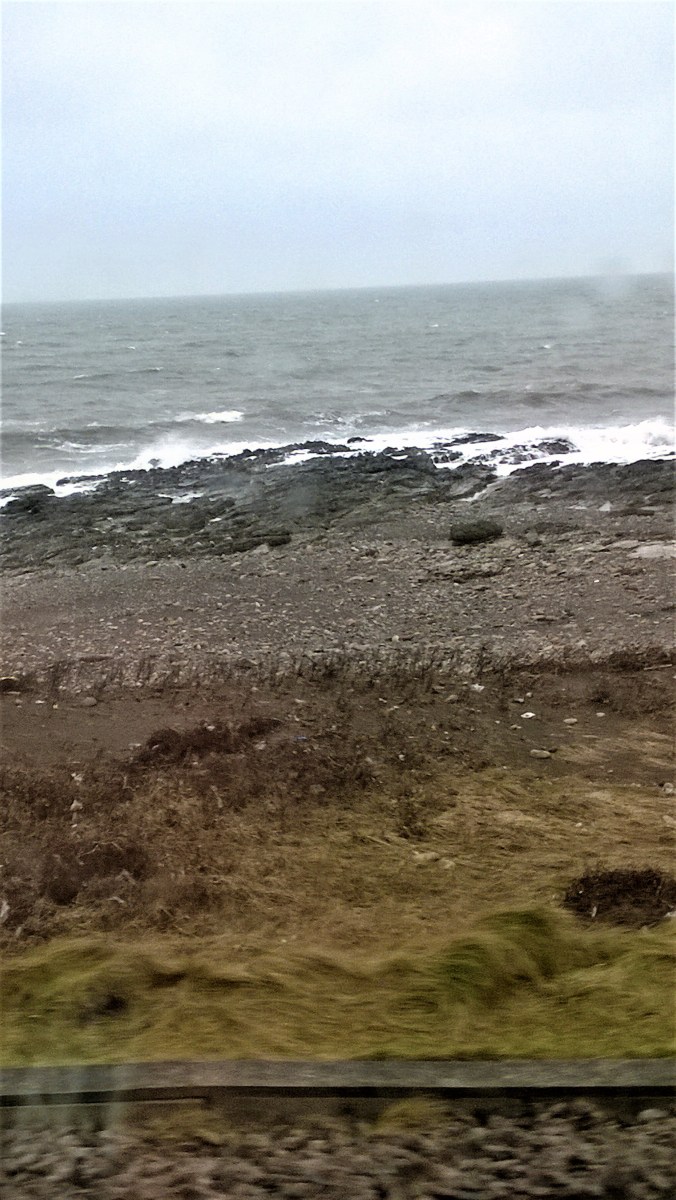
-Over the Rail Out to the Irish Sea by Paul Brookes

We picked our way down
to Peppercombe bay,
where the cliffs are paprika
and the grey stones wait
quietly, to be ground by the surf;
through the green hush of trees
to the place where there’s only
the wide sky and the salt sea.

-Sarah Connor

jagged teeth of rocks
black spikes along the shoreline
the slow hush of waves

-Bronwen Griffiths

Obsession

The sucking hiss of the indrawn breath of the tide
draws the land closer, grain by grain,

stealing, in tiny increments,
the gift it takes for itself and piles back on the shore.

This compulsion I know: drawn to the granite edges of you,
again turned aside.

Close as the heart’s core, or as far away as the moon,
are the sources of the timeless force that binds you to me.

Age by age;
tide by tide;
by the dark magic of gravity I take you now.

I am the ocean and you are my shore.
You will come to me.
Grain by grain, you will come to me.

-Yvonne Marjot

Precariously,
between slimy sea rock pools
I see it scuttles

-Paul Brookes

Sand clouds billows blown
hide fresh prey from predator
who waits all to clear

-Paul Brookes

In isolation
pools await the next tidal door
into the wider sea

-Paul Brookes

Saturday: Beachcombing. Share what you love about the sea using #NationalMarineWeek 25th July- 9th August, more like two weeks poetry and artwork challenge I’d love to hear all about your favourite marine wildlife, the actions you take to help our sea life, and what the sea means to you. Final Seven Days: Saturday: Beachcombing, Sunday: Rocky Shorelines, Monday: Mermaids And SeaMonsters, Tuesday: Sea Shanties, Wednesday: Ocean Vegetation, Thursday: Deep Sea, Friday: What Should We Do For Sealife. Please submit your poems and artwork by DM to me, or send a message via my WordPress “The Wombwell Rainbow” contact screen or my FB “Paul Brookes-Writer and Photographer” Today Saturday: Beachcombing.

Beachcombing.

Useful resources:

https://www.shorelocalnews.com/the-beginners-guide-to-beachcombing/

https://www.countryfile.com/how-to/outdoor-skills/beachcombing-guide-things-to-find-along-the-seashore-and-best-beaches-in-the-uk/

https://www.mcsuk.org/blog/post/gillian-burke-plastic-

__________________________________________________________________________________________

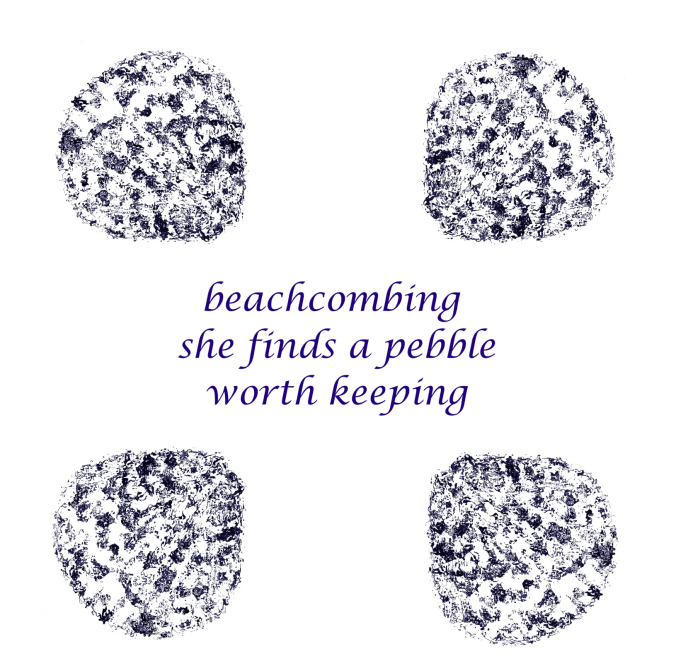
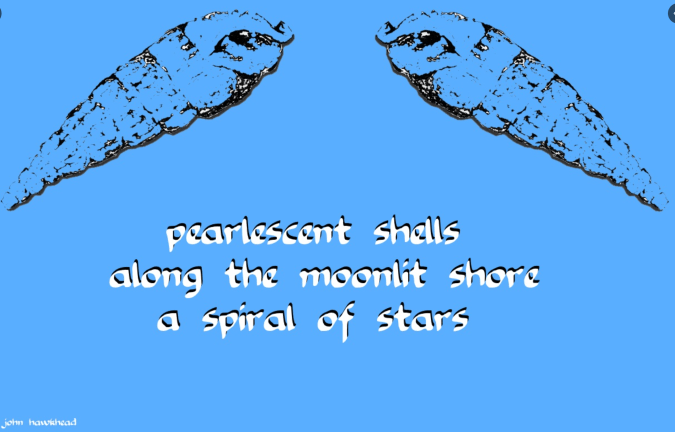
John Hawkhead The BeachJohn Hawkhead BeachcombingJohn Hawkhead Purlescent shells

-John Hawkhead

Beachcombing, Lower Largo

Forget the kite surfers, the holiday makers.
The Forth’s sailing boats will be there, all day.

Keep your eye on the shoreline.

Look, one hundred years of sea glass,
a tumbler on the ocean, ground smooth,
frost-gems recycled by nature.
They call it drift glass,
those fragments in your palm,
once a beer bottle or fruit jar
from another’s life,
a remnant of some shipwreck,
now a gift of earrings.

-Maggie Mackay

Saturday beach combing

Beach roses
Make me cry

Pickets washed bare
Dune’s graceful curves

Hidden horizon
Hope offered

Silver foam
Chases plover

Chase me
I submit

I feel the smell
Of sailors yells
And maiden’s tears ashore

Laid my back on rock
And watched the clock
Of night sky rolling in

As sun sinks down
Below blue line
Dark silhouette
Embraces mine

Sea frost caresses me
Moist cold lustily
Grabs my bones

Grey mist expanse
you are now home

Gull screech
Soul search
I think I will die
If not here

-Laurel Joy Graceson

Beachcombed rocks

-Karin B

Collecting Sea Glass with Janis

for Janis Smith

We could be people in a painting,
two women arm in arm, laughing.
A sudden slap of sea air and sand

and still we laugh as we continue
our walk along the beach recalling
silly superstitions handed down

from our mothers: Never cross knives
or put shoes on a table. I confess
I once walked under a ladder.

‘Sea glass is the answer,’ Janis reassures,
‘find frosted red, rare pink or
kelly-green and wear it for luck
on a necklace of seaweed like a mermaid.’

-Catherine Graham (The poem was previously published in Reach Poetry magazine)

.instruct’d .

Posted on August 24, 2018
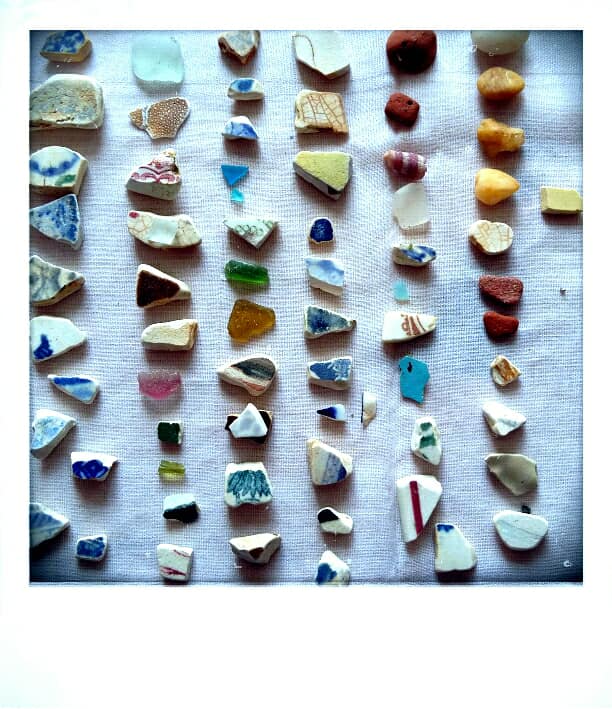
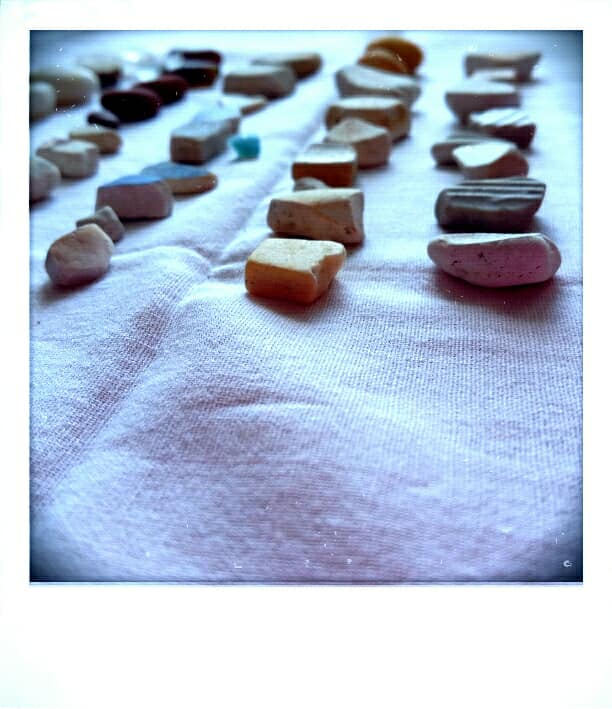
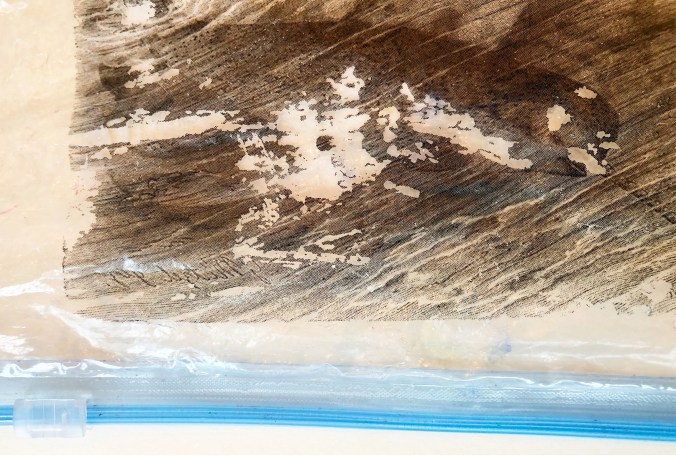
There will be a cotton hankie and a bag of beach combed pieces.

Some are very tiny so I tips them onto something white to see. Set up is lining them into rows onto the hankie. I make up categories for the rows and use even the tiniest bits too.

instruct'd 1 SBMinstruct'd 2 SBMInstruct'd 3 SBM

-sbm

Beach Combers

All the decades we wandered the beach
my hand in yours, driftwood, fossils, shells
cracked-open, trickle to an end with sun’s
Autumnal roseate set. The sea
claims you.

It was always the sea, even after you clawed your way
from tail fin to legs, bare feet stamping a pattern
along soft, wet sand. The sea sighed, let you go,
promised to return to lay claim.

Mind muddled by mermaid song, you rest
on your pile of pillows like a small child with
stunned, round eyes. ” How did I get here?”
You ask me while the waves roll in, tide rises,

licks at your feet. Skin the color of storm skies.
I answer ” You got old.” Because it is truth.
Denial, no more. Sea-salt corrodes everything,
dissolves castles we built from upended buckets of sand.

Water rises inside you, sponges soaked from lungs
that once held air enough to shout.

I draw your name in the sand with a stick.
Your face coalesces from the shadows, you and me,
that photograph last April, me, a princess, you,
our castle’s queen. Then you laid your body upon the beach,
bones and wrack yourself. Translucent skin, opal eyes,
waiting for the water.
Waiting for the water.

-Rachael Ikins

What Marine Life Does For Us, what do you see, taste, smell, feel, hear? Share what you love about the sea using #NationalMarineWeek 25th July- 9th August, more like two weeks poetry and artwork challenge I’d love to hear all about your favourite marine wildlife, the actions you take to help our sea life, and what the sea means to you. First Seven Days: Saturday: Seawatch, Sunday: Rock-pools, Monday: Seabirds And Seals, Tuesday: The Strandline, Wednesday: Sand Dunes And Salt-Marshes, Thursday: Fish-Life, Friday: What Marine Life Does For Us. Please submit your poems and artwork by DM to me, or send a message via my WordPress “The Wombwell Rainbow” contact screen or my FB “Paul Brookes-Writer and Photographer”. Today: Friday: What Marine Life Does For Us?

Friday: What Marine Life Does For Us?

At Bayard’s Cove we’d throw
Tennis ball after tennis ball
Out for the family dog to fetch.
The beach was wracked with drift
Wood, salt scored bric-a-brac-
Matter that the waves sent back.
Long gone, but still I see his head
Above the surf’s lip,
The lick of water in his wake

-Peter Boughton

I see a thin line
which might be half sea
the other half, sky

-Elly Nobbs

Chimes

#SlamWords
We are broken,
whatever you do,
place his letter in a bottle
let us sail to where
lemons and oranges grow
blow shapes on the glass
slowly turning around
let it go with the tides
into the perfect dream
floating on the chimes

-Fi

The seaside

tastes of particles of salt
Swimming
in puddles of vinegar
Atop
Crunchy batter
Surrounding
cod.
The coast
Tastes of sugar
Sprinkled atop
Freshly fried
Donuts,
Babies in trollies scream
For smooth ice cream.

-Anthony J.P.

Dora Incites the SeaScribbler to Lament

Sees him at the far end of the strand,
squamous in rubbery weed, his knees bobbing
urchins, his lean trunk leaning, sea-treasure for her.

After it all (they mate, like carapaces, in parentheses)
Dora feels coolness in new places, lifts a reused
razor shell, mother-of-pearly and straight

and signals out to the swell of mouldering green.
Dora is electric, in love, and deep water.
Dora, Dora, Dora, in which dread is.

People people the beach, peering
through splayed hands, appealing:
DAW-RAAaargh. A boat sees her passing.

Sea-scribbler’s chest buckles
in aftershock—his quill is primed:
squid-inked and witful.

——————————–

From:
Monica’s Overcoat of Flesh, Nine Arches Press, 2020

-Geraldine Clarkson

Our Hands

Sea stars on the glass.
Sweat toward each other.
Pores open to give kisses
that never touch skin.

Sunlight-fine hairs
on their backs burnished,
late afternoon.

Evenings we send messages
in bottles that float a sparkling cyber-sea, only a wall between us.
Thicker than air, ten feet of granite.

But thin enough I hear you
from the bed where I float toward
a dream: tap-tap-tap,
you tap some song. I sleep
knowing you
are still there.

-Rachael Ikins

Another Tide

Another Place by Anthony Gormley at Crosby Beach

His metal men, barnacled and lichened
stand firm on the beach. I’ve touched them,
marvelled at their beautiful limbs, the penis,
the proud bones of the feet. Each made the same
but changed by different encounters with the sea.
I’ve stood beside them, posed for photographs.

Today, they were dark dots in the spring tide
as the Irish Sea battered them, beating the Mersey
into coffee-coloured spray, thick with silt.
Salt spurted at walkers, the bitter wind
drove fingers to whiteness. The hundred
iron men appeared and disappeared, unmoved.

Do they look out, across the river
back to an Ireland they left on a harvest ticket,
riding the sea fourth class, saving every penny
to send home? Long before the famines,
they crossed backwards and forwards as if
the sea were nothing more than a road of water.

Blight came and hunger followed:
Fever, famine, emigration, deportation.
Tides recede, salt dries on rusted faces.
History’s hard stories are still told here.
Had they tongues to sing, they would voice
a hundred songs of yearning for home.

-Angela Topping

First published in Not A Drop (Beautiful Dragons 2016)

seafoam
spray the rocks
after a boom

~ Christina Chin

rising tide
pounding the rocks
a submerged Islet

~ Christina Chin

salt spray.

ah the sea, the sand, it comes in bottles now, dearer than the cheaper stuff.

i had not met her before, went in on the off chance. waited a while till she
was free.

she did it different, said nice things about my skin. in a small way she gave
me confidence.

i bought the quiche, sat in the cathedral grounds.

used the salt spray, and did not die.
of it

sbm.

come gently with birth
come gently with life
grow with the place
until we grew beyond how it was

beyond the culture and crowding
thinking
becoming unsettled
moving
retaining memory

1.

cycling the promenade hoping
some one will love us some day

baking down dunes
walking down tracks
barefoot hoping for less paving in town

2. humbling for a home
walking looking in windows
will some one want us
house us?

3. finding the two above
settling for the place where folk
come to holiday beautiful
while we work the bones of it
the grit beneath

bournemouth beautiful

the reason beneath the move away
is beyond any words i have just
now
where folk
come to holiday beautiful

Bournemouth

-sbm

.dunoon.

All is the same there.
I left the stone yet the storms may have moved it a little.
I said hello to your hotel.
Yes the Durley Dene is good with a spa and a wonderful cream some tea oh and chandeliers of course. The other Bournemouth hotel whose name I forget was all mirrored furniture and starchy tablecloths.
Saw two films in the little cinema with a fellow traveller while others sheltered from the storm in the hotel lounge with sandwiches and games.
I avoid private views so a day at home after a quick trip into Dolgellau for the post etc. Hope you have a real good time in Dunoon.
Oh there is a good photography exhibition at Burgh Hall and the cafe is open there too. The library is open in the Queens hall and has stunning views.
A friend showed me her photos of whales up the watter. ..teaching their offspring to hunt. The watter turned red. It is said they swam up to Glasgow where they turned and headed back.
The framers up the back road may be open so one can visit his pet lizard. Have

-fun.

-sbm

Dunoon 1

Ps. There is a shop on a corner in Dunoon. Named Doon the Watter that sells Waverley posters. Rather good.

Dunoon 2

The Cloud Breakers

plunge and spill in the oceaned sky,
refract in a curve a gust of breath.

Cirrus ripples, cumulonimbus breakers,
your spirit observes as it rises above yourself

spread on a blanket laid on watered memory sand.

Out of body, out of mind, look at the lilted lap
at your feet of cloud tumble, wax and wane

of moon tempered ruffled white.

A tide of clouds inches down,
leaves a faint thought
of where it has been.

-Paul Brookes

#InternationalFriendshipDay poetry challenge. A quick one today, amid the main challenges. I have just reunited with a best friend of mine who I had not spoken to for fifteen years. We lost touch. What stories do you have?

Friend of The Shadows

He walks, a friend of his shadow.
Trees hug eachother’s growth.
I have not called him yet.

He thinks he heard his phone ring.
Ringing befriends silence.
They have so much to catch up with –

mistaken identities, leaving,
not telling about birth of a child.

-Kushal Poddar

Friend

A friend is a buddy, a partner, a pal
A friend’s anywhere, anytime, anyhow
When troubles are piled up
Like fries on a plate
A real friend is there and will not let you wait

A friend will ply your lungs with laughter
A friend will be your sticking plaster
Make you happy ever after
A safety net
A sure-fire bet

A friend is a neighbour, a backer, an aide
Who smooths your rough edges when you’re worn and frayed
When loneliness beckons
Or hopelessness looms
Their kindness will catapult you to the moon

A friend will not refuse a mission
A friend will fuel your optimism
Tough cement that heals division
Erase the blue
Is what they do

A friend’s a companion, a comrade a chum
There are other numbers but they’re number one
When days are huge mountains
Far too tall to climb
A friend is the leg-up that’s lifting you high

A friend will not have cause to doubt you
A friend won’t want to live without you
Even when disaster clouts you
Secure as locks
Like solid rocks

A friend is a buddy, a partner, a pal
A friend’s anywhere, anytime, anyhow.

-Neal Zetter

we were friends’ 

more than that with promises

that faded into silence.

i woke this morning the same,

a taste of autumn,

mists and biblical sheep

resting.

a new grave here,

a new grave near,

while all is growing,

there.

a cloud hangs in the valley

-sbm.

https://dailypost.wordpress.com/prompts/promises/

Friends sbn

-sbm

.friends.

. we are friends .

we are friends , we met in the lane.

the words sound like poetry, the quiet
voice sounds shouting in this silence.

it can make windows and opportunities,
space to accompany the music.

travel far and in between, play the right notes,
write notes, and then maybe, all will come

clear. or not.

i need that stop.

sbm.

‘friends.

i am sorry to hear of your day
if you able
the detail
i can listen
a new day
goldfinches on seeding knapweed
simple things

i was to cut it down soon
now i shall not

they balance so sweetly
eating the seed

yesterday was charming
i looked at the trees with clover
underlay
i looked at the garden

i will go again
another day

6.56
late summer
worrying

about friends

-sbm

On Female Friends

Both tote cans of lager,
all in black leggings

get the weekly shop in.
One says to the other who

packs the shop “I’ll stand
on his face. Tell him.

I’ll stamp on his face.”
The next couple,

“Mam, you buy the weirdest.
What’s suet for the birds? Fat balls?”

“It’s your dad’s dinner, pet”
They both laugh.

-Paul Brookes (From my collection “Please Take Change”, Cyberwit.net, 2018)

My Strangers

are friends who haven’t been estranged yet.

All my mates are strangers.
I keep them at a distance.

Chat to them in third person.
Internet on my mobile tells me

when I’ve to give them best wishes
for a special occasion like anniversaries.

They inspire closeness and loyalty.
I can trust them.

They know me.
What I eat, sup.

laugh at.

Strangers are more intimate than friends.

-Paul Brookes (From my collection “A World Where”, Nixes Mate Press, 2017)

Fish-Life, Crab-Life, Whale-Life, Turtle-Life, what do you see? Share what you love about the sea using #NationalMarineWeek 25th July- 9th August, more like two weeks poetry and artwork challenge I’d love to hear all about your favourite marine wildlife, the actions you take to help our sea life, and what the sea means to you. First Seven Days: Saturday: Seawatch, Sunday: Rock-pools, Monday: Seabirds And Seals, Tuesday: The Strandline, Wednesday: Sand Dunes And Salt-Marshes, Thursday: Fish-Life, Friday: What Marine Life Does For Us. Please submit your poems and artwork by DM to me, or send a message via my WordPress “The Wombwell Rainbow” contact screen or my FB “Paul Brookes-Writer and Photographer”. Today: Thursday: Fish-Life, Crab-Life,Whale-Life, Turtle-Life.

Oarfish_NMW_foil1

Oarfish

Narwhals_NMW_plastics2

Narwhals

Narwhals_NMW_plastic1

Narwhals

-Marcy Erb (Artwork she says was inspired by my project. I am honoured.)

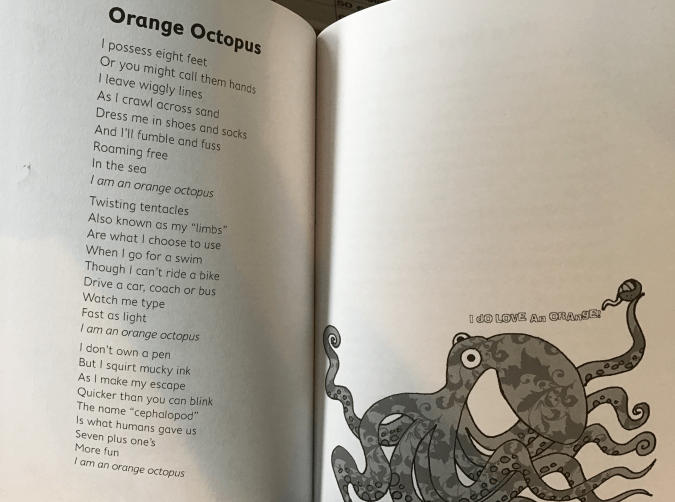
Neal Zetter Orange Octopus

-Neal Zetter

The Tench

The only remarkable thing I can say that’s concerning the tench
It doesn’t waste time writing poems of me while it sits on a bench

-Al Barz

Sea Fish

-Rachael Ikins

She says of it:

The cowfish is…an acrylic, mixed media painting. This is a poisonous ocean fish. I like painting faces and eyes in particular and this guy just looks like hebis swimming straight at you to see what’s going on. The cowfish title is “Does This Color Make Me Look Fat?” Is quite large bigger than 16” x 20”. The original is available as are prints if something grabs someone’s fancy. People can direct message me on my arts page Ask the Girl Arts on FaceBook.

Offering

Welcome, silver swimmer,
leaper of rocks and sills,
darer of foam and roar,
glittering life-giver.

Offer to our hooks and reels
your own bright self.

We mark your coming,
first of the shoals,
sign of our thriving,
fattener of gaunt bodies,
saviour of fading children.

We will dress you with eagle feathers,
lay to rest on red cedar bark,
sever your head with the best mussel shell,
boil a new kettle,
place you in fresh water.

Your gracious gift is honoured,
not a morsel wasted.

Fly higher, flashing river bird,
fins whirr like wings,
tail lash in joy.
We will win freedom together,
you from the bonds of flesh,
we from our mortal hunger.

Go home, swimmer friend,
now you have met our elders.
Tell your brethren they are always welcome

-Kathryn Southworth

She Says “. It opens my Indigo Dreams collection ‘Someone was here’. ”

.whales.

the title got me thinking

we had comics on tuesdays and thursdays
from the middle shop up the hill

sometimes there was a whale
in the story with a picture

round grey with a fountain in it’s head
it’s tail akimbo later

i learned that they don’t look like that
really .

he said

real stars do not have points .

i guess i shall never see a whale
though some bones are over the door
in mallwyd church porch

up the road

-sbm

Journey Home

Mother-moon pulls me east.
Fat silver face, 13 days into
trembling month on the lip
of summer.

I feel my roots,
in my gut, do not try to resist. I am
a small crab who scuttles 25 miles,
white-wash,
beach sand, leave

poetry threads,
necklace strands,
claw marks
with my sisters.

Almost six decades
ago I floated, plankton
until sea tossed me
onto land.

When wind and waves rise
I cling to a rock. There are bugs,
rotting minnows and
seaweeds to sort.

In the moonlight
we savor. We grip,
burrow, lose a claw
to a predator. Yet,

my sisters are my home,
25 miles in one night
following the beckoning silver fingers of Mother-moon.

-Rachael Ikins

ChristinaChin_kelp_Wombwell Rainbow

open sea
a clam shuts tighter
in the pebbles

~ Christina Chin

running tide
in the rock pool
foraging sea bass

~ Christina Chin

Two Tied

fishtails. Mam and me,
Swim away from his slaughter

offriends and neighbours,
fall of Ash and mortar,

Taste of burning skin.
Not sure who me father is,

As me mam goes with owt
in trousers. Her first names

Promiscuous but folk, ‘specially men
call her Promise. She calls me Lust.

Me Dad could be Chaos or War.
Me mam’s been with both.

We’ve scarpered from Destruction
who clamours atta end on us all.

Mam and me lept into watta,
as fish tied together wi ship rope

So as we can’t drift apart,
tho ad be glad if we could

as ad like a life a me own
not chained to her,

and how can I tell her
am getting younger by the day.

Soon al be a bairn with a bow and arra
and tiny wings shooting me

Arras off not bothered who they hit,
an consequences of giving folk

bits of mesen, so their bodies hanker
like me mam after owt with a pulse.

-Paul Brookes

(From my as yet unpublished collaboration with Iranian artist Hiva Moazed: Kosshali)

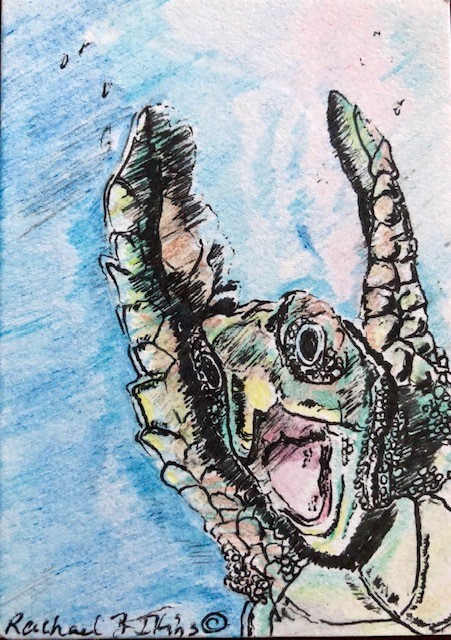
Turtle

_Rachael Ikins

She Says: This is pen and ink with colored pencil. Title is “Weee!!” A baby sea turtle.

It is an art trading card available as well.

CoralSea Cucumber

Sea Cucumber

Both by Rachael Ikins

Feeling, Ironic

Manatee,
Solemnly seeking
A place for life,
The peace of warm waters –
Do you feel?
Or, is that a curse
Singularly
Reserved
For what we call
Humanity?

Humanity,
Violently seeking
To restore – What? Order?
With tear gas, and oppression.
Do you feel?
Or is that a gift
Singularly
Reserved
For the greater
Animal kingdom?

-st

Links And Bios

-Al Barz

A performance poet and event organiser who’s been around the block many years, Al Barz now resides in a semi-rural West Midland alcove. Responsible for Spoke in the Lamp event, and SpokeScreen during lockdown, Al keeps popping up at pubs, theatres, cafes, festivals when a slot
appears, adding to his many semi-rural alcoves within high-heeled media platforms.

Sand Dunes And Saltmarshes, what do you see? Share what you love about the sea using #NationalMarineWeek 25th July- 9th August, more like two weeks poetry and artwork challenge I’d love to hear all about your favourite marine wildlife, the actions you take to help our sea life, and what the sea means to you. First Seven Days: Saturday: Seawatch, Sunday: Rock-pools, Monday: Seabirds And Seals, Tuesday: The Strandline, Wednesday: Sand Dunes And Salt-Marshes, Thursday: Fish-Life, Friday: What Marine Life Does For Us. Please submit your poems and artwork by DM to me, or send a message via my WordPress “The Wombwell Rainbow” contact screen or my FB “Paul Brookes-Writer and Photographer”. Today: Sand Dunes And Saltmarshes

Better Marram Grass By Yvonne Marjot

Calgary Bay on Mull

-Yvonne Marjot

Wendy Saltmarsh photo art

saltmarsh at Cape May

-Wendy Notarnicola

Beach Finds by Rachael Ikins

“The Shell Collector.” (16” x 20” available as a print)

-Rachael Ikins

Formby Sands

This beach is not for sunbathing,
not at this time of year.
Inland, birds may sing
and hawthorn’s pink tips
froth in the woods, but here

wind makes new partings
in my hair, blows shell-grit
ground by sea-roiling
into my mouth and eyes.
The dunes have swallowed you.

I wade through shifting sand
which sucks and ripples
as I try to follow.
Words are ripped from my mouth.
Where are you? I flounder

think I’ll never find you again
scale sand hills close to crying,
not that anyone would hear me
in this banshee place
of screaming gusts and gulls.

When we find each other
between dips and rises, your calling
and mine, things we dare not say
rise like distant waves,
glitter in cold spring light.

-Angela Topping

a blue heron wades
through its own reflection –
salt marsh at high tide

windy morning –
a flock of sandpipers
huddle by the dunes

-Wendy Notarnicola

Saltmarsh in October

Small groups of skylarks rise and spiral-soar
and distant curlews keen their plaintive cry.
Runnels and peaty pools reflect the sky.
The wind disturbs the rushes and my hair,
like a new lover’s rough caress – and flings
the gulls about the sky on paper wings.
My feet are silent on the sandy path
save when they step, unheeding, on the black
pods of the pistol-popping bladder-wrack,
strange to my ears – while stretched, before my eyes,
in orange, russet, lichen-yellow hues,
the marshland lies in many-textured bands,
a sampler by a needlewoman’s hand,
its hem a distant estuary-blue.

-Jenni Wyn Hyatt

First published online in ‘The Road not Taken, a Journal of Formal Verse’, Fall 2015

Lifesaving Poems: Samuel Beckett’s ‘my way is in the sand flowing’

A powerful poem by Samuel Beckett that features sand dunes. Inspiration for tomorrow’s #Nationalmarineweek poetry and artwork challenge.

Anthony Wilson's avatarLifesaving Poems

10561210_1460597930865961_1905582399_n

my way is in the sand flowing
between the shingle and the dune
the summer rain rains on my life
on me my life harrying fleeing
to its beginning to its end

my peace is there in the receding mist
when I may cease from treading these long shifting thresholds
and live the space of a door
that opens and shuts

Samuel Beckett, from ‘Four Poems’ (2)

‘The summer rain rains on my life.’ Suddenly there it was, a sentence I hadn’t thought about for years. I was standing by the kitchen window making breakfast, trying not to think, as I do. The summer rain rains on my life. A day that began grey, gradually warmed up, then surprised itself by becoming a belter. The summer rain. It must have been in that unspeakable flat in Cricklewood, with finals approaching, all of life and learning on little cards (did we…

View original post 307 more words

Poem: Waldringfield salt marshes – seal

Just found this marvelous poem by Andrea Skevington featuring a saltmarsh. I hope it inspires for tomorrow’s #Nationalmarineweek poetry and artwork challenge.

andreaskevington's avatarAndrea Skevington

WP_20200621_20_34_58_Pro These beautiful photos are by Pete Skevington, with thanks.

We haven’t been far from home, since Lockdown started.  It’s been astonishing how that restraint has made us more inventive, seeking out places we haven’t been to, or haven’t been to for years.

We have a very loose walking project of seeing how far along our local river, the Deben, we can go. How much of it is walkable, and accessible by footpath. The river is an estury downstream from us, an unstable and changing and hazardous landscape.  At times, the public right of way marked on the map crosses open water.

We hadn’t attempted to walk this particular route for a very long time ideed.  My memory of it, my first experience of this kind of landscape, was nearly losing my boot in sinking, sucking mud, and being unable to pull myself free.  Now, being more accustomed to the great…

View original post 422 more words

The Strandline, what do you see? Share what you love about the sea using #NationalMarineWeek 25th July- 9th August, more like two weeks poetry and artwork challenge I’d love to hear all about your favourite marine wildlife, the actions you take to help our sea life, and what the sea means to you. Furst Seven Days: Saturday: Seawatch, Sunday: Rock-pools, Monday: Seabirds And Seals, Tuesday: The Strandline, Wednesday: Sand Dunes And Salt-Marshes, Thursday: Fish-Life, Friday: What Marine Life Does For Us. Please submit your poems and artwork by DM to me, or send a message via my WordPress “The Wombwell Rainbow” contact screen or my FB “Paul Brookes-Writer and Photographer”. Today: Tuesday: The Strandline

Tuesday: The Strandline

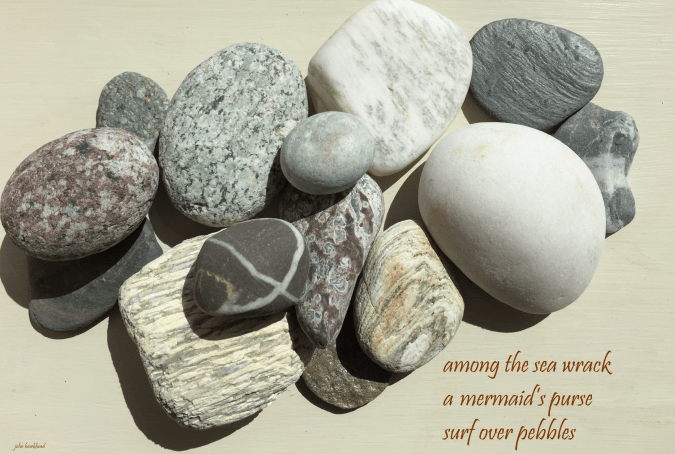
John Hawkshead Mermaid's purse

-John Hawkhead

Along the Strandline

Bare feet squelch furtively,
lungs gag at weeds
fermenting, lamenting.
Foraging for sea soft glass
in amongst deserted
debris, snickered at, avoided.
A milky thread laces
slippery orange,
hesitant fingers pincer,
easing away gunk,
held up to the solitary sun
a string of forgotten pearls.

-Anna Chorlton

The port of the bog

Its purpose, woven
across the landscape.
East Strand, a beach of shells:
mussels and clams. Cast overboard,
washed up; stranded.
Above the high tide line
lobster pot pyramids.

Stone walls, pincushion
bleached-wood net needles,
colourful markers, buoys
and floats, decorate gardens.
Lawns quilted by drying nets.
The harbour seal, circles,
disturbs oily rainbows.

Ebb and flow history, the rise
and fall of quotas, trawlers
trailed to bog-land. Burnt.
Those who remember
and those who don’t.

-Gaynor Kane

Rachael Ikins mixing bowl

-Rachael Ikins

Not Quite Low Enough

High tide’s
strand line mostly
dried eelgrass where you stand
near the lighthouse; the blue herons
aren’t here.

-Elly Nobbs

gentle breeze
in her wet tangled hair
the ocean smell

~ Christina Chin
The Haiku Foundation
Photo Teresa Cobb

Stranded

The bandstand by the strandline
rocks. I dive to salvage
the wreckage of what you have been
saying between the sips of pale ale.

In the part we don’t see sand often,
yet my ears seem to be filled with
the golden grains. The local pickpocket
returns my perpetual empty wallet.

The bandstand now play Good Vibrations.
I love the colourful clothes. Sunlight fiddles
with things premonition proclaims
as soon to be lost. We are white noise.

In buzzing flickers the image of the strandline
stares at the dead whale drifting this way.
……………………
……………………
Three Dead Lines
.
days stroll by strandlines

the misplaced swab test result
and town-lanes emptied

-Kushal Poddar

Wombwell Rainbow Interviews: Daniel Fraser

Wombwell Rainbow Interviews

I am honoured and privileged that the following writers local, national and international have agreed to be interviewed by me. I gave the writers three options: an emailed list of questions or a more fluid interview via messenger, or an interview about their latest book, or a combination of these.
The usual ground is covered about motivation, daily routines and work ethic, but some surprises too. Some of these poets you may know, others may be new to you. I hope you enjoy the experience as much as I do.
Daniel Fraser website

Daniel Fraser

is a writer from Hebden Bridge, Yorkshire. His poetry and prose have featured in: LA Review of BooksAeonAcumenX-R-A-YEntropyThe London Magazine, and Dublin Review of Books among others. He was awarded 3rd prize in The London Magazine 2019 Poetry Competition. Twitter @oubliette_mag.

Here is a website link: https://danieljamesfraser.wordpress.com/

The Interview

1, When and why did you start writing poetry?

Like many people I suppose I started writing poetry when I was a teenager, partly as a way to deal with the difficult time I was having and also because it was the time when the world of literature first started to open up for me. At school, early on I had always been more interested in science and mathematics but then something started to shift. Reading and literature became increasingly central to how I reacted to and responded to what I was experiencing and writing poetry became part of the way I tried to express that change. Back then it was little more than a kind of psychic effusion, a mess of borrowings and moods. I did not begin writing seriously until I was 24 or 25; I spent much of my early adulthood ‘gathering material’ is the most charitable way I could put it. I was, I think, almost 30 before my poetry found the first grains of what it was (and still is) looking for.

1.1. Were there any writers you were drawn to in this early period?

The first things I picked up were Rimbaud and Baudelaire, which I took from my Dad’s shelves, and Sylvia Plath, who was buried very near where I am from. Her poem ‘Hardcastle Crags’ is still my favourite poem about the area. There was Bukowski too, inevitably, and some Beat stuff; my Dad gave me a copy of A Coney Island of the Mind which I read over and over again.
Then Eliot, which was completely transformative for me. Reading Four Quartets then felt almost alien in a way that made me want to find out why.

1.2. How was Eliot transformative?

I suppose it was the odd sensation of closeness and distance I got from reading Four Quartets, familiar and unsettling at once (without wanting to get too Freudian).

The poems were written in language I knew and understood, much of their rhythms and allusions were not so far beyond me, but somehow there was something infinitely puzzling about them.

Each time I tried to get hold of certain parts or phrases, others eluded me completely.

More than this, the poems themselves seemed to be trying to reflect on this problem, questioning their own presence, their form.

2. How aware are and were you of the dominating presence of older poets traditional and contemporary?

I’m not sure I gave it much thought. I was simply reading whatever was close to hand.

[Sorry that’s not a very good answer!]

2.1. What came close to hand?

I suppose in that second phase of reading I was drawn to a lot of translated poetry.

I read Vallejo, Neruda, Rilke, Tsvetaeva. This was when I first starting reading Shakespeare too. I remember reading Bolaño back then, one of literature’s great name-droppers, and seeking out some of the poets he mentions: like Gonzalo Rojas.

My dad was (and still is) running a secondhand bookshop, and so there was always interesting stuff around, though not for too long! He always gets nervous when I go to visit, in case I start trying to steal the stock.

Both my parents were dealers of secondhand stuff actually: my mum sold antiques and pictures and other bits and pieces, so everything in our house was on a constant carousel. I rebelled there, I’m a hoarder. Books everywhere. Bits of paper with notes on, receipts, tickets.

2.2. A second hand bookshop must have been a treasure trove.

It was! I’m very thankful for it (even if it partially led to me hoarder tendencies!).

3. What is your daily writing routine?

I still find it difficult to settle into anything like a routine, particularly with work and various other commitments. I set myself a daily minimum of 30 pages of reading and 30 minutes of writing which gives me something easily attainable on days when I’m struggling and leaves scope for writing to swallow the whole day when it needs to.

I don’t have any fixed hours, I don’t find myself being particularly a ‘morning’ or a ‘night’ person but I do find different spaces suitable for different kinds of work. For inspiration and initial creative efforts I find background noise, particularly cafe noise and transport sounds, being on a train or a bus, very helpful; which is probably why so much of my writing starts out life on scraps of paper. Editing and re-writing are firmly indoor activities: at home, plenty of coffee and silence.

3.1 What subjects are you especially motivated to write about?

Good question! At a general level, a lot of the time it feels random, what comes. Things start with a mood or an experience.
There is that great line Geoffrey Hill borrows from David Bomberg about ‘grasping mood through structure’. I still go back to that often. If I start with the idea, with something too structural, then the work is often harder, and easier to abandon somehow.

More specifically, there is a good deal of my home landscape of West Yorkshire in the poems: waste grounds and industrial premises as much as mills, thick woods, and moors.

My philosophical reading also finds its way in there, though only as a trace, a chunk of mica in the sediment: Marx especially, in the ideas of history, of nature and of work, but also Blanchot, Benjamin, Kristeva, Malabou.

I also find much of my poetry bears marks of awareness of their construction, of its status as poem, a kind of uncertainty. I feel like this uncertainty is an important part of what allows literature, and poetry, to live, to keep moving across time. The gap between language and experience is always there, however we might try to cover or cross it.

Besides, as human beings we have to question the meaning of our existence and the effect of our words constantly, I don’t see why poems should be let off the hook in this regard.

4. How do the writers you read when you were young influence your work today?

They are all part of the ‘poetic sediment’ that builds up of course, though it can be difficult to identify specific influence. In general, there is too a kind of affective memory, where the particular emotive response generated by reading those poets at certain points in my life re-emerges when working. More specifically, I certainly think encountering a lot of translated poetry early on introduced me to unusual rhythms and forms, and gave me confidence to allow some of more experimental impulses into my work.
In practical terms, when working on a poem, one often finds a particular image or shape is being pulled in several directions at once: toward the lyric, the surreal, the modernist, the commonplace and so on. And these forces or tensions are naturally shaped by previous poetic reading. So, whilst I might not be able to say ‘there was an element of Plath in this phrase’ or ‘I found this image in Vallejo’ (beyond those poems which are designed to speak directly to another poem or poet and where certain phrases might be directly adopted and acknowledged as such), all of what we read forms part of the murmur from which the work develops.

5. Who of today’s writers do you admire the most and why?

Thanks for this question Paul. A lot to choose from! I shall limit myself to poets because the list will be long (and incomplete) enough as it is but, the ones that immediately come to mind are: Karen Solie, Michael Hofmann, Rory Waterman, Vahni Capildeo, Anne Carson, Fred Moten, Ocean Vuong, and two recent losses to the category of contemporary: Geoffrey Hill and Sean Bonney.
Solie for the blend of philosophical and colloquial, of industrial and natural, that make her one of the best poets of work and material labour as well as of nature and landscape. Her concern of how these two are formed and forming one another, the economy of natural history, makes her work something I return to on an almost daily basis. Hofmann has been one of my favourite poets for a long time. His voice, piercing, literary, and often extremely funny, cuts out wonderful poems from moments of awkwardness, failure, and misunderstanding that manage to be both superbly readable and endlessly re-readable. Alongside Solie he is the poet whose work I most often give as a gift.

In Vuong, there is something in the way that the finished poem still feels cut raw, the images being wild/surprising but somehow not out of place. I have re-read Night Sky with Exit Wounds probably five times and found new favourite moments each time. Waterman I admire, perhaps, for working from the opposite direction: where what is strange and special rises slowly from below a seemingly familiar surface. His grasp and twist of the everyday can be extraordinary. Like the title of his book Sarajevo Roses he often draws beauty from small wounds, repairing them not by attempting to ignore or cover them but rather by deepening their significance.

Moten for his theoretical depth and political commitment; and for giving some of the best live readings I’ve ever experienced. He is someone who’s ability to shape language and rhythm to his own ends seems almost limitless. Capildeo (another wonderful reader of poetry) for a plurivocalism and formal experimentation that can only inspire awe and admiration, capable both of narrative ‘epic’ and tightly wound images that explore the shapes of individual words, forcing a recognition of the material weight of sound in the mouth. Bonney: again for his political commitment, and for developing a kind of communist metaphysics from the French tradition, particularly Rimbaud. His polemics manage to avoid being either dull or arbitrarily experimental but, like the best invocations, are memorable, rousing, moving.

Hill not only for poetry, but for his writing about poetry. His Oxford lectures and entry in the famous Paris Review ‘Art of Poetry’ series are incredibly rich sources of inspiration and poetic-thinking. As for the poems, Canaan in particular remains one of the most incredible books of poetry I’ve ever read, where his frighteningly powerful sense of time, of the present and its deep history, is at its most acute. He is a poet of Benjamin’s catastrophe, of the paradox of urgency and century.

Carson, on the other hand, seems to be writing ancient myths for a future world that’s still to come.

6. Why do you write, as opposed to doing anything else?

The short answer I suppose is that I have to. The long answer is very difficult to pin down and may sound convoluted but here are a few notes which fumble towards an answer:

Our experience of the world is narrated all the time both by the structures of language by which the conflation of word and object becomes naturalised and the structures of power which naturalise historically created institutions and ideas.

The only way the world can become, in any lasting sense, genuinely liveable requires a radical shift both in the way we understand wealth and the way we understand being human; a transformative opening out of the restrictive and broken modes of social being which capital currently offers us.

Whether writing or poetry can form a small part of pointing the way to these things, resisting the realist narrative by which the world comes to us, allowing us to think about different ways of being, creating moments of experiencing different temporalities, and so on, I don’t know. But I think the best writing tries to find out, even if its quest is a doomed one.

Writing can certainly lead us to think again about the discomforting, uncanny character of life, of the places where the communicative aspect of language shuts down (mourning and trauma for instance), making us more attentive to the fissures of a world that presents itself as whole. In this way, I do think political activity and literature share some ground in their attempt to critique reality, and in both cases doing so effectively means to be self-critical: that is, to be critical of both the reality from which they are created and the realities which they create. In both cases our relationship should always be unsettled and uncertain: fetishism (whether it be for an element of doctrine or a cultish appreciation of the sentence) is toxic. And yet, criticism cannot collapse into relativism: in the end something must be said, must be believed in. This is part of what makes things so difficult, and why nihilism is often so close at hand.

R.P. Blackmur’s quote about the best poetry ‘adding to the stock of available reality’ is perhaps too grand a claim, and is still couched in the language of the commodity, but something like that, an opening of possibility, is worth fighting for, and failing to reach, again and again.

7. What would you say to someone who asked you “How do you become a writer?”

I can only respond with cliches for this one I think, but I find them useful nonetheless:

Read, read, read, write, write, write.
Attention to the strange spaces of experience and language is the most important thing. Commitment to the object, to what you are writing about, is the second.
Don’t listen to too much writing advice. Use what helps you, if it helps you.
Don’t be afraid to keep everything.
Don’t be afraid to throw everything away.
Always have a pen/dictaphone/notes app to hand. Leave pens in the shower if you have to.
Don’t be afraid of cliche. It takes more skill to push a cliche into new ground than it does to experiment arbitrarily.
Writing is hard. It should be.

8. Tell me about the writing projects you have on at the moment.

I’m currently gathering together my essays on literature and cinema and re-working them into a book manuscript, and putting together a book of short fiction. In 2021 I will begin my PhD Scholarship at University College Cork, looking at trauma as a category of historical experience. In between I’ll obviously keep working towards a first poetry collection. Hoping to fit eating and sleeping in there too somewhere!