Recent Poetry from Carcanet: Morrissey, Jones and Watts — The High Window

***** Sinéad Morrissey’s Found Architecture reviewed by Malcolm Carson Found Architecture by Sinéad Morrissey. £14.99. Carcanet. ISBN: 978 1 78410 931 8 It’s somewhat daunting to review the Selected Poems of someone so festooned in honours: in January 2014 Morrissey won the T.S.Eliot Prize for her fifth collection Parallax and in 2017 she won the […]

Recent Poetry from Carcanet: Morrissey, Jones and Watts — The High Window

Review of ‘I Have Grown Two Hearts’ by Zoë Siobhan Howarth-Lowe

Nigel Kent's avatarNigel Kent - Poet and Reviewer

When I read ‘Morning Song’ by Sylvia Plath, I thought I would never again read a poem that so vividly and movingly captures motherhood. That was until I read Zoë Siobhan Howarth-Lowe’s second pamphlet, ‘I Have Grown Two Hearts’ from Hedgehog Poetry Press. There are so many poems here to match Plath’s classic.

In her collection Howarth-Lowe reflects upon her experiences of motherhood and parenting. She explores both the joys and the difficulties. In ‘Ultrasound’ we share with her the sense of wonder at new life: in ‘Hearing the Unheard’ and ‘Guilt and Longing’ the irresistibility of the maternal instinct; and in ‘Going Back’ and the title poem, ‘I have Grown Two Hearts’, the fulfilment of parenting. Readers will be struck by the honesty of Howarth’s writing: whilst she captures these positives, she also deals with the daily challenges: such as…

View original post 310 more words

Drop in Patricia M Osborne

Nigel Kent's avatarNigel Kent - Poet and Reviewer

Thanks to everyone who checked out Damien Donnelly’sDrop in‘ and my review of his ‘Eat the Storms‘. The second in the series is novelist and poet, Patricia Osborne. Here’s Tricia talking about ‘Soulmates‘ from her debut collection, ‘Taxus Baccata‘.

Soulmates  Last survivors, Gog and Magog lean side by side on Tor Hill’s dry plain.   Gnarled trunks, stretched girths, cracks and circles.   Branches creak, royal-yellow catkins kiss, caress.   Magog, shrunk with age, hunches, an old woman.   Gog taller, majestic, sways sideways, brushes Magog’s bough.   Sun burns strong, branches              wilt, scallop-leaves scorch, earth                splits.   A feral flame guzzles Gog’s bark. Skeletal, blistered, bare, he’s grown his last flower.   Magog stoops lower, her branches languish,   crevices become cavities,   she wills her earthly trunk to die   so her                           spirit  …

View original post 431 more words

Drop in – Damien B. Donnelly

Nigel Kent's avatarNigel Kent - Poet and Reviewer

This is the first in a planned series of ‘drop-ins’: opportunities to meet the poets whose collections will be reviewed in subsequent posts. I have some wonderful poets lined up and hope you’ll enjoy their reflections on their writing. They have been asked to choose a poem and reflect upon its conception.

The first of our poets is the wonderful Irish writer, Damien B. Donnelly.

Grains of Sand Beneath Cerulean Skies Faith is fragile, courage is not always conclusive, we don’t command the waves or comprehend the clouds. I tell you this sand will be swept into the sea by nightfall, this baying breath of cyan beneath the stretch of those cerulean skies. This smooth, salt-licked land was forged from fire before you were born, when vultures had feathers instead of hands and knives, when volcanos were all there was to fear. Faith is fragile, we can’t see what once…

View original post 409 more words

Drop in Zoë Siobhan Howarth-Lowe

Nigel Kent's avatarNigel Kent - Poet and Reviewer

For the third ‘Drop in‘ in the series we welcome Zoë Howarth-Lowe who talks about ‘You Don’t Fit the Way You Used To‘ from her latest pamphlet, ‘I Have Grown Two Hearts‘, published by Hedgehog Poetry Press in September 2020.

You Don’t Fit The Way You Used To

I am unable to explain my inadequacies
to your nearly five year old stamping foot.
How you have grown too heavy for my weak hip.
You were too heavy in my womb, your growing body
creating a weak spot in mine.
A hinge that crumples under the weight of you.

I cannot carry you home

When I was pregnant with my second child I experienced a problem with my pelvis that made it very painful and difficult to walk. It was a scary time as my first child was still under a year old and I ended…

View original post 170 more words

Drop in Zoë Siobhan Howarth-Lowe

Nigel Kent's avatarNigel Kent - Poet and Reviewer

For the third ‘Drop in‘ in the series we welcome Zoë Howarth-Lowe who talks about ‘You Don’t Fit the Way You Used To‘ from her latest pamphlet, ‘I Have Grown Two Hearts‘, published by Hedgehog Poetry Press in September 2020.

You Don’t Fit The Way You Used To

I am unable to explain my inadequacies
to your nearly five year old stamping foot.
How you have grown too heavy for my weak hip.
You were too heavy in my womb, your growing body
creating a weak spot in mine.
A hinge that crumples under the weight of you.

I cannot carry you home

When I was pregnant with my second child I experienced a problem with my pelvis that made it very painful and difficult to walk. It was a scary time as my first child was still under a year old and I ended…

View original post 170 more words

Drop in Gaynor Kane

Nigel Kent's avatarNigel Kent - Poet and Reviewer

This week’s Drop in welcomes, wonderful Belfast poet, Gaynor Kane, to talk about From Benin to Belfast, a poem from her stunning new collection Venus in Pink Marble, Hedgehog Poetry Press, 2020…

Nigel, thank you for giving me the opportunity to talk about one of the poems in Venus in Pink Marble in your ‘drop in’ series. I know you have been reading the collection and I hope you have been enjoying it. It has been hard to choose which poem to discuss but I have finally decided to talk about From Benin to Belfast.

From Benin to Belfast Benin boy whittles under shade of oil palms and cocoa plants. Plagued by flies, wishing for a spare hand or tail to swish, like the bony cattle. He’s told it is a great honour to prepare ivory for the mask that will adorn Oba’s hip. Elephant blood…

View original post 578 more words

Fires and a mother’s absence – A Poem by Henrietta Enam Quarshie

robertfredekenter's avatarIceFloe Press

Fires and a mother’s absence

Here in this place and time we are together.
Tired skins stretched over brittle bones like the yarn that stretches to cover the buttocks of our youngest. The night is cold and the winds whisper like gossip we are not interested in.

Here in this place and time we huddle together.
We try to keep warm but the cold is within and not without.
Father blows air into the fire in the wall.
His eyes are hazy and he lets out a sigh that echoes through our eardrums.
We know, yes we know he is frustrated by more than just the wet firewood.

Mother may come in soon or perhaps later or not today.
Maybe she will smile and cuddle us beneath her breast.
Maybe she will return with goodies that will distract us all.
Maybe she and father will not sizzle in argument under…

View original post 151 more words

Two Poems by Sage Ravenwood

robertfredekenter's avatarIceFloe Press

Blood Boils a Family Whole


We can’t see the weight of festering want
Just out of reachWe taste
Darkness on lips tar sealed honey stung
How do you hate/love
With a rope burned heart

Familial brother/sisterhood abandoned

ethnicity scorched belonging
When a parent dies Is it relief or grief
What remains from distilled pain
Hallelujah praise the distance between
mothers and daughters who refuse
to be saved in your God’s name
Someday the call will come
Rib-caged shackled lungs screaming
Emancipation tongues bit clean through
sharpened on inescapable jagged truths
Can you see in your mind’s eye
The cost to belong Blood boils a family whole
Dodadagohvi – we will see each other again
Standing among hellfire’s burnt religion
May your savior have mercy on your soul
Mine savors death with all my relations
Walking behind me comfort me not

Mother Monster


Mother’s Day is jagged and sharp edged,
cutting…

View original post 306 more words

Wombwell Rainbow Interviews: Justin Jannise

Wombwell Rainbow Interviews

I am honoured and privileged that the following writers local, national and international have agreed to be interviewed by me. I gave the writers three options: an emailed list of questions or a more fluid interview via messenger, or an interview about their latest book, or a combination of these.

The usual ground is covered about motivation, daily routines and work ethic, but some surprises too. Some of these poets you may know, others may be new to you. I hope you enjoy the experience as much as I do.
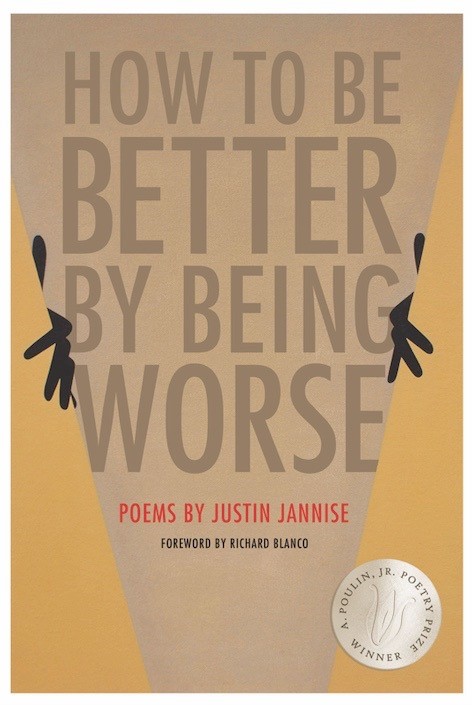
How To Be Better By Being Worse by Justin Jannise

Justin Jannise

is the author of How to Be Better by Being Worse, which won the A. Poulin, Jr. Poetry Prize and is forthcoming from BOA Editions, Ltd., in April 2021. His writing has appeared in Best New Poets, Best of the Net, Copper Nickel, Yale Review, Poetry Northwest, and New Ohio Review. Recently a recipient of the Inprint Verlaine Prize in Poetry and the Editor-in-Chief of Gulf Coast, Justin lives in Houston, where he is pursuing his Ph.D. 

The Interview

1. When and why did you start writing poetry?

The first poem I wrote, if I’m remembering correctly, was for church when I was 10 years old. Although we didn’t remain in that church for very long, my mother still has the poem framed and hanging up in her living room. Very embarrassing. I don’t recall having much of an interest in poetry between then and high school, when I became obsessed with Sylvia Plath. I don’t think I understood a word of Plath’s poetry, but I studied it, believing that if I read it enough times, eventually its secrets would be revealed to me.

2. Who introduced you to poetry?

In college, after flirting with becoming a sociology major, I soon realized that there were no classes I wanted to take more than literature and writing classes. I preferred fiction, however, since poetry seemed so difficult as to be virtually un-makeable. In the last semester of my senior year, I was told I’d have to take one creative writing class outside my fiction concentration, and I ended up in J.D. McClatchy’s introductory class. He was a tough teacher, and a stalwart formalist, but he opened the door to poetry – to understanding it better, as well as to writing it — in a way that nobody else ever had. I never looked back after that.

3. How aware are and were you of the dominating presence of older poets traditional and contemporary?

Personally, as a teenager, I was much more aware, and much more interested, in the classics of literature. Even in high school, I supplemented required reading with even more required reading. For some reason I believed that difficult literature would make me smarter, and what’s more difficult to a 16-year-old than Henry James, Faulkner, Virginia Woolf, Joyce, and so on? I had no idea that there were living, breathing poets or writers who were producing new literary classics. As far as I knew, back then, Sylvia Plath was the last poet ever to have lived. Very few poets passed through the small town where I grew up. If somebody back then had introduced themselves to me as a poet, I probably would’ve assumed that they wrote children’s literature.

4. What is your daily writing routine?

First, let me suggest that you never ask this question of any writer ever again. The only word in “daily writing routine” that doesn’t immediately make me wince is “writing.” I don’t do anything “daily” except eat and brush my teeth. I find “routine” anathema to the life of an artist.

Now that’s out of the way, I’ll answer the question in the spirit with which I think you meant it. I write by reading, listening, and paying attention. My mind is always doing two things at once: I’m doing my best at being present to the world around me, which usually means the people around me. I’m also tracking my attention, almost like a constantly running EKG scanner. When I get a signal that causes my EKG to spike, I stop what I’m doing immediately, and I write a note on my phone. The rest depends entirely on what is written down.

5. What subjects motivate you to write?

No subject interests me more than language itself – how it works, how it fails, how it is everything and nothing at the same time.

6. What is your work ethic?

I sing for my supper.

7. How do the writers you read when you were young influence your work today?

I think real influence is something much more mysterious and unconscious than we’re used to thinking. When Louise Glück won the Nobel Prize recently (news that I was absolutely ecstatic about, by the way, having long admired her work), I saw many poets on Twitter come forward to describe the specific ways that she had influenced them. I wouldn’t call that influence; I call that teaching. There needs to be a word for what happens when a poem or a book gets so woven into your DNA that you can’t even recognize it on your own anymore. It cannot be seen with the naked eye because it is the eye, the instrument with which things are seen. Anyway, I think T.S. Eliot and Harold Bloom have both showed how meaningful influence is often negative. As humans, and especially as artists, we yearn for freedom, and for some of us that means freedom from influence. Every time I get compared to another writer, it’s usually one whose work I did not read when young enough to be influenced by them.

8. Whom of today’s writers do you admire the most and why?

I think the word “admire” is interesting because it’s a synonym of “love” but it implies a distance, possibly even something like insincerity. Suffice it to say that I equally admire all today’s writers who swim upstream in a world that’s generally hostile to the kind of authenticity that writing demands.

9. Why do you write, as opposed to doing anything else?

Oh, I do plenty of other things. My friend D.A. Powell puts it this way: “I’m trying not to write.” I think what he means is that, with poetry especially, writing is a more-or-less safe place to act out one’s fantasies. The fantasy that one can live for ever, for example, or the fantasy of blamelessness, that all one’s problems have been created by outside forces. Don’t get me wrong: writing, when it’s going really well, is my number one favourite thing to do. When it’s not going well, which is really quite often, I start wishing I knew how to carve wood, or analyse the stock market, or make blockbuster movies from home.

10. What would you say to someone who asked you “How do you become a writer?”

If you can avoid becoming one, consider yourself lucky.  

11. Tell me about the writing projects you have on at the moment.

My first book, How to Be Better by Being Worse, is out from BOA Editions, Ltd., in April 2021. You may now pre-order it on Amazon.com. I’m working on a series of epigrams, as well as a collection of craft essays. I’ve done a fair amount of teaching, and I’ve noticed how often I repeat myself about certain things, that I’ve decided to write those things down.