1348 & Other Equations by Valeria Melchioretto (Eyewear Pamphlet Series)

tearsinthefence's avatarTears in the Fence

Poems about plagues have an understandable fascination nowadays, and this one, published in 2019, was ahead of the curve. 1348 was the Western European advent of the Black Death, and the title’s ‘equation’ here appears in its root sense of ‘making equal’ – not only in the irreparable way that death does, but also in terms of social re-stratification in the plague’s aftermath. Starting from England, and travelling with the Arthurian Prince Galehaut, the poem quickly reaches Italy, for 1348 is also the year The Decameron is set, its narrators wintering out from the carnage in Florence. Events in Boccaccio’s narrative and Pasolini’s film version are alluded to, but especially their themes: fortune, sex, trickery, mercantilism, class conflict and Church corruption. The poem has a lot of fun, too, with medieval numerology, expanding (or detouring) onto the Four Horsemen of the Apocalypse and Leonardo’s Vitruvian Man.

Some readers might be…

View original post 359 more words

Wombwell Rainbow Interviews: Frank McMahon

Wombwell Rainbow Interviews

I am honoured and privileged that the following writers local, national and international have agreed to be interviewed by me. I gave the writers two options: an emailed list of questions or a more fluid interview via messenger.
The usual ground is covered about motivation, daily routines and work ethic, but some surprises too. Some of these poets you may know, others may be new to you. I hope you enjoy the experience as much as I do.

At The Storm's Edge

Frank McMahon

was born and raised in Birkenhead, Merseyside. After graduating he began his career in Social Work/Welfare as a practitioner and manager, working for three Local Authorities, British Red Cross and Action for Children. He also served for nine years as a school governor. His last full-time post was to set up and manage a SureStart Children’s Centre. “There is nothing like working with and for young children. They constantly teach you to look at the world with fresh eyes and be open to new experiences.” Frank is married with two children and six grandchildren. When not writing (plays, a novel, short stories and poems) he enjoys walking, (The Cotswolds are his new playground); his allotment (save for the weeds), golf, chess, travel, music, and counts himself fortunate to have some wonderful friendships. He is a member of Somewhere Else Writers Group in Cirencester, whom he thanks for their patience in reading and critiquing his work. As part of that group, he works with Corinium Radio on programmes and plays. 
The Interview

1. What inspired you to write poetry?

I suppose many years back it was in response to experiencing very strong emotions but I went for years without writing anything. Then in 2017, three things suddenly got me going. The first was reading Angel Hill by Michael Longley and particularly the lyrical tone of some of it. ( I had been reading Heaney, Edward Thomas, John Burnside, Hughes but this seemed to give me permission to write some tender/ lyrical work.) Next was a trip which my wife and I made round some European cities and in two of them, Berlin and Budapest, history just confronted me full –on, the history of the Holocaust and two poems came from that. Finally, I joined a writers group here a year after moving and that gave me critique, affirmation, an echo chamber and access to the creative work of other members.

2. Who introduced you to poetry?

Teachers at school but it did not spark anything then. I recall one teacher ( as I found out later, it was the Australian writer David Malouf!), trying to take us through Christabel. It was when we looked at Eliot that I began to get intrigued.
At university, it was discovering Wilfrid Owen which helped me see the power of poetry and it resonated because it was at the time of the Vietnam War. Yeats and Dylan Thomas were coming onto my bookshelf.
I think I began to find poetry in the songs of Bob Dylan, the Beatles and Simon and Garfunkel and the classic songs sung by Sinatra and Bennett.

3. How aware were you of the dominating presence of older poets?

I guess it depends how one defines older poets.
I am not sure how much the classical poets dominated as I found it hard to enter their world. I was much more taken by Yeats and Dylan Thomas and then I came across the Penguin Modern poets series with wild stuff from Ginsberg and Ferlinghetti, alongside calmer work from Jon Silkin and Dom Moraes .

4. What is your daily writing routine?

It is more of a weekly routine to accommodate the rest of life! Usually I have ideas, a few lines, first drafts, stories to work on. I do not set aside a particular time of the day. Work is done in spurts with fallow periods.
5. What motivates you to write?

Various themes: anger at the state of the world and its injustices; the natural world; grief; memory; pleasurable experiences; musings or meditation drawn from my sketchy knowledge but strong interest in matters scientific; reflecting on aspects of my former life. I think now that I have things worth sharing with others.

6. What is your work ethic?

Conscientious, willing to labour until a work feels complete; critiquing the work of group members and encouraging them; trying to stay relaxed if no new creative idea pops up for a few days; being willing to set myself an idea to write about and/or feeding off the writing prompts from others.
Reading and studying the work of contemporary poets, especially women poets.

7. How do the writers you read when you were young influence you today?

This is really quite a mixed answer as I am really a late developer.

Eliot with rhythm, pacing and intellectual underpinning; Yeats and Thomas for emotional expression, Owen for his cold fury; Ted Hughes for the gutsiness of his work, really visceral images.

In later life, Edward Thomas and Robert Frost, for showing the richness of simple language. Elisabeth Bishop, for her powerful and stylish restraint; Robert Lowell and his at times overwhelming power.

I also need to include Anna Akhmatova particularly for her moral courage and articulation of the sufferings of millions.

Miroslav Holub springs to mind from some time back with his quirky and moving images.

RS Thomas for his beautiful austerity.
Auden and Larkin are there in the background.

8. Who of today’s writers do you admire the most and why?

Heaney and Longley: the range of subjects and their use of language in a palpable way; Alice Oswald for her amazingly fluid imagination; John Burnside for his imagery ( though some of it baffles me ). I am getting to know some of the work of Lemn Sissay and Carol Ann Duffy.

9. Why do you write, as opposed to doing anything else?

I suppose that the urge to write has always been with me but my career in Social work and raising a family means that I was trying to make the world better by getting stuck in. I suppose now that I have decided to take a step back and channel my energy into writing.

However, i do have other interests which help give me a balanced life.

10. What would you say to someone who asked you “How do you become a writer?”

Pick up a pen, get some paper, write the first line, then the next, then the next; at some time, find an honest person or group and share your work; be open, learn, go away and try to write even better. But write from the heart first.

11. Tell me about the writing projects you have on at the moment.

A first draft short story; some poems; a friend is critiquing my children’s novel; the script for a radio play; two plays to be produced for local radio. Finally, trying to get myself spots in lit and poetry festivals.

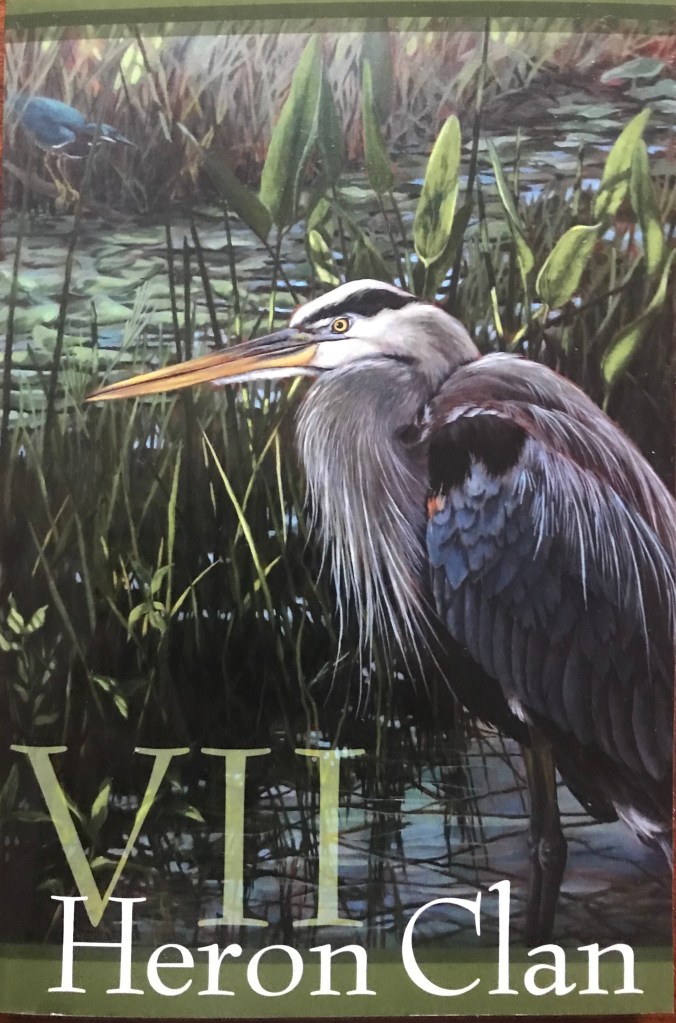
Honoured and privileged to have a poem that previously appeared in Black Bough (2019) appear in Heron Clan VII (Katherine James Books, 2020). Thankyou Doug Stuber, Delaney Watson, Lillie Harward Delott, Tim Mattimoe, JeanMarie Olivieri.

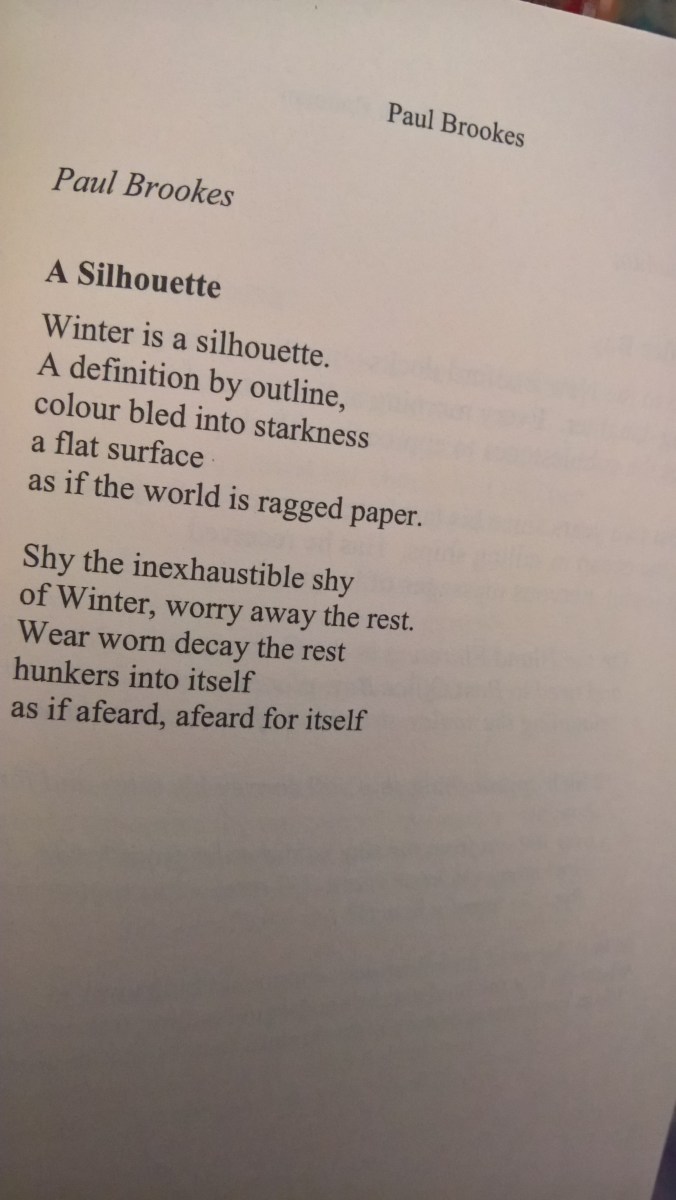
Bigger Heron Clan Front CoverA Silhouette is winter


Sunday: Jetsam and Lagan. Final day. Share what you love about seas and shores #NationalMarineWeek poetry and artworks challenge. Please submit your unpublished/published poems and artwork by DM to me, or send a message via my WordPress “The Wombwell Rainbow” contact screen or my FB “Paul Brookes-Writer and Photographer” Today is Jetsam and Lagan

Beaxh by Sue Harpham
Beach by Sue Harpham

What treasures
Churned by the ocean
And returned home.
Each tide
A patch of shade
A patch of shine
But alive
Tumbled in time
Forever

-Sue Harpham

Recovered from the Permian:
Sparse bivalves. Nothing. Nada. Zilch.

Today, in the Gulf of Mexico, hypoxic
Waters foster a similar bounty.

Observed at Bempton: one black browed
Albatross: “Unlucky in love” according

To the local news.

-Peter Boughton

Polvo

A popular main course in Portuguese culture
Salada de polvo
Not to be confused with chicken salad
Polvo does not mean poultry
Translates to octopus
Found this out the hard way while out for dinner
It was a group setting
Ordered the dish without a second thought
When it arrived at the table, I was confused
The server clarified that the octopus salad was for me
My mouth replied thank you but my eyes stared at the table
Laughter and inside jokes came from my mistake

-Samantha Merz

Queen Carola’s Parotia on the Pergola

There was a gypsy moth massacre
Searching under decaying wood to get to the heart of contentment
Queen Carola’s Parotia on the Pergola
Reminiscent of a young European Paola
I heard news reports that it would be too windy for the vessels to dock
Ignoring the coarse-haired drummer
Into the virtual portal, longing to feel the sun again
Getting carried by Sunday schemes in your Chevrolet Blue Blazer
In the middle of doubting myself before speaking out
Overjoyed when I saw you outside the drugstore
I’m glad you’re grounded because I don’t want you to leave
Just know I’m wide for you

-Samantha Merz

Queen Carola’s Parotia on the Pergola poem published online at Grey Thoughts on May 25, 2019

Searching

A lone woman wanders sands
As Ocean licks her feet to taste.
Seagulls dip and scry, Ocean ponders human searching dunes, the wrack, her crabbed back, beseeching hand understood by oceans everywhere.

She nudges sea weed piles with a foot, listens to shells’ chime.
She looks for the child who left bare footprints in this sand long ago.
She finds her
self.

Naked as a just-moulted crab,
vulnerable to sun’s love. She longs to retreat deep into her shell.
To be thrown back
into the deeps.

-Rachael Ikins

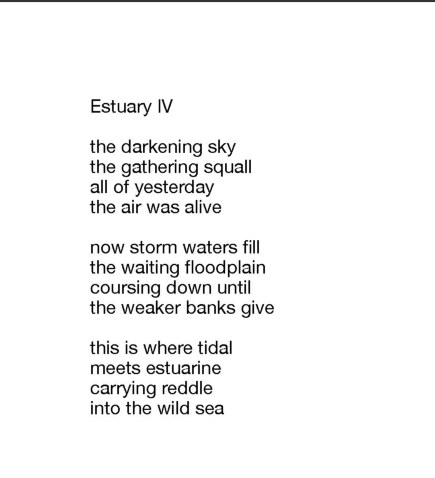
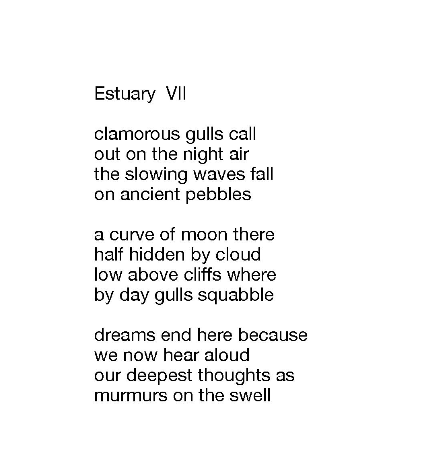
Estuary iV by Don OldhamEstuary VII by Don Oldham

-Don Oldham

-Paul Brookes

Rain Is Awake

when it falls
hits the snuggled earth
with wet caresses

Conscious movement
rippled determination
to move forward
once a route is found

knows it must find rest
a place to sleep
but other droplets insist
on movement forward

-Paul Brookes

Have you written poems about Hen Harriers? Have you drawn, painted Hen Harriers? #HenHarrierDay2020 poetry and artwork challenge. Campaign against their persecution. Celebrate their beauty.

https://www.theguardian.com/books/2015/aug/08/hen-harrier-poems-colin-simms-review-robert-macfarlane

https://markavery.info/2017/06/24/hen-harrier-poem-anneliese-emmans-dean/

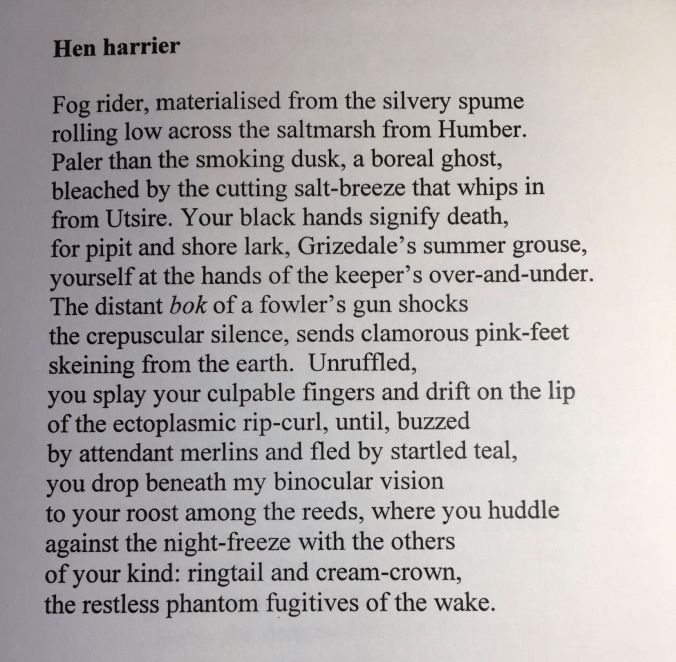
Hen harrier by Steve Ely

-Steve Ely

Saturday: Flotsam and Derelict. Join Jason O’Toole, Rachael Ikins, Don Oldham, Samantha Merz, and me in sharing the ocean. Share what you love about seas and shores #NationalMarineWeek poetry and artworks challenge. Please submit your unpublished/published poems and artwork by DM to me, or send a message via my WordPress “The Wombwell Rainbow” contact screen or my FB “Paul Brookes-Writer and Photographer” Today is Flotsam and Derelict, tomorrow is Jetsam and Lagan


-Rachael Ikins
Portuguese Plums
At the breakfast buffet, I choose cut up Portuguese plums
Put them on my plate
Poured myself some peach juice in my glass
Spread some apricot jam across my baguette
A blue bookmark for my yellow paperback
Wearing a cork necklace and pink sandals
Looking for bronze bell earrings
Many fortresses are nearby
Floating past on kayaks
Bubbles from the ripples in the brackish water
Will have dinner after a couple of appetizers and Aperol Spritz
Heaven is on the horizon
-Samantha Merz
Sultry July
A coral fire burns through the night
There could be morning lightning
My version of a nightcap consists of nightly capsules to take with water
A science fiction fantasy
Surprised that squirrels get along with rabbits
Hallucinations of halos
Failing to ask for the recipient
Cornflower blue blouse over a burgundy dress
Sunlight shines and sparkles on my skin
Sun glitters off the Pacific blue waves
We’ll each have a glass of red sangria on this summer’s day
The angel’s trumpets don’t leave behind any shadows
-Samantha Merz

New Year’s Eve
Cannot see but know.
Know it surges, there in the dark,
across the two-lane road,
behind the black wall
of night.
Constant rumble, waves
slapping concrete.
Full of life, but not my kind.
Cannot see but know.
Sister Death’s voice
carries on every wave;
sings to my still
warm blood.
Must not want it enough.
This wall built to keep me out
for which I am grateful.
Drive away, the darkness stays
with me.
First appeared in VerseVirtual April 18, 2020
Glaucous Gull
Riding ice floes
out to the Atlantic.
Ate all the algae
underneath.
No picnics to raid.
No boats tossing herring.
& so, kill plovers.
Kill ducks on the water.
Kill laughing gulls in midair.
Kill Icelandic gulls
only here for the winter.
Faithful spouses,
Great parents.
Living off the sea.
I might like to be one.
The Terrible Gulls
Above twin redbrick
Smokestacks, inert
urban volcanos:
Gulls wing through
sky tinted in
own plumage’s
grey pearl.
Bumping midair:
they’re not mating,
nor being social.
4-year gulls hunting
the smaller ones.
Picking them off.
How terrible!
says I, chewing
chicken salad
sandwich as downy
pale feather descends
past dirty window.
First appeared in Neologism Poetry Journal, Feb. 2020
Seagods of the Lower Merrimack
Violin-throated seagulls.
Howling sea-gods summoned
with punitive strokes
of over-rosined bows.
Warnings?
No. Shouts
at safety-oranged
construction crew
laying gray foundation
in the mud below:
“Pay our tithe!
Pay our tithe,
of breakfast burrito leavings
stuck to wrappers,
& errant corn chip!”
“We, immortal children of Glaukos,
demand our portion
of your Dunks & Cumbies!”
Never be rid of them
should you toss any scraps.
Neither you, nor they
Should even eat that
nutrient-bare slop.
Let seagulls be seagulls;
hover-dip & dive
into the Merrimack
after bass and salmon.
Let us all stop.
Stop eating garbage
wrapped in garbage.
Let us plunge.
Plunge into the cold river
ensnaring eels with our teeth.
Leviathan Tours
This morning in the kitchen,
after first asking
if you had time to hear it,
described last night’s dream.
Met you in empty football stadium.
On the run from dream-scene,
got violent.
Streets upon streets, each unfamiliar;
on-the-fly simulacrum.
Chased by cocaine dealers.
Almost hit by woman in Subaru,
New Hampshire plates.
Avoiding teenage gang
standing four abreast, blocking sidewalk.
Cut left, slim alley, tight
liana tangles possess chain-link.
Through neon doors
past bloody aprons fileting black cod,
headless & gutted,
out dead fruit loading docks –
Until you stopped me.
Your delicate hands.
Sleek travel brochure
from your dreamworld:
Ice caves occupied by prehistoric whales
buried face down, fanned out, or stacked
by size, one on top the other,
Largest, Livyatan L. melvillei, on bottom.
“Let’s go!” You say.
Yes, but must keep running
southeast towards that sunny orchard
often dreamt, through which I must…
In our kitchen, waking-you says,
“Yes, that sounds just like me.”
First appeared in Spillwords (Jan. 2020)
Seahorse Homecoming
In this estuary of the river
That flows both ways
Seahorse hunts on his lands
Tail curled around a ribbon
Of eelgrass
Cloaked in this sunken forest
Eyes search his quarry
A clutch of fish eggs
Seahorse strikes fast
Drawing them in
Through stubby snout
Under a crumbling pier
Where Mahicantuck opens to the sea
In the shallows where sunrays
Pierce the turbid waters
Seahorse anchors himself
To the seabed
Courage outlasting
The fate of wild past
Reeling back victorious
from annihilation’s static border
Seahorse scans the poisoned waters
Brimming with creatures
Nature has made immune
Seahorse stalks ghost shrimp
To feed the many young
Growing in his pouch
Through the strength of his resolve
His tribe thrives
Restored to ancestral lands
First appeared in We’ve Seen the Same HorizonPoems of Awakening (The Red Salon, 2019)
-Jason O’Toole

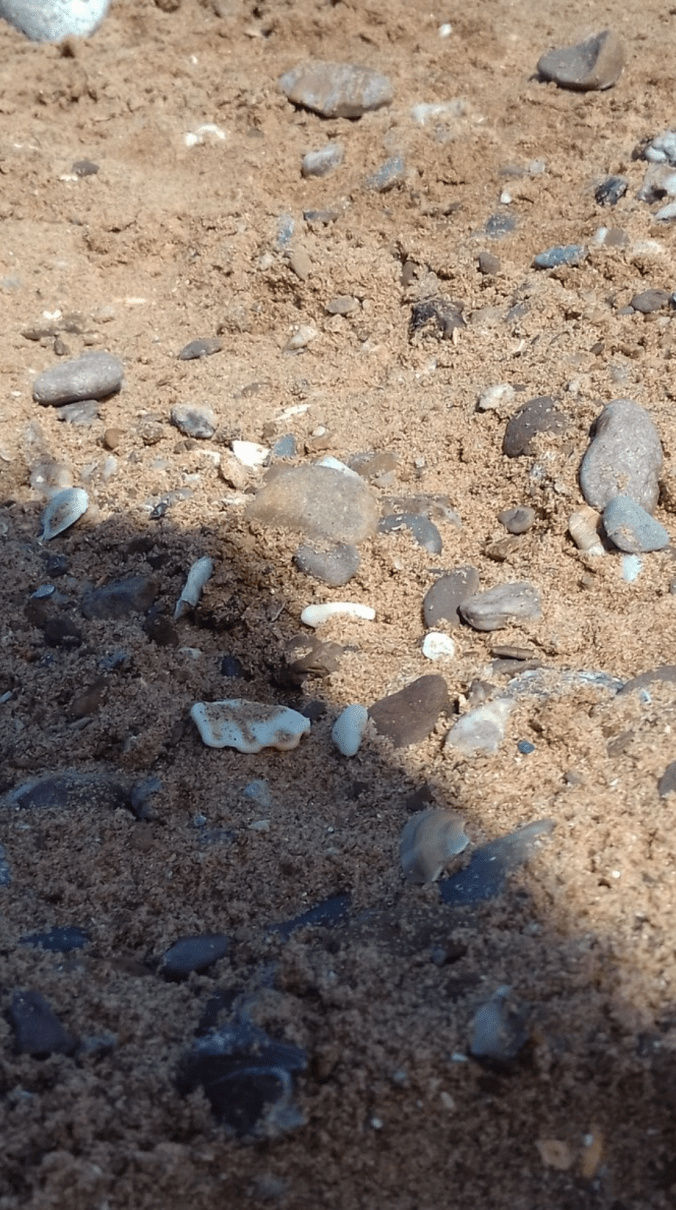
-Beach by Paul Brookes
My Afterlife
is a half life.
is a rainbow,
brief but colourful.
A bucket and spade
left on a beach
for the sea to play with.
A sentence ending
in a connecting word.
Scatter my ash
on a sea of plastic,
On the remains of the last living
thing that is now extinct.
In the concrete underpasses
tagged, graffitied, dismissed.
Under the feet of refugees,
on the drowned water
of those that did not make it.
Scatter me like fragrant leaves
in the baths of the rich.
-Paul Brookes
Bios and Links
-Samantha Merz
Poems by Samantha have been published by Polar Expressions Publishing, Grey Thoughts, Reality Break Press, Fevers of the Mind Poetry Digest, Nymphs, Malarkey Books, Poetry Festival, Dreams Walking and Resurrection Mag. In 2019, Samantha self-published a collection of poetry called Kazoo.

Friday: What Should We Do For Sealife?Share what you love about seas and shores #NationalMarineWeek 25th July- 9th August, more like two weeks poetry and artworks challenge. What do the seas and shores mean to you? Final Seven Days: Saturday: Beachcombing, Sunday: Rocky Shorelines, Monday: Mermaids And SeaMonsters, Tuesday: Sea Shanties, Wednesday: Ocean Vegetation, Thursday: Deep Sea, Friday: What Should We Do For Sealife. Please submit your unpublished/published poems and artwork by DM to me, or send a message via my WordPress “The Wombwell Rainbow” contact screen or my FB “Paul Brookes-Writer and Photographer” Today Friday: What Should We Do For Sealife?

Out To Sea
Out To Sea

-Paul Brookes

Mother Earth

She is a big, soft woman,
a curled foetal ball.

They swarm her like ants.
Assault her; bombs, pile drivers,
endless marching foot steps.
Strew her skin with trash.
Piles of nothing alive.
dust caked nostrils, a trickle of blood stripes her chin.

An anonymous woman
forgotten by the entitled masses who wrangle and tromp
all her secret places.
Digging, gouging, drilling,
pipelines to suck her blood.

Sometimes she wakes from
nightmares she wanders:
Rolls her arm-earthquake shatters a city.
Blinks a tsunami-washes away thousands.
Her heart beats-volcano
blows, slashes of lava pulse through civilizations at mountain’s feet.
She raises waters, pulls the land back. Her fury floods,
her voice the sound of hurricanes shrieking.

Some say she is off her axis.
Some say she is crazy

with grief, heart aching for humans who steal life from beloveds;
her centipedes, honey bees, ants, her elephants, orchids,
sightless worms that hunt by hot springs in ocean depths.

Her immune responses evolved when she was nothing but
a star’s dream. She urges them to genocide, war, the moon; sends in viruses, bacteria, her fiercest warriors the smallest-anything to rid
the plague that consumes her,
afraid nothing will remain-
stone bones flash past the sun.

She curls up, exhaustion takes her. Sleep. Too soft to face their sharp
edges any more
for this day.

(It appeared in the anthology Planet in Peril and also in the publication Headline Poetry)

-Rachael Ikins


near Anacortes on a beach, tide out,
it could be Thor

on that beach or so we tell ourselves right
by the refinery smelling of sulfur

we say beach combing sounds
pretty like blue glass turned
green softened edges, surprise

it could be that factory you worked in/
burned when you
were away & again & again/you don’t believe
unless you see

something about the ocean makes you
think bad things can’t happen if you just look hard enough

throw back the shells, he says, positive relieved of his own guilt
they are somebody’s home in the future

-Constance Bacchus

Wednesday: Sea Plants. Share what you love about seas and shores #NationalMarineWeek 25th July- 9th August, more like two weeks poetry and artworks challenge. What do the seas and shores mean to you?Final Seven Days: Saturday: Beachcombing, Sunday: Rocky Shorelines, Monday: Mermaids And SeaMonsters, Tuesday: Sea Shanties, Wednesday: Ocean Vegetation, Thursday: Deep Sea, Friday: What Should We Do For Sealife. Please submit your poems and artwork by DM to me, or send a message via my WordPress “The Wombwell Rainbow” contact screen or my FB “Paul Brookes-Writer and Photographer” Today Wednesday: Sea Plants

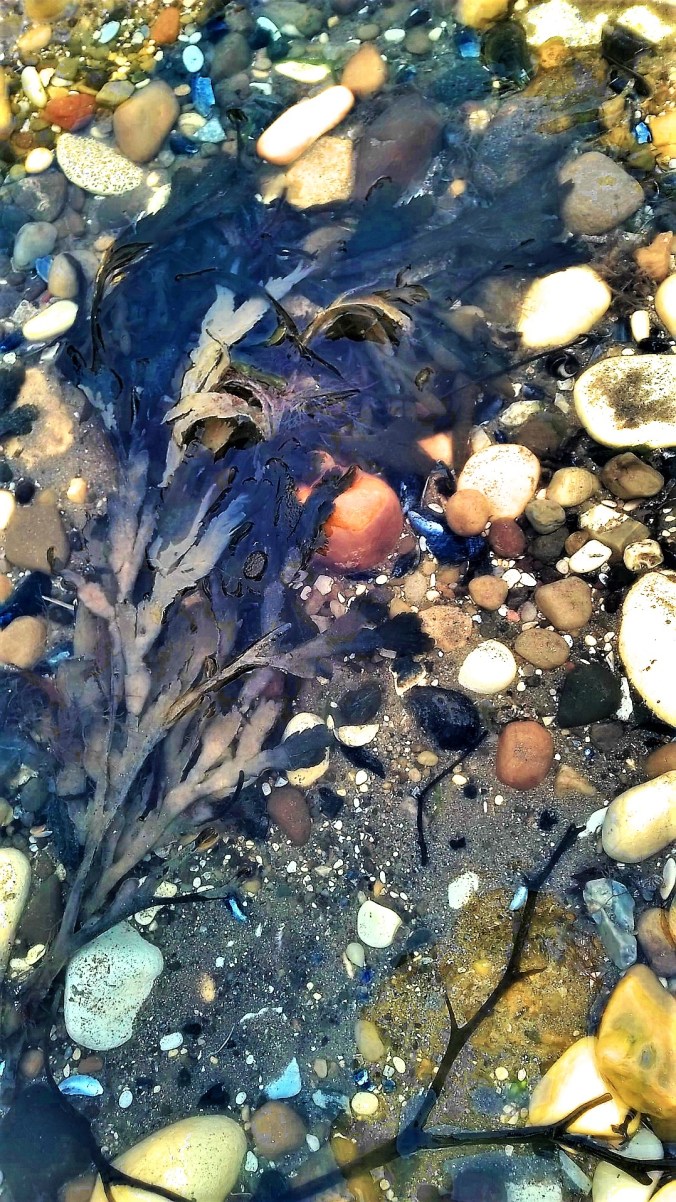
BladderwrackBladderwrack

-Paul Brookes

Beach Morning

Ocean heaves a ladder toward
shore, sighs and spits.
Retreats, not strong enough
yet, returns, slaps another rung up hardscrabble beach. Step by step
lifts Herself onto land.

Soft seaweed clumps cushion Her steamy, fragrant elbows as She humps Herself out. Air bladders
of their leaves pop, sound
like bubble wrap threaded through
the tangle.

-Rachael Ikins

Wombwell Rainbow Book Interview: Ralph Dartford

Wombwell Rainbow Book Interview

I am honoured and privileged that the following writers local, national and international have agreed to be interviewed by me. I gave the writers three options: an emailed list of questions or a more fluid interview via messenger, or an interview about their latest book, or a combination of these.
The usual ground is covered about motivation, daily routines and work ethic, but some surprises too. Some of these poets you may know, others may be new to you. I hope you enjoy the experience as much as I do.

Recovery So9ngs By Ralph Dartford

Ralph Dartford

hails from Basildon in Essex, and now lives in West Yorkshire, having got there via Australia, Barcelona and Los Angeles. He was the founding member of influential spoken word collective ‘A Firm of Poets’, and his first collection of poetry, Cigarettes, Beer and Love was published by Ossett Observer Presents in 2013. His latest collection, Recovery Songs – also touring as a spoken word show – was published by Valley Press in 2019. His third collection, ‘Hidden Music’ will see the light of day in 2021.

The Interview

1. When and why did you start writing poetry?

When I was a kid I’d always make up song lyrics in my head whilst walking to and from school. I found it hard to write things down because of chronic dyslexia. However, in my teens i was lucky to have a teacher and he slowly taught me a technique to putting things down on a page in a coherent order. So I I would say I started writing poetry when I was fifteen years of age. That‘s thirty years ago. More importantly, I read poetry from that age.

2. Did the teacher introduce you to poetry?

Yes. Lots of Ted Hughes and Spike Milligan. Also to the novels of John Steinbeck. I remember being fascinated by ‘Of Mice and Men’. The story and the language.

2,1, What fascinated about the language?

The way that it manipulated me as a reader to a time and place. The landscape, colour, the sound of people’s voices. I lived in Basildon in Essex, a concrete attempt of building some kind of utopia. Steinbeck, in this book and many of his others, wrote about early 20th Century America, about ordinary, compromised people. He constructed these people in colour and in full. I believed in the voices, how they rang true in a world that was removed from my own. The cadences, what clothes they wore, their physicality. All great writing has to have that, the ability to disarm the reader and to put them in the middle of the story or the poem. To make the reader breathe the same air.

3. How aware are and were you of the dominating presence of older poets traditional and contemporary?

I was aware of the giants of poetry, but did not necessarily read them with conviction. I remember loving the Liverpool poets of the 60’s and I still do today. I was also drawn to the poetry of America, the Beats: Ginsberg, Kerouac and Snyder, then Bukowski. One of my favourite poets ever is Raymond Carver. He is of course a sublime short story writer and rightly celebrated for that, but his poetry refines moments to an almost impossible detail.

3.1. What drew you to the Beats?

I think it was the sense that they had a vision of freedom and rebellion at the time. That life was wild and untamed and it moments should be lived within the moment. Of course that is unrealistic and flawed, but it was incredibly attractive as a young person to feel that. In my next collection, ‘Hidden Music’ there is a poem called, ‘To Recover’ that explores that belief and it’s consequences.

4, Music plays a big part , calling the collection “songs” , references to Peggy Seeger and Tom Waits.

Yes. Music is important to me, obsessively so. If you read the collection forensically and are inclined to ‘nerdy’ details, you will find many musical influences and references. The second collection explores that further and riffs on a quote by Duke Ellington when speaking about Jazz and art.  Hence the title, ‘Hidden Music’.  The quote is:

You’ve got to find some way of saying it without saying it.’

4,1, Why is music so important to you?

Because of suffering with dyslexia, I listened more. Lyrics became hugely important to me and still are. However, the is a fine line between poetry and lyrics. Poetry only has a blank page, lyrics have a backing of musicians. Most lyrics if placed on a page don’t stand up. Glen Maxwell in his brilliant book, ‘On Poetry’ writes about this brilliantly. Poetry on the page has too many variables (line break, metre, stanza length, form) that trumps a lyricist time after time. However, I will fight that Tom Waits, Nick Cave, Bob Dylan and PJ Harvey sometimes pull off both.

5. In “After The Poetry Slam In New York” you talk of “overwrought poetry”. What do you mean by that?

When I visited New York a few years ago I went to a ‘Slam’ event just off Union Square. I was shocked at how dramatic and how unsubtle the poetry was. Everyone seemed to be virtue signalling their own agenda. Of course there is nothing wrong with that and I do that in my book to a point. But there was a lack of finesse, wit or beauty about it. This style of reading poetry, I think, has crossed the Atlantic and is a problem. Spoken Word is fantastic when what is said on a stage is also compelling on a page, when both merge successfully. It’s becoming increasingly rare that that is the case. I kind of gave up on going to those nights because I wanted to learn more about form and craft. I took a Masters Degree in creative writing and locked myself in a room with hundreds of books. Spoken Word however, is a great way to get into poetry, but I wanted something more, something academic that would make me a better writer. Just for balance though, there is another poem in the collection  titled, ‘That Poetry Voice’ that has a dig at actors who read other people’s poetry as if they are performing King Lear regardless of the subject matter of the poem. It’s usually on Radio 4 and usually does a disservice to the poet who wrote the poem.

6. The book begins with a complaint and ends with a song.

I don’t think the opening poem, ‘At the Arts Council in Manchester’ is a complaint. It’s a story about outcomes (a true story too). The point I’m trying to make with the poem, I guess, is that we are all haunted by our own history and experience. That our ghosts are not tangible in a modern world. That they can, if allowed, defeat us.

The final poem, ‘Recovery Song’ is an acceptance of all that has gone on before and a willingness to move forward. That if we let our pasts dictate our future, we are trapped.

7. What is your daily writing routine?

My daily routine starts with reading, it gets me in the mood to write, gets the blood pumping. I walk a lot, that’s where the writing percolates. I make notes either on my phone or in a notebook that I always carry. Most days, I try to write a poem or edit something that I have written previously. I love editing, the craft of it. Some days though, the words don’t come and it’s frustrating.

8. Besides your struggles with addiction what other subjects motivate you to write?

There will always be an element about writing about addiction in my work. It can’t be escaped because of my deep and personal knowledge of the subject matter. However, the new poems from the forthcoming collection have broader leanings. Poems about America, history, growing up and politics. The overriding theme though is the musicality of language. I have been very taken by the recent Bob Dylan album, ‘Rough and Ready Ways’ and two sings in particular, ‘I Contain Multitudes’ (which riffs on a Walt Whitman poem ‘Sing of Myself’) and ‘Murder Most Foul’. The new poems tell bigger stories, many are written in the third person. It would be easy for me to write about addiction all the time, but I don’t want to thought of as the ‘Recovery Poet’.  I want to prove myself as a writer of many things, of multitudes.

9. “Sheffield, Bow, Bretton, Bradford, Wakefield”. You like to name the places where a particular incident happened in your titles.

Place to me is very important in a poem. It gives the reader knowledge of where the actual action is located. Places always sound interesting to read too, the word of a place.

10. There is a lot of mention of “rain”:

“The rain so hard and northern” , White Poppy

It rains vertical.

Needle hard. The Song Of Mickey Clemons

There was no rain, At The Arts Council In Manchester

the dirty-needle rain The Levee

Rain on me, like a memory, We Will Be Men

(Perhaps a reference to the Eurhythmics song: Here Comes The Rain, Again)

And a rain ceases to fall, Haiku Five-O

To cause this rain to question itself, White Poppy

What does rain mean to you?

Yes. I use a storm of rain in the collection. Actually the original title was to be ‘Dirty, Needle, Rain’. I use the word as an outside force that we have no control over. That the rain, when it comes takes no prisoners and dictates our moods. It’s a constant metaphor that is visual. A natural occurrence in I think, in the urban and man made world where the poems take place.

11. How do the writers you read when you were young influence your work today?

I think the storytellers I read when I was young hold a big sway on how writers write when they are older.  I’m still influenced by Roger McGough (who I read at school and college) and his ability to compress language into a poem to make a story. Storytelling is important to me in a poem, I like poems that demand the reader to engage with the next line and get to its bottom and resolution. Even If that resolution is open ended. The cinematic approach of Steinbeck and Kerouac are still deeply resonant to me. The world in widescreen, monochrome or technicolour.

12. How important is form to you in poetry?

Very important. I’m obsessed with where a line breaks in a poem, the use of stanzas and where the a poem beats and echos. All poems reflect time and as Glynn Maxwell says, ‘master time, you master form’. If you look at the long poem in the collection, ‘We Will Be Men’, it appears as if its ‘free verse’ and sometimes it is. But, there are other times, when the poem has strict rhyme, shape z as and form.

13. Who of today’s writers do you admire the most and why?

I love the poems of Ella Frears. Her collection, ‘Shine, Darling’ is excellent in it’s playfulness of language and sense of danger.  Clare Shaw’s ‘Flood’ is also excellent in its sense of drama that engulfs a West Yorkshire community. Novels: ‘Girl, Woman, Other’ by Bernardine Evaristo Is exciting in how she uses form to write a novel. I also admire John McGregor for similar reasons, ‘If Nobody Speaks of Remarkable Things’ is outstanding.

14. You say “where a poem beats and echoes”. How important is this in the placing of poems in the collection?

Absolutely vital. The placing of the poems, the sequencing, was very difficult. The poems have to talk to each other, even when they may seem remote or in isolation. The best collections this, I think. Tell stories that may not be seen at first glance throughout.

15. The Understory?

Yes. The understory. Of course.

16. What would you say to someone who asked you “How do you become a writer?”

I think you need to read as much as you can, anything.  Examine how it is written, why it does or does not work. Also, learn to be disappointed. You have to develop a thick skin because there will always be more rejection than success. Also, connect with other writers as much as you can, become part of a community. This way, you are aware of what is happening in the writing world. Finally, never give up, write every day if you can.

17. Tell me about the writing projects you have on at the moment.

Right now, I’m just completing the second collection. All the poems are complete, it’s just the sequencing to finalise and to write an ‘afterword’. Then I’ll work with my editor, Emma King to iron out any issues. Once that is complete, it will go to my publisher, Valley Press and they will have the final edit. Once that is complete, I let go of it until it’s out in the wider world in October 2021.

I’m also concentrating on finishing my first novel, ‘The Radio Rooms’. I’ve been part of the Penguin Books ‘Write Now’ scheme, which has been a revelation in terms of mentoring. The novel will shortly start a process whereby it will be sent out to agents with the aim of securing a publishing deal. I always had the ambition of writing a novel, and this book has been worked on for nearly ten years. First though and most importantly, is the completion of my Masters Degree in Creative Writing at Sheffield Hallam. It’s been a wonderful academic experience. I left school at sixteen with absolutely no formal qualifications, so to have a Master’s Degree is a big deal.

18. What do you want the reader to leave with, once they have read “Recovery Songs”?

I would like two things. Firstly, that they are affected by the content, that it has meaning to them and there is an understanding of how other people’s life who have encountered difficulties function and survive. Secondly, that they feel the quality of the writing is good and that the poems stand up.

Thursday: Deep Sea. Share what you love about seas and shores #NationalMarineWeek 25th July- 9th August, more like two weeks poetry and artworks challenge. What do the seas and shores mean to you? Final Seven Days: Saturday: Beachcombing, Sunday: Rocky Shorelines, Monday: Mermaids And SeaMonsters, Tuesday: Sea Shanties, Wednesday: Ocean Vegetation, Thursday: Deep Sea, Friday: What Should We Do For Sealife. Please submit your poems and artwork by DM to me, or send a message via my WordPress “The Wombwell Rainbow” contact screen or my FB “Paul Brookes-Writer and Photographer” Today Thursday: Deep Sea

Deep

-Paul Brookes

The Ocean

Ocean
Always frightens me
It’s vastness
Takes my breath away
It’s seemingly endless depth
Hides the unknown
And that’s scares me the most
The inability to see
What’s coming
From the deep belly
Of the cold hell
On earth

-Carrie Anne Golden

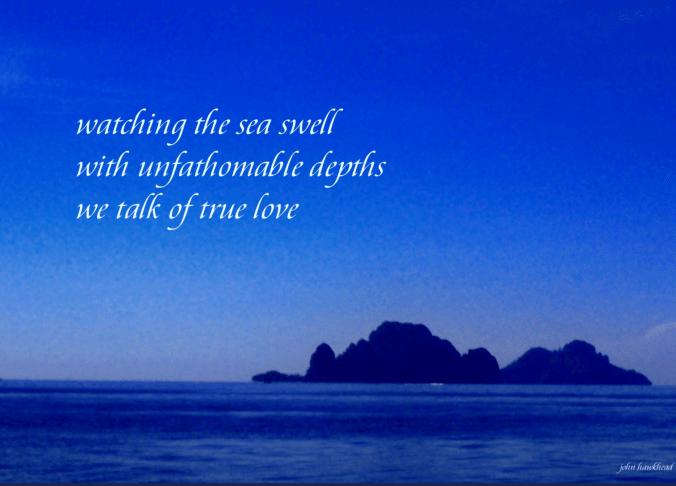
John Hawkhead Depths

watching the sea swell
with unfathomable depths
we talk of true love

#senryu Previously in A Hundred Gourds 3.1

-John Hawkhead

Fathoms

Deeper than the trawlers net
Fifty fathoms deeper yet
The crushing weight of oceans brine
Holds the secrets kept through time
Stabs of light from other world
Cannot reach the sails unfurled
Of sunken ships that lie beneath
Their guts torn out on rocks or reef
They rest in silence on the ocean bed
The haunting fifty fathoms deeper yet

-Graham Bibby
@gtmaddison

WHALEWEND

Heart-ship tugs at its harbour.
My imagination in mere-flood,
in whale plunge, wide in its turns
eager for seas vastness. Gannet yells
as whale-wends, spirit quickens over holm’s deep,
irresistible delights of life are more
than this life that flits on land.
Illness, old age and aggression
wrests life away, bests breath.

-Paul Brookes (From “I’m Wave Rider”, a retelling of an anglo-saxon poem, featured in my collection “The Headpoke And Firewedding”)