The Collected Poems of Robert Desnos, translated by Timothy Adès (Arc Publications, 2017), Despair Has Wings: Selected Poems of Pierre Jean Jouve (Enitharmon Press, 2007), Robert Desnos, translated by Martin Bell (Art Translated)

Worth a gander.

tearsinthefence's avatarTears in the Fence

In the opening poem of the 1926 sequence À La Mystérieuse (To the Woman of Mystery) Robert Desnos wrote

J’ai rêvé cette nuit de paysages insensés et d’aventures
dangereuses aussi bien du point de vue de la mort que du
point de vue de la vie qui sont aussi le point de vue de l’amour.

In this ambitious new translation of Desnos, one which will I suspect remain the standard text for some years to come, Timothy Adès suggests the following as a bridge crossing two different languages:

I dreamed last night of unhinged landscapes and dangerous
adventures, as much from death’s viewpoint as from life’s,
and they are both the viewpoint of love.

The word ‘unhinged’ conveys a colloquial awareness of how one might refer to madness and indeed Martin Bell’s translation of the same line offered support for this when he rendered the line into English as ‘Tonight…

View original post 822 more words

Wombwell Rainbow Interviews: Peter Bakowski

Wombwell Rainbow Interviews

I am honoured and privileged that the following writers local, national and international have agreed to be interviewed by me. I gave the writers two options: an emailed list of questions or a more fluid interview via messenger.

The usual ground is covered about motivation, daily routines and work ethic, but some surprises too. Some of these poets you may know, others may be new to you. I hope you enjoy the experience as much as I do.

Peter Bakowski

Melbourne-based poet, Peter Bakowski, fell in love with the map of the world at the age of six. In 1983 he wrote his first poem while staying at a friend’s farmhouse in Waco, Texas, in response to receiving a “Dear John” letter from a Melbourne girl. As a result of that fateful letter, Peter ended up travelling for seven years, caught a freight train across Montana, lived in a cave on a Mexican island and ate gazelle cooked in stale blood with road builders in the Central Africa Republic. Peter has been writer-in-residence in Rome, Paris, Macau, Suzhou (China), Battery Point, Tasmania; Greenmount, Western Australia and at the Broken Hill Writers Festival. His poems continue to appear in literary magazines worldwide and have been translated into Arabic, Bahasa-Indonesian, Bengali, French, German, Italian, Japanese, Mandarin and Polish. In February 2015, Editions Doucey of Paris, published a bilingual edition of his Selected Poems, entitled “Le cœur à trois heures du matin.” Peter’s aim as a poet is to write as clearly as possible and no matter how many books he writes in his lifetime, they’ll all be about what it’s like to be a human being.

http://bakowskipoetrynews.blogspot.com/

The Interview

1. What inspired you to write poetry?

I wrote my first poem in 1983 at a record collector friend’s farmhouse in Waco, Texas, after receiving a Dear John letter from a Melbourne girl. At the time I thought I’d be away from Australia for six weeks but ended up travelling for 7 years.

2. Who introduced you to poetry?

I sniffed around for plain-speaking poets. It was the poetry of Charles Bukowski which showed me you could write about the urban, the domestic, your city, your neighbourhood, your blues in plain, direct, conversational language.

3. How aware were you of the dominating presence of older poets?

I gravitated to 20th century poets. Any earlier I found too romantic, not down-to-earth and gritty enough.

4. What is your daily writing routine?

Part of gathering material for regular poems is daily “nourishment” – daily reading, daily walking, observing and daily thinking about people, life, identity and imagining characters and scenarios, pivotal moments in a real or fictitious life.

5. What motivates you to write?

I’m trying to express myself, to reveal the individual, real or fictitious, in the camera frame of a poem. I’m also very interested in the refreshing image and wordplay.

6. What is your work ethic?

I feel that being a creative person is a 24 hours a day activity – observing, pondering, experiencing, digesting, filtering, sculpting and painting for the mind’s eye of the reader and listener. I constantly tour Australia and present my poetry in Europe annually.

7. How do the writers you read when you were young influence you today?

Charles Bukowski, Ted Kooser and Raymond Carver and Billy Collins are my plain-speaking poetry heroes. Clarity is my big thing. I’m trying to communicate and reveal in each poem.

8. Who of today’s writers do you admire the most and why?

I continue to admire Ted Kooser, Charles Simic and Billy Collins because they continue, they have persevered, remained curious about life, death, dogs and cats and imagined lives in houses and apartments they walk by in their real and imaginative strolling.

9. Why do you write, as opposed to doing anything else?

Writing is my means of expression, my camera, the arena in which I reveal the overlooked or what otherwise may pass out of memory.

10. What would you say to someone who asked you “How do you become a writer?”

By daily reading, by spending thousands of hours testing and trialling words on paper, saying them out loud, sculpting them into pieces of writing where no word is superfluous, then send your writing to reputable magazines – that’s the reality test, to see if your writing has meaning to others beyond your computer screen or notepad.

11. Tell me about the writing projects you have on at the moment.

I’m working on my eighth poetry collection which will largely comprise of portrait poems of real and imagined individuals.

12. What inspired “Wardrobe of Selves”?

I’ve always had a strong interest in writing portrait poems of real
and imagined people. In “Wardrobe of Selves” there are researched
portrait poems of Man Ray and also Willem de Kooning. There are also
portrait poems of fictitious musicians. Via a variety of portraits of
individuals I wish to reveal a spectrum of responses to pivotal
moments in a person’s life – love, betrayal, anger, creativity, loss,
grief, the philosophical shrug. I’ve titled my seventh poetry
collection, “Wardrobe of Selves” – to address via poems the different
costume one may wear or remove when moving through public and private
situations. I feel each of us can draw upon more than one self as a
form of defence, self-protection or even self-delusion. I read an
interview with Bob Dylan in which he stated “Each morning when I get
up I don’t know what self I’m going to be.”

13. You use a lot of second person narratives as opposed to first person. How deliberate is this?

I have a long and continuing interest in writing portrait poems of
real and fictitious individuals. The second person narrative allows me
to reveal perhaps the self-delusion in a portrayed individual, allows
me to reveal the individual in most cases without judgement as if the
reader is watching and listening to a character in a play. I remain
wary of the first person “I,I,I, me, me, me” poem which can invite
self-pity. Of course I sometimes write a poem in the first person if I
want the individual portrayed to reveal some honest self-examination.
Ultimately I’m writing about what it’s like to be a human being so I
want any “voice” or portrayal to be credible, for the individual
portrayed to resonate with the reader/listener.

14. In “At my Craft” you say “illuminate the overlooked” when arranging poems for a collection. As this collection is a gathering of portraits could this refer to the people portrayed?

I present two types of portrait poems. Researched poems of real individuals. Then I also create portrait poems of fictitious individuals. In all my portraiture poems I am illuminating THE INDIVIDUAL and a variety of individuals to show a spectrum of responses to pivotal moments in a life. I’m also trying to illuminate the secret self. As with painterly creators of portraits I’m seeking to reveal the essence of an individual – what makes them tick. Portrait poems of individuals are the way I continue to address my life’s work as a poet -to write about what it’s like to be a human being.

15. You like to play with aphorisms in your poetry that is not portraiture.

An avid, daily reader since age 8, I’m a collector of aphorisms,
epigrams, maxims and proverbs and as a poet dabbling in humour,
surrealism, the philosophical, I try and come up with my own aphorisms
and proverbs for the 21st century. I remain attracted to
honing/refining world views and moments. Being concise makes sense to
me in this modern world, where realistically some people’s attention
span is as long as a tweet.

16.

Some selves are secret, take themselves to the grave—their
Existence exposed in a diary, a bundle of letters—angers and
Loves, visions and regrets—not torn in half, not rewritten.
Versions of ourselves, face half in shadow under a hat brim,
Elude conclusive portraiture. Brush the lint from your cautious
Shoulders. Your true self may be in the vicinity awaiting your arrival.

From the poem “A Wardrobe of Selves”

This clever mnemonic poem acts as an introduction to the whole collection, balancing light and dark, hidden and revealed.


Peter: All my writing life I’ve undertaken portrait poems wherein I explore
duality, for example the creative and destructive within an
individual, the tug-of-war our thoughts and emotions engage in,
beneath our skin.
Our modern age is arguably obsessed with identity, the me generation,
the selfie, the cult of celebrity and gender fluidity. We read that so
and so has “reinvented” themselves, David Bowie, was an astounding
example. In an interview I read, Bob Dylan said, “When I wake up, I
don’t know what self I’m going to be that day.” Sometimes a friend may
say to us “You’re not yourself today.” One ultimately hopes the self
can be supple rather than inflexible. “Our true self” is arguably a
self we like or feel comfortable in owning.
I continue, via portrait poems, to try and reveal, like a painter, the
essence of the individual portrayed.

Opportunities Knock for Poets and Writers: Calls for Submissions, Contests, Fellowships

Opportunities

Jamie Dedes's avatarJamie Dedes' THE POET BY DAY Webzine

“He would give every penny he has (such is the malignity of the germ) to write one little book and become famous; yet all the gold in Peru will not buy him the treasure of a well-turned line.”  Virginia Woolf,Orlando


CALLS FOR SUBMISSIONS

“THE BeZINE” CALL FOR SUBMISSIONSthebezine.com is open for submissions to the upcoming March issue, deadline March 10, themed Waging Peace. Please forward your submissions to bardogroup@gmail.com No odd formatting.Submit poems and narratives in the body of your email along with a BRIEF bio. Art and photography may be submissed as attachements. Work submitted via Facebook or message will not be considered for publication. We are also devoting the BLOG POSTS THROUGHOUT FEBRUARY to work addressing illness and disability. Submissions of poetry, fiction, creative nonfiction, feature articles, art, photography, and music videos and anything that lends itself to online posting. There are no…

View original post 626 more words

Last year I submitted to Teesta Journal. I received no reply so assumed I had been rejected. Just this minute searched their archives to find my poetry had been printed. I am STOKED!

http://www.teestajournal.com/p/a-city-inhis-pocket-paul-brookes.html

Teesta Review Journal

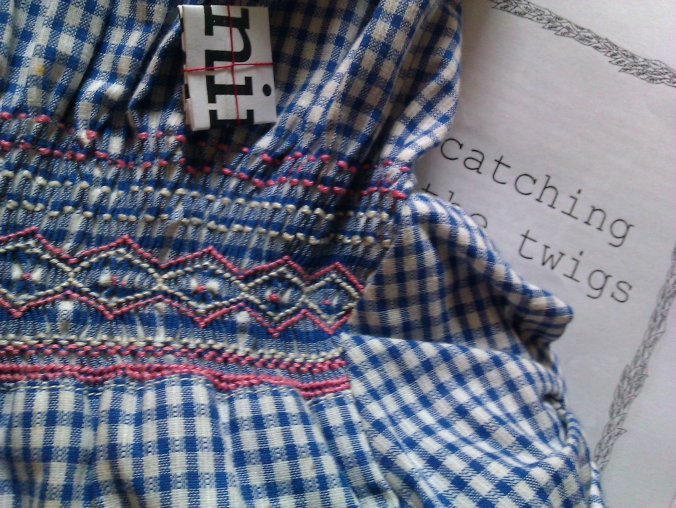
. catching twigs .

Sonja Benskin Mesher's avatarsonja benskin mesher

it is good to move things about
to stitch and make things
stitch and mend things

harder to thread the needle
daylight helps
by the door

when we gets distracted by
trees and birds
and suchlike
natural things

i like the stitch backwards
the stretching threads

the littled dress

she is older now

287644_10150381254601177_5931471_o

View original post

.the thread.

Excellent as usual

Sonja Benskin Mesher's avatarsonja benskin mesher

what is she sewing
downstairs while
you are watching the snow

i like the sound of a sewing machine
i miss it here and will miss it also

where she steadily works
i hear she has a new job
and is leaving the
workshop

as am i

we work together
those that sew
though
we do not always converge

it is a curious thread that
hold us together
while apart

36899275_10156618985421177_6273411760057745408_n

View original post

“The BeZine” Call for Submissions, March 2019 issue, Themed: Waging Peace; open call for the Zine blog, February, Illness and Disability Month

Jamie Dedes's avatarJamie Dedes' THE POET BY DAY Webzine

MISSION STATEMENT:  To foster proximity and understanding through our shared love of the arts and humanities and all things spirited and to make – however modest –  a contribution toward personal healing and deference for the diverse ways people try to make moral, spiritual and intellectual sense of a world in which illness, violence, despair, loneliness and death are as prevalent as hope, friendship, reason and birth.

Our focus is on sacred space (common ground) as it is expressed through the arts. Our work covers a range of topics: spirituality, life, death, personal experience, culture, current events, history, art, and photography and film. We cover these topics in the form of reviews, essays, poetry, fiction and creative nonfiction, music, art, and photography. We share work that is representative of universal human values however differently they might be expressed in our varied religions and cultures. We feel that our art and our Internet-facilitated social connection offer…

View original post 415 more words

Wombwell Rainbow Interviews: Nabeela Saghir

Wombwell Rainbow Interviews

I am honoured and privileged that the following writers local, national and international have agreed to be interviewed by me. I gave the writers two options: an emailed list of questions or a more fluid interview via messenger.

The usual ground is covered about motivation, daily routines and work ethic, but some surprises too. Some of these poets you may know, others may be new to you. I hope you enjoy the experience as much as I do.

Nabsticle

Nabeela Saghir

is a recent English graduate from Keele University, and currently runs an online blog on all things poetry, including reviews, advice, Q&As with other writers and her own work. She enjoys writing about both familial and romantic relationships, mental health, and has a particular fascination with fruit imagery. Nabeela’s literary inspirations include Amy Lowell, Li-Young Lee, Kim Addonizio and Franny Choi; she also aims to publish a short poetry collection in the next few years.

And my blog link:
https://nabsticle.com/

The Interview

1. What inspired you to write poetry?

I’ve been writing a form of poetry for years, maybe since I was 15 or 16. I used to write little snippets of lines and descriptions in a notebook but they were never fully formed poems at that point. They were very personal and diary-like; I just loved placing different words together and playing around with weird imagery aha!

But I think it was actually when I started university and took creative writing modules, where I had to read out my work to a class, that gave me a different feeling, a different motivation. The realisation that I can write and I’m not actually as terrible as I thought really inspired me to take poetry seriously.

2. Who introduced you to poetry?

I got my first glimpse of poetry through school, specifically secondary school. My English teacher was amazing, she always encouraged me to keep writing and pursue English further. I owe a lot to her. However, I think it was only when I went out of my way to read poetry outside of the national curriculum, for example when I read and fell in love with Imtiaz Dharker’s collection ‘The Terrorist at my Table’ outside of school, that was when I got a real sense of the poetry that I personally liked.

So I’d say it was school that introduced me to poetry as a form, but it was my own interest and developing passion that brought to light the literary community that comes with it, and really showed me the wider context of what poetry can achieve.

3. How aware were you of the dominating presence of older poets?

I was very aware, especially when it came to studying literature at both college and university. However, because they were older and no longer around, I didn’t feel pressured or threatened by their work. I always try my best to educate myself on the history of poetry and learn from the style, genre and form of older poets, but, I’m a strong believer in that this is our time now. Knowing that the dominating presence of older poets consists primarily of white, able-bodied, heterosexual men is actually the thing that motivates me to keep going, because I want to change that. I’d love to see poetry become more inclusive and accessible which I think is slowly happening, but we unfortunately still have a long way to go.

4. What is your daily writing routine?

It’s hard to answer this one since I’ve only recently started to implement an actual writing routine. It was usually university deadlines for creative writing modules that forced me to write but it was always so sporadic, writing was never dedicated to a fixed time or moment in the day. However, since starting my own poetry blog, I tend to have a more focused approach. So typically, in the afternoon when my little sisters are at school and everyone else is out busy doing other things, I make myself a hot drink (I’ve been loving camomile at the moment) and make my way downstairs to the kitchen. I open up my laptop to a blank Word document and write down the first thing that comes to mind. It’s almost always random nonsense but it helps to form some sort of image. Ideas stem from this and before I know it there’s a few lines already written.

Explaining my writing routine has made me realise it’s nothing fancy at all aha! But most of the time it works, it kicks my brain into writing mode. Of course, it does change from time to time. Some days I like writing in bed and some days I don’t write anything at all. But I guess that’s okay, as long as I’m at least trying.

5. What motivates you to write?

I think this goes back to my previous answer about the excitement of stringing words together and creating an image with emotion. That’s literally all poetry is if you strip it down to the basics. So the idea that I can do that, create something honest, beautiful and powerful from just words; it’s the feeling that I get when I finish a poem that I love, that’s what motivates me and pushes me to keep going.

6. What is your work ethic?

Having a great work ethic and attitude is so important but I think it’s something that you have to teach yourself, it’s rare that you’ll have an excellent work ethic naturally. It’s all about giving a damn about what you’re doing and, most importantly, remembering why you’re doing it. As long as I care about what I’m writing and I keep in mind why I’m doing it, my work ethic will be at its best.

I’m going to admit though that it’s not always easy. My attitude towards writing does falter from time to time (I think that’s just part of being a writer unfortunately!) But it’s just part of the process. I do believe though that when my work ethic is good, it definitely translates into my writing.

7. How do the writers you read when you were young influence you today?

Fun fact, I never used to read poetry! I adored novels. Fun stories and classics and of course Harry Potter! So, in terms of form and structure, I didn’t really take much away from these writers. However, I remember reading profusely and knowing from a really young age that literature is important to me and has value. The writers I used to read didn’t exactly influence my writing per se but they definitely played a part in my excitement and passion for words, which is the thing that keeps me focused and driven now.

8. Who of today’s writers do you admire the most and why?

That’s such a difficult question, there’s so many that I love! But if I had to pick one who stands out it would be Kim Addonizio. She’s unapologetically feminine, never shying away from talking about her promiscuous side. Her poems zoom in on the simple everyday objects and moments which is something I try and do myself, so she’s a huge inspiration for me.

9. Why do you write, as opposed to doing anything else?

Not many people know this but I started a sales and marketing job recently and quit soon after because I realised that the entire time I was there, all I was thinking about was going home and writing. I just felt that life’s too short to be doing something that didn’t make me happy.

So I write because the thought of doing anything else that takes up all of my time just doesn’t appeal to me, it doesn’t make me feel excited to wake up in the morning and start my day.

10. What would you say to someone who asked you “How do you become a writer?”

It sounds so easy when I say it and if you ask any other writer they will tell you the same, but to be a writer you simply just need to write! But more practically speaking, I’d say to set yourself small goals and deadlines. Tell yourself that you’re going to write two poems a week, or that you’re going to submit to a writing competition/journal once a month. These little goals will keep you focused and on track.

As well as that, read like your life depends on it, and talk to other writers! Don’t be afraid to drop someone a quick message and say hi, even if it seems weird and out of the blue, and start a conversation. Share other people’s work as well as your own. Not only will this motivate you to keep writing, but being involved in the literary community is just as integral to your development as a writer as writing itself.

11. Tell me about the writing projects you have on at the moment.

I don’t actually have any projects that I’m working on at the moment, or I guess I do but I’m just not labelling them as projects in fear that it’ll overwhelm me aha! I’m just writing as much as I possibly can, getting every emotion out there on paper. I’m still figuring out exactly what I want to write about and what kind of writer I want to be.

I have my blog which I absolutely adore so I’m always planning and writing posts for that. By the end of the year I want to be able to say that I’ve written as many poems as I possibly could, more than I’ve ever written before. And hopefully those poems will find a home in potentially my first ever collection… but we’ll just have to wait and see!

Seven Poems by me featured over time in The Ekphrastic Review. Thankyou, Lorette

http://www.ekphrastic.net/apps/search?q=%22Paul+Brookes%22