Two Poems by Mbizo Chirasha. . . and your next Wednesday Writing Prompt

Powerful prompt.

Jamie Dedes's avatarJamie Dedes' THE POET BY DAY Webzine

Sandstone rock formations typical of Mapungubwe National Park courtesy of Laura SA under CC BY-SA 3.0 license.

The Kingdom of Mapungubwe (or Maphungubgwe) (c.1075–1220) was a medieval state in Southern Africa, the first stage in a development that would culminate in the creation of the Kingdom of Zimbabwe in the 13th century.


This week’s prompt is graciously hosted by Zimbabwean poet, Mbizo Chirasha. 

MAPUNGUBWE

Land of baobab, land of eagles
Mapungubwe,sagging with ambition of nujoma, madikizela and sobukwe
Land of crocodiles and spiritual eagles- Mapungubwe
Rivers groaning with sweet tongues and sacred laughters
Mapungubwe – dream of stones
Bones and spirits quietly sleeping under the burden of peaceful rocks
Your songs , mapungubwe rhythm to bones of dead heroes and sleeping heroines
Mapungubwe ,crying tears of laughter, struggle and freedom ,
Mapungubwe!

Editor’s Note: nujoma is Sam Nujoma, a Namibian revolutionary, anti-apartheid activist and politician; Madikizela is Winnie Madikizela-Mandela, a South-African…

View original post 647 more words

.recovery.

Tribulations of a mouse

Sonja Benskin Mesher's avatarsonja benskin mesher

good news indeed
hopes that you improve
steadily

with good things to eat
with plenty of drinks for

we must not get dehydrated
time off work is good for they

will find how good you are
and how it is without you

maybe
maybe

i will go to the orchard
and maybe not for the
stress factor
may be high

too much for a mouse like me
do you think it will be heavy
work

too much for a mouse
like me

44366666_184306789070101_4802672184604491776_n

View original post

Wombwell Rainbow Interviews: Amanda Crum

Wombwell Rainbow Interviews

I am honoured and privileged that the following writers local, national and international have agreed to be interviewed by me. I gave the writers two options: an emailed list of questions or a more fluid interview via messenger.
The usual ground is covered about motivation, daily routines and work ethic, but some surprises too. Some of these poets you may know, others may be new to you. I hope you enjoy the experience as much as I do.


Amanda Crum

is a writer and artist whose work has appeared in publications such as Eastern Iowa Review, Barren Magazine, and Corvid Queen, as well as in several anthologies such as Beyond The Hill and Two Eyes Open. In 2019, her short story “A Shimmer In The Parlor” was a finalist for the J.F. Powers Award for Short Fiction; her book of horror poetry, Tall Grass, made the shortlist for a Bram Stoker Award nomination the same year. She is also a nominee for the Best of the Net Award and the Pushcart Prize. Amanda currently lives in Kentucky with her husband and two children.

https://amandacrumwrites.wordpress.com/2018/01/21/the-journey-begins/

The Interview

1. What inspired you to write poetry?

I’ve been writing poetry since I was very young. I grew up in a trailer park and I used to take a notebook on walks around the neighborhood and make up little haikus and songs about what I saw. It was such a great way to stretch my imagination and to learn more about the way the world works.

2. Who introduced you to poetry?

I honestly don’t remember! I always loved to read as a kid, though, and I fell in love with language at a very early age.

3. How aware were you of the dominating presence of older poets?

I never thought about it until I was in my 30s and started focusing on my writing as something that could be published. I would scour the internet reading everything I could find, gathering inspiration and educating myself about those who had come before me. It was intimidating, to say the least, and at first I felt silly for even trying in a field where so much greatness had already been established. But writing is such a part of me that I knew I had to push forward and honor the ones who paved the way.

4. What is your daily writing routine?

I have two kids and work a full-time day job, so nighttime is my writing time. I stay up into the wee hours working on whatever project I have going, because that’s the only time the house is quiet enough.

5. What motivates you to write?

I wish I knew where that compulsion came from. It’s always been there, as long as my memory runs back. The feeling of being inspired and then being able to pull the right words from the atmosphere is such a high.

6. What is your work ethic?

I’m an extremely hard worker, to the point that I have to make myself slow down a bit every now and then. When it comes to writing, I always have four or five projects or ideas I’m working on at a time, and even when it’s stressful, I’m at my happiest when I have a lot on my plate.

7. How do the writers you read when you were young influence you today?

I was always an old soul, even when I was very young, so I read Nancy Drew and the Hardy Boys, and when I was a little older I discovered Stephen King. Those styles of writing–the old fashioned, language-heavy, noir tales and the character-driven horror–merged to create my own style.

8. Who of today’s writers do you admire the most and why?

Carol Goodman writes haunting, lovely tales of murder and secrets and loss. Her use of language is so beautiful it makes me cry. Alix E. Harrow, a fellow Kentuckian, is my new favorite. I just finished The Ten Thousand Doors Of January and it seemed to complete me in a way that few books ever have.

9. Why do you write?

I write because I have to. There isn’t a choice. If I don’t write, I lose a part of myself.

10. What would you say to someone who asked you “How do you become a writer?”

Read. Every day. Read books, newspapers, magazines. Read children’s books and young adult books and fantasy and horror. Read non-fiction. You cannot be a writer if you don’t read.

11. Tell me about the writing projects you have on at the moment.

Right now I’m editing my middle-grade fiction book about an Appalachian girl with magical talents, and I’m also working on a horror tale that I think might morph from a short story to a full-length novel. I have an idea brewing for a futuristic western, too. I’m all over the map!

The Encyclopedia of Obscure Sorrows

Excellent Lorette.

perfectsublimemasters's avatarEunoia Review

after John Koenig

after The Dead Toreador, Édouard Manet, 1864

  1. All the art in Seville is making our eyes bleed. We cannot bear the beauty of another palacio of a million mosaics, or the clatter of one more café. We follow the swans around the bend, under a bundle of low leaves, into the soundless grove. I’ve told you already to go off and find yourself a young woman, someone who could keep up in this heat, but you were too busy fiddling with your camera battery to assuage my neuroses.
  2. If I was afraid to come here with you, it’s only because I was afraid of what I might lose.
  3. There is an old woman in flowing purple and red scarves, armloads of bangles, and sensible shoes. I do a double take, thinking for a strange second that I was passing some kind of mirror.
  4. When I turn…

View original post 344 more words

.razor rabbit.

Love this from sonja

Sonja Benskin Mesher's avatarsonja benskin mesher

introducing

razor rabbit

some killed him, ate him, in casseroles and pies.

i will keep him. called razor for his quick wit, his

courage in crossing rivers & railways

rescuing, saving

he is a hero

is razor rabbit….

wait for more from razor rabbit

461213_10150825775606177_675531176_11928744_427753829_o

View original post

.the garden shed.

Sonja Benskin Mesher's avatarsonja benskin mesher

( a rhyming poem. homage to cold comfort)

it all happened down the woodshed

she said.


not the garden shed

then? he said.


no you see the shed i mention is designated for wood

and should

be used for that.


while a garden shed

she said

stores the mower and other tools

and it did not happen in there

it happened elsewhere


in the woodshed

see

she said


11336882_10153461781901177_5264547570224954833_o

View original post

Wombwell Rainbow Interviews: Peter Thabit Jones

Wombwell Rainbow Interviews

I am honoured and privileged that the following writers local, national and international have agreed to be interviewed by me. I gave the writers two options: an emailed list of questions or a more fluid interview via messenger.

The usual ground is covered about motivation, daily routines and work ethic, but some surprises too. Some of these poets you may know, others may be new to you. I hope you enjoy the experience as much as I do.

America (c) 2019 Gareth Davies Photography, Tenby, UK

(c) 2019 Gareth Davies Photography, Tenby, UK

Peter Thabit Jones

is the author of fourteen books, several of which have been reprinted and four published in Romania. His work has been translated into over twenty languages.

He is the recipient of the Eric Gregory Award for Poetry (The Society of Authors, London), The Society of Authors Award, The Royal Literary Fund Award (London) and an Arts Council of Wales Award. He was awarded the Ted Slade Award for Service to Poetry in 2016 by The Poetry Kit (UK), the Shabdaguchha Poetry Award 2017 (USA), and the 2017 Homer: European Medal for Art and Poetry.

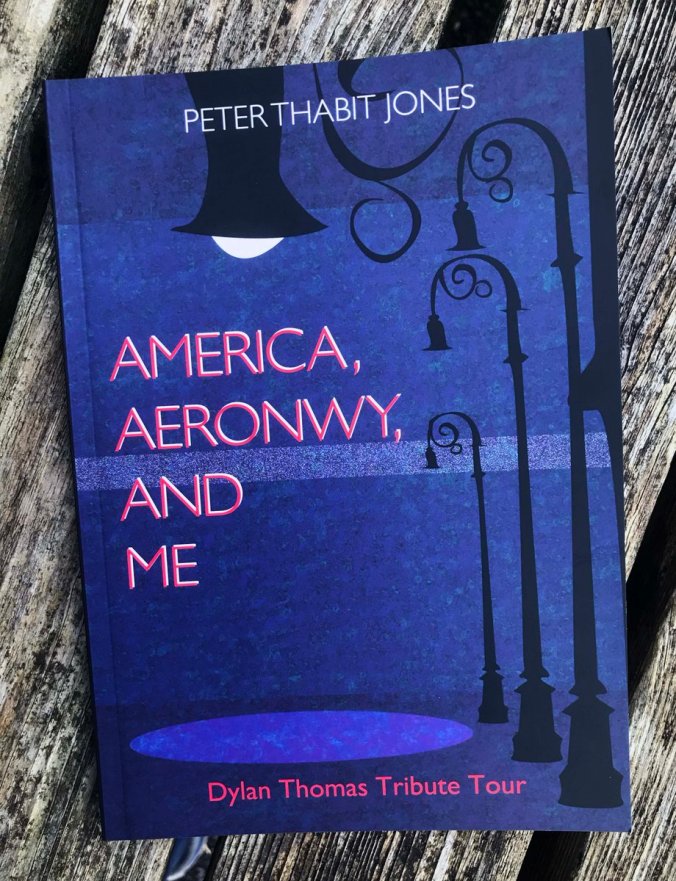
In March 2008 Peter’s American publisher, Stanley H. Barkan, organised a six week poetry reading tour for Peter and Dylan Thomas’s daughter, Aeronwy. The pair gave readings and workshops from New York to California, at many universities and prestigious art venues. Peter is also the co-author, with Aeronwy, of the Dylan Thomas Walking Tour of Greenwich Village.

Peter has participated in many festivals and conferences in America and Europe, including World Affairs Conference, Colorado, 2009; NEMLA Conferences, (Boston, 2013, Pennsylvania, 2014, and Toronto, 2015); and the Massachusetts Poetry Festival. He has also organised A Visiting American Students/Dylan Thomas in Wales Project with Knox College, America, 2010, and an International Poetry Festival, 2011, and a Drama Festival, 2012, at the Dylan Thomas Theatre, Swansea. The latter two events were part of an ongoing collaboration with Cross-Cultural Communications, New York.

His chamber opera libretto, Ermesinde’s Long Walk, for Luxembourg composer Albena Petrovic, premiered at the Philarmonie Luxembourg in 2017; and his full opera libretto for her with Svetla Georgieva, Love and Jealousy, premiered at the National Opera House Stara Zagora in Bulgaria in May 2018.  Ermesinde’s Long Walk also premiered at National Opera House Stara Zagora in December 2018. Love and Jealousy also premiered at the Théâtre National Du Luxembourg in December 2019.

He resided at Big Sur, California, in the summer of 2010 as writer-in-residence, returning again for summer residencies each year from 2011 to 2020.  Whilst in California in 2012, Peter wrote his drama The Fire in the Wood, about Big Sur sculptor Edmund Kara, who is famous for his sculpture of Elizabeth Taylor in the film The Sandpiper. The drama premiered at the Actors Studio of Newburyport in Massachusetts in April 2017 and at the Henry Miller Library and the Carl Cherry Center in California in May/June 2018.

Peter is the Founder and Editor of The Seventh Quarry Swansea Poetry Magazine, which publishes poetry, translations, interviews, and articles from around the world, and the accompanying The Seventh Quarry Press, which publishes international books of poetry, prose, and art.

His poem Kilvey Hill has been incorporated into a permanent stained-glass window in Saint Thomas Community School in Swansea, Wales. In April 2014, he was inducted into the Phi Sigma Iota Society at Salem State University, Massachusetts, for his contribution to literature and literary translations.

His poem Lament for Soldiers of the First World War is featured in the film Bells on the Western Front, produced by Holly Tree Productions. The film has won several international awards including First Prize in the 2017 Wales International Film Festival.

Further information: www.peterthabitjones.com

The Interview


1. What inspired you to write poetry?

As a boy, I use to sit on Kilvey Hill, a sulking hulk of a mini-mountain that darkened and dominated the row of houses where I lived with my grandparents in Eastside Swansea, Wales. I spent a lot of time up there, alone, looking and thinking.  Even then, to quote Edward Thomas, an English poet, I sensed that I wanted “To bite the day to the core”.  Then in Danygraig Boys Secondary School, Swansea, my teacher Mr. James read out a poem, The Kingfisher, by Welsh poet and tramp W.H. Davies. The opening line is: “It was the rainbow gave thee birth”. That word rainbow lit up in my mind. I had once seen a kingfisher bird down by Port Tennant Canal, where I sometimes played with friends.  I suddenly saw what one word, all by itself, could do. It was the real beginning for me, when language became more than just a way of communicating in the ordinary world of relationships.  I was eleven years-old.

Mr. James gave us an exercise to write a poem.  I wrote one called The Canary (one of my uncles actually did keep canaries in a shed in our garden). Mr James took my poem apart but also showed me how to really put a poem together, with rhymes (internal and external in those days). That, for me, was the beginning of the learning of the lifelong thing of craftsmanship.  I realised the excitement of not knowing what was around the corner when one first received inspiration, when one first started to draft a new poem.

I wrote about the things around me, my grandfather (I was raised by my maternal grandparents) who was slowly dying in a bed in the parlour,  Kilvey Hill where I played and where I first experienced a sense of otherness,  “bright shoots of everlastingness”, to quote the poet Henry Vaughan, something beyond what we call reality, a sniff of eternity.  I was in the dark, writing poems and not knowing if they were good or bad poems. I did, though, even at that young age, take it seriously.

2. Who introduced you to poetry?

Mr. James, though  when I was about thirteen years-old and determined to be a poet, I joined Swansea Central Library and I immediately scanned its Poetry section. The only books in our home were the Bible and, oddly, a book about the Kon-Tiki Expedition. I never found out why we had a copy of the latter in what we called the spare room.

I discovered a treasure-chest of poets in that library, such as Gerard Manley Hopkins, Thomas Hardy, Emily Dickinson, W. B. Yeats, Edward Thomas, Dylan Thomas, R. S. Thomas, Alun Lewis, W. H. Auden, Vernon Watkins, William Carlos Williams, Robert Frost, Charlottte Mew, Edna St. Vincent Millay, Philip Larkin, Seamus Heaney, Sylvia Plath, and Ted Hughes.  Then later on I accessed the works of the likes of Arthur Rimbaud, Charles Baudelaire, and Federico Garcia Lorca (a favourite) through books of translations of their poems. I became a regular and very keen customer at the library.  Later on, I discovered that Dylan Thomas also made use of the library when he was alive and living in Swansea.  So, in many ways, I introduced myself to the ‘world’ of poetry and poets.

At the same time, I worked as a newspaper boy after school, to earn pocket money. I delivered newspapers in the area where I lived. With some of my money, I started to collect J. M. Dent’s Aldine Paperback editions of the works of Dylan Thomas.  I still have them.  I eventually bought books by other poets, biographies of poets, and critical books on poetry.  I was slowly learning more and more about poetry, its craft and its contribution to human development down the centuries. All the while, I tried to make better poems of my own.  I did not show them to anyone.

How aware were you of the dominating presence of older poets?

Very aware, but mainly through books I borrowed from the library. Around the age of eighteen, I started to send some poems to magazines in Wales and it was such a thrill to have work accepted by two of the main magazines here at the time, The Anglo-Welsh Review and Poetry Wales.  This led me to getting to know about older Welsh poets (and eventually meet them in person), such as Leslie Norris and Dannie Abse.  I also started to get to know other Swansea poets, who were older than me and who suggested I read such and such a poet. Some of those early poets I discovered in the library remain firm favourites of mine.

3. What is your daily writing routine?

I am very well organised and, according to my family,  a workaholic.  I do put in a lot of hours each day and each night, seven days and seven nights of the week. Luckily, I have a supportive family.  My wife is a children’s nurse and works long twelve-hour night shifts etc and our grown-up children have fled the nest, so I find I am on my own a lot – ideal for a writer and publisher.
I have my own writing room, which overlooks a green and bare field. I am usually in there by 9am. My room is packed with shelves of books, shelves of files that contain my old and new manuscripts, with favourite things on top of the shelves, such as ornaments (birds, a tiger, a fox, an elephant), and shells and stones collected on my walks.  Favourite posters, such as one of an American Native Indian and one of Picasso’s Guernica painting, and favourite photos cover what can be seen of three of the walls between the shelves. On the fourth wall there are some posters and photos of my and Aeronwy Thomas’s 2008 Dylan Thomas Tribute Tour of America, which was organised by my American publisher Stanley H. Barkan. Books and magazines also occupy some of the floor space.

I have three desks, a large one for doing my writing, a small one with a computer and a small one for sorting out postal mail etc. The room is a bit too packed, but for me it’s as cosy as a womb.  Beautiful silence helps me concentrate.  I work until about midday, grab some biscuits or make a smoothie, then back to my room until an evening meal.  In the evenings, if my wife is working a night shift, I spend a few hours, revising what I have done or reading a book.  I am an avid reader, in particualr biographies of writers and books of literary criticism.  Even when I was part-time teaching at Swansea University on the part-time degree programme for the Department of Adult Continuing Education for twenty-two years, this was more or less  my daily and nightly routine. As a young parent, I struggled as a freelance writer for fifteen years before I started teaching, so I already had an established pattern with regard to my writing. I retired from the university in 2015 and I am now self-employed.
I always write by hand, poems and substantial works such as dramas and commissioned opera libretti.  I love the feel of the pen in my hand as if part of me is going into the very ink.  I only go to the computer screen when a piece of work is finished.

Each summer, since 2010, I have been a writer-in-residence in Big Sur, California, for two months.  I reside in a very isolated and small cabin, a fifteen minute or so walk from the Pacific Ocean and where there is no public access for thirty miles.  A lady brings me provisions once a fortnight.  There is no television.  The aloneness is not for everyone, though I have found it truly inspiring and I have written a book of poems, “Poems from a Cabin on Big Sur”, three dramas, many more poems for a future collections, and half of a novel, which I hope to finish this summer. I work in the small bedroom of the cabin, at a round table.  I work, cook, walk the mountain, and read at nights or revise what I have written.  Sometimes I give talks or readings in Monterey. One of my dramas, The Fire in the Wood, about reclusive sculptor Edmund Kara, premiered at the Henry Miller Library, Big Sur, and then had a run at the Carl Cherry Centre Theatre in Carmel in 2018.

I can hear the constant lap-lapping of the ocean from the cabin.  One becomes very aware of the incredible life-force of nature there.  I see seals, sometimes a whale, pelicans, raccoons, deer, a coyote once (at night), rabbits, lizards, and even the occasional snake basking itself in the sun.

4. What motivates you to write?

There is a mental cliff-edge gamble when one picks up a pen and paper. The gamble that what is stirring among one’s thoughts, one’s nest of emotions and experiences, could become a fully-fledged poem. Without poetry I would find my own life less of an experience, less of a journey. A blank piece of paper and a pen are for me like a vast forest is to a man on the run, a scary but an exciting adventure.  I love the uneasy stir of a poem in the mind, a word, a phrase, an observation, a rhythm, the way all is ejected for the focus of shaping something, the taking away of everything that is NOT a poem, until there is a poem: on that sheet of paper, possibly forever. As William Carlos Williams claimed, “If it ain’t a pleasure, it ain’t a poem”.

I particularly like self-made forms, which can use rhythm, rhyme and metre but in which you can also make use of weakened rhymes and other ‘tricks of the trade’.  So even if I write in free verse I try to make the poem sound good, for it to ‘sing’ when read aloud.  I use to encourage my students at Swansea University to try the traditional forms because they are a good way to practice using language, to control words into doing what you want them to do.  I see traditional forms as an adventure and not a strait-jacket.

Structure, for me, is all-important, be it the stanza structure of a poem or the sound-texturing structure of a poem. I don’t think one needs to sacrifice imagination for structure.  I think imagination can contribute to structure and structure can contribute to imagination. Even the energetic passion of a painter like Van Gogh is contained within the rectangle or square of a frame. For me, a good poem should contain the three main ingredients:

*  A message or messages
*  Imagery
*  The Texture of a Tune, in other words musicality or sound-texturing.

An excellent poem, of course, has ‘a ghost in the machine’, a touch of duende as the Spanish poet Federico Garcia Lorca suggested, the unexplainable. The difference between an ordinary poem and an excellent poem is a bit like Welsh poet R.S Thomas’s comment on translation – an ordinary poem is “kissing through a handkerchief”, an excellent poem is real kissing.

The writing of a poem for me is everything. Publication is secondary.  The fear and excitement of a blank page is still something I love. I feel craft assists in the communication, the connection, between writer and reader.  One should use the available ‘tricks of the trade’, in other words the application of craft, to make a reader feel sorrow, sense a landscape of snow, or hear the eternal engine of the ocean etc.

I am so caught up in trying to catch the poem forming in my mind, thus my focus is purely on applying what skills I have to bring the poem out into the world – on to a sheet of paper.  My main concern is have I done enough work with the phrases and lines and rhythms that made me feel this is a poem about to be born.  Does the poem work for me the poet?  It is only later that I think that maybe such and such a poem will connect with a certain type of person or persons.  I don’t show a poem I’m working on to anyone and I rarely discuss a poem I’m working on. Once a poem is published, one hopes that it will connect with someone, hold their attention for the span of its ‘conversation’.

     With regard to writing a drama, it is initially a solitary act like writing a poem, but once it is read on stage or performed it involves teamwork with other professionals.  One must become aware of that factor at some point in the writing process when working on stage directions, dialogue, and action.  A director and actors will bring their energy, often their interpretation to the script.  One must begin to try to see things through their eyes and come to some compromises.

Once a drama goes into the process of production other factors have to be considered, the size of the stage, and the financial input available for the staging, the backdrops, fees for actors etc.  So one has to often curtail one’s inner visualization of what one originally wrote and accept what the director, the actors, and the backstage people can do with your work.

Most audiences, especially with a new and unknown drama, take away a suggestion of a plot when they have experienced a live drama. It is only later, when they dwell on certain things, that other issues and themes within the drama start to make an impact on them. So one must be aware of the need to connect with an audience on an immediate level and to hopefully engage them for the whole unfolding of the drama. It is such a thrill to be in an audience when the curtain goes up and to experience their reactions to the characters one has lived with for so long in one’s mind and on paper.

I begin by making basic notes about the plot, the types of characters, how many acts will it have, how many scenes within an act, and so on. One lives with the characters, their personalities and their contributions to the planned plot and the climax of the drama. I do character notes for each one, such as their age, gender, occupation etc. I am really into writing plays and currently, among a tower of other chores, making notes for a new drama and working on a dramatic piece for voices.

As with a poem, I don’t really think of an audience when first tackling an idea for a play. I am too involved in the plot and getting the characters to interact via their dialogue and their actions, and creating the architecture of the drama (the stage directions, the acts and the scenes).  Once my ideas start to look like a drama, I then think of whether or not it is too long, or too short, for a production in a theatre and whether a director can replicate my vision as close as possible for it to connect with an audience. Once I complete a drama, I start to envisage an audience of sorts.  So for my drama The Fire in the Wood, about Big Sur sculptor Edmund Kara, it seemed natural that we should try to get it produced in his areas, Big Sur and Carmel in California.  The test, though, for a drama is can it connect beyond the obvious audience.  It was such a thrill when it was performed in Massachusetts and the nightly audiences did connect with the dramatised life of Edmund Kara.

5. What is your work ethic?

I believe if you give yourself over to poetry, poetry will reward you. By giving yourself over, I mean put in the hours, learn as much about the craft as you can, read the works of other poets, especially the ‘greats’, and read books of literary criticism. I would apply that to all genres of writing.

6. How do the writers you read when you were young influence you today?

I still go back to their works and they still inspire me by their approach to craft, their commitment to the written word, and their giving their lives over to writing.  Poets such as Auden, Larkin, and Dylan Thomas still remind me of the importance of  what the Welsh poet Vernon Watkins said,  ”Cold craftsmanship is the best container of fire”. Edward Thomas still reminds me of the inportance of that self-made solitariness which is very much a part of a writer’s life. Federico Garcia Lorca reminds me that drama for the stage can be  magically metaphorical at times, powerfully poetic, intense and pulsing with the notion of duende; and Dennis Potter reminds me that drama can reveal the extraordinary in the seemingly ordinary.

7. Who of today’s writers do you admire the most and why?

I really admire the work of Welsh dramatist Ed Thomas, whose plays often explore the post-industrialised and deprived areas of South Wales and the impact of unemployment and the sense of no hope on his characters.  House of America is probably his best-known drama. His works are so well organised, brooding, moving, and lightened by a raw and dark humour. As for poets, Irish man Paul Muldoon is a favourite.  I like his probing intelligence, the careful casualness of his work, and his masterly handling of a variety of subjects.  As for a novelist, the American Andre Dubus III.  His works, in particular House of Sand and Fog, show a piercing observation when it comes to contemporary America and how human misunderstandings and mistrust can lead to tragedy.  His array of writing skills is truly impressive and he can really tell write a riveting narrative.

9. Why do you write, as opposed to doing anything else?

What I love about writing poetry is that during the ritual of creation, the committed poet is plugged into a no-man’s-land of memories, a no-man’s-land of emotions.  Words, syllables, their very singing, are as precious as breath. The calling to poetry rings through one’s being. One is at the altar of all that makes life worth living. The ghost of one’s muse is back in the room. One is a poet once again.

What I love about writing dramas for the stage is that creation of a ‘world’/a location and characters, which for the duration of the performance can  – via the actors – occupy and hold the minds of an audience, draw them in like an ancient storyteller as the theme or themes of the plot unfold.

     Writing is also is something I have done from a very early age and something I committed myself to at an early age. It is who I am as a human being.  I built my life around being a writer, rather than fitting writing into my life.  It has been a struggle. I have done other things, to keep some ‘bread on the table’.

As I said earlier, I taught at university.  When I left school, I worked in offices, worked underground for two years at Abernant Colliery in the Swansea Valley. I did work in factories.  All those experiences were good compost for my writing.  I’m very lucky in that I have arrived at a stage where I can be a full-time writer.

I did stop writing for three years at the age of twenty-four. The death of my second son, Mathew, when I was twenty-four years old took me into a cold corner, a cul-de-sac of grief.  I had come face to face with ‘the eternal note of sadness’, to quote English poet Matthew Arnold. The conveyor-belt of busy life, of course, wants one to carry on, to get back in to the speed of things.  One, though, is dulled by the palpable sorrow, the colours of life darken.  There seems to be more shadows than shining.  One’s heart is in the mud of low-tide, day and night. Words lost their magic for me. There was a dust of silence on my internal voice. I was a dark bird on a wintered and skeletal tree – with no desire to sing.

I realized, as I later wrote in a poem for my son, “Poetry Reading: Robert Frost Farm, New Hampshire, USA”, ‘I am a singer merely, I sing my song’. What else could I do but write? I had been writing in a serious way since I was eleven years-old. When poetry did come back to me I knew I could not fall back on someone else’s voice or experiences. I feel it was the real beginning of my finding my own poetic voice. The loss of my son, though, is ever-present in my poetic vision, ever-present in my life.

10. What would you say to someone who asked you “How do you become a writer?”

I think I would echo my response to an earlier question of yours. I would suggest he or she give their life, or as much as they can of their life, over to writing. To put in the hours, learn as much about the craft of their chosen genre or genres as he or she can.  I would suggest they read the works of other writers, especially the ‘greats’, and read books of literary criticism. It would suggest they read biographies of writers, to see how they coped with their ‘dark nights of the soul’ when their writing was not going well and their work was not being recognised, not getting published. I would point out the solitariness of the vocation, the need for such aloneness to write and to improve one’s writing skills.  I would suggest they find out as much as they can about the way the literary world works, such as the standard requirement of magazines and publishers. A lot of disappointing rejections can be avoided by knowing more about the submission policies of magazines and publishers and the types of writings they tend to publish.  I would suggest they look into copyright and learn the ‘rules’ of copyright.  Finally, I would suggest they should try to love what they do, enjoy those hours and hours alone when the blank pages are offering an adventure for their pen.

11. Tell me about the writing projects you have on at the moment.

My ‘bread and butter’ work at the moment is the finalising of a commissioned biography of an American poet and artist, who has to remain anonymous at this stage.  It is a ‘putting in the hours’ chore.  I’m revising aspects of the biography with the poet/artist and I’m finalising the Index of the manuscript.

With regard to my own work, I’m hoping to almost complete a novel, which is a comedy about the literary world and set in Wales and America, when I return to California for my eleventh writer’s residency there in April.  I am also working on a dramatic piece for a group of voices. Via individual poems, it explores war, especially the victims, political extremism, and the way we humans are damaging not just the environment but damaging the soul of what it means to be human.  It is meant for the stage and it will utilise photos on a screen and occasional music. To quote W. H. Auden, we are in a “low dishonest decade” and, to quote him again, an “Age of Anxiety”.  Theatre, I feel, can and should tackle such social and political darkness, as well as the joys and grief of being human.

I am very, very slowly putting together ideas for a stage drama about the last days of Dylan Thomas in New York, prior to his death there. I think I have found a new way of approaching those days that have been covered, of course, by other writers. I’m also waiting for the subject of my third commission for an opera libretto, from the composer for whom I have already written two libretti.

I hope, of course, that ideas for possible poems will still continue to visit me, often when least expected in my case.

Wombwell Rainbow Interviews: Lisa Folkmire

Wombwell Rainbow Interviews

I am honoured and privileged that the following writers local, national and international have agreed to be interviewed by me. I gave the writers two options: an emailed list of questions or a more fluid interview via messenger.
The usual ground is covered about motivation, daily routines and work ethic, but some surprises too. Some of these poets you may know, others may be new to you. I hope you enjoy the experience as much as I do.

Lisa Folkmire

Lisa Folkmire

is a poet and legal technical writer from Warren, Michigan. She holds an MFA from Vermont College of Fine Arts where she studied poetry. Her poems have appeared in many journals, including Up the Staircase Quarterly, The Mantle, Glass, Barren Magazine, Alegrarse, and Okay Donkey.

You can find all of her publications at lisafolkmire.com.

The Interview

1. What inspired you to write poetry?

On one hand, it was basic curriculum. I was in a creative writing class in college and the professor was a poet and he had us start with poetry, easy as that. I was mad because I really wanted to write out a story, but then I noticed that something different was happening when I wrote poetry. It wasn’t work at all, it was more of an uncovering. I realized that by writing poetry, I allowed a corner of my thought process that I initially thought was an obstacle to understanding thrive. Which is funny, because I have never felt more transparent than with my poetry.

2. Who introduced you to poetry?

My mother always found an annual book of children’s poetry for my siblings and I to read, but I guess the first non-rhyming original poetry was passed my way through English class. But it was always more of a benchmark than anything emphasized as worthwhile. I remember hating it, that no matter what we said the poets were getting at, we couldn’t seem to match the back of the book answers. I really didn’t see the point.

3. How aware were you of the dominating presence of older poets?

(See above.) TOTALLY unaware. I thought they were all out and buried since WWII. It was a rude awakening once I moved away to school and started taking real literature classes, like “hey those unsolvable riddles were really quite cool!”

4. What is your daily writing routine?

“Daily” is a stretch here because I believe in writing when I have writing ideas, but I do have a daily reading routine which usually feeds into a daily writing routine. I have this physical pile of books I call my “reading queue” that I get through before picking out a pile of new books to read from my backlog. If I’m reading and something hits me as an idea, I grab the journal and pen I always keep next to me and let my mind just ramble until I know I’m ready to type out what I’m thinking on the computer. Once I type, I read out loud what I wrote, and instantly start editing. I’ll return to this pretty obsessively for days until I know that I wrote something worth reading, which is when the peer review starts. Then I let the piece sort of incubate for a few weeks. If I’m still feeling like it has the energy it had when I first had to scribble it out, I send it out to journals. If it’s sitting dormant for me, I let it nap for a bit. Sometimes pieces just need to regain friction (as in be edited forever after) to be ready for the real world. Come to think of it, I’m probably more in tune with my writing than I am with a lot of my friendships. I just go with where my mind leads me the whole way through.

5. What motivates you to write?

I think other writers really push me. I read all of these fantastic books with fantastic worlds and I think “hey, I have this world here in my head and these characters won’t leave me alone” or “hey, that’s an experience I have trouble discussing too, but these images won’t leave it. I wonder what it would all look like if I spent time on it.” Maybe a need for brain vacancy is my real motivation!

6. What is your work ethic?

I have a decent work ethic. Like, it’s not the best, but it’s definitely not the worst. I am embracing the idea of letting myself breathe, and I’m learning it’s a fine balance between a break and keeping myself from pushing forward in my writing. But I think that the work that I write after a break is usually better than the work I do when I’m forcing myself to enjoy writing. When I’m in a writing phase, that’s all I’m doing, when I’m out of a writing phase, I’m just reading through my queue. I guess I am pretty devoted to the learning process, if anything.

7. How do the writers you read when you were young influence you today?

I only remember the fiction that I read when I was young, which always had a girl with some magic powers or supreme quirkiness that she overcame. Some of this is coming through in my fiction, where the women are running the show and the men are kind of fading to the background. That and the animals were always providing some sort of knowledge in the books I read, which really comes through in my poetry. Wildwood Dancing (Juliet Marillier) and Goose Girl (Shannon Hale), even Henry and Ribsy (Beverly Cleary) provided that type of “trust the animal instinct” thesis I often find in my poetry.

8. Who of today’s writers do you admire the most and why?

Ada Limón is at the top of my poetry list. She writes so beautifully about terribly unbeautiful situations that her poetry is both a wonderful lesson in writing and a guiding light in life. I read her and I feel okay with things, which is hard to do. I think everybody needs some Ada in their lives.

9. Why do you write, as opposed to doing anything else?

I can’t not. I have so many stories and poems buzzing around in my head all the time, it’s hard to believe that I can hold down a day job and an every day life (band member, Social Media Editor, podcaster, freelancer, fiancé, daughter, sister, dog pal—which is the biggest gift of all). I’m a walking daydream. I need to write.

10. What would you say to someone who asked you “How do you become a writer?”

Pick up a journal you love and a pen and have at it. Find a circle of readers you trust, beg for real critique, and read every day. Mix up genres. Don’t marry yourself to one. And get an animal who will nap by your side while you do it. I’m beginning to think that’s a requirement.

11. Tell me about the writing projects you have on at the moment.

I always have my poems, which I expect to naturally grow as I go. They’re going to be something someday, I just know it, but for now I’m letting them talk amongst themselves as I slowly introduce them to new friends. I also have a bit of a fiction piece that’s brewing. I am letting my characters form it (it’s sort of Mrs. Dalloway in that it’s third person and the viewpoints swap between as the story unfolds) and it’s about climate change and family and that terrible point in young adulthood when you realize that you’re done growing up. There’s a lot more too it, I just haven’t gotten there yet. I guess all of my pieces are like a room of guests that are bringing out more about each other while they wait for dinner to start, and I’m the host, and I forgot to figure out what’s for dinner. Hopefully it’s something good.

Prague Travelogue by Stuart Buck

More cracking stuff from Stuart Buck

robertfredekenter's avatarIceFloe Press

as i descend through the clouds over rakovnik, i see the beautiful city laid out before me like a banquet of setting suns. the iodine lights of ten thousand streetlamps below me like candles, like the sun shining through bullet holes in a vast steel sheet, like a thousand lonely smokers. i turn from the window and a soft fatigue washes over me. if the plane was suddenly to fail, and all its passengers to die, i think i would be quite content to have the lights of prague be the final thing burnt on my retinas.

the first morning brings fermented cheese, pickled fish and rye bread that smells of an evening spent in a field with a loved one. czech coffee is strong but barely there, a couple inches of malt black liquid, a brief mention of foam, every cup served with a glass of water as if…

View original post 941 more words

Wombwell Rainbow Interviews: Henry Gould

Wombwell Rainbow Interviews

I am honoured and privileged that the following writers local, national and international have agreed to be interviewed by me. I gave the writers two options: an emailed list of questions or a more fluid interview via messenger.

The usual ground is covered about motivation, daily routines and work ethic, but some surprises too. Some of these poets you may know, others may be new to you. I hope you enjoy the experience as much as I do.

Henry G books[64941]

Henry Gould

The Interview

1. When and why did you start writing poetry?

First off, thank you, Paul, for proposing this interview. I started writing poetry at age 14, during my first year in high school (what we call 9th grade in the U.S.). That was in 1967. I had thought of myself as a “writer” much earlier, by age 10 or 11. I hoped to become a newspaper reporter, maybe a novelist. What brought me to start in with poetry? My English teachers over several years included poems in our reading and composition. Poetry was also an emphasis in the French and Latin classes. I was very fortunate to have teachers like that, who took an interest. Around age 14 I simply discovered I had a talent for writing short poems. Both the contemporary things I was reading in school anthologies, and the exotic glamour of French poetry, got my attention. From there the interest and ambition grew, very gradually, so that now poetry has pretty much taken command of my earthly existence, so to speak.

2. Would you say that it was your teachers who introduced you to poetry?

In a certain sense, yes. They helped focus my attention at the right time. I owe them a debt of gratitude, for bring poems into the school routine, for stimulating classroom reflection and critical discussion, for forcing us to write about it, and finally for encouraging my own experimentation. On the other hand, I don’t want to give you an oversimplified answer. How does poetry make itself felt in one’s awareness to begin with? This is actually an issue that has preoccupied me lately. Do the schools, and culture at large, confine poetry within too narrow a channel right now, exotic and specialized? In my view, poetry, with all its technical specificity and particular history, is nevertheless part of a seamless continuum. It’s a phase phenomenon, on a spectrum with literature as a whole (poetry, drama, fiction, criticism), with the arts (music, dance, visual art), and even with sciences and humanities more generally. And in our personal experience, we are soaked in unconscious poetry from an early age, within this luxuriant context of aesthetic experiences of all kinds. Poetry is inseparable from this wider artistic milieu. I could say I wrote my first poem in 1956, when I was 4 years old. My workaholic father was heading out the door in the morning. I called out this little sing-song doggerel bit toward him (“Play, Play! / It’s time to play! / Play all day, / that’s what I say! / Your work is done, / come out in the sun! / Play, play, play!”). My father stopped right there, and wrote it down on a little cardboard key card he had in his pocket. 50 years later, my mother found the card in a drawer and sent it to me. As my former teacher Edwin Honig once wrote, for a children’s pamphlet put out by the government : “Poetry is a buzzing in the air. It’s everywhere. Poets hear that sound, and write it down.”

2.1. How did “the exotic glamour of French poetry, (get your) attention”?

A few years ago I experienced one of those all-too-rare Proustian spontaneous memories (though I can’t remember what triggered it, which is actually what would make it Proustian).  Very evocative.  It was probably the summer of 1968.  I was sitting barefoot on a little metal balcony at my parents’ house, reading one of those tiny French paperbacks – Baudelaire, probably.  The profound pleasure in being able – somewhat! –  to read the French; to hear the slow sound of it… “luxe, calme et volupte“… and to understand it – somewhat! – in my own language.  With that purely literary phenomenon of experiencing something distant, remote, untouchable… yet one is absorbed by it nonetheless.  At that adolescent time of life, when love and desire and romance seem so utterly, physically close, and yet so impossible to find, to know… all that oceanic dreaming and loneliness and uncertainty all in one flow, one deep well of naive, semi-childish consciousness.  Actually an episode in the long farewell to childhood.  This kind of experience seems to epitomize the point that poetry is actually born and grows within the already-poetic consciousness of the reader.  The poem is the flower, the reader is the garden (something like that).  Poetry is elusive, subjective, it changes, dependent on our personal state of mind.  As the Spanish playwright put it, La vida es sueno.  Life is a dream.

3. How aware are and were you of the dominating presence of older poets traditional and contemporary?

You probably realize this is a big, challenging question.  I’m tempted to say “Next question”.   But I’ve thought of a few fragmentary things by way of response.

Perhaps the ideal for poets is not “domination” but “guidance”.  Or better yet, “friendship”.  Canadian scholar Elena Glazov-Corrigan wrote a book about this, with respect to Osip Mandelstam (Mandelshtam’s Poetics : a Challenge to Postmodernism).  She traces the transformations in Mandelstam’s development as a movement away from postmodern otherness and non-identity, toward a new concept of poetic “friendship” or affiliation.  A personal bond, between poets – regardless of time and space – which promises new creative/spiritual integration.  One can see this exemplified in another way in Paul Celan’s profound affiliation with Mandelstam himself – M-at-a-distance.

And perhaps it’s no accident that Glazov-Corrigan centers her analysis on Mandelstam’s late essay “Conversation About Dante”.  In this rhapsodic work, Mandelstam strives to raise up a new Dante for the 20th century – in fulfillment and transmutation of his early Acmeist doctrines (“We do not want Ovid in translation – we want the living, breathing Ovid!”).

Dante, of course, narrates the paradigmatic healthy relationship between a poet and his or her famous ancestors.  Virgil – who, as the poet avows, is his great literary model and creative inspiration – becomes a benevolent, if circumscribed, character in Dante’s own effort.  What is happening here?  Virgil offers Dante the literary, generic template : the organizational algorithm.  But the literary technology is only the vehicle (flaming chariot though it may be).  The journey itself belongs to Dante : which occasions his transformation of all the categories of classical literature into his new, medieval, romantic, Biblical key – the key of spiritual eternity, the key to the Kingdom.

Can we glimpse, in this design, a reversal of the (Harold) Bloomian model of Oedipal struggle, between strong literary fathers and striving sons?  Can we project the negation of an abstract Bourdieuvian theory of literary power mechanics?  If the basis of the affinity between Dante and Virgil, or Mandelstam and Dante, or Celan and Mandelstam, is really not one of dominant-model-to-youthful-imitator, but more like the “mysteries” shared between fellow Masonic master craftspersons – then maybe there is some actual, neutral, personal ground for the possibility of the next trans-chronological spiritual fellowship.  This is clearly an Acmeist idea.  If simple craft is the bond – the techne of poetic expression – then this leaves open the personal, historical, moral, and spiritual differentiations and distinctions which divide political parties and nation-states and historical eras.  So, for example, the criminal Francois Villon can be seen as the soul-mate of (political) sacrificial lamb Osip Mandelstam, etc. etc.

4. What is your daily writing routine?

For many years I had to work around my day job.  I decided early on, for better or for worse, that I didn’t want to teach writing or literature.  I felt I could never write and teach at the same time.  If others can, all power to them!  It seemed impossible for me.  So I had various lines of work over the years – I’ve been writing poetry for half a century – but the main job I held was as a low-level clerk in an academic library (Brown University, in Providence, RI).  I went and got myself a professional library degree, but I never used it.  Too much responsibility!  I needed a day job I could forget about in the evenings.  The library was perfect.  I had all the research materials and latest books right to hand.  It was tedious, secluded, socially-detached, drab drudgery – very boring!  But it paid the bills and gave me unlimited access to the wonders of literature and scholarship.

So this is a long-winded answer!  I’m retired now.  I keep daily notebooks, with little compositional jottings for future poems.  My reading usually circles very closely around the topics confronting me in the poems under construction.  So it’s basically : the notebooks, the reading, the thinking… and the writing.  I like to take walks.  I take photos which sometimes illustrate or record what ends up in the poems. Composition has become something like second nature with me.  I can feel the poems approaching.  My type of poetry is rather specialized.  I’ve been writing long poems for many years.  So there’s an over-arching if implicit narrative, a kind of thematic structure, behind the diaristic series of individual poems.  I apply pretty repetitive patterns, and I find this allows me to loosen up and let go in other ways.  I’ve had some musical training and experience, which I think made itself felt very deeply in my approach, on different levels.  Improvisation within a thematic design is what it’s all about for me.  I’d hate to jinx myself, but I’ve had no problem with writer’s block or anything like that.  Maybe I inherited a bit of Irish gift of gab somewhere along the line (for better & worse, again).  Since the poems are diaristic to a degree, I like to post them on my blog (hgpoetics.blogspot.com) – it has an immediacy I like.  Doesn’t help me break into the Main Stream Scene so much, but who knows.

5. In addition to photos what else motivates you to write?

This is a seemingly simple question, but I’m finding it not so simple to answer. The photos are more ancillary : sometimes they give me an entry to a phrase or an opening to a poem, but they’re not essential.

What then are the real motivators? Poetry is a kind of spiritual force, a power. In poetry speech takes on that striking, vivid, real & authentic vitality. It is a way of saying true things that makes the saying beautiful, and finds and expresses the beautiful in things. So for me since I was quite young, making poetry involves trying to inhabit that spiritual aptitude, and make my own new versions of it. I looked on it – the making of poems – as a kind of sacred state, set apart in its own magic circle. I think this is something of what is meant when it’s said that poetry necessarily proceeds from inspiration. It’s a gift and power the poet can’t calculate, manipulate, or predict – at least not entirely.

So perhaps that’s the primary motivation – simply to replicate, if possible, that productive, natural atmosphere of poems being born. That is, I’ve known it – and I want to experience it again, make a new poem.

Perhaps alongside that is another, almost equally-central motivation. It’s more social – has to do with a sort of technical-professional sense of being a poet. I’m part of a traditional guild of artists who have been making poems since the beginning of recorded history. I bring with me a specific set of visions, beliefs, historical circumstances, and social commitments – and I want to express these things in poetry that could stand without deference or shame with my contemporaries, and with poets and poetries of other times and places. This is the deep ambition of poets, and I suppose it’s this particular motivation, along with the first one mentioned above, which shapes the directions of style and genre that I’ve taken over the years.

6. How do the writers you read when you were young influence your work today?

I started out in poetry way back in the mid-1960s.  My parents sent my brothers and I to a private school in Hopkins, Minnesota called Blake (in fact we walked to school, it was just down the street).  Blake is an elite private school, modeled on the English “public schools”.  The ’60s were, as the cliche has it, a time of change.  When I was in the 6th grade at Blake, our English teacher required us to memorize Tennyson’s “Charge of the Light Brigade” in its entirety, and recite it at the front of the class.  The teacher, Mr. Close, stood close behind us.  If we forgot a line or made a mistake, he would swat us hard over the shoulders with his yardstick.  He was “old school”, so to speak.

At the same, time we also had more forward-looking English teachers, interested in contemporary poetry.  (Allen Grossman, the American poet and critic, attended Blake exactly 20 years before I did.) We had a student anthology called A Gift of Watermelon Pickle, which included a lot of modernist and contemporary poets, and had a very light touch (photographs were used to enhance the poems).  In the late 60s, toward the end of high school, I also started to absorb current poetry on my own.  I became completely infatuated with the wry and playful approach of the New York School poets.  There were a couple of NY School anthologies out then which commanded all my attention and emulation.  I believe it was partly on the basis of some NY Schoolish poems, which I submitted with my college application, that I was granted admission to Brown University.

So my early years in poetry were marked by this zeitgeist shift – from “old school” seriousness, with respect to the traditional exalted status of poetry, to the more “contemporary” informal and iconoclastic attitude.  I think both ends of this spectrum have fed into what I’ve tried to do, and still try to do, in a general way.

However, I think if I could characterize my development in a shorthand way, I would say my poems have gradually, over the decades, become more complex, distinct from any particular school, and “serious”.  I credit this development to my encounter with a wider spectrum of poetic models from all over the world, and from the distant past.  It would take a dissertation or a monograph to go into all this in detail.  But this encounter began early for me, and played out in a highly dramatic and crazy way.  I’m afraid if I start recounting that tale it would really stretch the boundaries of the interview format.  I’ve written about it elsewhere (including in a memoir-essay published in 1994, as part of a festschrift I co-edited and published in honor of poet-translator Edwin Honig, called A Glass of Green Tea – with Honig.  This book was distributed by Fordham Univ. Press).  Basically I had a kind of spiritual crisis and mental breakdown in 1973, while at Brown.  I thought the ghost of William Shakespeare was literally communicating with me via the Sonnets.  It threw me for an enormous loop.  I retreated into the Bible, and dropped out of school for several years.

6.1. I believe “ A Glass of Green Tea- with Honig” can be bought on Amazon. Could you give a brief description of the “wider spectrum of poetic models from all over the world, and from the distant past” that influence you now.

That’s hard for me to summarize.  My experience with the muse over 50 years seems to fall into distinct layers.  I went to college at Brown in 1970, already under the influence of the NY School and the “Deep Image” and neo-archaic movements (Technicians of the Sacred, et al.).  At Brown I studied Shakespeare and the Elizabethans.  My comp lit and writing courses under poet/translator Edwin Honig broadened my perspective.  I met a lot of young poets and won some awards, traveled around New England and NYC for readings, etc.  Then after two golden years I went into a period of depression and withdrawal.  I underwent a severe spiritual/psychological/vocation crisis.  Renounced poetry and dropped out of college, traveled around for several years, came back in 1977 to change my major and finish my B.A.  My final (double) major was in Semiotics-Creative Writing/Local Agriculture.  I put poetry at arm’s length for several years.  Ran a food coop; worked in community organizing for 5 years as a VISTA volunteer; built a solar greenhouse and community gardens etc.

Poetry never went away, though.  I would say the most pivotal and sustained influence on my poetry comes from Osip Mandelstam, and his wife Nadezhda’s dual memoirs of their life together in Stalin’s Soviet Union.  I discovered David McDuff’s translations of Mandelstam’s Selected Poems in a bookstore across the street from the food coop, and the poems immediately took hold of me.  I credit Mandelstam, and the scholarly work I explored in that regard, with leading me not only to Hart Crane’s Bridge, but, by a kind of domino effect, to the whole field of epic and the long poem – Pound, Olson, H.D., Zukofsky, WC Williams et al.  Moreover, just as an example, what I learned about Mandelstam’s application of ring-structure, numerology and odic design led me back to the Renaissance studies in this area (Alastair Fowler’s books et al.).  Not only that : it was through a Providence friend, Tom Epstein, a scholar of Russian samizdat poetry, that I was able to meet several times and correspond with the late Elena Shvarts, a wonderful Petersburg poet.  The Russian-American poetry conferences in Hoboken also introduced me to a number of other Russian poets.

These various experiences and encounters, along with others, have fed into the streams and directions I’ve pursued in my own work.  My poems, long and short, reflect these influences.

6.2. What about the long poem enthrals you?

Twelve years ago I wrote a brief note called “How to Read a Long Poem” (online here : http://hgessrev.blogspot.com/2007/01/how-to-read-long-poem-long-poem-is-not.html ).  It might provide part of an answer to your question.  I believe there exists an intellectual (and also emotional) impulse toward wholeness, or a holistic philosophical understanding of experience.  The long poem, the epic poem, offers, truly or falsely (the “Gate of Horn” or the “Gate of Ivory”) a possible means toward such holistic expression.

In the Middle Ages, scholars illustrated the idea of different levels of poetic style with a model they called “Virgil’s Wheel”.  The three levels were pastoral, didactic, and epic (exemplified by Virgil’s Eclogues, Georgics, and Aeneid).  Aspiring poets would emulate the Master by starting with the plain, or “rustic” style; advance to the didactic; and finish with the epic.  The pedantic quality of the method was a typically medieval, but these distinctions imply that a poet might require the adoption of such an expansive sense of genre, in order to achieve that mimetic realism or holism which could do justice to experience.

My absorption with the long poem happened gradually.  I think it began in the early ’80s with a creative impasse – a dissatisfaction, a sense of disconnect between what I was thinking and experiencing on the one hand, and the way I was writing on the other.  I was utterly under the spell of Mandelstam, and was writing what I thought were “Mandelstamian” poems : elusive, gnomic, elliptical, riddling.  But at the same time, my life in general and my energies were still on the anti-poetic side of the gyre.  In the mid-70s I had really renounced poetry.  I tried with all my might to ground myself in something real, useful, practical, objective.  As I mentioned, I had changed my major in college to include “Local Agriculture”.  After graduating I threw myself into various kinds of community organizing.  I was something of a grassroots activist in Providence.  It was all-consuming work.  Meanwhile I had gotten married.  My wife and I had two children in the early 80s.  The work, among other things, involved a lot of political talk (in smoke-filled factory rooms full of asbestos droppings) and theorizing and debating and maneuvering among different actors and political groups.  I got a Master’s degree in Community Organization during those years.  My state of mind was bent toward the abstract, theoretical, strategic aspects of local politics and social justice.

It was not that I had given up on reading and poetry entirely; just that I was having difficulty relating my previous writing style with what I was currently thinking and doing.  I wanted to find a way to make poetry that reflected history and politics and facts.  I was most interested in two exemplars from early Modernism : Ezra Pound’s Cantos and Hart Crane’s The Bridge.  I was utterly fascinated with Crane’s entire oeuvre.  In part I thought I recognized an affinity between his style and that of Mandelstam.  You could sum it up in both cases as resonant, mysterious, musical, multivalent, allusive imagery.  After many years I think I’ve come to the conclusion that there is not so much a close or special affinity between these two poets, but the sense of such an affinity is a result of the fact that both of them drew on deep, rich wells of traditional poetic lore and technique.  They are both part of the main high stream, the grand manner, going back through Yeats et al. to the Romantics, to the Renaissance, and further back.

With Pound it was more a fascination and an admiration for his powerful, free and easy way with vast tons of historical material – specific facts, which he enlivens and causes to sparkle with his garrulous, joshing mannerisms.  And in my researches I found there was a kind of sub-genre, a special niche, for the long poem in America.  Pound’s grandiose ambition, his will to rival Dante’s Commedia no less, was a kind of virus for new generations of similarly-infected ambitious poets – William Carlos Williams, Louis Zukofsky, Charles Olson, many others.  I was one of them.  My own ambition was complicated by a desire to turn the tables on Pound to some extent.  I had, and have, a fundamental disagreement with his worldview and politics.  And my own personal stylistic affinities (going back to Mandelstam, and further back to the “Deep Image” poets, maybe) were with Crane.  So, I could very reductively summarize my strategy in the long poem – and I’ve written nine of them – as an effort to counterbalance the influence of Pound and Eliot with a leaning toward Crane.  And both of them go back to Whitman.

So over a 30-year period – from 1989 to now, 2020 – I’ve been experimenting with successive versions of the long poem.  With occasional breaks for short poems!  I’ve written a lot of those, too.  My current ongoing version is called Ravenna Diagram.  Two volumes have been published, and the third, concluding volume is nearing the finish.  It’s over 1000 pp. so far.  Here’s the chronological sequence from 1989 of my long poems : Memorial Day, Spring Quartet, In RI, Island Road, Forth of July (which is three distinct volumes : Stubborn Grew, The Grassblade Light, July), Rest Note, Lanthanum, Ravenna DiagramStubborn Grew was published by Spuyten Duyvil Press in 2000; Dos Madres Press is publishing Ravenna Diagram.  I self-published all the rest of them.

7. Who of today’s writers do you admire the most and why?

Far be it from me to pretend some bird’s-eye view or panoramic perspective on the contemporary scene.  I am a voice crying in the wilderness.  My random enthusiasms happen on the periphery of my personal focus, which is on my own work.  It has always been this way.  From early on – I mean from the late 1960s – I have felt that the process of making poetry is a spiritual mystery, a quasi-sacred activity.  I have tried from the beginning to keep myself open to this mystery of composition.  One way that happens, for me anyway, is to avoid mixing motives when it comes to writing.  I have felt this runs directly counter to the trends in poetry teaching and publishing – trends which went into high gear at the very moment I was starting out.  We are talking about the effects of the “program era” in the U.S., when college English and humanities departments organized an institutional niche for poets and creative writers.  These became well-established, and their faculty (poets and writers themselves) began to influence, through their students, the choices made by journal editors, grant and award systems, and major publishers.  The whole “program” became fairly integrated.  And what it is, in my opinion, is a standardization and professionalization of the art form itself.  This is not a bad thing; some standards in literary writing have been raised, in some places.  But it’s not my path, and never has been.  I don’t see poetry-writing as offering a paying career or a professional academic position.  I never have.  I’ve always tried to distinguish between the life of poetry, and the professional academic life, or the professional publishing world.  In the early 1990s, in Providence, Rhode Island, I helped found a small local independent nonprofit group called the Poetry Mission.  We published a little mag called Nedge for ten years, and sponsored readings and talks in the area which were distinctly separate from the thriving Creative Writing scene at Brown University, and other area colleges (though occasionally we drew on some of their talent for our readings).  Our events were held in art galleries, coffee houses, and public libraries.  These were all choices predicated on the notion – much-contested, of course – that poetry is a supremely unmediated phenomenon, rooted in inspiration and creative freedom.  It’s not a matter of the poet separating herself from the sources, the well-springs of poetry, in the models offered by other writers and the poetry of the past.  Far from it.  But it is fundamentally a question of the poet’s state-of-mind in the process of making.  Is it free?  Or is it an effort to please others, to pass a course, to benefit from an academic program, to network, to achieve recognition from influential writers and publishers?  Is it all a game, or is it something challenging, free, original and new?

I have witnessed the generations come and go, of clever, ambitious and successful poets who insist that a position like mine is ideologically confused, intellectually naive, morally hypocritical, and generally self-defeating.  “Come off your high horse, Henry,” is the message.  But it’s not a high horse, and I can’t climb off it.  It’s my own sense of Pegasus, which I seem to have been saddled with from the very beginning.  I value the moment of free, unmediated imagination – the spark of inspiration.  And I see the forces of institutions and markets and careerism as inimical to that creative state of mind.  I recognize that I have come from a highly privileged background – white, male, upper-middle-class.  And I don’t criticize or resent the energy and hustle it takes for some writers to try to make it and survive in the worlds of publishing, fame, the universities, etc.  I admire them.  But I don’t live in some rich trust-fund haven – I’ve always worked for a living, at relatively menial jobs, so I could focus on writing without interference.

This long introduction or deviation from your question, Paul, is just something I had to get off my chest.  I can’t keep up with the current scene.  It strikes me as very vibrant, diverse and productive at a high level right now.  I think the current scene should keep up with me, though.  During the last 15 years there has been a shift of interest, back toward some of the formalities of rhyme and meter, as well as a heightened sense of political awareness and responsibility for social justice.  This seems good to me (although I don’t believe rhyme and meter in themselves are any kind of serious measure of quality or interest, as some neo-formalists contend).  But I finished a book-length poem, Stubborn Grew, back in 1998 – published in 2000 by Spuyten Duyvil Press – written in rhymed quatrains, which is a local history poem, directly confronting issues of race, class, historical amnesia, and the corruption of democratic politics by money.  It was ignored.  Before that, I published an experimental sonnet sequence called Island Road (first published in a chapbook form in London), which also failed to win notice.  But it was about 20 years ahead of the current interest in sonnets and sonnet sequences.  So hey, world.

Who of today’s writers do I admire, and why?  I think in the U.S. Ange Mlinko is the leading poet-critic.  Her poetic talent and critical erudition are very fine.  Perhaps I’m a little biased : the Poetry Mission sponsored a reading for her in Providence 25 years ago.  And she and I are perhaps on very slightly parallel paths (though I would never claim some kind of equality of eminence) : coming out of an initial interest in the New York School milieu, and gradually assimilating a wider and older array of traditions and techniques.  I like Jordan Davis, though we are very different.  He’s keeping alive a certain goofy iconoclasm from the New York School.  I admire Canadian-American poet Lissa Wolsak, a true original.  I admire and respect many, many other poets and critics I come across in my scattershot reading these days, both in English and in translation, and I’m sure I’ll remember them after I finish this reply; but I think for now I’ll just leave it at that.

8. What would you say to someone who asked you “How do you become a writer?”

Read and write as much as you can.  Listen; learn.  Don’t be afraid to share what you write, in person and by sending it around.  Meet and talk with other poets.  Write to established poets you really admire.  As long as you actually want to keep writing, don’t quit. These are the basics.

9. What inspired “Ravenna Diagram”, books 1 and 2 ?

I’m glad you asked that, Paul.  It’s very curious.  Ravenna Diagram is planned as a 3-volume poem, in 20 books, or chapters.  I’m working on book 19 now.  There will be roughly 1132 pp. to the whole thing when it’s finished.

It started out as a single poem, which I wrote in November, 2012, called “Potter’s Whirl”.  It’s dedicated to my mother, a retired potter.  After finishing it I had a sense it was part of something larger, but I didn’t know what.  As I’ve mentioned here, composition is a mystery to me.  I sense it arriving on my nerves, in my heart, my subconscious.  Anyway, not long after that I happened to see the old film Deserto Rosso, by Antonioni, which stars Monica Vitti, as a troubled person and amateur ceramic artist, in Ravenna.  I loved the film.  It evokes a certain wistfulness, a deep and quiet sadness.

Dante is buried in Ravenna.  We’re told by scholars that some scenes in his Paradiso are modeled on the great mosaics hidden in the old Byzantine churches there.  I’ve had a longtime interest in Byzantium.  And I suddenly felt this coalescence of feeling (Deserto Rosso) and intellect (Dante, poetry, theology).  I felt there might be a kind of framework there for what I wanted to do, and have tried to do repeatedly in my long poems : which is to offer a poetic/philosophical perspective on, or response to, history – its meaning for human persons as individuals, and humanity as a whole.  A challenge to Ezra Pound’s Cantos-vision, or Eliot’s Four Quartets-vision, of some of those same materials.  In order to do that I felt I needed to do something large and wide-ranging, something heavy and persistent.  So Ravenna Diagram has ended up being a kind of pilgrim’s progress, a diaristic journey-poem, the frail leaves of grass of my personal Sybil.

What do I look for and hope for?  Hopefully I can live to finish the poem.  It’s not far to go, but each step gets a little slower.  I also have a selection of short poems from 50 years or so in manuscript, which I’m calling Continental Shelf.  Looking for a publisher for that.  And I’ve written a prose memoir of my adventures in the ’70s, called Holy Fool.  Would like to find a publisher for that, too – either separately, or with an earlier piece of autobiographical fiction, set in the ’60s, called Chapel Hill.

Many thanks to you, Paul, for conceiving this project and for inviting me to participate.