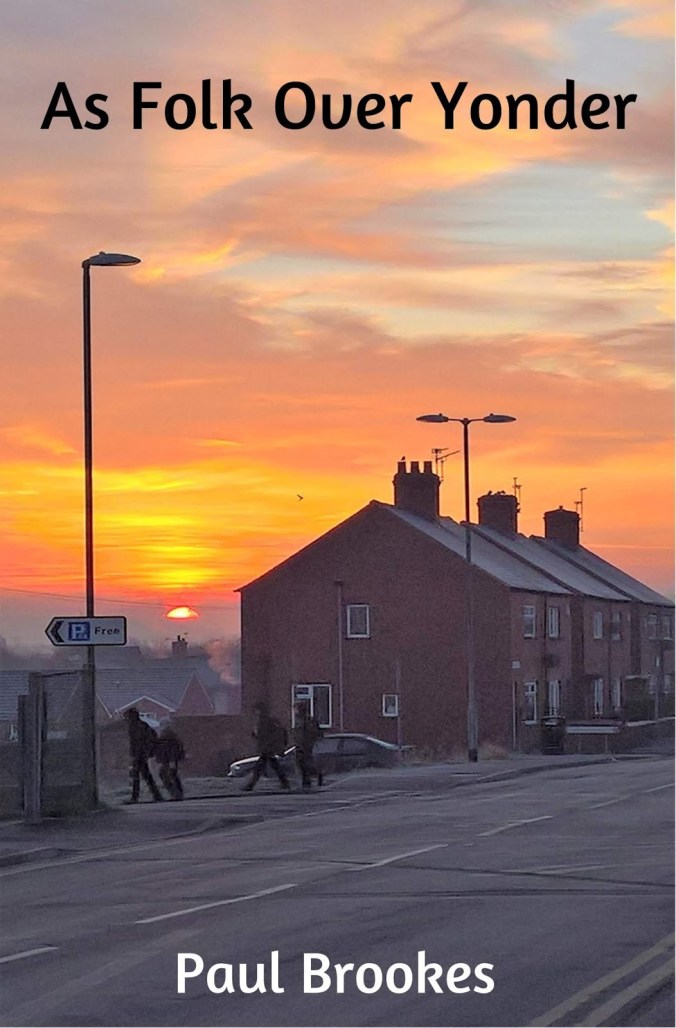
 https://www.afterworldbook.com/2019/08/as-folk-over-yonder.html
Year: 2019
Wombwell Rainbow Interviews: Steve Nash
Wombwell Rainbow Interviews
I am honoured and privileged that the following writers local, national and international have agreed to be interviewed by me. I gave the writers two options: an emailed list of questions or a more fluid interview via messenger.
The usual ground is covered about motivation, daily routines and work ethic, but some surprises too. Some of these poets you may know, others may be new to you. I hope you enjoy the experience as much as I do.


Dr Steve Nash
is a writer, lecturer, and musician from Yorkshire. He won the 2014 Saboteur Award for Best Spoken Word Performer from a shortlist that included Kate Tempest and Hollie McNish, and his first collection, Taking the Long Way Home, is available from Stairwell Books. Steve’s pamphlet The Calder Valley Codex, was released in 2016 and has now sold out, with copies only available in libraries. His most recent collections are Myth Gatherers and Taking The Long Way Home.
You can find him on Twitter @stevenashyorks or https://www.stevenashwrites.com/
The Interview
1. What inspired you to write poetry?
Originally I think it was something I got interested in at school and it never really left me. Even when I got a little older and started writing music, it’s clear looking back that the lyrics were all part of that same interest in words and what they have the potential to do.
2. Who introduced you to poetry?
I don’t know if this was the first person to introduce me to it, but a school teacher I had made a massive dramatic deal out of poetry. We were given very special notebooks that we were only allowed to write in once a month. We had to plan and draft, and edit a poem – one poem per month – and then once it was absolutely finished, we were allowed to write them up as neatly as possible into the notebook (and even then, only in pencil in case we made a mistake). It’s strange because now I find all the pompousness that can be ascribed to such things really off-putting, but it certainly had the desired effect on my wee young brain.
3. How aware were you of the dominating presence of older poets?
I’m not sure I was ever aware of a dominating presence. I did have a habit of seeing their names just as names though. Like they were something mythological and not real people. I have continually been staggered by the down-to-earth nature of the vast majority of established poets I’ve met, and their willingness to give advice, even to hyperactive weirdo like me.
4. What is your daily writing routine?
Due to the rather chaotic nature of my work life, there’s no real opportunity to designate any kind of routine in terms of setting aside a particular time to write. I try to make sure I’ve always got a couple of projects on the go though, so I have somewhere to focus my energies while I’m wandering around, and I always have a notebook with me. So, I guess, rather than a routine, it’s a sustained attempt to keep open to any ideas or sparks that might whip by.
5. What motivates you to write?
This is something I’ve often wondered myself. There are extreme moments that come along in life that of course give you the urge to reach for a pen to, in some small way, respond to or manage the emotions or concerns that are shaken up. Honestly though, it is just something I have always done, for as long as I can remember. I wrote terrible stories that I’d make my older sisters or my parents read when I was a child, and it’s an urge that has morphed over the years but never really gone away. At present I’m writing because I’m lucky enough to have a couple of places want to publish more collections of my work, so I’m highly motivated to get some shiny new stuff ready for those.
6. What is your work ethic?
My work ethic is to push myself to try to write something every day, even if it’s not an actual poem, story, or contribution to a larger narrative. Sometimes it can be lists, sometimes gibberish, but something. These little word doodles, or broken bits of lines help to keep me focused on those projects so they don’t fall too far into the distance, and I’ll often find they can provide me with answers when I’m struggling to complete a line or paragraph elsewhere.
7. How do the writers you read when you were young influence you today?
Probably more acutely than I realise. I remember we had an enormous collection of the old Point Horror novels when I was young, and I thought they were the coolest thing in the world. I remember being looked at as a bit of a weirdo by some kids at school because I was always reading about vampires, ghosts, murderers, and werewolves, but I do now still get described as being slightly obsessed with the macabre and horror themes. In addition to that some of my favourite poems and stories from when I was really young would still be in my list of favourite books now. ‘Oh the Places You’ll Go’ by Dr Seuss is still in my mind an absolute tour de force of a poem, and stories like ‘Not Now Bernard’ or ‘Where the Wild Things Are’ still seem to me remarkable works of imagination.
8. Who of today’s writers do you admire the most and why?
There are so many that I almost don’t want to answer for fear of the inevitable leaving someone out. That being said, Helen Mort is a writer who repeatedly and consistently breaks me with her ability to craft words and stories in startling but grounded ways. I cannot wait to read her debut novel. I’m currently reading Zaffar Kunial’s ‘Us’ and it really is a remarkable piece of work. He’s lives locally and by all accounts is a super lovely chap, but my anxiety and lack of faith in my own status as a real human being has always made me too afraid to actually chat to him properly. I’m really fortunate to be able to call some of my favourite contemporary writers friends, such as Helen, but also Oz Hardwick, John Foggin, Kate Fox, Gen Walsh, and so many others. These are all huge inspirations to me.
9. Why do you write?
I’ve never known why, but I just have for as long as I can remember. I suppose now it’s because it has become my way of engaging with the world in a way that makes sense to me. I’ve always been better with words than with any other medium, and being an awkward sort of guy, the ability to think about and shape what I say before it just comes galloping out of my mouth in a messy scattered way (no seriously you should ask my students) is a real gift.
10. What would you say to someone who asked you “How do you become a writer?”
I would say – you take this pen and you take this paper and away you go. I know that’s a really facetious answer, but it’s true isn’t it? What is stopping anyone becoming a writer? Becoming a writer worth reading I guess would be the trickier part, and I genuinely don’t know if I would put myself in the category (yet), but read others’ writing, listen to criticism, be open to ideas, and never believe that your way is the only way of doing something. Equally, if anyone ever tells you there is one single right way to write a poem, a story, a screenplay, whatever it might be, ignore them. Read widely, see what interests you, but be yourself. Write the things that only YOU could write.
And don’t let anyone stop you.
11. Tell me about the writing projects you have on at the moment.
I am working on a children’s poetry collection (mostly about monsters, and spooky things), and I have the beginnings of a collaboration that I’m pretty excited about, but that one’s in the very early stages at the moment.
Wombwell Rainbow Interviews: Joanna Ingham
Wombwell Rainbow Interviews
I am honoured and privileged that the following writers local, national and international have agreed to be interviewed by me. I gave the writers two options: an emailed list of questions or a more fluid interview via messenger.
The usual ground is covered about motivation, daily routines and work ethic, but some surprises too. Some of these poets you may know, others may be new to you. I hope you enjoy the experience as much as I do.

Joanna Ingham
Her debut pamphlet Naming Bones was published by ignitionpress in 2019. Her poetry has been widely published in magazines including Ambit, Magma, The North, Under the Radar and BBC Wildlife. It has appeared in The Sunday Times and the anthology The Best British Poetry 2012. She has recently been awarded a Developing Your Creative Practice grant by Arts Council England. Joanna also writes fiction and is represented by Thérèse Coen at Hardman & Swainson.
Website: www.joannaingham.com
Pamphlet available to buy here: https://shop.brookes.ac.uk/product-catalogue/faculty-of-humanities-social-sciences/poetry-pamphlets/naming-bones-by-joanna-ingham
Twitter: @ingham_joanna
The Interview
1. What inspired you to write poetry?
The first poem I remember writing was about a kestrel I’d seen hovering by the side of a road. I wrote it at school and my teacher was very encouraging. The poem ended up framed in the headteacher’s office. I was about ten. A few years later I won a local poetry competition with a poem about a lion. So I’d say the natural world was what first inspired me, and it still does.
2. Who introduced you to poetry?
Mainly my school teachers. My parents took me to the theatre a lot and we had a CD of ‘the nation’s best-loved poems’, but they weren’t especially into poetry. When I was fifteen and I won the local poetry competition, an amazing woman called Mrs Bence-Jones contacted my grandfather and asked if I would like to join her poetry group. She was a landowner and minor aristocrat, lived in a manor house, and wrote poetry. She even had a cook. I started going to meetings, which began with a meal. The dining chairs had deer’s legs, complete with hooves, and the chair-backs were made of antlers. All the other participants were adults; an earnest older couple, a few bohemian middle-aged women, an ex-monk who took a shine to me, a man called Ivor who played the piano. Mrs Bence-Jones used to listen to our work lying on the floor. It sounds a little mad, but it was a very important experience for me. I realised that poetry wasn’t something just for school. Adults could care about it too. Poems took work, and discussion, and craft.
3. How aware were you of the dominating presence of older poets?
Through school I was certainly aware of older poets, mainly the classical canon. We studied the Metaphysicals and Romantics. I remember sitting in my room crying at Christina Rossetti and my favourite poem was probably ‘Ozymandias’. On holiday in Somerset I made my family read ‘The Ancient Mariner’ out loud with me after a visit to Coleridge’s house. I didn’t feel that the presence of these writers was dominating, though. I think my main concern was that my own life was far too unromantic and mundane to make me into a writer.
4. What is your daily writing routine?
I usually write during school hours, unless I’m working on a freelance project. When I’m writing fiction I sometimes feel compelled to go on writing into the evenings and weekends, and poems can grab me at any time too, but I try to be quite professional in my approach. If I write in the evenings I often can’t sleep. With fiction, when I’m into it, I just sit down and write until my alarm goes off reminding me to collect my daughter from school. Poetry is less predictable. Some days I’ll mainly edit existing work. Others, I’ll begin by reading poetry as a way into finding poems I want to write.
5. What motivates you to write?
I think I write mainly because it makes me happy. There’s nothing quite like the pleasure of finding just the right word, of expressing something with the perfect balance of simplicity and complexity. When my writing is going well and I’m lost in it, it actually makes my heart beat harder. Also, I’ve never coped very well with the passing of time, with change and loss. I think a lot of my writing comes from a desire to preserve people and places and moments. I take a lot of photographs for the same reason. Reading a poem that speaks to me makes me want to write.
6. What is your work ethic?
I come from a family of builders, shopkeepers and accountants, so one of my challenges as a writer is how to justify – to myself especially – that a different kind of work ethic is okay. That just making stuff up all day is a valid use of time and still counts as work. That money isn’t the only measure of success. I can sometimes get paralysed by self-doubt and anxiety, but generally I’m very focused. Sometimes I have to remind myself that reading and thinking are necessary and acceptable parts of my working day.
7. How do the writers you read when you were young influence you today?
I think that beauty is an important element in my writing and I suppose that lots of the classical writers I read when I was young were very conscious of beauty too. I think I’m still inspired by Plath’s intensity and Larkin’s melancholy. The passion of Edna St Vincent Millay. I mostly read contemporary poetry now, though. I guess it’s good to be most influenced by what’s going on in writing now.
8. Who of today’s writers do you admire the most and why?
There are so many, it’s hard to choose! I very much admire the way poets like Liz Berry, Rebecca Goss and Fiona Benson write about motherhood. I admire the wit and playfulness of poets like Suzannah Evans and Paul Stephenson. The wildness and sensitivity to nature of poets like Jacob Polley and Sean Hewitt. At the moment I’m reading and admiring Julia Webb, Mary Jean Chan and Jacqueline Saphra.
9. Why do you write, as opposed to doing anything else?
I’m generally a very creative person. I love sewing, photography, printmaking, gardening, interior design – anything crafty, really. Writing would always be my first choice, though. I suppose it’s because I love words and so they are my favourite medium. I feel most myself when I’m writing. Periodically, I decide that I should have done something sensible with my life like becoming a lawyer or an accountant. But those feelings never last for long! I’ve done lots of teaching creative writing, and I do enjoy that, but my desk and my own head are always the safest and most comfortable places to be.
10. What would you say to someone who asked you “How do you become a writer?”
I would tell them to write as much as possible and to read as much as possible, probably the other way around. I think it’s important to find a way to cope with rejection, to be patient and to resist regret. Part of me wishes that I could have had my first pamphlet published and written my first novel in my twenties instead of my forties – and maybe I could have done if I’d been from a different background, or been more confident – but sometimes things take their own time.
11. Tell me about the writing projects you have on at the moment.
I have recently received a Developing Your Creative Practice grant from Arts Council England to enable me to work towards a first poetry collection, mentored by Rebecca Goss. I am also embarking on my second novel for young people, about the friendship between girls. My pamphlet Naming Bones is available from ignitionpress.
Wombwell Rainbow Interviews: Benedicta Boamah
Wombwell Rainbow Interviews
I am honoured and privileged that the following writers local, national and international have agreed to be interviewed by me. I gave the writers two options: an emailed list of questions or a more fluid interview via messenger.
The usual ground is covered about motivation, daily routines and work ethic, but some surprises too. Some of these poets you may know, others may be new to you. I hope you enjoy the experience as much as I do.
Benedicta Boamah
is a skilled nurse in emergency cases who writes poetry during her leisure periods. She is the fourth and last child of her parents who was born in Bloemfontein, Free State on 20th November but completed her higher education in Ghana as a professional nurse at Garden City University College. She’s so proud to be a unique writer which was built during her basic education at junior high school in reading out her manifesto after she got selected as the senior prefect. She currently has her personal blog (https://bbvintagepoetry.wordpress.com/) and is determined to continue writing to the fullest.
The Interview
1. What inspired you to write poetry?
I got inspired to write poetry through various novels that I read whilst growing up as a young adult. Glancing through the pages by each author brought some sense of unique style and words which helped me in picking up vocabulary.
It also came as an in-built outpour of the heart, soul and mind as a result of the hardships that I passed through in life and the dents that it left behind.
2. Who introduced you to poetry?
I must say that no one did the introduction; I did my own write-ups and gradually gained confidence in presenting one of my poems during a world health day activity held at my old workplace. It added up to us winning a trophy and that is how it started.
3. How aware were you of the dominating presence of older poets?
With regards to dominating older poets I’m already aware that there were pacesetters in the poetry industry which became a stepping stone for emerging poets to follow suit. Experience is said to be the best teacher.
4. What is your daily writing routine?
I write mostly early in the mornings when I wake up based on whatever comes into mind. I don’t have an exact consistent pattern it changes most of the times.
5. What motivates you to write?
I get motivated to write more poetry by what I read from already established poets which encourages me to do better. The stages and ordeals that I passed through in life gave me an inner will power to bring
out the best in me and voice it out.
6. What is your work ethic?
My work ethic is to stay focused & principled in all that I write as well as avoid plagiarism.
7. How do writers you read when you were young influence you today?
Well these writers paved a way through my heart by their artistic style of writing and how they were able to bring out literally meanings in their novels, journals and abridged books.
8. Who of today’s writers do you admire the most and why?
Sidney Sheldon is one of the writers I admire the most especially with his book that he came out with “if tomorrow comes’’ I cried when I read this book but I really learnt a lot from it. Even though he isn’t alive but part of the 20th century writers; his novels had a captivating suspense about the major happenings encountered in life. His writing construct kept you reading without placing the book down and I used to read his books with one of my favorite teachers.
9. Why do you write as opposed to doing anything else?
I have that inner desire of writing the least detail that comes to mind because it’s my passion and inner tenacity to write for my readers to select essential facts from it or enjoy every bit of what is read.
10. What would you say to someone who asked you “How do you become a writer?’’
I’d say it depends on your zeal and whether if you have the passion for writing. It all starts from within: what your aspirations are towards writing and whether if you are equipped to always reveal your writing skills.
11. Tell me about the writing projects you have on at the moment?
I’m currently working on ‘Tales of an Elegant Woman’ and ‘A Weeping Soul’ which will come as mini novels very soon. I’m as well working on daily and monthly poetry write-ups on my personal blog on word press, twitter and others. I have made quite a number of submissions to Black Bough Poetry, the BeZine, Haiku Dialogue, Bristol Museum & Arts, the London Magazine and a whole lot more.
Wombwell Rainbow Interviews: Mela Blust
Wombwell Rainbow Interviews
I am honoured and privileged that the following writers local, national and international have agreed to be interviewed by me. I gave the writers two options: an emailed list of questions or a more fluid interview via messenger.
The usual ground is covered about motivation, daily routines and work ethic, but some surprises too. Some of these poets you may know, others may be new to you. I hope you enjoy the experience as much as I do.
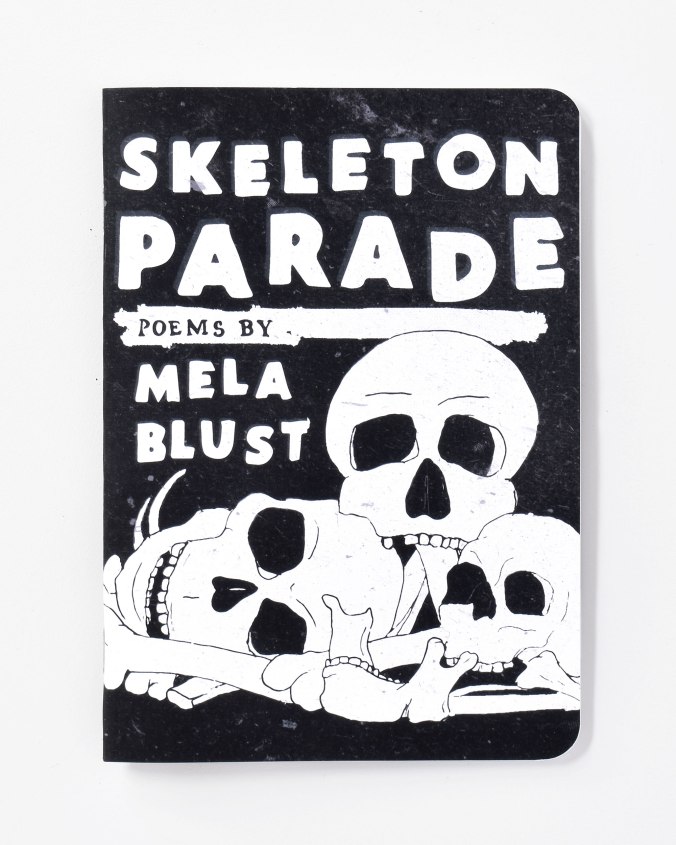
Mela Blust
(according to her website) is a moonchild, and has always had an affinity for the darkness. She is a poet, a painter, a sculptor, and a jeweler. She has been writing poetry since she was a child.
Her work has appeared in The Bitter Oleander, Isacoustic, Rust+Moth, Anti Heroin Chic, Califragile, Tilde Journal, Setu Magazine, Rhythm & Bones Lit, and more, and is forthcoming in The Nassau Review, The Sierra Nevada Review, and The Stray Branch, among others.
Her debut poetry collection, Skeleton Parade, is available now at Apep Publications .
She is the social media coordinator for Animal Heart Press, as well as a poetry reader for The Rise Up Review.
She can be followed at https://twitter.com/melablust.
The Interview
What inspired you to write poetry?
I truly do not know. I never thought to myself, “Oh, I’d like to write poetry.” It just happened, somewhat organically. I started writing at a very young age, six or seven. And then upon seeing my writing, my mother shared that she, and my grandmother, had always written poetry. My daughter, who is now 8, wrote her first poem about a year ago. I’m concerned that it may be genetic.
2. Who introduced you to poetry?
I suppose my formal introduction was my family. And books. We had a library in our home, growing up. Whenever a school or anyone gave away encyclopedias or textbooks, my father would go get them and bring them home. I read constantly.
3. How aware were you of the dominating presence of older poets?
That hasn’t been my experience at all. I have received nothing but kindness and support, from old and young alike. I hope to give that back.
4. What is your daily writing routine?
Haha, I don’t have one. I try to devote at least an hour each evening to poetry, but not always writing. Sometimes just reading. I have often said that I do not write poetry, it writes me. The muse strikes when it wants to, I don’t get much of a choice.
5. What motivates you to write?
Profound emotion. Sadness, the darkness of humanity, suffering,and sometimes, although rarely, love.
6. What is your work ethic?
I would hardly call this work. It is a privilege I am wholly grateful for. I tend to make lists and check things off, in between bouts of largely ignoring my writing.
7. How do the writers you read when you were young influence you today?
They don’t, anymore. I am far more interested in what the writers and poets of today have to say.
8. Who of today’s writers do you admire the most and why?
Oh wow, this question is tough. It is very difficult to limit, as there are so many. But I would say Ilya Kaminsky, Camonghe Felix, Kai Coggin, Hanif Abdurraqib, Danez Smith, Jericho Brown, Ross Gay. Because they are saying things that need to be said, and need to be heard. Because their writing is, enviably, so beyond the scope of the self.
9. Why do you write, as opposed to doing anything else?
I do not write as opposed to doing anything else. I do everything. I write, paint, sculpt, collage, make jewelry, and garden. I never want to stop learning. But I would say that I write because I have to. There are things in me that need to be unearthed.
10. What would you say to someone who asked you “How do you become a writer?”
I hardly feel qualified to answer this, but I suppose I would just say that there is no such thing as a dumb question. I found writers online and asked them for advice, and I was endlessly welcomed and guided. And now here I am.
11. Tell me about the writing projects you have on at the moment.
Skeleton Parade is available now through Apep Publications.
On Fiction Wombwell Rainbow Interviews: Caroline Ailanthus
On Fiction Wombwell Rainbow Interviews
I am honoured and privileged that the following writers local, national and international have agreed to be interviewed by me. I gave the writers two options: an emailed list of questions or a more fluid interview via messenger.
The usual ground is covered about motivation, daily routines and work ethic, but some surprises too. Some of these poets you may know, others may be new to you. I hope you enjoy the experience as much as I do.

Caroline Ailanthus
is a science writer; from blogging about climate change and editing scientific papers to her meticulously-researched fiction, her projects blend science and story. She grew up in Delaware and attended various small, odd schools, mostly in New England. She now travels often, but usually lives in Maryland with her husband and assorted animals.
Caroline has a BA in Environmental Leadership and an MS in Environmental Studies. When not writing fiction or walking her beagles, she works as a free-lance writer and editor. She is the author of two novels and three blogs, and her short non-fiction, and occasionally her short fiction, has appeared in multiple publications, including Pangaia,
Caroline has a BA in Environmental Leadership and an MS in Environmental Studies. When not writing fiction or walking her beagles, she works as a free-lance writer and editor. She is the author of two novels and three blogs, and her short non-fiction, and occasionally her short fiction, has appeared in multiple publications, including Pangaia,
Dreamstreets, and Appalachia, among others.
Links
Climate in Emergency (blog) (https://climateinemergency.wordpress.com/)
News From Caroline (blog) (https://newsfromcaroline.wordpress.com/)
School with No Name (blog) (https://schoolwithnoname.blogspot.com/)
Ecological Memory (novel; both print and ebook editions)
To Give a Rose (novel; both print and ebook editions) (https://www.amazon.com/Give-Rose-Caroline-Ailanthus/dp/1628061219/ref=sr_1_2?keywords=Caroline+Ailanthus&qid=1567799899&s=books&sr=1-2)
The Interview
1. What inspired you to write fiction?
I don’t know. I can’t remember ever not creating stories, even before I could write.
2. Who introduced you to reading fiction?
My parents; they read to me a lot when I was a kid.
3. What is your daily writing routine?
When I don’t have anything else pressing, I write (or sometimes waste time on Facebook). It’s not a routine; it’s a default option.
5. What motivates you to write?
The people in my head knocking to get out….Seriously, I make up stuff all the time, and if I don’t share it somehow I don’t feel right.
6. What is your work ethic?
In some ways I have a very strong work ethic, but I have trouble focusing. I have to maintain a lot of projects because I need to switch gears often.
7. How do the writers you read when you were young influence you today?
Certainly they give me a sense of what good writing is supposed to look like. Sometimes I notice more obvious inspiration, vague similarities between what I write and certain things I have read. And Ursula K. LeGuin is a personal hero of long standing, and I still go back to her work often to see how she did things, like the equivalent of studying the brush strokes of a master.
8. Who of today’s writers do you admire the most and why?
I don’t know what you mean. Does someone have to be currently alive to count as a writer of today, or do you just mean not someone from the 1800s? Does LeGuin count? There are a lot of living writers whose work I really like, but none are currently literary heroes of mine. There are also living people I greatly admire and who write, but that’s not exactly what I admire them for.
9. What would you say to someone who asked you “How do you become a writer?”
I’d say “by writing.” That’s really all it takes. To become an excellent writer, write A LOT and always seek to be better. Don’t ever think you’re good enough. Read a lot—talking to younger writers, I’ve realized there is so much I know about writing and almost take for granted because I learned it by accident while reading. Also get other people to edit your work; the value of a ruthless editor whom you trust absolutely cannot be over-stated. You will not get better beyond a certain point unless someone shows you where you need to improve. You won’t see it on your own.
It’s not that I see natural talent as unimportant, but it’s presence or absence is irrelevant to the writer—because no matter how talented you are, you still need to work to get better, and no matter how untalented you may be, you can still get better with work. So the question is never “Am I good enough to be a writer,” but, rather, “Do I want to write?”
Also, learn not to take your writing personally. If someone says it’s good, they don’t mean you’re good. If someone says it’s crap, they don’t mean you’re crap. If you can’t grasp that on a deep, fundamental level, you won’t be able to benefit from a ruthless editor, and you won’t reach your potential. Learning to grin and bear criticism isn’t enough—if you feel like your writing is you but just decide to let people criticize you, you’ll leave yourself vulnerable to abusive jackasses. You need to know the difference between you and your work, because real friends tell you to improve the latter, not the former.
How to earn a living writing? That’s a related question, and the answer changes over time. Decades ago, you could do it by writing short fiction for magazines while you tried to convince a big publishing house to give you a nice, fat advance for your next novel. That’s why we have such wonderful short fiction by the old greats, like Kurt Vonnegut Jr. and Ernest Hemingway. But magazines have switched to non-fiction, for the most part, and publishers seldom offer much marketing support any more—so getting published is just the beginning of figuring out how to sell your work, not the end. Many writers these days pay the bills with a combination of free-lance writing (mostly web content) and editing. Writing books loses money for many people, but we do it anyway because we must. It’s a pretty dark time for writers, frankly.
11. Tell me about the writing projects you have on at the moment.
I have two novels published, and several more on the way. My first book, To Give a Rose, is about a community of proto-human ape-like beings (australopithecines) and a modern human woman studying their bones. The two timelines interact and comment on each other thematically. Ten years of research went into creating a plausible vision of the African Pliocene and the australopithecine mind. There may someday be a sequel or two, but I’m currently focused on sequels for my second book, Ecological Memory.
Ecological Memory is part post-apocalyptic travelogue, part scientific detective story. It’s not a dystopia—my view of the world after the collapse of civilization is distinctly optimistic—but the central theme I ended up exploring is resilience in the face of loss. That’s what “ecological memory” means. It’s a technical term for the capacity of an ecosystem to regrow. In the story, ecosystems are indeed regrowing, but so are the human survivors—rather imperfectly. The book is the first in a series, but each book in the series will be able to stand on its own.
I also have various free-lance jobs going (care to hire me?) and I maintain three blogs. News From Caroline is about my work and the craft of writing. Climate in Emergency is about various aspects of climate change, from politics to science. School with No Name is the serialized first draft of a group of novels about an Earth-centered spiritual community. It’s an interesting project, writing a first draft in public like this, not really knowing what I’m going to write until I write it!
On a million nights like this
Cracking poem from Ian Parks


Noir
Ian Parks
The plot is complicated
but all its tangled threads
have found their resolution here.
The end is all we need to know.
It’s midnight on the waterfront
and all the ships have loaded up
their cargoes and have gone.
The hotel lights are lit:
a hundred rooms with a hundred beds
identical with blinds.
An interface of fire-escapes
supports it from outside.
A bright façade distracts us
from the narrow alleyways
where trash cans spill their overflow
and rats search out a meal.
Somewhere a storm is gathering.
Out there in Hudson Bay
it swirls unseen, unnoticed.
The city streets absorb it
for a moment then let loose
a sudden lethal downpour
that shimmers in the heat
and bounces off the sidewalk
where she steps purposeful, intent.
All we know about her are her heels,
her black silk stockings with…
View original post 528 more words
Wombwell Rainbow Interviews: Gary Barwin
Wombwell Rainbow Interviews
I am honoured and privileged that the following writers local, national and international have agreed to be interviewed by me. I gave the writers two options: an emailed list of questions or a more fluid interview via messenger.
The usual ground is covered about motivation, daily routines and work ethic, but some surprises too. Some of these poets you may know, others may be new to you. I hope you enjoy the experience as much as I do.


Gary Barwin
is a writer, composer, and multidisciplinary artist and the author of twenty-one books of poetry, fiction and books for children. His latest book is the poetry collection No TV for Woodpeckers (Wolsak & Wynn). His recent national bestselling novel Yiddish for Pirates (Random House Canada) won the Stephen Leacock Medal for Humour as well as the Canadian Jewish Literary Award (FIction) and the Hamilton Literary Award (Fiction). It was also a finalist for both the Governor General’s Award for Fiction and the Scotiabank Giller Prize. His interactive writing installation using old typewriters and guitar processors was featured during 2016-2017 at the Art Gallery of Hamilton. Forthcoming books include, A Cemetery for Holes, a poetry collaboration with Tom Prime (Gordon Hill Press, 2019) and For It is a Pleasure and a Surprise to Breathe: New and Selected Poems, ed. Alessandro Porco (Wolsak and Wynn, 2019.)
A finalist for the National Magazine Awards (Poetry), he is a three-time recipient of Hamilton Poetry Book of the Year, has also received the Hamilton Arts Award for Literature and has co-won the bpNichol Chapbook Award and the K.M. Hunter Arts Award. He was one of the judges for the 2017 CBC Poetry Prize.
A PhD in music composition, Barwin has been Writer-in-Residence at Western University, McMaster University and the Hamilton Public Library, Hillfield Strathallan College, and Young Voices E-Writer-in-Residence at the Toronto Public Library. He will be Edna Staebler writer-in-residence at Wilfrid Laurier University in Winter 2019. He has taught creative writing at a number of colleges and universities and currently teaches writing to at-risk youth in Hamilton through the ArtForms program. His writing has been published in hundreds of magazine and journals internationally—from Readers Digest to Granta and Poetry to the Walrus—and his writing, music, media works and visuals have been presented and broadcast internationally. Though born in Northern Ireland to South African parents of Ashenazi descent, Barwin lives in Hamilton, Ontario. He is married with three adult children and lives in Hamilton, Ontario and has never been Governor of Louisiana. garybarwin.com
The Interview
1. When and why did you start writing poetry?
The first poem I remember writing was written on filing cards. I was smitten by the way the cards seemed to belong in the world and how they fit in their little filing card box. I had heard of “rosewood.” My parents had furniture made of rosewood. I assumed, however, that rosewood meant the wood from a rose plant and so I found a small stub of dried rose vine and brought it to my bedroom. I was perhaps 8. I wrote an incantation for the rose wood. The wood seems druidical. Magic. Elemental. And so what I wrote was not English, but numinous, potent sounds. I remember writing it in Roman script but highly stylized and with diacritics. This idea of the immanence of things, of language as an invocation, as an object in itself, made of the elements of the world but rearranged into something different, something that allowed a deep engagement with thought, a sense of things, tactility, pataphysics and a sense of being a particular time and place while being highly conceptual was formative to me.
2. Who introduced you to poetry?
I was introduced to poetry in waves. When I was young, I recall going to synagogue and hearing the chanted prayers in Hebrew which I didn’t understand but being captivated by its allusive and inscrutable beautiful. I remember Mr. Calvert, my P.5 teacher in Inch Marlo school in Northern Ireland reading us Robert Service. There were the often cosy and mythic words of hymns and Christmas carols. “Without a city wall.” Not not having a wall around the city, but outside. Then my parents had copies of Seamus Heaney in the house. And various poetry anthologies. And once I stole a complete Shakespeare from someone whose kids I was babysitting when I was 13. And then I went to an arts boarding school where my roommate, Jay Frost, would recite The Waste Land—from memory. And we had poetry workshops with guest writers, such as Robert Bly, Mark Strand and Etheridge Knight. I was surrounded by this poetry. And finally, I attended York University where my little Seamus Heaney-limited poetic world, my “eye clear as the bleb of icicle” was blown open by studying with bpNichol. Poetry as curiosity, as investigation, as an appreciation and exploration of the materials of language and their possibilities.
3. How aware are and were you of the dominating presence of older poets traditional and contemporary?
“Dominating” is interesting. Just like a word doesn’t function as a word without other words, without past and current uses of words, I don’t think poems (or poets) can either. We write and read in the context of other work. So, I don’t think of being dominated, rather as existing in a poetic ecosystem. I came to writing and I have stayed here by experiencing other writing and also language. So reading and listening comes before writing. And in fact, writing is a form of reading and listening. In one eye or ear and out the fingers as writing. Some processing may be involved. Other writers have made me aware of what is possible, what ways language can be explored, how it can be taken apart and put together differently, how I can follow the myriad forces that it embodies, how it can be used as a tool to explore, a vehicle to ride. All of which helps me spelunk the human, the non-human, the world, the linguistic and the non-linguistic both.
4. What is your daily writing routine?
This changes depending on what I’m working on, however, distraction and diversion are a standard part of my routine. I often start by avoiding a project and instead creating a visual piece—lately, works exploring the ampersand—or a poem based perhaps on a whim or something I tumble onto on social media. I’ve been working on a novel for the last year and a half and so my goal for my daily minimum is 500 words. I write until I’ve written 500 words. Often this includes figuring out what is going to happen in those 500 words as I don’t write from a premeditated plan, except in a very general sense. In order to keep motivated, I keep a chart of words written compared to words projected (i.e. if I actually wrote 500 words five days a week vs. what I actually managed to write.) Sometimes I write more than the 500, sometimes less, or, more likely, I have something else to do that day and so don’t manage to work on the novel at all, except in my head. Some days, I schedule time to work on collaboration. These days, I’m writing a poem or two once a week with Tom Prime. We Skype each other and open up a Google doc. Then we write. I like the idea of writing as dialogue and so work often emerges from interactions on social media, riffing off an image, a phrase, a discussion, or some other writing that I encounter.
I like the energy of the impulse or the distraction. Sometimes it’s fuelled by nervousness or uncertainty about the project that I’m “supposed” to be working on. But I’m ok with channelling that into something else, knowing that I’m getting work out of it. Of course, at some point, I have to confront the procrastination, and buckle down and actually work on the main project, otherwise it won’t get done. The other good thing about distraction is that one can be surprised by a sudden confluence of ideas or inputs and connect things or write in a way that enables something unexpected to occur.
5. What motivates you to write?
This seems like a very simple question, however, it isn’t so easy to answer. Certainly, my writing comes from curiosity. I am intrigued to explore what is possible—what is possible in language, in writing. What it is possible to say. Where the language might guide me, what it might draw out of me, what it might draw out of itself through my engagement. There is something about communication. About connection or engaging with people (readers) — the impulse for interaction. There is something elemental, something fundamental, somatic, about the act of making. Writing is about exploring writing, but also about exploring the world and the act of writing. About exploring the writing self and the self writing. And also, I want to be so rich I can buy all the letters of the alphabet, bronze them in solid gold and then, when the sun is bright, signal to it with its own light.
6. How do the writers you read when you were young influence you today?
I am young. At least when compared to English. Or a rock. Or that obscure jarred thing in the back of my fridge. But I am always reminded of the elemental and preternatural power of language—and of poetry specifically—of its ability to be a trickster, a Rorschach test, a finger in a socket, a consoler, debunker, debater, songster, and seducer, and how, even though my knowledge was limited, I immediately got the sense of what might be possible. And so with the writers that I read in the past. From Spike Milligan and Ogden Nash to Wordsworth, Heaney, Ferlinghetti, Ginsberg, Trakl and so on, to religious texts (the Jewish translations direct from Hebrew as well as King James and the others.) I have the sense, as I did with reading poets when I was young, that there was more just around the.corner: more confusion, more understanding, more meaning, less meaning, more technique, more chances.
7. Who of today’s writers do you admire the most and why?
The way your question is phrased is interesting. You ask about which “writers” I most admire rather what “writing” and so it leads me to think about what are qualities that I value in a writer. Passing over the issue of what happens when the work is good, but the writer is perhaps ethically or morally compromised in some way, I do think about what it is to be a writer in society, what it is to be a writer in community and (to paraphrase Sheila Heti) “How should a writer be?” and what does creativity look like.
I admire writers who mentor, support and build community. But I also admire those who are able to forge their own paths and remain true to their values both aesthetically and politically even if that leads them to pursue an individual path, perhaps one not comfortable with the prevailing fashion. Of course, this only makes sense to me if they are sensitive, thoughtful listeners who consider how large-scale historical, political and systemic issues shape aesthetics and the writer’s life and opinions and continually check in to ensure that they haven’t gone astray or been seduced by their own solipsism into thinking that their view is the only authentic one. And here I’m making a distinction between “fashion” and “developed contemporary understanding.” A writer and their writing can’t exist outside of the systemic influences on them and the culture, whether legible to them or not, but they can write outside of the prevailing fashion or taste.
I also consider the kind of writer who is curious about everything and explores many creative avenues—perhaps different forms, media, aesthetics and so on. I tend to be like this, creating music, art, poetry and fiction, using digital and analogue means, exploring both more lyric as well as more experimental approaches, creating, performing, exhibiting, publishing in a wide variety of ways. The other type of writer is one who hones their craft to an almost laser-like concentration, working within one approach or aesthetic. Samuel Beckett was like this. He spent his life focussing his work more and more acutely, stripping away everything extraneous to the essential vision.
I’m hesitant to begin naming who I “most” admire. I resist hierarchies and ranking as too fraught. But since I had a conversation yesterday about her yesterday, I will say that I follow Kai Cheng Thom’s online presence with great respect. She is thoughtful, articulate, earnest, compassionate and willing to consider positions with great insight, even if they reevaluate what may appear to be the consensus opinion or approach.
8. What would you say to someone who asked you “How do you become a writer?”
For me, a writer is someone who writes. So, regardless of who you are, if you write, you are a writer. I believe everyone can be a writer. Everyone can have a particular and personal relationship to language, whether spoken or written. Becoming a good writer involves reading a lot, trying many things, really thinking through what you’ve written and what it is doing. Considering what assumptions you’ve made about what the writing should be, or things you haven’t considered? So, becoming a writer involves reading and thinking intently. Others’ work. One’s own.
One of the hardest things is to write what you actually want to write rather than what you think you should write. Well, that and seeing what is actually going on in the writing one is doing. And keeping going. Because becoming a writer involves keeping doing it. I feel that it is important to keep writing. That’s how one becomes a better writer. But it is important to keep pushing, to try to see more of what is possible, to try to learn to make one’s writing more resonant, or to contain more, if not multitudes then multivalences or multiverses. Tumult or mulch. Unless you’re a born genius like Rimbaud, I feel the difference between the path of someone who writes and someone who learns to make really good writing is that for the good writer it isn’t about being a writer, but about really trying to make the writing the best it can be, to learn to really read the work in front of you and edit or develop it so that it truly is the best it can be. For me, becoming a writer is about learning to really be attuned to your creative process, and also about really trusting the writing and, like a dowser, learning to see how it pulls you, learning to sense the subterranean before you, learning to be attuned to the language and where it wants to take you. And to keep learning to follow it more places, to be more keenly attuned to it. It is a kind of dance—the language leads you, sometimes without you even realizing it, and you follow it, waltzing or polkaing around the dance floor. I know this sounds like I’m Yoda, and I’m saying, “Follow the Force.” But I guess I am. Though I have more restrained ears and a better barber. And I’m (usually) less green.
9. Tell me about the writing projects you have on at the moment.
I have many specific projects that I am working on, but I also relish the opportunity to explore a whim or particular inspiration and create something on the spur of the moment. Sometimes these get folded into a larger project and sometime they exist as confounding outliers. I am an advocate of allowing the moment to suggest something to you. Often this results in creating something fresh and surprising, something which subverts your usual expectations of what it is that you do.
The main project that I’m working on is a novel, Nothing the Same, Everything Haunted. It is a Wild West Holocaust novel set in 1941 Lithuania. My protagonist is a Don Quixote-type middle-aged Litvak who imagines himself a cowboy. It makes connections between the Holocaust and North American Indigenous genocide via the Western novels of Karl May. Also, my protagonist is looking for his testicles which became frozen in a Swiss glacier after being shot off 20 years before. It’s scheduled to come out in 2021. I’m also writing a new book of collaborations with Tom Prime (we’ve just published our first one, A Cemetery for Holes). A chapbook of prose poems with Kathryn Mockler will appear next year as will a collection of ekphrastic works I created with the artist Donna Szoke. I’m also working on a big public art piece about persecution and refugees with Tor Lukasik-Foss and Simon Frank for a park in Hamilton. (I’ve never worked in bronze before!) I’m working on a collection of my ampersand-based visual poems and finishing a book and recording with Gregory Betts and Lillian Allen. Greg and I are also part of the band TZT and will be releasing a recording of sound poetry and sound works we did with a variety of sound poets.(We’re hoping for vinyl!) I’m also doing a collaboration with Shane Neilson involving hurricanes, naming and class photographs. I’m also working on a continuing poetic project of my own based on experimental translations of a variety of poems, from William Bronk and Rilke to Medieval poetry. It combines a kind of oblique lyricism with a variety of conceptual and experimental transformational practices. (Maybe that’s our life. Oblique lyricism and conceptual and experimental transformations.) Also, any minute now, my “New and Selected Poems” will come out with Wolsak & Wynn. And while writing this, I just got an email inviting me to create some visual poems out of scientific papers, something I’ve done before. It’s really intriguing to explore technical language and a very specific textual form (the scientific paper) about which I know nothing and is just on the border of intelligibility for me.
This kind of disorganized multidirectional chaos—this whole mess of projects—seems to work for me. Because, as they say, if it’s not one thing, it’s another.
Wombwell Rainbow Interviews: L. Austen Johnston
Wombwell Rainbow Interviews
I am honoured and privileged that the following writers local, national and international have agreed to be interviewed by me. I gave the writers two options: an emailed list of questions or a more fluid interview via messenger.
The usual ground is covered about motivation, daily routines and work ethic, but some surprises too. Some of these poets you may know, others may be new to you. I hope you enjoy the experience as much as I do.
L. Austen Johnston
a debut poet from Virginia and counts herself lucky to be from the lovers’ state. She studied English, Archaeology, and Astronomy in university, which may explain her love for stargazing and time traveling.
She’s an avid reader, a sometimes writer, and an attempter of various art projects. When she’s not in class, you can find her searching for animals to pet, singing off-key in the shower, and learning the art of making the perfect cup of tea.
Website: https://laustenjohnson.com/
Facebook: https://www.facebook.com/laustenjohnson/
Instagram: @girlfriendofbath
Tumblr: @laustenjohnson
Goodreads: https://www.goodreads.com/author/show/17578375.L_Austen_Johnson
Twitter: @laustenjohnson (but I don’t use it much
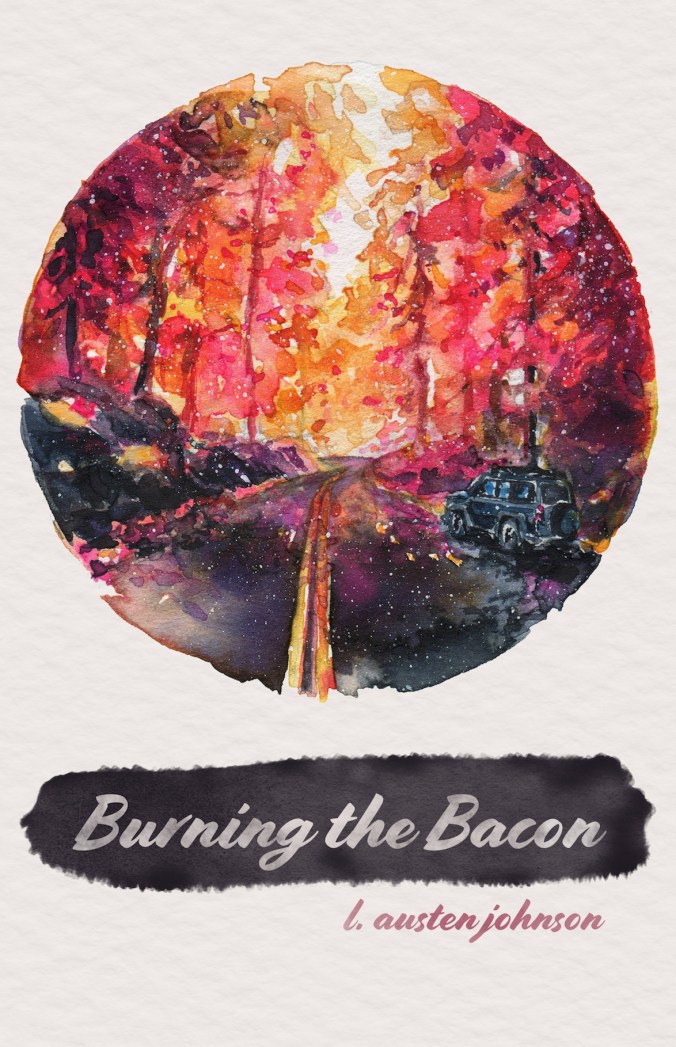
Link to book: https://www.amazon.com/Burning-Bacon-L-Austen-Johnson-ebook/dp/B07B6RDZ9G
The Interview
1. What inspired you to write poetry?
I started writing when I was in middle school and had no care for whether it was good. (May we all aspire to have a 12-year-old’s confidence in pursuing art.) I continued to write because I felt that I had to. Looking around the world and living in it seems to require some type of reflection. For me, poetry was the place where I could be overly dramatic, process emotion, take on a new character, or even just churn over a turn of phrase or two. I was not and am not always successful, but it’s fun to create images out of words and it’s heart-breaking and exciting and nerve-racking to read other people’s poetry as well.
2. Who introduced you to poetry?
I think the first time I actively tried to write poems, not just scribbling phrases and song lyrics in my diary, was in eighth grade after a teacher gave my class the freedom to do so. We read and wrote and read some more.
3. How aware were you of the dominating presence of older poets?
I ended up getting a Master’s in poetics, so now I definitely have an awareness of the Byrons, Wordworths, and Charles Wrights of the poetry world. I guess it would depend on what you mean by “dominating” and “older.” In academic settings, we’re usually studying writers who are dead—or maybe that’s just my course of study. In high school, I read Dickinson and Eliot, for example. But I think in daily life for most casual poetry readers, those types of authors are not that dominating. When I think “dominating” poets, I think Rupi Kaur, Lang Leav, Amanda Lovelace. I think of young women with a certain type of fanbase dominating book sales and charts and Instagram. I think I find the overabundance of both frustrating. I love me some old dead poetry: I’ve spent days reading Chaucer and Keats and the Brownings. But I recognize that they don’t represent everyone. Maybe people want less aristocracy and easier-to-read diction. Hence “pop poetry.” But now it’s kind of like unless you’re super academic or super relatable to the point of basically just writing good quotes, then you’re not a poetry that’s going to be liked. Maybe we could have something accessible and wordy? Something easy to read by not so easy that readers feel it’s all surface?
4. What is your daily writing routine?
Recently I haven’t been writing poetry as much. When I do, it’s usually a phrase that haunts me when I’m trying to fall asleep that I then have to jot down in Evernote before my brain will be quiet. Other times I just take a pen out and see what happens. Unfortunately, I’m not very routine. I admire those NaNoWriMo types who can set daily word limits, but that’s not what I’ve been doing.
5. What motivates you to write?
I once read “Atlantis: The Lost Sonnet” by Eavan Boland in high school, and my understanding of poetry changed. I started to try to unite the mythic, grandiose poetry (what I saw to be “official” and “historical”) with the personal (what I had been writing but saw to be only “modern” and “immature”). For me, I write to try to find a connection between personal experience and humanity’s experiences. I like using tiny details that should alienate a scene to actually make it feel closer to the reader. And finding how that all interacts is, I think, at the basis of why I write.
6. What is your work ethic?
I’m not quite sure how to answer this. In general? For writing specifically? I have many ideas and don’t always commit myself to bringing them to fruition. But, on the other hand, I have many interests that I dabble in and commit to, like designing book covers and doing marketing consulting and writing lyrics. If something interests me, I will work my very hardest on it. And if I commit to something, I’ll make sure I get it done.
7. How do the writers you read when you were young influence you today?
That one poem by Eavan Boland certainly influences me even though I read it at 15 or 16. I am still quite young (22), so I’m still being influenced. Some authors I read as a college student that influences me are Gwendolyn Brooks, Swinburne, and Yeats. Like many young writers, I had a stage where the confessionalists blew my mind. For me, the days of Plath and (not so much) Bukowski were late high school. I remember reading Plath and being shocked at the closeness and aggression in her poems. One poet I read around that same time was Clementine von Radics, who is a confessionalist, but one I prefer to Bukowski. Her work showed me how to write short, sweet, and to the point while still making it sound nice to the ear and without being too bare of rhetoric. I tried to write like her for a bit at 18 before coming more into my own voice.
8. Who of today’s writers do you admire the most and why?
I admire writers who can be direct and relatable while still being traditionally poetic. To that end, I really enjoyed Home and Other Place I’ve Yet to See by Daniel J Flore, III. And I’ve liked some of Neil Hilborn’s recent collections/performances, though I tend to enjoy written more than spoken pieces better (I can come back to them and digest them visually).
9. What would you say to someone who asked you “How do you become a writer?”
Write. That’s a cheeky comment, but really, if you write and it’s a defining part about you, you’re a writer. Now, to become a published writer, you have to write, edit, edit some more, think about how you want to arrange your pieces into a whole, and then submit to a publisher (or you can do it yourself, but that can be harder). The most important part to transition from being someone who writes for themselves and someone who writes for a (potential) reader to me is editing. Take it from Wordsworth, not me: “Poetry is the spontaneous overflow of powerful feelings: it takes its origin from emotion recollected in tranquility.” To get it good for an audience, you’ve got to master that “recollected in tranquility” part.
10. Tell me about the writing projects you have on at the moment.
I’ve been trying my hand at prose. I’m in the middle of writing a young adult fantasy book based on a Polish folk story called “Unburied Man.” It promises gods, gothic elements, and love. I’ve also started a screenplay about a girl with an ostomy bag navigating the trials and tribulations of high school. As someone with an invisible illness, I think it’s really important to think about how disability can present itself. Chronic illnesses can also change the stakes of some of what we deal with as young adults. Some of the tropes + themes that are normal in media for teens take on increased meaning (think pool parties, finding independence, feeling unsure in your own body). You can follow some updates on these on my tumblr or Instagram.
Wombwell Rainbow Interviews: Karen Jane Cannon
Wombwell Rainbow Interviews
I am honoured and privileged that the following writers local, national and international have agreed to be interviewed by me. I gave the writers two options: an emailed list of questions or a more fluid interview via messenger.
The usual ground is covered about motivation, daily routines and work ethic, but some surprises too. Some of these poets you may know, others may be new to you. I hope you enjoy the experience as much as I do.


Karen Jane Cannon
is a UK poet and author. Her poetry has been published widely in literary journals and anthologies in the UK and USA, including Acumen, Envoi, Mslexia, Orbis, Obsessed with Pipework, The Interpreter’s House, Ink, Sweat & Tears, and Popshot. She was a 2017 finalist in the Mslexia Poetry Competition and was commended for the Flambard Poetry Prize in 2014. Emergency Mints, her debut poetry pamphlet, was published in Spring 2018, by Paper Swans Press
Her novel Powder Monkey (as Karen Sainsbury) was published by Weidenfeld & Nicolson in 2002 and Phoenix in 2003.
Karen is also an award-winning radio playwright. She has an MA with distinction in Creative Writing from Bath Spa University, where she lectured for three years. She is a PhD Candidate at the University of Southampton. Karen is creator of Silent Voices: found poetry of lost women (https://silentvoicespoetry.wordpress.com/)
The Interview
1. What inspired you to write poetry?
I started writing poetry when I was very small and was encouraged enormously by various teachers. I entered competitions and read lots of poetry ‘how to’ guides. When I was studying English as an undergraduate, I suddenly became frustrated and frightened by poetry, lost the unselfconscious way of writing I’d had as a teenager—for two decades I didn’t have anything to do with poetry, became totally poetry-phobic. After having several articles published, I started writing radio plays and then a novel, but I felt I wasn’t really a storyteller—fiction seemed too contrived and unreal. I entered quite a bad depression. Felt I had lost my way as a writer and the only way out for me was through rediscovering poetry. I remember picking up Ted Hughes’ Moortown Diary and thinking poetry could be real and earthy and alive. I decided to try and be the thing that terrified me most—a poet! Or at least conquer my fear of it. Orbis published my first poem a year later. In 2017 I was delighted at being a finalist in the Mslexia Poetry Competition. This has really boosted my confidence.
2. Who introduced you to poetry?
I’m not sure. Maybe, I found out by myself, at the library when I was at primary school searching out Walter de la Mare and Kipling. Taking my MA in Creative Writing I was inspired by the work of Philip Gross who taught me for a semester—I really connected with The Wasting Game, but was still suspicious of poetry. Another tutor, Tracy Brain reintroduced me to Sylvia Plath via The Bell Jar, and her love for all things Plath was very contagious.
3. How aware were you of the dominating presence of older poets?
Writing poetry, you are always aware of walking in the footsteps of others. It’s normal for a poet to think, how do I get my voice heard? Why is my voice relevant? I think it’s either huge ego or that persuasive fluttering muse that makes you think your contribution is worthy. As a writer, you have to develop a thick skin and learn to do what makes you happy. Rejection is a healthy part of the writing process—the biggest thing that will make you stop and re-evaluate your work and seek to improve it. The Poetry World is hugely competitive.
Studying English at degree level, I became frustrated by the study of poetry—not being able to get a poem to immediately yield all its secrets. I remember very simplistically thinking, for example, why can’t a poem be just about blackberries?! Why does there have to be a whole subtext behind it? I was too immature to understand that this is the challenge of any piece of art. Every time you re-examine a text, you read something new into it—that’s what makes a reader return to it years later, why it stays in the head. Every text means something different to every reader. That’s the power and joy of poetry.
4. What is your daily writing routine?
I write daily, every morning, either on new work, editing or submitting. Creativity isn’t something you can control—new poems can magically pop up at any time and need writing down before they vanish. I am very organised when it comes to writing or studying. The rest of my life is somewhat haphazard.
5. What motivates you to write?
Above anything, I am a writer of place. From my first articles, to my plays, novel and poetry, I write landscape, both physical and emotional. That is what motivates me to write. I have always chosen to live in strange and fascinating places, from the second highest village in Scotland, to a village on the edge of Longleat Safari park, going to sleep each night to the sound of roaring lions and howling wolves. I was brought up a mile from the sea in Worthing, West Sussex, and spent much of my childhood either on the beach or on the beautiful South Downs. The sea, its dynamic movement and power, is a great source of inspiration for me. My first pamphlet, Emergency Mints (Paper Swans Press, 2017), is set on the south coast. Now I live in the magical New Forest National Park, a surprising wilderness in the heart of the south of England. The main themes running through my work are loss and motherhood—the two ends of the circle. I am fascinated by maps and boundaries—both real and imaginary—and the industrial footprint left in the landscape. These things all motivate me creatively, but I am motivated also by success and becoming a better poet.
6. What is your work ethic?
I have a hugely strong work ethic when it comes to creativity. I am a perpetual student—it’s important to me to improve and grow as a writer, to hopefully reach my potential. I am in the 2nd year of a part time PhD at the University of Southampton, researching poetry and place. It is a very stretching and rewarding experience. I am very focused. I don’t go on holidays—I go on research trips! My husband is very supportive—on our last ‘holiday’ we ended up down a stone quarry, because I wanted to write about it!
7. How do the writers you read when you were young influence you today?
That’s difficult to gauge. I write about the effects of industry on the landscape and its inhabitants and I wonder if Blake’s Songs of Experience—and the whole Romantic movement— influenced this. I remember being moved by these poems when I was a young teenager, the hopelessness and inevitability of change. Even childhood reading like Enid Blyton has shaped my connection to the countryside. I was obsessed with the War Poets when I was sixteen—maybe they influenced the themes of loss that always run through my work, the long connection between war and poetry is fascinating and paradoxical.
In reality, it was growing up in the 1970s that has influenced my writing more than anything else. The Seventies were a dismal decade to be a child—a time of dissatisfaction and misery. This was represented across popular culture—even sitcoms such as The Likely Lads and Butterflies portrayed an adult world of frustration and yearning. The lingering after-effects of the war, sexual revolution and political turmoil were frightening and unsettling. Nothing was stable—not even the concept of family—no one was happy. Everyone trapped by something—sex, class, respectability. But, ironically, it was all these things that made me become a writer. I rejected the restraints and limitations of the previous generation and chose my own path.
8. Who of today’s writers do you admire the most and why?
I have spent the last twelve months immersing myself in books on place—from Dorothy Wordsworth’s wonderfully rich journals and Nan Shepherd’s beautiful The Living Mountain, to Roger Deakin’s Waterlog and Wildwood. And of course, Alexandra Harris, Luke Turner, Richard Mabey, Philip Hoare and everything Robert MacFarlane writes! Groundwork, edited by Tim Dee, is an excellent introduction to the genre. These writers share the ability to conjure a place from the page with their knowledge and love for it. They create value. ‘Local’ doesn’t mean parochial, it reflects the whole. I am also interested in how different genders approach the writing of place.
I have also been reading a lot of ecopoetry—one approach to ecopoetry is of the close observation of place proposed by Linda Russo. This genre needs careful handling as it involves writing with intent, which is problematic. The Ground Aslant, edited by Harriet Tarlo, is an excellent example of how to get it right.
9. Why do you write, as opposed to doing anything else?
I have had ideas about doing other things, but I am only driven to write. I have other useable skills—ones that would pay better—but I have no heart for them. I think I may be quite lazy. As I said above, I have had plays produced and a book published. Poetry uses the least words! What I love about poetry is the journey it takes you on. I read a lot of fiction and I find so many authors only have the one brilliant book in them. Poets by contrast keep growing and expanding. That’s a huge draw to me. It’s rewarding.
10. What would you say to someone who asked you “How do you become a writer?”
I would say, to be a good writer, you have to be a good reader. To paraphrase Reynolds on art, you gather the pollen to create your own honey. Experiment. Be flexible—you may start off thinking you want to be a poet, but may discover you are an amazing playwright. See where writing takes you. Write with your heart and not with your head. And if you want to improve, get critical feedback. You are unlikely to get this from friends or family. They will either tell you your work is brilliant, or that it’s not their cup of tea! Constructive criticism is invaluable. The Poetry School offers fantastic courses for all levels. And, really importantly, read contemporary work if you want to see your work published—styles change!
11. Tell me about the writing projects you have on at the moment.
I am just finishing my second pamphlet, based around my experience of living 1400 feet up in the Lowther hills of Southern Scotland without electricity in an old leadminer’s cottage. I am working on two full collections—one set on the South coast and its industrial footprint, and a second more experimental work centred around the New Forest, which is part of my PhD. I am loving the writing of all of these book
 The Wombwell Rainbow