#MeToo, by Nancy Dunlop

reubenwoolley's avatarI am not a silent poet

I wish I hadn’t publicly shared that I was a #MeToo.

I thought it would feel cathartic.

It didn’t.

I thought it would help me feel a stronger bond with women who also said #MeToo.  Help to bring us out of our personal isolations.

It didn’t.

I feared that if my male friends saw that I was a #MeToo, they would get uneasy, and I would need to protect them from hearing bad things.   So, did this allow me to feel like I could be honest with men I knew?  Gain their support?  A shoulder to lean on?

It didn’t.

I had the tiniest pipe dream that men would see #MeToo, and it would make them speak up, show some outrage, some sort of appropriate reaction.

It didn’t.

I feared that if I came out as #MeToo, I would be met with, not just outright denial, but with aggression and anger…

View original post 437 more words

Wombwell Rainbow Interviews: Madison Kalia


Wombwell Rainbow Interviews

I am honoured and privileged that the following writers local, national and international have agreed to be interviewed by me. I gave the writers two options: an emailed list of questions or a more fluid interview via messenger.
The usual ground is covered about motivation, daily routines and work ethic, but some surprises too. Some of these poets you may know, others may be new to you. I hope you enjoy the experience as much as I do.

Crepe and Penn

Madison Kalia

is a senior at Delta State University where she spends a great deal of time studying poetry and Sally Hemings. When she isn’t writing poetry (or doing homework), she enjoys finding new series to watch on Netflix and listening to Janet Jackson or Jaden Smith. She is the editor for Crepe & Penn (Twitter: @crepeandpenn) and has work published with the Mississippi Poetry Society, Delta Arts Literary Journal and Burning House Press. She loves reading and supporting other artists’ work and can be found on Twitter @MadisonKalia.

http://www.lulu.com/shop/madison-kalia/cr%C3%AApe-penn-april-2019-issue-no-1/paperback/product-24094639.html

The Interview

1. What inspired you to write poetry?

I’ve always been really in touch with my sensibilities, and for a while, I thought fiction-writing was the best way to express or release all those heavy, intense feelings I carried with me everyday, but when I started reading poetry (I mean really reading poetry, like, with real intent, not just because I like to read just anything), I thought that poetry might be a better medium for my writing style, and it was. It is. So, I write poetry.

2. Who introduced you to poetry?

I honestly don’t think it took, like, one introduction. I think it was really more like every writing- or reading-oriented person I’ve ever been fond of has introduced me to poetry because there’s more than just one side to poetry, you know? The people that come to mind first, though, are my tenth and eleventh grade English teachers, Coach Jackson and Mrs. Grice, and one of my current professors, whom I’ll just call Prof. E.

3. How aware were you of the dominating presence of older poets?

Not too aware, really. I mean, of course, I knew of their presence, but I wouldn’t say they have a dominating presence in my mind. I have a terrible habit of finding poets that I like and never reading anything outside of their work until someone makes me, so I read a lot of newer peoples’ things.

4. What is your daily writing routine?

What routine? Ha! I don’t write everyday, and I don’t think my writing would be any good if I did. There are days that come maybe every few weeks where I write prolifically about everything I’ve been feeling in the time between my writings, and that’s it. I think that if I were to write everyday, the emotion in my writing would become diluted or tired. I’d become tired.

5. What motivates you to write?

Overwhelm. I hold everything until I can’t hold anymore, and that’s when I write. No sooner than that.

6. What is your work ethic?

My work ethic is heavily dependent on what the work is. If it has to do with Sally Hemings, injustice, politics, poetry or gothic things, I can be up all night for it. Anything else, I’m going to have a hard time getting out of my seat for it. As a matter of fact, I’ll probably forget the work even exists.

7. How do the writers you read when you were young influence you today?

Not at all. I don’t even know how I got through half the things I read when I was young. My God, it’s all so boring now–and plain! It’s almost as though I had no sense of lyricism or creativity because I look back at some of the books I used to read and those authors should have been writing textbooks, not novels. Well, I guess I could say they’ve moved me to try my hardest to be riveting.

8. Who of today’s writers do you admire the most and why?

I love April Genevieve Tucholke. She’s absolutely brilliant, and has a whimsical but solid style, and I think that if I could situate my style somewhere between hers and Sylvia Plath’s, I’d be precisely where I want to be, and I’d never write again.

9. Why do you write, as opposed to doing anything else?

I love making people feel things. I love being able to make someone experience something without ever having to live through it.

10. What would you say to someone who asked you “How do you become a writer?”

Sell your soul to every piece of paper you pick up.

11. Tell me about the writing projects you have on at the moment.

I’m working on a couple of things. I’ve been planning my first chapbook, which I’m super-excited about, of course, and I’m working on a fairly poetic novel. I have no idea where either one of these projects will go, but I’m ready for all the ups and downs, for sure.

Wombwell Rainbow Interviews: rob mclennan

Wombwell Rainbow Interviews

I am honoured and privileged that the following writers local, national and international have agreed to be interviewed by me. I gave the writers two options: an emailed list of questions or a more fluid interview via messenger.

The usual ground is covered about motivation, daily routines and work ethic, but some surprises too. Some of these poets you may know, others may be new to you. I hope you enjoy the experience as much as I do.

rob mclennan

Born in Ottawa, Canada’s glorious capital city, rob mclennan currently lives in Ottawa, where he is home full-time with the two wee girls he shares with Christine McNair. The author of more than thirty trade books of poetry, fiction and non-fiction, he won the John Newlove Poetry Award in 2010, the Council for the Arts in Ottawa Mid-Career Award in 2014, and was longlisted for the CBC Poetry Prize in 2012 and 2017. In March, 2016, he was inducted into the VERSe Ottawa Hall of Honour. His most recent poetry titles include A halt, which is empty (Mansfield Press, 2019) and Life sentence, (Spuyten Duyvil, 2019). An editor and publisher, he runs above/ground press, seventeen seconds: a journal of poetry and poetics (ottawater.com/seventeenseconds), Touch the Donkey (touchthedonkey.blogspot.com) and the Ottawa poetry pdf annual ottawater (ottawater.com). He is “Interviews Editor” at Queen Mob’s Teahouse, editor of my (small press) writing day, and an editor/managing editor of many gendered mothers. He spent the 2007-8 academic year in Edmonton as writer-in-residence at the University of Alberta, and regularly posts reviews, essays, interviews and other notices at robmclennan.blogspot.com. He has a million links to books, chapbooks, interviews and other activity at his author page: robmclennanauthor.blogspot.com

The Interview

  1. What inspired you to write poetry?

That’s a good question. I’m not entirely sure, and it’s a question I was asked by another not that long ago. I think poetry found me, and the finding, during my early high school years, solidified some of the thinking I’d already been attempting. Writing simply made sense.

It helped that I had a good social group around me during that period, many of whom were also experimenting with the beginnings of writing. We even started a small publication that our English teacher put together for us, and I contributed poems, postcard fictions and a couple of drawings.

Once my twenties began, it was the birth of my first child that really made me realize I should either pay attention to “this writing thing” properly, or simply not bother. She was born two months before I turned twenty-one, and I was soon running a home daycare full-time so I could stay home with her (taking in two other children five days a week, ten hours a day). I was writing in a coffee shop three nights a week during that period, from 7pm to midnight.

  1. Who introduced you to poetry?

During my mid-teen years, my girlfriend (the eventual mother of my first child) was a big reader, and she introduced me to many things, including poetry and fiction, predominantly Canadian literature of the period—Leonard Cohen, Margaret Atwood, Margaret Lawrence, George Bowering, John Newlove, Alice Munro, Michael Ondaatje, Elizabeth Smart, etcetera. Through another high school peer, I became introduced to the work of Richard Brautigan, who remains my preferred American writer. I have a soft spot for him and his work I refuse to relinquish.

  1. How aware were you of the dominating presence of older poets?

“Dominating” seems an odd word. Anyone who publishes, especially for an extended period, is going to overshadow anyone younger who hasn’t yet published. Also: I’ve known a great many ‘older poets’ who have been remarkably generous with emerging writers, many of whom might not have managed to get to where they needed to gain traction with their own work without that kind of mentoring. I, myself, spent my teens and twenties encouraged by a great number of well-established writers, including Henry Beissel, Gary Geddes, Ken Norris, Judith Fitzgerald, John Newlove, George Bowering, Bruce Whiteman, Robert Hogg, Diana Brebner, John Barton, Mark Frutkin, Barry McKinnon, Elizabeth Hay and others.

I was aware of other writers only abstractly during my teen years, with few examples. Gary Geddes and Henry Beissel lived close, and I became aware of them through high school workshops. Ralph Connor was very much on my radar, as he’d written extensively on and around my geographic area, but he existed as a historical figure, not as a contemporary one (he sold a million copies of his books in 1900, being Canada’s earliest, if not first, best-selling fiction writer). It was only once I moved from the farm to the city at nineteen that I began moving through bookstores and libraries and multiple reading series, and getting a slow sense of what was happening with writing.

By the time I was twenty-three (1993), I’d started reviewing poetry titles, which quickly emerged into what has become a lengthy engagement with reviewing poetry, fiction and non-fiction books, journals and chapbooks. I started with a column in our local weekly paper in 1994, but by the end of the decade that had fizzed out, which eventually shifted my attention online, and my blog, which began sometime in 2003. For many years, as reader, writer, editor, reading series organizer and publisher, I’ve made it my business to be aware of as much as I possibly, humanly, can.

  1. What is your daily writing routine?

Before the birth of our wee girls (who are now three and five and a half), I was writing daily from the time I woke until late afternoon, and even kept “office hours” at a donut shop from 1994 to 2000, before shifting over to a coffee shop (once my donut shop closed) where I sat daily for fourteen further years. Once the (more recent) wee children plus our house, I moved from writing almost exclusively in public spaces to sitting at my desk in a home office. These days, I’m either with the children, or I’m at my desk. There aren’t many opportunities for much else.

I’m currently writing around their summer program schedule—three mornings a week from 9am to 12:30pm—before I collect them from the church down the street for further adventures. There are times they are willing to play quietly, whether downstairs or in the living room, which allows me some further time at my desk, but I try to be careful with that. Once September hits, our big one begins grade one, and the wee one most likely returns to her three mornings plus two full (school) days a week, which will allow me some further attention. Perhaps that might even open the possibility that I return to that “big novel” I keep promising myself I’m still working on.

  1. What motivates you to write?

This would seem an odd question to pose to a dairy farmer: what motivates you to milk the cows? Or to a welder: what motivates you to weld? So I offer: this is what I do. I start projects to make sense of things, and to explore particular subjects, thoughts and shapes. I finish projects because I am project-oriented (and am often eager to get to whatever might come next). Perhaps it comes from being the son of a self-directed dairy farmer, but I see what I do very much as existing in a working-class ethic. I get up, I work. I keep working. Very “Alice Munro” in my Scottish-Protestant ethic.

  1. What is your work ethic?

My work ethic is the muscle I utilize to create and complete work. It is something I struggled to establish during my twenties, and has sustained much of my writing since.

  1. How do the writers you read when you were young influence you today?

George Bowering was a great jumping-off point for my reading and research. He remained my favourite Canadian poet for two decades or more. He is often underacknowledged in CanLit for his wide range, and enormous amount, of editorial work and critical writing. He did, it was said, more critical work on those around him than any other writer of his generation. Through him, I discovered the work of a great deal of writers, from established to emerging, from mainstream to experimental, from Canadian to international. If one thought inevitably leads to another, so, too, my reading and thinking, and Bowering, singularly, increased my awareness exponentially.

And there are multiple books and authors I continue to return to, for rejuvenation, or solace. I’m rereading Jack Spicer these days, for example. Before that, I was digging through, yet again, Rosmarie Waldrop and Norma Cole.

  1. Who of today’s writers do you admire the most and why?

There are many! And too many to list here. But I am always excited to see new works by Lydia Davis, Lorrie Moore, Rosmarie Waldrop, George Bowering, Stuart Ross, Gil McElroy, Jason Christie, Brecken Hancock, Julie Carr, Pattie McCarthy, Erín Moure, Jack Davis, Monty Reid, Stephen Brockwell, Pearl Pirie, Amanda Earl, Stephen Collis, Sarah Manguso, Cole Swensen, Megan Kaminski, Anna Gurton-Wachter, Hailey Higdon, Shazia Hafiz Ramji, Jordan Abel, derek beaulieu, Sarah Mangold, Sandra Ridley, Hoa Nguyen, Jessica Smith, etcetera. There are so many writers doing amazing things! And there are new things to learn and relearn from every one of them. I want to experience it all. I like seeing what I haven’t before, which can often be difficult. I want to see work that challenges the way I think of writing, and thinking.

  1. Why do you write, as opposed to doing anything else?

This is something I know I can do, and do very well. I also really enjoy it.

It makes sense to me when I tell myself that I write. I am a writer.

  1. What would you say to someone who asked you “How do you become a writer?”

Write as much as possible. Read as much as possible. Be fearless. Employ the long game.

Be open. Engage with others attempting the same. Edit later. Don’t be afraid to fail.

Keep going. Repeat as necessary.

  1. Tell me about the writing projects you have on at the moment.

Since January I’ve been working on a poetry manuscript titled “book of magazine verse,” which plays off Jack Spicer’s title, writing poems that aim themselves toward specific journals and presses. In hindsight, I’m realizing just how little such pointed compositions are acknowledged, and I’m enjoying seeing where the poems end up taking me. If one attempts a couple of poems for Fence magazine, for example, they are going to sound very different than, say, poems that one might send to Grain magazine, so why not play with that structure? So much contemporary literary production would be lost without the little magazine and the small and smaller presses.

I’ve also been poking at a handful of short stories, attempting to get a sense of where a new manuscript might take me, especially since completing a further manuscript of short stories last year. I don’t just want new stories to sound like an extension of what that prior book was doing. I want to see if I can do something different with the tone, and the structure. I’m still feeling it out. I’m also working on a follow-up manuscript of postcard stories, furthering a line begun with the publication of my debut collection of short short stories, The Uncertainty Principle: stories, (Ottawa ON: Chaudiere Books, 2014). I step into that manuscript every so often, but am not in any particular hurry, there.

There are numerous other projects in various states of incompleteness, which I would like to focus on, but I might have to wait until the fall before I can consider any of that. I mean, I’ve a post-mother creative non-fiction manuscript, “The Last Good Year,” that could use reworking. I’m half-through a poetry manuscript, “snow day,” currently made up of two longer prose poems (I haven’t yet decided on what the potential third section might look like). I’ve multiple unpublished manuscripts of literary essays that could use some attention, and re-shaping, for potential publication.


There is so much more that needs to be done.

Wombwell Rainbow Interviews: Laura McKee

Wombwell Rainbow Interviews

I am honoured and privileged that the following writers local, national and international have agreed to be interviewed by me. I gave the writers two options: an emailed list of questions or a more fluid interview via messenger.

The usual ground is covered about motivation, daily routines and work ethic, but some surprises too. Some of these poets you may know, others may be new to you. I hope you enjoy the experience as much as I do.

pretendpoet

Laura McKee

started writing by mistake. Her poems can be found on postcards to friends, a patio when it rains, once on a bus, and in various poetry journals in print and online: Crannog, Pouch, Obsessed With Pipework, The Rialto, And Other Poems, Frogmore Papers, Poetry Salzburg Review, Molly Bloom, Butcher’s Dog, The Interpreter’s House, Prole. Also in anthologies including Mildly Erotic Verse (Emma Press) and forthcoming in The Result is What You See Today (Smith Doorstop). She was a winner in the Guernsey International Poetry Competition, shortlisted for three years running in the Bridport Prize, and nominated for Best Single Poem in the Forward Prizes.

Twitter:@Estlinin https://twitter.com/Estlinin
Wordpress:https://wordpress.com/view/pretendpoetblog.wordpress.com
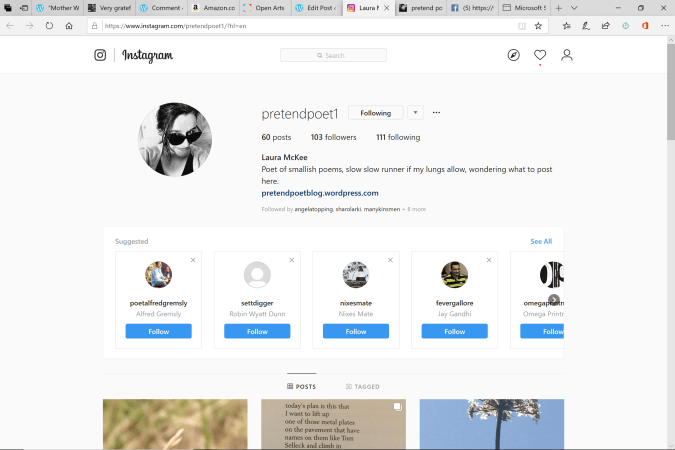
Instagram: https://www.instagram.com/pretendpoet1/?hl=en

The Interview

1. What inspired you  to write poetry?

In my forties I started listening to The Verb on Radio 3 and hearing poets read and perform their work seemed to bring it to life for me; particularly a performance by the poet, Ira Lightman, because I loved it and wanted to understand. In time I learned you can get a lot from a poem without demanding that it explains itself.

2. Who introduced you to poetry?

My mum had heard her dad, a bus conductor, recite poems, and she would recite bits to me. My Dad showed me poems by Spike Milligan, Hilaire Belloc, Tennyson. I went to a Secondary Modern school and didn’t have any formal education in poetry.

3. How aware were you of the dominating presence of older poets?

I think this has been changing for some time now. My feeling is we can learn from each other, I hate cliques of any kind.

4. What is your daily writing routine?

I’m not a prolific writer, and I don’t have a daily writing routine as such. I do read poetry every day. I always use my notes app on my phone to record ideas while I’m out and about. Then one day I’ll think of something that ties perhaps two ideas together, then that’s the beginnings of a poem. Either that or an idea seems to spring almost fully formed and the poem flows all at once, I love those moments. Strange fact: that’s happened a couple of times when I’ve been on antibiotics.

5. What motivates you to write?

Antibiotics apparently. Otherwise, to express myself in a way I find difficult sometimes in everyday speech, to communicate, and to calm myself the hecking heck down.

6. What is your work ethic?

Always wear a bowler hat.

7. How do the writers you read when you were young influence you today?

From Milligan and Belloc I learned that I can use humour in poetry. From Tennyson and rap and hip hop artists I have a pretty good ear for the rhythm, pace, and musicality of a poem.

8. Who of today’s writers do you admire the most and why?

Those who are resolutely themselves, and so bring something of themselves to poetry, and are also geniuses, eg. Carole Bromley, Briony Littlefair, Ali Whitelock, Mark Waldron, Hannah Lowe, Denise Riley.

9. Why do you write, as opposed to doing anything else?

Perhaps to leave something else behind to embarrass the children. When I started to write, I was pushing a pushchair, the poem arrived in my head as an escape I think. It feels like something I have to do now, so lord knows how I didn’t for so long, though my friends say I always wrote good letters and postcards.

10. What would you say to someone who asked you “How do you become a writer?”

Read widely, and listen, first. Keep doing that actually, it will inspire you to find your own words.

11. Tell me about the writing projects you have on at the moment.

I have a poem due in an anthology of poems on running, ‘The Result is What you See Today’, from Smith Doorstop. I have applied to do an MA in Writing Poetry, and will also need a scholarship award to afford the fees. I should hear before the end of this month, so, wish me luck!

Very grateful to Jamie Dedes for featuring six of my poems in the excellent company of other responses to last Wednesday’s prompt on her The Poet By Day.

“Mother With the Green Hair” … and other poetic responses to the last Wednesday Writing Prompt

Wombwell Rainbow Interviews: Timothy Tarkelly

Wombwell Rainbow Interviews

I am honoured and privileged that the following writers local, national and international have agreed to be interviewed by me. I gave the writers two options: an emailed list of questions or a more fluid interview via messenger.
The usual ground is covered about motivation, daily routines and work ethic, but some surprises too. Some of these poets you may know, others may be new to you. I hope you enjoy the experience as much as I do.

gently (1)[41625]

Timothy Tarkelly

Timothy Tarkelly’s work has been featured by Cauldron Anthology, Back Patio Press, Philosophical Idiot, Tiny Essays, GNU, Rusty Truck Zine, Sludge Lit, and others. His book, Gently in Manner, Strongly in Deed was published by Spartan Press in April, 2019. When he is not writing, he teaches in Southeast Kansas.

The Interview

1. What inspired you to write poetry?

I have been writing since childhood. I have always connected to poetry and music. When I was in the third grade, my favorite book was A Child’s Garden of Verses by Robert Louis Stevenson. Almost immediately, I started writing my own poetry and stories. I’ve worked a lot of different jobs and have changed my life’s direction several times, but being a writer of some kind has always been my primary ambition. Poetry has always been my favorite medium, but never in a serious way until the last five or six years.

I am inspired by a variety of subjects and have been moved to write poetry about my own life experiences, dead presidents, medieval warriors, vampires, Japanese mythology, politics, and just about everything else.

2. Who introduced you to poetry?

While I connected with poetry at an early age, I had no concept of how vast the world of poetry really was. After I discovered A Child’s Garden of Verses in my elementary school library, my father bought me a book of Edgar Allen Poe’s collected works, as well as Shakespeare’s sonnets. Then, a few years later, my stepfather gave me a collection of Shelley. My senior year of High School, my English teacher introduced me to Petrarch and Donne, and challenged me to write sonnets for the first time. I didn’t even really discover the breadth of contemporary poetry for a while after that.

3. How aware were you of the dominating presence of older poets?

That was all I knew for such a long time. And don’t get me wrong, I appreciate the introduction and still have a deep appreciation for the old poets (Petrarch and all the graveyard poets especially), but living in a small town in Kansas, where there is no literary scene whatsoever, I simply was not exposed. Even in my juvenile forays into the google-sphere turned up very few results that weren’t inundated with “These are the poets you MUST read.” I was in my twenties before I discovered the beats, and it wasn’t until then that writing poetry became more than just a weird hobby I didn’t tell people about.

4. What is your daily writing routine?

Anymore, my writing routine involves me setting aside time to write and then doing anything else instead. When I try to write poetry, I am either spending hours scraping the inside walls of my skull for words that barely make sense, or I am writing ten poems inside of an hour. I know no middle ground.

5. What motivates you to write?

This is a tricky question to answer because my interests are so all over the place. I have always wanted to write and I simply can’t imagine not doing it. I’m not sure it’s more complicated than that. I would like to say that it’s about sharing a certain message, or a deep love of the process, but honestly the process sucks and I write about everything. I write poetry, plays, films, sad stories, essays, and steamy romance novellas. One day, I’ll be working on a 300+ line poem about love in medieval England, then I’ll be working on a romance set in modern day, war-torn Istanbul. I am also the official poet for Altcoin Magazine, where I publish poems about cryptocurrency.

6. What is your work ethic?

When I’m in the zone, I can’t be stopped. However, when I’m not, I can’t be moved to write at all.

A lot of writers will say things like “there’s no such thing as writer’s block. That’s just a fancy way of saying I don’t feel like writing.” Well, I’m glad their brain works in such a singular fashion. Call it laziness if you want, I get writer’s block often and in a very bad way. I haven’t written anything in a month. Which in a way is good, because I get to focus on revisions for another novella I have coming out. I’m struggling now, but last month, I wrote 26 poems. So, who knows?

7. How do the writers you read when you were young influence you today?

I think the content holds true a lot of the time. I don’t write like Thomas Parnell, or Ann Radcliffe, but I am drawn to gothic imagery and it comes out in a lot of my work. Just like the old guard, I make way too many allusions to Biblical and Mythological themes and characters.

I also still use a lot of old forms. The majority of my work is “free verse” (I hate that term), but in the Eisenhower collection, I use Petrarchan sonnets, haibuns, trochaic tetrameter, and other relics from my childhood canon.

8. Who of today’s writers do you admire the most and why?

There are so many, TOO many to really include them all, but I’ll try to name a few. The poets I read the most right now, the ones I can’t stop re-reading are Safiya Sinclair, Joanna C. Valente, Ada Limón, John Dorsey, Kat Giordano, Shawn Pavey, Jason Baldinger. Really, the entire catalogue of Spartan Press and everything Cauldron Anthology, Luna Luna Magazine, and Trailer Park Quarterly publishes.

9. Why do you write, as opposed to doing anything else?

No matter what my job has been, or any situation I have been in, I have always found a way to turn it into some sort of writing project. I don’t understand how you can read and learn, and not want to turn it into work of your own. Eisenhower is a perfect example. The more I learned about Eisenhower, the more I wanted to create something with all of that knowledge, interest, and passion. While it might not have the widest audience appeal, I care deeply about it, and anything or anyone I care about is eventually going to find itself in a google doc, or scribbled inside of a notebook.

10. What would you say to someone who asked you “How do you become a writer?”

First and foremost: find people who support you. I took a lot of writing courses which were all helpful in their own way (even in the sense of learning what kinds of people/advice to ignore completely), but you do not have to go to college or get an MFA to be a writer. HOWEVER, what I got from college and being in an MFA program, is people who believed in me without question. If you are not around creative people, you will feel discouraged and likely spend years not applying enough energy or focus to your craft (like me). The first time I got a story published, I excitedly told someone at work about it. Their response was, “Why?” Why. Why did I write a story and have it published?! To some people, like the population of Chanute, KS, creative endeavours are such a bizarre waste of time that even when you find success, they still don’t get it.

Find your community. Find people who will nod in understanding when you say you’re a writer, even if you haven’t published anything yet, even if your writing only exists as scribbles in a notebook. Online, or in person, I would have never taken a single chance with writing if I hadn’t finally found a group of supportive people.

11. Tell me about the writing projects you have on at the moment.

I am in the revising process for a romance that will be published by The Wild Rose Press. I can’t say much, but it is set in a monastery in Western Kansas, and is being published under their mystery line.

As far as poetry goes, I have been working on a series of prose poems, which is new territory for me and I like it so far. I am also doing research in a lot of areas to finally settle on what my next big project is going to be. I had a lot of fun writing the Eisenhower book and want to do something similar, but in a much different area. So far I am considering a book of poems about: the Moorish conquest of Spain, Fat Mike from NOFX, Mathematics, the history of Fort Scoot, Laura Dern, or something else entirely.

Wombwell Rainbow Interviews: Lisa Kelly

Wombwell Rainbow Interviews

I am honoured and privileged that the following writers local, national and international have agreed to be interviewed by me. I gave the writers two options: an emailed list of questions or a more fluid interview via messenger.

The usual ground is covered about motivation, daily routines and work ethic, but some surprises too. Some of these poets you may know, others may be new to you. I hope you enjoy the experience as much as I do.

Lisa Kelly

Lisa Kelly

Lisa Kelly’s first collection, A Map Towards Fluency, was published by Carcanet in June. Her poems have appeared in Stairs and Whispers: D/deaf and Disabled Poets Write Back (Nine Arches Press) and Carcanet’s New Poetries VII. Her pamphlets are Philip Levine’s Good Ear(Stonewood Press) and Bloodhound (Hearing Eye). Lisa has single-sided deafness through childhood mumps. She is also half Danish on her mother’s side. She is Chair of Magma Poetry and co-edited Magma 69, The Deaf Issue, with Raymond Antrobus. She often hosts events at the Torriano Meeting House, London – a grassroots community arts venue. Her poems have appeared in a range of magazines and anthologies and she has been longlisted twice for the Bridport Prize, and twice for the National Poetry Competition. She is currently studying British Sign Language and is a freelance journalist writing about technology and business.

Her website is Lisa Kelly

Lisa performs her poetry at iambapoet.com

https://www.iambapoet.com/lisa-kelly

The Interview

1. What inspired you to write poetry?

‘Conspired’ maybe. I’m quite suspicious of inspiration. I don’t think you can wait around for the muse to strike. I wrote a little book of poems when I was young about squirrels and such like. I tortured my even younger brother by making him read them as part of our game, ‘School’. My parents had offered me 50p if I taught him to read. I was forced to write poetry at school as most children are at some point – whether for English homework or for projects, when it was always the easier option as opposed to building a Roman fort out of paper machee. One found its way into a school magazine and won a prize. I tried to repeat this success and failed. I gave up writing poems. I studied poetry at school and loved it, discussing it, dissecting it. I was no good at science but liked the science of poems – how they work, where their energy comes from.  I had mumps as a child and as a result am deaf in my left ear. Playgrounds were a nightmare. Books and poetry were much easier and more fun to be around than big gangs of children. Matthew Arnold’s poem, ‘Dover Beach’ made me cry. I loved words and found an outlet for this love in acting, but enjoyed the rehearsal period, the discussions over interpretation etc. more than performing in the same play night after night. I knew something was missing, and the missing something was writing. I retrained as a journalist, but that, as you know, is a different sort of writing, so something was still missing. I joined a creative writing class over ten years ago and then the ‘inspiration’ and poetry community worked together to continue inspiring or conspiring for me to write poetry.

2. Who introduced you to poetry?

My father, I think. He would read me made-up bedtime stories and poems. He left school early to join the Royal Navy to avoid having to go into the army on the advice of my grandfather who experienced the trenches. My father was an autodidact and had one of the best brains I’ve ever come across. He had a deep curiosity about many subjects. He was brilliant at maths and loved literature. I let him down on the maths front, but he always encouraged my love of books. He used to listen to Dylan Thomas’ ‘Under Milk Wood’ on a vinyl LP with a cast of characters. My brother and I were not to disturb him during these sessions, and I gave listening a try, but can’t say I was enthused. However, these things that make an early impression, stick. Later, I had some very good English teachers – Mrs Heritage and Mr Hoffman are two names that come to mind. I thank Mrs Heritage for introducing me to the metaphysical poets and Milton, and Mr Hoffman for being very encouraging about everyone’s poetic efforts and putting them on the classroom wall. Encouragement is so important for anyone in any introduction to poetry – whether in the reading or the writing. When I started writing seriously, the Torriano Meeting House run by John Rety was lifechanging. He was a massively inspirational character, and a very generous soul, who didn’t suffer fools gladly. His partner, Susan Johns, edited my first pamphlet for Hearing Eye, and she is a brilliant and tireless force for grassroots poetry. The Torriano Meeting House is my poetry home.

3. How aware were you of the dominating presence of older poets?

I’m actually more aware now. Back in the day, you just got on with it and the canon was presented as something that came down from Mount Olympus. There is much more questioning now of how that canon was created – the sexism, the racism, all the horrible isms which still exist. Much more is being done now to increase awareness of new voices in poetry and ‘new’ old voices. Poets such as Gertrude Stein, I only looked at later. She would have been considered too difficult for a school curriculum when I was studying. I am always learning – you never stop. So, I think the canon is continually being revisited and re-evaluated. It is no bad thing having a dominating presence of older poets, in my opinion, if we are in some way in communion with those voices and do not feel stifled by them. Look at how Daljit Nagra communes with the canon. When I first read ‘Look We Have Coming to Dover’, I was stunned. It had the vision of possibilities.  I find that very exciting, and I find what is happening with programmes such as The Complete Works; Ledbury Emerging Critics; the spoken word scene especially encouraging. There is such a lot of great energy being injected into the poetry world which is challenging any accepted vision of what a poem should be. Things are always being shaken up, including the presence of dominating older poets. We can have new ghosts to haunt us.

4. What is your daily writing routine?

Nothing set in stone. I write ideas or lines that might trigger a poem on scraps of paper, but I like the discipline of writing in Word on my PC because it is much easier to see the line-breaks – where the poem is baggy, and to play around with form which I enjoy. I like the visual aspect of poems. I’m learning British Sign Language, and as someone who is deaf on one side, control of my ‘interactive’ space is requisite to hearing. This personal preoccupation comes into my poetry. I am often at my PC as my day job as a freelance journalist specialising in technology, means I might have a very dry article on the go about scalable processors and Artificial Intelligence as well as a poem, and switch between the two. It makes for a good balance and stops you getting stuck. Looking after the family, my hands and body might be busy, but there is nothing to stop you thinking or composing in your head. My voluntary role as Chair of Magma takes up a fair bit of time, and if I am co-editing a magazine, then my own poetry takes a backseat. I do try and get out and like to walk to destinations if I can. Sometimes, I’ll read poetry when I’m walking, which is probably as annoying as people looking at their iPhone screens and bumping into you, but reading poetry is incredibly important to my daily writing routine. If I just got caught up in my own writing, my poetry would stagnate.

5. What motivates you to write?

I am always thinking about writing and poetry in some capacity. As a journalist, I am conscious of deadlines and the need to get something finished. If I haven’t written for a while, I get irritable, a bit like if I haven’t exercised. In terms of what I write about – the motivation varies. Sometimes it is anger, and there is much to be angry about in society at present, but we won’t get into Brexit or Trump etc. I will often write as a way of working through something – to discover what I feel about it. A splinter gets trapped in the finger and needs to be teased out with tweezers. It is often cathartic. From a practical point of view, I am part of a peer group of poets, and we meet once a week at the Torriano Meeting House in Kentish Town, London. We take it in turns to run a session and bring in poems on a theme or that illustrate a form. We discuss the work and go away with a prompt to write, and the ‘homeworks’ get read at the next session and sometimes workshopped. What I find is that a prompt might motivate you to write, but what you write about will be something that you need to write about that the prompt unlocks. Times of great stress or sorrow also motivate me to write. Nobody wishes for horrible events but writing about my mother after her death was important to me. She is my muse. When you write about someone who has gone, you bring them back to life in the space of the poem.

6. What is your work ethic?

Strong. I feel guilty if I am not feeding my writing in some way, whether it’s reading, writing, redrafting, attending poetry events. Sometimes, I feel guilty writing poetry because I feel I should be writing stuff that earns money. I had Obsessive Compulsive Disorder (OCD) as a child, and it blew up severely as a teenager, and was related to my schoolwork. It ruined my teenage years, although it got me good A level results. I have to guard against ensuring I don’t get back into OCD thought patterns, as it can crop up at stressful times, such as after the birth of my first child, and I’ve written a couple of poems about it, addressing OCD directly, but actually obsessiveness is a strand within my poetry, especially around form. This might be true for many poets. You have to be a bit OCD to worry about a comma or a line-break.

7. How do the writers you read when you were young influence you today?

Very much so. Many of my poems are in conversation with poems and poets that I read when I was young, and their voices remain alive in my mind. That is why the poets we introduce to children within a classroom setting are so critical to their appreciation and attitude towards poetry. I know many fantastic poets who are working with young people to overcome any fear of poetry and it is amazing how well they respond and many start writing their own poetry and discovering their creativity and worth in self-expression which has positive benefits in all subjects, and of course their lives.

8. Who of today’s writers do you admire the most and why?

I can’t single out a name, because actually it is the poetry community that I admire. I am constantly energised by what I read. I am a magpie for poetry and am always reading new poetry that inspires me. My bedside table and floor is piled high with magazines and books, and if I find a poem I like by a poet I’ve not heard of, I will look them up and follow them on social media, and sometimes invite them to the Torriano Meeting House to read if I have a hosting spot. The poets I especially admire are the ones putting something back – the poets who are working for the poetry community in some way. And brave poets. Alice Hiller, who writes in the face of sexual abuse, comes to mind. There. I’ve mentioned a name.

9. Why do you write, as opposed to doing anything else?

Hmm. I think if I didn’t write, I would have gone very quietly mad. Although sometimes I have a fantasy about being a lumberjack. I love woods and forests.

10. What would you say to someone who asked you “How do you become a writer?”

I would say, you are the only person who can decide if you are a writer. It is a mental attitude. I know poets who don’t describe themselves as poets even though they have had collections published. It is not just down to publication. Poets that we know now as great writers, like Emily Dickinson, who were not widely published in their lifetime, serve an example that success today does not guarantee any poetic legacy. So, with all those caveats in mind, if you want to be a writer, you must ask yourself what the job means to you. If it is about money, then there are very few poets who can claim it as a profession. To get to that point, they will have worked very hard, nurtured their talent, gone to a lot of open mic events, been prepared for criticism, sent off poems, got rejected, tried again, got accepted, got lucky to some extent. Perseverance is helpful. Developing a thin skin for sensitivity to language, and a thick skin for reception of your work is necessary. Don’t let your ego get in the way of the poem. Even if you have a success, when you go back to the blank page, you begin again as a debut writer. Beyond the mechanics of making time to write, it is essential to read as much as you can and be hungry for other people’s poetry more than for your own. If you only read your own writing, you are going to be a terrible writer. Find a supportive group who you can comfortably show your work to, and be prepared to listen to their feedback, think about it, discard what you don’t find helpful, and take on board what you do. If you enjoy the process, you will find a way to becoming a writer on your own terms.

11. Tell me about the writing projects you have on at the moment.

My first collection has just been published by Carcanet, which I am very grateful for, and I have some events at which I am reading, but beyond that, I take it one poem at a time. Some I am happy with and some not so happy with, and it was like that from day one, even when I was writing about squirrels!

Very grateful to Jamie for featuring, in talented company, seven of my poems on the subject of “strangers and sojourners” on her “The Poet By Day”

“I Cannot See My Face”. . . and other poetic responses to the last Wednesday Writing Prompt