Boston: ‘The Most Divided Place in England’

An excellent bloglog by Rowan the Door To Door Poet. Engrossing and well written. Highly. Recommended.

Rowan The Poet's avatarDoor-to-Door Poetry

Boston 2

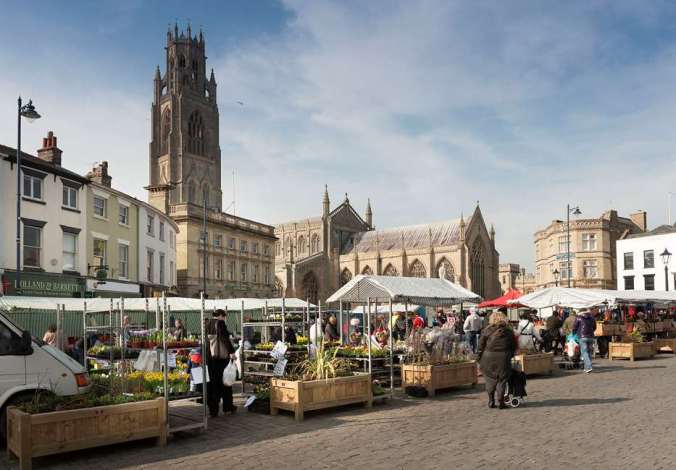
When I told my friends I was doing Door-to-Door Poetry in Boston, they all thought I was going to America. In fact, the original Boston is a small town in Lincolnshire, known for the surrounding farming industry and for landmarks like ‘The Stump’, which is one of the largest parish churches in England.

Boston is also famous for being ‘the UK’s most Eurosceptic town’,

View original post 3,965 more words

My National Poetry Month challenge to myself has become a collaboration between synaesthetic artist Sammy-John, myself, Anjum Wasim Dar and Jay Gandhi: Day Twelve: September in E Flat

September in E Flat

September in E Flat

September in E flat
My goldfish hums a solo in its bowl.
I can hear it because I live alone
and more so because I am lonely.
Septembers can be very tricky—
some rain, some sunshine,
chilled mornings:
I can accurately measure
the warmth of the city
and more so because I am lonely.
September in an E flat chord and
an E flat chord in September
evoke the exact same emotion.
I feel a longing for a partner
and more so because I am lonely.

By Jay Gandhi

A Heady Burnt

fragrance
means autumn’s
soft E Flat footfalls can be heard.

Sun’s blaze warms my back
as I cut dry grass, autumn
breaks out a rumble overhead

By Paul Brookes

September in E Flat

During the senior school years, there were hardly any fears
the best I remember, song  ‘Come September’ in rhythm
and  dance,  I can still hear the silence of the summer, turn
to E Flat murmur in melancholy, half cool half  warmer

younger days when responsibility ensnares
but that September,   a war, felt in E Flat chord
the only outcome, smoke and oily smell of metal,
and falling leaves, an occasional falling petal-

when we could hear the drops of rain
light was the hurt  less was the pain
we could dance to the tune, but softly
now I hear the E  Flat octave tremble

what should I remember,
the melody or the number?
2019 © CER     Anjum Wasim Dar

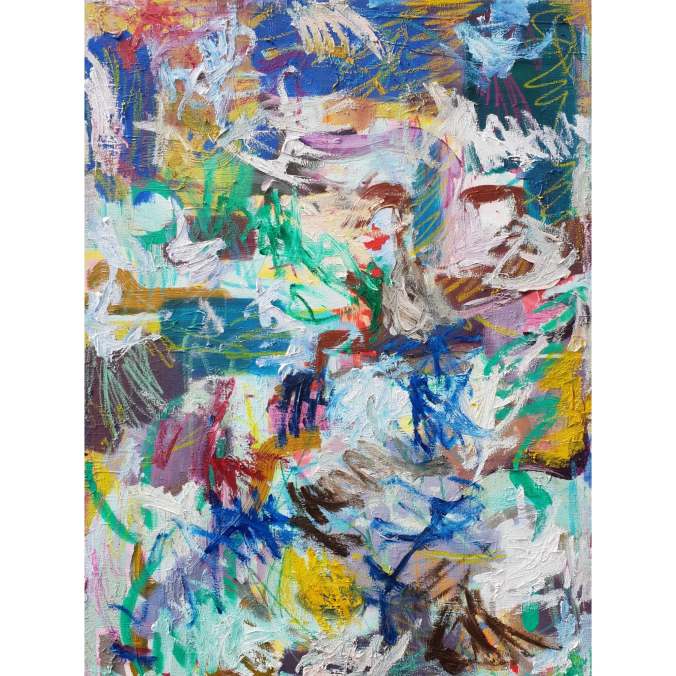
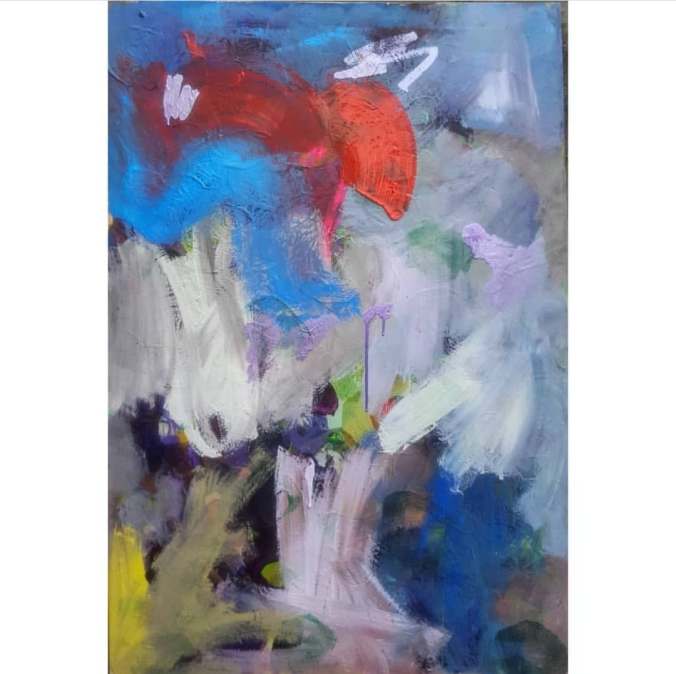
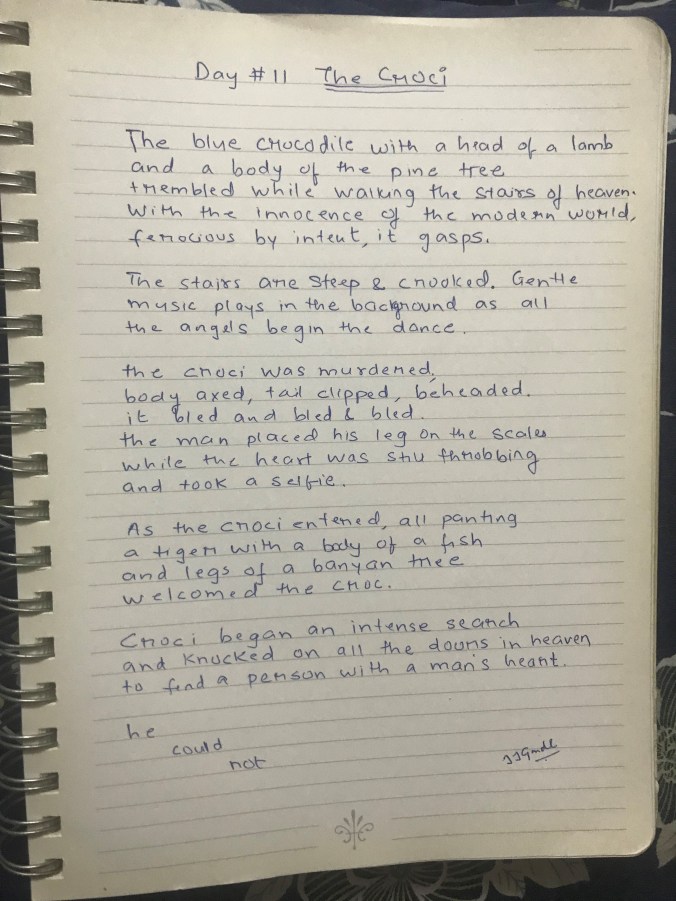
My National Poetry Month challenge to myself has become a collaboration between synaesthetic artist Sammy-John, myself, Anjum Wasim Dar and Jay Gandhi: Day Eleven: My Croci

The Croci

The Croci

CROCi (2)

By Jay Gandhi

Bindweed And Thread

Him hip in a white T-shirt and purple slacks,
yellow complexion all smiles and come on,

Her sinuous and prickly, ignores his glances,
clingy with her mates all winter.

Come spring he thinks himsen not worth her spit
so hung his sorry self with a sinewy rope. When she hears

Sobs so many tears nowt is dry in her house.
Right sad pair so I makes them into flowers because I can.

He a glad sign of early spring in his saffron crocus glory,
Her bindweed bloom in late spring flowers then bulks bold bright berries.

By Paul Brookes

CROCI

Oh Croci no more do I see you on wine glasses,
nor in wreaths crowned on the heads of joyful
Youths, winter white shawl lies  cold spread out
all over the valley, river runs red with blood  of
Martyrs, the young who still had life to live  and
love, but freedom  lies fettered , glaciers gaze
From snowlines on the peaks, the sun timidly peers
Oh Croci, wake up’ it’s time wake up before death
Plays its tune, in colors blue white and golden yellow
wake up in purple royal, let the golden strands flow
O Croci bring dignity pride and success, and saffron
let the rebirth begin, the season rise with your perfume
The early bird waits on the bare branch silently-
do not despair oh winged warner’ gold will bloom
Oh Croci  come let us be joyful and welcome Spring
many grooms are waiting  for many brides to bring…
O Croci may the prayers be answered may freedom ring’
Let freedom ring…

2019 ©  CER  Anjum Wasim Dar

On Fiction Wombwell Rainbow Interviews: Ho Lin

On Fiction Wombwell Rainbow Interviews

I am honoured and privileged that the following writers local, national and international have agreed to be interviewed by me. I gave the writers two options: an emailed list of questions or a more fluid interview via messenger.

The usual ground is covered about motivation, daily routines and work ethic, but some surprises too. Some of these poets you may know, others may be new to you. I hope you enjoy the experience as much as I do.
chinagirl-shanghai3-1024x793

Ho Lin

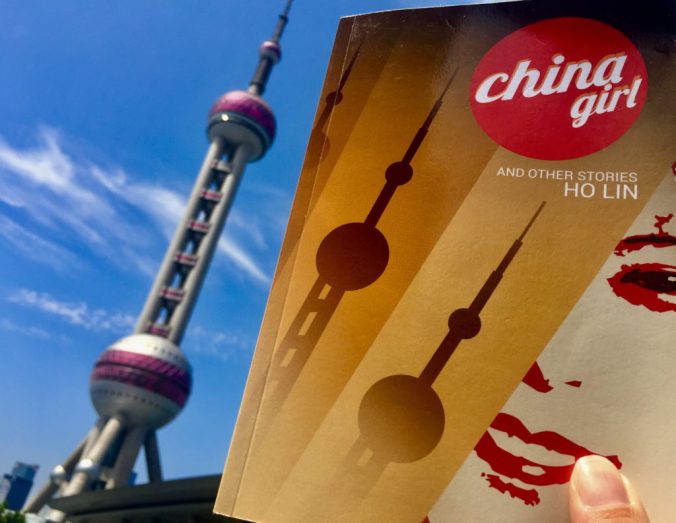
is a writer, editor, musician and filmmaker, and not necessarily in that order (it depends on time of day). He is co-editor of the long-running literary journal Caveat Lector, a lover of fiction and film criticism, and is striking out with his first short story collection, China Girl. He currently resides in San Francisco, although his wanderlust has led him to many different countries, including a stint in Asia.

The Interview

1. When and why did you start writing fiction?

My mother (who was a translator and author in her own right) loved reading, and was poring through Rex Stout mysteries when she was pregnant with me, so it’s fair to say that I’ve had an appreciation of literature from the womb. My first direct contact with fiction probably came with the children’s book “Goodnight Moon” — my brain registered the unreality of the narrative, as we move from day to night in just a few pages, but I was inspired by its creativity, as time collapsed. I wanted to be on the other end of that exchange, constructing something that would give a reader a similar sense of “wow.”

My first attempts at fiction came when I was four, drawing picture stories without dialogue, usually trying to reproduce events from the 1960s “Batman” TV show from my mind. Soon “Batman” gave way to “Star Wars,” and all might have been lost, but fortunately I also started reading E.W. Hildick’s McGurk mysteries (always back to mysteries for me), which impelled me to write stories with full-fledged, honest-to-goodness text. Of course these stories were pale rip-offs of Hildick’s work, with dynamic titles such as “The Case of the Dead Dog,” but my path had been set. Years later, at a fiction workshop at Brown University, one of our exercises was to create a vignette around the discovery of a dead dog in the woods! Life is indeed circular.

2. How aware are and were you of the dominating presence of older writers traditional and contemporary?

The influence and shadow of other writers is unavoidable, and it’s been the case for me for a long time. From the start, really, with my E.W. Hildick pastiches. I think all writers are impressionable to some extent, and it ‘s sometimes challenging to avoid parroting my influences. Anyone who’s been through a standard English major curriculum in university can’t help but be keenly aware of who else is out there.

On the other hand, I’ve been lucky enough to study under authors such as Robert Coover, Robert Stone and John Barth, and draw encouragement from them to go my own way. I like to think that I’m old enough now that I’ve established a middle ground in my writing which acknowledges what’s come before, but also makes room for my own quirks and identity. It’s a sports cliche for a superstar to say, “I can’t worry about being the next [insert legendary superstar name here], I just gotta be me,” but I’ve tried to follow that advice in my own writing. It helps that I’m also a long-time musician, and long ago came to grips with the fact that I’ll never be Paul McCartney. When you learn early in life that you can’t be your idols, you can then move on.

2.1. What did you learn from Robert Coover, Robert Stone and John Barth?

I studied hypertext with Bob Coover (back when linking from one webpage to another was a miraculous thing), and in the process learned that I could play around with the form as well as the content of my work. From a workshop with Robert Stone, I learned how to be tougher on my writing (as one would expect from a two-fisted writer like Robert Stone). And from John Barth, I learned how to let my imagination wander off down cul-de-sacs, blind alleys, and scenic byways, leading to unexpected (but sometimes welcome) destinations.

3. What is your daily writing routine?

I have no routine at all, which is probably the antithesis of what every good writer should do. Most of the time I ruminate and take notes, and when the dam is fit to burst, I’ll write out huge chunks in single settings. Sometimes it takes a week, sometimes a month. I find that this “process” works for short stories, in which I can maintain a consistent rhythm and feel for a short burst. Longer works are a bigger challenge, but my writing tends to coalesce around vignettes and compartmentalized narrative bits, so I’ve gotten by so far. Maybe one day I’ll grow up and commit to writing like committing to a 9-to-5 gig.

4. What motivates you to write?

I’m inspired most by situations — whether it’s something I happen upon as life happens, or something I read about. Even a scrap of conversation or story is usually enough to get ideas ping-ponging around my head, and from there it’s only a matter of time before I’m compelled to apply the written word. I’m also strongly impacted by locales. Lost in an unfamiliar city, or alone in an expanse of landscape — the experience of getting out in the world somehow draws me into my own mind, and allows me to imagine happenings in these places. Wordsworth says plenty on the subject. Finally, I’m motivated by the art around me, whether it’s a book, a film, or a song. In “China Girl,” I count six stories that owe at least a partial genesis from a movie or song snippet, or a particular writer. Usually these moments lead me down a path where I move away from pastiche and towards something of my own. At least, that’s the theory.

5. How do the writers you read when you were young influence you today?

Paul Bowles looms large for me, both in the quality of his writing and his subjects (interlopers and visitors out of their depth in foreign lands). He ranges from the naturalistic to the phantasmagoric, and I’ve tried to stretch in those directions in my own stories. I hesitate to call Haruki Murakami a “young” influence since he’s always been present, but he had a huge impact back in my college days, particularly “A Wild Sheep’s Chase.” In that novel, his narrator describes himself as five-foot-seven, 130 pounds, twentysomething and rootless, which described me to a T at the time I first read it. He has a melancholic sense of whimsy, and I think many of “China Girl”‘s stories appropriate that tone.

Lawrence Durrell is another young influence who is making his way back into my writing. I’m working on a novel that features intersecting plot threads and character perspectives, and in my view, Durrell’s Alexandria Quartet is a masterpiece of that kind of intricate construction.

5.1 Which young influences are calling to you again, and how do they manifest themselves in “China Girl”?

It all goes in circles: I was heavily into genre fiction when I was young (Agatha Christie and Isaac Asimov), and as I grew older I became more aware of their particular limitations as writers, and moved on to postmodernism (and probably a few other -isms). Now I can revisit them and appreciate what they brought to their work in terms of plot and shape. With my own writing, I’ve been through more experimental (chaotic?) phases, and now I find myself looking to simplify, compress and streamline, so my young influences are calling to me again. Call it a second childhood, but everything old does eventually become new.

6. Whom of today’s writers do you admire the most and why?

She’s been around a while, but I enjoy Jane Gardam’s work — most of her books are “quiet,” but they marry plot, tone and style effortlessly. I think they’re quite magical. Lydia Davis is another current favorite — she’s such a master of wit and compression, two qualities often lacking in my own writing. And even though he’s no longer with us, I’ve been getting into Roberto Bolaño. He tackles weighty subjects and moral themes, but he has a certain lightness, a surety of voice, that I find appealing.

7. What would you say to someone who asked you “How do you become a writer?”

Writing is about craft and inspiration — you learn your craft from all the literature that has come before, but you have to live a life to find inspiration. I’m sure examples exist of fantastic writers who thrived based purely on their own imaginations, but most of us need to engage with the world to find the raw materials that fuel what we write. Don’t lock yourself in your head, and if you’re always out in the world, make time to ruminate and compose.

I would also advise a healthy mix of confidence and skepticism. Have faith that what you want to say matters — because heaven knows no one else will do it for us — but be open to the idea that it might not, or that what you say can always be improved upon. Find a community of writers who can nourish and challenge you. I’ve been in workshops and groups that didn’t necessarily “get” my writing, and I’ve come across writers who are so convinced of the rightness of their path that no amount of criticism is allowed to penetrate their hermetically sealed defenses. Finding that sweet spot in-between is challenging but worth it. Assume nothing, have the courage to forge ahead in everything.

Finally, once you’re in a position to get your work out, champion it as much as you can. I’m no marketing genius, in fact it’s my last favorite aspect of the writer life, but one must find ways to gain attention. Use your social networks, contact influencers, or just go out and meet people. Even hiring some publicity help for a few hours can make an impact. You might be surprised by how little things can build momentum, and then suddenly it’s not such a chore.

8. Tell me about the writing projects you have on at the moment.

“China Girl” is a short story collection in which all the stories have something to do with Asia, even if only tangentially. The earliest story in the collection dates to 2002 and the latest to 2017. Some of the tales are naturalistic in approach, while others are more fantastical and fable-like. Nonetheless, some of the happenings that might seem imaginary are based on true events, and vice-versa. Ultimately, the collection is a dialogue between East and West — sometimes political and sometimes personal — seen through the prism of my Asian-American upbringing.

I’m currently dividing my time between two projects: a contemporary novel set in Shanghai, which hinges on a mysterious disappearance (as I said, shades of Lawrence Durrell), and editing travelogues of my late mother’s numerous visits to China during her lifetime. The latter combines the personal and the cultural, as we witness China’s changes over the years, and also learn about my mother’s family story, including reunions with relatives and friends she hasn’t seen in decades.

Thanks for taking the time to interview!

Ho

Wombwell Rainbow Interviews: Shanda D. Boone-Hurdle

Wombwell Rainbow Interviews

I am honoured and privileged that the following writers local, national and international have agreed to be interviewed by me. I gave the writers two options: an emailed list of questions or a more fluid interview via messenger.

The usual ground is covered about motivation, daily routines and work ethic, but some surprises too. Some of these poets you may know, others may be new to you. I hope you enjoy the experience as much as I do.

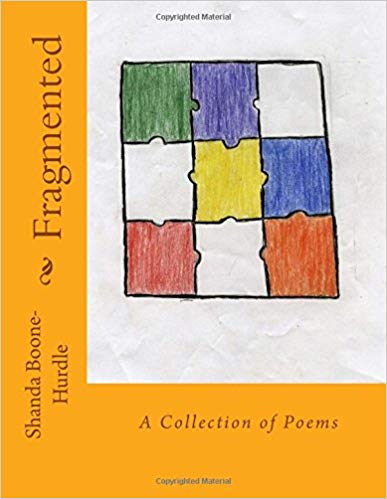
Fragmented

Shanda D. Boone-Hurdle

is a native of Portsmouth, Va. A product of the Portsmouth Public School system, it was her 7th grade and high school English teachers who introduced her to African-American writers. This introduction set the course for her writing and speaking career.
After completing high school, she went on to attend Ferrum College, Ferrum Va., where she received a B. A. in English with minors in Journalism and French. Later, she would attend Old Dominion University, Norfolk, Va., where she received a M. A. in English with a concentration in Professional Writing.
As a highly passionate speaker and educator, it is her strong belief that “You are not a mistake.” There is only one of you and though you have several different roles in your life, you only have One Mission, One Vision, and One Purpose, and everything in your life should work together to achieve it.

The Interview

1. What inspired you to write poetry?

I have been writing poetry since I was about eight years old.  I am not sure how it started.  I just always loved it.  It is my happy place.

2. Who introduced you to poetry?

I am not sure how I was introduced to poetry, probably Dr. Seuss.  However, I was in the 7th grade, when my English teacher, Mrs. Edmonds, introduced me to Black Poets.  Langston Hughes, Gwendolyn Brooks, and James Weldon Johnson were the first.  They knew me.  They told my story. They made my life and existence real.

2.1. How did Langston Hughes, Gwendolyn Brooks, and James Weldon Johnson know you.? How did they tell your story? How did they make your life and existence real?

For the first time, I read stories that told the black experience. The people were familar. I knew these people, though we never met. The people in their stories and poetry were my neighbors, my aunts, my uncles, my church members, and my friends. They spoke in a language that I understood.

3. What is your daily writing routine?

As a public school English teacher, an adjunct professor for a community college, a wife, and mother of five, I do not have a daily writing routine.  I write when the creative process hits, and it is all too consuming to contain.  I write in those limited moments of peace and quiet.

4. What motivates you to write?

Anything can motivate me, a song on the radio, a movie that I saw, a conversation that I had, a new experience, or a painful moment.

5. What is your work ethic?

Normally, I am inspired either first thing in the morning or late at night.  Therefore, I sit and write.  I use the old fashion paper and pencil method.  I feel more connected to my thoughts using paper and pencil versus typing.  I save typing until the end.

6. How do the writers you read when you were young influence you today?
I am greatly influenced by the greats. I love Maya Angelou, Nikki Giovanni, Langston Hughes, Paul Laurence Dunbar, and more.  I keep them in mind.  I want to tell a story the way they did.  I want to make people feel and connect with my pieces the way I connected with theirs.

6.1. How do you tell a story the way Maya Angelou, Nikki Giovanni, Langston Hughes, Paul Laurence Dunbar do?. How did you connect with their stories?

I try to bring a realness to my writing. I want my readers to see themselves or people who they know. I want my readers to know that they are not alone. I try to make the words come to life, as if the reader can close his or her eyes and see the words take shape.

7. Why do you write, as opposed to doing anything else?

I love words. I love the power of words, the way they make you dance.  I love their rhythm, their beauty.  There’s nothing more exciting than when words come together to serve their purpose…delivering a specific message.

8. What would you say to someone who asked you “How do you become a writer?”

I would simply tell them to start writing.  Everyone has a story.  Once that pencil hits the paper, even the author has no idea of what’s to come until it’s done.

9. Tell me about the writing projects you have on at the moment.

I am currently working on my second book, a collection of monologues; I hope that it will be completed by July 2019.  After this book, I will be working on my first novel.

Here is the link for my book:  You can find it on Amazon.com
The book is entitled: Fragmented: A Collection of Poems by Shanda Boone-Hurdle

https://www.amazon.com/s?k=shanda+boone-hurdle&ref=nb_sb_noss

My National Poetry Month challenge to myself has become a collaboration between synaesthetic artist Sammy-John, myself, Anjum Wasim Dar and Jay Gandhi: Day Ten: C Sharp Minor

C Sharp Minor

C Sharp Minor

A day in the park

the light is white as noise is bright
they tread along the spectrum tight,
and every ray is welcome bliss;
each wavelength blows a tender kiss
a shade of green between the mean
a patch of gray amidst the scene
beetroot is pink and there’s a link
which makes me tangle as I think
a cream has come up from behind
like a curtain which blocks the mind
At playground, the children are tired
and all my neurons have been fired
it’s all quite mysterious and dark
but that’s the charm of night at park.

By Jay Gandhi

Picked Apple And Change In C Sharp Minor

I wrap my head with a coloured scarf,
lean on a staff, sprout grey hair, wrinkled,

as a decaying fruit fungus faced, moles and brown blotches,
and a small spiky moustache. She lets me in

the well-tended garden, and admire the fruit
and the fruit of her.

She is

a Pear’s sweetness salves a searching tongue,

a Peach’s blush like sunrise

a Plum’s scent entices, smooth and laughing,

a Cherry’s scarlet lips rain sodden

a blossoming branch

makes bees dance

a secret orchard

‘You are so much more lovely’, I snog her.

Then apologise.

I sit on the flattened grass,
look at the branches
bend weighed down with fruit.

There is an elm opposite,
with gleaming bunches of grapes.
I tell her with my ancient voice.

Remarkable tree, and its entwining vine.
But, if that tree stood there, unmated, without its vine,
it wouldn’t be sought after for more than its leaves,
and vine also, which is joined to and rests on the elm,
will lie on the ground,
if it were not married to it, and leaning on it.’

She replies “It is a tree. Marriage means nothing to me.”

” A thousand men want you,
you shun them, turn away
from their wooing.

But if you are wise,
if you want to marry well,
listen to me, an old lass,

as loves you more than you think,
more than them all, reject others
and choose Change to share your bed!

You have my pledge as well:
he’s not better known to himself
than he is to me: he does not wander
hither and thither, lives by himself
and he doesn’t love latest girl he’s seen.

You’ll be his first love, and his last.
He’ll devote his life only to you.
He’s young, blessed with natural charm,

can take on a fitting appearance, if needs be. Whatever you want,
though you ask for all of it,
he will do.

He doesn’t want fruit of your trees,
or sweet juice of your herbs:
he needs nothing but you.
Take pity on his ardour,
and believe that he,
who seeks you,
is begging you,

in person, through my gob.

C  Sharp Minor
It will not be in a tin fruit can with sweet juice
but in gardens high of a hundred levels

with flowing river water falls and fruits in plenty
none forbidden nor prohibited, but tasty
fruits I saw in childhood would be a surprise
studded rubies  in yellow without space, like
Berries, bananas layered , dates figs and olives
grapes, apples I  loved and dreamed about –
Dreams colorful peaceful and brighter than  the
brightest star, skies opening  in circles of sound
C  sharp minor , symphonies of  fragrant flowers,
celestial  overtures descending in harmony, all

these emerge  as ecstatic aquamarine in numbers
in thousands of  pearly castles in golden diamonds

O beautiful gardens heavenly, I hear notes in C sharp
minor, I  gather good deeds to be in, with the symphony

By Anjum Wasim Dar

My National Poetry Month challenge to myself has become a collaboration between synaesthetic artist Sammy-John, myself, Anjum Wasim Dar and Jay Gandhi: Day Nine: A G Minor

G Minor

G Minor

G minor

Today my heart aspires to go to Church
but feet demand a holiday and park
the 100 kilo body on the sofa:
embrace inertia

if God’s within me, why go to the temple.
Mother’s spirit can also visit the living room

and I think opening up to my lover
or blurting out in front of a counsellor
can at least give me a receipt that
I did confess.

While I find chaos in synagogue,
I find peace during Ganesh Visarjan
when the songs are blaring out

Energy means different things
to different people just as G minor does.

By Jay Gandhi

The Invent Me In G Minor

Make stories about me.
Tell tales of how I live.

Tell of folk I’ve met, slandered,
divorced, harmed and shagged.

Their inventions come back to me.
I’m amazed, horrified, delighted

at what I’ve done. Then worry,
because I remember none of it.

Worry that my mind is going.
I need to hold onto who I am.

In G Minor

It’s her ’ and  no one smiled.
abandoned,  just  a heap of trash
In many lands, born of any caste
or creed, not differentiated, cashed
song composed without G Minor
fifteen to a forty niner, old miner-
might as well dig coal or carry bricks
facing negligence torture injustice
books burnt, sold destroyed tricked
yelling in silent agony, ravaged  into
zombies senseless, has humanity not
metamorphosed, song stilled , shot.

By Anjum Wasim Dar

My National Poetry Month challenge to myself has become a collaboration between synaesthetic artist Sammy-John, myself, Anjum Wasim Dar and Jay Gandhi: Day Eight: Wildflowers

Wildflowers

Wildflowers

in the garden
shake at the sight of themselves
in Alice’s looking glass.

Pink are drained to white.
Pale flowers colour up.

The garden path tells
her to stay still
and she’ll have adventures.

She lets her feet lead her
up or down the garden path
but arrives where she started.

Alice can’t stay still.
She has to move but in moving
always returns to what
she already knows.

I want to have adventures
But nobody’ll let me. she complains.

Looks directly at a Rose
And advises it: Your petals
are a disgrace. They need
To lean in one direction,
not all directions.

By Paul Brookes

Native & dense roses
make colours radiant and
pink turns sky candid.
Happiness inside light;
Everyone is free—
~Wild Flowers~
Free is everyone;
Light inside Happiness.
candid sky turns pink and
radiant colours make
roses dense & native.

By Jay Gandhi

Beyond the beauty, revealed,
quest of finding more persists,
on green and brown sky on land
tiny yellow blue and white, exists

I have found flowers, flowers wild
dancing, waving, studded in green
visible in the weeds, I hear the velvet
tripping of the footsteps of Spring-

Summer pheasants’ eyes shine-
agave branches out to meet Alder
or trumpets  at ‘baby blue eyes’, or
the Barren Strawberry white roses’

Wild flowers touch me like poetry
swaying to soundless sacred sweet
symphonies side to side in obeisance
to invisible conducting companies,
Offering soft cool overtures to
burning soles of injured souls,
enriching meadows to the core,
offering ample colorful cures,
wild flowers in deserted desert
dunes, dream to possess, as King
Ozymandias waits in stony silence,
slithering snakes undulating weave
their colors in the sand, dreading
the deadly Peregrine, embroidered,
jaded, studded, laid for romances,
wondrous world of plant fragrances,

wave upon wave of variegated crowns,
at times, in remote treks, God’s prosody
wild flowers grow, the sight so asking for
journeys, ventures and a supreme odyssey’


2019 © CER    Anjum  Wasim Dar

My National Poetry Month challenge to myself has become a collaboration between synaesthetic artist Sammy-John, myself, Anjum Wasim Dar and Jay Gandhi: Day Seven: The Willow Tree

The Willow Tree

The Willow Tree

The Willow Tree

Either we sprinkle or we splash
sometimes we loiter while we dash

Circling the full grown Willow tree
we get dizzy and we often smash

The colours of the leaves daily vary,
the texture changes just in a flash

Alas! wood will be cut and it will burn
all that will remains is the honorary ash

Jay, the tree lovers will feel sullen:
Hackers have spread like a wild rash.

By Jay Gandhi

An Osier

Use my pliable limbs

wish as you tie me

into a loose knot.

Your wish granted

return untie the knot

you made of me.

By Paul Brookes

Birds chirp, is it dawn ?
it’s still dark, leaves  invisible,
murmur  shiver, tremble,
will we get rain today, it’s so dry –
Someone’s tears may fall
someone may cry, but where?
in a dream, with a willow wand
under the pillow, or on a boat

drifting  along  the river, afraid
of hidden serpents, spellbound
by the moon, what lies beneath
who knows  but Hecate , sound

O’ Orpheus, come play the lyre
so silent is the world  in grief,
seems you have seen magical
colors in harmony, play relief-

The world needs you, play
for hope, we are still green,
green is all they see, no-
not the pale, hanging low

the mournful wailing boughs
For whom do they  weep ?
for thousands  lost at sea ?
or buried  in rubble heaps –
a home a place a country
food sanctity security liberty,
cutting sawing  chopping  up
our green growing solid family,
O Hecate what do you teach
magic for ? We write poetry,
play music do spells for good,
See the hanging willow tree-,

waits for one who planted it free,
by the river calm, as birds chirp
as dawn breaks, now they fly
with the unseen breeze, up high

with a message to return
to brighten the colors, on the
silver river, in the moon light
O Helice’ let the colors shine

Make Happy the lovely Willow Tree
2019 © CER  Anjum Wasim Dar